
Epistle — 1 Corinthians 1:10–17
Brethren, I appeal to you by the name of our Lord Jesus Christ, that you all speak the same thing and that there be no divisions among you, but that you be perfectly joined together in the same mind and in the same judgment. For it has been reported to me concerning you, my brethren, by those of Chloe’s household, that there are quarrels among you. What I mean is that each one of you says: “I belong to Paul,” or “I belong to Apollos,” or “I belong to Cephas,” or “I belong to Christ.” Is Christ divided? Was Paul crucified for you? Or were you baptized in the name of Paul? I thank God that I baptized none of you except Crispus and Gaius, lest anyone should say that you were baptized in my name. I also baptized the household of Stephanas; beyond that, I do not know whether I baptized anyone else. For Christ did not send me to baptize, but to preach the Gospel, and not with wisdom of words, lest the Cross of Christ be made of no effect.
The News from Corinth
Paul was in Ephesus when the people of Chloe’s household arrived. They brought news from Corinth, from the community where he had preached and remained for a year and six months. The news was that the people there had divided into factions, each attaching itself to the name of a particular man.
One of the names they were invoking was his own.
Few things are more bitter for a man than to learn that what he built with his own hands is breaking apart, and that it is breaking apart through the use of his name. Paul had every means at his disposal. He had built them up, had baptized some of them, and was an Apostle. He could have written a letter that would set matters right through the sheer weight of his authority.
The letter he writes moves in precisely the opposite direction. In the answer he gives here, instead of strengthening his own faction, he takes care not to place himself in the foreground.
How He Begins
He does not begin with a rebuke, but with an appeal, and he appeals to them by the name of our Lord Jesus Christ. Saint John Chrysostom pauses here and says something that applies to every correction: a man who is rebuked harshly from the beginning becomes shameless and can no longer be corrected, whereas one prepared by gentle words bows his neck. Paul wanted to set them right, not to defeat them.
He then says from whom he heard the news: from the people of Chloe’s household. He gives no individual’s name. He names an entire household, and Chrysostom sees pastoral care in this: had he named a single person, that person would have been hunted down, while Paul was equally concerned for the benefit of those being corrected and for the safety of the one who had spoken.
Then comes the list of factions: one says that he belongs to Paul, another to Apollos, another to Cephas. Here we see most clearly what kind of man was writing. He places his own name first and Peter’s last. Chrysostom explains why: so that no one might think that he was speaking out of envy or defending his own honor against others. He receives the whole blow upon himself first.
And he does something more. He does not mention at all the names of those who had actually divided the Church. Chrysostom says that he hides them behind the names of the Apostles, as behind a curtain. In other words, he covers the guilty with his own name, so that they may still have a place to which they can return without being pointed out before everyone.
The Three Questions
Three short questions follow, one after another.
Is Christ divided? Chrysostom interprets it without softening the force of the words: you have cut Christ into pieces and divided His Body.
Was Paul crucified for you? It is worth noticing what he leaves aside. He could have asked: Did Paul make the world? Did Paul bring you from non-being into being? He leaves both questions unasked and chooses the Cross, because the creation of the world reveals God’s love for mankind, but His descent even to the Cross reveals it more greatly still. And Paul does not ask whether he died for them, but whether he was crucified, naming even the manner of death.
Were you baptized in the name of Paul? The question is carefully framed. He does not ask who baptized you, but in whose name. This distinction contains the whole teaching about Baptism: it is not the one who baptizes who matters, but the One whose name is invoked in Baptism, for it is He who forgives sins.
I Thank God That I Baptized None of You
Then comes the sentence that sounds strange in the mouth of an Apostle. Paul thanks God that he baptized almost none of them.
Chrysostom is careful to explain at once what these words do and do not cast down. Baptism remains a great thing, and Chrysostom emphatically says that without it the Kingdom is not attained. What is cast down is the pride of those who thought themselves great because they baptized. The explanation is simple: the great work is not accomplished by the one who baptizes, but by the One whose name is invoked.
Paul’s fear was very concrete. If factions had arisen around less prominent ministers, what would have happened if his own name had stood over the Baptism of many? Those baptized by him would have taken his name. He therefore rejoices that he baptized few, so that no one might turn this into the title of a party.
Here he humbles himself a second time. First, in the list of factions, where he put his own name first so that the blow might fall upon him. Now, in speaking of Baptisms, where he rejoices that he gave them no occasion to attach themselves to him.
And Not with Wisdom of Words
The third time is the hardest, and many readers stop before reaching it.
Paul says that Christ did not send him to baptize, but to preach the Gospel, and immediately adds: not with wisdom of words, lest the Cross of Christ be made of no effect.
Chrysostom shows that the Apostle is turning here against another form of pride. To those who boasted that they baptized, he had spoken gently, touching them with only a few words. To those who boasted of their learning, he delivers the blow from the very outset.
His argument is unexpectedly sharp. If worldly wisdom fights against the Cross, then not only is it no cause for boasting, but it ought rather to be hidden. This is why the first preachers were not chosen from among renowned rhetoricians and philosophers, not because grace is opposed to learning, but so that the victory might not be attributed to human skill. The message was confirmed precisely by men whom the world could not regard as victors through the art of speech.
Then comes the objection, which Chrysostom raises himself: if this is so, why was Apollos, who was learned, sent to the Corinthians? He answers that it was not because of the power of his eloquence, but because he was mighty in the Scriptures and refuted the Jews. The point is another: the first sowers of the Gospel were not learned men.
And Chrysostom recounts something he had witnessed himself, a scene repeated even today. He had heard a Christian arguing with a pagan about Paul and Plato, and each, without noticing it, was defending the other’s position. The pagan strove to prove that Paul was unlearned. The Christian strove to prove that Paul was more learned than Plato. Without intending it, Chrysostom says, the pagan’s argument served the Gospel better than the Christian’s defense. For if Paul had surpassed Plato in learning, then one might rightly say that he conquered through eloquence rather than grace. But if he was unlearned and nevertheless overcame him, the victory is all the more glorious.
Three times in succession, then, the same man takes care not to stand in the foreground. He places his name first in the list of factions, so that the blow may fall on him. He gives thanks that he baptized few, so that no one may attach himself to him. And he rejects eloquent speech, so that no one may think that he conquered through it. He states the reason himself at the end: lest the Cross of Christ be made of no effect.
A boundary must also be set here, because this passage is often misused. The unity Paul demands is not indifference toward truth. Chrysostom states emphatically that the rupture in Corinth had not arisen from a dispute over the faith, but from ambition and passionate attachment to men. The Apostle does not ask for a reconciliation between truth and error; he asks for the healing of rivalries among those who confess the same faith.
Gospel — Matthew 14:14–22
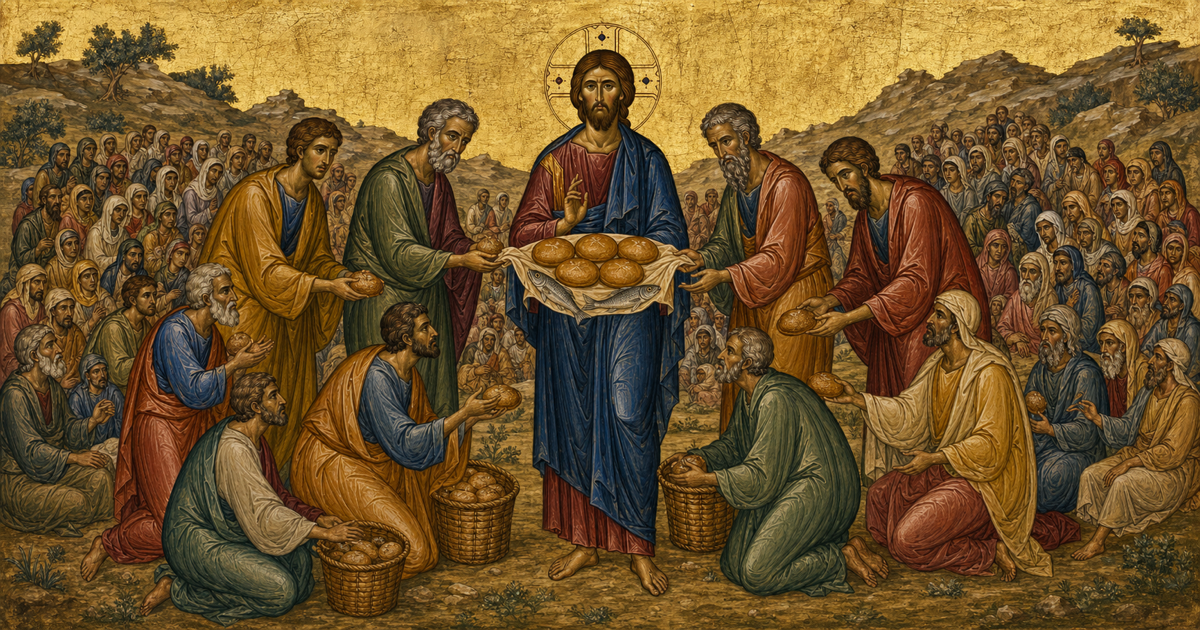
At that time, Jesus saw a great crowd, and He had compassion on them and healed their sick. When evening came, the disciples went to Him and said: “This is a deserted place, and the hour is already late. Send the crowds away, that they may go into the villages and buy food for themselves.” But Jesus said to them: “They need not go away; you give them something to eat.” They said to Him: “We have here only five loaves and two fish.” And He said: “Bring them here to Me.” Then He commanded the crowds to sit down on the grass. Taking the five loaves and the two fish, He looked up to heaven and blessed; and breaking the loaves, He gave them to the disciples, and the disciples gave them to the crowds. They all ate and were satisfied, and they took up twelve baskets full of the fragments that remained. Those who had eaten were about five thousand men, besides women and children. And immediately Jesus made the disciples get into the boat and go before Him to the other side, while He sent the crowds away.
After the News of John’s Death
The reading of the day begins with Jesus going out to the crowd. What happened immediately before it stands in the preceding verse, and Saint John Chrysostom begins there, because without it the scene has no foundation.
Jesus had just received the news that John the Baptist had been killed, and He withdrew to a deserted place. Chrysostom says that He often withdraws and that He wished many of His works to take place according to human order, not from lack of power, but because He did not reveal His divinity everywhere in the same manner. The crowds learn where He has gone and set out after Him on foot from the towns; what had happened to John did not frighten them.
From here on we follow the appointed reading. He goes out to meet them, and instead of avoiding them, He has compassion and heals their sick.
Evening comes. The place is deserted, the people have nothing to eat, and no one asks for anything. Chrysostom pauses over this silence: their love of remaining near Christ had made them forget even food. The disciples approach and ask one thing only: that the crowds be released to buy food in the villages.
Then comes the word: you give them something to eat.
He does not say that He will give them food, because He would not have been believed. Saint Theophylact adds the reason: He allows the Apostles themselves to confess that they have nothing, so that it may be clearly seen that the miracle proceeds from need and not from a desire to be seen.
The disciples answer that they have five loaves and two fish. The number deserves attention: there were twelve men, and this was all they had for their own food. Yet they did not keep even that little for themselves, but handed it over when asked, without wondering what they themselves would eat.
The Bread
Christ takes the loaves, looks up to heaven, and blesses.
Here Chrysostom raises the question that usually troubles readers. Why does He pray for so small a miracle, He who had raised the dead and calmed the sea without prayer? His answer follows two paths at once, and neither suggests that the Son receives from outside a power He lacks. He performs the great miracles by His own power, that His divinity may be known. In the lesser ones He lifts His eyes, that it may also be known that He came from the Father. We needed to know both truths. And in addition, He teaches us something small and daily: not to sit down at table before giving thanks to Him who gave us the food.
Why does He not make bread from nothing? To silence the Marcionites and the Manichaeans, who separated the visible world from the good God and assigned it to another origin. By multiplying loaves that already exist, He shows by His deed that He is the One who causes the earth to bear fruit and the waters to bring forth living creatures. It is no lesser miracle to draw fruits from the earth than to make so much from five loaves.
The wilderness too is deliberately chosen. He works the miracle there, Chrysostom says, so that no one might suppose that anything had been brought from a neighboring village.
Then follows the part upon which he insists most strongly. Through the disciples, Christ seats the crowds on the grass. From their hands He takes the loaves. He breaks them and gives them to the disciples, and the disciples give them to the crowds. This order has a purpose: that every Apostle should be a witness of the miracle through what he said and did, and that their hands themselves should bear witness. Chrysostom describes what happened there in an unforgettable image: the loaves flowed like a fountain in the hands of the disciples.
At the end fragments remain, not whole loaves, so that it may be known that these are precisely what remained from the original loaves. Theophylact adds that the abundance shows that the miracle was not an illusion. Concerning the twelve baskets, both Fathers observe that Judas too would thus carry one and remain a witness. Theophylact adds that, carrying the miracle in his own hands, he ought not to have rushed headlong toward betrayal.
Their sitting upon the grass, the simple food, and the same portion for all, with no separate table for those of rank: Chrysostom reads all of these as instruction. Christ wished not only to satisfy their bodies, but also to teach their souls humility, self-restraint, and love.
Theophylact also reads the scene according to its higher meaning. Herod, who in the spiritual interpretation represents carnal-mindedness, had cut off the head of John, the head of the prophets. Jesus therefore departs into a deserted place, that is, to the nations which had until then lacked the knowledge of God, and there He first heals and then feeds. For, Theophylact says, unless He forgives our sins and heals us through Baptism, He does not feed us with the Holy Mysteries. This is a typological reading: the multiplication of the loaves is not yet the institution of the Eucharist, but it foretells it.
In the final verse, Christ makes the disciples enter the boat. In the word made, Theophylact sees how difficult it was for them to part from Him, because they always wished to remain with Him. He sends the crowds away so that they will not follow Him, lest He appear to love vainglory.
Sources
Saint John Chrysostom, Homilies on the Gospel of Matthew, Homily XLIX.
Saint John Chrysostom, Homilies on First Corinthians, Homily III.
Saint Theophylact of Bulgaria, Explanation of the Holy Gospel According to Matthew, chapter 14.