
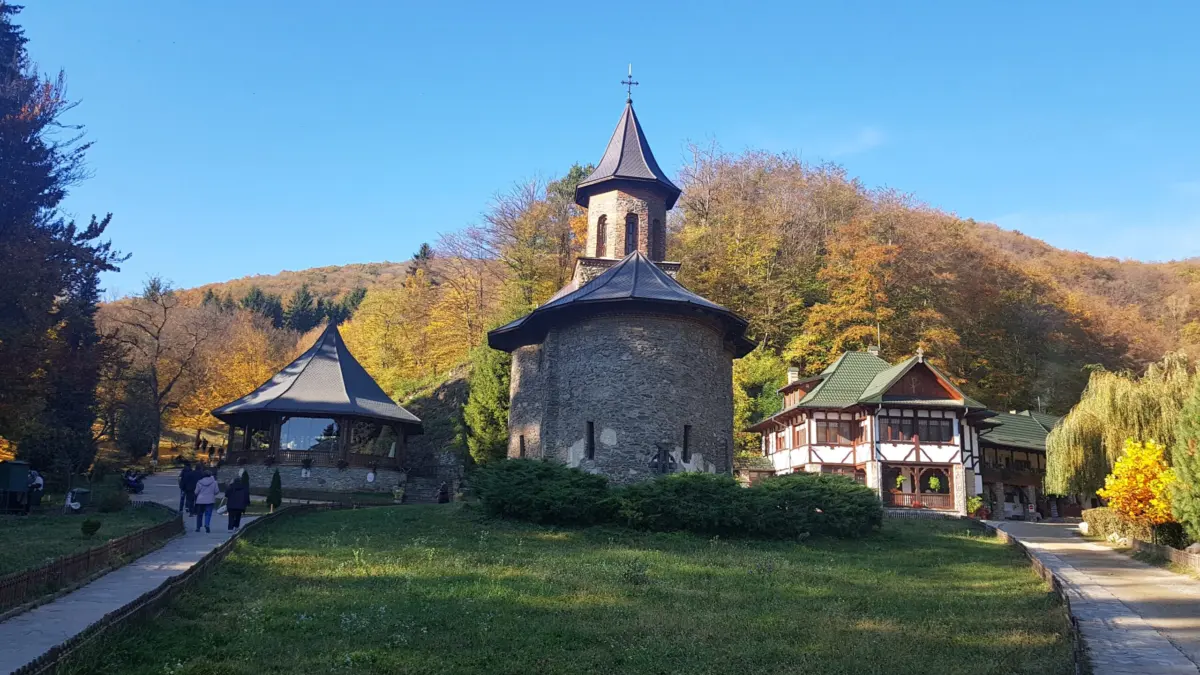
Top image: the “Saint John the Evangelist” church of Prislop Monastery, photographed in 2019. Photo: Leontin l, CC BY-SA 4.0, via Wikimedia Commons.
The second article in the series about the hieromonk Arsenie Boca (1910–1989). The first, The Life of Arsenie Boca (I): Up to Prislop (1910–1948), tells of the years up to his move to Prislop.
Every statement is referenced to its source.
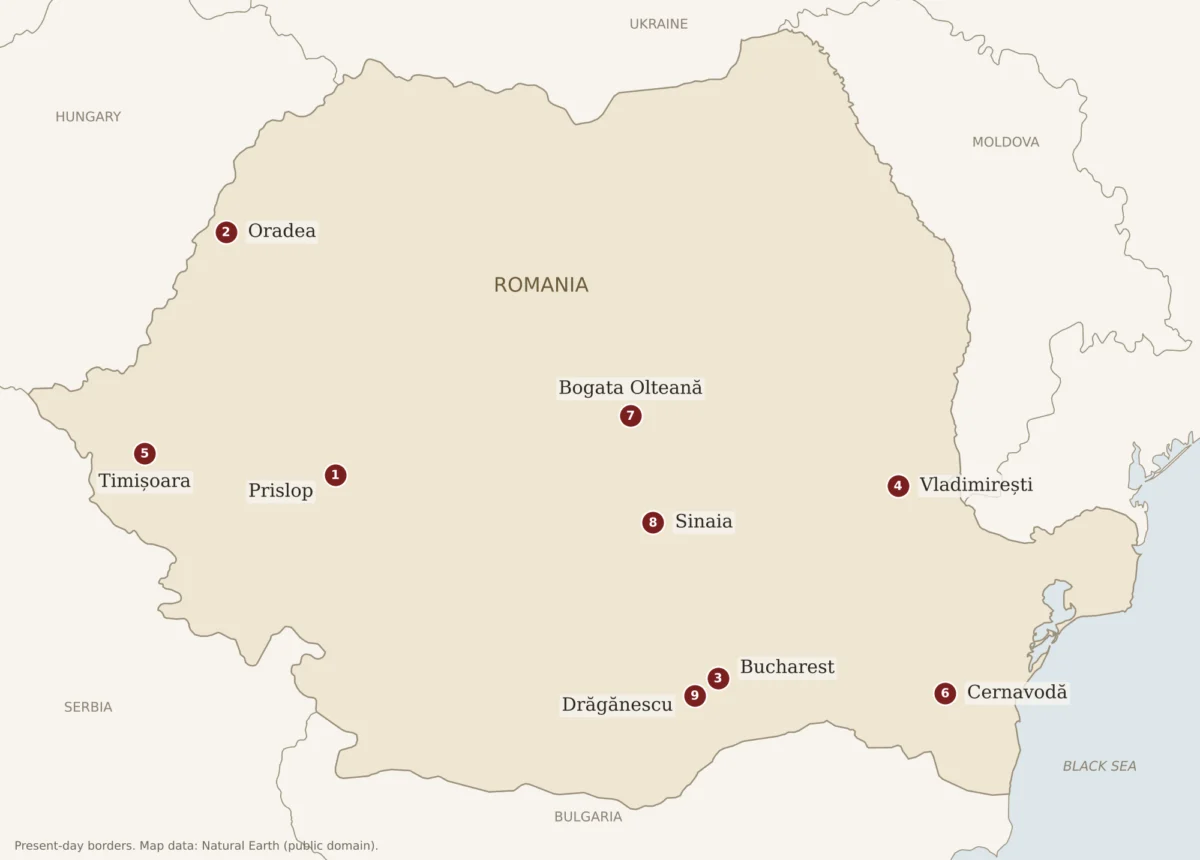
Map: OrtodoxWay. Cartographic data: Natural Earth (public domain).
- Prislop: the monastery near Hațeg to which he was brought on 25 November 1948 and from which he was removed in 1959; here he was buried, on 4 December 1989.
- Oradea: on his journeys for the 1949 mission he came here and visited the parents of Nicolae Bordașiu; in 1955–1956 he was also held in the prison here.
- Bucharest: here he delivered his report at the Patriarchate, in 1949; here he lived from 1959 until his move to Sinaia and worked in the Patriarchate’s painting workshop. In 1955–1956 he was also held at Jilava, near Bucharest.
- Vladimirești: the monastery between Tecuci and Galați to which he went in 1949, together with Julieta Constantinescu.
- Timișoara: here, in the summer of 1949, he met Nicolae Bordașiu, who was hiding from the Securitate; here he was interrogated in the autumn of 1955.
- Cernavodă: here and at Saligny, in the labour colonies on the worksite of the Danube–Black Sea Canal, he was detained between 1951 and 1952.
- Bogata Olteană: the village in which he was granted residence in the autumn of 1960 and in which he worked on the painting of the church in 1962 and 1963.
- Sinaia: the town in the Prahova Valley from which he went up the mountain in 1962, followed by the Securitate; here he lived his last years and died, on 28 November 1989.
- Drăgănescu: the village near Bucharest whose church he painted between 1968 and 1983.
In this article
At Prislop (1948–1950)
Arsenie Boca arrived at Prislop Monastery on 25 November 1948, brought there by the Metropolitan of Transylvania, Nicolae Bălan. Prislop is an old monastery near Hațeg, in south-western Transylvania. Until then it had belonged to the Greek Catholic Church, which the communist regime was abolishing in those months; its parishes were being transferred to the Orthodox Church. Decree no. 358, which put an end to its metropolis, dioceses and monasteries, was published in Monitorul Oficial on 2 December 1948. At Prislop Boca found the old church and a building put up in the time of the Greek Catholics, with walls full of damp, but no community, because the last three Greek Catholic monks had left. He had been sent “for the enlightening of the people returned to Orthodoxy”, and the monastery’s records show him as “seconded” there, that is, sent for a time, not appointed.1
On 14 December 1948 he wrote to the brothers who had remained at Sâmbăta de Sus, the monastery in the Land of Făgăraș where he had lived until then, that the desolation of the place gathered him into his cell, among the writings of the Fathers. For this he felt full of gratitude towards “the governance above, which has freed me a little from the crowding and the plundering at Sâmbăta”. And he added: “I would not go away from here any more, nor would I go out among men any more; but neither would I let them crowd me any more. You cannot be both with God and with men.”2
In the spring of 1949 Prislop came, together with the whole of Hunedoara County, under the jurisdiction of the Diocese of Arad, led by Bishop Andrei Magieru. On 17 March the Metropolitan of the Banat, Vasile Lăzărescu, asked the Bishop to leave Boca at Prislop for two or three years, so that he might finish Cărarea Împărăției, the book he was then writing, and the Bishop gave his assent “with pleasure”. In June Metropolitan Bălan asked that Boca return to the diocese of Sibiu, and Bishop Andrei asked Boca whether he wished to remain at Prislop. On 16 July 1949 the Bishop came to Prislop for the first time, and Boca welcomed him with the words: “You are received, with love, by the oldest Monastery in Transylvania: the foundation of Nicodemus the Sanctified and of Princess Zamfira.” Nicodemus the Sanctified is Saint Nicodemus of Tismana, and Princess Zamfira restored the monastery in the sixteenth century. According to the diocese’s records, on that occasion the Bishop made him a protosyncellus, a rank of honour for hieromonks. Five days later Boca wrote to Metropolitan Bălan that he had decided to remain “permanently in the Diocese of Arad, at Prislop”, and asked him for a “canonical letter of transfer”, the document by which a cleric passes from one diocese to another. On 8 August the Metropolitan accepted his request.3
On 16 May 1949 a report of the Securitate, the political police of the communist regime, recorded that Boca had been summoned to the Patriarch of the Romanian Orthodox Church, Justinian Marina, and Archimandrite Teoctist Arăpașu, the future patriarch, believed that Justinian wanted to give him “the monasteries of Transylvania to lead”. Bartolomeu Anania, whom the Patriarch had taken to his side as steward of the patriarchal palace, wrote in 1998, as Archbishop of Cluj: “I know for certain that the Patriarch was thinking of calling him to the rank of bishop, but, as is known, Arsenie was arrested, taken to forced labour camps and then, practically, obliged to remain inactive.”4

Unknown author, “Biserica Ortodoxă Română”, Editura Institutului Biblic și de Misiune Ortodoxă, Bucharest, 1967, p. 52; public domain, via Wikimedia Commons.
On 19 May 1949 the Patriarch sent him “on a special mission, concerning the former Greek Catholic monasteries”. For a month Boca visited the communities of Greek Catholic nuns at Obreja, in Alba County, at Cluj and in the village of Jucu de Jos, near Cluj, at Aiud and at Beiuș, in Bihor. According to an article published in 2005, he was accompanied by a few nuns from Bistrița Monastery in Vâlcea and by the abbot of Cozia Monastery.5
On 18 June he sent the Patriarch a report. He wrote there that the Greek Catholic convents “must be kept under watch – which is indeed being done –, since everywhere they have organs of control in the immediate vicinity”. He advised him not to move them: “Their relocation or their scattering among the other Orthodox monasteries would create for them, among the people, a sympathy, as for those who suffer. Better that they remain where they are, so that the people may see that, in cases of force-majeure need, they ask for the Hungarian priests, and not for the Romanians. In this way they discredit themselves”. For the clergy who had come over from the Greek Catholics he proposed that “the whole Greek Catholic element” be “concentrated in thorough courses” of dogmatics, liturgics, church law and liturgical practice, concluded with “examination, qualification and oath”. He called them “de-Catholicization courses” and wanted the priests who had not passed over to Orthodoxy to be called to them as well: “So not isolated, but invited to courses, so that it does not look like force.”6
On the night of 9 to 10 September 1949 the Greek Catholic nuns were nevertheless taken in lorries to Bistrița Monastery.7
On his journeys for the mission, which also took him to Oradea, Boca visited, at the request of Julieta Constantinescu, the parents of Nicolae Bordașiu; the father was a priest. Julieta, the student who had been coming to Sâmbăta since 1947, loved Bordașiu, her fellow student at the faculty, without being loved in return any longer. Bordașiu was now hiding from the Securitate. Boca later declared to his interrogators that he had gone “to discuss the possibility of the marriage of Bordașiu Nicolae, the son of the priest Bordașiu, with Julieta Constantinescu”. The father told him that he did not know where his son was. After he had delivered his report at the Patriarchate, Boca set out for Vladimirești Monastery, also called Tudor Vladimirescu, between Tecuci and Galați, and took Julieta with him. “I, seeing her distress,” Boca declared, “being on the way to the Tudor Vladimirescu Monastery, I think I invited her too to come with me”.8
There they learned that Bordașiu was said to be hiding in Timișoara, and in the summer of 1949 the two of them went there. Boca met him three times, twice together with Julieta and once alone, to persuade him to marry her. Bordașiu refused each time. “For all my insistence,” Boca declared, “Bordașiu refused on the grounds that Julieta might annul his personality if he married her”. In another declaration Boca said that he had promised Bordașiu to intercede for him with the Patriarch, “in order to resolve his situation as a fugitive and so that he might be ordained a priest”, but that he had not done so, “because BORDAȘIU NICOLAE categorically refuses to marry JULIETA”. Bordașiu, for his part, would later declare that Boca told him then that “Julieta is lost and that he has given her rebirth again and must take care of her”. Bordașiu remained in hiding until July 1955, when he was caught.9
In the summer of 1949 two theology graduates came to Prislop, Leonida Plămădeală, the future Metropolitan Antonie of Transylvania, and Stelian Manolache. Boca wrote to Metropolitan Bălan: “God has helped me to find two licentiates in Theology from Cluj and Bucharest, the best, who are becoming monks at Prislop.” At the beginning of August Bishop Andrei ordained them at Arad, Manolache a priest and Plămădeală a deacon. On 14 September 1949, at the monastery’s patronal feast, Boca tonsured them monks with the names Dometie and Antonie, with the Bishop also present. Antonie’s sponsor at the tonsure was the monk Agaton, called from Bucharest. Agaton was the writer Sandu Tudor, who had founded at Antim Monastery in Bucharest the prayer group called the Burning Bush (“Rugul aprins”).10
After the meetings in Timișoara, Boca and Julieta went together to Prislop, and Julieta stayed there for a few months. Antonie Plămădeală described her stay in an interrogation conducted by the Securitate in 1955, while he himself was under arrest. Julieta, a theology graduate like him, “admired the personality of the monk Arsenie from the religious point of view, as a holy person”. “She said her prayers together with B. A. in the church; on walks too they went together.” The initials B. A. are those of Boca Arsenie. Julieta “no longer wanted to leave the monastery”, although Plămădeală and his colleague told them both that “the stay of a girl among monks and among us who were younger, for so long (2-3 months), is not fitting”. Because of this they quarrelled, and Boca made it clear to them “that we should look for another place if we do not like that one”.11
Julieta took offence at the two of them and spoke only with Boca, “with whom they studied together all day”. Plămădeală also says: “At the same time, desperate that she would leave the monastery, she told the monk B. A. that if he drove her away, she would kill herself, a fact by which B. A. justified to us her being kept in the monastery.” And he adds: “I mention that I have no suspicion of a moral nature regarding the friendship that formed between B. A. and Constantinescu J.”12
In the end, Plămădeală writes, Julieta left Prislop. On 20 January 1950, while Boca was at the Patriarchate, he too left. In Rugul aprins, his book of memoirs, he tells that a brother who had come from Bucharest told him that the Securitate was looking for him and that he left that same night. In the 1955 interrogation he also mentions another reason: “I too left, because I was always quarrelling with the monk B. A. over the departure of this girl, and he being always sad and upset”. In the same place he says that he heard later that Julieta had supposedly returned to Prislop and become abbess.13
On 11 April 1950 Prislop became a convent. The decision was taken by Bishop Andrei, who had come to Prislop again at that time, writes the church historian Mircea Păcurariu in his history of the monastery, printed in 1986. According to Lidia Stăniloae, the plan was Boca’s, and he had sought advice about it from her father, the priest and professor Dumitru Stăniloae, the theologian who had translated the first volumes of the Philokalia, the collection of writings of the Fathers on prayer. Lidia Stăniloae remembered that Boca came to Bucharest for this and that they talked at length. Her father “did not agree” and told Boca “that this thing could give rise to a host of ambiguities and misunderstandings”. His advice was: “Father, make a monastery for monks. It would be very welcome there.”14
The first nun of the new community was Julieta. Boca tonsured her a nun in August 1950 and gave her the name of Princess Zamfira.15 A document of September 1950, kept in Boca’s Securitate file, says that Julieta had tried “on countless occasions to kill herself”. According to the inventory of the Securitate documents about Boca, cited by a blog, the same document adds: “The abbot […] sought to satisfy all her wishes, so that lately she has become the leader of the monastery.”16 In the same month, on 27 September 1950, the Securitate Office in Hațeg wrote to the county Securitate: “On the day of 30 Sept. this year we shall send a woman to compromise the said BOCA ARSENIE in accordance with your ord. and we shall report its result.” The officers added that they had made contact with the party organization of the Hațeg district in order to carry out “a work of combating his influence among the population”.17
The people who used to climb up to Sâmbăta now came to Prislop. On 14 November 1949 a Securitate report called him a “swindler monk”, of whom “it is said that he is a miracle-worker”, and mentioned the proposal to move him to a monastery where people did not know him. Photographs of him were sold at the monastery. At the patronal feast of 14 September 1950 between two and three thousand people came, by train, from Făgăraș, Brașov, Sibiu and Alba, and some from Bucharest and Ploiești. The commissioner for religious affairs, the official who supervised church life on behalf of the state, wrote that the pilgrims looked for the abbot everywhere, to speak to him, to touch him and to kiss his hands and his cassock: “His influence over the pilgrims is unimaginable.”18
In the summer and autumn of 1950 Saint Cleopa the Venerable, then abbot of Slatina Monastery in Moldavia, wrote to him twice, asking him to visit his community. Boca had sent a few disciples from Sâmbăta to him there. The letters have been preserved in the Securitate’s surveillance file, and the second shows that the meeting which they both desired had not taken place.19
The Canal (1951–1952)
Meanwhile the Securitate was preparing his arrest. On 29 May 1950 a section of the Central Committee of the communist party notified the Securitate that the villagers of Șugag, in Alba County, were going to Prislop, to a monk who was said to have healed a woman, and asked for “the taking of measures for combating these miracles and healers of diseases”. On 2 June a Securitate officer proposed, in a submission, “the urgent placing in a U.M. for a period of two years of Archimandrite Boca Arsenie, abbot of the Prislop-Hunedoara monastery”. U.M. stood for unitate de muncă, a labour unit, that is, a forced labour colony. On 14 October 1950 a decision of the Ministry of Internal Affairs sent him for twelve months into administrative detention, that is, into imprisonment decided by the ministry, without trial.20
Ten men took him away on the morning of 16 January 1951, between four and five o’clock. The hieromonk Dometie, who was present, reported to the diocese: “no order was presented. The procedure was brutal. They entered the cells of the sisters speaking very improperly, all this without any justification”. On 18 January Mother Zamfira was received by the Patriarch. The notes of someone who spoke with her then, probably an official, say that the Securitate’s cars had broken down both on the way there and on the way back, so that the villagers of Silvaș, near Prislop, had seen Boca being taken away in a cart. The fact, their author writes, “was interpreted as a miraculous sign, as a kind of miracle that was worked for saint Arsenie”.21 Some ten days later Zamfira came to the Patriarchate again. According to the historian Adrian Nicolae Petcu, she also went twice to the Ministry of Religious Affairs.22
In February a delegation of peasants from the parts around Prislop and Făgăraș came to the Patriarchate to ask for his release. On 11 March the community at Prislop, with the hieromonk Dometie at its head, wrote to the Patriarch: “We have gathered here, in the foundation of Saint Nicodemus to rekindle Orthodoxy.” The monastics asked him for “fatherly measures” and added: “If you cannot give them to us, we are determined to follow the disciples of the saints in the Synaxarion: we go where our confessor is. […] We did not enter the monastic life in order to lead the existence of worms.” About the authorities, the community wrote that it had towards them “the attitude of the Holy Apostle Paul that ‘every authority is from God’ and, in line with him, that of Father Arsenie that, ‘with regard to Christianity, the present authority is better than any other’”. The words attributed here to Boca are written by the community, in a petition for his release. The next day Justinian wrote on the first page of the memorandum a resolution by which he sent it on to the Minister of Internal Affairs, Teohari Georgescu, “with the request to find a solution for the calming of minds, not only within the Monastery, but also among the faithful of Transylvania, where Arsenie has many thousands of followers”. And he added: “Arsenie is at Canal-Cernavodă. If he is left under arrest, we can confirm in advance, that the thousands of faithful followers of Arsenie will set out for Cernavodă.” According to Petcu, the memorandum had been given to the Patriarch by Zamfira. The intervention had no result.23
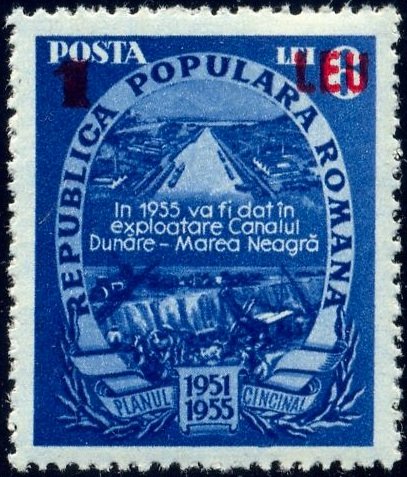
Boca had been taken first to a transit centre in the commune of Tudor Vladimirescu, near Bucharest, then to the labour colonies at Cernavodă and Saligny, on the worksite of the Danube–Black Sea Canal. In March 1951 he wrote to Mother Zamfira: “Settled in good health in Cernavodă […]. I work in good conditions […]. Remarkably good spirits.” Zamfira went to see him almost every month. In May 1951 an informer noted that she had learned from him, on a visit, that “he is satisfied with the treatment”. According to the biography published in 2018, Zamfira related that “she had not expected to find him in such a good state”.24 Petcu writes that Boca was put to forced labour. The 2018 biography, following a book published in 2016, says that he kept the colony’s account books and that he was thus spared the heavy work of the other prisoners. Among the faithful there went round at that time a rumour, recorded by the Securitate in June 1951, that at the Canal, “where he worked the earth would cave in and he was moved from one job to another, but in the end it became necessary for him to be set free”.25
Public domain, via Wikimedia Commons.
At the Canal he was also questioned about Bishop Nicolae Popovici of Oradea, his former professor in Sibiu, whom the authorities had sent in October 1950 to live confined in Cheia Monastery. According to Petcu, Boca declared that he had known the Bishop since the time when he had been his professor and that he had seen him again in 1949, at Beiuș, during the mission among the Greek Catholics, and about the Bishop’s sermons against the regime he said nothing. According to the 2018 biography, he declared that, since Popovici had become a bishop, he had visited him only once and that he had learned from the Patriarch and from people of the Patriarchate that his sermons were reactionary, that is, hostile to the regime.26
While Boca was away, the monastery was led by the hieromonk Dometie, and from 1 October 1951, at the community’s request, Bishop Andrei appointed Mother Zamfira acting abbess. In those months Boca’s mother, whom Zamfira visited every month at Hălmagiu, a village in Arad County, fell ill. His mother died on 6 December 1951, and Zamfira was at the funeral. In 1984 Boca told a carpenter who was working at his house and who gave reports to the Securitate that at that time “it had been rumoured that he had escaped from the Canal” and that the authorities had looked for him, but that “in reality, he had not escaped and was at the Canal”. He had sensed “that something had happened at home, but he did not know, until it was communicated officially”.27
According to the Securitate’s records, Boca was imprisoned from 19 January 1951 to 17 March 1952, nearly fourteen months, although the ministry’s decision spoke of twelve. On 3 April 1952 he wrote to Bishop Andrei: “On the Annunciation, with God’s help, I arrived, home, at Prislop: in good health, much profited and just as serene.” The Bishop at once made him confessor of the monastery again. The Ministry of Religious Affairs, through which the state then kept the Churches under control, recognized him in this office only in February 1953.28
The last years at Prislop (1952–1959)
The Securitate continued to keep him under surveillance after his return. The commissioner for religious affairs had proposed that a man prepared in advance be sent to Prislop, who would pass himself off as a “political refugee” and ask for shelter, so that the authorities would then have grounds to strike at the monastery. The man came in April 1952, and Boca and Zamfira denounced him to the Securitate in Hațeg. An agent wrote at the same time that Boca “has made contact with all the organs of state power”. According to the 2018 biography, which summarizes the report, whenever a suspect pilgrim appeared at Prislop, Boca informed the Securitate in Hațeg, which came and checked him.29
In June 1953 the Securitate in Cluj informed the one in Hunedoara about a meeting of anthroposophists, the disciples of the Austrian philosopher and esotericist Rudolf Steiner, held in Cluj on 31 May. The letter said that “this monk has ‘the gift of clairvoyance’”, that “after he entered the anthroposophical group he made rapid progress” and that the participants had spoken of him “with much admiration”. In November the Securitate in Deva wrote that it had been notified that Boca was part of “the anthroposophical counter-revolutionary subversive organization in the RPR”. Petcu, who publishes these letters, regards them as a denunciation “which cannot be proved”. They do not show that Boca was at that meeting.30
A document in his Securitate file says that after his return Boca “took silence upon himself”. Mother Zamfira then set the monastery a strict rule for visitors. To those who asked after Father Arsenie she said that he was now following the word heard by Abba Arsenius the Great, the hermit of Egypt whose name he bore: “Flee from men and you will be saved.” An informer sent by the Securitate in July 1955 found the gate locked and eight sheepdogs in the courtyard. The abbess questioned the visitors at the gate and sent most of them home; from those she admitted she took their identity cards, and she usually did not keep them more than a day. It was to him, too, that she told how she had once driven away some visitors from Hunedoara who wanted to take photographs: “I then took a stone from the ground […] and ordered the nuns to do the same.”31
In May 1952 the hieromonk Dometie was moved as confessor to Afteia Monastery, in Alba County, and Boca remained the only priest of Prislop. The community grew in the following years, to thirty-five nuns and sisters, that is, novices, in 1959. They worked in workshops for carpets, woven fabrics, tailoring and knitwear, registered in a craft cooperative, and in the monastery there was a monastic school, at which Boca and the abbess taught. The nuns learned psaltic chant, that is, the old church chant of the Byzantine tradition, and their choir was trained by Boca.32
Between 1954 and 1956 the Directorate of Historical Monuments restored the church, with the support of the Ministry of Religious Affairs, of the Patriarchate and of the Diocese of Arad. The stalls, the door and the tabernacle, that is, the box on the Holy Table in which the Holy Gifts are kept, were carved by a craftsman from Sibiu, Rudolf Lorentz, after Boca’s drawings. Boca wanted to paint the church himself. For this, in December 1954, he asked to do the six months of practice required of church painters, on the worksite of the cathedral in Galați, and the Patriarch approved his request. On 26 March 1958 he presented to Bishop Andrei the estimate for the painting, that is, the costing of the work, so that the Patriarchate’s commission for church painting might approve it. In January 1959 the monastery engaged the painter Ștefan Constantinescu, who was to paint the church together with Boca. The painting was not carried out: in 1986 the church was still unpainted.33
On 19 September 1955 the Securitate arrested them both, Boca at Prislop and Zamfira at the cooperative in Hațeg. Bordașiu had been caught in July, and their names had been mentioned in the inquiry into him. At Timișoara Boca was questioned about Bordașiu and about other arrested men regarded as Legionaries, that is, members of the former Legionary Movement, the nationalist political movement of the years before the war. He was also questioned about Antonie Plămădeală, about his former professor Nichifor Crainic, about Princess Ileana, of the royal family, and about Vladimirești Monastery. Nichifor Crainic, himself sentenced by the regime, was questioned as a witness on 11 October and said of Boca that he was “a monk of real spiritual worth” and that he “was completely apolitical”. Zamfira was released on 8 October.34
Petcu found in the file seven records of the interrogations at Timișoara, from 27 September to 5 October 1955. In one of them Boca declares: “I make it clear that I did not join the Legionary organization, nor were proposals made to me to this effect.” Of these, the interrogation of 5 October, about Princess Ileana, has been published. The record was written by the interrogator, and Boca reread it and signed it. There Boca gave the names of a few people whom he had known around the princess, at Bran Castle, near Brașov. Of two of them he said that he had considered them fugitives, and of one, that “my own belief was that he had been a Legionary”. He also said that the letter of thanks which the princess had left him “can be found” at Sâmbăta, “together with several books which are hidden under the eaves of the metropolitan’s guest house, at the place indicated by me in the sketch which I have made”.35
The detention order issued by the Military Prosecutor’s Office in Timișoara charged him with “failure to denounce”, that is, with not having denounced Bordașiu, whom the authorities were seeking. Petcu writes that at Timișoara, in 1949, Boca had given Bordașiu “moral-spiritual and even material support”. Boca was taken through the prisons of Jilava, near Bucharest, and of Oradea, where he was held from 17 December 1955. According to Petcu, the Military Tribunal in Timișoara sentenced him to six months’ imprisonment. He was released on 7 April 1956, by a letter of the Military Tribunal in Oradea, and on leaving he signed an undertaking not to tell what he had seen in prison and at the inquiries. The next day he was back at Prislop.36 The 2018 biography writes that there are no indications that he was tortured or subjected to inhuman treatment.37
In 1958 the Securitate opened a new surveillance file on him. The officers complained that, “for lack of an agent network and, moreover, because of the persevering measures of verification which the Legionary Boca Arsenie takes together with the abbess Constantinescu Julieta, our informative possibilities are limited”.38
The regime was then preparing the removal of a large part of the monastics from the monasteries. Decree 410, issued in the autumn of 1959, would allow entry into monasticism at any age only to graduates of the schools for the training of clergy who had done their military service; the others could be received only after the age of 55 for men and of 50 for women, and on other conditions as well. The Department of Religious Affairs, the institution through which the state controlled the Churches, targeted first those whom it regarded as “bad citizens”, that is, those who had already been imprisoned. Among these it had listed Boca and Zamfira.39
On 22 April 1959 the Diocese of Arad required them, by an order given by word of mouth, to leave the monastery within twenty-four hours and in civilian clothes. Three days later, on the Saturday before Palm Sunday, they complained about the measure to the Securitate officer in Hațeg and asked his permission to go first to Bucharest. Zamfira left the officer a memorandum in which she showed herself determined to unmask “from the roots” the plots against the regime of the Orthodox hierarchs and of the former Greek Catholics who had passed over to Orthodoxy in form only. The officer then proposed that she be recruited as an informer. Petcu writes, without citing a document, that Boca went to the Patriarch, and that the Patriarch told him not to leave the monastery without a written order.40
The written order was signed by Bishop Andrei Magieru on 14 May 1959, after a long discussion with an inspector of the Department of Religious Affairs who had come from Bucharest: “In accordance with the dispositions given by the Holy Synod, concerning the removal from the monasteries of the dwellers, who through their activity harm ecclesiastical interests, we decide that hieromonk Arsenie Boca, confessor at the Prislop convent, is to leave forthwith the premises of the above-named monastery. The aforesaid will leave the monastery without the cassock, with our Diocese to place at his disposal the necessary sum of money, in order to purchase a civilian suit.” Mother Zamfira received a similar decision. The vicar of the diocese and the envoy of the Department took the decisions to Prislop on the same day, and on 17 May 1959 Boca and Zamfira left.41
In July Patriarch Justinian thanked Bishop Andrei for having protected the remaining community and asked him not to take any further measure “until you have asked me”. The community was nevertheless scattered. In September 1959 ten nuns received the order to move to Gai Monastery, near Arad, and in October others left as well. In September 1960 Prislop was closed as a monastery, and until 1976 an old people’s home operated in its buildings.42
In the world, in Bucharest (1959–1968)
From Prislop Boca and Zamfira went to Bucharest, where they settled in the home of her mother, Ecaterina Constantinescu, on Litovoi Voievod Street. From 7 August 1959 Boca worked as a painter at the new church of Saint Eleutherius in Bucharest, in the team of the painter Vasile Rudeanu. A monk removed from his monastery could be given residence in the capital only with the approval of the Department of Religious Affairs. On 3 December 1959 Boca applied for it, writing: “The undersigned, having been left an orphan as a child and having left home as a child I no longer have anything or anyone in my native commune, where I might settle”. In the autumn of 1960 he applied for and obtained residence in the village of Bogata Olteană, in Brașov County, where he was to paint the church built by the priest Spiridon Cândea, a former professor of theology in Sibiu. The commissioner for religious affairs of the region reported that he had made it clear to him “to mind only his lay affairs, not to meddle in church affairs”.43
At the beginning of 1961 Patriarch Justinian employed him as a “stencil painter” in the Patriarchate’s painting workshop, which belonged to the Biblical Institute and was housed at the Schitul Maicilor church in Bucharest, with a salary of 1,061 lei a month, paid from the Patriarchate’s funds. He seems not to have received a Bucharest identity card: in the Securitate reports of 1962 and 1963 he appears as “living as a temporary resident”, that is, with only a permit for a temporary stay in the city. At the workshop he learned enamel painting, that is, painting with enamel on metal, from the painter Ottilia Oteteleșanu, who ran the workshop. An informer wrote in 1966 that Boca made all the designs and drawings for the commissions, that “the patriarch appreciates him very much” and that “during work he does not want there to be talking in the workshop”. The same informer noted that Boca had acquired this art “with much skill (stolen, strictly speaking)”, because the painter kept it secret, and that he was now training two apprentices himself. He attributed to Boca the words: “Look here, since the old ones who know the secrets of the trade do not want to pass them on to the young ones, we have to steal it.”44
In Bucharest, too, people who knew him from Sâmbăta and from Prislop sought him out. An informer wrote in February 1961 that Boca “is visited by very many people from the provinces, who come to see him at the Eleutherius church, some with letters, others with parcels”. Another noted in January 1962 that Boca “works very little and instead – on the pretext that he hears confessions (although he is no longer a priest and does not belong to the Eleutherius Church) – has lengthy conversations in the church with various persons”. In the following years people looked for him at the Patriarchate’s workshop, asking him for advice, for an icon or for a cross carved in wood, and in the informers’ reports there recur sayings such as “his prayers work miracles”.45
During his leave in the summer of 1962 Boca painted at Bogata Olteană, and in 1963 he went there again for a few months; the Securitate asked that he be watched in the village as well.46
He now went about in civilian clothes and no longer wore a beard. The Securitate described him in 1962 with a “forked moustache and spectacles with green lenses”. Lidia Stăniloae once met him in the street: “in civilian clothes, without a beard. Nor did he any longer have the white cassock that gave him presence.” Further on she writes: “He had become an anonymous person, a passer-by in the streets of Bucharest and nothing more.” An informer noted in February 1965 that Boca went to the services at the Patriarchate on feast days and that, “whenever I have spoken with him he has told me that people gave him false publicity, exaggerated certain things and because of this he has had to suffer”.47
Lidia Stăniloae also tells of an incident from the years when her father was in prison and the family no longer had news of him. One day she found her mother, Maria Stăniloae, with her eyes red from weeping. She had been in town and had met Zamfira, who had told her, Lidia writes, “with a total lack of tact”: “I’ve heard that Father Stăniloae has died”. Her mother added “bitterly”: “She was smiling when she asked me!” Then she recounted: “She crossed the street to come to me. And she shouted to me from ten paces, ‘I’ve heard that Father Stăniloae has died!’” Her mother had retorted: “He hasn’t died! There are plenty who are glad to spread such news, but he hasn’t died. I know for certain!” Lidia writes that they both wept all day. Stăniloae was alive: later, a young man released from prison, who had been in the same cell with him, brought them news of him.48
In all these years he lived in the same house as Zamfira. From 1963 they lived in a home bought that year, and from 1968 in the Cotroceni district, on Dr. Petrini Street, in a house that belonged to Zamfira. The same informer wrote in 1965: “Some even said that Arsenie Boca is married to her.” The officer who kept him under surveillance wrote in the same year: “Around the year 1963 they bought themselves a house with the contribution of both of them. Because of this, among their acquaintances from church it is considered that they are married, which, however, is not true, because they do not have the legal forms of marriage.”49
The Securitate kept him under surveillance in Bucharest too. At the beginning of 1962 it opened a file on him under the name “Pictorul” (“the Painter”), and in August it decided that he “will be studied with a view to recruitment”, because he “is known as having a great influence among the Orthodox faithful and the Legionaries, a real myth having been created around him”. Between 21 August and 9 September 1962 he was followed step by step in the street, under the name “Bratu”, and Zamfira appears in the reports as “Beti”.50
The reports of these three weeks show him going to the workshop by tram in the morning, and after work through the streets of the centre or to the Boteanu church, also in Bucharest, where he painted in the evenings. On 23 August he left with Zamfira for Sinaia, a mountain town in the Prahova Valley. They went up to Cota 1400, that is, to 1,400 metres, and the next day to the Babele chalet, in the Bucegi Mountains, and they were photographed by agents on the train and on the mountain. According to the 2018 biography, which reproduces photographs from this excursion, on the mountain Boca wore shorts, a beret and a rucksack. On 9 September, the last day of the surveillance, he was present at the episcopal consecration of Visarion Aștileanu, the future Bishop of Arad.51
The Securitate tried to recruit him as an informer in November 1961 and again in 1964. About his conduct in prison, the officers wrote in July 1962: “We do not possess information regarding the activity possibly carried out in the penitentiary.” In April 1963 they asked that “the behaviour, the activity carried out and the connections maintained with the arrested elements” be established for the time he had spent in detention. An officer noted on 28 August 1963: “The element in question is very prudent. Not just any agent has access to him. For BOCA ARSENIE an agent at least of his calibre is needed in order to establish his true conceptions.” The 2018 biography, written on the basis of the files, says: “There is no signed undertaking and no document that would certify such a hypothesis.” On 12 November 1965 the Ministry of Internal Affairs placed him in “passive record”, that is, it kept him in the Securitate’s records without active surveillance, after a summary from May had found that “he does not appear with hostile manifestations”.52
In March 1965, according to the reports of a woman informer, Zamfira visited the priest Ioan Iovan, a former confessor at Vladimirești Monastery, released in 1964 after almost ten years in prison. Iovan told the informer that Zamfira had proposed to him, on Boca’s behalf, that he join a secret organization and that he had refused. Boca is then said to have told the informer that it had been a wager: “None of it is true, only a piece of childishness, to take poor Iovan’s pulse.” He is said to have told an archimandrite at the Patriarchate that he had wanted to find out “whether he still has bees in his bonnet” and that he had found out “that he got cured in jail”. The 2018 biography writes that the episode might raise “certain question marks”. The reports do not show, however, that Boca worked for the Securitate.53
In these years the informers had also noted down his words about the new order. According to one of the reports, Boca said: “Communism helps man to come to God and to work righteousness, it helps man to be saved. This is the meaning of our times today, to which we must submit with all understanding, because they work at the salvation of us men, with or without the knowledge of the many.” Another time he said that, if he had not been a monk, he would certainly have been a communist, “because such is my nature, to be as correct as possible and with a spirit of equity”. He also said, however, that when communism rules the world, the churches will be closed and the persecution of Christians will begin, which will be their “examination”. One of the informers wrote to his superiors that Boca, “if he supports communism it is only out of fear, that he is not convinced of what he says”.54
In August 1965 a former nun told an informer that she had been to the workshop to tell Boca her troubles. She had gone over to the Old Calendarists, the faithful who keep the old calendar and have separated from the Romanian Orthodox Church, and had married one of their priests. Boca scolded her, because the Old Calendarists were “suspected and watched”, and asked her why she did not take an example from him, who “has given up the uniform since he left the monastery and today nobody has anything against him and he submits to orders”.55
In January 1966 another informer asked him whether he intended to remain “only here with the icons and the saints”. Boca answered him that “he feels very happy with the saints whom he paints” and that, if the Patriarch did not wish to give him another assignment, “which he has had in the past and which, between ourselves, it does not depend on me to desire, it means, that he has no need of me or that I do not correspond to his views (those of the Patriarch) and, therefore, it is good and I must feel happy in the situation in which I find myself”. The divine law, he said according to the same informer, means love, peace, obedience and work without slackening, all “in full submission to the spiritual leadership and to that of the state, as before God”.56
In January 1967 there was talk in church circles that the monastics removed from the monasteries might be received back. It was said, among other things, that the hieromonk Dometie, who had led Prislop while Boca was at the Canal, would be called with a community to Râmeț Monastery, in Alba County, recently restored. Dometie later became the well-known confessor of Râmeț.57
On 24 February Boca asked the Patriarch, in his office, whether the rumour was true. An informer who was present noted down the conversation: the Patriarch asked him whether he wanted to leave him, and Boca said that he would like to go “to the same monastery where he had been, Prislop”. “He was told in answer that he will have to go not where he wants, but where the Church will see fit.” The Patriarch added that the monastics would be received back: “Of course, only those who still fulfil the conditions.” To colleagues who might have spoken for him to the Patriarch he said that he had put work and money into Prislop, that he knew the place and the people and that he was needed there, “at that point where the Catholic and Hungarian influences meet”, for, “being a good Romanian and a good Orthodox, he renders real services to the ancestral church and to the fatherland through the activity he will carry out”. About the Patriarch’s answer, Boca said “that he will submit and will go to any place where he will be sent, awaiting the moment when he will be called and sent where he wishes”.58
A few days later another informer noted down what Boca said when some people congratulated him on an appointment as abbot: “he no longer wants to organize and put in order certain things in a monastery which would have been given to him, for he is no longer for adventures, but for meditations”. In the same report Boca says that he had been admonished “not only by our own people”, that is, by the hierarchs, “and even by others higher up”: “That many people came to me. But I did nothing to them, except that I talked with them, guided them and when they left they said that they had been changed, and then they considered me a miracle-worker.”59
He was not sent anywhere. According to the 2018 biography, in those years other monastics removed from the monasteries were returning to them. In the informers’ reports from the same time Boca complains that the workers at the workshop are badly paid and says of some around the Patriarch that “they are swindlers” and that “he had not imagined that it was possible for so much dishonesty to exist in this institution [the Patriarchate]”. Another time he said that “priests are bigger thieves than any others”.60
From June 1967 he no longer worked at the workshop every day and did work for the Patriarchate at home. At the same time his eyesight weakened, “because of the work on miniatures”. Cărarea Împărăției, the book begun at Sâmbăta, circulated in copies among those close to him. A report in the Securitate file shows that in the same month a woman believer from Brașov was giving it to a priest for copying, in “two notebooks”. It was printed at Arad in 1995, after his death.61 On 12 October 1969 he was at Brad, the town in western Transylvania where he had grown up, for the centenary of the secondary school where he had studied. On that occasion he wrote a few lines of gratitude for the family of Professor Popa and signed them “Arsenie, icon-painter and monk”.62
Drăgănescu (1968–1983)
From 1968 Boca painted the church in Drăgănescu, a village in Giurgiu County, some twenty kilometres from Bucharest. The parish priest was Savian Bunescu, the husband of Ligia, Zamfira’s sister. The church, dedicated to Saint Nicholas, had been founded in 1870 and rebuilt, probably, in 1953. Boca painted it to a design of his own, for fifteen years, until 1983. The priest Petru Moga, who used to go there with people from the Land of Făgăraș, remembered that Boca wore a white smock and a painter’s cap and that he stayed up on the scaffolding for as long as the local priest’s service lasted. After the service he would come down and talk with those who had come to see him.63
On 7 May 1976 the Securitate sent to Drăgănescu a woman informer with the code name “Vicol Tatiana”, whom Vasile Manea, who in 2009 published part of Boca’s file, considers a former nun. According to her report, Boca greeted her with the words: “Hey, you too have got yourself mixed up in some affairs that are beyond your powers”. She asked him whether he would found a monastery again, and he answered that he would not; he gave the same answer when she asked him about Mother Veronica. Then he said to her: “We must be stripped of everything and have only God in our soul”.64
In these years he lived with Zamfira in her house in the Cotroceni district. Daniil Stoenescu, who would be a priest at Prislop and later a bishop, the author of three books about Boca, which he presented in 2016 to the commission for Boca’s canonization, writes that in the autumn of 1971 Nichifor Crainic visited him at Drăgănescu.65 According to the 2018 biography, both of them had been at Crainic’s funeral in 1972 and went year after year to his memorial service, at the Boteanu church. Crainic’s daughter used to leave her keys with Zamfira. On 24 September 1976, while Boca was at Drăgănescu and Zamfira had been summoned on a pretext to the Militia station, the police of that time, Securitate officers entered the house for three hours. They searched for manuscripts of Crainic’s, took an impression of his daughter’s keys and planted microphones. In February 1977 the person who listened to the house’s telephone conversations noted that Radio Free Europe was listened to there, the radio station which broadcast from Germany the news forbidden in Romania.66
On 1 October 1976, through the efforts of the Bishop of Arad, Visarion Aștileanu, monastic life began again at Prislop, with a community of nuns led by Mother Apolinaria, one of Boca’s former disciples. The hieromonk Nicodim Zaharia, tonsured at Prislop in 1949, was appointed confessor of the new community. Petcu writes that Boca was not allowed to return there and that he guided the new nuns from afar.67 According to the 2018 biography, the church at Drăgănescu was consecrated in 1983 by Roman Ialomițeanul, vicar bishop of the Archdiocese of Bucharest, and the painter was not allowed to take part in the service.68
Sinaia and the end
Boca lived his last years at Sinaia, in the house on Privighetorilor Street belonging to the nuns of the former community at Prislop. The nuns had bought the house in 1971 and worked in the town or at the loom in the house. In the same courtyard a new house was then built; according to a Securitate document, the work cost 179,377 lei. The carved wooden gate was made after Boca’s drawings.69 Petcu writes that Boca moved there in 1984, after he had finished the painting at Drăgănescu and retired, and that he then let his beard grow again. According to the 2018 biography, he had been living at Sinaia since the end of the 1970s and stayed at Drăgănescu only from spring until autumn. In the Securitate’s records he appears, on 8 January 1985, as a pensioner, residing at Sinaia, at 16 Privighetorilor Street. A Securitate document described the women of the house: three weavers, a shop assistant and nine pensioners; only Zamfira had higher education.70
The nuns went to services at Sinaia Monastery and at the Saint Elijah church, and Boca urged them to live according to the monastic rule. In 1984, at Prislop, two principal icons of the Saviour and of the Mother of God, made and given by Boca, were placed in the iconostasis, the wall of icons in front of the altar. In 1986 the Annunciation, on the royal doors, and the Holy Archangels Michael and Gabriel, on the deacons’ doors, also made by him, were added.71
The Securitate watched him here too, under the same suspicion of “Legionary activity”, but found that he “leads a retired life, does not receive and does not make visits, being ill”. To the carpenter who helped him in 1984 with the carvings of the house, and who gave reports to the Securitate, he said that “both at Prislop Monastery and in Bucharest, where he resided, he was permanently checked by the Securitate and if anyone were to inquire about him, they could convince themselves that he has minded his own business and no longer carries on any kind of activity”. The same informer wrote that Boca went once a month to Bucharest to collect his pension from the Patriarchate, and that he sometimes walked about the surroundings with the nuns. A report in the Sinaia file recorded that Boca considered that he “has done his duty fully towards God”.72
In the autumn of 1988 he stayed once more at Prislop, from the middle of October until 17 December. So writes Stoenescu, then a priest at the monastery.73 Petcu writes that there he was not permitted to serve, and Manea, that the last thirty years “he spent as a layman” and that “he was no longer permitted to serve”. Neither cites the act by which this would have been decided.74
A Securitate report of 3 March 1989, written from what the carpenter informer said, records that he was working on carvings which Boca drew for him and that, before his illness, Boca “did not engage in discussions of a political nature; mostly he spent his time at home reading, without making or receiving visits”. About the illness the report says: “In the month of December he had a heart attack, being a heart sufferer. After this, in the month of February 1988 he had a facial paralysis and then a paralysis of the left leg, which confined him to bed.” The year 1988 does not fit with his stay at Prislop in the autumn of that same year, so the date of the illness remains uncertain. He had been admitted to hospital in Bucharest, but the treatment did not help, and now he lay ill at home. On 10 April 1989 the Securitate officer who kept him under surveillance found him “paralysed and confined to bed”, in the care of a carer: “I could communicate with him only with difficulty, because he has a facial paresis and one can barely make out what he wants to say”. The officer also wrote that the carer “has been used by our organs in the solving of certain informative tasks” and that, for this reason, “she was instructed and the said BOKA ZIAN-VĂLEAN was given into her care”.75
On 28 September 1989 a Securitate informer wrote that “those close to him are worried about the state of his health and have made the necessary preparations for the situation in which he might decease”. The same report says that a priest from the Saint Elijah church in Sinaia was performing for him “certain religious offices”. The next day a Securitate major proposed that he be removed from “informative surveillance”, giving as the reason: “At present he is gravely ill, confined to bed, and no longer presents interest for the security of the state.” He was removed from surveillance, but kept in the Securitate’s records.76
Arsenie Boca died at Sinaia on 28 November 1989. On 4 December he was buried in the vestments of a hieromonk, in the cemetery of Prislop Monastery. According to the 2018 biography, his friends carried his coffin from Sinaia in a Dacia 1300 estate car, and the funeral service was performed by a few priests close to him, among them Savian Bunescu, the parish priest at Drăgănescu, and Nicolae Streza, a priest at Rășinari, near Sibiu.77
[Next article: Arsenie Boca (III): The Teachings in Cărarea Împărăției (in Romanian).]
Notes
- The date, the fact that Bălan “personally brought the hieromonk Arsenie Boca to Prislop” and the state of the monastery, “abandoned by the last three Uniate dwellers, — with the walls of all the buildings full of damp”: Mircea Păcurariu, Istoria Mănăstirii Prislop, Tipografia Eparhială, Sibiu, 1986 (hereafter: Păcurariu), p. 56. Păcurariu, a historian of the Church, worked with the archives of the diocese, but on these pages he gives no references. “For the enlightening of the people” and “seconded”: Adrian Nicolae Petcu, “Părintele Arsenie Boca (o biografie documentară) I”, Tabor, XVII, no. 2, February 2023, pp. 5–35 (hereafter: Petcu 2023, I), p. 20; for “seconded”, Petcu refers to the Archive of Prislop Monastery (hereafter: AMrii Prislop), dosar Corespondență (1949–1952), f. 63. Petcu is an author favourable to Boca; from him I take the facts supported by documents, which I have not seen, and where he gives no reference I say so. That Bălan took him to Prislop is also written by Tatiana Niculescu, “Ei mă consideră făcător de minuni”. Viața lui Arsenie Boca, Humanitas, Bucharest, 2018 (hereafter: Niculescu), p. 104, who cites a Securitate document: ACNSAS (the Archive of the National Council for the Study of the Securitate Archives), P 13928, f. 46. The abolition of the Greek Catholic Church: Petcu 2023, I, p. 20 (“of the process of the return of the Greek Catholics to Orthodoxy and of the abolition of the Greek Catholic Church”), and Niculescu, p. 110 (“their Church, newly abolished by the communists”). The decree: the legislative portal of the Ministry of Justice, legislatie.just.ro, “DECRET nr. 358 din 2 decembrie 1948 pentru stabilirea situației de drept a fostului cult greco-catolic”. It was published in Monitorul Oficial no. 281 of 2 December 1948, as is shown by its reproduction in Foaia Diecezană, the official organ of the Romanian Orthodox Diocese of Caransebeș, year LXIV, no. 1–2, 9 January 1949, p. 8. The portal lists it in Buletinul Oficial, the gazette that took the place of Monitorul Oficial only from 1 March 1949 (Decree no. 66/1949, Monitorul Oficial, part I A, no. 44, 22 February 1949, p. 1362). Art. 1 says that the central and statutory organizations of the denomination, among them the metropolis, the dioceses and the monasteries, “cease to exist”. ↩
- The letter: Daniil Stoenescu, Părintele Arsenie – “Omul îmbrăcat cu haină de in” și “Îngerul cu cădelnița de aur”, Charisma, Deva, 2nd ed., 2009 (hereafter: Stoenescu 2009), p. 207. I give the title following the cover and the title page; in the running title of the pages and in Petcu it is “în haină de in”. Stoenescu gives the letter as “the end of a letter of 14 December 1948, addressed to the fathers and brothers who had remained at Sâmbăta”. After “You cannot be both with God and with men”, the editor refers to a saying of Abba Arsenius the Great: “(abba Arsenius 13 editor’s note)”. The letter ends: “Be comforted that God gladdens me here with much profit. Prislop 14.XII.1948. Arsenie”. I read the pages in a scan of the book, which lacks the page with the edition details; a text in the appendices is signed “Vârșeț, Great Thursday–2009” (p. 525), so the scan is not of the 2008 edition. Petcu 2023, I, pp. 20–21, cites the letter after the 2008 edition (Deva, Charisma), on the same page, 207; the other pages that he cites from that edition (206, 10, 106–107, 429–446) also have the same text in the 2009 edition. ↩
- The transfer of the county: Petcu 2023, I, p. 21, connects it with the new statute of the Church, of February 1949, but Bishop Andrei noted on 26 March that the Archdiocese of Sibiu “has not yet handed over to us Hunedoara Co.”; Păcurariu, p. 56, gives the day as 1 April 1949. Petcu 2023, I, pp. 21–22: the request of Metropolitan Vasile Lăzărescu, of 17 March 1949, and the Bishop’s resolution, of 26 March, the Archive of the Archdiocese of Arad (hereafter: AAA), dosar III-396-1948, f. 235; Bălan’s request of 13 June and the Bishop’s question of 22 June, ibid., f. 270; the words of welcome of 16 July 1949, spoken, Stoenescu writes, “on the occasion of the first visit made to Prislop” by the Bishop: Stoenescu 2009, p. 206 (Petcu cites it after the 2008 edition, on the same page); the cheirothesia as protosyncellus, AAA, dosar III-293-1949, unnumbered f. (Păcurariu, p. 57, places it on 14 September 1949, at the first hierarchical Liturgy held at Prislop); Boca’s letter to Bălan, of 21 July 1949, the Archive of the Metropolis of Transylvania (hereafter: AMA), dosar V-66-1949, unnumbered f.; Bălan’s answer, of 8 August 1949, AAA, dosar III-317-1949, f. 579. The founders: Păcurariu, p. 56, calls Prislop “the foundation of Saint Nicodemus of Tismana and of Princess Zamfira”. In the sixteenth century Princess Zamfira laid “a new stone foundation for the church” and surrounded the monastery with a wall, according to Niculescu, pp. 106–107, who follows the historical account in Diecesa Lugojului. Șematism istoric (1903), pp. 467–469. ↩
- The report of 16 May 1949: Adrian Nicolae Petcu, “Părintele Arsenie Boca în percepția poliției politice din România”, in CNSAS, Arhivele Securității, Nemira, Bucharest, 2004 (hereafter: Petcu 2004), read in the reprint on marturisitorii.ro of 29 September 2014, without the book’s pagination and without diacritics (in the quotations I have supplied them myself); there the report is cited with a reference to the Central Historical National Archives (hereafter: ANIC), fond DGP, dosar 78/1946, f. 98 (in the reprint, note 123). Anania: † Bartolomeu Anania, “Amintiri despre Patriarhul Justinian”, Biserica Ortodoxă Română, year CXVI, no. 1–6, January–June 1998, pp. 110–130, here pp. 121–122 (after Petcu 2004, note 122, where the author is named “† Bartolomeu of Cluj”); I read the text in the reprint in Biserica Ortodoxă Română, no. 3/2017, pp. 363–389, here p. 377. The appointment as steward, after the autumn of 1948: ibid., pp. 364–366. Teoctist as patriarch: ibid., p. 371, where Anania addresses him. The reports of the Securitate and of its informers, like the declarations from the inquiries, show what was recorded at the time; I cite them as such, without taking them as proof of every statement in them. ↩
- Patriarchal order no. 617 of 19 May 1949: AMrii Prislop, dosar Corespondență pe anii 1949–1952, f. 331, published by Adrian Nicolae Petcu and Fr. Florin Dobrei, “Misiunea duhovnicească a Părintelui Arsenie Boca în mijlocul călugărițelor greco-catolice din ținutul Clujului (mai–iunie 1949)”, in Slujire – mărturisire – pătimire în Biserica lui Hristos. Simpozion teologic internațional (Deva, 27–28 iunie 2017), coord. Fr. Florin Dobrei, Reîntregirea, Alba Iulia / Editura Episcopiei Devei și Hunedoarei, Deva, 2017, pp. 198–214 (hereafter: Petcu–Dobrei), p. 205. The places: Petcu–Dobrei, p. 201, and Petcu 2023, I, p. 23. The companions do not appear in the documents; the editors give them after † Ambrozie Sinaitul [Meleacă], “O perspectivă ortodoxă asupra reunificării bisericești din 1948”, Studii Teologice, series III, year I, no. 2, 2005, pp. 12–13 (Petcu–Dobrei, p. 201). ↩
- Boca’s report, “Bucharest, 18 VI. 1949”: AMrii Prislop, dosar Corespondență pe anii 1949–1952, ff. 322–330, published by Petcu–Dobrei, pp. 206–214; the quotations, pp. 213–214. The editors say that they published it “with brief additions (completions of the text, where this was needed) and updates of language” (p. 204). See also Petcu 2023, I, pp. 24–25. ↩
- Petcu–Dobrei, p. 204, and Petcu 2023, I, p. 26, without a reference to a document. ↩
- Boca’s declaration, ACNSAS, P 001659, vol. IV, ff. 13–16, after Niculescu, pp. 110–111, who does not give the date of the declaration. According to Adrian Nicolae Petcu, “Părintele Arsenie Boca (o biografie documentară) II”, Tabor, XVII, no. 3, March 2023, pp. 5–33 (hereafter: Petcu 2023, II), p. 8, Boca was questioned about Bordașiu in the inquiry of the autumn of 1955 (see note 34). On Julieta and Bordașiu at Sâmbăta, see article I. ↩
- Boca’s declaration (ACNSAS, P 001659, vol. IV, ff. 13–16) and Bordașiu’s declaration (ACNSAS, I 203645, vol. I, f. 93), after Niculescu, pp. 111–113. Boca’s other declaration, undated: ACNSAS, Dosar informativ 2637, vol. 2, f. 335, published in part by Vasile Manea, Părintele Arsenie Boca, obiectivul “Bratu”, Patmos, Cluj-Napoca, 2009 (“Document” series, 1; hereafter: Manea), pp. 23–24. Manea published several dozen pages from Boca’s surveillance file, with their archival references; the documents that I cite after him I have read in his book, not in the archive. Bordașiu’s arrest, on 18 July 1955: Petcu 2023, II, p. 8. ↩
- Petcu 2023, I, pp. 21–22: the letter to Bălan, AMA, dosar V-66-1949, unnumbered f.; the ordinations of 6 and 7 August 1949, AAA, dosar III-317-1949, f. 99; the tonsure, ACNSAS, fond Informativ, dosar 2637, vol. 3, f. 2. Antonie Plămădeală, Rugul aprins, Arhiepiscopia Sibiului, Sibiu, 2002 (hereafter: Plămădeală): the date of the tonsure, pp. 5–6 and 20 (on p. 63 he writes “in the summer of 1949”); the tonsure performed by Boca, with the Bishop present, pp. 20–21 and 65; Agaton called from Bucharest, pp. 63–64; Sandu Tudor and the Burning Bush (“Rugul aprins”), p. 20. The tonsure of 14 September 1949, with the Bishop present, and the names Dometie and Antonie: also Păcurariu, p. 57. Petcu describes Agaton as “from the monastery of Crasna-Gorj”; according to Plămădeală, p. 21, Agaton became abbot at Crasna only after Plămădeală’s departure from Prislop. ↩
- The record of the interrogation of Leonida Plămădeală, Bucharest, 1955 (the day and the month are left blank in the document), taken by Lieutenant Golea David: ACNSAS, Dosar informativ 2637, vol. 1, ff. 98–100v, published by Manea, pp. 49–55; the quotations, pp. 53–54. In the heading of the record, Plămădeală is “the arrested man” (p. 49). On Julieta’s studies: “she too being a graduate of Theology in Bucharest” (p. 54). That Boca and Julieta went from Timișoara to Prislop: Niculescu, p. 113. ↩
- Manea, p. 54 (the threat) and p. 53 (the sentence about the friendship). Niculescu, pp. 114–115, cites the same interrogation after ACNSAS, I 002637, vol. II, ff. 99–100, with the full name, “Boca Arsenie”, in place of the initials. The volume of the file is not the same in the two authors (vol. 1 in Manea, vol. II in Niculescu). The file which Niculescu designates “I 002637” is the same as the one cited by Petcu as “fond Informativ, dosar 2637”. ↩
- The departure, on 20 January 1950: Petcu 2023, I, p. 22, who refers to Mihai Plămădeală and Adrian Nicolae Petcu, Mitropolitul Antonie Plămădeală. Detalii biografice, part I (1948–1956), Andreiana, Sibiu, 2011, pp. 59–67. Plămădeală’s recollection: Plămădeală, p. 66. The 1955 interrogation: Manea, pp. 53–54. ↩
- The date of 11 April 1950: Petcu 2023, I, p. 22, after AAA, dosar III-317-1949, ff. 582–583; the act of the metropolitan synod that met on 9 November 1998, led by the Metropolitan of the Banat, Nicolae Corneanu, also says that the monastery was “transformed into a convent in the month of April 1950” (after Niculescu, pp. 202–203). The Bishop’s decision and the first six sisters, who entered in May 1950: Păcurariu, p. 57, without a reference to documents. Lidia Stăniloae Ionescu, Lumina faptei din lumina cuvântului. Împreună cu tatăl meu, Dumitru Stăniloae, Humanitas, Bucharest, 2023 (the pagination is the same as that of the second edition, of 2010; hereafter: Lidia Stăniloae), p. 233: “Father, whose advice he had asked, had opposed the plan to make a convent there.” ↩
- Petcu 2023, I, p. 22, after AAA, dosar III-317-1949, ff. 574–575, who gives the day as 5 August 1950. Niculescu, p. 118, without a reference, places it on 6 August, the feast of the Transfiguration. ↩
- The first sentence: Niculescu, p. 116, after ACNSAS, I 002637, vol. III, f. 12; Petcu refers to the same leaf for the report of the commissioner for religious affairs on the patronal feast of 14 September 1950 (see note 18). The continuation is given by Grozăviile neasemănate de la Drăgănescu și viața Părintelui Arsenie Boca în lumina Sfinților Părinți – v 11, the blog “Adevărul despre Părintele Arsenie Boca” (888adevarul8despre8arsenieboca8.wordpress.com), 2016 (I cite the printed page), pp. 834 and 839, after the blog anomismia.wordpress.com (22 October 2014), which cites it from Florian Bichir, Romeo Petrașciuc, Raluca Toderel, Părintele Arsenie Boca în arhivele Securității. Opis de documente, vol. II, Agnos, without a page number. It has passed through two hands; I have not seen the inventory. ↩
- Letter no. 131-1580 of 27 September 1950 from the Hațeg Securitate Office to the Hunedoara-Deva County Securitate Service, signed by Lieutenants Ujfalvi Alexandru and Molnar Alexandru: ACNSAS, Dosar informativ 2637, vol. 2, f. 295, after Manea, p. 21. In the document: “we have made contact with the PRM Org. of the Hațeg district in order to carry out a work of combating his influence among the population within the area of our sector”. Manea writes that the attempt to discredit him “it seems […] did not give the expected results”; I have not seen a document about what happened on 30 September. ↩
- The report of 14 November 1949 (ACNSAS, fond Informativ, dosar 2637, vol. 3, f. 8) and the commissioner’s report on the patronal feast of 1950 (ibid., ff. 12–13): Petcu 2023, I, pp. 30–31. Niculescu, p. 117, cites the same lines and connects them with the patronal feast of 8 May 1950. The photographs: Niculescu, p. 108, after ACNSAS, P 13928, f. 36. ↩
- The letters of 6 July and 29 October 1950: ACNSAS, fond Informativ, dosar 2637, vol. 3, ff. 248–249 and 175–177, reproduced by Petcu 2023, I, pp. 26–29. According to Petcu, the first letter did not reach Boca. ↩
- Petcu 2023, I, pp. 31–32: the notification from the Administrative-Political Section of the Central Committee of the PMR, ACNSAS, fond Penal, dosar 13928, f. 43; MAI decision no. 150 of 14 October 1950, ibid., f. 123. Manea, p. 21, calls the act “the RSP Sibiu decision no. 150/ 50”. Administrative detention was decided “by the decision of the MAI minister, not by sentence”: Petcu 2004. ↩
- The day, the hour and the ten men: Manea, pp. 21–22, who refers to Dosar informativ 2637, vol. 2, f. 303. Petcu 2023, I, pp. 32–33: Dometie’s account, AAA, dosar III-213-1948, f. 396; the notes made, “it seems”, by an official, according to Petcu, ANIC, fond Ministerul Cultelor și Artelor, dosar 3/1978, ff. 173–175. Their author places the seizure of Boca on the morning of 17 January, and Petcu notes the mistake. ↩
- Zamfira’s return to the Patriarchate: the same notes, Petcu 2023, I, p. 33. The Ministry of Religious Affairs: Petcu 2004 (in the reprint, the text at note 159), after ACNSAS, fond informativ, dosar 2637, vol. 2, f. 302. ↩
- The memorandum of 11 March 1951 and the Patriarch’s resolution, dated “12-III-951”: ACNSAS, Dosar informativ 2637, vol. 3, ff. 16–17v, published in part by Manea, pp. 22–23, and by Petcu 2023, I, pp. 33–34, who refer to the same leaves. The first sentence of the memorandum and the sentence about authority are given by Petcu; the request for “fatherly measures”, the resolve to follow their confessor and the whole resolution I cite after Manea. Petcu transcribes “where Arsenie has thousands of followers”; Manea, “many thousands”. In the resolution the minister’s name is written “Teohar”. The delegation of February and the lack of any result: Petcu 2023, I, pp. 33–34. Niculescu, pp. 122 and 126–127, attributes the memorandum to Mother Zamfira. That Zamfira gave the memorandum to the Patriarch: Petcu 2004 (in the reprint, the text at note 159), after ACNSAS, fond informativ, dosar 2637, vol. 2, f. 302. Petcu speaks there of “a written request for an intervention with the Ministry of Internal Affairs”, and in note 159 he shows that it is the letter sent to the minister with the Patriarch’s resolution. ↩
- Petcu 2023, I, p. 32 (the transit centre and the colonies) and p. 34 (Zamfira’s visits; also Manea, p. 24, after Dosar informativ 2637, vol. 2, f. 225). The postcard: Niculescu, p. 126, after ACNSAS, I 002637, vol. III, f. 100; the memorandum of 11 March 1951 says that the community had received it “today” (Petcu 2023, I, p. 33). The report of informer “15” of 2 May 1951: ACNSAS, fond informativ, dosar 2637, vol. 2, f. 210, after Petcu 2004 (in the reprint, the text at note 173). Zamfira’s words: Niculescu, p. 127, after ACNSAS, I 002637, vol. II, f. 206. ↩
- Petcu 2023, I, p. 32: Boca was “obliged to perform forced labour”. The registers: Niculescu, p. 127, after Marius Vasileanu, Altfel despre Părintele Arsenie Boca, Școala Ardeleană, Cluj-Napoca, 2016, p. 230. The rumour: the letter of the Hunedoara Regional Directorate of the Securitate to the Hațeg Office, of 23 June 1951, ACNSAS, fond informativ, dosar 2637, vol. 2, f. 307, after Petcu 2004 (in the reprint, the text at note 152). Niculescu, p. 130, refers to the same leaf for healings attributed to Boca in those months. ↩
- Petcu 2023, I, p. 32, and Petcu 2004 (in the reprint, the text at notes 155–156), who gives the declaration with the date of 9 June 1951 and refers, for the inquiry, to the letters of the General Directorate of the People’s Security to the Securitate in Constanța, of 27 April 1951 (the Archive of the Ministry of Justice, fond penal, dosar 21342, ff. 127–128). Niculescu, p. 127, without a reference, places the declaration at Constanța. On p. 130, Niculescu cites a declaration given by Boca at Constanța on 9 May 1951, in which he described himself as “administratively punished two months, detained at the labour colony Cernavodă” (ACNSAS, P 013928, f. 132); it may be the same declaration. I have not seen its text. The sending of the Bishop to Cheia: Petcu 2023, I, p. 32. ↩
- Petcu 2023, I, p. 34: Dometie’s leadership, AAA, dosar III-213-1948, f. 400; Zamfira’s appointment, AAA, dosar III-317-1949, ff. 75–76; his mother’s illness and death, without any other reference. The report of 4 June 1984 of the informer “Tâmplaru Ion”: ACNSAS, fond Informativ, dosar 2710, f. 12, after Petcu 2023, I, p. 34, note 123; that the informer was the carpenter who was helping him with the house in Sinaia: Petcu 2023, II, p. 18. ↩
- The days of detention: Petcu 2023, II, p. 9. The ministry’s decision, for twelve months: see note 20; Petcu 2023, I, p. 34, writes that Boca “remained at the Canal for the period provided for in the administrative decision”. The letter of 3 April 1952: Petcu 2023, II, p. 5, after AAA, dosar III-213-1948, f. 173. The return to his office and the recognition of 1953: Petcu 2023, I, p. 35, after AAA, dosar III-213-1948, ff. 180–183 and 173. For the release, the Securitate records give 17 March 1952, while the same Petcu (2023, I, p. 35) gives 20 March; for the return to Prislop, Petcu gives 21 March, while Boca’s letter mentions the Annunciation, that is, 25 March. Niculescu, p. 133, writes, with a reference to the priest Petru Vamvulescu (Părintele Arsenie Boca. Mărturia mea, Arad, 2012, p. 66), that after 1952 Boca took part in the services at Prislop “as a chanter, and not as a priest”, having been barred by the diocese from priestly ministry; the documents cited by Petcu do not mention any such prohibition. ↩
- Petcu 2023, I, p. 35, after ACNSAS, fond Informativ, dosar 2637, vol. 2, ff. 174–175, 190, 282–282v. The agent’s report: Niculescu, pp. 133–134, after ACNSAS, I 002637, vol. II, ff. 270 and 282–283. ↩
- Petcu 2004 (in the reprint, the text at notes 206–207): the letter of the Securitate of the Cluj region to that of the Hunedoara region, of 6 June 1953, ACNSAS, fond informativ, dosar 2637, vol. 3, f. 319; the letter of the Securitate of the Hunedoara region, at Deva, to that of the Ploiești region, of 21 November 1953, ibid., f. 289. Petcu 2004, note 207: “From having ‘connections’ to being a ‘participant in meetings’ was only a step for the Securitate, a denunciation which cannot be proved.” The November letter names the host of the meeting and two anthroposophists, from Câmpia Turzii and from Timișoara, with whom Boca is said to have had connections; we do not give their names. On the book by Steiner found in 1945, see article I. ↩
- “Took silence upon himself”: Dosar informativ 2637, vol. 2, f. 183, after Manea, p. 24; Manea adds, without quoting more of the document, that he no longer preached and that he answered the nuns’ questions in writing. Petcu 2023, II, pp. 6–7: Zamfira’s rule, ACNSAS, fond Informativ, dosar 2637, vol. 2, f. 184; the report of the informer “Mironescu”, ibid., ff. 130–131v. ↩
- Petcu 2023, II, p. 9: Dometie’s transfer, AAA, dosar III-317-1949, ff. 63 and 69–70; the community and the workshops, ibid., ff. 278–280, 367, 390–394. Petcu gives, for a date that he does not specify, seventeen nuns and seventeen sisters, and places the beginning of the work in the workshops in January 1953. Păcurariu, p. 58, gives the thirty-five dwellers of 1959, the monastic school (at which “the confessor, the abbess” and a few nuns from Hurezi taught), the psaltic chant and the choir “trained by the confessor of the monastery”; on p. 59 he writes that the “Prislop Monastic Cooperative” was organized in 1952. ↩
- The restoration: Păcurariu, pp. 58–59, who places it from 1954 onwards; the years 1954–1956 and the Patriarch’s support: Petcu 2023, II, p. 9, after AAA, dosar III-317-1949, ff. 1, 258–259, 314, writes that it was often done with the support of Patriarch Justinian. The carvings “after the drawings of the confessor of the monastery”: Păcurariu, p. 58. The church “has remained unpainted to this day”: Păcurariu, p. 69. The request of 14 December 1954, for 12 January 1955: Petcu 2023, II, p. 24, after AAA, dosar III-317-1949, f. 660; the Patriarch’s approval, after ACNSAS, fond Informativ, dosar 2637, vol. 3, f. 35. In July 1955, a peasant woman told the informer “Mironescu” that Boca “is at Galați, at a school of painting” (Petcu 2023, II, p. 7). Niculescu, p. 139, names the church as Precista, in Galați. The estimate of 26 March 1958 and the hiring of the painter Ștefan Constantinescu, in January 1959: Petcu 2023, II, p. 24, after AAA, dosar III-317-1949, ff. 485–485v and 468. ↩
- Petcu 2023, II, pp. 8–9: the arrest, AAA, dosar III-317-1949, f. 199; the questions in the inquiry, ACNSAS, fond Informativ, dosar 2637, vol. 2, ff. 85–100v, 335–352 and 348–351. Boca’s interrogation about Princess Ileana, Timișoara, 5 October 1955: Manea, pp. 79–87, after Dosar informativ 2637, vol. 1, ff. 40–43. Crainic’s interrogation, Bucharest, 11 October 1955, in which he is called “Accused (witness)” and signs “Convicted”: Manea, pp. 39–46, after Dosar informativ 2637, vol. 1, ff. 85–88v; the quotations, pp. 39 and 46. Crainic, his professor in Bucharest: Petcu 2023, II, p. 26. ↩
- The seven records, of 27, 29 and 30 September and of 1 and 3–5 October 1955 (ACNSAS, fond informativ, dosar 2637, vol. 2, ff. 33–48 and 335–352), and the declaration about the Legionary Movement (ibid., f. 35): Petcu 2004 (in the reprint, note 209 and the text at that note). The interrogation of 5 October 1955, taken by Lieutenant Antilă Nicolaie (see note 34): the people at Bran, Manea, pp. 81–82; the letter, the books and the sketch, pp. 86–87; the formula at the end, by which Boca states that he has reread the record and signs it, p. 87. On how I cite the documents of the inquiries, see note 4. ↩
- Detention order no. 184 of the Timișoara Territorial Military Prosecutor’s Office, for “failure to denounce”, and the release “on the date of 7. 04. 1956, in accordance with letter no. 1517/56 of the Oradea Military Tribunal”: Manea, p. 24, after a report in Dosar informativ 2637, vol. 1, f. 35. “Moral-spiritual and even material support”: Petcu 2023, II, p. 8, who refers, for the inquiry, to ACNSAS, fond Informativ, dosar 2637, vol. 2, ff. 335–352. Jilava and Oradea, from 17 December 1955: Petcu 2023, II, p. 8. The sentencing to six months by the Timișoara Military Tribunal and the undertaking signed at the release: Petcu 2004 (in the reprint, the text at note 208), after ACNSAS, fond informativ, dosar 2637, vol. 1, f. 33, and vol. 3, f. 84; I have not seen the judgment. In the 2023 work, Petcu does not mention the sentencing: he writes that Boca was released “by the decision of the Oradea Military Tribunal” (II, p. 8) and calls the time spent there “the period of the trial at Oradea” (II, p. 9). Niculescu, p. 141, without a separate reference, writes that in the release declaration Boca stated that he had been sentenced “for the omission of non-denunciation [sic!] of Bordașiu Nicolae” and that he undertook not to tell anyone what he had seen, heard and spoken in custody. Manea writes that Boca was “detained again on the date of 11 November 1955” with the above order, and Petcu 2004 gives the same day for the arrest; Petcu 2023 gives the seizure at Prislop on 19 September, after the documents of the diocese. The two dates may be the seizure and the issuing of the order. The release, also in Petcu 2023, II, p. 8, after the penal registration card published on biblioteca-represiunii.ro (consulted by Petcu on 5 July 2018; on 16 October 2026 the site was no longer responding). The return to Prislop: Petcu 2023, II, p. 8, after AAA, dosar III-317-1949, f. 310. Petcu 2023, II, p. 9, gives, after the Securitate records, a total of 585 days of imprisonment (411 and 174), but the dates he gives for the two detentions (19 January 1951–17 March 1952 and 19 September 1955–7 April 1956) make 423 and 201 days, that is, 624; the total remains to be cleared up. ↩
- Niculescu, pp. 141–142. ↩
- Petcu 2023, II, pp. 9–10, after ACNSAS, fond Informativ, dosar 2637, vol. 3, f. 19. ↩
- The preparation of the measure: Petcu 2023, II, p. 10. Decree no. 410/1959 added to Decree no. 177/1948 an article on monasticism, with the conditions of entry (for graduates, military service; for the others, age, the renunciation of a salary or pension from the state, and not being married): according to Fr. Ionuț-Gabriel Corduneanu, “Decretul nr. 410/1959 – o perspectivă juridică”, Ziarul Lumina, 19 November 2009, republished on arhiva.basilica.ro; see also Niculescu, pp. 146–147, and Petcu 2004 (in the reprint, the text at note 216). The article was 7¹, and the decree was published in Buletinul Oficial, part I, no. 28 of 19 November 1959: Law no. 178/2002, sole article, by which the article was repealed (the legislative portal, legislatie.just.ro; the same text in the Senate’s file, L67/2002). “Bad citizens”: Petcu 2023, II, p. 10, after ANIC, fond Ministerul Cultelor și Artelor, dosar 57/1960, f. 265. ↩
- The day of 22 April 1959: the letter of the Diocese of Arad to the Deva Militia of 14 May 1959, AAA, dosar III-317-1949, f. 460, after Petcu 2023, II, p. 11. The order by word of mouth and the civilian clothes: Petcu 2023, II, p. 10, without a reference. The complaint, the memorandum and the officer’s proposal: Niculescu, pp. 148–149, after ACNSAS, I 203645, vol. I, ff. 16–21 (the proposal, f. 20). The visit to the Patriarch: Petcu 2023, II, p. 10. ↩
- Petcu 2023, II, pp. 10–11: decision no. 2407/1959, AAA, dosar III-317-1949, f. 463; the decision for Mother Zamfira, no. 2408/1959, ibid., f. 462; the departure, ibid., f. 449. The Bishop’s discussion with the inspector Gheorghe Nenciu: Pavel Berariu, Din viața Episcopului Dr. Andrei Magieru al Aradului (1936–1960), [1997], p. 48, after Petcu. ↩
- Petcu 2023, II, p. 11: the Patriarch’s letter of 27 July 1959, ANIC, fond Ministerul Cultelor și Artelor, dosar 2/1959, f. 162; the transfer of the nuns, AAA, dosar III-317-1949, ff. 455, 603 and 659. The old people’s home until 1976: Petcu 2004 (in the reprint, the text at note 217). ↩
- Petcu 2023, II, pp. 12–13: the residence with Zamfira’s mother and the request of 3 December 1959, ANIC, fond Ministerul Cultelor și Artelor, dosar 86/1961, ff. 189 and 187; Bogata Olteană, ibid., dosar 13/1961, ff. 2–4; the “Sf. Elefterie”-Nou church, after Fr. Nicu Moldoveanu, Cartierul Cotroceni “Sf. Elefterie”-Cotroceni, Basilica, Bucharest, 2012, p. 247. The address on Litovoi Voievod Street: also Niculescu, p. 151. The church built by the priest and professor Spiridon Cândea: Petcu 2023, II, p. 13; that he had been a professor at the Faculty of Theology in Sibiu: Niculescu, p. 152. ↩
- Petcu 2023, II, pp. 13–14 (the hiring, ANIC, fond Ministerul Cultelor și Artelor, dosar 13/1961, ff. 549–550; “temporary resident”, ACNSAS, fond Informativ, dosar 2637, vol. 1, ff. 29, 152, 195, 215), p. 24 (the workshop and the enamel) and pp. 16–17 (the report of “Rafael”, 15 April 1966, ibid., vol. 4, ff. 38–39). Boca’s words about the secrets of the trade, from the same report: Petcu 2004 (in the reprint, the text at note 220), who gives it at greater length; the diacritics I have supplied myself. ↩
- The report of February 1961: ACNSAS, fond Informativ, dosar 2637, vol. 1, f. 113, after Petcu 2023, II, p. 14. The report of the agent “Ionescu Ion” of 10 January 1962: ibid., ff. 225–226, after Petcu 2004 (in the reprint, the text at note 222). The people who sought him out at the workshop and the words in the informers’ reports: Petcu 2023, II, p. 16, after ibid., ff. 174, 191, 223. “Although he is no longer a priest” is the informer’s phrase; it does not take the place of a church decision about Boca’s status. ↩
- The leave of 30 July–13 August 1962: the report of the informer “Timotei” of 1 August 1962 (ACNSAS, fond informativ, dosar 2637, vol. 1, f. 213) and the letter of Directorate III to the Securitate of the Brașov region, of 2 August 1962 (ibid., f. 29), after Petcu 2004 (in the reprint, note 223 and the text at that note). The departure scheduled for 28 May 1963, for some three months, and the surveillance measures: the report of an informer of 9 May 1963 and the letter of 15 May 1963 (ibid., ff. 13 and 179), after Petcu 2004 (in the reprint, the text at note 224); Petcu 2023, II, p. 15, after f. 13, shows him under surveillance at Bogata in April 1963. ↩
- The description of 1962: Niculescu, p. 159, after ACNSAS, I 002637, vol. I, f. 302. Lidia Stăniloae, p. 233 (“in civilian clothes, without a beard”) and p. 234 (“He had become an anonymous person…”). The report of the informer “Florică”, 5 February 1965: ACNSAS, fond Informativ, dosar 2637, vol. 1, ff. 143–144, after Petcu 2023, II, p. 16, and Petcu 2004 (in the reprint, note 219). ↩
- Lidia Stăniloae, p. 292. Lidia was not present: she knows of the incident from her mother. In the same place she writes that, “almost four years later”, a young man released a few days before, who had been with Stăniloae in the same prison cell, brought them news from him. The mother’s name and Stăniloae’s arrest, in September 1958, with the sentence of five years’ hard labour: Niculescu, pp. 144–145, who for the sentence refers to Lidia Stăniloae, p. 252. Niculescu places the encounter “shortly after the sentencing” of Stăniloae; Lidia does not give the date. ↩
- The dwellings: Petcu 2023, II, pp. 14–15, after ACNSAS, fond Informativ, dosar 2637, vol. 1, ff. 49, 181, 220, 322, and vol. 2, f. 81; Niculescu, p. 164, after ACNSAS, I 002637, vol. I, f. 320, and I 002710, f. 7. The sources do not agree: according to Petcu, in February 1963 the ground floor of a house at no. 24 Țiglina Street was bought, through the efforts of Zamfira’s mother and of the priest Virgil Runceanu, and later Boca appears living at no. 24 Gheorghe Paloș Street; according to Niculescu, Boca bought “together with Julieta” a flat at no. 24 Gheorghe Paloș Street, and afterwards they lived on Țiglina Street. The house on Dr. Petrini Street, “Julieta’s property”: Niculescu, p. 164; a Securitate report of 31 January 1976 shows him living “in Dr. Petrini St. no. 2” (Manea, p. 28, after Dosar informativ 110555). The sentence about marriage, from the report of “Florică”: Petcu 2004, note 219 (Petcu 2023, II, p. 16, leaves it out of the quotation). The words of the officer, Senior Lieutenant Ștefan Băjenaru: Petcu 2023, II, p. 14, after ACNSAS, fond Informativ, dosar 2637, vol. 1, f. 317. ↩
- Petcu 2023, II, pp. 14–15: the “Pictorul” file, opened, according to him, in March 1962, ACNSAS, fond Informativ, dosar 2637, vol. 1, f. 5; the surveillance of 1962, ibid., ff. 272–307. The decision of August 1962 and “Beti”: Niculescu, p. 159, after ACNSAS, I 002637, vol. I, f. 214. The decision of 16 January 1962 to open an individual file on him and the surveillance under the name “Bratu”: Manea, pp. 25–26. The surveillance reports of 3–9 September 1962, with the archival references Dosar informativ 2637, vol. 1, ff. 272–307: Manea, pp. 93–141; “BETI” is Mother Zamfira (Manea, p. 96, note 2). ↩
- The places he went to, among them the Boteanu church and the Caraiman: Petcu 2023, II, p. 15, after ACNSAS, fond Informativ, dosar 2637, vol. 1, ff. 272–307. The daily route and the evening painting at Boteanu: Niculescu, pp. 161–162, after ACNSAS, I 002637, vol. I, f. 285. Sinaia and the Babele chalet, 23–24 August 1962, with the photographs in the file: Manea, p. 26, after Dosar informativ 2637, vol. 1, ff. 298–299. His clothing on the mountain: Niculescu, p. 161; the photographs from the excursion are in the unnumbered plates between pp. 160 and 161, one with the caption “In the mountains, in sports clothes, with Julieta Constantinescu, 1962”. The episcopal consecration of 9 September 1962: Manea, p. 12; the surveillance report of that day is published in the second part of the book, on p. 135. Visarion Aștileanu, Bishop of Arad in 1976: see note 67. ↩
- Petcu 2023, II, pp. 14–16: the attempts at recruitment, ACNSAS, fond Informativ, dosar 2637, vol. 1, ff. 37, 181, 214 and 344; the summary of May 1965 and the closing of the file, ibid., f. 101 and vol. 3, ff. 328–332. The report of 9 July 1962 (ibid., vol. 1, f. 315) and the letter of Directorate III to the Securitate of the Crișana region, of 26 April 1963 (ibid., vol. 1, f. 19): Petcu 2004 (in the reprint, note 226). The report of Senior Lieutenant Ene Dumitru of 28 August 1963: Manea, p. 27. The transfer to “passive record” by the decision of 12 November 1965 of Directorate 3 of the Ministry of Internal Affairs: Manea, p. 27, who adds that the surveillance “never ceased altogether”. The sentence about the undertaking: Niculescu, p. 165. The second attempt: Petcu 2023, II, p. 15, places it in December 1964, after f. 344; Niculescu, p. 162, cites the same leaf with the date August 1964: “we opine in favour of contacting him with a view to drawing him into collaboration with our organs”. ↩
- Niculescu, pp. 165–167: the visit to Iovan, as he had told it to the informer, ACNSAS, I 002637, vol. I, ff. 134–137; the explanation given by Boca to the informer, ibid., f. 127; the words to the archimandrite of the Patriarchate, ibid., f. 130. We do not know whether the three reports are independent of one another. We do not give the names of the informer and of the archimandrite. Iovan’s conviction and release: Niculescu, pp. 165–166. ↩
- ACNSAS, I 002637, vol. I, f. 158 (communism and salvation), f. 7 (“such is my nature”), f. 175 (the persecution as an “examination”) and f. 172 (the informer), after Niculescu, pp. 155–158, who does not give the date of each report and places them in the years at the Patriarchate’s workshop. Niculescu writes that these opinions “sometimes hide the humour and the ambiguity of one who knows that he is watched and followed, but at other times express sincere thoughts” (p. 155). On how I cite the informers’ reports, see note 4. The sentence from the community’s memorandum of 1951, according to which, “with regard to Christianity, the present authority is better than any other”, is at note 23. The report on f. 172 is by the informer “Timotei”, of 27 November 1963. On it, a senior officer wrote: “I think Boca has sniffed out the agent and is now ‘serving’ him according to the questions that are put to him” (ACNSAS, fond informativ, dosar 2637, vol. 1, ff. 172–172v, after Petcu 2004, in the reprint, the text at note 235). ↩
- The informer’s report of 3 August 1965: ACNSAS, fond informativ, dosar 2637, vol. 1, f. 120, after Petcu 2004 (in the reprint, note 243). The woman had told the informer about the meeting; her name appears in the document, but we do not give it. ↩
- The report of the informer “Mușat” of January 1966: ACNSAS, fond Informativ, dosar 2637, vol. 4, f. 41, after Petcu 2023, II, p. 17, who gives it at greater length, and Manea, p. 27. ↩
- Petcu 2023, II, p. 17, after ACNSAS, fond Informativ, dosar 2637, vol. 4, f. 19. Dometie, confessor at Râmeț: Manea, p. 22. ↩
- The report of the informer “Giar” of 27 February 1967: ACNSAS, fond Informativ, dosar 2637, vol. 4, f. 26, after Petcu 2023, II, p. 17, and ff. 25 and 28, after Petcu 2004 (in the reprint, note 221), who gives the full text and Boca’s words about submission. The Patriarch’s sentence about the conditions: Niculescu, p. 169, after the same leaf. What he told his colleagues about Prislop: Niculescu, p. 172, after ACNSAS, I 002637, vol. IV, f. 25. ↩
- The report of the informer “Vasile”: ACNSAS, fond Informativ, dosar 2637, vol. 4, f. 27, after Petcu 2023, II, p. 18 (the congratulations and the abbacy), and Petcu 2004 (in the reprint, note 218 and the text there). The place where Boca spoke is not the same in the sources: Petcu 2004 writes that he said this “before the patriarch, on 1 March 1967”; Petcu 2023, II, p. 18, and Niculescu, p. 171, connect his words with the congratulations on a post as abbot. Niculescu cites the same leaf and gives Boca’s words in the present tense: “But I do nothing to them…”. ↩
- Niculescu, p. 172: the return of other monks, without a reference; the complaints, after ACNSAS, I 002637, vol. IV, ff. 14–15 and 6. The fourth volume of the file contains reports from 1965–1968 (Petcu 2004, in the reprint, note 259). ↩
- Petcu 2023, II, p. 23: the circulation in copies and the “two notebooks” of June 1967, after ACNSAS, fond Informativ, dosar 2637, vol. 4, f. 4; the beginning of the book at Sâmbăta, ibid., p. 22. The edition: Hieromonk Arsenie Boca, Cărarea Împărăției, edited by Fr. Simion Todoran and the nun Zamfira Constantinescu, Editura Episcopiei Ortodoxe Române a Aradului, Arad, 1995, after Petcu 2023, II, p. 23, note 99. ↩
- The withdrawal of June 1967 and his eyesight: Petcu 2023, II, p. 25, without a separate reference; Niculescu, p. 173, gives the day as 1 June 1967, without a reference. The report of “Giar” of 31 May 1967 says that Boca “has withdrawn from this post beginning with the date of 1 June of the current year” and that he “suffers from a weakening of the sight because of miniature work” (ACNSAS, fond informativ, dosar 2637, vol. 4, ff. 5, 9, 10, after Petcu 2004, in the reprint, the text at note 260). Brad, 1969: Stoenescu 2009, p. 10. The lines are on a slip of paper found by Stoenescu in Boca’s Bible. On one side is written “Brad, 12 Oct. 1969. The days of the centenary of the Secondary School”, and on the back: “To the family of Prof. Popa. A simple record of Gratitude. In which are included: The forebears – our parents – those present and the descendants. That from the courtyard of this house, in late hours of meditation, I took my flight, kindling my destiny, by the Spirit who wrote this book for men. Arsenie, icon-painter and monk, Brad 12.X.1969 in the days of the Centenary”. Petcu 2023, II, p. 15, cites the same page after the 2008 edition. ↩
- The parish priest and the design: Niculescu, p. 173, without a reference; according to her, the church “was recently built on the ruins of an old place of worship”. The founding in 1870, according to the dedicatory inscription, and the probable rebuilding of 1953: Bogdan Tănăsescu, the report on the archaeological research at the “Sf. Nicolae” church in Drăgănescu (Mihăilești commune, Giurgiu County), 2007 campaign, in Cronica cercetărilor arheologice din România, electronic edition (cronica.cimec.ro, report no. 3881). The years 1968–1983: Petcu 2023, II, p. 25, after ACNSAS, fond Informativ, dosar 2637, vol. 4, ff. 5, 9, 10 and 38. An informer’s report of 3 September 1975 records that Boca “was painting the church in the commune of Alexandru Drăgănescu” (Manea, p. 28, after Dosar informativ 110555). The testimony of the priest Petru Moga, of Câmpina, from an interview conducted by Marius Vasileanu: Petcu 2023, II, pp. 25–26, without further details. ↩
- Dosar informativ 110555, f. 9, after Manea, pp. 28–29. The informer had been sent by Directorate I of the Securitate. Manea considers her “a former nun, probably an abbess”, and identifies Mother Veronica with Veronica Gurău, of Vladimirești (p. 29, note 27). We know Boca’s words only from the informer’s report; as I said in note 4, I cite them as what was recorded at the time. ↩
- Stoenescu 2009, pp. 78–79. The date, “the autumn of 1971”, is Stoenescu’s. In the same place he gives a letter of Crainic’s about Boca’s painting, without a date, which we leave for the article on the paintings at Drăgănescu. ↩
- Crainic’s funeral and the memorial services at Boteanu: Niculescu, p. 191, without a reference. The Securitate’s entry of 24 September 1976: Niculescu, p. 191, after ACNSAS, I 203645, vol. II, f. 173. Radio Free Europe, in February 1977: Niculescu, p. 192, after ACNSAS, I 203645, vol. III, f. 41. ↩
- The reopening, with the day and the Bishop: Păcurariu, p. 61. That he was not allowed to return: Petcu 2023, II, p. 18, without a reference. The guidance from afar and Mother Apolinaria, “coming from among the disciples who had attended the monastic Seminary at Hurezi”: Petcu, ibid., after Patricia Codău, Ale Tale dintru ale Tale, Învierea, Arhiepiscopia Timișoarei, Timișoara, 2006, p. 173; on the nuns of Prislop sent to that seminary, Petcu 2023, II, p. 9. Prislop as an old people’s home until 1976: see note 42. The confessor: Păcurariu, p. 61, who writes that Nicodim Zaharia had been “the first to be tonsured here, in 1949”; he had come from Sâmbăta, according to p. 56. ↩
- Niculescu, pp. 195–196, without a reference. ↩
- Niculescu, p. 194, after ACNSAS, I 203645, vol. II, f. 202. Petcu 2023, II, p. 18, writes that Boca built himself a house there. ↩
- The move and the life there: Petcu 2023, II, p. 18. The house and the year of purchase: Niculescu, p. 193, without a reference. The move after the earthquake of 1977 and the summers at Drăgănescu until 1983: Niculescu, pp. 191–195, without a reference. Stoenescu 2009, p. 7, writes that Boca lived in the cell at Sinaia “the last twelve years of his earthly life”, which agrees with the 2018 biography. The year of his retirement is not certain: Petcu, p. 18, connects it with 1984; Niculescu, p. 173, writes that on 1 June 1967 Boca informed the Patriarchate that he was giving up the post; on basilica.ro (“114 ani de la nașterea Sfântului Arsenie de la Prislop”, 29 September 2024) it is said that “in 1968 he was retired”. A pensioner at Sinaia, in 1985: Manea, p. 29. The women in the house: Niculescu, p. 196, after ACNSAS, “I 20365” [probably I 203645], vol. II, f. 211. ↩
- The services and the exhortation to the nuns: Petcu 2023, II, p. 18, who refers to the meditation “Toți sunteți fiii lui Dumnezeu prin credința în Iisus Hristos”, printed by Stoenescu 2009, pp. 429–446 (Petcu: the same pages, after the 2008 edition). The addressees and the year are placed by the editor under the title, in square brackets: “[To monks (nuns), 1986]” (p. 429); the text is neither dated nor signed. The icons: Păcurariu, p. 61, who calls him “the painter-hieromonk Arsenie Boca”; Petcu 2023, II, p. 18, writes that Boca brought them himself, in September 1984, and refers to the second edition of Păcurariu’s book (Editura Episcopiei Ortodoxe Române a Aradului, Arad, 2006, p. 138). ↩
- Petcu 2023, II, p. 18, after ACNSAS, fond Informativ, dosar 2710, ff. 4 and 12–13. The pension and the walks: the reports of the informer “Tâmplaru Ion” of 1984, ibid., ff. 11–15v, after Petcu 2004 (in the reprint, the text at note 264). “Has done his duty fully towards God”: Niculescu, p. 196, after ACNSAS, I 002710, f. 14. ↩
- Stoenescu 2009, pp. 106–107. Stoenescu writes that Boca came “from Sinaia, together with the most reverend Mother Zamfira, several times a year and stayed as long as was needed for the supervision, guidance and coordination of the multiple works that were being carried out and done at that time at Prislop”, “with due discretion and with the self-imposed and jointly established ‘disciplina arcana’”, that is, keeping the secret. The last visit lasted “approximately from the middle of the month of October until after the middle of the month of December of the year 1988”; Boca took leave of the community on the afternoon of 16 December and left “the next day, 17 December 1988”. Petcu 2023, II, pp. 18–19, cites the same pages after the 2008 edition. Stoenescu’s three books about Boca and his report on them, presented at the meeting of the canonization commission at Prislop on 31 October 2016: basilica.ro, “Mănăstirea Prislop: Întrunirea comisiei de canonizare a părintelui Arsenie Boca”, 2 November 2016 (see also the first article, note 35). ↩
- Petcu 2023, II, p. 18 (“Although he was not permitted to serve”), without a reference. Manea, p. 32, without a reference. For the years 1952–1959, see note 28. ↩
- The report of 3 March 1989: ACNSAS, Dosar informativ 110555, f. 16, after Manea, pp. 29–30. The report places the paralysis “in the month of February 1988”, and for the heart attack gives only the month of December; we do not correct the year. Stoenescu shows him at Prislop until 17 December 1988 (see note 73). Petcu 2023, II, pp. 18–19, who for the illness and the hospital refers to “dosar 2710, f. 16”, probably the same file under an older archival reference, places the paralyses, with an “it seems”, on 17 December 1988, on the return from Prislop. Niculescu, p. 197, without a reference, places the heart attack at the end of 1987 and the paralysis in February 1988, that is, she takes the year from the report as it stands. The report of 10 April 1989: Manea, pp. 30–31 (Petcu: ff. 18–18v). The report names the carer; we do not give her name. The carvings and the reading: Manea, p. 30. The use of the carer by the Securitate: the same report, Manea, p. 31. ↩
- The report of 28 September 1989: Petcu 2023, II, pp. 18–19, after ACNSAS, fond Informativ, dosar 2710, f. 19. Petcu 2023 attributes it to the informer “Tâmplaru Ion”, and Petcu 2004 (in the reprint, the text at note 267), to the informer “Florea Gh.”. “Certain religious offices”: Niculescu, p. 198, after the same leaf; the biography names the priest, but we do not give his name. The report of 29 September 1989, signed by a major, with the proposal for “removal from i[nformative] s[urveillance]”: Manea, pp. 31–32, who calls it the last document in the surveillance file. The removal from surveillance and the retention in the records: Petcu 2023, II, pp. 18–19, after dosar 2710, f. 20. ↩
- The death, the burial and the vestments: Petcu 2023, II, p. 19, without a reference to documents. The car and the priests: Niculescu, p. 201, without a reference. ↩
The next part of this series: Arsenie Boca (III): The Teaching of Cărarea Împărăției.
