
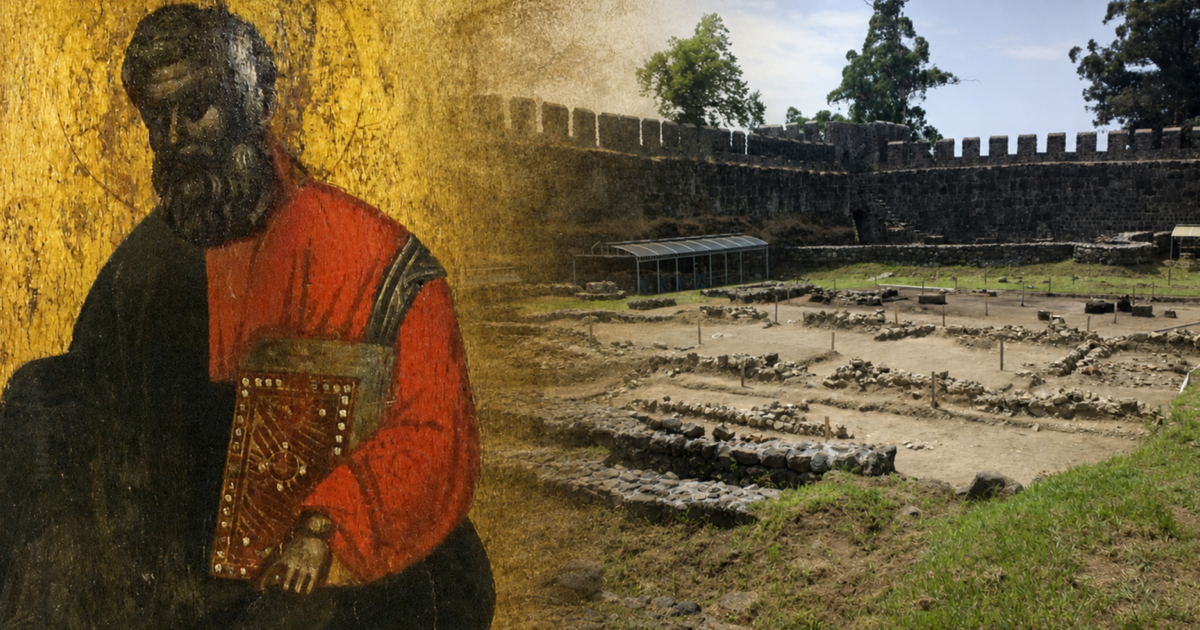
On the ninth day of August the Church commemorates the Holy Apostle Matthias, the disciple chosen by lot to take the place of Judas Iscariot among the Twelve. The choosing took place at Jerusalem, in the days between the Lord’s Ascension and the descent of the Holy Spirit, and it is the only notice that Holy Scripture gives of him. After that hour his name appears in no other book of the New Testament. Everything further that is known of his preaching and of his end comes from the Tradition of the Church and from late ecclesiastical historians, whose testimonies do not always agree with one another.
The years before the apostleship
The Synaxarion shows Matthias born in Bethlehem, of the tribe of Judah, and raised at Jerusalem, where from childhood he is said to have learned the Scriptures and the understanding of the Law from Saint Symeon, he who had received in his arms the Child brought to the temple. When the Lord went out to preach after the baptism in the Jordan, Matthias followed Him together with the others and was numbered first among the seventy apostles.
These particulars come from the Synaxarion and from the collections of the lives of the saints, not from any apostolic testimony. The tradition that numbers Matthias among the Seventy was nevertheless already known to Eusebius of Caesarea, who, in the Ecclesiastical History (I, 12), says first that the names of the Seventy have nowhere been preserved, and then adds that of Matthias and of Joseph Barsabas it is related that they had been counted worthy of the same calling. Eusebius therefore hands down a tradition, not a list. What the Acts of the Apostles truly guarantees is the antiquity of his discipleship, and the tradition of the Seventy settles naturally upon that antiquity.
The last choosing by lot recorded in the New Testament
The book of Acts sets the choosing of Matthias immediately after the Ascension, when the disciples had gathered in the upper room, about a hundred and twenty souls. The Holy Apostle Peter rose up in their midst and showed that the place left empty by the fall of Judas had to be filled, setting down at the same time the measure by which the choice was to be made: “Wherefore of these men which have companied with us all the time that the Lord Jesus went in and out among us, beginning from the baptism of John, unto that same day that he was taken up from us, must one be ordained to be a witness with us of his resurrection” (Acts 1:21-22).
The measure Peter utters concerns testimony: the one chosen had to have walked with the Lord from the Jordan to the Mount of Olives and to be able to bear witness to the Resurrection out of what he had seen. Of the inward worthiness of the two the assembly says nothing, but leaves it whole to Him who knows the hearts. The assembly set forward two men who fulfilled this requirement, Joseph called Barsabas, who was surnamed Justus, and Matthias, and prayed: “Thou, Lord, which knowest the hearts of all men, shew whether of these two thou hast chosen, that he may take part of this ministry and apostleship” (Acts 1:24-25). Then they cast lots, and the lot fell upon Matthias.
It is worth taking note that this is the last choosing by lot recorded in the New Testament. Saint John Chrysostom, in the third of his homilies on the Acts of the Apostles, plainly binds the use of the lot to the fact that the Holy Spirit had not yet descended. After Pentecost, Acts no longer shows such choices: at the appointing of the seven they pray and lay their hands upon them (Acts 6:6), while at the sending forth of Barnabas and Saul the choice is ascribed to the Spirit Himself (Acts 13:2-3).
This does not mean that the Church abandoned the lot for ever. It was kept for rare occasions, and the Moscow Council of 1917 used it in the election of Patriarch Tikhon, from among three candidates set forward beforehand.
One thing remains to be said: Peter did not ordain, nor did he appoint of himself. The assembly proposed, and God made manifest. No man takes this honour unto himself, but only he who is called of God (cf. Hebrews 5:4); and the choosing of Matthias shows from the beginning that ministry in the Church is not seized but received.
Why the number of the Twelve had to be filled
The apostolic company does not number twelve out of any practical reckoning. The number answers to the twelve tribes of Israel and shows that in Christ the new people is being built up, whole and undiminished. The Lord Himself had bound the Twelve to the twelve thrones of judgement (Matthew 19:28), and the Jerusalem above has twelve foundations, bearing the names of the twelve apostles of the Lamb (Revelation 21:14).
The fall of Judas left a gap in that foundation, and the gap was filled before Pentecost. When the preaching of the Church begins in the power of the Holy Spirit, the company of the Twelve is whole again. The betrayal of a single disciple could not diminish the Church.
The preaching and “outer Ethiopia”
The Synaxarion says of Matthias that he preached the Gospel in Judea, and afterwards in “outer Ethiopia,” where he endured torments of many kinds. This phrase has caused much misunderstanding, since the modern mind carries it at once to African Ethiopia. In ancient geography, however, the name was given also to the eastern lands of the Black Sea, and the Byzantines spoke of a Pontic Ethiopia, that is, of Colchis, in what is now western Georgia.
The Synopsis attributed to Dorotheus of Tyre — a late compilation, received with reserve by historical criticism — shows Matthias preaching in the interior of Ethiopia, at the mouths of the river Phasis, near the harbour of Hyssos, and falling asleep at Sebastopolis. Nicephorus Callistus Xanthopoulos, a historian of the fourteenth century, sends him first into Judea, then into that same Ethiopia bordering upon Colchis. Other Eastern testimonies bind him to Antioch of Syria, to Cappadocia, and to the shores of the Caspian.
In a considerable part of the Eastern tradition this “Ethiopia” has been understood not as the African country of today, but as the Pontic lands toward Colchis. If the identification is received, the testimonies concerning Ethiopia and those concerning Colchis point to the same region, and what seemed divided gathers toward the east of the Black Sea. It remains, nevertheless, an identification and not a proven fact: the traditions concerning the journeys of Matthias are late and unsettled.
One clarification is due here. The apocryphal writing called The Acts of Andrew and Matthias in the City of the Cannibals, preserved in Coptic and in Greek, is reckoned by scholarship a late composition, of the fourth or fifth century, without historical foundation. In its manuscript tradition the name wavers between Matthias and Matthew, which has increased the later confusion. It nourished much of the popular literature about this apostle, but the Church never received it among the sources of his life.
The martyrdom: sources that contradict one another
Concerning the end of Saint Matthias the sources do not agree among themselves, and this must be said plainly, not hidden beneath a single version.
One tradition, followed by the Greek and the Romanian Synaxaria, brings him back to Jerusalem, where he was seized and led before the Sanhedrin, under the high priest Ananias. Confessing there that the Crucified is the Son of God, he was condemned to be stoned and led out of the city. After he had given up his soul beneath the stones, his killers cut off his head with an axe, after the manner of Roman condemnation, so that their deed might take on the appearance of an execution against an adversary of Caesar. From this comes the axe with which Westerners sometimes depict him. The year the Synaxarion gives for his martyrdom is 63.
A second tradition, preserved chiefly among the Georgians, shows him crucified in Colchis and buried there.
A third, contained in the writing On the Twelve Apostles ascribed to Saint Hippolytus of Rome, says that Matthias fell asleep at Jerusalem in old age. That writing, however, is reckoned inauthentic and much later than the century of Hippolytus.
The Church commemorates him as apostle and martyr, and the service of the day sings his suffering. The place and manner of his end remain among the things that Tradition has not preserved with a single voice.
The relics and the places of veneration
In the East, the most living local tradition binds him to the fortress of Gonio, the ancient Apsaros, a few kilometres from Batumi, in Adjara. Within the Roman walls, still standing, the place reckoned to be the apostle’s grave is marked, honoured to this day with procession and Liturgy on the day of his commemoration.
In the West, an old tradition says that the relics were brought into Italy through the care of Saint Helena the Empress. Relics of Saint Matthias are claimed both at the monastery of Santa Giustina in Padua and at the abbey in Trier, in Germany, where they were found in the year 1127, on which occasion the abbey received the apostle’s name. These Western testimonies are late and were called into question as early as the seventeenth century by the Bollandists.
The name of Matthias and the writings ascribed to him
The silence of Scripture concerning Matthias was, from the second century onward, an open door for fabrication. Clement of Alexandria mentions in the Stromateis a writing called the Traditions of Matthias, which the Basilidians used; and Eusebius of Caesarea, in the Ecclesiastical History (III, 25), places a Gospel of Matthias among the rejected books, alongside the other heretical inventions.
This deserves attention, because it repeats itself throughout the history of the Church: where the apostolic source is silent, those hasten to speak who wish to cover their own teaching with a name worthy of credence. The heretics chose precisely the name of the apostle about whom Scripture says nothing further, reckoning that no one would be able to prove them liars. The Church rejected these writings because they did not stand within the apostolic tradition received and confessed in the Churches, and because they did not accord with the rule of faith; the name of an apostle set at the head of a writing was not enough to give it authority.
The apostle of whom Scripture says nothing further
With the verse that says the lot fell upon Matthias and that he was numbered with the eleven apostles (Acts 1:26), Scripture concludes all it had to say of this man. He received the Spirit at Pentecost together with the others, he preached, he suffered, he died; and none of this was written down.
The name of Judas the whole world has remembered. The name of Matthias has remained in the remembrance of the Church, inscribed for ever among the Twelve.
Here it may be seen that apostleship is not measured by how much of it has been preserved in writing. Matthias stood, like Peter, beneath the same hand of God, received the same tongue of fire, bore the same ministry; and of all his labour nothing has been kept for us but the hour in which God made him manifest. Whoever labours in the Church without being seen has in Saint Matthias an apostle who went before him along the same road.
Also commemorated on this day
On the ninth of August the Church also commemorates the Holy Martyrs Julian, Marcian, John, James, Alexis, Demetrius, Phocas, Peter, Leontius and Maria the patrician, who suffered in the eighth century under the emperor Leo the Isaurian for the icon of the Saviour at the Chalke Gate, together with the Holy Martyr Antoninus of Alexandria.
Troparion of the Holy Apostle Matthias, Tone 3:
O holy Apostle Matthias, entreat the merciful God to grant our souls forgiveness of sins.
Sources
- Acts of the Apostles 1:15-26
- Eusebius of Caesarea, Ecclesiastical History, I, 12 and III, 25
- Saint John Chrysostom, Homilies on the Acts of the Apostles, Homily III
- Clement of Alexandria, Stromateis, II, III, VII
- The Synopsis attributed to Dorotheus of Tyre
- Nicephorus Callistus Xanthopoulos, Ecclesiastical History, II, 40
- The Menaion for August, the ninth day
- Saint Demetrius of Rostov, Lives of the Saints, the month of August
Scripture quotations follow the Authorised Version.
Image: icon of the Holy Apostle Matthias, photograph by Gmihail, CC BY-SA 3.0 RS, and Gonio Fortress, photograph by Soghomon Matevosyan, CC BY-SA 4.0, via Wikimedia Commons. Adapted composite published under CC BY-SA 4.0.