
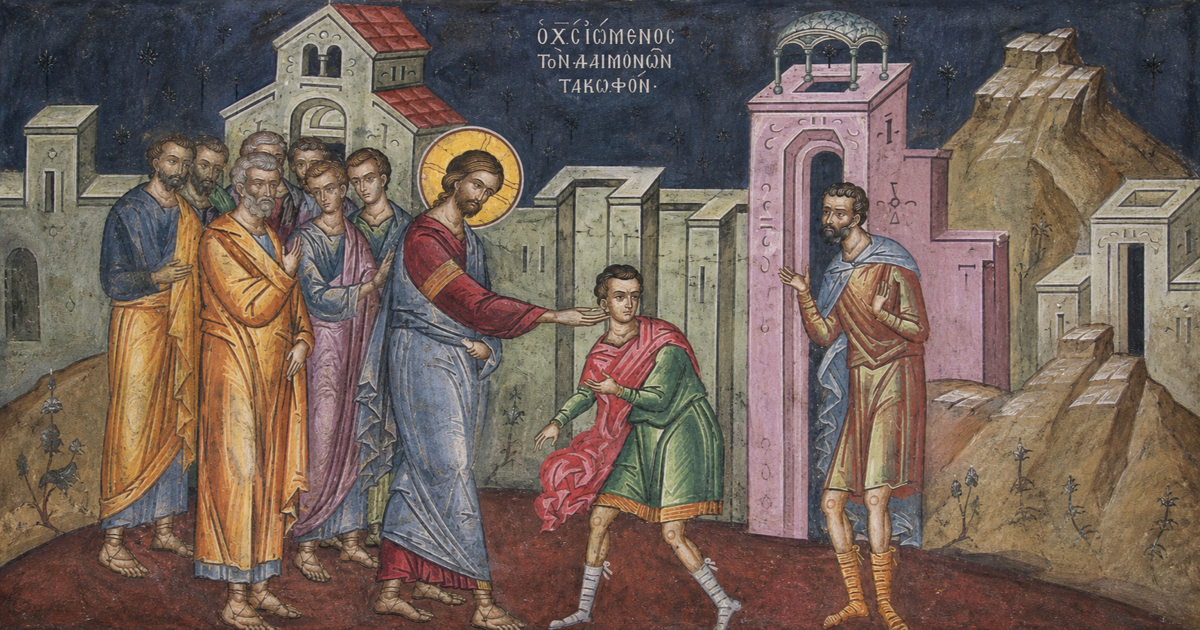
On the Tenth Sunday after Pentecost there is read at the Divine Liturgy the healing of a child whom the Gospel calls a lunatic (Matthew 17:14-23). The word renders the Greek σεληνιάζεται, “moon-struck,” the name the world of that time gave to an illness whose seizures returned at set intervals and which was thought to depend upon the phases of the moon. St. Matthew the Evangelist keeps the word that everyone was using, and in the lines that follow he shows what lay hidden beneath that name: an unclean spirit that threw the child into the fire and into the water.
This year the text is read on the ninth of August, between the feast of the Transfiguration and its leave-taking, and in the middle of the Dormition Fast. The feast stands at the very beginning of the chapter, and the fast in the word at the end of it.
The Descent from the Mountain
The pericope begins thus: “And when they were come to the multitude, there came to him a certain man, kneeling down to him” (Matthew 17:14). Those who were coming were Christ, Peter, James and John, who had just descended from the mountain where, a few lines earlier in the same chapter, they had seen His face shining as the sun. Below, a kneeling father was waiting for them, and the disciples who had accomplished nothing.
St. John Chrysostom observes that the weaker among the disciples had remained below, since the pillars — the three — were above, upon the mountain. The light of Tabor and the helplessness in the valley are written a few lines apart. These same men had earlier received power over unclean spirits (Matthew 10:1), and now they stand before a child whom they cannot help.
What “Lunatic” Means
The father is the first to speak the word: “Lord, have mercy on my son: for he is lunatic, and sore vexed: for ofttimes he falleth into the fire, and oft into the water” (Matthew 17:15). The Evangelist uses it once more, when he gathers together the multitude whom the Lord was healing at the beginning of His preaching (Matthew 4:24).
St. John Chrysostom stops here on purpose, lest the reader think that the Gospel accepts the belief of the age. The evil spirit strikes and releases according to the courses of the moon, he shows, not because the moon works anything, but so that the reproach may fall upon the creation of God; and simple men, deceived, came to call the spirit itself by that name. The Evangelist keeps the name the multitude gave, and then shows the true cause in this child.
The Father Who Complains
“And I brought him to thy disciples, and they could not cure him” (Matthew 17:16). This word is spoken before the multitude, and there is an accusation in it.
St. Mark the Evangelist, who tells the same thing at greater length, shows how little this man believed: “but if thou canst do any thing, have compassion on us, and help us” (Mark 9:22). Only after the Lord turns the word back upon him does the father cry out with tears: “Lord, I believe; help thou mine unbelief” (Mark 9:24).
The Lord’s answer does not fall upon the disciples: “O faithless and perverse generation, how long shall I be with you? how long shall I suffer you? bring him hither to me” (Matthew 17:17).
This rebuke has two edges. The first word, “faithless,” concerns faith. The second, “perverse,” renders the Greek διεστραμμένη, which means bent, twisted, and concerns the life. The same word stands also in the Song of Moses, where Israel in the wilderness is called “a perverse and crooked generation” (Deuteronomy 32:5, following the Greek of the Septuagint). The Lord pronounces over the multitude of that hour the judgment given to the generation that had seen the wonders and still had not believed.
St. John Chrysostom reads this word as an acquittal of the disciples before the multitude, and as a rebuke that turns chiefly upon the father, without naming him, so as not to shame him in the presence of so many; and for this reason the rebuke widens over the whole generation standing there. And in the question “how long shall I be with you?” the same Father sees that death was welcome to Him and His departure desired, since what was grievous to Him was not the Cross but His sojourning among them.
Two Rebukes of Unequal Measure
The disciples come apart and ask. St. John Chrysostom reckons that they came apart because they feared they had lost the grace entrusted to them, seeing that they had received power over unclean spirits.
The answer is short: “Because of your little faith” (Matthew 17:20). The word is not the one spoken a little before. To the multitude and to the father the Lord had said “faithless generation.” To the disciples He says something else: that they have faith, but little of it. The Greek here, ὀλιγοπιστία, indicates precisely the small measure.
This distinction, however, depends on the text that is followed. The Byzantine text reads here ἀπιστίαν, “because of your unbelief,” and St. John Chrysostom comments on this second reading; the Authorized Version and the New King James follow it, while the Revised Standard and the English Standard versions read “little faith,” as does the Romanian Synodal edition.
Power had been given them, yet the gift does not work by itself in a man, apart from the one who bears it. This concerns everyone who has received a gift from God and keeps it idle.
The Grain of Mustard Seed
“For verily I say unto you, If ye have faith as a grain of mustard seed, ye shall say unto this mountain, Remove hence to yonder place; and it shall remove; and nothing shall be impossible unto you” (Matthew 17:20).
St. John Chrysostom explains the seed itself: small to the eye, yet the strongest of all through the power that lies within it. The measure the Lord asks is not weighed. That seed grows because it is alive, and so also works the faith that has life in it, however small it may be.
The Gift and the One Who Bears It
Something remains to be said about the disciples’ question. They do not ask what will become of the child, but: “Why could not we cast him out?” (Matthew 17:19). Nowhere is it said that the disciples did not care for the child. What is said is what they asked, and their question concerned their own power. St. John Chrysostom, as was shown above, reads in it the fear of having lost the grace they had received.
The Lord had once before corrected this same disposition of heart. When the seventy returned and told Him with joy that the demons were subject to them in His name, He did not deny them the power, but showed them where they ought to rejoice: “Notwithstanding in this rejoice not, that the spirits are subject unto you; but rather rejoice, because your names are written in heaven” (Luke 10:20). The seventy were not the twelve, yet the latter had also received power over unclean spirits (Matthew 10:1; Luke 9:1), and the Lord’s word corrects a disposition found alike in both companies.
St. Paul the Apostle takes up the same image of the faith that moves mountains: “And though I have the gift of prophecy, and understand all mysteries, and all knowledge; and though I have all faith, so that I could remove mountains, and have not charity, I am nothing” (1 Corinthians 13:2). The gifts may be great, and he who bears them may remain, in himself, nothing.
“By Prayer and Fasting”
“Howbeit this kind goeth not out but by prayer and fasting” (Matthew 17:21).
The verse calls for a clarification. It is absent from several of the oldest Greek manuscripts, among them Codex Sinaiticus and Codex Vaticanus, and it stands in the Byzantine text, as also in the parallel place at Mark 9:29, where the manuscript tradition knows the same division. The Fathers expounded it as part of the Gospel, and the liturgical order preserves it. Some modern critical editions do not place it in the main text, while the Byzantine manuscript tradition keeps it.
St. John Chrysostom shows that by “this kind” is to be understood the whole company of evil spirits, and not only that which worked upon lunatics. And he also sets prayer before fasting. Fasting alone does not suffice; it lightens a man and makes him watchful, and the prayer of one who fasts rises without torpor. And to him whose body cannot bear a harsh fast, the same Father leaves a way: let him at least renounce the life of luxury, since nothing is more welcome to the evil spirit than luxury.
This word is read in the middle of the Dormition Fast. Fasting is not a device by which spirits are cast out. It humbles the body, wakens the mind and makes prayer more active; and He who casts out the spirits remains Christ.
The End of the Pericope
The Gospel does not stop at the healing. Immediately after it comes the second foretelling of the Passion: “And while they abode in Galilee, Jesus said unto them, The Son of man shall be betrayed into the hands of men: and they shall kill him, and the third day he shall be raised again. And they were exceeding sorry” (Matthew 17:22-23).
St. John Chrysostom takes note that the Lord often foretells His Passion alongside a great miracle, setting the one beside the other to lighten the sorrow of the disciples. Thus the end of the pericope is bound to its beginning. The Lord’s face had shone upon the mountain, the disciples had accomplished nothing in the valley, the child was healed from that very hour, and the last word speaks of the hands into which He was to be given.
What Can Be Done
The father came with what he had, and what he had was little. He brought the child, complained of the disciples before the multitude, and received a rebuke. From that very hour the child was healed. What had been lacking was not the power, but the faith that sets it to work. The steps this man took can be numbered, and they can be taken.
He came himself and he brought. He did not send word and did not let another go in his place. He who has a burden carries it himself before Christ, within the life of the Church: he confesses, he approaches the Holy Mysteries with the preparation required, he asks for Holy Unction for the one who is ill.
He knelt before he spoke. The Evangelist sets the kneeling before the request: the man draws near, falls upon his knees, and only then opens his mouth (Matthew 17:14-15). He knelt for his son, since it was not he who was ill, but the child. And he knelt before he believed, since the rebuke that follows catches him too within the faithless generation. The body bowed first, and faith was given him afterward, when he asked for it. The Christian who does not find his faith need not wait until he finds it; he has to do what that man did: bow and ask. So also he prays at home, at his prayer rule, when he kneels and makes prostrations, that the request may not remain in the mind alone.
He did not stop where nothing could be done. The disciples did not succeed, yet he did not leave; he remained until his burden had come before Christ. The powerlessness of a man of the Church is not the powerlessness of Christ, and it does not end the road.
He told the truth about himself. He did not prove his faith, but confessed that it was lacking and asked that it be given him: “Lord, I believe; help thou mine unbelief” (Mark 9:24). These words anyone can say, exactly as they are written.
He asked for the increase of faith. So did the apostles: “Increase our faith” (Luke 17:5), and the Lord answered them again with the grain of mustard seed (Luke 17:6). Faith is asked for, as every gift is.
He saw the worsening. In St. Mark the Evangelist, the child is torn and lies as one dead before he is raised up. St. John Chrysostom says that Christ permitted this for the father’s own sake, so that, seeing the spirit troubled at His mere call, he might be led toward faith. What worsens before a man’s eyes is not, of itself, a sign that Christ has withdrawn.
Prayer and fasting are not to be numbered among the things this father did; nowhere does the Gospel say that he fasted. The word concerning them the Lord speaks to the disciples, after they ask Him why they could not. It stands said, nevertheless, for everyone: faith is kept alive through prayer, and fasting serves it, wakening the mind and restraining the body. To him who cannot fast harshly, St. John Chrysostom leaves at least the renouncing of the life of luxury.
One thing more remains to be said. The end does not lie in the hand of the one who asks. This father received his child back from that very hour; it is not given alike to all, and the Gospel itself does not close with the healing, but with the Cross foretold and the disciples sorrowing. He who takes these steps does what that father did; what comes after them remains God’s.
Sources
- The Holy Gospel according to Matthew 17:14-23; Matthew 4:24; Matthew 10:1.
- The Holy Gospel according to Mark 9:14-29.
- The Holy Gospel according to Luke 10:17-20; Luke 9:1; Luke 17:5-6.
- Deuteronomy 32:5.
- The First Epistle to the Corinthians 13:2.
- St. John Chrysostom, Homilies on the Gospel of Matthew, Homily 57 (PG 58; English translation in Nicene and Post-Nicene Fathers, First Series, vol. 10).
- Scripture quotations follow the Authorized (King James) Version, except at Matthew 17:20, where the reading of the Romanian Synodal edition is given.
- Textual note: Matthew 17:20 reads ὀλιγοπιστίαν in the Alexandrian text and ἀπιστίαν in the Byzantine text.
- Textual note: Matthew 17:21 is absent from Codex Sinaiticus (ℵ*) and Codex Vaticanus (B); it is present in the Byzantine text and in the liturgical lectionary.
Image adapted for editorial use from “Christ Healing a Demoniac”, a fresco by Theophanes the Cretan, Dionysiou Monastery, 1547, public domain, via Wikimedia Commons.