
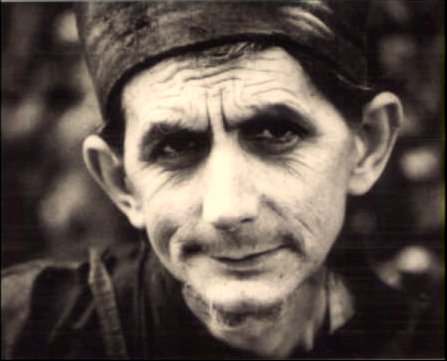
Hieromonk Ghelasie Gheorghe lived for thirty years at Frăsinei Monastery, in Vâlcea County, Romania, and died there on 2 July 2003. Frăsinei is a monastery for men, known for its strict rule. An older skete had stood on the site since the early eighteenth century, and St Callinicus of Cernica founded the monastery there, building its great church between 1860 and 1863.[1]
After 1990 this monastery became the source of a teaching that its author called “Carpathian hesychasm.” Hesychasm is the way of prayer of the Eastern Church: a person stills the mind from thoughts and calls unceasingly on the name of the Lord with the prayer “Lord Jesus Christ, Son of God, have mercy on me, a sinner.” Father Ghelasie set the name of the Carpathian Mountains beside this word and maintained that the Romanian lands had preserved, from ancient times, a hesychast tradition of their own, distinct from that of Sinai, of Athos and of the Slavic world.
After his death his disciples printed his complete works, wrote his life and composed akathists to him. Monks, priests, professors of theology, writers, actors and scientists have gathered around his name. This article sets out what he taught, how his teaching stands beside the prayer of the Holy Fathers, and what has grown from it to this day.
In this article
His life, as his disciples tell it
Everything we know about his life comes from those who loved him. The biography published on his disciples’ website says that he was born on 18 March 1944 in the village of Șerbănești in Vâlcea, as Gheorghe Teodor Popescu, into a family with several generations of priests.[2] He attended a nursing school in Cluj, and at about twenty-three he went to the mountains of the Râmeț Gorge, where he lived for some years near a hermit named Arsenie Praja. In 1973 he entered the brotherhood of Frăsinei.
The same biography records something unusual. Ghelasie had been tonsured a monk and ordained a priest before he came to Frăsinei, yet he lived there for almost twenty years as a simple brother, known as “Brother Gheorghiță.” In the early 1990s the then auxiliary bishop of Râmnic, Irineu Popa, today Metropolitan of Oltenia, restored him to priestly ministry. The biography on the disciples’ website does not say who ordained him. One of them, Father Mihai Deliorga, says it in his book Practica Iconică (The Iconic Practice), published by Platytera in 2026. Ghelasie was ordained on 21 June 1969 by “the non-canonical hierarch Evloghie Oța, the former abbot of Râmeț Monastery.”[3] Evloghie Oța had been abbot of Râmeț since 1940. After canonical disagreements with the Church, he passed over in 1954, together with his community, to the so-called “Romanian Orthodox Church of the East,” and its metropolitan, Galaction Cordun, consecrated him bishop.[4] Of the restoration in the early 1990s, Father Deliorga writes that Ghelasie then becomes “officially” a hieromonk. His wording also shows why Ghelasie lived for so many years as a simple brother: until then his priesthood had not been recognized.
In the footnote on the same page the author explains the restoration by economy (oikonomia). In times of persecution or schism, he writes, the Church has sometimes recognized ordinations performed outside the proper order, and the supreme criterion would have been “discerning the work of the Holy Spirit beyond formal limits” (pp. 35–36). The book does not say, however, in what way the restoration was carried out, nor does it mention any decision of the Synod, and we have found none. The canons of the Church exist precisely so that discerning the work of the Spirit is not left to each person.
The disciples also relate that before 1989 Ghelasie went with another monk of Frăsinei, Ioanichie, later an abbot, to the church of Drăgănescu, where Arsenie Boca was painting. Boca is said to have asked them: “Hey! Which of you is the priest?” and to have told Ghelasie: “You will stir up many spirits!” Later, when his books began to provoke opposition, Ghelasie remembered this word and regarded it as a prophecy fulfilled.[2] The incident was related by Ioanichie himself, at a seminar on Ghelasie held in Râmnicu Vâlcea in 2017.[3]
His first book, Memoriile unui isihast (Memoirs of a Hesychast), appeared in February 1991. In the preface the author warned his readers that many would see in it something new or an invention, and the most dogmatic “an aberration.” He asked them to read to the end and to pass over the contradictions, which he called more supposed than real.[2] Other volumes followed, among them Medicina isihastă (Hesychast Medicine), whose preface is dated November 1991.
Accounts of his death, taken up by the press as well, say that he departed to the Lord at prayer, with an icon on his chest, while a disciple was reading him the Akathist to the Protection of the Mother of God.[5] This is how the synaxaria tell of the end of the saints.
What he called “Carpathian hesychasm”
For Ghelasie, Frăsinei was a “little Carpathian Mount Athos.” His disciples keep his saying that this Carpathian character “is our character,” and that whoever ignores it contradicts himself.[2] They regard his writings as a “Carpathian Philokalia,” and in 2017 they printed the Memoirs of a Hesychast with exactly this subtitle.[6] The Philokalia is the collection of the writings of the Holy Fathers on prayer and watchfulness, read throughout Orthodoxy as a foundational book of the spiritual life. To place a “Carpathian Philokalia” beside it is to set the word of a monk of the last century alongside that of the Fathers.
In Chipul Omului (The Face of Man), a volume reissued by Platytera Publishing House in 2013, Ghelasie describes his tradition in detail.[7] He links it to the last high priest of Zalmoxis, the god of the ancient Getae of whom Herodotus writes. From him the tradition would have passed to a “Grandfather-Hermit” and then to a hermit named Neophytus, who would have lived in the tenth century in the Râmeț Gorge (p. 231, note 5). In the Memoirs of a Hesychast he also mentions a “Manuscript of the Neophytes,” which would have revealed to him a secret language (vol. 2, p. 5).
This genealogy does not come from any patericon. The idea of a Dacian religion that prepared the way for Christianity circulated widely in Romania in the 1970s and 1980s, encouraged by the communist regime through so-called protochronism and spread by the “Dacomania” of Iosif Constantin Drăgan. Earlier, in the 1930s, Vasile Lovinescu, a Romanian disciple of the French esotericist René Guénon, had written about a “Hyperborean Dacia,” the spiritual centre of a primordial tradition.[8] We do not know what Ghelasie read. His genealogy, however, resembles these ideas more than any life of a saint.
In the same book Ghelasie writes that the hermits of the Carpathians did not have the schools of Athos, Jerusalem or Russia, but rather “the tradition handed down by the blood of the place” (p. 330). As a young man he had read in the Philokalic writings about the prayer of the mind as St Gregory Palamas taught it. His elder hermit, however, did not practise the prayer of the mind but “the prayer of the icon” (p. 330). He kept the beginner away from much prayer, which, he says, would have stirred up “the demonization within him,” and gave him prostrations and bows instead. The prayer of the mind and of the heart he did not allow him at the first stage (p. 329). On p. 255 the author maintains that this tradition does not contradict the Philokalia. On the next page, however, he describes it as a Thraco-Dacian tradition without Sinaite asceticism, in which “the question of struggle with evil spirits did not arise” (p. 256). We know this teaching, attributed to the elder Arsenie Praja, only from Ghelasie’s books, which appeared eighteen years after the hermit’s death in 1973.
The order of the Church shows otherwise. In the eighteenth century the Jesus Prayer was renewed in the Romanian lands above all through St Paisius of Neamț (Velichkovsky), who had come from the Holy Mountain, gathered hundreds of monks around it and translated the writings of the Fathers on prayer. At Cernica, St George, a disciple of St Paisius, established the same rule. In the brotherhood of Cernica grew up St Callinicus, who, having become bishop of Râmnic, built Frăsinei. The fire of prayer at Frăsinei was thus kindled from the lamp of Athos, through the disciples of St Paisius. From the same rule were nourished, in the last century, St Cleopa of Sihăstria and Elder Arsenie Papacioc.
The Philokalia is, from beginning to end, a book about the struggle with thoughts. The Fathers teach that many of the thoughts that trouble the mind are cast in by demons, and that watchfulness means repelling them from the first moment by calling on the name of Christ. Of the passions Ghelasie writes that “we do not fight with them,” and that iconic practice excludes the struggle of the mind, putting worship in its place (p. 70). The tradition he claims, without the struggle against thoughts and evil spirits, has lost the very heart of hesychasm. Something similar happens with prayer. St Ignatius Brianchaninov also kept beginners away from the bodily method of the prayer of the mind, with its breathing and posture, but gave them from the start the Jesus Prayer, said slowly and with attention.[9] The elder in Ghelasie’s book, by contrast, held that lack of attention does not matter (p. 329), and in place of the prayer of the mind he set a “prayer of the icon,” which the Philokalia does not know.
Orthodoxy has had local traditions of ascetic struggle: Sinai, Athos, the Paisian school, the Russian elders. Each had its own emphases, but all said the same prayer and fought the same unseen warfare. Orthodoxy does not know, however, the mysticism of a nation, with a source of its own, separated from the Fathers. When the particular character of a people becomes the “character” of the spiritual life, the measure is no longer Christ, but blood and place.
“Hesychast Medicine”
Ghelasie’s most widely read book is Medicina isihastă (Hesychast Medicine), reprinted in 2017 by Platytera under the title Taina vindecării (The Mystery of Healing), edited by Florin Caragiu, with the copyright held by Frăsinei Monastery.[10] The pages cited below are from this edition.
Already in the preface Ghelasie knows that some accuse him of “a kind of Theosophy,” a Christian one (p. 13). Theosophy is an occult current that arose in the West in the nineteenth century, mixing Eastern teachings with speculation about subtle bodies and energies. The author rejects the accusation. Throughout the book, however, he uses the very vocabulary of these currents.
Here are a few examples:
- The human body would have three “openings,” and the author names them with the terms of occultism: “the so-called Mental-Astral Body” and “the so-called Etheric-Vital Body” (p. 34). He adds that, in the Christian view, the three are a single body. The terms, however, are those of Theosophy.
- Hesychast medicine should awaken in man “Cosmic Consciousness” (p. 29), and the body would be “the Energetic Aura of the Soul” (p. 44).
- The author writes that “the Paranormal through the Spirit stands out as an incontestable reality” (p. 46).
- The book starts from the pair of yin and yang in Chinese cosmology and adds a third term, “the Neutral,” because “in the Christian sense it must be a Trinity” (pp. 55–56). The author does not stop at a comparison: the whole physiology of the book rests on this triad, and “as the Physiology of Hesychast Medicine, Functionality is Trinitarian” (p. 60). The mystery of the Holy Trinity thus becomes the pattern by which a philosophy of energies is Christianized.
- The forbidden tree of paradise would have been “the Tree of Non-Living Food,” and the sin of the body would be the passage from living food to “dead” food (pp. 52–53).
- The sick are advised not to tear vegetables roughly, because plants would emit negative energy waves. A plant taken out of the ground must be left for twelve hours “to enter into Dormancy” and neutralize its radiation, and sprouted wheat must be left to dry again and “pass into a Dormancy,” so that chewing it does not lead to “the triggering of Killed Information” (p. 57). Ghelasie says that this “has also been discovered scientifically.” The discovery he refers to is, to all appearances, that of the American Cleve Backster, who in the 1960s connected plants to a polygraph. His idea spread through the book The Secret Life of Plants (1973), and his experiments could not be repeated by other researchers.[11]
- Confession appears in a chapter on psychoanalysis, as an advantage enjoyed by religious people when they search out their own hidden lies (pp. 42–43). The book addresses everyone, “regardless of religious convictions” (p. 26).
- The Jesus Prayer appears as well, as a healing technique. The sick person is urged to cry out the name of Jesus and listen to its echo, to the rhythm of inhalation and exhalation, for up to half an hour (pp. 123–124, 172). The prayer “Lord Jesus Christ, have mercy on me, a sinner” is to be pronounced with the vowels drawn out as long as possible, to cleanse the mind of thoughts and of “the Serpent-Microbes of Illnesses” (p. 180).
Chipul Omului completes the picture. There Ghelasie describes a fixed posture, with expansion of the chest, stretching of the limbs and straightening of the spine, and in a note he himself mentions the comparison with yoga (pp. 232, 241 and note 6). In the same book he prescribes unbaked hermit’s bread and raw or dried nettles, while baked bread and cooked food would make one ill (p. 242).[7]
A testimony from outside the books comes from his own family. The actor Florin Zamfirescu says that Ghelasie was “my cousin, older by some seven years,” and that he too grew up in a family of priests. Throughout his account he calls him “Doru,” the name used at home, a diminutive of Teodor. In a 2023 interview Zamfirescu recounted an evening spent at Frăsinei. Entering his cousin’s cell, he found him kneeling, facing east, “with his hands placed in the Diamond position,” motionless and with “the colour of a dead man on the bier,” so that he took him for dead. Colour returned to his cheeks only after a few minutes. Zamfirescu wondered whether his cousin had been “in a trance,” “in one of those meditations, he was in another world.” He also says that Ghelasie did not lie down in a bed for twenty-four years.[12]
Scripture says plainly that sin entered the world through one man, through his disobedience (Rom. 5:12, 19). Adam’s fall was the transgression of the commandment, not a passage to food without energy. St Basil the Great sees in the commandment of paradise the first law of fasting, and for him the fall lies in the commandment that was not kept.[13] The Lord teaches that it is not what goes into the mouth that defiles a man, but what comes out of the mouth, from his heart (Matt. 15:11, 18). The Apostle Paul calls doctrines of demons those that command abstinence from foods which God created to be received with thanksgiving (1 Tim. 4:1–3). The Apostle does not condemn fasting. He condemns abstaining from foods on the basis of a false teaching about them, and here the basis is precisely such a teaching: cooked food would carry death within it. The Church fasts with cooked food on most fasting days and has never regarded cooked food as poison. Her fasting humbles the body and bridles the passions. It does not look for living energies in leaves.
The desert Fathers also had strict rules of diet. They received them, however, through obedience, in community or under a guide, as an ascetic labour for humility, not as a science of energies. And the posture of prayer described by some Philokalic Fathers, with the head bowed and the breathing slowed, was a small tool in the service of calling on the name of Jesus. With Ghelasie the tool became a system, and within the system the Jesus Prayer itself has become a tool of healing. The comparison with yoga was made by the author himself.
Beneath the diet lies an anthropology. Ghelasie takes care not to say that the body is soul turned into energy. The body is not, he writes, “Soul transformed into Energies,” but “Energies of the Movement of the Soul” (p. 15). The following pages show, however, that the expression concerns the origin of the body, not merely its relation to the soul. Just as uncreated grace emanates from the movements of the Persons of the Trinity, so from the soul would emanate the energies that “become Body” (pp. 31–32). The energies of matter are called “Emanations” of the soul’s movement, and matter is a radiance of the soul, as grace is the radiance of God (p. 47). The body thus comes to be for the soul what uncreated grace is for God. The Church teaches otherwise. St Maximus the Confessor and St John of Damascus show that soul and body come into existence together, as parts of one and the same human nature, and that neither takes its being from the other.[14] The body does not emanate from the soul. It is God’s creation, called to resurrection as well.
From this anthropology the book’s teaching on healing also proceeds. Ghelasie writes that, however sick he may be, man is “in Essence” a “Perfectly Healthy One” (p. 30). He too speaks of a fall, but describes it as an addition, “Illusory and Unreal,” laid over a perfection that remains untouched: “There is nothing but Perfection” (p. 40). The first remedy would be “the Power of the Consciousness of Healing,” which “some call Faith” (p. 30). The Church also confesses that human nature has remained good, because God created it. The corruption brought by sin, however, is real. If imperfection were merely illusory, it would no longer need healing, only man’s awakening from illusion. Here Ghelasie’s conception parts ways with St Athanasius the Great. For him, the image of God in man was darkened by sin, and to renew it the Word Himself had to come. He likens the work to the restoring of a faded portrait: the one who was painted comes again, so that the likeness may be painted anew on the same board.[15] Man’s healing comes from Christ, through repentance and through the Mysteries of the Church.
What place, then, does the grace of God have in this healing? The book gives two answers. In the chapter on the power of healing, the first remedy is man’s consciousness that he is, at bottom, healthy, and faith itself would be this consciousness awakened in him (p. 30). In the last chapter the author writes that the healing of the soul cannot begin without grace and quotes the word of the Lord: “Without Me you can do nothing” (p. 259). There grace is placed as the first of three therapies, before the therapy of the soul and the energetic one.
The way the book speaks of grace, however, shows what grace is for it. Grace is called a “Semi-Substance” (p. 14) and “a Real Energy” (p. 262). During the breathing exercises the reader is to be aware that he is also breathing in “the Divine Energy of Grace” (p. 98). Elsewhere he is urged to charge himself at once with energies of grace and with the energies of his own soul (p. 172). Church services, holy water, holy oil and Holy Communion are called “Real Energetic Remedies of Grace” (p. 262), and Confession is the unloading of the conscience from “the Toxins of Sins” (p. 202). Grace thus becomes one energy among others, received like a medicine.
For St Gregory Palamas, whose vocabulary he borrows, uncreated grace is God Himself acting in man. It is given, according to God’s will, to the one who repents, and man cannot breathe it in with the air. Holy Communion is union with Christ Himself, with His Body and Blood.
Christ, too, has an unusual place in the book. The preface and the first ten chapters (pp. 9–61), where the author speaks of origin, fall, illness and living food, do not name Him. His name appears only from p. 76 onward. On p. 82 Ghelasie confesses that Christ took our sins upon Himself and that we cannot save ourselves. On the same page he adds that, in the same way in which Christ became incarnate, every child’s soul is created with the calling of “Saviour of Some Parents” (pp. 82–83). Scripture knows no other name under heaven by which we must be saved but the name of Christ (Acts 4:12).
What the fathers of that time said
Among the fathers who lived in those same years, the clearest word preserved is that of Elder Arsenie Papacioc. In the second volume of Ne vorbește Părintele Arsenie (Father Arsenie Speaks to Us), edited by Archimandrite Ioanichie Bălan of Sihăstria, a conversation between the two is recorded.[16]
Father Ioanichie asks what Father Arsenie thinks of the movement at Frăsinei, in which, he says, Orthodoxy is mixed with Buddhist ideas, with plants and with roots. Father Arsenie answers, laughing: “With grace-filled bread.” Of the book Father Ioanichie mentions he says that it is written in small print and cannot be read. After Father Ioanichie describes its content, Father Arsenie concludes briefly: “It is something mixed, Father.”
Later in the conversation, Father Ioanichie relates that the Dogmatics professor Dumitru Stăniloae, a few months before his death, spoke to him of seven grave cases in the Romanian Orthodox Church in which the Church ought to have taken measures. On the list, alongside Vladimirești and Pucioasa, was Ghelasie of Frăsinei.[16]
The disciples do not dispute the authenticity of the conversation. Florin Caragiu, the closest of them, reproduced the part about Father Arsenie on his blog in 2010 precisely in order to refute it, and there he also answered the word attributed to Professor Stăniloae.[17] His answer is discussed at the end.
What has grown from this teaching
After 2003 Ghelasie’s teaching did not remain a book read in secret. It became a current with publishing houses, journals, colloquia, monasteries and akathists. Each of those mentioned below answers for what he himself has said and done. We name them because, through their word and their position, they have given Ghelasie’s teaching the weight it has today.
The books. Platytera Publishing House in Bucharest, run by Florin Caragiu, has since 2003 been reissuing Ghelasie’s work in a series of “Complete Works,” in the “Hesychasm” collection.[18] Caragiu graduated in Mathematics and Theology in Bucharest and is a poet and essayist. In the “Chipul iconic” (The Iconic Face) collection appear volumes of studies that apply “Carpathian iconic hesychasm” to law, aesthetics, psychology and medicine.[2] The sixth volume of this collection, published in 2017, opens with a text by Archbishop Varsanufie of Râmnic, entitled “Avva Ghelasie of Frăsinei – a contemporary icon of Romanian hesychasm.” In the same volume Father Dan Popovici and Archimandrite Hristofor Bucur contribute studies.[6] Ghelasie’s writings have been translated into English, French and German, and the Memoirs of a Hesychast. Carpathian Philokalia were launched in 2017 with Prof. Dr Ionel Popescu, of the Faculty of Mathematics of the University of Bucharest, as special guest.[6] His connection with Ghelasie goes further back. In the commemorative volume of 2004, Părintele Ghelasie de la Frăsinei, Iconarul Iubirii dumnezeiești (Father Ghelasie of Frăsinei, Iconographer of Divine Love), Ionel Popescu, then a researcher in the mathematics department at MIT, gave testimony about the Father and gathered his sayings and counsels.[19] On 28 August 2022, Ziarul Lumina, the daily newspaper of the Romanian Patriarchate, published an interview with Florin Caragiu in which Ghelasie’s work is called one of the “great theological-mystical syntheses of Eastern Orthodoxy.”[20]
The people. Florin Caragiu presents himself as editor and coordinator of the journal Sinapsa, together with the priest Neofit Linte and the actor Dan Puric.[21] The archive of the journal, published between 2008 and 2012, is today on the website of Ghelasie’s disciples. There too, in the presentation of the Memoirs of a Hesychast, a text by Dan Puric is published, in which he writes that “Father Ghelasie’s Iconic Word has the power of the Gospel word.”[22] Archimandrite Hristofor Bucur, abbot of the Skete of St John the Baptist in Poiana Brașov, worked for ten years as an engineer and became a monk at Ghelasie’s urging. In a 2018 interview he said of him: “My chosen one... was Father Ghelasie.”[23] The former actor Dragoș Pâslaru, today Father Valerian, was his cell attendant in his last years.[5] In 2018, with the blessing of Archbishop Varsanufie, he founded the Monastery of the Holy Martyr Philemon, patron of actors, whose church was consecrated by the same archbishop in November 2024.[24] Metropolitan Serafim Joantă of Germany wrote a word of praise in 2004, in which he called him one of the most profound Romanian monks.[25]
The innermost circle. The most steadfast and best-prepared defenders of Ghelasie work around Platytera and the YouTube channel “Chipul Iconic,” which has more than thirteen thousand subscribers.
The monk Ieronim Pătrulescu, formerly a teacher under the name of Ion Pătrulescu, lives in seclusion near Oașa Monastery, in the mountains of Alba.[26] “Chipul Iconic” devotes to him a playlist of 111 videos, which opens with four conversations entitled “In memoriam Avva Ghelasie.” There, over the years, the monk Ieronim converses with Hieromonk Neofit, with Father Dan Popovici and with Fr Adrian Olteanu, and in 2024 he spoke at the seminar on Ghelasie at the Faculty of Theology in Sibiu. His conversations with Hieromonk Neofit have been printed in two volumes, made freely available on the disciples’ website. The cover text of the first volume, signed by Hieromonk Neofit, says that the book’s vision is indebted to Ghelasie’s legacy. The same text shows that hesychasm is set there in relation to “the metaphysical scheme of universal Possibility, of Guénonian esoteric expression,” which recurs often in the book. The second volume places hesychasm alongside the ternaries treated by René Guénon in The Great Triad.[27] Guénon (1886–1951) ended his life in Islamic Sufism, and his foundational idea is a “primordial Tradition” hidden beneath all religions. The cover texts call their approach apologetic, and their intention is, no doubt, the defence of hesychasm. The defence, however, is conducted willingly on Guénon’s ground, where the measure is no longer the Philokalia.
Father Dan Popovici, presented in 2026 as a hieromonk, signs the first study in the sixth volume of the “Chipul iconic” collection and has several series of conversations with the monk Ieronim. On 10 June 2026 he spoke at the symposium “The Mother of God in the work of Hieromonk Ghelasie of Frăsinei,” held at the Monastery of St Philemon. There he summarized a piece of advice from Ghelasie, connected with what he called “the Carpathian hesychast tradition of the hermit Neophytus”: a daily akathist read before the icon of the Mother of God, “even mechanically” and without knowing much about it, which would produce in a person the opening of the spirit needed for hesychast practice (min. 17:59–18:14).[28] The advice has its root in Chipul Omului, where the elder hermit tells his disciple that lack of attention and many thoughts do not matter, as long as the prayer is said strictly and at its appointed time (p. 329). The recording was made by Fr Costin Butnar, who published it on his channel, “Suflet Transilvan.”
The Fathers urge the beginner to pray even when he feels nothing. They do not promise him, however, that prayer done mechanically will produce of itself the opening of the spirit. The opening of the heart is a gift of God, received with repentance and attention, and grace does not descend because a recipe has been fulfilled.
The colloquia. The seminar “The Personality of Father Ghelasie Gheorghe of Frăsinei” was held at the Faculty of Orthodox Theology in Sibiu. According to one of its organizers, its purpose was also to bring the theological school of Transylvania closer to Ghelasie’s writings. Metropolitan Laurențiu Streza of Transylvania took part in its second edition.[29] At the third edition, on 6 November 2014, the guests included Fr Assoc. Prof. Dr Constantin Necula, of the same faculty, Fr Costin Butnar and Archimandrite Hristofor Bucur. Father Necula’s lecture is published by the disciples on their website.[30] In 2023 the seminar was held at the Brâncoveanu Monastery of Sâmbăta de Sus. In 2025 and 2026 the colloquia were held at the Monastery of St Philemon. At the colloquium of 9 May 2025, Fr Mihai Deliorga was introduced as “one of the Father’s disciples” and spoke about how he himself had understood Ghelasie’s writings. Fr Silviu Popescu, a priest of the Archdiocese of Sibiu, related there that he discovered Ghelasie in 2017 through Archimandrite Hristofor Bucur, and that Ghelasie had helped him “very much to understand Orthodox dogmatics.” Father Valerian also spoke at the same colloquium.[31]
The veneration. Platytera has published The Life and Akathist of Our Venerable Father Ghelasie Gheorghe, composed by Florin Caragiu. A priest, Sorin Benescu, has composed an “Akathist to Saint Ghelasie of Frăsinei.”[29] In the foreword to the Carpathian Patericon, Caragiu writes that the Father’s spiritual stature is seen ever more clearly as his holiness is revealed.[32] The secular press already calls him “the Venerable Ghelasie.”[5] Father Mihai Deliorga’s 2026 book calls him in its very title “the Venerable Ghelasie Gheorghe of Frăsinei.”[3] In the recording of the 2025 colloquium at the Monastery of St Philemon, an icon of Ghelasie, painted with a halo and called “the Venerable,” stands on the speakers’ table, with a lit lamp before it.[31] The Romanian Orthodox Church has not canonized him, and his name is not among the sixteen canonized by the Holy Synod in July 2024. No synodal decision has numbered him among the saints.
On the internet. The largest YouTube channel of the current bears the very name “Isihasmul Carpatin” (Carpathian Hesychasm). It has more than nine thousand subscribers and almost five hundred videos, and its description says that it wishes to be a living sacrifice offered in memory of “the Venerable Ghelasie.” Its creator writes of himself that he was born and grew up “in the shadow” of Father Ghelasie. Since 2020 the channel has published Sunday sermons, recordings of Ghelasie, new akathists and the series “Avva and the Disciple.” Its most-viewed video, Father Valerian’s testimony about Ghelasie, has more than one hundred and forty thousand views. On the same channel writings of Joseph Hazzaya are also read; he was an eighth-century mystic of the Syriac Church of the East, the Church called Nestorian. From that same milieu the Orthodox Church has received St Isaac the Syrian among the saints. Joseph Hazzaya she has not received, and his own Church condemned him in 786–787, at a synod held under Patriarch Timothy I, for Messalian tendencies. The Messalians, condemned as early as the fourth and fifth centuries, taught that Baptism does not drive out the evil dwelling in man and that only unceasing prayer casts it out and brings a perceptible experience of the Spirit; for this reason they diminished the worth of the Mysteries. We do not know precisely what was objected to in Joseph’s writings, and some scholars consider the accusation unjust.[33] On the channel he is nevertheless called “Avva,” and one of the recordings is a “prayer before Communion” composed by him. The prayer may be beautiful. It comes, however, from an author whom the Church has never received, and it is read before the Chalice. Alongside this channel work the channels “Chipul Iconic” and “Colocviile Părintelui Ghelasie” (Father Ghelasie’s Colloquia).[34]
The readers. Around Hesychast Medicine a wide readership has formed, especially among the sick and among those drawn to raw-food diets. The recipes circulate freely on the internet. Some readers testify that they came from yoga or other Eastern practices and that through Ghelasie they came to the Church. One of them relates that he found Hesychast Medicine on the shelf of a yoga library.[35] Their testimony is sincere. The question remains, however, whether a book that spoke to them in the language of the place they came from led them all the way to the prayer of the Fathers.
What has happened here resembles what happened at Prislop, around Arsenie Boca, where popular veneration came many years before the canonization decision of July 2024. In the history of the Church the devotion of the people has often gone before canonization, and this is not wrong in itself. Here, however, akathists are read to a man who has not been canonized, without any synodal inquiry having weighed his teaching. Hierarchs, faculties of theology and monasteries have given their word and their place to a teacher whom Elder Arsenie Papacioc considered “mixed” and whom, according to Father Ioanichie’s testimony, Professor Stăniloae had placed among the grave cases of the Church.
The thread that leads to Boca
The link between the two does not end with the meeting at Drăgănescu. In Chipul Omului, Ghelasie quotes Boca approvingly and builds on a saying of his about hormones his energetic scheme of the hands and of food (pp. 109, 119–120). In the same book he writes that we, the people of today, can no longer fight the passions (p. 119). Of Boca’s mass mysticism he says that it is effective, but that it risks becoming populist and even sectarian (p. 78).[7]
The two cases have the same shape. Each brought into the Church a language and a practice that the Fathers do not know, and each was venerated as a saint by admirers from every rank of the Church before she had given her judgment. Ghelasie stands today where Boca stood before July 2024. The “Arsenie Boca” series on this site examines the case of Prislop at length.
What the defenders answer
Ghelasie’s defenders have four arguments, and they deserve to be heard in their own words.
The first is set out by Florin Caragiu in his 2010 reply. He writes that Elder Arsenie Papacioc had heard about Ghelasie from others without having read his books, and that he admitted this to him personally. Of Professor Stăniloae he says that he acknowledged having read only a few pages.[17] The second argument concerns intention. The disciples say that Ghelasie used the language of Eastern currents in order to bring to Christ those who had gone astray in them. Metropolitan Serafim Joantă wrote that his writings are like a trap into which fall precisely those who look in them for occultism and syncretism.[25] The third argument is that of awkwardness. Archimandrite Hristofor Bucur acknowledged, in a letter published in 2004, that his teacher sometimes expressed himself awkwardly and resorted to poetic language where ordinary language did not suffice him.[36] The fourth argument is Ghelasie’s own. The disciples’ biography shows that, from his very first volume, he distinguished hesychast mysticism from the Eastern mysticisms of fusion and self-deification, and in Hesychast Medicine he rejects the charge of Theosophy.[2]
These arguments speak of the man, of his intention and of his language. The text, however, remains as it was printed. Whoever has not read the books can read them today, and the pages cited above are those of the edition prepared by the disciples themselves. A writer’s intention does not change what he wrote. The declarations of fidelity stand in the same books as the pages that say otherwise. An “astral” body and an “etheric” one, a triad in the image of the Trinity laid over yin and yang, a tree of paradise made of “non-living food” and a tradition that begins with the priest of Zalmoxis do not become Orthodox because the author meant well. And awkwardness of expression may be forgiven a man, but it cannot be printed as a Philokalia.
St Ignatius Brianchaninov advised those beginning the spiritual life to read only books written by saints whom the Church has recognized.[37] He distinguished two kinds of spiritual delusion (prelest). One inflames the imagination and brings visions. The other is quieter and harder to see: a person forms a high opinion of himself and of his labour, and his mind and heart are corrupted without any noise. For the second kind no visions are needed. A new language suffices, one that sounds deep and can no longer be measured against that of the Fathers.
Conclusion
The Romanian lands have had a true hesychasm, and it needs no other name than that of Christ. It was lived by St Paisius at Neamț, St George at Cernica and St Callinicus, the founder of Frăsinei. It was lived in the last century by St Cleopa, at Sihăstria and in the forests of Stânișoara, and by Elder Arsenie Papacioc, in his cell at Techirghiol. They sought no traditions hidden in the mountains and no energies in leaves. They said the Jesus Prayer in obedience, went to confession, received Communion and fought with their thoughts to the end.
Whoever wishes to pray as they did needs a spiritual father, the Liturgy and the name of the Lord, called upon with humility. This is the path walked by all the saints of the East, from Sinai to the Carpathians. We too are called to walk it.
Notes and sources
“Frasinei Monastery,” discover-valcea.com (the old skete, with its wooden church of 1710, rebuilt in stone in 1762–1763; the great church of St Callinicus, 1860–1863). ↩
“Biografie,” the disciples’ website Chipul Iconic (chipuliconic.ro/biografie). Dates of birth and death, the school in Cluj, the years near the hermit Arsenie Praja, entry into Frăsinei (1973), the almost 20 years as “Brother Gheorghiță,” restoration to the priesthood by Irineu Popa, the meeting with Arsenie Boca at Drăgănescu, the preface to the Memoirs of a Hesychast (February 1991), the phrase “little Carpathian Mount Athos,” the “Carpathian Philokalia,” the “Chipul Iconic” collection. ↩ ↩ ↩ ↩ ↩ ↩
Fr Mihai Deliorga, Practica Iconică. Metoda duhovnicească a Cuviosului Ghelasie Gheorghe de la Frăsinei, Platytera, Bucharest, 2026, p. 32 and note 14 (the 1969 ordination), p. 35 and note 22 (the restoration and economy; the note continues on p. 36), p. 36 and note 24 (the meeting at Drăgănescu, related by Abbot Ioanichie at the seminar in Râmnicu Vâlcea, 27 May 2017). ↩ ↩ ↩
“Prea Sfinţitul Evloghie Oţa,” Râmeț Monastery group on crestinortodox.ro (12 August 2011); “Lăcașuri de cult nr. 1,” catacombeleortodoxiei.ro (biography of Evloghie Oța: Athos 1922–1940, the abbacy of Râmeț, the 1954 move, consecration as bishop by Galaction Cordun, sentence to forced labour). ↩
Antena 3, “Patru sfaturi pentru o viaţă liniştită de la părintele Ghelasie de la Frăsinei,” 15 November 2022, after crestinortodox.ro (death at prayer; Father Valerian, cell attendant; the title “the Venerable”). ↩ ↩ ↩
The blog “Părintele Ghelasie Gheorghe de la Frăsinei,” run by Florin Caragiu (ghelasiegheorghe.blogspot.com), October 2017: contents of the volume Chipul iconic. Crochiuri antropologice, vol. VI, Platytera, 2017 (text by Archbishop Varsanufie, p. 5); the launch of Memoriile unui Isihast. Filocalie Carpatină, vols. 1–2, Platytera, 2017. ↩ ↩ ↩
Ghelasie Gheorghe, Chipul Omului, ed. Florin Caragiu, Platytera, 2013, pp. 70, 78, 109, 119–120, 231 (note 5), 232, 241 (note 6), 242, 255–256, 329–330; idem, Memoriile unui isihast, vol. 2, Platytera, p. 5. ↩ ↩ ↩
On protochronism: Edgar Papu, “Protocronismul românesc,” Secolul 20, 1974; Iosif Constantin Drăgan, Noi, tracii. Vasile Lovinescu, “Dacia hiperboreeană,” published in Études Traditionnelles (1936–1937) under the pseudonym Geticus. ↩
St Ignatius Brianchaninov, Ascetical Experiences, vol. I, the writings on the Jesus Prayer. ↩
Hieromonk Ghelasie Gheorghe, Taina vindecării: Medicina isihastă, ed. Florin Caragiu, Platytera, Bucharest, 2017, ISBN 978-973-1873-69-5, © Holy Monastery of Frăsinei, pp. 6, 13–17, 26, 29–32, 34, 40, 42–44, 46–47, 52–53, 55–57, 60, 76, 82–83, 98, 123–124, 172, 180, 202, 259, 262 (PDF published by the disciples on chipuliconic.ro). ↩
Peter Tompkins and Christopher Bird, The Secret Life of Plants, 1973 (on Cleve Backster’s experiments); for the failed attempt to replicate them: K. A. Horowitz, D. C. Lewis, E. L. Gasteiger, “Plant ‘Primary Perception’,” Science 189 (1975). ↩
YouTube, Luis Lazarus channel, “Maestrul Florin Zamfirescu scandalizat de incompetenții care ne conduc!!!”, 25 July 2023, min. 1:09:04–1:09:26 (the kinship and the family of priests), 1:10:49 (“Doru”), 1:16:21 (the bed), 1:16:49–1:18:23 (the incident in the cell). ↩
St Basil the Great, First Homily on Fasting, 3–4. ↩
St Maximus the Confessor, Ambigua 42; St John of Damascus, Exact Exposition of the Orthodox Faith II, 12. ↩
St Athanasius the Great, On the Incarnation of the Word, 13–14. ↩
Ne vorbește Părintele Arsenie, vol. II, edited by Archim. Ioanichie Bălan, Sihăstria Monastery Publishing House (2004 ed.). The part about Father Arsenie is reproduced by Florin Caragiu (note 17); the continuation, with the list attributed to Professor Stăniloae, is quoted from the same volume in a comment by the editors of RazboiIntruCuvant (2008), republished on saccsiv.wordpress.com on 8 August 2010. ↩ ↩
Florin Caragiu, “Răspuns de apărare,” blog Florin Caragiu, 7 March 2010 (florincaragiu.blogspot.com/2010/03/raspuns-de-aparare.html). ↩ ↩
Florin Caragiu, “Cuvânt înainte” (Foreword) to Taina vindecării; Rețetele medicinii isihaste, vol. 7 of the Opere complete series, Platytera (PDF on chipuliconic.ro). ↩
Părintele Ghelasie de la Frăsinei, Iconarul Iubirii dumnezeiești, Platytera, 2004, pp. 188–200: “Despre Părintele Ghelasie – Mărturii” and “Din zicerile, sfaturile și cugetările Părintelui Ghelasie,” gathered by Ionel Popescu (reproduced on chipuliconic.ro, 29 June 2017). ↩
Fr Ioniță Apostolache, “Părintele Ghelasie Popescu, isihastul de la Frăsinei,” interview with Florin Caragiu, Ziarul Lumina, 28 August 2022. ↩
Author profile on Florin Caragiu’s blogs (florincaragiu.blogspot.com; ghelasiegheorghe.blogspot.com). ↩
chipuliconic.ro: “Memoriile unui isihast Vol 1” (30 June 2017), text signed by Dan Puric; archive of Revista Sinapsa, nos. I–X (2008–2012), chipuliconic.ro/revista-sinapsa. ↩
Interview with Archim. Hristofor Bucur, Formula AS, 2018; Trinitas TV broadcast, 2025. ↩
basilica.ro, “A fost sfințită Biserica Mănăstirii «Sf. Filimon», înființată de un fost actor devenit călugăr,” 6 November 2024. ↩
Metropolitan Serafim Joantă, in Avva Ghelasie, Cuvântătorul de Dumnezeu, Platytera, Bucharest, 2004, pp. 6–10 (English translation on iconicrenaissance.blogspot.com, 27 April 2010). ↩ ↩
chipuliconic.ro: “O întâlnire revelatorie cu Părintele Monah IERONIM Pătrulescu din Oașa” (3 October 2026); “Turnul Babel și încâlcirea graiului – prof. Ion Pătrulescu” (19 July 2021). ↩
YouTube, “Chipul Iconic” channel, playlist “Ieronim Monahul” (111 videos): “In memoriam Avva Ghelasie – Monah Ieronim Pătrulescu” (I–IV); “Seminar dedicat Părintelui Ghelasie, Sibiu 2024, Facultatea de Teologie – Ieronim Monahul” (3 June 2024); “Ieronim monahul, pr. Adrian Olteanu, Neofit ieromonahul – Preambul: Isihasm/metafizică mistică” (5 November 2024), with the cover texts of the volumes Convorbiri I–II in the description. ↩
Hieromonk Dan Popovici, “Avva Ghelasie, Maica Domnului și isihasmul,” symposium “Maica Domnului în opera Ierom. Ghelasie de la Frăsinei,” Monastery of the Holy Martyr Philemon, 10 June 2026; filmed by Fr Costin Butnar, YouTube channel “Suflet Transilvan,” published 19 June 2026 (youtu.be/5VFdXgKnGSs), min. 0:06, 13:31, 17:59–18:14. ↩
Reports on basilica.ro (the Sibiu seminar, the participation of Metropolitan Laurențiu Streza), Ziarul Lumina (2022), recordings of the colloquia at the Monastery of St Philemon (9 May 2025; 2026); Florin Caragiu, Viața și Acatistul Preacuviosului Părinte Ghelasie Gheorghe, Platytera; Fr Sorin Benescu, “Acatistul Sf. Ghelasie de la Frăsinei.” ↩ ↩
YouTube, “02 Pr. Constantin Necula – Seminarul dedicat Părintelui Ghelasie – Sibiu 2014” (description: third edition of the seminar “Personalitatea Părintelui Ghelasie Gheorghe de la Frăsinei,” 6 November 2014, list of guests and words of the organizer, Assoc. Prof. Dr Liviu Bogdan Vlad); republished on chipuliconic.ro, 9 August 2017. ↩
YouTube, “Chipul Iconic” channel, 10 May 2025, “Colocviu dedicat Părintelui Ghelasie Gheorghe, Mânăstirea Sf. M. Filimon, Vâlcea, 9 mai 2025”: “Pr. Mihai Deliorga – Colocviu, Mânăstirea Sf. Mc. Filimon, 2025” (min. 0:13); “Pr. Popescu Silviu – Colocviu, Mânăstirea Sf. Mc. Filimon, 2025” (min. 0:01–1:25; the icon is visible throughout the video). ↩ ↩
Florin Caragiu, “Despre Avva Ghelasie – Cuvânt înainte la Patericul carpatin,” ghelasiegheorghe.blogspot.com, 16 October 2017. ↩
“Yawsep Ḥazzaya,” Gorgias Encyclopedic Dictionary of the Syriac Heritage (electronic ed., gedsh.bethmardutho.org): condemned by the synod of Patriarch Timothy I (786–787) for Messalian tendencies. ↩
YouTube: the “Isihasmul Carpatin” channel (@IsihasmulCarpatin; channel description, the playlists “Avva și ucenicul” and “Predici Ortodoxe” 2020–2026, the videos on Joseph Hazzaya), the channels “Chipul Iconic” and “Colocviile Părintelui Ghelasie”; figures consulted on 7 November 2026. ↩
Signed readers’ comments on the article of 8 August 2010 on saccsiv.wordpress.com, “Ieromonahul Ghelasie Gheorghe un înșelat…”. ↩
Letter of Archim. Hristofor Bucur in Părintele Ghelasie de la Frăsinei, Iconarul Iubirii dumnezeiești, Platytera, 2004, pp. 139–142. ↩
St Ignatius Brianchaninov, Ascetical Experiences, vol. I (on the reading of books); idem, “On Prelest.” ↩
