
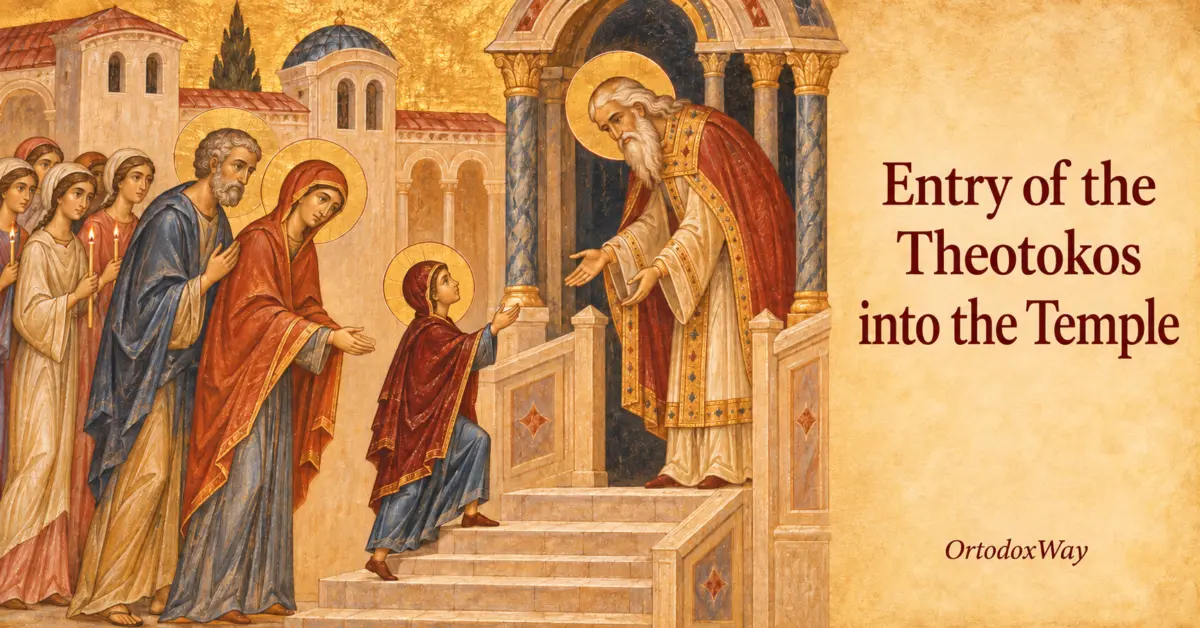
On 21 November, the Orthodox Church celebrates the Entry of the Most Holy Theotokos into the Temple. On this day we remember how the Virgin Mary, at the age of three, was brought by her parents, Joachim and Anna, to the Temple in Jerusalem and left there, so that she might grow up in the house of God. The Temple was the place of worship for the whole people of Israel, and the hymns of the feast call it "the temple of God"; from this the feast takes its name.
The Holy Gospels do not tell of this beginning of the Mother of God's life. The Church has kept it in Holy Tradition, in the Synaxarion of the day (the short account of the feast read at the services) and in the hymns she has sung on this day for more than a thousand years. Whoever hears the account almost always stops at the same thought: how could a little girl of three climb the steps of the Temple and remain there, far from her mother and father?
In this article
What took place
Joachim and Anna lived for many years without children. In Israel, childlessness was borne as a shame, as though God had withdrawn His blessing from that house. The two prayed for a long time and promised that, if God gave them a child, they would dedicate it to Him. Saint Cleopa of Sihăstria renders their prayer thus: "Lord, if You give us a child, we will dedicate it to Your Temple for all its life."
God heard them, and Mary was born. The oldest account of her childhood, on which the hymns of the Church have drawn, says that when the girl was two, Joachim wished to fulfil the vow. Anna asked him to wait one more year, so that the child would no longer seek her father and mother. When she turned three, Joachim called pure virgins from among the daughters of the Hebrews and asked them to walk before her with lighted lamps, so that the child would not turn back and her heart would not be drawn away from the house of the Lord.
Tradition says that fifteen steps led up to the Temple and that the Levites sang a psalm on each step. These psalms have remained in the Psalter under the name "Songs of Ascents".1 Her parents wanted to lead her up by the hand, but the child, says Saint Cleopa, slipped from their hands and "began to climb all the steps like an innocent dove", and the priests marvelled at how so small a child could climb.
At the top Zacharias was waiting, he who would become the father of Saint John the Forerunner, and whom the hymns of the feast call "the great high priest". Zacharias received her, blessed her and, enlightened by God, did something that had never been done: he led her into the Holy of Holies. The Holy of Holies was the innermost chamber of the Temple, separated from the rest by a heavy curtain, which Scripture calls the veil. Only the high priest entered it, once a year, on the day of the people's atonement, and only with the blood of the sacrifice.2 There a three-year-old child was brought.
The Synaxarion says that the Virgin remained in the Temple for twelve years and that she was fed with heavenly food by the Archangel Gabriel. Joachim and Anna returned home without the child they had waited for their whole lives.
How could a three-year-old part from her parents?
The Tradition of the Church does not hide how hard this was. Anna asked to wait another year because she knew that a two-year-old cries for its mother. Joachim placed virgins with lamps before the girl because he knew that a child may turn back on the way. This account does not show us a heartless child, nor parents who were glad to be rid of a burden. It shows people who felt the full weight of the parting and who, for that very reason, prepared it with care and with prayer.
And yet what the parents feared did not happen. Saint Gregory Palamas, who preached homilies on this feast, says that the Virgin left behind the choir of virgins around her, went ahead of them all, and went to the high priest entirely alone and full of joy. In another homily on the same feast he adds that she was not so much brought to the Temple as she herself entered the service of God, and that she, more than the others, determined what was done for her. She went of her own will, as if she had wings, drawn by a holy love.
Here lies the key to the question. The grace of God worked in this child beyond the measure of her age, but it did not work without her. The child's will was already wholly turned towards God, and grace strengthened her to do what she willed. The Virgin had been born of prayer and had grown up in the home of parents for whom God came first, and her pure heart recognised in the Temple the house in which she was called to dwell.
There is something more, which the Saviour Himself reveals to us. He said: "Whosoever shall not receive the kingdom of God as a little child, he shall not enter therein."3 What seems almost impossible to a grown man, a child does with simplicity, because his heart is not yet divided. Parting from things and people pains us because we love many things at once and do not want to lose anything. The Gospel read at this feast speaks of exactly this division of the heart: the Lord says to Martha, who was troubled with serving, "Martha, Martha, thou art careful and troubled about many things: but one thing is needful: and Mary hath chosen that good part, which shall not be taken away from her."4 The three-year-old already had this "one thing". That is why she could climb the steps without looking back.
The Church has seen the Virgin in the words of the psalm: "Hearken, O daughter, and see, and incline thine ear; and forget thy people, and thy father's house. Because the king has desired thy beauty."5 Saint Cleopa brings this verse precisely when he speaks of her entry into the Holy of Holies. The forgetting the psalm speaks of does not mean that the Virgin did not love her parents. The Church honours Joachim and Anna as "the holy and righteous ancestors of God" and commemorates them at the end of every Liturgy. This forgetting means that love for her parents could no longer hold her back on the way to God, as the Lord would later tell His disciples: "He that loveth father or mother more than me is not worthy of me."6 She did not lose her parents; she gained the heavenly Father, into whose hands Joachim and Anna entrusted her.
The wonder of the child cannot be separated from the wonder of her parents. Blessed Theophylact of Ohrid says that Joachim and Anna brought Mary to the Temple as a gift returned to God, who had given her to them. They did what another Anna — Hannah, the mother of the prophet Samuel — had done a thousand years before. She too had been barren, had prayed with tears at the tabernacle of the Lord and had promised that, if she had a son, she would give him to the Lord. After she had weaned Samuel, she took him to the priest Eli and left him there for all the days of his life.7 But Joachim and Anna gave more: they gave their only child, received in old age after long years of waiting. A child who does not look back usually grows up in a home where the parents too have learned not to look back.
Joachim and Anna had learned this in their long years of waiting. They could have kept the child by their side, told themselves that God would understand their wish to enjoy her in their old age, and put off the vow from one year to the next. Instead they kept their eyes on the One who had given them the child and gave her back to Him. The little girl climbed the steps with her eyes forward because that is how she had seen her parents look. A child learns where to look above all from the eyes of those who raise it.
Scripture also keeps the image of the one who looked back. When God decided to punish the city of Sodom for its iniquities, two angels led the righteous Lot out of it, together with his wife and daughters, and commanded them to flee without looking back. On the way, Lot's wife looked back and became a pillar of salt.8 Her feet had left Sodom, but her heart had stayed there. Christ the Lord gave her as an example to all: "Remember Lot's wife."9
Looking back turned Lot's wife to stone in the very moment she looked. She remained forever turned towards what she had left, motionless, unable to take another step. This is the state of the soul that keeps looking back, towards the sins, habits and pleasures from which God wanted to bring it out: it stops growing, hardens into what it was and no longer changes. The glance of Lot's wife was not a mistake of a moment: it revealed an attachment she had long carried in her heart. The choices a man makes again and again become, in time, a kind of second nature, from which he can no longer escape by himself. Yet as long as a man lives, his gaze can turn once more towards God. Repentance is precisely this turning, through which grace breaks the hardness of the heart and opens again the way of ascent. I have written at length about this hardening, and about the grace that can break it, in the article Why Does Man Not Change? Lot's Wife and the Mystery of the Hardened Soul.
The same law also works upwards. The child who, from her earliest years, chose prayer and stillness before God day after day was making of this choice a nature turned towards Him. On the steps of the Temple she shows the other way. She climbs, and every step takes her higher than the one before. The Apostle Paul describes the same path when he writes that, "forgetting those things which are behind, and reaching forth unto those things which are before", he presses towards the mark.10
God made man in His image and after His likeness.11 Saint John of Damascus explains that "in the image" means the mind and free will that man received, while "after the likeness" means likeness to God through virtue, as far as is possible for man. The image was given to us at creation; the likeness we acquire by walking. Saint Gregory of Nyssa taught that man's perfection lies in this very growth in goodness that never stops, because God, towards whom he ascends, is without limit. The man who keeps his gaze on God is changed, little by little, after the image of the One he looks upon. The Apostle says it plainly: "But we all, with open face beholding as in a glass the glory of the Lord, are changed into the same image from glory to glory."12 This is the ascent the Virgin began on the steps of the Temple, and which every Christian begins who no longer turns back towards what he has left.
Why the Holy of Holies
Saint Cleopa explains why Zacharias broke so strict a rule: being a prophet, he saw that this child would carry within her the One who dwells in the Holy of Holies, and therefore "this child is holier than the Holy of Holies". The holiest place made by human hands received into itself the living temple which God Himself was preparing for Himself.
This is the meaning sung in the kontakion of the feast: "The most pure Temple of the Saviour, the precious Bridal Chamber and Virgin, the sacred Treasure of the glory of God, is presented today to the house of the Lord. She brings with her the grace of the Spirit; therefore the angels of God praise her: Truly this woman is the abode of heaven." The Virgin is called here temple, bridal chamber and treasure, because in her the Son of God was to dwell when He became man. Saint John of Damascus writes that she grew up in the house of God, nourished by the Holy Spirit, and was shown to be a holy and wondrous temple, worthy of God Most High.
The troparion of the feast says: "Today is the prelude of the good will of God, of the preaching of the salvation of mankind. The Virgin appears in the temple of God, in anticipation proclaiming Christ to all. Let us rejoice and sing to her: Rejoice, O Fulfilment of the Creator's dispensation." A prelude is the sign given beforehand, like the first lines of a book, from which one understands what is to follow. The Entry of the Virgin into the Temple shows that God's eternal counsel for the salvation of mankind is drawing near to its fulfilment: He who decided from all eternity to become man is now preparing His dwelling in their midst. That is why, from this feast onward, the Church begins to sing at Matins the katavasias of the Nativity: "Christ is born, glorify Him!" Saint Theophan the Recluse observed that through these hymns the faithful are prepared to meet the feast of Christ's Nativity worthily.
After the fall, paradise had been closed to man. In the same way, under the order of the Old Law, entry into the Holy of Holies was barred, and the veil that covered it showed that fallen man still needed reconciliation with God, which Christ alone would bring. When Christ died on the Cross, the veil of the Temple was torn in two from top to bottom, and the Apostle Paul writes that we now have boldness to enter into the Holy of Holies by the blood of Jesus, "by a new and living way" which He has opened for us.13 Blessed Theophylact says that Christ, having cleansed us with the water of Baptism and with the Holy Spirit, receives us into the Holy of Holies, and that this is why He now receives the Virgin into the Temple. The child who enters through the closed door foretells the way to God that Christ would open to all who believe in Him.
What the Virgin did in the Holy of Holies
Saint Gregory Palamas, who before becoming Archbishop of Thessalonica lived for many years in prayer and stillness on Mount Athos, wrote about the Virgin's years in the Temple with particular insight. He says that the Mother of God withdrew from people from the very beginning of her life and chose to live unseen by anyone, within the holy sanctuary. There she gathered her mind within herself, with attention and unceasing prayer, and found holy stillness as her guide towards God.
Stillness, which the Fathers call by the Greek word hesychia, means here the halting of the mind from its running after the things of the world. Saint Gregory describes it as a forgetting of the things below, an initiation into heavenly mysteries and a laying aside of the mind's images for something better. He teaches that man is deified not by reasoning and by observing the world, but by the vision of God, to which stillness guides him. Stillness, however, is not a technique by which man could compel God to show Himself. It is the humble placing of the soul before Him, and the vision of God remains a gift of grace, given to the purified heart. In this way Saint Gregory presents the Virgin Mary as the perfect model of the hesychast life, of the mind gathered in prayer and of union with God by grace.
He also interprets the food brought by the angel. The angel came every day with the Virgin's food, and this food showed the heavenly life she led on earth and the reward for her disdain of passing pleasures. The Church does not probe this mystery with curiosity; she honours it and follows it.
What the Christian must understand and do
We too are a temple
The Apostle Paul writes: "What? know ye not that your body is the temple of the Holy Ghost which is in you, which ye have of God, and ye are not your own?"14 At Baptism each of us was brought into the Church, most of us as infants, carried in the arms of others, just as the Virgin was brought. What she did in the Holy of Holies we are called to do in the temple of our heart: to keep it clean, to fill it with prayer and not to let the world enter it as into a marketplace. Saint Theophan the Recluse urged that, in the fast that prepares for the Nativity of the Lord, the Christian should go to confession and receive Holy Communion, so that the feast should not remain foreign to him and God's coming in the flesh might become a joy he truly lives.
Parents and children
Joachim and Anna did not wait for their daughter to grow up and decide for herself whether she wanted to go to the Temple. They brought her at three, and the grace of God found good soil in her. Many parents today say they do not want to "burden" their children with the Church and that they will let them choose for themselves when they are grown. But a child grows from what he sees at home: if he sees his parents put the Sunday Liturgy before everything else, his heart learns that God comes first. I have shown in another article how few Christians actually go to church: about one child in a class of thirty (How Many Orthodox Actually Go to Church?). Today's feast shows parents that age is no obstacle to grace, and that a child brought to church from an early age can carry all his life the light he received there.
Not looking back
Joachim placed virgins with lighted lamps before the little girl so that she would not turn back on the way. The Lord says to us too: "No man, having put his hand to the plough, and looking back, is fit for the kingdom of God."15 The man who has begun to walk towards God is pulled back by old habits, by his cares and by the world he has left. If he lets himself be pulled, he hardens like Lot's wife. The Church lights lamps for us too, which go before us: the services, the fasts, the feasts, the lives of the saints and the example of those who have walked this way before us. The fast we are now in is one of these lamps. Whoever keeps his eyes on them climbs the steps without turning back.
The good part
In the Gospel of the feast, after the words about Martha and Mary, a woman in the crowd cries out to Christ: "Blessed is the womb that bare thee, and the paps which thou hast sucked." The Lord answers: "Yea rather, blessed are they that hear the word of God, and keep it."16 With these words Christ does not lessen the honour of His Mother. He shows what made her blessed: she heard the word of God and kept it in her heart, from the steps of the Temple to the Cross.
The Christian who lives in the world cannot enter the Holy of Holies, nor live as the Virgin did in the Temple, but he can make for himself each day a place of stillness before God. He can stop for a while his running after small things, gather his mind and say with attention the prayer: "Lord Jesus Christ, Son of God, have mercy on me, a sinner." Little by little, this stillness becomes "the good part" which shall not be taken away from him. Saint Cleopa ended his homily on this feast by urging prayer together with the Mother of God and coming to church as regularly as possible, especially on Sundays and feast days.
Conclusion
We return, at the end, to the child on the steps of the Temple. Her parents watched her from below, the virgins held their lamps alight, and she climbed alone, full of joy, towards the place no child had ever entered. She did not look back because she saw before her something more beautiful than all she was leaving behind. She was entering the house built for God in order to become herself the living house of His Son, who would become man from her. This is the beauty of the feast: man ascends towards God because God Himself comes down to man. The feast asks the same of each of us: to see God before us so clearly that everything that pulls us back loses its power.
Most Holy Theotokos, who climbed with joy the steps of the house of the Lord, help us too not to look back, to keep our heart as a temple, and to meet your Son, who is coming to be born. Rejoice, O Fulfilment of the Creator's dispensation!
Notes
- Psalms 119–133 in the Septuagint numbering of the Orthodox Psalter; Psalms 120–134 in Bibles that follow the Hebrew numbering. ↩︎
- Exodus 26:33; Leviticus 16; Hebrews 9:3-7. ↩︎
- Mark 10:15. ↩︎
- Luke 10:41-42. The Gospel of the feast is Luke 10:38-42 and 11:27-28. ↩︎
- Psalm 44:11-12 (Septuagint; Psalm 45:10-11 in the Hebrew numbering). ↩︎
- Matthew 10:37. ↩︎
- 1 Kingdoms 1 (1 Samuel 1 in the Hebrew numbering). ↩︎
- Genesis 19:15-26. ↩︎
- Luke 17:32. ↩︎
- Philippians 3:13-14. ↩︎
- Genesis 1:26. ↩︎
- 2 Corinthians 3:18. ↩︎
- Matthew 27:51; Hebrews 10:19-20. ↩︎
- 1 Corinthians 6:19. ↩︎
- Luke 9:62. ↩︎
- Luke 11:27-28. ↩︎
