
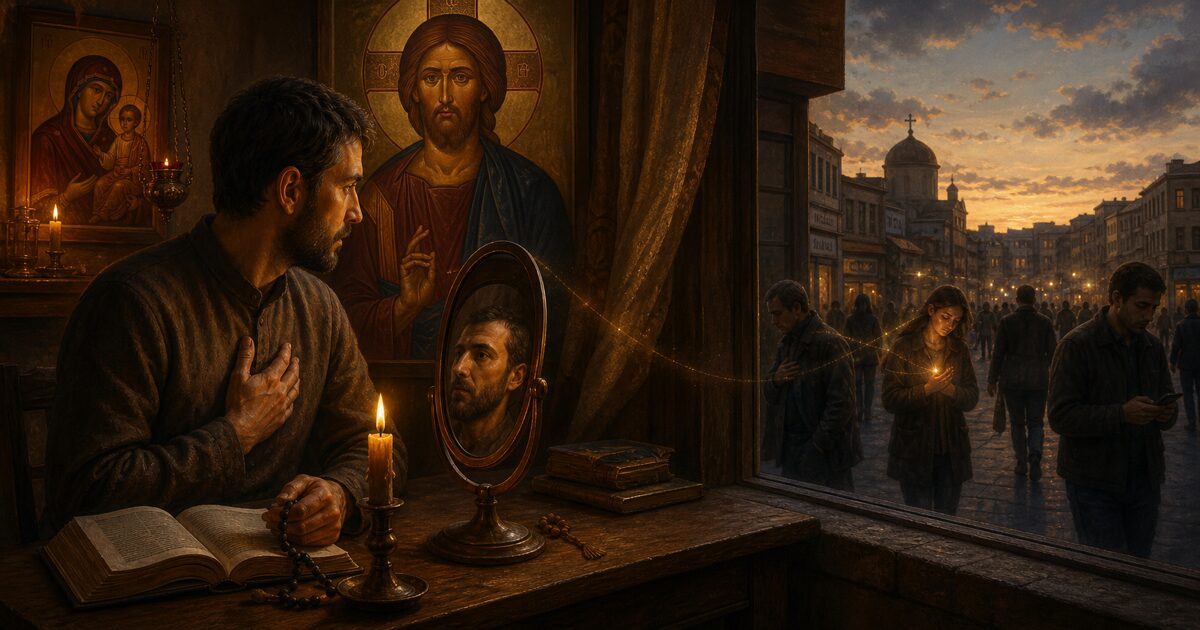
The Question That Troubles Us
There is a question that, sooner or later, every Christian who has looked closely at the world comes to ask: why do people not change, even when you show them the truth? You bring them arguments, patristic witnesses, living examples, scriptural citations — and they remain what they were. You walk away from the conversation stunned. How is this possible? You showed them everything in black and white. It was perfectly clear. And yet… nothing.
This phenomenon has many faces. Let us examine it in four different registers — each revealing the same hidden mystery.
First, the heretics. The Holy Fathers struggled against heresies for centuries. St. Athanasius the Great stood before the Arians with a theological clarity history has rarely seen. St. Basil the Great wrote entire volumes against the Eunomians. St. Gregory Palamas defended the uncreated light against the Barlaamites. St. Mark of Ephesus, at the Council of Florence, refused to sign the union with Rome, confronting an entire imperial delegation alone. Patristic arguments were not lacking. Theological demonstrations were impeccable. The witness of Holy Tradition was clear. And yet — Arianism lasted for decades. Iconoclasm lasted a century. The rupture between Rome and the East has lasted nearly a thousand years, despite the repeated witness of Orthodox Tradition. Arguments collided with an invisible wall. How is this wall to be explained?
Second, those of other confessions or religions. Here the phenomenon is even more widespread. Authentic conversions — deep, inward, total — are not frequent. And not because witness is lacking. There are Orthodox Christians in the West who speak openly about their faith with Catholic, Protestant, atheist friends — and the friends listen, are impressed, recognize the beauty — and yet remain where they are. There are missionaries who give their lives among non-Orthodox peoples — and conversions, when they come, are rare. Why? Because to receive the truth would mean losing one’s home, family, community, childhood, ancestors. To change means to die for an entire inward world. And many people fear this inward death and put it off to the very end.
Third, the older generations. Here the phenomenon is universal — and the most painful for the young or mature Christian who loves his parents. Our parents, relatives, teachers, the generations before us — they all generally remain with the same convictions they entered maturity with. Their views about the world, about the Church, about family, about man — formed by the age of thirty, remain unchanged until death. Even when you point out, with gentleness, that they are mistaken. Even when you bring them patristic evidence. Even when you beg them with tears to consider a better view. The soul closes itself — and convictions, even mistaken ones, become part of the person’s identity. To abandon them would mean acknowledging that one’s life was built on error. And very few have the moral courage to do this.
Fourth — and this is the deepest case of all — the passions invisible to the one who has them. The angry man does not see himself as angry. The greedy man does not see himself as greedy. The proud man does not see himself as proud. The narcissist believes he loves. The egotist believes he sacrifices himself. Here a spiritual law operates that all the Desert Fathers knew: the passion blinds precisely the organ through which it would be seen. You cannot see pride through pride — for pride tells you that you are humble. You cannot see greed through greed — for greed tells you that you are merely prudent. The inner world of the passion builds its own justification, and the man caught in that world does not see what we see, but what the passion shows him — and it appears to him normal, right, even virtuous.
Four cases. Four different registers — dogmatic, confessional, social, ascetic. And yet, if we look carefully, we shall discover that it is the same mystery with four faces.
The Superficial Answer That Fails
The Christian’s immediate reaction, when seeing these phenomena, is to assume that what is missing is information or formulation. “If only I had explained it better. If only I had found the right words. If only I had been more patient in showing them from Scripture. If only I had given them that book. If only I had brought them to that confessor.”
This reaction is, at depth, the expression of a modern anthropological illusion: man as a rational being who merely awaits information in order to change. If we gave him the arguments, if we cleared up his mind, if we educated him — then he would change. This is, in essence, the anthropology of the Enlightenment. And it is profoundly un-patristic.
The Holy Fathers knew something that modern pedagogy has forgotten: man is not a mind in search of information. Man is a wounded being, in whom the free will constantly chooses against the good it recognizes. The Holy Apostle Paul formulated this reality with disturbing clarity in his Epistle to the Romans: “For the good that I would I do not: but the evil which I would not, that I do” (Romans 7:19). And St. Maximus the Confessor reinforced the Pauline observation: man’s natural will tends, in its essence, toward the good — it is, in its nature, turned toward God. But fallen man often chooses through a wounded deliberative mode, through a gnomic will (γνώμη) troubled by the passions. Repeated, these choices form habits, and the habits come to seem nature itself.
This is the key. Man does not change not because he does not know, but because, in his depths, he does not truly want to change — even if his mind claims to want it, even if he asks for arguments, even if he cites Scripture. Knowledge of the truth does not automatically produce change. The demons know the truth better than all the theologians — and they do not change. “The devils also believe, and tremble” (James 2:19). Knowledge without change. Truth without correction. Light without reception.
This is why long sermons, patristic arguments, and theological demonstrations do not, by themselves, change anyone in the depths. They can illuminate the mind, move us emotionally, awaken a question, prepare the soil. They can give the pleasure of understanding. But they do not, in themselves, change the will. And without the changing of the will, no real change exists. The changing of the will comes only when truth is received in humility and worked upon by grace.
A Hidden Spiritual Law
Now we must go deeper. For if man does not change because of his wounded will, the question arises: why is the will so wounded that it can no longer choose the good it recognizes? What has happened to this free will, which in Adam and Eve, before the fall, was naturally turned toward God?
The Holy Fathers’ answer is precise. The will is wounded by the choices it makes. Each choice leaves a trace. Each trace reinforces an inclination. Each repeated inclination becomes a habit. And the habit, once deeply rooted, becomes a second nature. In the language of St. Maximus the Confessor, man’s nature is created for God and tends, in its depths, toward the good — the natural will (θέλημα φυσικόν) remains, in itself, turned toward God. But fallen man often chooses through a wounded deliberative mode, through a gnomic will (γνώμη) troubled by the passions. Repeated, these choices form habits, and the habits come to seem nature itself. Humanly speaking, the freedom to choose otherwise narrows ever further — until the way out seems impossible; but for God, through grace, repentance, and humility, even this narrowing is not insurmountable.
Here is the exact meaning of the four cases described above. Seen in the light of this law, they appear as stages of the same process:
The angry man does not see himself as angry — because decades of angry choices have made anger his second nature. Anger has become his normal. And the normal, by definition, is invisible. You say to him “you are angry”; he replies “I am not angry, I am only being just, only being honest, only telling the truth.” And he is right — from inside his world, that is exactly how it is. His world has been built such that anger has become virtue.
The older generation does not change — because thirty, forty, fifty years of choices have fixed their convictions into the very fabric of the personality. They are no longer opinions, they are pillars. To shake them is to shake the entire structure. The soul refuses instinctively — not because it is foolish, but because it would have to rebuild itself from scratch.
Those of other confessions do not pass to Orthodoxy — because the confessional or religious inclination has been woven into their lives from childhood. Every service they attended, every prayer they offered, every moment of communion with their loved ones happened within that form. To leave it means to leave not just a theory, but an entire fabric of life.
The heretics do not receive the truth, not even from saints — because heresy has become, through the repeated choices of their community, their identity. It is no longer an error; it is who they are. To receive the truth would mean acknowledging that they are not who they think they are. And this requires a humility few possess.
None of these “cannots” is accidental. They are the result of a slow, gradual, real process — a process that leads, if unchecked, to an inward state from which, humanly speaking, escape becomes nearly impossible. This state has a name in patristic Tradition: the hardening of the heart (in Greek, πώρωσις τῆς καρδίας). Holy Scripture mentions it often. Pharaoh hardened his heart. The Jews of Christ’s time hardened their hearts. “With a hardened heart they shall not be able to understand” (cf. John 12:40, citing Isaiah).
And if there is a threshold — and there is a threshold — at which the hardening becomes irreversible, then we already have, in this life, the icon of eternity. Here is the central thesis of all our reflections, which all the pages that follow merely unfold:
Eternity is not a state that begins after death. Eternity is the fixing of the inward state in which death finds us. And this fixing can be anticipated, gradually, already in this life, through the partial hardenings of the soul.
In other words: what we shall be in eternity, we are building now. Not elsewhere, not at some other time, but here and today — in every small choice, in every inclination of the will, in every thought resisted or received. And if death finds us in a hardened state, that hardening becomes eternal — not because God is cruel, but because we ourselves, through our repeated choices, have made ourselves incapable of anything else.
Lot’s Wife — The Icon
Of all the examples in Holy Scripture that show us this mystery, none is as cutting as Lot’s wife. A single image. A single gesture. A single moment. And an eternity.
The story is brief, almost terse, in the Book of Genesis. Sodom and Gomorrah are about to be destroyed for their wickedness. The angels of the Lord have come to lead Lot, his wife, and his two daughters out of the city. The command is clear: “Escape for your life. Do not look behind you, nor stay anywhere in the surrounding region. Escape to the mountain, lest you be destroyed” (Genesis 19:17). The family is led out. The fire of judgment is about to fall. And then: “But his wife looked back behind him, and she became a pillar of salt” (Genesis 19:26).
For a hurried reader, the episode seems disproportionate. A simple look back — and an eternal punishment? A glance — and instant petrification? The Holy Fathers, however, saw here one of the deepest mysteries of biblical theology.
The Holy Fathers’ answer is one of the most overturning in all patristic exegesis: it was not a disproportionate punishment. The look back was the exact expression of her inner state. She was not turned into a pillar of salt because she looked back. She was already a pillar of salt, inwardly — and the look back revealed this reality. Her glance was not the cause; it was the revealer.
In the moral reading of the Church Fathers — St. Ambrose of Milan, Origen in a moral reading of the episode, St. John Chrysostom — Lot’s wife’s glance is not seen as mere curiosity, but as the disclosure of a heart that had remained bound to Sodom. It was the expression of the bond that still held Lot’s wife to Sodom. Not to the stones of Sodom, not to the houses of Sodom, not to the goods lost there — but to Sodom’s way of being. She was still inwardly bound to the world of Sodom. The body was fleeing; the soul had remained.
This patristic reading has a terrible consequence. Lot’s wife was not punished for a trivial gesture; she was disclosed for what she already was. And the state in which she already was, inwardly — attached to a world that burns — became, through that gesture, her state forever.
Yet there is more. The salt. The Holy Fathers saw a symbolic depth here as well. Salt is what blocks change. Salt preserves the state in which whatever it contains finds itself. Salt blocks decay, but it also blocks growth. Salt halts all transformation — both forward and backward. The pillar of salt is the icon of the soul fixed in its state, no longer advancing, no longer moving, no longer responding to the call. She remained, literally, in the moment of the glance — forever.
The Lord Himself, in the Gospel of Luke, takes up this image with frightening seriousness: “Remember Lot’s wife” (Luke 17:32). It is not a casual reminder. It is a warning given by Christ Himself to all who follow Him. Remember her. Remember that turning back, inwardly, can become irrevocable. And just a little earlier, in the Gospel of Luke: “No one, having put his hand to the plow, and looking back, is fit for the kingdom of God” (Luke 9:62). The look back is not merely a human psychological weakness; in the context of the command received, it discloses an inward choice against salvation.
Lot’s wife, then, is not merely a historical example. She is the central icon of our article: she shows us what it means, in symbolic language, what St. Maximus called the corruption of the gnomic will. There is a threshold. There is a moment. There is a “too late” — not as a juridical sentence from without, but as the fruit of thousands of small choices which, in the end, fix the soul in a direction from which, humanly speaking, it seems it can no longer return.
The Fall of the Angels — The Paradigm of the Irreversible
To understand more deeply what hardening means, the Holy Fathers turn to the highest paradigm of irreversible fixity: the fall of the angels.
St. John of Damascus formulates a spiritual law that all the Fathers receive unanimously: “It must be known that what death is to men, the fall was to the angels. For after the fall they have no possibility of repentance, just as men have none after death.” (On the Orthodox Faith II.4)
This sentence opens a depth that requires our patient attention.
Why can the angels no longer repent after the fall? The patristic answer is profound. The angels, in their bodiless nature, see directly — without the mediation of the senses, without the limitation of time, without the filter of matter. Their choice is therefore total, lucid, definitive. When Lucifer chose to rise up against God, he did not make a partial choice, under the influence of momentary passion, out of ignorance, out of passing weakness. He made a choice with his whole being, seeing all, understanding all, willing all. And a choice of this nature can no longer be taken back. There is no repentance left, for there is no longer the inner division that, in us, makes repentance possible.
In men, by contrast, repentance is possible because man is a being in time, in the body, in becoming. Our choices are partial. We never choose with our whole being. Always there remains a part of the soul that sees differently, that feels differently, that can be touched by grace and overturned. As long as we are in the body, there is time for repentance — so the Tradition of the Fathers constantly teaches. The body, in its paradoxical weakness, is also the guarantor of our inward freedom — for it does not let us be totalitarian in our choices.
But — and here enters the depth — death changes this condition. At death, the soul leaves the body. It leaves the time of becoming. It leaves the inner divisions of earthly life. And the state in which death finds it becomes eternal — for there is no longer the material substrate that made change possible. The soul remains fixed in the direction it had taken.
And the threshold of hardening, of which we have been speaking, is an anticipation in time of the post-mortem state. The soul which, through repeated choices, has fixed itself deeply in a direction, begins to live, even in this life, a state that anticipates the angelic irreversibility. You cannot easily convince a man of seventy who has been angry all his life to see himself as angry — not because biological time has run out, but because the inward structure has been fixed through the choices of a whole life. Decade after decade, he has made choices that gradually narrowed his freedom — until, humanly speaking, he barely sees a single direction anymore. Only the grace of God, received in humility, can break this enclosure — and this remains possible as long as man is still in the body.
Here we see the full weight of the thesis we set down at the beginning of our reflection. We are living, in this life, already an anticipation of eternity — and every choice strengthens or widens the space of our inward freedom. The one who daily makes evil choices gradually narrows his freedom — until the good seems foreign and hard to choose. The one who daily makes good choices gradually widens his freedom — until the good becomes natural to him, and he becomes free in the truth of Christ.
Eternal Judgment: Not an External Sentence, but a Truth Revealed of the Soul
This understanding overturns a vision often present in popular Western theology: that of eternal punishment as a juridical sentence applied by an angry God against rebellious men. As if God, indignant at the sins of an entire life, decreed eternal punishment in proportion to those sins.
In a deep line of the Eastern Tradition, found in St. Isaac the Syrian, St. Maximus the Confessor, St. John of Damascus, and St. Sophrony of Essex, the teaching is this: hell cannot be reduced to a punishment applied from outside. Hell is the state of the soul that can no longer receive God’s light — because it has made itself, through its own work, incapable of receiving it.
God does not change in eternity. God is the same yesterday, today, and forever — light, love, life, fire of love offered without reserve to all of creation. The blessed and the damned find themselves in the same presence of God — but they experience it in radically different ways. For the blessed, the presence of God is paradise — light, joy, infinite communion. For the damned, the same presence of God is hell — burning, refusal, infinite suffering. Not because God acts differently on them, but because they themselves have made themselves incapable of receiving His love. The fire of God’s love becomes, for the one who hates it, the fire that burns him without consuming him.
St. Isaac the Syrian formulates this with overwhelming clarity: “Those who are punished in hell are scourged by the scourge of love. And how bitter and harsh is this torment of love! For those who realize that they have sinned against love suffer a torment greater than any feared torment. The pain that takes hold of the heart at having sinned against love is sharper than any other pain. It is absurd to think that the sinners in hell are deprived of God’s love.” (Ascetical Homilies, Homily 22)
This is one of the most powerful passages in all of Eastern theology. The fire of hell is the very love of God. But love rejected becomes torment. Love refused becomes pain. The same energy which, for the saint, is bliss, becomes for the damned the unsupportable burn.
And St. Sophrony of Essex, in the twentieth century, teaches us that our earthly life unfolds upon the border between two realities: the paradise of God’s love and the hell of the refusal of God. Those who did not love God in this life will not be able to receive His love in eternity either; and that inward refusal is their hell.
Now we see why eternal punishment is not disproportionate to the sins of a finite life. The punishment is not a sentence pronounced by an indignant God for past deeds. The punishment is the inward state that man has fashioned for himself, through his own choices, in this life. And that state, fixed at death, becomes eternal — not because God refuses post-mortem repentance, but because man himself, in that state, no longer desires repentance and, humanly speaking, can no longer work it. Repentance presupposes acknowledging that one has erred. And the one definitively hardened refuses, from the depths of his being, this acknowledgment — for it would tear down all that he is.
The Only Power of Real Change — Grace
If all that we have said until now is true, then we find ourselves in a situation of breath-taking gravity. Man does not change by arguments alone. He does not change by demonstrations alone. Not even meeting the saints changes a man automatically. Then how does anyone ever change?
The Holy Fathers’ answer is clear: only grace changes the man. Not human persuasion. Not external pressure. Not threats. Not promises. Only the living touch of God upon the soul, which works mysteriously, in a way we cannot foresee or program.
And here we must distinguish between two kinds of change. There is the small, gradual change — what we call growth in virtue, slow progress in the spiritual life. This is given to those who have already opened themselves to God, who already pray, who already strive. It is the work of grace in those who already wanted the change.
And there is the radical, sudden change — the breaking of an old, hardened structure. This is something altogether different. It is not progress; it is a leap. It is not slow growth; it is mutation. The soul, fixed in an old direction, is suddenly turned, as if from another being, toward a new direction. And this kind of change cannot come except by direct intervention of grace, in a way that the soul itself recognizes as something coming from outside it, something stronger than itself.
All those who, in the history of the Church, were changed in profundity, were touched, not convinced. Saul, the fanatical persecutor of Christians, was not changed by the Christians’ arguments — which were brilliant, with St. Stephen among them. He was changed by the real encounter with Christ on the road to Damascus. St. Mary of Egypt, after seventeen years of debauchery, was not changed by sermons — but by the invisible force that stopped her at the door of the church in Jerusalem. The thief on the cross was not changed by religious instruction — but by the direct sight of the suffering Christ beside him.
The Holy Great Martyr Eustathius Placidas was a brilliant Roman general in the time of Emperor Trajan, a pagan from birth, glorified in the army, devoted to the gods of his fathers. No Christian argument had ever touched him — he was wholly a man of the old world, caught in its religious, military, and familial structure. But one day, while hunting, pursuing a great stag, he saw it stop on a cliff. And between the antlers of the stag — the image of Christ Crucified. And a voice spoke to him: “Placidas, why do you persecute Me?” (in the likeness of St. Paul on the road to Damascus). In a single moment, the old world collapsed. He was baptized with his entire family, receiving the name Eustathius. He lost everything — wealth, military rank, wife, children — and endured all with unshaken confession. In the end, martyrdom in a heated bronze bull, together with his wife and sons. Not argument — living grace, seen with the eyes.
And the same is true of all the great conversions of Tradition. St. Moses the Ethiopian, the head of a robber band, was changed by an inward revelation that all his philosophy could not have produced. St. Pelagia the Harlot was changed by a single sight of the holy bishop Nonnus weeping over his own unworthiness. St. Photini, the Samaritan woman at the well, was changed by a brief conversation with Jesus.
In each of these cases, the same pattern: a fixed soul, an old structure, a state of hardening — and suddenly, the touch of grace, irresistible, total, definitive. Not persuasion. Not slow accumulation of arguments. Mutation.
Why is grace so powerful? Because the living God is not to be debated. When He reveals Himself directly, in power, the soul can no longer remain neutral. It is brought into crisis, revealed to itself, called to a choice it had been postponing or hiding. It sees. And what it sees is so overwhelming that all inward defenses fall like a house of cards. This is the exact meaning of the words of the Holy Apostle Paul: “For the word of God is quick, and powerful, and sharper than any two-edged sword, piercing even to the dividing asunder of soul and spirit” (Hebrews 4:12). The sword. The division. The mutation.
But — and here lies the inevitable paradox — grace does not come at our command. We cannot demand it. We cannot manufacture it. We cannot produce it by the right techniques, the right prayers, the right teachings. Grace is a gift, in the proper sense of the word. It comes when God wills, where God wills, how God wills.
What, then, do we do? What is our part?
The Holy Fathers have a clear answer: our task is to prepare the ground. Not to change ourselves by our own power — that is impossible. But to make ourselves capable of receiving the grace that, when it comes, will perform the real change. And this preparing of the ground has a name: humility.
Humility is the open door through which grace enters. Pride is the closed door against which grace knocks in vain. The proud man, even if he hears the truth, cannot receive it — for pride tells him that he already knows it, or that he is already worthy. The humble man, even at the lowest fall, can receive everything — for humility leaves him empty, open, waiting.
This is why the Holy Fathers placed humility above all other virtues. Not because it is one virtue among many, but because it is the condition of receiving every other gift. St. Silouan the Athonite said: “Keep your mind in hell, and despair not.” In this brief sentence is the whole spiritual life: see your inner hell — and do not despair. The seeing humbles. The not-despairing opens to grace. And between the two, the soul becomes the place where the change of God can happen.
The Structure Imprinted on the Face — And How God Yet Breaks It
We have spoken of hardening as an inward process. But the Holy Fathers go further. They affirm that inward hardening imprints itself on the body, on the face, on the bearing. The soul fashions the body. And the more the soul becomes set in a passion, the more clearly that passion writes itself on the face.
This observation is not metaphor. St. Athanasius the Great, writing the life of St. Anthony, bears witness that the Father of the desert was recognized among hundreds of monks not by his garments or gestures, but by his serene face, which was the expression of his quiet soul. St. Seraphim of Sarov radiated a light that those who saw him could describe only as a true brightness like the sun. St. Silouan, St. Porphyrios, St. Paisios — all had faces on which passion had not left its wound, faces which the long contemplation of God had made luminous. And inversely, it is something Tradition has observed that long-worked passions leave their traces in the features of the face — without this giving us any right to judge people by their faces. Rather, it is a call to ask what our own passions are imprinting in us. The face becomes, in time, an icon of the soul. A hardened soul gives birth to a hardened face. A loving soul gives birth to a luminous face.
And beyond the face, into the very structure of the being, this work goes deeper still. The Holy Fathers distinguished between nature (φύσις) and habit (ἕξις). Nature is given by God and remains unchanged — for God does not take from anyone what He has planted at creation. But habit is the “second nature”, built through repeated choices. And habit roots itself so deeply that it comes to seem nature itself. The one who has been angry all his life can scarcely conceive of himself as gentle — not because the gentle nature no longer exists in him (God has not taken it from him), but because the habit of anger has covered the nature like a thick layer of slag. The passion has become the organ by which he perceives the world. The world itself appears to him “this way” — hostile, unjust, deserving of anger — because he no longer sees it through the pure nature, but through the grid of habit.
This is why telling such a man “you are wrong” is, humanly speaking, a futile labor. His error is not an idea he can easily change. His error is the structure through which he exists. To change it would mean to change himself from the foundations — to demolish his world — to acknowledge that decades of his life have been lived through a defective lens. And that requires a humility which, caught in his own structure, he finds it humanly very difficult to find. Only the grace of God, received in a moment of inward brokenness, can break this enclosure.
So how, then, does God yet break the structure? In what ways does His grace enter where the inward defenses are so thick? The Holy Fathers, observing the lives of saints and the conversions of sinners, identified several principal paths.
First: suffering
Suffering, in the spiritual order, is the great breaker of structures. Wherever life, satisfaction, and self-fulfillment confirm the old structure, suffering tears at it. Illness. Loss of a beloved. Failure. Humiliation. Poverty. The death of a child. Betrayal. The man who has built his life upon a passion, and whom that passion serves with success, will never see his passion — for the passion gives him what he wants, and he is content. But the man whom suffering strips of all certainties — that man begins to see. Why does life flee me? Why has everything I built turned to dust? Why am I so empty inside, when I should be full?
This is why the Tradition has always considered suffering, when received well, as a privileged path of grace. Avva Pimen the Great gives us a luminous image of this hidden work: “The nature of water is soft, that of stone is hard; but a wineskin hung above a stone, letting the water flow drop by drop, pierces the stone. So too the word of God is gentle, and our heart is hardened, but the man who hears it often opens his heart to the fear of God.” Here is the very law we sought: the stone of the heart does not break by hammer blows — but by the unceasing water of the divine word, drop by drop, over years. Suffering and trial come the same way — drop by drop upon the hardened heart — and open a path there through which grace can enter. And the Holy Apostle Paul, in Romans 5: “Tribulation worketh patience; and patience, experience; and experience, hope: and hope maketh not ashamed” (Romans 5:3-5). Without suffering, the soul remains clothed in its own garments. With suffering, the soul is stripped naked — and only then can it be clothed in the garment of Christ.
Second: revelation — the real encounter with God
The second great breaker of structures is the direct, real, unforeseen encounter with the living God. Not the encounter through books, not the encounter through preaching, not the encounter through theological discussions — but the encounter in which the soul knows, beyond any doubt, that the Other is here, now, real.
These encounters are rare. They are gifts. They cannot be programmed. But when they come, they perform what years of catechesis could not perform. The soul of Saul, on the road to Damascus, did not need ten years of explanations; one sentence sufficed: “Saul, Saul, why persecutest thou me?” (Acts 9:4) — and the structure broke. The soul of the Roman general Placidas did not need theological treatises; the sight of Christ Crucified between the stag’s antlers sufficed — and the soldier of pagan Rome became the martyr of Christ.
In our day, these encounters still happen — though rarely. Some men encounter Christ in a dream that changes their lives. Others through a sudden inner illumination at the Liturgy. Others through an icon that suddenly looks back at them. Others through a saint they meet who, with a single glance, makes them see what they had been hiding from themselves for decades. We cannot produce these encounters. But we can ask for them, in trembling, with humility.
Third: imminent death
The third great breaker of structures, often the last one God uses, is the closeness of death. When the soul faces the certainty of its passage — through a fatal illness, an accident that almost killed it, the death of someone of the same age — suddenly everything else becomes secondary. The accumulations of a life lose their flavor. The disputes that seemed essential become ridiculous. The pride that has been so well defended seems suddenly absurd in face of the open grave.
The thief on the cross is the supreme example. A whole life of theft. A whole life of contempt for the law of God. And then, hanging beside Christ, a few hours from death, the soul opens for the first time. He sees the suffering Just Man beside him. He sees what he himself is. He says: “Lord, remember me when thou comest into thy kingdom” (Luke 23:42). And Christ’s response — perhaps the most overwhelming response in all of Scripture: “Verily I say unto thee, Today shalt thou be with me in paradise” (Luke 23:43). Hours of true repentance saved a life of perdition. Because death broke the structure.
This is why Tradition has always insisted on a good death — that is, conscious, repentant, with the Holy Mysteries received. For there, in the last moments, the soul has its final chance. And for many men who, throughout their lives, have refused, the closeness of death is the only space in which their inner door can finally open.
Sudden change and gradual change
It is important to distinguish here between two phenomena which the Tradition speaks of separately.
Sudden change is the mutation produced by the touch of grace. Saul on the road to Damascus. Mary of Egypt at the door of the church. The thief on the cross. Eustathius before the stag. In all these cases, the direction of the soul changes in a single moment, in a single decisive act. Henceforth, the man is another. He no longer wants what he wanted before. He no longer sees what he saw before. The structure broke.
But the structure breaking does not mean the work is finished. After Saul’s conversion on the road to Damascus, three days of blindness followed, then years of solitary preparation in the desert of Arabia before Paul became the great Apostle. After the conversion of Mary of Egypt, forty-seven years followed in the desert in unceasing battle with the passions she had brought there. After the conversion of Moses the Ethiopian, long decades of monastic asceticism. The mutation is a beginning, not a fulfillment.
What follows is the slow, gradual change — the slow refashioning of the structure by grace, through the willing collaboration of man. This second phase the Holy Fathers called asceticism. It is the work of unstitching, fiber by fiber, the old structure, and weaving in its place the structure of Christ. This work is long, painful, often arid, but it is real. And it is needed, for without it the original mutation remains a memory, not a transformation.
The body works upon the soul
There is one more aspect we must touch upon, brief but crucial. The Holy Fathers, in the line of the Eastern ascetical tradition, knew something modern psychology has rediscovered only partially: the body and the soul work upon each other reciprocally.
The soul shapes the body — we said this above. But also the body shapes the soul. Fasting humbles the soul through the humbling of the body. Prostrations break inner pride through the bowing of the head. Standing at services teaches the soul perseverance through the perseverance of the legs. The Jesus Prayer, said with the breath, re-orders the rhythm of the very thoughts. The body is, in this sense, an instrument for the inner transformation.
This is the integral patristic anthropology — man as a body-soul unity, not as a soul imprisoned in a body (as the Origenists and Platonists believed). Not only does the soul shape the body; the body shapes the soul. Fasting is not just an ascetic technique to humble pride; it is a work upon the structure of the soul through the body. Prostrations are not just physical movement; they are a humbling of the soul through the humbling of the body. Standing at services, bowing the head to the ground, kneeling at prayer, the position of the body at the Jesus Prayer — all are paths by which the body reforms the soul.
The pastoral application for the ordinary Christian is this: do not wait to feel inwardly before you do. Begin to do, and the soul will follow. Stand at prayer even if your mind wanders. Fast even if your heart does not want to. Go to the Liturgy even if your feet hurt. Make prostrations even if you are tired. Say “Lord, have mercy” even if the words seem empty. Because the body, working steadily, opens new pathways in the structure of the soul. And through these new pathways, grace finds its way slowly to the heart. St. Theophan the Recluse, in The Path to Salvation, teaches that the work with the body prepares the work of the soul — and that the soul follows the body when the body is consistently placed in good habits.
The Turning Toward Oneself
Up until now we have spoken of “them”. The heretics who do not change. Those of other confessions who remain where they are. The older generations who die with the same convictions. The angry man who does not see his anger. The greedy man who does not see his greed. Lot’s wife who looked back.
Now we must ask: But what of me?
Where do I resemble the heretics who refuse the truth? In what part of my life do I hold a conviction that I defend with stubbornness — even though in the depths of my heart I know it is mistaken — because abandoning it would mean acknowledging that my whole life has been built upon an error?
Where do I resemble those of other confessions who have not made the step? In what inner world am I caught, even though I know the truth, because leaving it would mean dying for everything I have built?
Where do I resemble the generation that does not change? What convictions have I taken from my parents, from my teachers, from the culture in which I grew up — convictions that have become my normal, that I no longer call into question, that I wear like a skin I no longer even notice?
And above all: in what passion am I the one who does not see himself? What is my anger that I do not see as anger? What is my greed that I do not see as greed? What is my pride that I do not see as pride? For, be sure, it is there. If you read this article and think “yes, yes, how true — there are so many people like that around me” — then that is the moment you must stop. For this is exactly how the blind passion works. It shows you the passions of others — and keeps you blind to your own.
Patristic Tradition constantly teaches: the one who does not know his own passions cannot be set right. The entire labor of the spiritual life begins with this self-knowledge. Not general knowledge — “I am a sinner” — which we all have, but which changes nothing. But the concrete, specific, painful knowledge: “I am angry. I am greedy. I am proud. I am narcissistic. I am closed. I am hardened here, here, and here.”
And this knowledge does not come of itself. It comes through:
- Repeated, humble prayer, asking God to show you what you do not see;
- Deep confession with a discerning spiritual father, who sees what you do not see;
- The reading of the Holy Fathers, especially the ascetic ones (Abba Dorotheos, St. John Climacus, St. Mark the Ascetic, St. Isaac the Syrian) — who describe the passions with such precision that you recognize yourself, if you are willing;
- The honest gaze upon your reactions — especially to criticism, to injustice, to loss, to insult; there the hidden passion shows itself.
And when you recognize yourself, do not despair. That is the second half of St. Silouan’s saying. Knowledge of the passion without grace leads to despair. Knowledge of the passion with grace leads to repentance. And repentance is the only force in the universe that melts hardening, however deep it may be. For God, wherever He sees authentic humility, comes. “A broken and a contrite heart, O God, thou wilt not despise” (Psalm 51:17).
Here, then, is the meaning of the article: it is not about “how to make others change”. It is about how not to become ourselves pillars of salt. For the real danger, for the attentive reader of this text, is not failing to understand the phenomenon — but forgetting to apply it to himself. “Remember Lot’s wife” — says Christ. The remembering is for us, not for her.
How I Change Myself: Receiving Criticism, Fleeing Praise
But now the hardest question arises. If I have recognized myself, if I have begun to suspect that I am caught in my own unseen passions — how do I heal? How do I bring to light what is hidden? How do I myself break the structure in which I am closed, when this very structure is what blinds me?
Here the Holy Fathers give us a strategy that is, in its depth, the opposite of the entire modern anthropology. A strategy the world does not understand, and even regards as foolishness. And this strategy is, in essence, a single observation:
The passion remains hidden as long as it is satisfied. It comes to light only when it is wounded.
That is: you cannot see your pride as long as you are praised — for praise feeds it, strengthens it, hides it even more. Pride is seen only when you are humiliated — for humiliation strikes it, wakes it, makes it cry out. And its inner cry is the light by which, for the first time, you see it.
So too: you cannot see vainglory as long as the world gives you the attention you crave. Vainglory is seen only when you are ignored, set aside, forgotten — then there rises in you a sharp pain, a disproportionate disturbance, an obsessive need to be recognized. That pain is the mirror. Never, in the midst of recognition, could you have seen it.
So too with anger. So too with greed. So too with envy. All the passions have the same mechanism: they sleep while they are served, and howl when they are wounded.
Praise Feeds the Blindness
Here, then, is the dreadful paradox of the spiritual life: what we all naturally seek — praise, recognition, the approval of those around us — is exactly what closes our inner eyes.
When someone tells you that you are good, hardworking, wise, humble, devoted — even if he says it sincerely, even if he says it with love — he is reinforcing your structure. He is making you even more certain that you are what you think you are. He is closing you even more deeply within your inner world. And if you truly have some passion in that area (hidden pride, vainglory, hunger to be seen), that praise directly feeds it — without your knowing it.
This is why the Holy Fathers fled the glory of men more than any other temptation. Not because they despised those who praised them. But because they knew what praise was doing to them inwardly: a soft pillow that was thickening the cataract on the soul, until they could see nothing. Elder Paisios the Athonite would flee into the forest when pilgrims came looking for him. St. Porphyrios would say: “I am nothing; leave me in peace.” St. Silouan, though he had received visions of the Uncreated Light, remained a simple monk for over fifty years, letting no one discover him. All knew the same thing: that a single praise received with inward pleasure can wipe out years of labor.
Criticism, Humiliation, Mockery — The Inner Lens
And conversely: what man by nature hates — criticism, humiliation, insult, unjust mockery, suffered injustice, public contestation — these are, in God’s hands, the only instruments through which you can see your inner hell.
For your reaction to a criticism shows you the passion. Look honestly:
- Someone tells you that you have erred. If you flared up, if you answered sharply, if you defended your righteousness with passion — you have just seen your pride. It was there, hidden, before the word. The word did not create it; it only made it visible.
- Someone ignores you, takes no notice of you, passes over you. If it hurt you, if you felt a deep disturbance, if you wanted to cry out your presence — you have just seen the vainglory that lived in you without your noticing.
- Someone has taken what was yours, received the praise in your place, was raised to where you wanted to be. If you felt an inward burn, a crying injustice, a need to bring him down — you have just seen the envy that was there beforehand, but which you did not recognize as such.
- Someone has accused you unjustly. If you felt the obsessive need to defend yourself, to justify yourself, to convince everyone around of your innocence — you have just seen self-love (philautia), the love of self disguised as love of truth.
These are the most precious moments of the spiritual life. Not the moments of peace, not the moments of joy, not the moments when all goes well — but the moments in which the passion was struck and cried out. In that cry you see it for the first time. And if you see it honestly, without fleeing, without justifying it, without defending yourself, you have taken the first step of real change.
Why the Saints Received Humiliation with Joy
Ordinary people do not understand why the saints endured unbelievable humiliations when they could have defended themselves. Elder Paisios could have answered sharply those who mocked him — and he preferred to be silent. St. Basil the Younger, when accused of being a spy and bound to tortures, did not speak in his own defense. Abba Macarius, when a woman accused him of being the father of her child, accepted the slander, worked for her, kept silent. St. Symeon the Fool-for-Christ chose the life of mockery, pretending madness, so that he would be despised. St. Andrew the Fool-for-Christ did the same.
Modern people look at this and think: “but it is unjust! Why do they not defend themselves? Why do they not cry out their truth? How can anyone accept such a thing?” And they answer with their own anthropology: “no, I will not be like them — I defend my dignity, I demand my justice, I speak my truth to their face.”
But the saints saw what we have forgotten. They knew two things:
The first thing: every defense of the self feeds self-love (philautia). The moment you cry out your justice, you feel an inward satisfaction — a satisfaction that shows it was not only justice you sought, but recognition of self. And that recognition closes you. The saints fled from this satisfaction as from a serpent — for they knew that, once tasted, it throws you back into the old structure.
The second thing: receiving humiliation breaks the structure. When you suffer injustice without defending yourself, when you let mockery flow over you without rejecting it, when you bear the accusation without contesting it — something tears inwardly. Your pride cries out, howls, struggles. And you, looking at it with stillness, see it for the first time, truly. And you can give it to Christ. With every humiliation well received, a layer of the old structure falls away. With every defense of the self, another layer is laid down.
This is why the saints thanked those who insulted them. Not out of hypocrisy. Not out of masochism. But because they saw what that insult did to their soul — and they received it as a true gift. For, in the most important matter in the world — the salvation of the soul — one insult well received is worth more than a hundred praises well spoken.
The Daily Application
And now comes the hard part. For it is easy to admire the saints who endured humiliations in the desert or in prison. It is another thing to receive, in your own daily life, the small sufferings that come to you without your seeking them.
For they come by themselves. You do not need to go to the desert. You do not need to pretend madness. You do not need to seek mockery. Life itself brings them to you daily:
- The sharp word of the spouse at the end of a hard day.
- The unjust reproach of a colleague at work, in front of everyone.
- The contemptuous look of the neighbor who has heard something about you.
- The praise that does not come when you expected it, after long work.
- Being ignored in a group where you wanted to be recognized.
- The public criticism you consider deeply unjust.
- The gossip that reaches you, without your being able to defend yourself.
- The child who answers you impertinently and makes you feel powerless.
- The car that cuts you off rudely on the road, the driver who curses you without reason.
- The grumpy salesclerk, the harsh customs officer, the contemptuous bureaucrat.
Each one of these is, if you look at it well, a gift. An occasion. A lens that shows you your passion. Your reaction tells you what you have inside. And if, in that moment — instead of defending yourself, growing disturbed, getting angry, seeking to prove your righteousness — you remain still, observe the reaction, see it honestly, give it to Christ — that day you have changed by a millimeter. And over thousands of such days, you have changed truly.
Christ teaches us directly, in the Sermon on the Mount: “But I say unto you, That ye resist not evil: but whosoever shall smite thee on thy right cheek, turn to him the other also” (Matthew 5:39). This word is not merely an abstract moral commandment. It is an exact spiritual strategy. The one who defends his cheek closes himself in the old structure. The one who turns his cheek breaks the structure. For the turning of the cheek burns inwardly — and in that burning, the hidden pride is seen.
A Necessary Warning: This Is Not an Invitation to Self-Destruction
Yet it must be said clearly, before we go further: this is not about seeking abuse, humiliation, or injustice artificially, nor about remaining in destructive situations. What we have said above is not an invitation to spiritual masochism, to complicity with evil, or to passive remaining in relationships of family abuse, harassment, manipulation, or violence. These situations are not the “spiritual lens” Tradition was seeking — they are evil itself, in the face of which the Christian has the duty to protect himself, especially when evil strikes the weak (children, the elderly, the dependent).
The Christian resists evil when this is necessary. Christ Himself, when the officer struck Him unjustly before the high priest, did not remain silent: “If I have spoken evil, bear witness of the evil: but if well, why smitest thou me?” (John 18:23). He did not turn the cheek automatically — He called the conscience of the one who struck Him. The saints defended the wronged. St. Basil the Great resisted the Emperor Valens. St. John Chrysostom rebuked the Empress Eudoxia. St. Mark of Ephesus refused union with Rome. They were not passive before evil — they were inwardly free of it.
The distinction is this: authentic spiritual work does not seek suffering for its own sake, but receives well the sufferings that God permits, in the normal life of the Christian. The unjust criticism you cannot avoid, the sharp word that comes to you without your seeking it, the being ignored which you do not control, the gossip that reaches you without your having caused it — these are permitted for your sanctification. Do not let them grind you down, but do not reject them with anger either. Look at them with watchfulness, give them to Christ, go on.
If you are in any situation of abuse — leave. If you are unjustly harassed at work — defend yourself with peace. If someone harms your children — intervene. If you are being manipulated — set limits. These are not lack of humility; they are the Christian economy of life in the world.
A Warning Against False Humility
A further warning is needed. We do not confuse the receiving of humiliation with weakness, cowardice, or false humility. The one who is silent because he lacks the courage to defend himself — that man is not receiving humiliation; he is merely fleeing confrontation. The one who receives mockery with a sad, martyr-like, ostentatious face — that man is not receiving humiliation; he is only converting it into a subtler vainglory. The one who accepts injustice in order to be admired afterward for his patience — that man has received his reward here, as Christ says of the hypocrites.
The authentic receiving of humiliation has three signs:
First: it is silent. You tell no one. You do not exhibit it. You do not seek for it to be seen how much you bear. The saints, when insulted, did not afterward recount how they had been insulted. They were silent and gave thanks to God in secret.
Second: it is interior. It does not show on the face. The saints did not have sad, martyr-like faces. St. Basil the Younger, in the midst of tortures, kept his peace. Elder Paisios, in the midst of evil words, laughed. For what was working in them was hidden — and where it does not show, grace rests.
Third: it is with joy. Not with heavy resignation, not with mute suffering, not with bitter submission — but with real joy, because you have recognized the gift. “Blessed are ye, when men shall revile you, and persecute you, and shall say all manner of evil against you falsely, for my sake. Rejoice, and be exceeding glad” (Matthew 5:11-12). Christ does not say “endure gloomily”. He says “rejoice”. For, if you have understood what you are receiving, truly you have cause for joy: a lens has been given you to see your inner hell and to give it to God.
Watchfulness as Companion
Over all this must be placed watchfulness (nepsis) — the continual inward attention. For the receiving of humiliation without watchfulness becomes merely blind suffering. Watchfulness means to observe in the moment when the humiliation comes: What do I feel now? What rises in me? Which passion has just been awakened? What does it show me about myself? This observation is what transforms small suffering into self-knowledge. Without watchfulness, suffering grinds you down. With watchfulness, suffering enlightens you.
This is why the Desert Fathers joined the bearing of humiliation with unceasing prayer. You cannot bear with profit if the mind is not set in the remembrance of Christ. But if the mind is set there — in “Lord Jesus Christ, Son of God, have mercy on me, a sinner” — then every humiliation becomes an occasion of grace. Then you can say, with St. Paul: “We glory in tribulations also: knowing that tribulation worketh patience; and patience, experience; and experience, hope” (Romans 5:3-4).
This is the way of the changing of oneself, by the witness of the Fathers. Not books. Not arguments. Not programs of self-improvement. But the daily, humble, lucid, joyful receiving of the small sufferings that life brings us — as gifts of God, through which He Himself breaks our old structure and prepares us for eternity.
What We Do with Loved Ones Who Do Not Change
And yet, after all this turning toward ourselves, an inevitable reality remains: we have loved ones who do not change. Parents, spouses, siblings, children, lifelong friends. People we love. People for whom we would pray for their salvation. People for whom we would wish spiritual good — and who, no matter what we do, remain where they are. Sometimes they even judge us unjustly, reproach our silence or our interventions, accuse us of not loving them, when it was love itself that made us try to show them the truth.
What do we do with them? How do we live alongside them? How do we not be destroyed by the pain of their stubbornness?
First: unceasing prayer for them
The first work — and the most powerful — is prayer. Not the prayer of demand (“Lord, change him!”), which often hides our pride and our desire to control. But the prayer of intercession (“Lord, have mercy on him; You who see him as he is, work in him what only You can”).
This prayer must be continual — not once, not sporadically, but daily, like breathing. The one for whom you pray will not feel, probably, anything concrete. But grace works, in depths we cannot see. The Tradition of the Church teaches us that many souls in danger of hell are saved by the prayers of those who love them — prayer made daily, with tears, without time limit.
St. Monica prayed for her son Augustine for seventeen years before he was converted. Seventeen years of tears. Seventeen years of seemingly fruitless petitions. And then — change. The same with many other mothers, wives, children, friends, who through long prayer ended up obtaining what no argument could obtain. Pray. Without ceasing. Without losing heart.
St. Nonna, the mother of St. Gregory the Theologian, did the same for her unbelieving husband. She prayed with tears and tireless faith — and at last, by the grace of God, her husband received baptism and even became a bishop, alongside her son. Patient prayer of the wife and mother changed the heart of a man who had remained closed for years.
Second: forgiveness, even of those who have judged us unjustly
A second labor, often overlooked, is forgiving them in our heart — including for the unjust ways in which they have judged us, contested us, refused us.
It is hard. Truly hard. Especially when those who have judged us unjustly are our parents, our children, our spouse, those whom we love. The temptation to hold a hidden resentment, to nourish a buried bitterness, to keep an inward distance — is great. But this hidden resentment closes us also, making us, in our turn, hardened toward them.
St. Silouan the Athonite taught this attitude with a unique depth: “But if we despise our brother or judge him, our mind is darkened and we lose peace and boldness toward God.” And Christ, on the Cross, prayed for those who crucified Him: “Father, forgive them; for they know not what they do” (Luke 23:34). They know not what they do. This is the key phrase for understanding people who do not change and who judge us: they do not, in truth, know what they do. They are caught in their world. And if we in turn judge them, we place ourselves in the same world — we ourselves become caught.
Forgive. Inwardly. Genuinely. Without grudge. Pray for them. Receive their unjust judgments as another lens of self-knowledge — perhaps there is something in you, however little, of what they accuse you of. And give over the rest to God.
Third: try to save them — with gentleness, with measure, with discernment
A third labor — but with much caution — is the loving attempt to bring them closer to Christ. Not by pressure. Not by repeated arguments. Not by reproaches. But:
Through example, more than through word. St. Porphyrios said: “Parents radiate what they live.” The same law applies to all relationships. If you change — if those around you see in you a soul being sanctified — this change works more powerfully than all your words. And conversely: if you preach about patience, but you yourself grow irritated at the first trial, your words are in vain. The silent example is the most powerful preaching.
Through a few well-chosen words, at the right moment. Not many. Not often. Not as predication. But a word, said with love, at a moment of openness — when the other is suffering, when he is in crisis, when his soul is for an instant exposed. That word can plant a seed that, over years, will sprout. Or not. But it is what we can do.
Through patient bearing of their faults, knowing that they are caught in their own structure, just as we are caught in ours. St. Paul: “Brethren, if a man be overtaken in a fault, ye which are spiritual, restore such an one in the spirit of meekness; considering thyself, lest thou also be tempted” (Galatians 6:1). Considering thyself. We are not separated from those whom we wish to help; we are next to them, partakers of the same fallen nature.
Through measure in our spiritual demands toward them. Do not expect a person who has not yet come to faith to act like a long-time monk. Do not expect a person caught for thirty years in worldly thinking to leave it overnight. The Holy Apostle Paul: “I have fed you with milk, and not with meat: for hitherto ye were not able to bear it” (1 Corinthians 3:2). Discernment of what each can bear, and when.
And — sometimes — accepting the martyrdom of silence. There are cases in which you can say nothing more. The loved one has rejected so many times that any new word is a new wound. Then keep silent. And bear. And pray. And be present — with warmth, with love, without reproach, without expectation. Your silent witness, which he sees daily, can do more than all the sermons. Many saints drew their families to Christ not by arguments, but by the unseen image of a changed life — which their loved ones saw daily, in silence, until at a moment they did not expect, their soul opened. So too, your presence — patient, humble, full of Christ — can be for the loved one the icon by which, in a moment, he will see what he did not wish to see for years.
Fourth: for the departed — prayer and remembrance
And there is something else. Many of those whom we loved, and who did not change, have died. They have gone from this life with the same convictions, with the same unseen passions, with the same unhealed wounds. What do we do with them? What can we still do for them?
Here we enter a delicate theological question, which the Orthodox Tradition handles with very fine nuance. On the one hand, we have said above that the state in which death finds a man has decisive weight — there no longer exist there the same occasions for working repentance as in earthly life. On the other hand, the Church prays, ceaselessly, for the dead. Liturgies. Memorial services. Commemorations. Almsgiving for their souls. How are the two reconciled?
The Orthodox Tradition’s response — preserved with particular care by St. Mark of Ephesus (Mark Eugenikos) at the Council of Florence, but above all alive in the entire liturgical work of the Church — is one full of prudence. After death, man does not work repentance in the same way as in earthly life. This is why the Church speaks with great seriousness about the state in which death finds each one. And yet, the Church does not cease to pray for the departed: through the Liturgy, memorial services, almsgiving, and remembrance. We do not know in any mechanical way how God works this prayer — and it would be presumption to claim to explain it. But we know it is real, that it springs from the love of the Church and rests upon the boundless mercy of God.
Especially for those who, in this life, had fragments of good — even if they died unprepared, even if they died with unhealed passions, even if they died without final confession. That fragment of good is brought before God by the prayer of those who love them; and the Liturgy gathered is, in the Orthodox Tradition, a real work for the departed — not a mere act of commemoration, but a work of the whole Church for their souls, whose fruit Tradition leaves in the mystery of God.
Therefore, do not despair over those whom you have lost. Do not say “they died as they lived; there is nothing more I can do.” There still is. And you must do it, as a sacred duty toward those who were close to you:
- Commemorate them at every Liturgy. Submit lists of names. Ask the priest to commemorate them. Bring the bread, the wine, the oil in their name.
- Have memorial services made, especially at forty days, six months, one year, and then annually on the date of repose.
- Give alms for their souls. Give to the poor, help orphans, support monasteries — and say in your heart: “For the soul of (name).”
- Pray daily, in your own prayers, commemorating them by name: “Remember, O Lord, Thy departed servant (name). Forgive him his sins, known and unknown, and grant him rest where the light of Thy countenance shines.”
- Believe that this work is real. Not a popular custom. Not a psychological consolation for yourself. A real work, which reaches them, through the mediation of the Church.
And if you wish to do something even more powerful — and here we enter a work reserved for the most zealous — do repentance in the name of the departed. Weep for their sins as for your own. Humble yourself before God, acknowledging that you too could be in their state, had grace not preserved you. This humility of the living, in the name of the departed, draws grace in a way we cannot explain rationally — but which Tradition confirms in thousands of examples. The Divine Liturgy for the departed is, in this key, the summit of this work.
In Place of a Conclusion
This article began with a question: why does man not change, even when he sees the truth? The answer, as we have seen, has many layers.
At the most surface layer: because arguments do not change the will.
Deeper: because repeated choices gradually fix the inward state — until the hardening of the heart.
Deeper still: because this hardening imprints itself on the structure of the being, on the face, on the body, on the everyday nature. And the structure, once woven over decades, is not easily unwoven; humanly speaking, the soul can no longer escape by itself the lens through which it sees everything.
Deeper still: because this hardening is an anticipation in time of the post-mortem state, and eternity does not begin after death, but is being built now, by every choice.
And at the deepest level: because man, by the nature of his wounded will, freely chooses against the good he recognizes — and the only power that can overturn this choice is the grace of God, received through authentic humility, often sent through paths man would never have chosen: suffering, revelation, the closeness of death.
And the practical conclusion for yourself: receive the criticisms, insults, daily humiliations as gifts, for they are the only lens by which you can see your inner hell that must be changed. Flee praise — not because it is evil in itself, but because it blinds you. Be watchful in the moment of every inward reaction, and give it over to Christ. This is the daily school of sanctification, the only one that works.
And the practical conclusion for others: do not exhaust yourself trying to change them through arguments — for arguments do not change structure. Pray for them. Forgive them, even when they have judged us unjustly. Witness by example more than by words. Do not murmur against the trials that come to them — for perhaps through those trials God is working the only mutation that can still save them. And for the departed, commemorate them and give alms for their souls. That is all. The rest, leave to grace.
And do not forget that, when we look upon the mystery of the soul’s hardening, we must look upon it first in ourselves. For the greatest danger of this article — and of any honest patristic article — is to imagine that it speaks of others. It speaks of us all. And remember Lot’s wife — not for her sake, but for ours. So that we do not look back. So that we do not remain fixed in the moments of inclination toward inward Sodom. So that we do not become, each in our own measure, pillars of salt in this life — and hardened in eternity.
And if, reading this article, we realize that we are already, in some part, caught in the structure of a passion — let us not despair. God has broken structures heavier than ours. He broke the structure of Saul the persecutor. He broke the structure of Mary of Egypt after seventeen years of debauchery. He broke, in a single moment, the structure of the thief on the cross. And He can break ours too — if we make Him room, through humility, through tears, through inward acknowledgment of the state we are in. “A broken and a contrite heart, O God, thou wilt not despise.”
Lord, give us the grace to see ourselves as we are. Lord, give us the humility not to despair when we see ourselves. Lord, give us the patience to pray for those we love, without growing weary. Lord, break our old structures — even through paths we have not chosen — and set us upon Thee as foundation. And give to all — the living and the departed — Thy living touch, which alone truly changes the soul.
Indicative Sources
Holy Scripture. Biblical citations (Genesis 19:15-26; Romans 7:19; James 2:19; Luke 9:62; Luke 17:32; John 12:40; Galatians 6:1; 1 Corinthians 3:2; Psalm 51:17; Luke 23:34; Acts 9:4; Matthew 11:29; Matthew 5:11-12, 39; Hebrews 4:12; Romans 5:3-5; John 18:23) are given according to the Orthodox Study Bible.
St. Maximus the Confessor. The teaching on the natural will (θέλημα φυσικόν) and the gnomic will (γνώμη), central to understanding the phenomenon of hardening, is found especially in the Disputation with Pyrrhus (PG 91), in the Ambigua, and in the Chapters on Love (Philokalia, vol. II).
St. Isaac the Syrian. The Ascetical Homilies, especially the homily on the “scourge of love” which torments those in hell — the teaching that the same divine presence becomes, according to the measure of the soul, paradise or hell.
St. John of Damascus. An Exact Exposition of the Orthodox Faith, the chapters on the angels and on the fall — the parallel between death in men and the fall in the angels.
St. Mark the Ascetic. On the Spiritual Law (Philokalia, vol. I) — the teaching on the knowledge of the causes of the passions and of the snares of the enemy as the foundation of spiritual correction.
St. Athanasius the Great. The Life of St. Anthony the Great — the description of the serene face of the Father of the desert, expression of his inner state.
Abba Pimen the Great and the Desert Fathers. The Sayings of the Desert Fathers — the authentic word about the softening of the hardened heart: “The nature of water is soft, that of stone is hard; but a wineskin hung above a stone, letting the water flow drop by drop, pierces the stone. So too the word of God is gentle, and our heart is hardened, but the man who hears it often opens his heart to the fear of God.”
St. John Climacus. The Ladder of Divine Ascent — the thirty steps of the struggle with the passions, paradigm for slow change after the initial mutation.
St. Theophan the Recluse. The Path to Salvation — the body-soul anthropology in the Orthodox understanding: the body, through its discipline, works upon the soul, and the soul follows the habits built by the body over time.
The thief on the cross (Luke 23:39-43) — supreme example of the mutation produced in the last moment of life, by the direct encounter with Christ.
St. Silouan the Athonite. “Keep your mind in hell, and despair not” — in the volume St. Silouan the Athonite by Archimandrite Sophrony Sakharov (English translation, SVS Press).
St. Sophrony Sakharov. We Shall See Him as He Is and On Prayer — the teaching that hell is the refusal of God’s love, become eternal suffering.
St. Nonna, the mother of St. Gregory the Theologian. Attested in the Funeral Orations of St. Gregory the Theologian (Oration 18, In laudem patris) — the right-believing woman who, through long prayer, won the conversion of her husband from hypsistarianism to right faith.
St. Moses the Ethiopian. The Sayings of the Desert Fathers — example of profound mutation in the midst of a life of banditry, through the working of grace at the moment of inner revelation.
St. Great Martyr Eustathius Placidas (commemorated on September 20). The Life and Passion of St. Great Martyr Eustathius Placidas, his wife Theopiste and their sons Agapius and Theopistus — preserved in the Menaia of the Church and in the Lives of the Saints — example of the direct call of grace upon a soul caught in the structure of the pagan world, through the visible revelation of the Savior between the antlers of the stag.
The patristic moral reading of the episode of Lot’s wife. St. Ambrose of Milan (in his commentaries on Genesis), Origen (in a moral reading of the episode), and St. John Chrysostom (in the homilies on Genesis) treat the look back not as mere curiosity, but as the expression of a heart that had remained inwardly bound to Sodom.
St. Mark Eugenikos (Mark of Ephesus). The treatises of the Council of Florence on the state of souls after death and on the Church’s prayer for the departed.
The Services of the Church for the departed (the Funeral Service, the Panikhida, the Liturgy of commemoration) — liturgical expression of the faith that the prayer of the living is a real work for the departed.
St. Symeon the Fool-for-Christ (commemorated on July 21). The Life written by Leontius of Neapolis — supreme example of the voluntary receiving of mockery for the sanctification of the soul through total self-humbling.
St. Andrew the Fool-for-Christ (commemorated on October 2). The Life, alongside the tradition of foolishness for Christ as a strategy of hiding sanctity and receiving humiliation.
St. Basil the Younger (commemorated on March 26). The Life — example of the bearing of humiliation and of unjust tortures without self-defense.
Abba Macarius the Great. The Egyptian Patericon — example of the bearing of unjust insult (falsely accused by a woman of being the father of her child) and of humble silence in the face of injustice.
Elder Paisios the Athonite. Spiritual Counsels, vol. III — Spiritual Struggle and vol. IV — Family Life (Holy Monastery of Evangelistria) — the teaching on fleeing the glory of men and on receiving criticism as a gift of God.
St. Porphyrios of Kavsokalyvia. Wounded by Love (English translation) — the teaching on hidden humility and withdrawal from the glory of the world.