
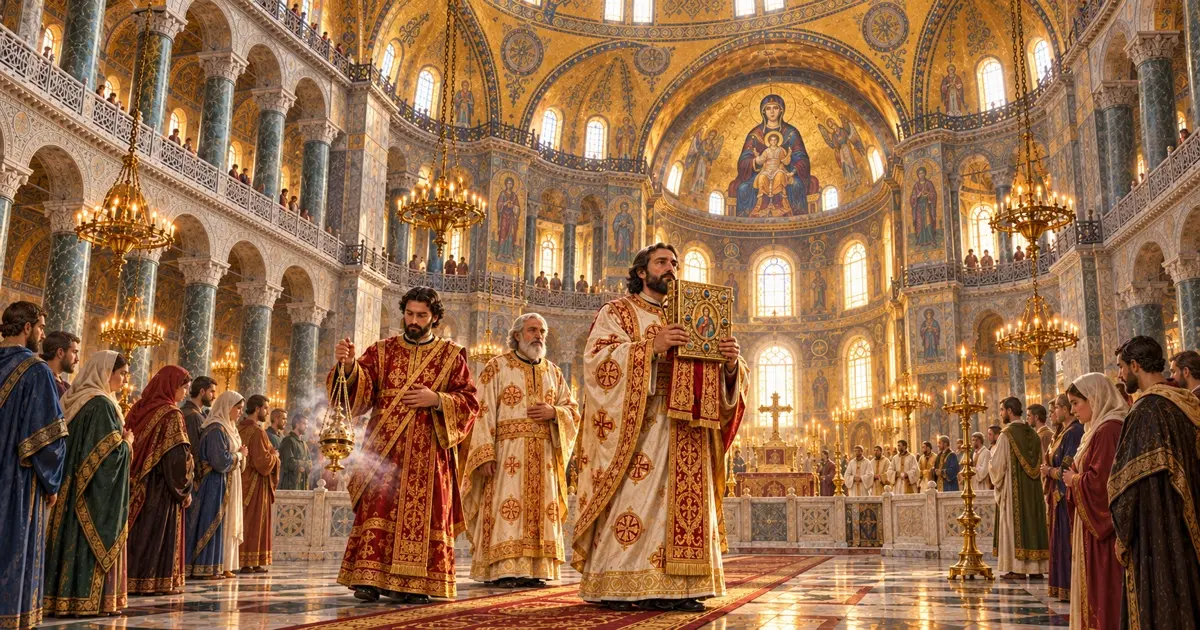
In the year 987, Prince Vladimir of Kiev, who still worshipped idols, sent a few trusted men to see how the peoples around him prayed. Their journey brought them to Constantinople, the capital of the Eastern Roman Empire, the city we call Istanbul today. In the old chronicle of Rus’, known as the Tale of Bygone Years, it is written that the emperor sent word to the patriarch to prepare the church and the clergy and to array himself in his vestments, so that the guests might see the glory of God. The patriarch gathered the clergy and the service was celebrated as on a great feast: incense was offered and the choirs sang. The envoys stood at this service in Hagia Sophia, the patriarch’s church and the largest in the city. When they returned home, they told the prince:
“We knew not whether we were in heaven or on earth. For on earth there is no such splendor or such beauty, and we are at a loss how to describe it. We only know that God dwells there among men […]. For we cannot forget that beauty.”
Every Orthodox Christian is called to the same meeting with God at every Liturgy, even if not all of us live it with the wonder the envoys of Vladimir confessed. Constantinople fell in 1453, and Hagia Sophia has long ceased to be a church. Yet the Liturgy that was celebrated beneath its dome is celebrated today throughout the Orthodox world, in Greek and in Slavonic, in Romanian and in Arabic, in Georgian and in English. Many of its hymns and rites were born in the streets of that city, in its days of earthquake and siege, and at the court of its emperors. We hear them almost every week, most often without knowing where they come from.
The Liturgy was not born in Constantinople. It begins on the evening of the Mystical Supper, when Christ “took bread, and gave thanks, and brake it, and gave unto them, saying, This is my body which is given for you: this do in remembrance of me” (Luke 22:19). The Apostles and the Churches of Jerusalem, Antioch, Alexandria and Rome celebrated it long before the City existed. The prayers of the two Liturgies we serve today came from Cappadocia, from St Basil, and, according to scholars, from Antioch, where St John Chrysostom had been a priest. In Constantinople, however, the Liturgy reached its fullest splendour. The patriarchs, the emperors, the chanters, the monks and the people of the City each brought something to it: a hymn, a rite, a procession, a prayer. Hagia Sophia remained the symbol of this Liturgy, and from the City it passed to the peoples who received from there the faith and the order of the services.
In this article
The City and the Great Church
St Constantine the Great, whom the Church honours as “equal to the Apostles”, built the city on the site of the old Greek settlement of Byzantium and dedicated it on 11 May 330. The Greek Synaxarion, the book in which the Church gathers the commemorations of each day, still keeps this date and calls it the “birthday” of the City. There, too, we read that St Constantine dedicated the new city to the Mother of God. The city would come to be called New Rome, but its inhabitants simply called it the City (in Greek, i Polis), without adding any other name. The Greeks still call it so today. Anyone setting out for it said he was going “to the City”, in everyday speech stin Poli. Foreigners heard these words often and took them for the name of the city. As early as the tenth century, the Arab historian al-Masudi wrote that the Greeks called it “Stanbulin”. The Turks pronounced the name in the manner of their own language, which does not allow a word to begin with “st”, and put an “i” in front of it. So the name Istanbul was born. For a long time, however, the Ottomans also used the name Kostantiniyye, that is, Constantinople, in official documents, and Istanbul became the only official name as late as 1930.
The largest church of the City was raised by the Emperor Justinian between 532 and 537, after the older church on the same site had burned down in a riot. St Menas, Patriarch of Constantinople, consecrated it on 27 December 537, in the presence of the Emperor Justinian. The Greeks called it the Great Church. Its name, Hagia Sophia (“Holy Wisdom”), does not come from a saint called Sophia. The Greek word sophia means “wisdom”, and the church was dedicated to the Wisdom of God, Who is Christ. Preaching Christ crucified, the holy Apostle Paul writes: “But unto them which are called, both Jews and Greeks, Christ the power of God, and the wisdom of God” (1 Corinthians 1:24).
The historian Procopius of Caesarea, who saw the church in the days of Justinian, wrote that its golden dome seems not to rest upon solid masonry but to be suspended from heaven. He also left a testimony of what a man experienced when he entered it to pray:
“And whenever anyone enters this church to pray, he understands at once that it is not by any human power or skill, but by the influence of God, that this work has been so finely turned. And so his mind is lifted up toward God and exalted, feeling that He cannot be far away, but must especially love to dwell in this place which He has chosen.” (Buildings I.1.61)
At the altar of the Great Church the two Liturgies that the Church still celebrates today were served. For a long time the ordinary Liturgy of the City was that of St Basil the Great, which today is served ten times a year. Gradually, around the tenth and eleventh centuries, the Liturgy of St John Chrysostom, who had himself been Archbishop of Constantinople, became the ordinary one. The prayers of the Liturgy of St Basil are much longer, and the shorter Liturgy of St John seems to have been served first on weekdays and then to have taken the place of the other. The Liturgy of St Basil remained for the great days: the first five Sundays of Great Lent, Holy Thursday and Holy Saturday, the Nativity and the Theophany of the Lord, on the eve or, according to the rubrics, on the feast day itself, and the feast of St Basil on 1 January.
Some two centuries after the church was built, St Germanus, Patriarch of Constantinople from 715 to 730, wrote a commentary on the service he celebrated at the altar of the Great Church. In its opening lines he wrote: “The church is an earthly heaven in which the super-celestial God dwells and walks about.” What the envoys of Vladimir would later experience, St Germanus had already put into words.
The Liturgy Set Out from the Streets of the City
In Constantinople the Liturgy was not always celebrated in the same church. On many feasts and commemorations the patriarch set out, with the cross carried before him, together with the clergy, the people and often the emperor and his court, towards the church where the service of that day was appointed. In the order of the Great Church in the tenth century, more than sixty such processions are listed for the year. Along the way psalms were sung, and after each verse the people answered with a short refrain, always the same. Psalms sung in this way, with a refrain that is repeated, are called antiphons. From the chants of these processions the three antiphons with which the Liturgy still begins were formed.
When the procession reached the church, the clergy and the people entered together, and the holy Gospel was carried before them. With this entrance the Liturgy once began, and the antiphons were placed before it later. In the Book of Ceremonies compiled at the court of the Emperor Constantine VII, the service of the Sunday of Orthodoxy is described, a feast established in the City in 843, when the veneration of the holy icons was restored. On this feast the emperor stood beside the patriarch at the doors of the church while the patriarch said the prayer of the entrance. The prayer of the entrance is still said today. In it the priest asks that, together with the entrance of the celebrants, there may be an entrance of holy angels, serving and glorifying together with them.
The priest makes the same entrance at every Liturgy: he comes out of the sanctuary with the Gospel through the north door and enters again through the Royal Doors. This is called the Little Entrance, and the chanters then call everyone: “Come, let us worship and bow down before Christ.” St Maximus the Confessor, who interpreted the Liturgy in the seventh century, saw in the first entrance of the bishop into the church an image of the first coming of Christ into the world in the flesh.
At the end of the second antiphon the hymn “Only-begotten Son” is sung. The tradition of the Church links it with the name of the Emperor Justinian, who raised Hagia Sophia, and for this reason it is also called “Justinian’s hymn”. In a few lines it confesses the faith concerning Christ:
“Only-begotten Son and Logos of God, being immortal, You condescended for our salvation to take flesh from the holy Theotokos and ever-virgin Mary and, without change, became man. Christ, our God, You were crucified and conquered death by death…”
The name of the emperor who raised the house of stone is linked to this hymn as well, and the hymn has travelled farther than the walls.
The Hymn a Child Heard
In the usual order of the Liturgy, before the reading of the Epistle, the faithful sing three times: “Holy God, Holy Mighty, Holy Immortal, have mercy on us.” This hymn is called the Trisagion, that is, “thrice-holy”. The Church keeps the memory of its beginning in the Menaion for September, the book containing the services of that month. On 25 September we find there “the commemoration in remembrance of the great earthquake, in which a child was caught up into the air”.
In the Synaxarion of the day it is told that, in the days of the Emperor Theodosius the Younger, a terrible earthquake shook the City. All the people went out of the city into the fields, together with the emperor, with St Proclus the Patriarch and with all the clergy, and made a litany, that is, a prayer in procession. Suddenly a little child was caught up into the air, and after a while “the little child came down again, sitting as if on a small cloud, and said with a loud voice that the hosts of angels sing the thrice-holy praise”. The people began to sing the words the child had heard. “And straightway, with these words, the little child gave up his soul to God, and the earthquake ceased.”
St John of Damascus also records, in his Exact Exposition of the Orthodox Faith, that in the time of St Proclus a child was caught up from among the people and taught this hymn by the angels, and that at the Fourth Ecumenical Council, at Chalcedon, it was sung in this form. With these words, which, according to the testimony kept in the Synaxarion, the child heard from the angels, the Church prays at the Liturgy, and every Christian says them at home as well, at the beginning of the morning and evening prayers.
The City passed through many earthquakes, and the Church has not forgotten them. Others are commemorated in the Menaia on 26 January, on 17 March and on 26 October, when the calendar has, beside the holy Great-martyr Demetrius, “the commemoration of the great and terrible earthquake”. On these days the inhabitants of Constantinople went out in procession through the city, with prayers of repentance and of thanksgiving. These processions were called litai, from the Greek word lite, “earnest supplication”. The order of the Litia (Lity) at the Vespers of feasts was shaped in part by them. At the Litia the celebrants come out of the sanctuary into the narthex, the part of the church nearest the entrance, and pray for the city or village where the church stands, that it may be delivered from famine, disease, earthquake, flood, fire and the sword.
The King of All
After the Gospel and the prayers that follow it comes the second entrance of the Liturgy. The bread and wine for the Sacrifice are prepared at the beginning of the service, at the proskomedia, the service of preparation, on a table on the left side of the sanctuary. In the Great Church the gifts were prepared in a round building, older than Justinian’s church, called the skeuophylakion, that is, “the place where the sacred vessels are kept”. The building still stands today, beside the north-east side of Hagia Sophia. From there the deacons brought the gifts in procession to the holy Table. From this procession the Great Entrance has been preserved, when the priest and the deacon come out of the sanctuary with the diskos and the chalice and enter through the Royal Doors.
Around the year 574, in the days of the Emperor Justin II, Justinian’s nephew, it was ordained that this procession should be accompanied by a new hymn. This is the Cherubic Hymn, so called because it begins with the Cherubim:
“Let us, who mystically represent the Cherubim and who sing the thrice-holy hymn to the life-creating Trinity, now lay aside every worldly care. So that we may receive the King of all, Who is invisibly escorted by the angelic hosts. Alleluia. Alleluia. Alleluia.”
The inhabitants of the City knew what it meant to receive an emperor. They saw him pass through the streets surrounded by his guard, with spear-bearers on either side. The Greeks called these soldiers doryphoroi, and the Greek word in the Cherubic Hymn rendered in English as “escorted” comes from their name: it means “attended by a guard, like an emperor”. Singing the Cherubic Hymn, the faithful prepare to receive the King of all, Whose guard is the angelic hosts, unseen by our eyes. For such a King it is fitting that every worldly care be laid aside.
The gifts carried at this entrance are still the bread and wine prepared for consecration. The Cherubic Hymn prepares us for the offering of the Sacrifice and for the moment when we shall receive Christ in Holy Communion. While the chanters sing it, the priest prays quietly and confesses that Christ is both the One Who offers the Sacrifice and the Sacrifice itself: “For You are the One Who both offers and is offered, the One Who is received and is distributed, O Christ our God.” The King Whom the Church receives is the One Who gives Himself for the life of the world.
After the Cherubic Hymn comes the heart of the Liturgy: the eucharistic prayer, called the anaphora (a Greek word meaning “offering up”), which the Great Church prayed in the words of St Basil and of St John Chrysostom. In it the Church gives thanks to the Father for the salvation granted through the Son and calls down the Holy Spirit upon those gathered and upon the Gifts set forth. The bread and wine are changed into the Body and Blood of Christ, and the faithful are called to be united with Him in Communion. This Mystery unites the Christians of today with those who once prayed in the Great Church.
What Remained from the Imperial Court
In Constantinople the emperors’ palace and the Great Church stood close to one another, and a number of court customs entered the services of the Church and remained in them after the Empire had perished.
Before the Trisagion, the deacon comes out through the Royal Doors and, pointing with his orarion, the long stole he wears over his shoulder, towards the icon of the Saviour and then towards the people, says: “O Lord, save the pious.” In the order of the patriarchal Liturgy of the fourteenth century, the acclamations for the emperors ended at this point with the deacon’s cry: “Lord, save the emperors.” After the fall of the City, in place of the emperors there remained the pious, that is, all who stand in church in the right faith.
The acclamation “Eis polla eti, Despota” (“Many years, Master”), with which the chanters greet the bishop, has its roots in the acclamations of “many years” with which the court and the people hailed the emperor. This chant is called the polychronion, that is, “the wish of many years”.
The sakkos, the bishop’s great outer vestment, also comes from the dress of the court. The emperors first granted it to the patriarchs, in the eleventh and twelfth centuries, and after the fall of the City it became, in time, the vestment of all bishops.
On the eve of the Nativity of the Lord, on the eve of Theophany and on Great Friday, the Great Hours are read. Their order came from Jerusalem, but in Constantinople they were celebrated in the presence of the emperor and ended with the acclamation of many years for him. In Greek books they are called simply the Great Hours. The name “Royal Hours” arose later in Slavonic books and passed from there into other languages, including English, and it preserves the memory of the emperors who stood at these services.
O Champion General
In the summer of 626, the City that St Constantine had dedicated to the Mother of God was surrounded by Avars, Slavs and Persians. The Emperor Heraclius was far away, at war with the Persians, and the city had been left in the care of Patriarch Sergius. In the Synaxarion of the Saturday of the Akathist it is told that the patriarch went around the walls together with the people, carrying the icons of the Mother of God, the image of the Saviour not made by hands, the wood of the holy Cross and the Robe of the Mother of God. A storm arose on the sea and shattered the enemy’s ships, and those cast ashore near the church of Blachernae were destroyed by the defenders of the City. Then, all night long, the people sang hymns of thanksgiving to the Mother of God without sitting down. For this reason the service received the name Akathist, a Greek word meaning “not seated”, because all the clergy and all the people stood.
The Akathist Hymn is older than this siege. The kontakion with which it begins, a short stanza often sung on its own, is the City’s thanksgiving for its deliverances. All three are commemorated in the Synaxarion: the siege of 626 and the sieges of the Arabs in the days of the Emperors Constantine Pogonatus and Leo the Isaurian. In the verses that open the commemoration of the day, too, it is the City that sings: “With sleepless hymns, in thanksgiving, the City praises its Protectress, who keeps vigil in battles.” Almost all the faithful know this kontakion by heart:
“O Champion General, we your faithful inscribe to you the prize of victory as gratitude for being rescued from calamity, O Theotokos. But since you have invincible power, free us from all kinds of perils so that we may cry out to you: Rejoice, O Bride unwedded.”
In the Greek original, the one who speaks in the kontakion is the City herself. Translated word for word, its opening runs: “To you, the Champion General, the songs of victory; and, as one delivered from dangers, I, your City, inscribe to you the songs of thanksgiving, O Theotokos.” Further on, the City prays: “free me from all kinds of dangers, that I may cry to you: Rejoice, O Bride unwedded!” In Slavonic and in Romanian, “your City” became “we, your servants”, and many English renderings follow them; the rendering quoted above has “we your faithful”. So every Christian who sings this kontakion today, wherever he may be, gives thanks to the Mother of God with the voice of the City she defended.
The City kept with reverence the Robe and the Sash of the Mother of God. The Robe was kept in the church of Blachernae, and the Sash in the church of Chalkoprateia, the quarter of the copper merchants. The Church still celebrates the placing of each in its reliquary: the Robe on 2 July, the Sash on 31 August. In the same church of Blachernae, as is told in his Life, St Andrew the Fool for Christ saw the Mother of God spreading her protecting veil over those at prayer. The commemoration of this vision was established as a feast in Rus’, according to tradition in the twelfth century, and from there it entered the calendar of many Orthodox Churches, on 1 October, as the feast of the Protection of the Mother of God.
On the eve of 1 August, the wood of the holy Cross was brought out of the treasury of the palace and taken to the Great Church, and in the following days it was carried through all the quarters of the city, to guard it from the sicknesses that often raged in that month. In the Menaion for July there still stands, on 31 July, the forefeast of the Cross, “that is, the bringing out of the precious Cross from the imperial palace into the city”. Day after day, the calendar of the Church carries within it the prayers of a city that lived under the protection of the Mother of God and under the sign of the Cross.
The Liturgy That Never Stopped
On the morning of 29 May 1453, the armies of Sultan Mehmed II entered the City. Hagia Sophia was turned into a mosque. In the last century it became a museum, and in 2020 it became a mosque again.
About the fall of the City, the Greeks also kept a popular legend. According to it, the Liturgy was being celebrated in Hagia Sophia when the soldiers entered the church. The priest who was holding the Holy Gifts went up to the wall of the sanctuary, and the wall opened, received him and closed behind him. In this legend the priest was to come out and finish the Liturgy when the City had become Christian once more.
Those who told the legend waited for the day when the Liturgy in Hagia Sophia would be brought to its end. Meanwhile, the Liturgy of the City did not stop for a single day. It was celebrated in the monasteries of the Holy Mountain of Athos and in the churches of the peoples who had received the faith from Constantinople, and today it is celebrated from Alaska to Australia, in languages the inhabitants of the City never heard.
The grandeur of former times did not return. In 535, Justinian decreed that the Great Church, together with the three churches attached to it, should have no more than sixty priests, a hundred deacons, forty deaconesses, ninety subdeacons, a hundred and ten readers and twenty-five chanters, besides a hundred doorkeepers. The clergy served these churches in turn, passing from one to another. The number was a limit set for the future, because the clergy were even more numerous at that time. The decline, however, had begun before the fall. In the last centuries of the Empire the City had grown poor, and the sung office of the cathedral gave way more and more to the order of the monasteries, which had come from Jerusalem. In the fifteenth century St Symeon of Thessalonica still kept it in the Hagia Sophia of Thessalonica, almost as an exception.
Under Ottoman rule many communities served in poverty, and the public life of the Church was restricted in different ways, according to place and time. Later, in the eighteenth and nineteenth centuries, the old chant gave way in many places to harmonized choirs, after the taste of the age, and iconography took on naturalistic influences. The same Mystery, however, continued to be celebrated, with the inherited prayers and order, which also developed with time. The all-night vigils were preserved in the monasteries, and in the eighteenth century St Nikodemos the Hagiorite and those around him called the faithful once again to frequent Communion. In the last century the Church began to return to Byzantine chant and to the Byzantine icon.
Another change, older than the fall, concerned the way in which the faithful could follow the eucharistic prayer. The prayers of the Sacrifice had begun to be said inaudibly, and in 565 Justinian ordered bishops and priests to say them so that they could be heard by the people. Also with time, and for other reasons, the faithful in many places came to receive Communion rarely. The beauty that amazed the envoys of Vladimir was not, however, a spectacle. It was the image of heaven, and a Liturgy celebrated with reverence and sung with care in a village church can be closer to what they experienced than a lavish but hurried one.
On Sunday, when the priest comes out with the Gospel, when the chanters sing “Holy God” and the Cherubic Hymn, the faithful take part in the same Holy Eucharist, in the liturgical tradition that the envoys of Vladimir knew and that was enriched in the centuries that followed. They pray together with the child who heard the hymn of the angels, with the people who stood a whole night giving thanks to the Mother of God, and with the holy patriarchs who served in the Great Church.
Every Liturgy begins with the same blessing: “Blessed is the Kingdom of the Father and of the Son and of the Holy Spirit, now and forever and to the ages of ages.” The City of the emperors has passed away, but this Kingdom does not pass. Towards it the Liturgy carries us, according to the word of the Apostle: “But ye are come unto mount Sion, and unto the city of the living God, the heavenly Jerusalem, and to an innumerable company of angels” (Hebrews 12:22).
Hagia Sophia was built for the Wisdom of God, and its walls have passed into strangers’ hands. Yet Christ, to Whom it was dedicated, is present at every Liturgy, wherever it is celebrated, and gives Himself to the faithful in Holy Communion. There, as on the day the envoys of Vladimir entered, God dwells among men.
Sources
- The Tale of Bygone Years (Russian Primary Chronicle), year 6495 (987). Quoted in the translation of S. H. Cross and O. P. Sherbowitz-Wetzor, The Russian Primary Chronicle (Cambridge, Mass., 1953).
- Procopius of Caesarea, Buildings I.1.46 and 61, trans. H. B. Dewing (Loeb Classical Library, 1940).
- St Germanus of Constantinople, Ecclesiastical History and Mystical Contemplation, ch. 1, trans. P. Meyendorff, St Germanus of Constantinople on the Divine Liturgy (Crestwood, NY, 1984).
- St Maximus the Confessor, Mystagogy, ch. 8.
- St John of Damascus, An Exact Exposition of the Orthodox Faith III.10.
- The Divine Liturgy of Saint John Chrysostom, English translation of the Greek Orthodox Archdiocese of America (goarch.org): the opening blessing, “Only-begotten Son”, the entrance hymn, the Trisagion, the Cherubic Hymn and the priest’s prayer during the Cherubic Hymn. “O Lord, save the pious”: English text of the Divine Liturgy published on ponomar.net.
- Liturghierul (Romanian Liturgikon, Bucharest, 2012): the rubric for “Lord, save the pious”.
- Kontakion of the Akathist: English text as published by the Greek Orthodox Metropolis of Atlanta (atlmetropolis.org); Greek original after the Greek Triodion; the word-for-word translation is our own.
- Romanian Menaia: September (Bucharest, 1986), 25 September; October (1929), 26 October; July (1928), 31 July; January (1926), 26 January; March (1930), 17 March. The quotations are translated from the Romanian.
- Synaxarion of the Saturday of the Akathist (Triodion). The verses of the Synaxarion are translated from the Greek.
- Greek Synaxarion, 11 May: the commemoration of the “birthday” of Constantinople.
- Holy Scripture, King James Version: Luke 22:19; 1 Corinthians 1:24; Hebrews 12:22.
- Constantine VII Porphyrogennetos, The Book of Ceremonies, trans. A. Moffatt and M. Tall (Canberra, 2012), p. 158: the service of the Sunday of Orthodoxy.
- Typikon of the Great Church (tenth century), ed. J. Mateos, Le Typicon de la Grande Église (Rome, 1962–1963): the processions of the City.
- V. Pechatnov, Божественная литургия в России и Греции (The Divine Liturgy in Russia and Greece), ch. 5 (azbyka.ru): the acclamations for the emperors in the order of the patriarchal Liturgy of the fourteenth century.
- E. Diakovsky, Царские часы Рождества Христова и Богоявления (The Royal Hours of the Nativity and Theophany) (Kiev, 1908).
- W. T. Woodfin, The Embodied Icon: Liturgical Vestments and Sacramental Power in Byzantium (Oxford, 2012), p. 26: the sakkos.
- A. A. Vasiliev, History of the Byzantine Empire (Madison, 1952): the legend of the priest in the wall.
- Justinian, Novel 3 (535): the number of clergy of the Great Church and of the three churches attached to it; Novel 137 (565): the audible saying of the prayers of the Sacrifice.
- S. Parenti, “The Cathedral Rite of Constantinople: Evolution of a Local Tradition”, Orientalia Christiana Periodica 77 (2011): the passage from the sung office of the cathedral to the order of the monasteries.
