
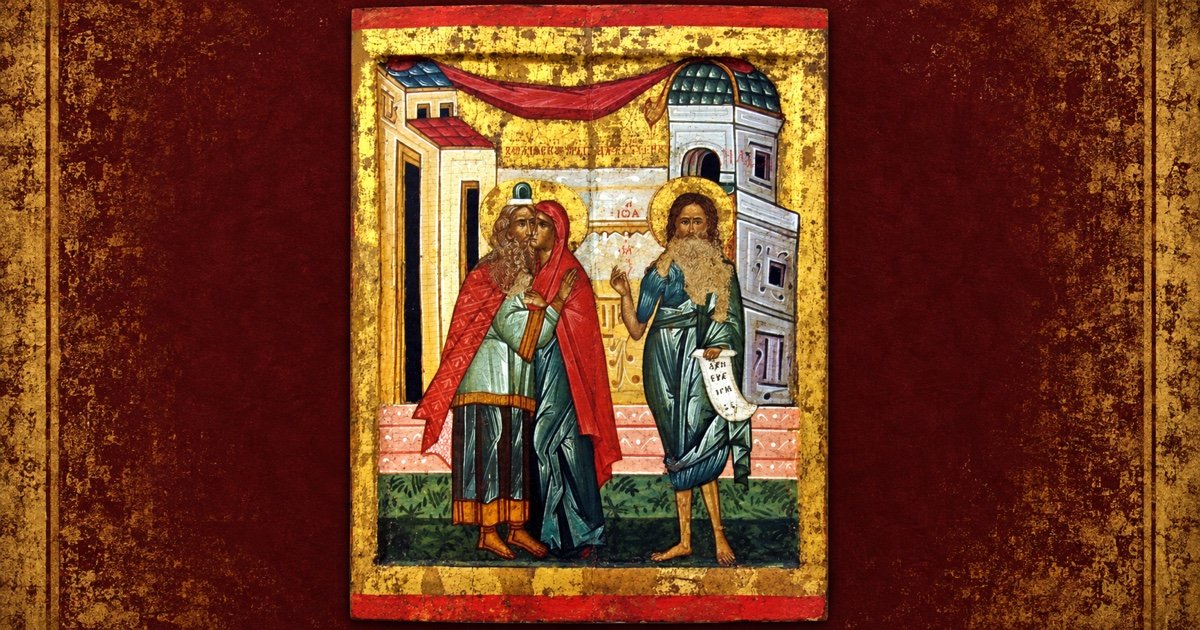
On 23 September, the Orthodox Church celebrates the conception of the Holy Prophet John the Baptist. On this day she commemorates the moment when Righteous Elizabeth, the wife of the priest Zacharias, conceived the child whom the Archangel Gabriel had announced in the Temple at Jerusalem. This feast goes together with the Nativity of Saint John, which we celebrate on 24 June. At his nativity, the Church rejoices that John has come into the world. Today she rejoices in the beginning of his life, still hidden in his mother’s womb.
Three Conceptions the Church Celebrates
Every human being begins life in the mother’s womb, and yet the Church does not usually celebrate the conception of the saints. Most of them she commemorates on the day of their repose. The Lives of the Saints, under 23 September, show how rare today’s honour is: many mothers conceive sons, but few are those whose conception the Church celebrates. In the calendar used throughout the Church there are three, and the Lives of the Saints name them one by one: “Righteous Anna conceived the Theotokos; Elizabeth, the Forerunner; and the Virgin Mary, Christ our Saviour.”
Each of these conceptions has its own day in the calendar. The Conception of the Theotokos by Saint Anna is celebrated on 9 December. The conception of Saint John is celebrated today. The conception of the Lord in the Virgin’s womb is the Annunciation, on 25 March.
The three conceptions are alike, but they are not of the same kind. Anna and Elizabeth were barren and had reached old age. God heard their prayer and loosed their barrenness, and their children were conceived of their husbands, according to the order of nature. The miracle lay in the gift of bearing a child, granted to women who could no longer bear. The Most Holy Virgin conceived the Son of God without seed of man, of the Holy Spirit. Anna and Elizabeth conceived human beings who were then beginning to exist. The Son of God is from eternity, and in the Virgin’s womb His human life began, through the assumption of our nature. This is the miracle beyond nature, and the other two prepare for it.
The link between them is made by the Archangel Gabriel himself. When he announces to the Virgin at Nazareth that she will bear the Son of the Highest, and she asks how this shall be, the angel gives her a sign from the house of Zacharias: “And, behold, thy cousin Elisabeth, she hath also conceived a son in her old age: and this is the sixth month with her, who was called barren. For with God nothing shall be impossible” (Luke 1:36-37).
Where the Gospel of Luke Begins
The holy Evangelist Luke, after a few opening words to Theophilus, begins his narrative with this conception. Zacharias, an aged priest of the course of Abia, goes into the Temple to burn incense, while the people pray outside. Then the angel of the Lord appears to him, standing on the right side of the altar of incense, and says: “Fear not, Zacharias: for thy prayer is heard; and thy wife Elisabeth shall bear thee a son, and thou shalt call his name John” (Luke 1:13). This is the first good news the reader of the Gospel hears, and it concerns a child not yet conceived.
The Gospel then links the two annunciations by a count of months: “And in the sixth month the angel Gabriel was sent from God unto a city of Galilee, named Nazareth” (Luke 1:26). The Church’s calendar expresses this link between the coming of the Forerunner and the Incarnation of the Lord by placing the feasts at intervals of roughly six and nine months. From 23 September to the Annunciation on 25 March is about six months. The Nativity of Saint John, on 24 June, comes about nine months after his conception, and the Nativity of the Lord, on 25 December, about six months after the nativity of the Forerunner. The Gospel does not name the day of the year on which Elizabeth conceived John. The date of 23 September is the day on which the Church commemorates this conception.
The Church year begins on 1 September. In its first month, the calendar commemorates the Holy Prophet Zacharias and Righteous Elizabeth on 5 September; it celebrates the Nativity of the Theotokos on 8 September, and on the following day her parents, Saints Joachim and Anna; and, on 23 September, the conception of John. The Church year thus opens with the remembrance of those through whom God directly prepared the coming of His Son in the flesh.
Five Months Hidden
What happened after the vision in the Temple, the Gospel tells in two verses: “And after those days his wife Elisabeth conceived, and hid herself five months, saying, Thus hath the Lord dealt with me in the days wherein he looked on me, to take away my reproach among men” (Luke 1:24-25).
The reproach of which Elizabeth speaks was her childlessness. Among the people of Israel, a woman without children bore this lack as a shame before others, and Elizabeth had borne it into old age. Yet this shame belonged to the eyes of men. Childlessness did not mean that Elizabeth was less loved by God, for the Gospel calls her and Zacharias righteous even before their barrenness was taken away: “And they were both righteous before God, walking in all the commandments and ordinances of the Lord blameless” (Luke 1:6).
Now God had taken away her reproach. Elizabeth did not go out at once among people to show them the gift she had received. She hid herself for five months. The Gospel does not say why. It says only what she was saying during this time, and her words are nothing but thanksgiving.
During these months Zacharias could not speak. He had come out of the Temple mute, because he had not believed the angel’s words. He who would later call the people to repentance began his life in the time of his father’s muteness and his mother’s withdrawal.
Elizabeth’s withdrawal can teach us not to seek at once the approval of others for the gifts we receive from God. Joy can also be lived in secret, before the One who gave it, and the first word spoken about a gift can be the thanksgiving offered to Him.
After these months of withdrawal, the Gospel narrative brings us to the meeting of Elizabeth with the Virgin Mary. The Virgin had learned from the Archangel Gabriel that Elizabeth was with child. After the Annunciation, she went with haste into the hill country, to the house of Zacharias, and when she greeted Elizabeth, “the babe leaped in her womb; and Elisabeth was filled with the Holy Ghost” (Luke 1:41). John met the Lord with joy while still in his mother’s womb. Elizabeth herself bears witness: “For, lo, as soon as the voice of thy salutation sounded in mine ears, the babe leaped in my womb for joy” (Luke 1:44). Of this work of the Holy Spirit in John, even before his birth, we have written at length in the article on his nativity.
The Lamp of the Sun
For today’s feast the Church has given us a short troparion, which holds the whole teaching of the day:
Be glad, O barren one who has not given birth until now, for behold, you have conceived the lamp of the Sun, and He shall enlighten all the earth, which is afflicted with blindness. Dance, O Zachariah, and cry out with boldness: The Prophet of the Most High is about to be born.
The Sun is Christ. John is the lamp, the light kindled in the house while it is still night. The earth was “afflicted with blindness”: it suffered from the darkness of sin and needed the full light of God’s revelation in Christ. Zacharias himself would sing, after the birth of his son, of the Dayspring from on high, who came “to give light to them that sit in darkness and in the shadow of death” (Luke 1:79). The lamp does not compete with the Sun. John does not hold people to himself but leads them to Christ, the true Light.
The troparion also calls the parents to joy. Elizabeth, the “barren one who has not given birth until now”, is told to be glad. And of Zacharias, the priest who had come out of the Temple mute, the hymn says that he dances and cries out. The Gospel shows that his tongue remained bound until the day the child received his name. The hymn does not narrate gestures made on the day of the conception. It hears in advance the joy that Zacharias would sing after the birth, when he said to his son: “And thou, child, shalt be called the prophet of the Highest” (Luke 1:76).
The kontakion of the feast says the same in other words:
The great and renowned Zachariah rejoices radiantly, and exults with his wife Elizabeth; for worthily does she conceive John the Baptist, whom the Archangel announced joyously, and men honor as an initiate of grace.
The kontakion calls John an “initiate of grace”, that is, one to whom the mystery of grace was entrusted and who serves it. He was to baptize at the Jordan the One who brings grace into the world, and to show Him to the people. The Church looks upon his conception in the light of this ministry.
Why We Honour the Beginning
The commemoration of a saint is usually tied to his repose. For the Forerunner, the Church celebrates both his conception and his nativity. She looks upon these beginnings in the light of his whole life and of his unique ministry, which was to prepare the coming of Christ.
John was announced before he was conceived. The Archangel spoke his name and said of him: “For he shall be great in the sight of the Lord, and shall drink neither wine nor strong drink; and he shall be filled with the Holy Ghost, even from his mother’s womb” (Luke 1:15). The first movement of his that we know from the Gospel is a leap of joy before the Lord. Yet the gift received at the beginning did not take away his freedom. John fulfilled his calling through his whole life: through his ascetic struggle in the wilderness, through his preaching, through obedience and, at the end, through martyrdom.
Today’s feast calls us to look with reverence upon the house in the hill country of Judaea: a priest who could not speak, an aged woman withdrawn from the eyes of men, and a child not yet seen. Far from the sight of the crowds, in this house the coming of the Forerunner was being prepared, and through him the coming of the Lord. There the promise began to be fulfilled which God had made to Abraham and proclaimed through the prophets, and which Zacharias would recall in his song.
Holy Prophet John, Forerunner and Baptist of the Lord, who were given to the world through the prayer of your parents and met Christ with joy while still in your mother’s womb, pray to God for us.
Related Articles
- Why the Church Celebrates the Nativity of Saint John the Baptist — the feast of 24 June and the rare rule of birthdays kept as feasts.
- Holy Prophet Zachariah and Righteous Elizabeth, Parents of the Forerunner — the righteous parents of the child announced by the Archangel Gabriel.
- The Nativity of the Mother of God, the Beginning of Our Salvation — the feast that opens the great feasts of the Church year.
- Saint Joachim, Father of the Theotokos — the prayer and endurance of parents who received a child in old age.
Image: The Conception of Saint John the Baptist, anonymous Russian icon from the second half of the fifteenth century, Andrei Rublev Central Museum; public domain, via Wikimedia Commons. Format adapted for OrtodoxWay.