
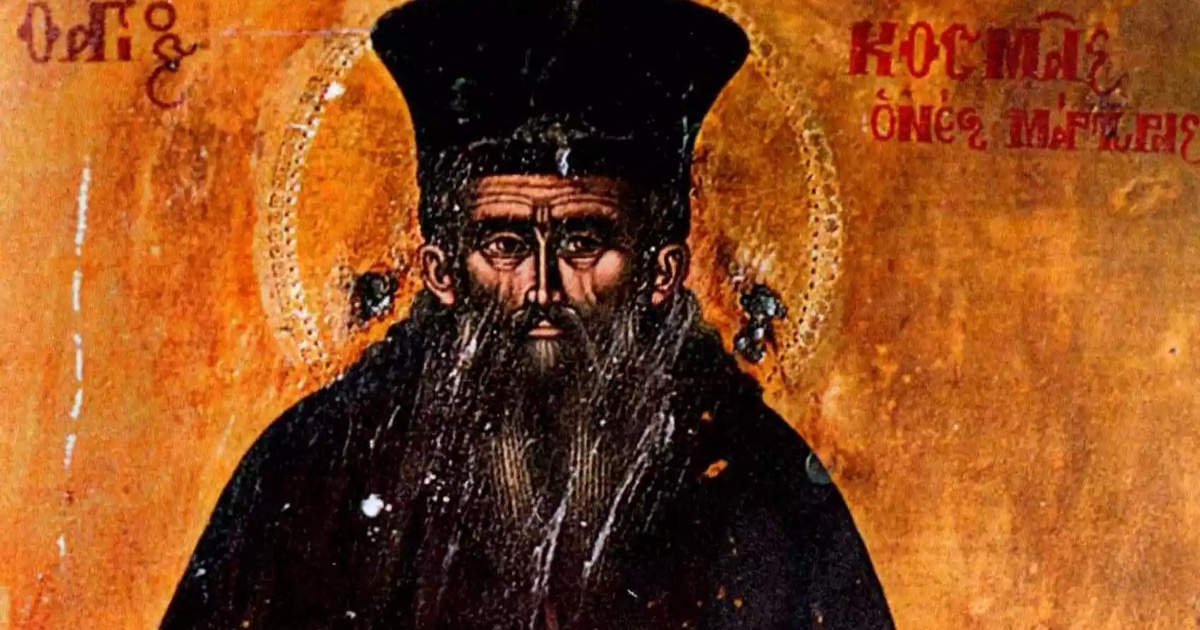
On the morning of 24 August 1779, near the village of Kolikondasi, not far from the town of Berat in present-day Albania, the men of Kurt Pasha took the hieromonk Kosmas the Aetolian to the bank of the River Apsos and strangled him with a rope. They threw his body into the water. He had been detained the day before, on 23 August, when he went in person to the local hodja to ask permission to preach. We have no record of any charge brought against him, nor of any trial.
He was about sixty-five years old. He had spent the last two decades walking through the villages of Epirus, Macedonia, Thessaly, and Aetolia, and across the islands, preaching to the crowds that gathered to hear him and leaving schools behind him.
His end does not resemble that of most of the New Martyrs of his century. The accounts of martyrdom from that period almost all preserve the same order: the accusation, the summons to renounce the faith, the judgement, the confession before the judge. Nothing of that order remains here. A man was seized after preaching and killed the next morning, as though an obstacle were simply being removed.
A Christian may be judged dangerous without having plotted anything against the authorities; that has been known since the Acts of the Apostles. The question is another: what was this monk doing that the authorities found it easier to silence him than to try him?
Constantine, the weaver’s son
He was born around 1714 in the village of Mega Dendron in Aetolia, in the district of Apokouro. His baptismal name was Constas — Constantine. His father, Demetrios, was a weaver.
The date of his birth comes not from a document but from a calculation: Saint Nikodemos the Hagiorite, the author of the first printed Life, writes that he was killed in 1779 at the age of sixty-five. Hence 1714.
He learned his letters late, at about twenty years of age, in the schools of Parnassida and Nafpaktia, under the hierodeacons Gerasimos and Ananias. He then taught in the villages of the region himself. His childhood need not be filled with prophetic signs: the sources closest to him give us none, and what follows can be understood without them.
Seventeen years on the Holy Mountain
He came to Athos, to the Athonite Academy at Vatopedi, together with other companions in study. He learned grammar and literature under Panagiotis Palamas and logic under Nikolaos Tzartzoulis of Metsovo, who directed the school after Eugenios Voulgaris. When the school emptied in 1759 with the departure of its teachers, he went to Philotheou Monastery, where he was tonsured a monk and received the name Kosmas. At the fathers’ urging, since the monastery needed a priest, he was ordained a hieromonk.
In the first of his surviving teachings he says of those years: “I remained on the Holy Mountain for seventeen years and wept for my sins.”
The number does not fit. Greek scholarship dates the foundation of the Athonite Academy to 1749 and places Kosmas among its students from the beginning; from then until his departure in 1759 there are about ten years, or somewhat more if his stay at Philotheou is included. The Romanian translation of the Life gives an earlier beginning in parentheses, which would almost close the gap, but that date is not confirmed elsewhere. The difference deserves to be left visible, not smoothed away.
What remains certain is that he left Athos after years of ascetic labour, not because of disappointment. His departure is not explained by weariness, but by the fact that what he had received there could no longer be contained within a single life.
That school was no ordinary place. Its first director was Hierodeacon Neophytos Kavsokalyvites, who a few years later would set the Kollyvades movement in motion; and the immediate occasion of that dispute, in 1754, during Kosmas’s own years of study, was a question concerning the liturgical observance of Sunday. Figures of the Philokalic movement would later emerge from the same school, but they belonged to the next generation, and Kosmas did not know them as teachers.
Nor was Philotheou a monastery without a history in this respect. Saint Dionysios of Olympus had left its abbacy to preach through Macedonia and Thessaly, and several others had done likewise before and after him. When Kosmas went out into the world, he was not doing something unheard of in his monastery.
Monk Moses the Hagiorite considers the connection between Saint Kosmas and the Philokalic revival to have received too little attention, while Metropolitan Amfilohije Radović goes further and calls him its forerunner. This is a theological reading, not a line of descent established by documentary evidence. It does, however, clarify what might otherwise seem an oddity of method: why a missionary required confession, fasting, vigil, and Holy Unction before opening his mouth. He had not invented an order of his own. He was carrying into the villages what he had lived on Athos.
The blessing of the Church
He did not leave on his own impulse. Nikodemos relates — in the customary manner of saints’ lives — that, measuring the weight of apostolic preaching and not daring to undertake it by himself, he opened Scripture and came upon the Apostle’s words: “Let no man seek his own, but every man another’s wealth” (1 Corinthians 10:24). What follows in the account matters more than the episode itself: he did not consider the sign sufficient assurance, but disclosed his thought to his spiritual fathers, received their blessing, and only then sought the Church’s permission.
He would later say himself why he left: “I left my own benefit, my own good, and went out to travel from place to place and teach my brethren.” Elsewhere, with a boldness that says everything about him: “Since our people had fallen into ignorance, I said: let Christ lose me, one sheep, and gain the others.”
Then he went to Constantinople, where his brother Chrysanthos, a teacher, was also living. Ecumenical Patriarch Seraphim II gave him permission and a blessing to preach. In 1760, at about forty-six years of age, he set out.
This detail places him where he belongs. Kosmas was not a wandering preacher working from his own enthusiasm and seeking his own justification. He asked the Church for leave to speak and received it from the hands of the Ecumenical Patriarch. Nor did he content himself with a single approval: in 1774–1775, Patriarch Sophronios II renewed his permission to preach. His work began with a patriarchal blessing and remained under it.
He kept this practice to the end. Nikodemos writes that wherever he arrived, he first sought permission from the local hierarch or his representatives, then sent Christians to obtain the same leave from the Ottoman authorities, and only afterwards preached. He never preached in secret. He died while still observing this order.
Twenty years on the road
His biographers divide his missionary journeys into three or four great itineraries, depending on how they distinguish the stages of his work. He crossed Thrace and Macedonia, went down into Aetolia and Acarnania, passed through Epirus, reached the Ionian Islands and the Cyclades, and in his final years worked chiefly in Himara and the lands of northern Epirus, in present-day Albania.
He went to poor and isolated communities where the services had become infrequent and where a priest was absent or no longer knew how to explain the faith. Epirus and southern Albania were at that time among the regions most deeply affected by conversions to Islam. He preached in market squares and cemeteries, beneath a tree, with a wooden cross planted beside him. When he left, he left the cross standing there.
He was watched. A Venetian report shows that on 18 April 1779 the agent Mamonas tried at Mavrolitari to discover what Kosmas sought through his preaching. Four months before his death, a monk who preached repentance was considered important enough to be investigated by a foreign power.
Ten Greek schools and two hundred schools of common learning
In March 1779, five months before his death, he made an account of his own work in a letter to his brother Chrysanthos: he had travelled through as many as thirty districts, founded ten Greek schools, and two hundred schools for common learning.
This is his own reckoning, ending in March 1779. Later tradition raised the figures to about 210 Greek schools and around 1,100 elementary schools. Those totals are not confirmed by his own record and would need to be established separately from other sources before being repeated.
The schools were free, and Nikodemos shows him working in small and practical ways: he collected money from the wealthy, bought books, and distributed them to those who could read or promised to learn. He did not content himself with exhortation. He sought teachers, raised the money, and attended to the building. In a letter to the inhabitants of Zalongo, he writes that he saw they had no school, that he urged the Christians and they gave what they could, and he asks the people themselves to help as well.
The purpose of these schools was clear to him:
“The school opens the churches; the school opens the monasteries.”
And elsewhere:
“It is better to have a school in your village than springs and rivers, for a spring waters the body, but a school waters the soul.”
He was not speaking about literacy in its modern sense. He himself says what is learned there: from school we learn what God is, what the Holy Trinity is, what angels and demons are, what Paradise and hell are, what virtue and sin are, what the soul and the body are. From school we learn what Holy Communion is, what Baptism is, what Holy Unction is, and what honourable marriage is. “For without school we walk in darkness.”
Faith does not depend on book learning — the Church has no shortage of saints without it. But where catechesis and understanding are absent, faith is left defenceless: it rests upon custom, and custom thins from one generation to the next. This is why he told parents that if they themselves had not learned, at least their children should learn.
This work also had a linguistic side, which he stated openly: children should learn Greek because the Church too was in Greek. The language of worship and the language of the school were the same, and from this comes the fact that the same work may be read by some as enlightenment and by others as Hellenisation.
What he taught
Saint Nikodemos the Hagiorite, who says that he heard Kosmas preach himself, writes that his speech possessed a perfect simplicity, like the speech of the fishermen, serene and calm. The surviving texts confirm his testimony. Kosmas did not construct treatises; he spoke about the Holy Trinity, repentance and confession, the Divine Liturgy and preparation for Communion, the priesthood, marriage and the raising of children, almsgiving, humility, the keeping of Sunday, and the school.
At the heart of his teaching stand two loves, which he always required together: “If we wish to call God our Father, we must first have two loves: love towards God and another love towards our neighbour.” The verse that had drawn him out of Athos asked the same thing, and he made it into a rule of life for people who had never opened a book.
His demands were very concrete. Whoever had wronged another was to restore the loss, without regard to the injured person’s faith. Whoever had wealth was to give from it to the poor. Sunday was to be kept. Children were to be baptised properly — and for this purpose he persuaded the wealthy to purchase more than four thousand large copper baptismal fonts for churches that had none. Children were to learn their letters.
The order in which he worked says more than the list. Forty or fifty priests followed him. When he arrived somewhere, he sent word beforehand that the people should confess, fast, and keep vigil. The priests served Holy Unction and anointed the people. Candles and bread were distributed. Only at the very end did the teaching come. His preaching never took the place of the Mysteries; it came after them.
He required much from priests as well. A man who wished to become a priest was to be pure as an angel; he was to learn Greek letters so that he could explain the Gospel and Scripture; he was to observe the ages laid down by the canons; and he was not to present himself, but to be called by the bishop. The same logic appears everywhere: whoever serves must understand what he serves.
He regarded himself as a sinner, and this was no mere formula. A sick Turkish official summoned him to give a blessing; Kosmas declined to go, saying that he was a sinner, and sent holy water instead, with two requests: the man was to give up drink and give a tenth of his wealth to the poor. The seventeen years of weeping for his sins had not been left behind on Athos.
He spoke to those whom no one noticed in the same way as to everyone else. A conversation has been preserved with a Roma man, called a “Gypsy” in the old text, who complained that although he too descended from Adam, his fellow villagers despised him even in church. Kosmas comforted him and said that, being baptised and keeping God’s commandments, he would enter Paradise, while Kosmas himself, who was not Roma, would go to condemnation if he did not do good. For him, the distinction was made by fulfilling the will of God, not by ethnic origin.
His best-known saying, the one preserved more firmly than all the others, is this:
“Let them burn your body, let them roast it; let them take your possessions; do not care; give them up, for they are not yours. Soul and Christ are what you need. These two, even if the whole world should fall, no one can take from you, unless you yourselves give them away. Guard these two, lest you lose them.”
It was heard by people from whom the authorities could take both body and possessions at any hour.
Sunday and the market
His most concrete struggle concerned Sunday.
In many places the market was held on Sunday. People bought and sold during the hours of the Liturgy, while the churches remained empty. Kosmas preached against this custom so persistently that in some districts the market was moved from Sunday to Saturday.
His preaching did not remain in words. If Sunday is the day of the Resurrection, then the Resurrection must be visible in the way an entire village orders its week. And a sermon that changes the market day touches interests, and interests answer back.
Why he was killed
Every word here must be weighed.
This is what is known about the deed itself. On 23 August 1779, Kosmas went alone to the hodja near Kolikondasi to ask permission, although the Christians tried to stop him, saying that no one went in person to the authorities for such a thing. The hodja detained him in the courtyard, claiming that he had an order from Kurt Pasha to send him to Berat. The next morning seven men took him away, led him to the river, and only there showed him the order for his death. There was no trial.
The explanation is found in the printed Life, and it has several links. First came a political denunciation: Jewish merchants from Ioannina were said to have accused him before the Pasha of being an agent of the Muscovites, sent to turn the Sultan’s Christian subjects towards Russia. The accusation failed. Then came the economic blow — the transfer of the public market from Sunday to Saturday and the exhortation that Christians cease buying certain goods. Finally, according to the same account, they went to Kurt Pasha with purses of money, and he took counsel with his hodja. Every link in this chain comes from the hagiographical literature; I have found no documentary confirmation of it outside that literature.
The same source also tells us what sort of man gave the order. Kurt Pasha had previously summoned Kosmas and had liked their conversation so much that he had prepared the velvet-covered stool from which Kosmas preached to the people. After the killing, he regretted that for empty gain he had murdered an innocent and peaceful man. Not an enemy of the faith, but a governor who took money.
What must not be done is to stop the article here with the brief formula, “the Jews killed him.” The reason is not delicacy, but accuracy and fidelity to what the source itself says.
For the source says something usually overlooked. Nikodemos writes emphatically that, until the conflict at Ioannina, Kosmas had not preached against the Jews — not in Thessaloniki, not in Kastoria, not in Ioannina itself — but had taught Christians only how to live as Christians and remain faithful to the appointed authorities. The polemic began after the denunciation, not before it.
Another matter must also be said without evasion. The Teachings transmitted under the saint’s name preserve harsh anti-Jewish expressions that cannot all be attributed to the biographer. Holiness does not make every expression of a person infallible, and the eighteenth century spoke this way. An article that conceals this loses its right to be believed in the rest.
Yet the same corpus also sets a clear limit. These two realities must be held together; separated, both lie.
Father Vasile Kalliakmanis, professor at the Faculty of Theology in Thessaloniki, sets out the context — the conflict began with the market day and its economic consequences, in an Ottoman society where communities lived under different legal statuses and exemptions — and gathers the passages in which Kosmas tells his listeners what they may not do with his words:
“Why have I told you these things, my Christians? Not so that you should kill the Jews and persecute them, but so that you should weep for them, because they have forsaken God.”
And elsewhere, turning the commandment against his own hearers:
“As many of you as have wronged Christians or Turks or Jews or Franks, restore what you took unjustly, for it is accursed.”
A saint who requires his disciples to restore loss to anyone, regardless of faith, cannot be read as a justification of hatred. Whoever uses him in that way uses him against himself.
The other matter must also be stated: in Albania, where he died, his memory is disputed. Albanian nationalists regard him as an agent of Hellenism, and the proof they offer is the Greek school itself. He has been claimed from several sides, and this is a good reason to remain with the sources.
The body in the river
The executioners tied a large stone around the body’s neck and threw it into the river. The Christians searched for it with nets and did not find it. Only on the third day did Father Mark, parish priest of the church of the Entrance of the Mother of God into the Temple at Kolikondasi, recover it from the water and bury it in the narthex of his church. Metropolitan Joasaph of Velegrada was present at the burial.
Thirty-four years later, in August 1813, Ali Pasha of Ioannina, by then ruler over Berat, asked the same metropolitan see to raise the relics and build a monastery in the saint’s name. The monastery was erected between August 1813 and June 1814. At Ali’s request, the skull was sent to him and encased in silver.
The man executed by the Ottoman authorities came, a generation later, to have a monastery built by one of the most powerful Muslim rulers in the region. The tomb, with a stone cross and the inscription Shen Kozma, still stands there today. The monastery was restored after 1990, during the time of Archbishop Anastasios. Portions of his relics are kept at the Archdiocese in Tirana and are also brought to the monastery at Kolkondas for veneration.
The problem of the texts
Kosmas wrote no books. A few letters and the Teachings remain from him, and the Teachings reached us through the notes of disciples who followed him and wrote after him. From this comes a real difficulty: we can be certain of the content of his preaching, but not always of the exact form of every sentence.
The chain of sources is this. Saint Nikodemos the Hagiorite wrote his Life in the New Martyrologion, printed in 1799 — twenty years after Kosmas’s death, by a man who says that he heard him preach. Sapheirios Christodoulides, another witness, composed a synaxarion and a service, printed in Venice in 1814 and later reprinted in Cephalonia in 1850, Bucharest in 1860, and Patras in 1878. A critical edition of the Teachings was prepared by Ioannis Menounos in 1979.
The prophecies are another matter. The collections grew from one edition to another, and lists of 122 prophecies circulate today. Some have early testimony. Others first appear in modern publications and are worded with suspicious precision for the technologies they claim to have foretold. Anyone wishing to write seriously about Kosmas cannot take the list as a whole. Each prophecy must be traced to the earliest witness that records it, and where that witness is absent, silence is more honest than enthusiasm.
One prophecy shows how the investigation must be made. According to the printed Life, when Kosmas passed through the region of Tepelena, while Ali Pasha was still a bey persecuted by Kurt Pasha, he told Ali that his rule would grow, that his name would become known throughout the world, and that one day he would take Kurt Pasha’s own city. Thirty years later Ali entered Berat, remembered the word, and ordered the raising of the relics and the building of the monastery.
This prophecy stands better than all those about flying ships and voices carried through the air: it has a verifiable end, because the monastery was indeed built and Ali’s part is attested. Even so, it cannot be counted as proved. The text that records it was written after its fulfilment, and a prophecy put on paper after it has been fulfilled remains, however old, a testimony to the belief of those who wrote it. This is the measure reached by one of the best-supported prophecies in the entire corpus. The others stand on much weaker ground.
One can write about him without them. The letters, the Teachings in their critical edition, and the printed Life are enough.
Veneration
Veneration did not begin in the twentieth century. Icons, places of pilgrimage, and popular memory formed immediately after 1779, and the monastery of 1814 is the clearest evidence. The formal act of recognition came from the Ecumenical Patriarchate on 20 April 1961, appointing his commemoration for 24 August, the day of his martyrdom.
In the Greek calendar his commemoration stands clearly on this day. In Romanian usage the situation is less uniform: the official calendar of the Romanian Patriarchate lists on 24 August the Holy Hieromartyr Eutyches and the Holy Martyr Tation, without including Kosmas, while extended calendars, including that of Doxologia, commemorate him on the same date. Russian menaia list him on both 4 and 24 August, with cross-references between the two dates, while services printed for these parishes — including Romanian translations — sometimes bear the date 4 August. A Serbian edition itself notes the discrepancy. The general commemoration and the date of his martyrdom remain 24 August.
The titles under which he is commemorated tell almost his entire life: Hieromartyr, Equal to the Apostles, Enlightener and Teacher, Apostle of the Poor.
What remains
Kosmas saw something difficult to see from within a community whose church is still open: a faith may be lost without persecution, simply through the ending of understanding. People continue to attend the services, light candles, and keep customs, but no longer know what they confess, while their children receive from them the form without the content.
He laboured against this slow extinguishing for twenty years. This is why he never separated the altar from the school, nor prayer from instruction. He did not regard learning as a worldly thing added alongside the faith, but as a support for it where catechesis had died away.
His century is not like ours, and it is more honest to say so than to force the resemblance. No one today is required to renounce the faith, villages have schools, and books are available everywhere. The mechanism is repeated, however: faith is lost first from understanding and only afterwards from practice, and between the two pass one or two generations in which everything still appears to be standing.
Against this mechanism, Kosmas did not confine himself to a call to awakening, nor did he point towards the signs of the times. He found a teacher, raised money, put up a building, and changed the market day. His answer was small, orderly, and without brilliance, and this is the part of his life that may be taken over unchanged today.
His simplest sentence says everything:
“The school opens the churches.”
Image: portable icon of Saint Kosmas the Aetolian, painted in 1767 during his lifetime, at the Church of St Nicholas in Zitsa. Unknown author; public domain, via Wikimedia Commons.