Contents
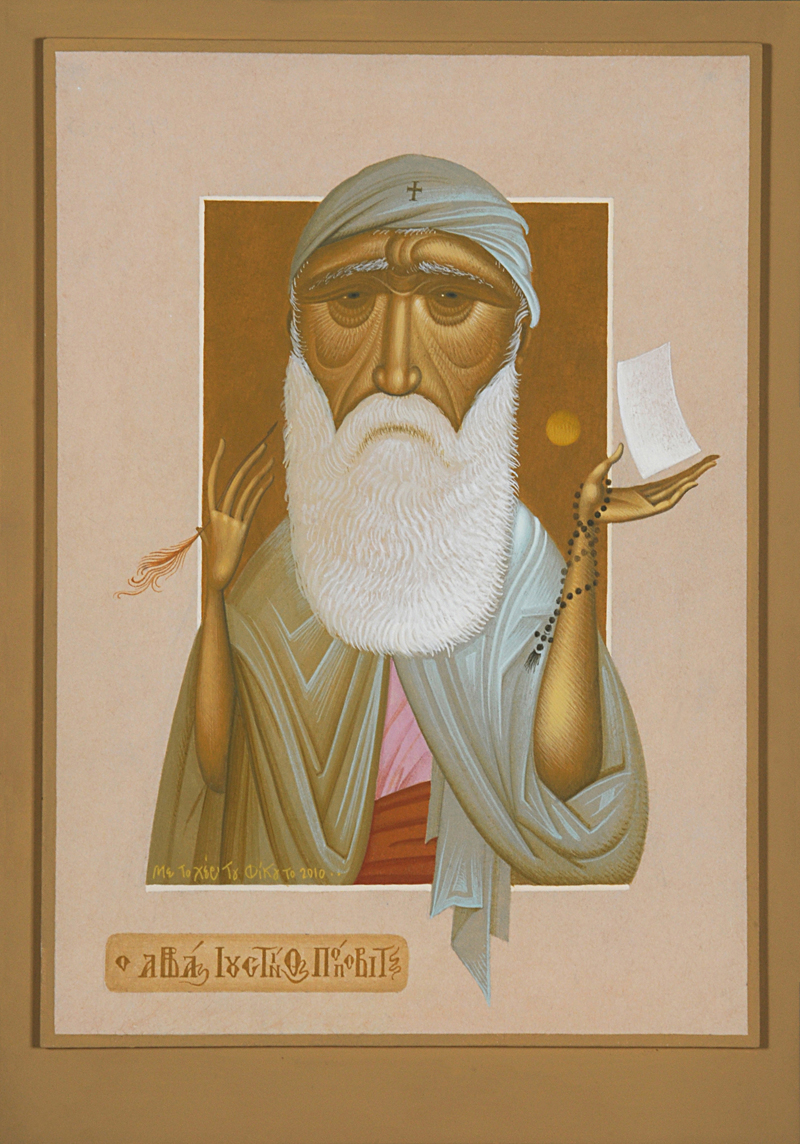
On June 1/14, the Church commemorates Saint Justin Popović of Ćelije, as the Orthodox world generally knows him. Although he fell asleep on the very feast of the Annunciation, on March 25 / April 7, 1979, his commemoration was appointed for June 1 on the Julian calendar — that is, June 14 on the civil calendar — on the day of the Holy Martyr and Philosopher Justin, whose name he had received at his monastic tonsure. So the Serbian Church numbered him among the saints, on May 2, 2010.1
There is a sign in his life that no biographer has been able to overlook: he was born on the Annunciation, in 1894, and was called to the Lord on the Annunciation as well, in 1979. A life enclosed, as between two covers, between two annunciations of the Incarnation. For a theologian who placed the Incarnation — God made man — at the center of everything he thought, it would be hard to imagine a more fitting frame.
Why write about him? Because few saints of the past century are claimed so insistently from opposite directions. Those who see in the ecumenical movement a natural path either avoid him awkwardly or declare him “outdated.” Those who have broken commemoration of their hierarchs wave his words like a battle flag. Both do the same thing: they sever the man’s words from his life. The present article attempts the opposite road — first the life, then the work, and then, with the life as the key, his harshest words: the “pan-heresy” of ecumenism, the “three falls,” the rhetoric about Europe, and the panegyric for his teacher, Nikolai Velimirović.
For this is our conviction: whoever takes a saint’s words without his life uses them to divide; whoever takes them together with his life receives a father.
In brief, for the hurried reader: Saint Justin was one of the harshest Orthodox critics of ecumenism — and he was no schismatic. He admonished in writing, submitted memoranda to the Synod, refused any compromise with the regime — yet he never broke communion with his patriarch and with the Serbian Church. This is why his sharpest words cannot be read except together with his liturgical, ascetic, and ecclesial life. The rest of the article unfolds this sentence.
The Life of Saint Justin Popović: An Arc of Confession (1894–1979)
The Child of the Annunciation
He was born in Vranje, in southern Serbia, on March 25 / April 6, 1894, in the home of the priest Spiridon Popović and the priest’s wife Anastasia. At baptism he received the name Blagoje, from Blagovest — the Annunciation, the day of his birth. His surname, in fact, said everything: “Popović” means “the priest’s son,” and before him seven generations of his family had served at the altar.2 His childhood was bound up, according to the witness preserved by his disciples, with the monastery of Saint Prohor of Pčinja, where the family went on pilgrimage and where his mother is said to have received healing at the relics of the saint.
Between 1905 and 1914 he attended the “Saint Sava” seminary in Belgrade. There the meeting took place that would set the course of his life: among his teachers was the young hieromonk Nikolai Velimirović, then the most vital voice of Serbian theology. The bond between the two — teacher and disciple, then fellow confessors — would run through the whole century and will meet us again, with a delicate question, in the third part of this article.
Then came the war. The young Blagoje served as a medical orderly in the Serbian army and passed, with the army in retreat, through the hell of the Albanian mountains, where tens of thousands perished. Whoever wishes to understand why his later theology has nothing of the hothouse about it must begin here: death was not, for him, a seminar topic but a companion on the road at twenty-one. On January 1, 1916, he was tonsured a monk, receiving the name Justin, after the second-century Martyr and Philosopher — a name that announced his road: the philosophy that ends in confession.
The West Known From Within
He was sent to study in Petrograd, but the times just before the revolution soon forced him to leave. At Velimirović’s urging he entered Oxford, where he studied between 1916 and 1919 and prepared a thesis on the philosophy and religion of Dostoevsky.3 Here occurred the first public confession of his life, preserved in the life written by his disciples: the committee asked him to temper his critique of Western humanism; the young hieromonk refused to change what he held to be true and left without a degree. For a man whose road ran through an academic career, the gesture was no figure of speech.
Truth before the diploma — this would remain the rule.
Let us note from the outset a fact too easily passed over: the harshest critic of “Europe” in the Orthodox theology of the twentieth century did not speak of a West he did not know. He lived in it, studied in its academic heart, and read it through Dostoevsky — a Russian, not a Westerner, but one of the most penetrating critics of modern European civilization. We shall need this fact when we come to weigh his rhetoric.
He took his doctorate at Athens, in 1926, with a thesis on the problem of the person and of knowledge in Saint Macarius of Egypt. The choice, again, said everything: not a topic in the history of dogma, but the very question of theology — how can we know God? And the answer of Macarius, which Justin made his own forever: through the heart cleansed of the passions.
The Teacher
He taught at the seminaries of Sremski Karlovci, Prizren, and Bitola. At Bitola he was a colleague and friend of another young professor, the Russian hieromonk John Maximovitch — the future Saint John of Shanghai and San Francisco. Two saints in the same faculty office: the twentieth century had such offices too. In the 1920s he founded and carried the journal The Christian Life (Hrišćanski život), one of the most vital spiritual platforms of interwar Serbia, and from 1934 he was called to the chair of Dogmatics at the Faculty of Theology in Belgrade. In those same years appeared the first two volumes of his Dogmatics (1932, 1935).
When he was elected bishop for the Carpatho-Russian diocese, which he knew from his years of labor there, he refused, pleading his unworthiness.4 He did not despise the office; he knew himself. There are refusals that show a man better than any rank received.
The Confinement at Ćelije
In 1945 the new communist regime removed him from his chair. A brief arrest followed, then years of wandering among monasteries, and from 1948 — the place that would be for him both cross and place of service: the women’s monastery of Ćelije, near Valjevo. With no formal sentence, Father Justin was for thirty-one years a de facto prisoner of the regime: without pension, without civil rights, under unbroken surveillance, forbidden to publish in his own country.5
What did he do with these thirty-one years? He served the Divine Liturgy every day, decades on end, and his disciples testify that he never served it without tears. He was the spiritual father of the community and of the thousands of pilgrims who began to cross his threshold, from Serbia and even from Greece. And he wrote: the twelve volumes of the Lives of the Saints, the third volume of the Dogmatics, The Man and the God-Man, the notes on ecumenism, the memoranda to the Synod.
His books left the country through his disciples and were printed in Greece and in the West, because at home his word was under lock and key.
The community of Ćelije preserved more fearful testimonies as well. The abbess Glikerija, who afterward took the helm of the monastery, used to recount that a man confessed to her how he had been sent, three times before 1960, to kill the father — and each time, entering the church, he froze, unable to do anything.6 We build nothing upon a single testimony; we record it for what it is — the living memory of a community about its father, of the kind from which the lives of the saints have always been woven.
Around him gathered a handful of disciples who would carry Serbian theology forward: Atanasije Jevtić, Amfilohije Radović, Artemije Radosavljević, Irinej Bulović. All four were ordained bishops of the canonical Serbian Church — the very Church whose failings their spiritual father had rebuked in writing. The school of Ćelije was not born, then, as a movement of rupture; and the later road of one of them — the defrocking of Bishop Artemije, in 2010, three decades after the elder’s repose — remains a wound of recent history, not a legacy of Justin, and cannot be used as a simplistic argument by any side.4b
This fact, as we shall see, is no detail: it is a key.
He fell asleep on March 25 / April 7, 1979, on the Annunciation, on the day he turned eighty-five. His simple grave at Ćelije became a place of pilgrimage long before the Synod in Belgrade pronounced, in 2010, what the churchly people had been saying for thirty years.1
The Work: Theology as the Fruit of Prayer
Here we touch a question the readers of this site know well: who has the right to write theology? The answer of the Tradition is severe and clear — theology is not a science you produce, but a vision you receive. Whoever truly prays, he is a theologian: this axiom of the Philokalic Fathers is not a metaphor but a definition. Dogmatics written from library files, without the life to cover it, remains literature about God — sometimes useful, sometimes dangerous, never theology in the full sense.
How does the work of Justin Popović stand before this measure? The short answer: it is one of the few modern cases in which this measure is not a problem for the work, but its very declared and lived principle.
The Organ of Knowledge: The Cleansed Heart
His entire thought rests on a gnoseology — a teaching about knowledge — which he did not invent but received from the Fathers: his doctorate on Saint Macarius, then his study on the theory of knowledge in Saint Isaac the Syrian. Its core: the organ for knowing God is not the autonomous mind, but the heart cleansed of the passions; truth is not conquered but indwelt; knowledge grows out of asceticism as fruit grows from the root. This is why, in Justin, dogmatics does not come before prayer, but after it — and out of it.
The thirty years of daily Liturgy at Ćelije are not the biography beside the work; they are the laboratory of the work.
The Dogmatics, or the Orthodox Philosophy of Truth
The three volumes of his Dogmatics bear a subtitle that is itself a confession: “The Orthodox Philosophy of Truth.” You will not find in them a scholastic system, with definitions weighed out by the gram and numbered objections. You will find something else: the dogmas treated as realities of life, not as propositions — each truth of the faith turned on every side until its bond with the salvation of man becomes visible. And at the center, with an almost relentless consistency, a single Person: the God-Man. This is the key word of his entire work. Everything is judged by a single criterion: does Christ stand at the center, or does man take His place?
All that is true holds to the God-Man; and all that removes Him from the center and sets there, in His place, autonomous man — whether man-the-measure of philosophy, man-the-infallible of a dogma, or man-the-collective of the ideologies — is, for Justin, one and the same fall under various masks. It is not a matter of weighing man against God, as two magnitudes of the same kind; it is a usurpation — the creature seating itself on the throne of the Creator and unable to fill it.
Out of this Christology grows directly his ecclesiology — and, with it, the key to all his later severity. The Church is not, for Justin, an institution founded by Christ and then left in the hands of men: it is the God-Man Himself, extended across the ages — the body in which the Incarnation continues. He said so plainly in his inaugural lecture at the Faculty of Theology in Belgrade (1935): the Church “is nothing other than the God-Man Christ, continued through all the ages.”8b Therefore, everything that relativizes the Church touches, in his eyes, not a human arrangement but the Person of Christ.
Whoever keeps this equation in mind — the Church is the God-Man in history — understands at once the temperature of his polemics: this man was not defending a jurisdiction; he was defending Someone.
The chronology of these volumes is worth reading theologically as well. The first two appeared in his youth (1932, 1935), from his years at the chair. Then followed a dogmatic silence of more than four decades, in which the man no longer wrote system, but served the Liturgy daily and compiled the Lives of the Saints. And only at the end of this road, past the age of eighty, in the cell of his confinement at Ćelije, did he close the system with the third volume (1978) — the one that contains the teaching about the Church, written by the man who had himself become, in the meantime, a witness of her.
Between the dogmatics of youth and that of old age stands, therefore, “applied dogmatics”: the system did not ripen in the library, but in the Liturgy and in the lives of the saints.
He has, however, a single criterion by which he measured all theology, his own and others’, and that one he left in writing without circumlocution: “Orthodox is only what is from the spirit-bearing saints, from the Holy Fathers of the Church… What is not from them, what is not in their spirit, is not Orthodox.”8c His entire thought stands or falls with this measure — and the hardest thing to overlook is that he himself stood under it: his work truly does come from the Fathers, and that is why he has the right to pronounce the rule.
Within this framework, systematization in itself is neither virtue nor fault — Saint John of Damascus systematized as well, but under the confession “I shall say nothing of my own.” The question is not whether a man sets the dogmas in order, but where he takes them from and with what he covers them. In Justin, the answer is the life. This is why the Church did not canonize him for the Dogmatics — the Church does not canonize bibliographies — but for the life out of which the Dogmatics grew. Books rise into the calendar only on the shoulders of a life.
The Lives of the Saints: Dogmatics in Motion
The most extensive labor of the years of confinement was the twelve volumes of the Lives of the Saints, compiled from Greek, Slavonic, and Syriac sources. For Justin, hagiography was not devotional literature alongside theology: it was theology itself, in its perfected state. Dogmatics describes what the God-Man has done; the lives of the saints show what happens when a man lets Him work to the end. He himself said it without circumlocution: the lives of the saints are “applied dogmatics,” and the saints are the living proof that the dogmatic truths can be lived to the end.5b
The two are a single book in two registers — and it is no accident that the same man wrote both, in the same cell, between the same Liturgies. This is, in passing, also the best resolution of the question with which we began: his theological work does not ask to be believed on his word, because it comes packaged with its own covering — a life that paid, day by day, the price of what was written.
A clarification is in order, because confusions arise around it. The twelve volumes of the Lives of the Saints compiled by Saint Justin (Žitija Svetih, Belgrade, 1972–1977) have not to this day been translated into Romanian — nor should they be confused with the Romanian collections of the same name (that of the Diocese of Roman, 1991–1998, or that edited by Archimandrite Ioanichie Bălan), which descend from another lineage, that of the Menaia and of Saint Dimitri of Rostov.
A complete translation of the Žitija into Romanian would be a real gain for the Romanian-speaking Church: not so much for “other” lives of saints — many overlap with the known ones — as for the manner of their treatment, in which each life is read theologically, as living dogma. It would be, in other words, the first time the Romanian reader would have the lives of the saints not merely recounted, but interpreted as “applied dogmatics.”
Dostoevsky, or the West Read Through Its Deepest Critic
From the thesis of his youth to the book of 1923, The Philosophy and Religion of Dostoevsky, and on to his last writings, the great Russian remains his constant interlocutor. Through Dostoevsky, Justin came to understand that the drama of Europe is neither political nor economic, but Christological: a continent that lowered the God-Man to the rank of mere man and raised man to the rank of the measure of all things. All his later critique of “humanism” feeds from here. We repeat what we said in the biographical part, because it is essential for a right judgment of his rhetoric: this man did not reject a West he had only heard about.
He knew it from within and judged it with eyes opened by the most restless of its readers.
He also has a way of his own in reading the novels, which we inherit chiefly through the scholars of his work: Justin sees Dostoevsky’s characters as lives of saints and of anti-saints.3b On one side stand the luminous figures — the elder Zosima in The Brothers Karamazov, men in whom one sees what Christ does with a heart that surrenders to Him; on the other, the dark heroes, the “anti-saints” — Stavrogin in Demons and the others of his kind — men who have lost precisely the power to love.
And the thread that binds all the anti-saints is one alone, and it is the nerve of Justin’s entire theology: the man who wills to become god by himself.
Kirillov, who kills himself to prove his own divinity; Ivan Karamazov, who “returns the ticket” to a world of God’s that he cannot accept; Raskolnikov, who grants himself leave to kill because he believes himself above the law — all are, in Justin’s key, embodiments of the same fall: the creature seating itself on the throne of the Creator. (On the way each novel conceals, beyond this, a Gospel parable — the raising of Lazarus, the grain of wheat, the Gadarenes — and on what in them passes the Philokalic test, we have written at length in the article “Dostoevsky and Orthodoxy”; here we confine ourselves to Justin’s lens.)
Here one sees why Dostoevsky is not an ornament in his work, but a column. The Grand Inquisitor — the man who “corrects” the work of Christ in the name of humanity’s good, taking upon himself an authority that belongs to God alone — is, read with Justin’s eyes, the very pattern of all he would later condemn: man set in the place of the God-Man. From this character to the dogma of infallibility, and from infallibility to the “pan-heresy” of humanism, the path of Justin’s thought is a single unbroken line. The seed of the diagnosis is in the pages of a novelist; the flower, in The Orthodox Church and Ecumenism.
A measure is in order, however, lest we fall into the symmetrical error. Precisely because Dostoevsky was so present in his formation, there is a temptation to make him the key that explains everything in Justin. His own biographer stops us on this road: Bishop Atanasije Jevtić writes plainly that it would be a mistake to exaggerate Dostoevsky’s influence upon the young Justin, since the truly decisive paternity came not from the novelist but from the Holy Fathers — Chrysostom above all, then Macarius of Egypt, Isaac the Syrian, Symeon the New Theologian.5c
Justin himself said of Dostoevsky that he had been “his teacher and his executioner”: teacher, because he opened his eyes to the abysses of man; executioner, because he led him to the edge of those same chasms from which Christ alone could draw him out. The great Russian put the question to him with all its sharpness; the answer, however, Justin took not from him, but from the Fathers. To confuse the question with the answer would be to make Justin a religious writer; he was a Father of the Church who made use of a writer.
A Sober Weighing of the Work
Let us also say what must be said coolly. The power of Justin’s work lies in the unity between life and writing and in the Christocentric consistency carried to the very end; his patristic synthesis is alive, not of the museum. Its limit lies in register: Justin does not analyze but preaches; does not distinguish but proclaims; he repeats himself, mounts into hyperbole, strikes with superlatives. Whoever opens him expecting the finesse of a Maximus the Confessor’s distinctions or the architecture of a John of Damascus will go away hungry. His writing is closer to hymn and to prophetic rebuke than to treatise.
This is no diminishment of his sanctity — but it is a feature of the text, and whoever ignores it will distort him. Precisely because he speaks prophetically, his harshest words call for a reading with discernment. To them we devote the part that follows.
The Words That Divide: An Analysis
Before we enter the text, let us pronounce the key in which we shall read all that follows: in Saint Justin, severity is not autonomy from the Church, but pain within the Church. This is the difference between confession and revolt — and it parts the waters in each of the four analyses below.
“The Pan-Heresy”: What He Said and What He Did Not Say
The book The Orthodox Church and Ecumenism was written in the years of confinement and printed outside Yugoslavia — at Thessaloniki, in 1974 — because at home it could not see the light of print; in Romanian it appeared in 2002.7 In it is found the sentence that went round the Orthodox world: the definition of ecumenism as the common name for the pseudo-Christianities and pseudo-churches of Western Europe, carrying in their heart the European humanisms, with papism at their head — heresy beside heresy, whose “common Gospel name is ‘pan-heresy.'”7
What does the argument actually hold? Justin observes that the old heresies each struck at some property of the God-Man: one denied His divinity, another His humanity, another the union of the natures. The novelty he sees in Western religious humanism — and in the ecumenism born from it — is that it no longer mutilates a property, but changes the center itself: in the place of the God-Man, man is set. Hence “pan-heresy”: not a heresy greater in degree, but one that contains them all in principle, because it touches not an article of the faith, but the foundation of all the articles.
And ecclesiologically: a movement that begins from the premise that the one Church has been lost and must be rebuilt out of fragments, through negotiations, denies — even if unconfessedly — the article of the Creed about the Church “one, holy, catholic, and apostolic.” The unity for which Christ prayed, “that they all may be one” (John 17:21), is, in Justin’s reading, the unity of life within the Holy Trinity, given in the Church — not a unity that could be manufactured diplomatically between truth and the deviations from it.
This is the diagnosis. And now, what it is not. It is not a canonical sentence. The condemnation of a heresy with the force of Church law belongs to the Synod, not to an archimandrite, however holy — and Justin knew this better than those who quote him. He wrote as a theologian and as a confessor: he put a name to a disease, like a physician; he did not pronounce an anathema, like a tribunal. The proof need not be sought in speculation, for it stands in his deeds, attested in writing by the man who was closest to him.
Bishop Atanasije Jevtić, his disciple and biographer, recorded plainly: Father Justin never broke communion with any Orthodox Church, with any bishop or patriarch — not even with the Serbian patriarch German, in the years when the latter was one of the presidents of the World Council of Churches; and those who spread the contrary the disciple bluntly calls liars.8
What Justin did instead was to admonish in writing, by the churchly way: letters to the patriarch and to the Synod, and in the matter of the preparation of the “Great Synod” pan-Orthodox — two memoranda, in 1971 and on May 7, 1977, the latter submitted through Bishop John of Šabac, with that bishop’s leave, to be placed before the Synod.9 Let us weigh this detail well: even his protest was obedience. Not a manifesto hurled over the head of the hierarchy, but a memorandum sent up through its ranks.
The same disciple records that the father used to say that schisms are easily made but most hard to heal — and that he plainly opposed the schism then tearing apart the Serbian diaspora.8
There is one more detail of the text itself, which those who wave it always skip: Justin’s diagnosis does not close in anathema, but in medicine. The only way out he sees for Western Christianity is not destruction, but repentance — the remedy God has given for every sin and every man. A text that ends with a call to repentance is not a cry of hatred; it is a physician’s consultation, spoken aloud to awaken.
Now we can draw the line, and we draw it in both directions. To those who break communion with their hierarchs invoking Justin we say: the man you quote lived fourteen years — from the Serbian Church’s entry into the World Council of Churches (1965) to his repose — under the patriarch who had become one of its presidents, and he did not break communion with him for a single day; he chose admonition within the Church over rebellion outside it; and his disciples did not make their father’s words a ground for leaving the Church. Whoever takes his words and tramples his example does not follow him — he uses him.
And to those who, on the other side, would have him forgotten as an awkward museum piece, we put a single question: if his diagnosis was error, why did the Church — the same Church he rebuked — canonize him thirty-one years after his repose? The zealots quote his words; the Church canonized his life. Between the two readings, the second is the Orthodox one. (On the bounds and the dangers of breaking commemoration we have written at length in a separate article — see “Further Reading.”)
The Three Falls: Theological Core and Prophetic Hyperbole
The second sentence that made him at once famous and uncomfortable comes from his essay on the infallibility of European man, taken up in several collections of his work: in the history of the human race there are said to be three “principal falls: that of Adam, that of Judas, and that of the pope.”10
Let us first draw out the core, then weigh the husk. The core is a single idea, repeated like a bell: the essence of every fall is the same — man’s will to become good, perfect, god by himself, without the God-Man and in His place. Adam willed deification without God and fell from paradise. Judas stood beside the God-Man and exchanged Him for thirty pieces of silver — the fall from discipleship.
And the third “fall” is not, in the letter of Justin’s analysis, a particular man, but a dogma: the proclamation of papal infallibility in 1870, in which he sees the gesture by which a man — and, through him, the principle of “man” — was set, in the very heart of Western Christendom, in the place that belongs to Christ alone. The target of the sentence is, therefore, infallibility as self-deification institutionalized; “the pope” stands in the text as the name of a dogma and a principle, not as a verdict upon persons, still less upon the millions of Western faithful.
And now the husk — because discernment requires that we name it. There are three things to guard against when we take this sentence in hand.
The first: the three falls are not of the same kind. Adam and Judas are persons, with falls that actually happened in sacred history; “the pope” here is an institution and a dogma, not a man. To set them in the same row is a device of shock, meant to awaken — powerful as such, but not a rigorous classification, as though the three were magnitudes of the same order. It is a cry, not a scheme.
The second: this is prophetic language, not the quiet language of teaching. Sharp rebuke has its ground in the Holy Fathers — they did not speak of heresies with gloves on. But a word that a confessor utters once, trembling, to awaken, becomes something else in the mouth of one who repeats it daily, as a slogan: from a diagnosis, it turns into contempt.
The third: the man who wrote it had the right to say it. He studied at Oxford, read the West with pencil in hand his whole life long, and ended his book on ecumenism by calling for repentance. In his mouth, the sentence is medicine from a physician who loves the sick man; torn from his life, it becomes a stone in the hand of one who hates.
The right use of the “three falls” is, then, this: as an X-ray of the anthropocentric principle — man in the place of the God-Man — where it became dogmatized. The crooked use: as a confessional slogan against people whom Christ calls, as He calls all of us, to repentance and to truth.
“Better It Should Not Be Held”: The Opposition to the Great Synod
Among his words that still spark debate today is this one, from the memoranda to the Serbian Synod: that for the Orthodox Church it would be more profitable if such a “Great Synod” were not convened at all — or, if it could not be otherwise, that at least his Church should take no part in its preparations and its proceedings.9 At first hearing, the sentence sounds like a paradox, if not something worse: how can an Orthodox theologian, for whom conciliarity is the very breath of the Church, oppose a synod?
A reading of the memoranda dispels the paradox. Justin was not opposing conciliarity, but that synod, as it was being prepared: with themes chosen from the top down, through restricted conferences, without the real labor of the body of the Church; with hierarchs already bound, through their ecumenical commitments, to directions the synod would merely have sealed; in an hour when half of Orthodoxy lay under atheist regimes, with its episcopate held by the throat.
His fundamental argument was one of the theology of councils: a council is not great because it titles itself so, but because the Church receives it; and a “great synod” convened without ripening, over the head of the churchly people, risks giving birth not to unity, but to new schisms — a wound graver than all those it would have wished to heal.
From his memoranda to the gathering of the much-prepared synod nearly five decades would pass: Crete, 2016. We do not here put that gathering on trial; we have written about its consequences elsewhere. We say only this: the simple fact that the 2016 synod did not bring all the autocephalous Churches to the table and was followed by tensions shows why Justin’s warning about conciliar ripening cannot be dismissed as a backward-looking fear.
Here too, however, it behooves us to weigh rightly. Taken as an eternal principle, the formula “better it should not be held” would itself be a maximalism: the Church cannot postpone conciliarity indefinitely, and perpetual postponement is also a disease. Justin’s word stands as a warning about ripening and about the right order of preparation — not as an everlasting prohibition. And let us note, once again, the form: this opposition too, the most emphatic he ever voiced, went up through the ranks of the hierarchy, through the local bishop, to the Synod. Here too no manifesto over the head of the Church; here too no rupture.
Europe and the Pseudo-Christianities: Prophecy and Totalization
Besides the two emblematic sentences, Justin’s writing is threaded through with a broad rhetoric about “Europe”: European humanism as the dethroning of the God-Man, the culture that made man the measure of all things and ended by losing both God and man. In his reading, secularization is not an accident of modernity, but the iron logic of a mistaken Christological choice made centuries ago. Let us admit it openly: in much, the times have proved him right. The anthropological crisis in which we find ourselves — man who no longer knows what man is — was, in him, a conclusion announced when it seemed a pamphlet.
But discernment, too, requires that we name the limit: the picture is totalizing. Justin’s “Europe” is a metaphysics, not a geography and not a sum of persons. The real West contains both the common saints of the first millennium and sincere seekers of the truth and — something the readers of these lines know on their own skin — millions of Orthodox who live, pray, and raise their children in its midst. From Saint Justin, these Orthodox receive not a mandate of contempt toward their neighbors, but a call to watchfulness against the spirit of the age.
He himself always made the distinction, even if unspoken, between systems and people: to the systems he gave a diagnosis; to the people he set repentance before them, that is, hope. Whoever takes up his rhetoric without this distinction does not continue him — he lowers him.
“The Greatest Serb After Saint Sava”: The Panegyric and the Temptation of the National Measure
There remains a question that those who honor him usually skirt and which we shall not skirt, because it touches the very theme of this site: the right measure of veneration. It concerns the way Justin spoke of his teacher, Saint Nikolai Velimirović.
Let us first set down the facts, because much approximation circulates here. The epithet “the new Chrysostom,” often attached to Velimirović’s name, does not belong in the first place to Justin: it circulated widely in the Orthodox world, and in its most-cited form it is ascribed to a Russian, not a Serb — Saint John Maximovitch, who is credited with calling Velimirović “a Chrysostom of our days,” a catholic teacher of the Church.11 Justin, however, said something else, and more emphatic: for him, his teacher was “the greatest Serb after Saint Sava”;12
and five years after the latter’s repose, when in communist Yugoslavia even the public commemoration of Velimirović’s name was dangerous, Justin wrote a litany of thanksgiving in which he calls him, step by step, a new Apostle, a new Evangelist, a new Confessor, a new Martyr, a new Saint.13
What do we do with these superlatives? Two things at once, and both honestly.
First, justice to the context. The encomium — exalted praise — is an old genre of the Church; the Fathers themselves compared the new saints with the old, and the comparison with Chrysostom for a great preacher is a hagiographic topos, not a weighing by the gram. And Justin’s litany of 1961 was not pronounced at a festivity, but under terror: to praise publicly a forbidden bishop, in the midst of an atheist regime, was an act of confession, not of protocol. Whoever judges those words as an academic communiqué judges them outside the world in which they were written.
Then, justice to the truth — and here we shall soften nothing. Justin’s superlative is framed in a national key: the form of the praise is taken from the nation, not from the Church. “The greatest Serb” — not “the greatest hierarch,” not “the greatest teacher of Orthodoxy.” Let us be just to the saint: he did not honor Velimirović as a hero of the nation, but as a teacher of repentance and a confessor; his intention was ecclesial. But the language of the age clothes this veneration in the garb of national history — and it is precisely the form that gives one pause.
One feels here the seal of an age: interwar Serbia of “svetosavlje,” in which faith and nation were spoken in a single breath, and a hierarch was weighed, almost naturally, by the yardstick of national history. Let us not be hasty with the stone: this temptation is not Serbian. We know it exactly among the Greeks, among the Russians, and — let us say it without circumlocution — among us Romanians: every Orthodox people is tempted to measure its saints by the yardstick of its own history and to raise them higher than the Church has raised them, precisely because they are “ours.” This is not veneration; it is a mirror.
And whoever has followed on this site our analyses of the criteria of canonization knows that it is precisely here that the “saints” manufactured by enthusiasm are born: there, where the measure of the nation takes the place of the measure of the Church.
The most beautiful part is that the remedy is found in Justin himself. His ecclesiology is decidedly supranational: the Church belongs to no nation, but is the body of the God-Man, and her work is pan-human — a theme he pressed from his youth. A telling incident has also been preserved: to an officer who boasted of being a Serb although he was not Orthodox, the father answered sharply that mere birth on Serbian soil makes no one a Serb — for, by his measure, it was not blood that gave content to faith, but faith that gave content to the nation.6
The reversal is exactly the opposite of ethnophyletism — and yet, let us note with sobriety: even in this reversal, the frame of the speech remains the nation. So deeply was it driven into the language of the age that even its overcoming was uttered within it.
Our verdict, therefore, with all veneration: the Church canonized Nikolai Velimirović (2003) and Justin (2010), and canonization confirms their sanctity — not their epithets. Veneration does not canonize the epithets. The comparisons with Chrysostom, with the Apostles, with the great Fathers are received, if they are received, through the slow and conciliar reception of the whole Church, across the ages and across the borders of the nations — they are not inherited from obituaries, however holy the one who wrote them. To venerate Saint Justin does not oblige us to take over his superlatives.
On the contrary: to take them over without measure would be to repeat, in pious form, the very error he condemned his whole life long — the setting of a human measure, even that of the nation, in the place that belongs to the God-Man alone.
(The proper dossier of Nikolai Velimirović, with its own questions, is a separate theme and is not the subject of these lines.)
The Right Measure of Veneration
Let us now gather the threads and say plainly on what — and on what it does not — rests the sanctity of Justin of Ćelije.
It rests, first, on the public confession made by churchly ways, from one end of his life to the other: the thesis refused at Oxford rather than the truth cut short; the word held under the communists at the cost of his chair; the letters to the patriarch; the memoranda to the Synod sent up through the local bishop. Nowhere rebellion; everywhere admonition with ground, under obedience.
It rests, second, on suffering not converted into compromise: thirty-one years of confinement without rehabilitation, without gestures of courtesy toward the regime, without protocol photographs — a life that the biographies do not reduce to shameful compromises, and that the memory of the Church received as a witness of purity, suffering, and prayer. And it rests, third, on a theology born of prayer and covered by asceticism — the daily Liturgy, the tears, the Lives of the Saints written between vigils — and on an organic reception: first the disciples and the community, then the pilgrims, then Athos, which printed his books, and only at the last, sealing what had already been received, the Synod.
It does not rest — and it is well to say it plainly — on the cover-blurb superlatives that commend him as the most important dogmatist since John of Damascus; it does not rest on the zealot iconization that cut him out into a battle flag; it does not rest on the panegyrics in the national key of his age. His sanctity has no need of these. More than that: these hide it, each in its own way, because they shift the gaze from what he truly was — a confessor and a teacher — toward what we would have wished him to be.
And perhaps this is his most needful lesson for the present hour, when the wounds left in the body of the Church by the gatherings and divisions of the last decade are far from healed. From Saint Justin we learn how one confesses: in writing, with ground, by the churchly way, without hatred and without rupture. We learn how one endures: without turning suffering into capital and without selling it on a stage. And we learn the hardest thing of all: how one loves the Church more than one’s own victory — how one can cry out the truth with all the strength of one’s chest, while remaining on one’s knees.
In Place of a Conclusion
A life opened by the Annunciation and closed by the Annunciation: as though God had set, at both its ends, the same seal — the tidings that God becomes man. Between these two seals, Justin of Ćelije did, in the end, but a single thing: he said, with all the strength of his mind and his heart, that outside the God-Man there is neither truth nor man. He said it in lecture halls and paid for it; he said it under the communists and paid for it; he said it to the Church herself, when he saw her wavering, and remained within her, on his knees, to the end.
On June 1/14, when we keep his commemoration on the day of the Philosopher whose name he bore, let us ask of him the gift that was most his own and that we most lack: confession without rebellion, and love without numbness.
Holy Father Justin, pray to Christ God for us.
Further Reading:
- Dostoevsky and Orthodoxy: From Darkness to Light
- Non-Commemoration After Crete: Bounds, Dangers, Discernment
- Known and Unknown Saints: Why Not Every Devout Life Should Be Proclaimed
- The Book of Revelation (III): The Lamb and the Heavenly Liturgy
Notes
- 1. Saint Justin was numbered among the saints by the decision of the Holy Synod of the Serbian Orthodox Church of May 2, 2010, with commemoration on June 1 (Julian calendar), the day of the Holy Martyr Justin the Philosopher — June 14 on the civil calendar. At the same synodal assembly, Saint Simeon of Dajbabe was also glorified. ↩
- 2. The biographical data follow the life compiled by his disciples (foremost Bishop Atanasije Jevtić) and the current synaxaria. For an overview in English: the study “Through the Pages of the Theological Works of Archimandrite Justin (Popović),” first published in Russian (1984). ↩
- 3. The thesis, “The Philosophy and Religion of F. M. Dostoevsky,” prepared at Oxford (1916–1919) for the B.Litt. degree, was later published in Serbian (1923). The episode of its rejection at the defense, following his refusal to temper his critique of Western humanism, is related in the life written by his disciples. ↩
- 3b. The way Saint Justin read Dostoevsky’s characters — the positive heroes as “stylized lives of saints” (Zosima), and the dark heroes as “lives of anti-saints” (Stavrogin) — within a Christocentric framework, with the Fathers of the Church as points of orientation and with Dostoevsky drawn close to the tradition of the elders (startsi) and of the Philokalia, is described in studies of his work; cf. Bogdan Lubardić, “St Justin Popović: Critical Reception of British Theology, Philosophy and Science,” in Bogoslovni Vestnik / Theological Quarterly, 80/1 (2020), pp. 37–48. The application of this framework to each novel follows Justin’s key, without claiming to reproduce his particular verdicts on each character. ↩
- 4. His refusal to accept the episcopate (the newly established diocese of Mukačevo, Subcarpathian Rus’) is documented in the biography compiled by his disciple, Bishop Atanasije Jevtić, who reproduces Father Justin’s letter of refusal to Metropolitan Josif (Cvijović): “I have looked at myself long and seriously in the Gospel… in no case can I and may I accept the rank of bishop, for I do not have even the most elementary Gospel qualities for it.” After this refusal, the episcopate was never offered to him again. Cf. Bishop Atanasije Jevtić, The Life of a Saint: Abba Justin Popović (Romanian ed.: trans. Miljurko Vukadinović and Traian Manta, Bunavestire, Galați, 2003). ↩
- 4b. Bishop Artemije (Radosavljević), one of the four disciples who became bishops, was removed from the see of Raška-Prizren and then defrocked by the Synod of the Serbian Church (2010), following an ecclesial and administrative conflict; a non-canonical structure later formed around him. However one may judge this painful case, it belongs to the history after Saint Justin’s repose — and cannot be invoked, in either direction, as a legacy of the school of Ćelije. ↩
- 5. For the years at Ćelije (1948–1979): without pension and without rights, under continual surveillance, with the daily service of the Divine Liturgy and a strict ascetic life — cf. the synaxaria and the testimonies of the Ćelije community. ↩
- 5b. “The Lives of the Saints mean applied dogmatics” — a formula taken up by Saint Justin in the Introduction to the Lives of the Saints and in other places of his work. The full text of the Introduction is for now accessible chiefly in English (trans. Asterios Gerostergios, in Orthodox Faith and Life in Christ, Belmont, 1994), where Saint Justin writes that the lives of the saints are “applied dogmatics,” “applied ethics,” and even “the Life of the Lord Christ, repeated in each saint.” The twelve volumes (Žitija Svetih, Belgrade, 1972–1977; some bibliographies indicate the completion of printing in 1978) remain untranslated in full in both Romanian and English. ↩
- 5c. The warning against exaggerating Dostoevsky’s influence, as well as the formula “his teacher and his executioner,” are recorded by his disciple and biographer, Bishop Atanasije Jevtić, in The Life of a Saint: Abba Justin Popović (Romanian ed.: trans. Miljurko Vukadinović and Traian Manta, Bunavestire, Galați, 2003). Jevtić specifies that the decisive spiritual paternity came from the Holy Fathers — above all Saint John Chrysostom, Saint Macarius of Egypt, Saint Isaac the Syrian, and Saint Symeon the New Theologian. ↩
- 6. The testimonies of the abbess Glikerija of Ćelije (about those sent to kill him) and the incident with the officer — preserved in the tradition of the community and reproduced in current hagiographic accounts. We record them as testimonies of the community, not as independently documented facts. ↩
- 7. Saint Justin Popović, The Orthodox Church and Ecumenism, Romanian translation by Adrian Tănăsescu, Holy Archangels Monastery, Petru Vodă, 2002, the chapter “Humanistic Ecumenism.” The first edition of the work appeared at Thessaloniki, in 1974. (The wording of the quotation follows the Romanian edition.) ↩
- 8. The testimony about the never-broken communion — not even with Patriarch German, in the years when he was one of the presidents of the World Council of Churches — belongs to his disciple, Bishop Atanasije Jevtić, and accompanies the text Notes on Ecumenism (manuscript 1972, published 2010). Therein also: the letters of admonition to the patriarch and Synod, the word about schisms, and the opposition to the schism in the Serbian diaspora. The biography compiled by the same Jevtić (The Life of a Saint: Abba Justin Popović, ed. cit.) confirms, in turn, his faithfulness by churchly ways and his opposition to rupture. ↩
- 8b. The inaugural lecture “On the Essence of Orthodox Axiology and Criteriology,” delivered at the Faculty of Theology in Belgrade on January 16, 1935; the quotation, reproduced in the biography by Atanasije Jevtić (The Life of a Saint: Abba Justin Popović, ed. cit.), continues: “The Lord Christ left Himself, His divine-human personality, to the Church; therefore the Church is only the Church of the God-Man… He is Himself the Church in the divine-human fullness, for the Church is nothing other than the God-Man Christ, continued through all the ages.” ↩
- 8c. Words of Saint Justin on Orthodox theology and illumination (“Orthodox is only what is from the spirit-bearing saints…”), reproduced in the biography by Bishop Atanasije Jevtić, The Life of a Saint: Abba Justin Popović, ed. cit. The formula of Saint John of Damascus — “I shall say nothing of my own” — opens the prologue to The Fount of Knowledge. The third volume of the Dogmatics appeared at Belgrade in 1978. (Romanian edition: The Dogmatics of the Orthodox Church, trans. Žarko Markovski, Doxologia, Iași.) ↩
- 9. The memorandum of May 7, 1977 concerning the convocation of the “Great Synod,” addressed to Bishop John of Šabac to be forwarded to the Holy Synod and the Council of Bishops of the Serbian Church; in the text, Saint Justin also recalls his earlier memorandum (1971), submitted by the same hierarchical way, after the preparatory consultation at Chambésy. ↩
- 10. The essay on the infallibility of European man, in: Saint Justin Popović, The Orthodox Faith and Life in Christ (Romanian ed.: Bunavestire, Galați, 2003); the text also circulates in The Man and the God-Man, in another translation. ↩
- 11. The epithet “the new Chrysostom” (or “the Chrysostom of our days”) is frequent in the Orthodox literature about Nikolai Velimirović and circulates widely, beyond any single author. Its ascription specifically to Saint John Maximovitch appears in collections of testimonies about Velimirović; the primary locus of the formulation remains to be identified with precision. What matters for the present argument is that the Chrysostomic epithet is not an invention of Saint Justin and does not carry, in itself, a national key. ↩
- 12. The formula “the greatest Serb after Saint Sava” is constantly ascribed to Saint Justin in the literature about Velimirović, usually in connection with his commemorative writings; it circulates widely as a testimony of his esteem for his teacher. ↩
- 13. The litany of thanksgiving (“…we have a new Apostle… a new Evangelist… a new Confessor… a new Martyr… a new Saint”), written by Justin five years after Velimirović’s repose (1961), when the latter’s public veneration was forbidden in communist Yugoslavia. The text circulates in collections and hagiographic accounts about Velimirović; the present rendering follows these sources, not a critical edition. ↩