
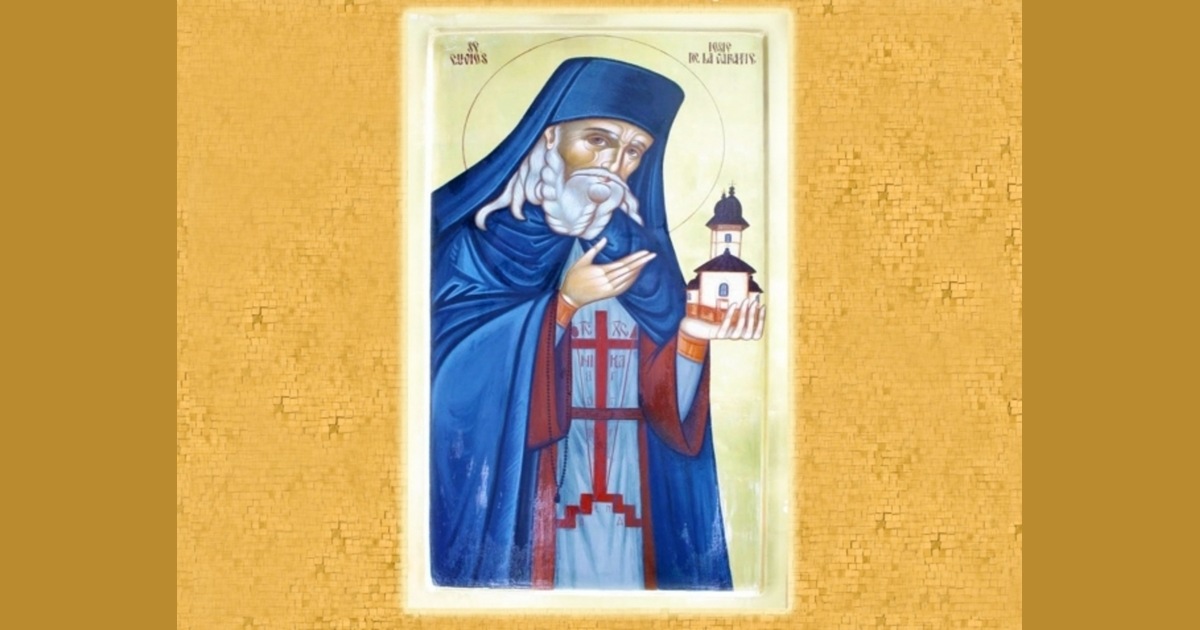
On 16 August the Church commemorates the Venerable Joseph, hieroschemamonk, disciple of Saint Paisius of Neamț and the first spiritual father of the community of nuns at Văratec, in the mountains of Moldavia. He lived from about 1750 to 1828, and the Synod of the Romanian Orthodox Church numbered him among the saints in 2008.
Leaving Transylvania
He was born around 1750, in a village the sources call Valea Jidanului, in Transylvania, to a family of Orthodox peasants. Those were the years when Austrian rule was pressing the Orthodox population of the province to accept union with Rome, and resistance had gathered around the Venerable Sophronius of Cioara, a monk who went from village to village calling people to remain steadfast. Many families chose then to cross the mountains eastward into Moldavia, where the Church had remained untouched by such pressures. Joseph’s family was among them.
Disciple of Saint Paisius
Once in Moldavia, the young man sought out the monasteries of the region and settled at Dragomirna, where Paisius Velichkovsky was then living. The elder had come from Ukraine by way of Athos and was gathering around him a community of many nations and tongues, which translated and copied the writings of the Fathers of inward struggle. There Joseph entered obedience.
When Bukovina passed under Austrian rule, the community moved to Secu and then to Neamț. Joseph followed the elder in both removals. At his word he was tonsured a monk and ordained hieromonk.
From these years came the discipline that shows in all his later work: obedience, guarding of the mind, abstinence, vigilance and unceasing prayer, learned not only from books but under the guidance of a living father.
A programme for the women’s sketes
Saint Paisius had a particular reform in view for the region of Neamț. Nuns were living scattered in small sketes, often set at the edge of villages and market towns, where neither stillness nor good order could be kept. The elder sought to gather them into a few large settlements, far from the world, with communal life and trained spiritual fathers.
Joseph was among the chief men through whom this gathering was accomplished. The documents show him, around 1779, as spiritual guide at the skete of Pocrov near Neamț, and as director of the nuns at the sketes of Pârâul Carpenului and Durău. His first disciple known by name, the schemanun Nazaria, came to Pârâul Carpenului, where she met Joseph. He later moved the community to Durău, beneath Mount Ceahlău, where Nazaria remained fourteen years under his guidance. Around 1779–1780 the elder Paisius gathered there the nuns and hermitesses of the district, under the direction of Nazaria and Joseph.
Nazaria was from Brașov. She had married and borne two children; her husband died first, then her children. Left alone, she entered monastic life, first at the skete of Scânteia in Vrancea, where she was made a rassophore nun with the name Natalia, then at the skete of Bonțești, where she received the great schema with the name Nazaria. By about 1770 she had reached the region of Neamț, and Joseph.
The wilderness of the Sihla mountains
After a time Joseph asked the elder for leave to withdraw into stillness. He received it and settled in the forests near Sihla, together with two other fathers, Herman and Gerontius. There he received the great schema, becoming a hieroschemamonk. A few cells of wood and clay were raised in the clearing, and a small chapel.
Those places have kept his name to this day: Joseph’s Clearing, Joseph’s Brook, Joseph’s Cells. The path to the spring that bears his name still sets out from Văratec.
The finding of the clearing
Durău, however, had proved too far from any help. Abbess Nazaria wrote to the elder Paisius, asking that the community be moved closer to Neamț. At the same time another disciple had come to Paisius: Bălașa Herescu, daughter of the priest Michael of the princely church of Saint Nicholas in Iași. Widowed young, she had become a rassophore nun at the skete of Topolița with the name Olympiada, but the rule there did not satisfy her. The elder commanded her to seek out, together with Nazaria, a place for a monastery.
Olympiada set out through the mountains, guided by the hermit Joseph, and found a clearing far from human settlement, called Văratec. She acquired land there from the great treasurer Deleanu and from the forester Ion Bălănoiu, and put her whole fortune at the service of the new foundation. Between 1781 and 1785 a small hermitage took shape in the clearing.
In June 1785, Olympiada and the spiritual father Joseph began to build a wooden church dedicated to the Dormition of the Mother of God. Cells rose around it, and nuns settled in them. So the skete of Văratec was born.
The growth of the community
In 1787 the skete of Văratec was united with the skete of Topolița, and the nuns there moved to the clearing. The following year those from Durău came as well, with Abbess Nazaria at their head, who was confirmed as abbess of the new foundation. She led the community from 1788 until 1814, assisted by the spiritual father Joseph. In 1794 a second wooden church was raised.
The rule they established together covered the services of the church, obedience within the community, handwork in the cell, the learning of reading and writing, and prayer at all times. In an age when few women knew letters, teaching them to write was itself an act of mercy. In 1803, by decision of Metropolitan Veniamin Costachi, a school for nuns was opened at Văratec and at Agapia, where Byzantine chant, Greek, embroidery and weaving were taught.
The community grew to more than three hundred nuns. Today Văratec is the largest women’s monastery in Romania.
The hands of the spiritual father
The stone church that still stands in the middle of the courtyard was raised through his labour. The Romanian Patericon preserves the memory of how he worked: he carried stone, lime, sand and water himself and bore them up the scaffolding, while the money to pay the workmen he gathered from those who had means. The founder’s inscription on the church names him beside the abbess, “through the labour of Father Joseph the Confessor and of Abbess Olympiada”, and adds that the first founders were the nuns of the place.
The same zeal he carried into the ordering of other hermitages in the mountains of Neamț. The sketes he shepherded he left with communal life and appointed services.
The spiritual father of the mountain
To his cell climbed the hermits of the Sihla mountains and of the Agapia forests, the monks and abbots of Sihăstria, Sihla, Pocrov and Neamț. He received them all, listened to them, taught them the work of the Jesus Prayer, heard their confessions, fed them with a hermit’s fare and sent them back in peace to their cells. Lay people came too, from great distances, for sicknesses and for troubles.
God gave him the gift of healing and of driving out unclean spirits. His disciples remembered that before he healed, he knew the cause of the illness.
He copied manuscripts himself — scriptural, theological and liturgical — which presupposes a thorough knowledge of Scripture and of the Fathers, acquired from his youth. Among his disciples was the hieromonk Irinarh Rosetti († 1859), founder of Horaița monastery, who later went to the Holy Land and raised the church on Mount Tabor.
The troparion of the day calls him, briefly and exactly, “founder and spiritual father of the Monastery”.
The Philokalia and his place in it
The Philokalia is not the work of a single author. It is a collection of patristic writings on watchfulness and on the prayer of the mind, gathered by Saint Nicodemus the Hagiorite and Saint Macarius of Corinth and printed in Greek at Venice in 1782.
The community of Saint Paisius was translating such texts even before the Greek printing. At Dragomirna, the monk Raphael assembled in 1769 a manuscript of six hundred and twenty-six pages of philokalic writings in Romanian, thirteen years before the Venetian edition. At Neamț the work continued: the hieromonk Macarius, the hieromonk Hilarion the teacher, the hieromonk Daniel and others translated and copied, and from this school came also the Slavonic Philokalia printed at Moscow in 1793.
In the known sources, Joseph does not appear among the translators of the Paisian school. He is attested, however, as a copyist of manuscripts. In the years when the scriptorium at Neamț was working most intensely, he was already in the mountains, and then at Văratec.
He entered the Philokalia by the other road. When Father Dumitru Stăniloae translated the Philokalia into Romanian, he added to the eighth volume a section of Romanian hesychast writings: the foreword of Saint Basil of Poiana Mărului, the counsels of the elder George of Cernica, and among them The Rule of the Holy Prayer of the Mind, as received from Father Joseph. So he came to be read alongside those whom he himself had read.
The rule of the prayer of the mind
The title shows that the text was set down as a rule received from Father Joseph, written in 1810, eighteen years before his death. It is not given as his autograph.
The rule is short and intended for beginners. It calls for the gathering of the senses and the inclining of the head onto the left shoulder, the mouth closed, two fingers of the right hand placed on the chest on the left side, above the heart. The breath is drawn in slowly through the nose, into the depth of the chest, and there the name of the Lord Jesus is invoked. The mind is not permitted to follow the breath, but remains in the depth of the heart, at the name. The text forbids any imagining: “Do not picture the heart, nor anything else.” And the measure is given there too: a quarter of an hour, without burdening the mind, since the one beginning is a beginner.
Similar rules are known from the thirteenth and fourteenth centuries, from Nicephorus the Solitary and from Saint Gregory of Sinai, and one of them, The Method of Holy Prayer and Attention, long circulated under the name of Saint Symeon the New Theologian without being his. All of them are alike in what they aim at: to halt the mind from scattering and to bring it down into the heart. Joseph’s differs in its measure. It promises nothing, describes no states, and does not go beyond the quarter of an hour.
The bodily details have been misread whenever they have been detached from their setting. They open nothing of themselves. They are a support given to one who stands under obedience and who is seen, week by week, by a father who knows his thoughts. Joseph spoke to the monks and nuns whom he confessed and knew by name. His rule can be read today by anyone. It must not, however, be detached from obedience and turned into a technique practised alone, without spiritual guidance.
Here too lies his link with Saint Paisius. What he received at Dragomirna and at Neamț was not merely a method but a tradition handed down: the books of the Fathers read under direction, prayer worked under obedience, the confession of thoughts as the foundation of everything. Joseph carried this tradition into a community of nuns and kept it alive there for three decades.
The prophecy of 1821
Shortly before his end he foretold that troubles would come over Moldavia, that villages and monasteries would be plundered, that Neamț would be left desolate for a time, and that Agapia, Secu, Sihăstria and Văratec would burn. The words were fulfilled in the autumn of 1821, during the Etairist uprising, when Ottoman troops passed through the region.
The end
He fell asleep on 28 December 1828 and was buried beneath the floor of the church he had founded.
His death changed the order of the community. Mother Olympiada, who had several times refused the office of abbess, counting herself unworthy, had nevertheless accepted it in 1822 and led for six years. At the repose of her spiritual father she withdrew from office. She was elected a second time in 1834 and carried the monastery until 1842, when she departed to the Lord at the age of eighty-five.
The relics
The grave remained beneath the church floor for nearly two centuries. In August 2013, during restoration work, the coffin was lifted from beneath the floor under the supervision of specialists of the Neamț Museum Complex. Since then the relics have lain for veneration in the monastery church, beside those of Saint George the Pilgrim.
The canonization thus came before the raising of the relics, not after it.
The canonization
The Synod of the Romanian Orthodox Church decided to number him among the saints at its session of 5–7 March 2008. The solemn proclamation was made on 5 June 2008 at Neamț monastery, and the local proclamation on 16 August of the same year at Văratec. The day of commemoration was set on the day after the Dormition of the Mother of God, the patronal feast of the monastery he had raised.
The disciples
On 16 August 2026, the day of his commemoration, the local proclamation takes place at Văratec of the canonization of three venerable women bound to the same monastery: Nazaria and Olympiada, his disciples, the first abbesses and founders of the settlement, and Elisabeta, known in the world as Safta Brâncoveanu, who took the monastic habit there in old age. The Synod numbered them among the saints on 1 July 2025, and the general proclamation was made on 6 February 2026 at the patriarchal cathedral in Bucharest. Their commemoration was set on 17 August.
The spiritual father and his spiritual daughters thus come to be commemorated on adjoining days, in the same church. This is how the work of a father becomes visible: not in what he left written, but in those whom he raised.
A note on sources
The account above follows the life received by the Synod of the Romanian Orthodox Church at the canonization of 2008, the liturgical texts composed then, the history of the monastery published by the Metropolis of Moldavia and Bukovina, and the Romanian Patericon of Archimandrite Ioanichie Bălan (Sihăstria Monastery Press). The pagination of the Patericon differs between editions.
The rule of the prayer of the mind. The text is found in the Romanian Philokalia, volume eight, under the title The Rule of the Holy Prayer of the Mind, as received from Father Joseph. Written in 1810. Older bibliography gives it at pp. 607–608; the jubilee edition of the Biblical Institute has it at p. 703. The volume is dated variously to 1977 and to 1979. The reference should be checked against the copy at hand. The title shows that the rule was set down as received from the Venerable Joseph, not presented as his autograph; the correct form in an article is “as received from Father Joseph”.
A prayer under his name. Current editions of the Apanthisma, the collection of prayers translated at Neamț in 1827, list in their contents a distinct piece entitled “A prayer of the Venerable Joseph of Văratec”, placed after the prayers of Saint Ephrem the Syrian. The text does not circulate online.
The fourteen years of the Venerable Nazaria. The Patericon places her fourteen years of ascetic labour at Durău, after the community moved from Pârâul Carpenului. Some church press accounts place them at Pârâul Carpenului. This article follows the Patericon.
The place of birth. The village of Valea Jidanului appears in every version of the life, but its identification with a present-day locality is not established in the sources consulted.
The dating of the stone church. The official life gives 1808–1812, and the founder’s inscription names the year 1808. The Patericon places the work between 1790 and 1800. The difference probably arises from confusing the second wooden church (1794) with the stone one.
The age of the Venerable Nazaria. The synodal summary of 2025 gives the years 1697–1814, and a manuscript on her life speaks of a hundred and seventeen years. If the figure is exact, she would have received the office of abbess at Văratec past the age of ninety. These data circulate constantly in the literature of the monastery and call for verification in the archives.
The order of the founders. The synodal summary calls Nazaria the first abbess and Olympiada the founder. The life of the Venerable Joseph published by the Archdiocese of Iași names Olympiada first. Anyone writing on the subject would do well not to settle the question.
A widespread confusion. Several websites attribute to the Venerable Joseph the prophecy of his own death “when the nations shall be troubled”, fulfilled in August 1916. Those words belong to Saint George the Pilgrim, who reposed at Văratec in 1916 and is commemorated on 17 August. Joseph’s prophecy concerns the uprising of 1821. The confusion comes from articles that treat the saints of the monastery together.
The name. The forms “Văratec” and “Varatic” both appear in church texts, sometimes in the same document, and the administrative register of localities uses “Varatic”. The calendar and the synaxarion use “Văratec”.
Image: icon of Saint Joseph of Văratec, published by Reîntregirea / Archdiocese of Alba Iulia.