
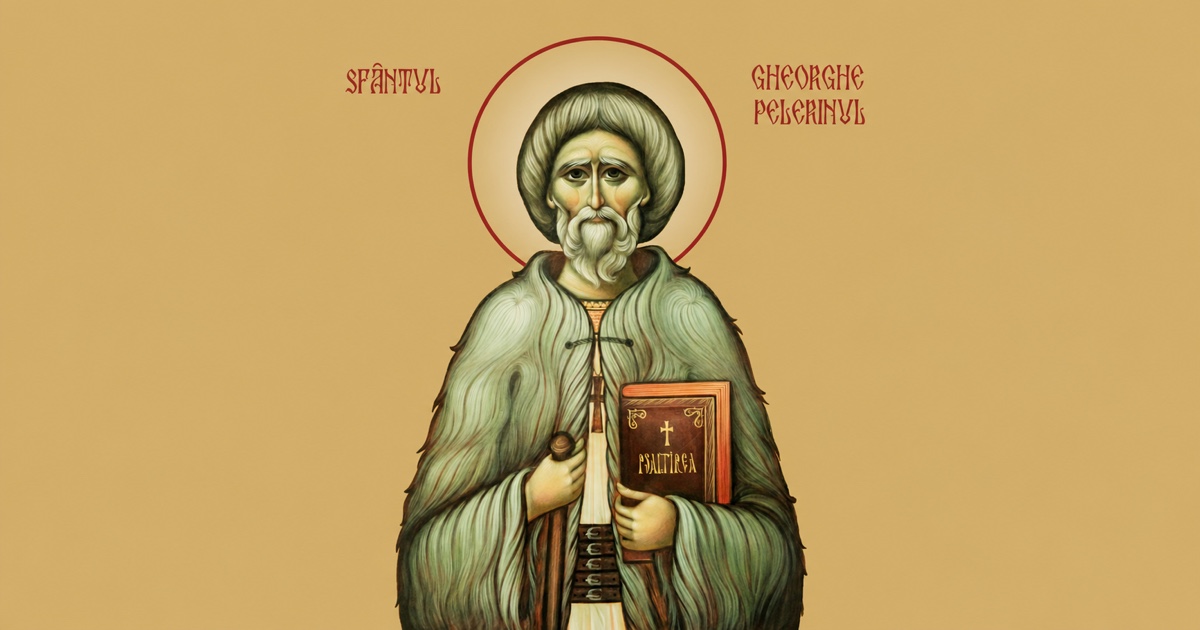
On 17 August the Church commemorates Saint George the Pilgrim, a married layman and father of five who spent the last decades of his life walking barefoot along the roads of Moldavia and praying at night in churches. His name was Gheorghe Lazăr. He was born in 1846 at Șugag, a mountain village in Transylvania, and fell asleep on 15 August 1916 in the bell tower of the princely church at Piatra Neamț. The Holy Synod of the Romanian Orthodox Church numbered him among the saints on 5 October 2017, and his relics rest at Văratec Monastery.
Three days set side by side
His commemoration falls at the end of a sequence of three days that are bound together at one and the same monastery.
On 15 August the Church keeps the Dormition of the Mother of God, the patronal feast of Văratec. On 16 August it commemorates the Venerable Joseph of Văratec, the hieroschemamonk who was founder and first spiritual father of the women’s community there. On 17 August it commemorates the Venerable Nazaria, Olympiada, and Elisabeta (Safta) Brâncoveanu, whose names entered the calendar through the canonization of 1 July 2025, with the general proclamation on 6 February 2026 and the local proclamation read at Văratec on 16 August 2026. On 17 August it also commemorates Saint George the Pilgrim.
The relics of Joseph, of the three nuns, and of the pilgrim all rest today in that same monastery. A hieroschemamonk, three nuns, and a married layman, gathered into three consecutive days.
The closest link, however, runs between the first day and the third. Gheorghe Lazăr fell asleep on the very day of the Dormition, the feast to which the monastery that now holds his relics is dedicated. His day of commemoration was appointed for 17 August, the first day left free after the feast and after the commemoration of Joseph, which had been set in the calendar in 2008. The sources consulted do not say whether this was the reason for the choice.
The house at the edge of the village
His parents raised cattle at Șugag, and the boy grazed the herd on the mountain with the Psalter at his side. He learned the psalms by heart before he came of age, and that book went with him afterwards to the Holy Land, to Athos, and into the tower at Piatra Neamț. It is kept today at Văratec.
In 1870, at twenty-four, he married Pelaghia Todescu, who would live to the age of ninety. The wedding was a restrained one, without festivity. They had five children: two sons, Ioan and Vasile, the latter dying in infancy, and three daughters, Maria, Ana, and Marta. Marta later recounted what she had heard from her mother. On the day after the wedding the young husband was missing from the house and was found at the far end of the garden, kneeling, with his hands raised.
He built his house at some distance from the village, up toward the mountain where he kept his pasture. He read the Psalter daily, went out at night to the edge of the forest and made prostrations, and gave away from what little he had.
The word that settled his life
After fourteen years of marriage, with his wife’s consent, he set out for Jerusalem together with other peasants from his village. He walked as far as Constanța, then went on by ship. At Jerusalem he stayed four days, going three times a day to the Holy Sepulchre, then visited the other holy places and spent a period in the monasteries of Palestine.
There he received the word that ordered the rest of his life. A hermit whom he had approached for a blessing told him that he was not called to monasticism but to an ascetic labour carried through the world: to walk from place to place in prayer, to gather no property, to honour priests and monks, to counsel laypeople, and to help the poor. As preparation, the hermit sent him to fast forty days in the desert.
He completed the fast, returned to the hermit, and received from him the assurance that he would walk all his life barefoot and bareheaded, and that the weather would not harm him. He then went on to the Holy Mountain, where he remained a year and a half, and returned home.
Here lies what distinguishes this life from others resembling it. The man who had reached that measure of ascetic labour received the word that his path was not monasticism but a labour carried through the world; the hermit told him it would surpass that of a monk. He received the word and followed it. He remained a layman until his death, with a living family in Transylvania, keeping an ascetic rule of unusual severity. The type is not unique in the Orthodoxy of the nineteenth century: the Russian pilgrim of The Way of a Pilgrim, an anonymous text from the same period, walks in the same manner, with unceasing prayer and a book in his bag, never entering a monastery.
The road
He did not remain long at Șugag. He set his family’s affairs in order, received Pelaghia’s consent once more, and took to the road. He crossed Transylvania stopping in villages and at monasteries, asking to be admitted to the night vigil in the local churches. When this was not possible, he prayed outdoors.
He then turned toward the monasteries of Moldavia. He went through them one after another — Neamț, Sihăstria, Sihla, Agapia, Bistrița, Nechit, Văratec — staying about a week at each. At Văratec he kept a hut outside the monastery walls, where he withdrew at night; the nuns gave him food in the evening and saw blood running from his cracked feet.
The tower at Piatra Neamț
He was given a cell in the bell tower beside the church of Saint John the Baptist at Piatra Neamț, a town in Moldavia, in the northeast of present-day Romania. The church is a foundation of Saint Stephen the Great, and the tower is known locally by his name. He remained there to the end. The sources differ as to the year. The life received at the canonization, and the material published then, give 1895, which leaves twenty-one years in the tower. The older tradition, supported by the figure of twenty-six years that circulates constantly, requires 1890.
The shape of his day is known from his disciples. By day he walked the town reciting the psalms aloud and slowly, breaking off only when someone asked him for a word of instruction. From the alms he received, taking no more than a single coin from each person, he bought bread and distributed it in the evening to the poor who gathered at the tower. He ate once a day, after sunset, and fasted altogether on Mondays, Wednesdays, and Fridays. Around eleven at night he came down from the tower, entered the church with the key the priest had given him, and prayed alone until near dawn, commemorating by name everyone from whom he had received anything.
He would not accept heavy clothing or shoes from those who offered them. To those who pressed him he answered that his feet were warm.
The disciples
Many of those who followed him entered monasteries. Among them were Damaschin Trofin, Mina Prodan, the brothers Chiril and Atanasie Păvălucă, and, the first of them all, Ioanichie Moroi.
Ioanichie Moroi (1859–1944) was born at Zărnești, near Brașov. He married and had two children, then entered monastic life together with his family. He spent a decade at a Romanian skete on Athos, nine years at Neamț, and from 1909 until his death was abbot of Sihăstria. The Romanian Patericon records that the young Ioan Moroi, before becoming a monk, asked counsel of Gheorghe Lazăr, whose disciple he was, and was sent for a year under obedience to the Skete of Peștera Ialomicioarei, with the charge of reading a Psalter every day.
Ioanichie Moroi gathered at Sihăstria a community of more than forty monks. Among those he received was, from December 1929, the young Constantin Ilie, the future Saint Cleopa of Sihăstria.
Here one of the threads leading toward the spiritual renewal of Sihăstria in the following century becomes visible: the word of a lay pilgrim bore fruit in Ioanichie Moroi, and through the community that he raised it reached the generation of Saint Cleopa.
This thread does not by itself account for what happened at Sihăstria. Saint Paisius of Sihăstria, the other great spiritual father of the place, comes by another route: he lived at the Skete of Cozancea from 1921, was Cleopa’s first guide there, and came to Sihăstria only in 1947, three years after the death of Ioanichie Moroi.
Prophecies and healings
The Romanian Patericon gathers testimonies of foresight and of the gift of healing, received from named witnesses: Evdochia Ștefan, who heard from her father the word about the war that was coming and about the brother who would return maimed; Mother Zenovia Iacov of Văratec, to whom he said, when she was a child, that she would wander some years in the world and end in a monastery; Archimandrite Mina Prodan, who saw him draw from his bag exactly what each person had asked for.
There too is preserved the word spoken to Ioanichie Moroi some thirty years before its fulfilment, that at the end of his life he would meet with many trials. The abbot remembered it in 1941, when Sihăstria burned to the ground and he himself was beaten by robbers and lost the sight of one eye.
These testimonies were collected from witnesses several decades after his repose and belong to the oral tradition of the monasteries of that region. They should be received as such.
The day of his death
The monks close to him used to ask when he would die. He would answer with his customary form of address, drăguță, “my dear,” and add: “I shall die when the nations are troubled.”
Romania entered the First World War on 14 August 1916 by the Julian calendar, then still in civil use there, which corresponds to 27 August by the calendar in use today. The next day, on the feast of the Dormition of the Mother of God, the bell-ringer of the church of Saint John climbed the tower to sound the general mobilization and found the old man asleep in the Lord in his cell, with the Psalter beside him.
Hierarchs, abbots, monks, and thousands of townspeople came to the burial. He was laid in the town cemetery at Piatra Neamț, dressed in his sheepskin coat, barefoot, with the staff of his wandering placed beside him in the coffin.
How the relics came to Văratec
In the summer of 1934, Protosyngellos Damaschin Trofin, his disciple, at that time abbot of Râșca Monastery, exhumed the bones in order to bring them to Râșca. He set out with them in a small coffin, by cart. At the crossroads with the road to Văratec the horses stopped and would go no further, then turned of their own accord toward Văratec and did not halt until they reached the monastery gate.
Protosyngellos Damaschin understood what had happened as a sign. He served the funeral office in the monastery church together with the assembly of nuns and laid the bones in the burial vault. From there they were later moved into a silver reliquary. At Văratec they have remained.
The canonization
The Metropolitan Synod of Moldavia and Bukovina submitted the proposal on 15 June 2017, with the name Saint George the Pilgrim and 17 August as the day of commemoration. The Holy Synod decreed the canonization on 5 October 2017, in the same session in which it canonized Metropolitan Iosif Naniescu under the name of Saint Joseph the Merciful.
The solemn proclamation took place on 25 March 2018, the feast of the Annunciation, at Iași. Local proclamations followed: on 23 June 2018 at Piatra Neamț and on 17 August 2018 at Văratec.
The act of canonization placed before his name none of the customary hagiographic titles, whether hierarch, venerable, or martyr, but entered him simply as Saint George the Pilgrim. He is the first saint in the Romanian synaxarion to bear the designation of pilgrim.
The Holy Synod decreed his canonization one hundred and one years after his repose. Throughout that time people came to his relics, and those who had known him — among them Ioanichie Moroi and, through him, the community of Sihăstria — held him to be a saint. The Church did not make him a saint by the decision of 2017; it recognized liturgically a holiness that the faithful and the spiritual fathers had been confessing for many decades.
What the three days show
The three days at Văratec set beside the feast of the Dormition a hieroschemamonk, three nuns, and a married layman who was never tonsured. What gathers them is not their state of life but their labour. The spiritual father raised a community; the nuns built a monastery and carried it forward; the layman walked through the world in prayer, and his words bore fruit in a disciple who in turn formed others.
A man who remained to the end a married layman, with a house in Transylvania and a wife still living, rests today in a women’s monastery born of the work of the Paisian circle, through Joseph, Nazaria, and Olympiada. That says something about who may attain holiness, and by what road.
Note on sources
The account above follows the life received by the Holy Synod at the canonization of 2017 and the testimonies gathered by Archimandrite Ioanichie Bălan. A few points for the reader who wishes to look further:
The title. The act of canonization of 5 October 2017 gives the name “Saint George the Pilgrim,” with no hagiographic title before it, and the bishop who read the tomos drew public attention to this. Church communiqués from 2026, however, also use the form “Saint Venerable George the Pilgrim.” This article follows the form given in the act of canonization.
The date of death and the calendar. 15 August 1916 is a Julian date, that calendar being in civil use in Romania until 1919, and corresponds to 28 August by the calendar in use today. The commemoration on 17 August follows the present calendar. Some accounts give 18 August 1916 as the date of burial; I have not been able to verify this against a document.
The years of the pilgrimage to Jerusalem. The sources give sometimes 1883, sometimes 1884. Reckoning fourteen years of family life from the marriage of 1870 yields 1884.
The four days and the forty days. The published life gives four days at Jerusalem and forty days of fasting in the desert. The two figures are easily confused with one another. Older accounts speak, in addition, of more than a year spent in the monasteries of the Jordan and Sinai deserts, which accounts for the interval between Jerusalem and the year and a half on Athos.
The place of the forty-day fast. The Patericon places it in the Jordan desert. Other accounts speak of the Sinai desert or of Upper Egypt. This article follows the Patericon.
The years in the tower. The life received at the canonization and the material published in 2018 give the year 1895, which leaves twenty-one years in the tower. The figure of twenty-six years, constantly repeated in popular literature, requires 1890. The article leaves both variants visible, since I have found no document that settles the matter.
Pagination of the Patericon. The life of Protosyngellos Ioanichie Moroi is found in the Romanian Patericon, Sihăstria Monastery Press, pp. 548–549. For the chapter on Gheorghe Lazăr I have no verified pagination, and the editions differ among themselves. Verbatim citation of the prophecy requires checking against the copy at hand.
The synodal wording. The description of him as a preacher of the Gospel by life and by word appears in the press communiqué of the proclamation of 25 March 2018. I have not been able to compare it with the printed tomos and do not present it as the text of the tomos.
The reliquary. The bones lay in the burial vault beneath the altar from 1934 until after the canonization, and today rest in a silver reliquary. The exact date of the transfer was not available to me. The reliquary is known to have been carried in procession to the Metropolitan Cathedral at Iași and back to Văratec in October 2021.
The testimonies of miracles. These were recorded from named witnesses several decades after 1916. They belong to the oral tradition preserved in the monastic communities of the region, and the article presents them as such.
The source underlying the published life. A considerable part of the account now in circulation — including the stay at Jerusalem, the year 1895, and the description of his wandering through the country — derives from the pages written about Gheorghe Lazăr by Fr Dumitru Stăniloae, taken up by the literature published after the canonization. I have not cited him in the text.
A confusion to avoid. The prophecy about dying “when the nations are troubled” belongs to Saint George the Pilgrim. Several websites attribute it to the Venerable Joseph of Văratec, who fell asleep in 1828, because they treat the saints of the monastery together. Joseph’s prophecy concerns the uprising of 1821.
Image: icon of Saint George the Pilgrim, painted by Florentina Mardari and published by Doxologia. Adapted by OrtodoxWay for the Facebook format.