
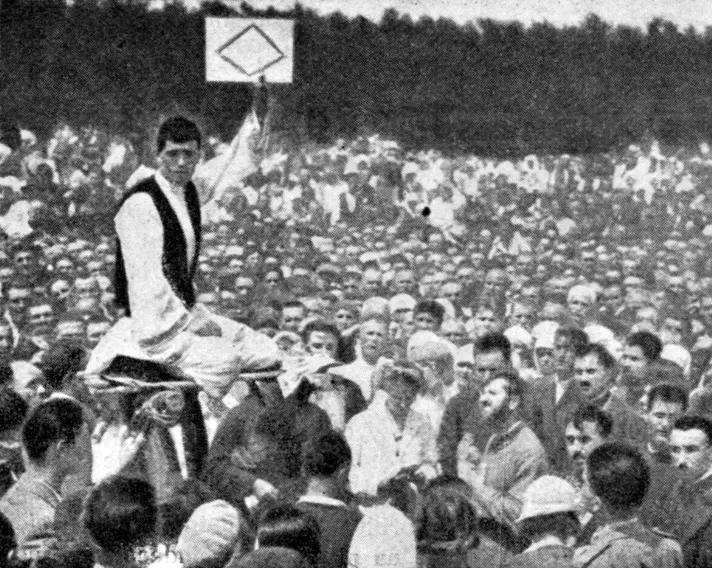
In the summer of 1935, a shepherd from Maglavit, a village in the south of Romania near the Danube, said that God had appeared to him.1 The shepherd's name was Petrache Lupu. The news went through the great newspapers of the day, and crowds set out for the village, so large that a hierarch of the time spoke of “more than two million people”. They came to ask for the forgiveness of their sins and the healing of their illnesses, and they called the shepherd “the saint of Maglavit”.2 Priests, professors of theology and a future metropolitan spoke publicly in his favour.
A few years later, a layman, Mihail Urzică, examined the case in the light of Scripture and of the Holy Fathers and came to the opposite conclusion. His book, Minuni și false minuni (“Miracles and False Miracles”), deals with four alleged theophanies in Romania between the two World Wars.3 A theophany is an appearance of God. The best known of them is Maglavit.
In this article
What Happened at Maglavit
On 31 May 1935, a Friday, Petrache Lupu was on his way to the sheepfold when, at the place called “La buturugi” (“At the Stumps”), an “Old Man” (in Romanian, Moș) with a white beard appeared to him. The Old Man commanded him to tell the people to repent, to keep the feasts, to go to church and to stop doing evil. The shepherd told no one. The vision was repeated on the next two Fridays, and the third time the Old Man commanded him to speak. On 15 June, Petrache Lupu told the villagers, the priest and the mayor what he had seen.4
The next day was the Sunday of Pentecost. During the service, the shepherd saw the Old Man in the altar, beside the Holy Cross. The Old Man beckoned to him, and he went into the altar through the Royal Doors.5 From June onwards people began to come from the neighbouring villages, then from the whole country. The great newspapers of Bucharest sent their reporters, who described at length the visions and above all the healings of the pilgrims.6 Near the place of the appearances, people gathered under some trees from whose dry branches water dripped. They held out their hands and their bottles for the drops, which they believed to have the power to heal.7
Those Who Believed
On 28 July 1935, the priest Dumitru Cristescu, the envoy of the local bishop, Vartolomeu Stănescu of Râmnic, spoke to the crowd gathered at the stumps. He said that his report would be favourable and that the bishop would rejoice that “on the banks of the Danube, at Maglavit, God has appeared”.8 Nicolae Colan, the rector of the Theological Academy in Sibiu, who was later to become Metropolitan of Transylvania, wrote at the time: “Perhaps Petrache Lupu too is such an ‘unwise’ man, through whom God wishes to put to shame the ‘wise’ of this age.”9
The priest Dumitru Stăniloae, a professor at the same academy in Sibiu, who was later to translate the Philokalia into Romanian, was at Maglavit from 22 to 25 September 1935. In Telegraful Român (“The Romanian Telegraph”), the Sibiu newspaper of which he was editor, he wrote: “I testify before God and before men, I the priest and professor D. Stăniloae, to the following wondrous healings, which I have ascertained with my own eyes at Maglavit”. He listed nine “wondrous deeds”. He then testified that he himself had seen, behind the shepherd, “a strange figure”, “a kind of bust of large proportions, of a bluish-green colour”.10 In January 1936 he concluded his study of Petrache Lupu's visions, printed in the review Gândirea (“Thought”), with these words: “As can be seen, there is nothing to prevent us from believing that Petrache Lupu saw God. His vision meets all the criteria of a theophany.”11
In the same issue of the review, Nichifor Crainic, professor of mystical theology in Bucharest, testified that he too had seen behind the shepherd “a luminous phantom with a human silhouette”. He nevertheless ended his article with a reservation: “If we have perhaps been mistaken, which is very probable, time will verify us.”12
Patriarch Miron Cristea spoke more cautiously. Asked by the newspaper Universul (“The Universe”), he said that the crowds “in their fancy also invent miracles that no one has seen” and that “time will crystallize the truth”.13 On 5 October 1935 the Holy Synod of the Romanian Orthodox Church decided to send to Maglavit a commission to investigate on the spot, and priests to care for the pilgrims. Among the grounds of the decision it also wrote this: “neither the theophany which Petrache Lupu affirms he has had, nor the things he counsels people, are in contradiction with the teaching of our holy church”. On the vision itself the Synod did not pronounce.14
What Scripture and the Fathers Teach about Visions
Scripture warns that signs, taken alone, do not prove that a revelation comes from God. The Saviour foretold: “For there shall arise false Christs, and false prophets, and shall shew great signs and wonders; insomuch that, if it were possible, they shall deceive the very elect.”15 The holy Apostle Paul writes that “Satan himself is transformed into an angel of light”. Saint John the Evangelist urges the faithful: “believe not every spirit, but try the spirits whether they are of God: because many false prophets are gone out into the world.”16 And of the day of judgement the Lord says that many will say to Him: “have we not prophesied in thy name? and in thy name have cast out devils? and in thy name done many wonderful works?”, and He will answer them: “I never knew you”.17
Saint John of Damascus writes that the demons have no power over anyone except as far as God permits them, as in the case of Job and of the swine in the Gospel. When they receive that permission, they change and take whatever form they wish to appear in.18 The desert fathers therefore kept a rule: they did not accept visions, even when these seemed holy. The Paterikon, the collection of sayings and stories of the desert fathers, tells of an elder to whom the devil appeared, saying: “I am Christ”. The elder shut his eyes, and when the devil urged him to look, he answered: “I do not want to see Christ with my eyes here, in this world”. To another elder several “angels” appeared and asked him whether he wished to see Christ. He answered them: “anathema to you and to him of whom you speak; for I believe in my Christ, Who said: ‘If any man shall say unto you, Lo, here is Christ, or there; believe it not’”.19
Saint Gregory of Sinai, one of the hesychast fathers, that is, of the ascetics who prayed unceasingly with the Jesus Prayer, gave the same command: “Never accept (as revelation) any imagining [...] or even the image of Christ, or of some angel, or the form of a saint, or light appearing like a phantom in the mind”. And he added: “He who has seen something with the mind or with the senses, even if it be of divine origin, and accepts it without the examination of the experienced, is easily deceived”.20
The archimandrite Arsenie Papacioc (1914–2011), spiritual father at the monastery of Techirghiol, near Constanța, asked the archimandrite Paulin Lecca, “alarmed”: “What will you do [...] if you work a miracle?” Lecca (1914–1996), for a time abbot of Arnota Monastery, in Vâlcea, notes in his journal that at the time he was not aware “of this danger, of the pride of holiness”.21
The Book of Mihail Urzică
Of Mihail Urzică we know only what his book says. From it we learn that he too once believed in Maglavit. In the conclusion he confesses that “at another time I too believed and upheld with great firmness the alleged miracles of Maglavit”, and that the conclusions of his research were for him too “an occasion of bitterness and of turmoil of soul”.22 In June 1937 he went to Maglavit himself and spoke with Petrache Lupu, and the book mentions events up to January 1940.23 At the beginning he writes that the Church had not yet pronounced in council on these appearances, that the opinions of theologians remained divided, and that any research made “in the fear of God and on the foundations of Orthodox mysticism and dogmatics” may be of use. He relied “for the greatest part” on facts known to all and on written testimonies of hierarchs, priests and theologians. Testimonies passed from mouth to mouth he set aside, even when they came from people of good faith.24 Most of the facts about Maglavit he took from the very books written by priests who had believed in it, those of Dumitru Antal, V. I. Ouatu and D. Roman. He therefore answers the defenders of Maglavit from their own books.25
Urzică sets five conditions for a revelation to be from God. The one to whom it is made must be pure, with “a sound mind” and “balance of soul”. The revelation must agree entirely with Scripture and Holy Tradition, and “the revelation must not contain any new teaching that could in the least oppose the old ones”. True revelations give no occasion for pride to the one who receives them. Miracles must be done “in the name of Jesus Christ, and not in any other way”. Prophecies come from the Holy Spirit, whereas fortune-telling and predictions come from the spirit of delusion.26 He ends them thus: “Let not one word be said beyond or short of the teachings of our Orthodox Church, and let no strangeness appear in anything that is proclaimed and done by such an illumined one.”27
To the one who has had a vision, Urzică shows the way of the Church. He must not believe it “without any reservation as coming from God”, but, through fasting, prayer and humility, take it “to a spiritual father as experienced as possible”. And if even the spiritual father cannot make clear what it was, “we are bound to remain in reserve until light is made”, for “in the end, what is from God will show itself to be from God, and what is from Satan will betray itself to be from Satan”. Of all the visionaries of his time he observes that they “accept being called saints”.28
What Urzică Found at Maglavit
After the first appearance, the shepherd told no one and did not go to a spiritual father, “as would have been natural”. The second time, when the Old Man rebuked him for having announced nothing, he answered: “Lord, forgive me that I forgot”. The shepherd thus called “Lord” an apparition which, by his own words, he did not yet know. Nor had he forgotten. Recounting later what had happened, he himself confessed: “I went to the sheep and again I said nothing to anyone, for I was ashamed that people would laugh at me”. Urzică concludes: “In reality, by these words of self-excuse, he lied.”29 After the third appearance he announced it to the whole village, and he came to the priest last, “only to report the ‘miracle’”.30
On the Sunday of Pentecost, after the shepherd had gone into the altar, the priest said to him: “What are you looking for in the Altar [...], it is not allowed”. The shepherd answered him: “I have no need of you. The old man called me”.31 Canon 69 of the Council in Trullo, one of the rules of the Church given by a council, does not allow laymen to go up into the altar. The only exception is the emperor, when he brings his gifts to God.32 Onto the mound of earth from which the shepherd preached, writes Urzică, only he went up. To a girl who tried to climb it he said: “Do not come up, for you have sinned much”.33
Christ was missing from the shepherd's preaching. “He does not mention Christ, but only the ‘old man’”, writes Urzică. The shepherd did not confess God in Trinity, and his signs were not done in the name of Christ.34 Punishment and reward he proclaimed in the fruits of the field and in health: if people do not repent, “you will have nothing to keep anything with: neither ox, nor horse, nor sheep, nor pig”.35 The forgiveness of sins he had moved from confession to the place of the appearances: “Go, brothers, to the stump, go to the Cross, stay there and pray that God may forgive you your sins.”36 Urzică answers that “true repentance is made only with the spiritual father, the only one who has the power to bind and to loose”.37 Of the fruits of Maglavit he writes: “a few people repent with the spiritual father, while most repent at a ‘stump’”.38
The shepherd also received honours that no saint ever asked for. Though he was a layman, he blessed the crowds by laying his hands on their heads. He allowed his hand to be kissed, and in Bucharest, in 1938, he told the faithful: “Brothers, it is not my hand you are kissing, but the ‘old man's’”. Urzică answers that, if the “old man” was not God, that hand was being kissed for someone else.39
The shepherd also drew close to the Spiritists. The Spiritist circles of Bucharest, that is, the groups that call up the spirits of the dead, received “communications” which praised Petrache Lupu. The shepherd spent his name day in 1938 among the Spiritists and often prayed together with them. Urzică himself told him, in June 1937, what Spiritism is. Their ties, he writes, grew stronger from then on.40
The shepherd also spoke about the sins of others. Asked how he knew what he knew, he answered Nichifor Crainic: “I see through a man”.41 The sins he “saw” he told before the crowd. To a man who asked him for the healing of an eye he said, according to a priest who wrote about Maglavit in 1936: “You will be healed when the priest you killed comes back to life”.42 Another man, who had come to give his fortune for the monastery that was to be built at Maglavit, he drove away before everyone, telling him that his fortune was made from thefts.43 Urzică sets beside this the sinful woman in the house of the Pharisee, whose sins the Lord did not reveal, although the Pharisee thought: “This man, if he were a prophet, would have known who and what manner of woman this is that toucheth him”. He also sets beside it the woman taken in adultery, to whom the Lord said: “Neither do I condemn thee: go, and sin no more.”44 And he concludes: “Neither the Lord Christ, nor the saints, nor His venerable ones ever revealed before the world the sins of those who repented”.45
It was told of the shepherd that his candle did not go out in the wind and that he passed his hand through fire without being burned. Urzică recalls that the holy Martyr Cyprian, while he was a sorcerer, before he was baptized, also raised winds and rains by the power of the devil.46 Of the healings he writes with measure. Some may have been real, but they took place “independently of the phenomenon of Maglavit”, through the prayers and fasting of the sick and through the Mystery of Holy Unction, the anointing with blessed oil which the Church performs for the sick.47
A church was also being built at Maglavit. Petrache Lupu himself said: “The ‘old man’ did not tell me to build a church.” Urzică writes that, if the house of worship is raised on the ground of unexamined appearances, its raising will be “a great abomination”, and he recalls Canon 83 of the Council of Carthage on altars raised as a result of dreams and false revelations.48 His conclusion about Maglavit has the tone of a lament: “What use is it that some apparent things, of those done with Petre Lupu, are good, if others instead carry with them the poison of the serpent!”49
What Followed
The Holy Synod returned to Maglavit. On 10 March 1936 it decided that all the committees collecting the pilgrims' money should be dissolved and that the building project should be abandoned. If the local bishop did not submit, the parish of Maglavit was to pass directly under the Patriarch.50 Bishop Vartolomeu, who had protected the phenomenon, was accused in Parliament of abusive conduct and of heresy.51 The Synod's decisions in the following years concerned what was happening around Maglavit, above all the money and the building. On the vision itself it did not pronounce then either.52
After the war, the communist regime imprisoned Petrache Lupu. After his release he kept silent until his death, in 1994.53 In 1952, Dumitru Stăniloae published the study “The Forms and Causes of False Mysticism”, without mentioning Maglavit.54 We know of no public retraction by him of what he wrote in 1935 and 1936.
Conclusions
Maglavit had everything that crowds take as proof. A simple man called people to repentance, people saw luminous apparitions and were healed, and priests and professors praised him. Urzică showed that none of these things proves by itself that a work comes from God. He judged by what the Church teaches: whether the vision was taken to a spiritual father, whether the one who proclaims it confesses Christ, whether he sends people to the Mysteries, and whether he obeys the priest.
Petrache Lupu fulfilled none of these measures. He received the apparition without asking anyone and proclaimed it without a blessing. He went into the altar and passed over the word of the priest. He sent his hearers to ask for the forgiveness of their sins at the stump. People's sins he told before the crowd.
Maglavit was not a theophany. Petrache Lupu's vision did not pass through a spiritual father and did not confess Christ, and the shepherd sent his hearers to ask for the forgiveness of their sins at a stump, in place of confession. Dumitru Stăniloae wrote in 1936 that it “meets all the criteria of a theophany”, and the Holy Synod held in 1935 that it did not contradict the teaching of the Church. Both judgements are wrong, because the vision fulfils none of the measures which the Fathers require and which Urzică followed. When we hear of visions and miracles, the Fathers teach us to do as the elder of the Paterikon did: not to seek to see Christ with our eyes in this world, but to receive Him in His Church, through confession and Holy Communion.
Notes
- Radu Petre Mureșan, “Fenomenul Maglavit (1935). Ecouri de la ‘Locul Minunilor’” [“The Maglavit Phenomenon (1935): Echoes from ‘the Place of Miracles’”], Revista Teologică (Metropolis of Transylvania), new series, no. 4/2019, pp. 84–106 (the issue according to revistateologica.ro, consulted on 6 November 2026; the pages according to the PDF; hereafter: Mureșan), p. 84: Maglavit, “in the south of Romania, close to the border with Bulgaria”. “On the banks of the Danube”: the priest Dumitru Cristescu, after Mureșan, pp. 97–98, n. 27 (see note 8). ↩
- The figure: a “well-known prelate”, whom he does not name, quoted by Mihail Urzică, Minuni și false minuni, Editura Anastasia, 1993 (hereafter: Urzică; see note 3), pp. 169–170. “The saint”: Nicolae Colan, after Mureșan, p. 97 (“‘the Saint’ of Maglavit, as the believing pilgrims call him”); Urzică, p. 197. ↩
- Urzică, “O lămurire” [“A Clarification”] (unpaginated, at the beginning of the book): the cases of Cuca-Argeș (Ion Popa Gheorghe, 1919–1923), Cassota-Buzău (Bănică Doleanu, 1928), Maglavit (Petrache Lupu, 1935) and Tudor Vladimirescu-Tecuci (Vasilica Barbu, 1937). The edition, according to the title page of our copy: Editura Anastasia, 1993; the cover bears the name of the collection, “Teologic”. ↩
- Mureșan, pp. 84–85. ↩
- Mureșan, p. 85; Urzică, pp. 180–181, after V. I. Ouatu, Maglavitul, Tipografia Oastei Domnului, Sibiu, 1935, p. 57. ↩
- Mureșan, pp. 85–86 (Dimineața, Curentul, Universul). ↩
- Urzică, pp. 187–190, after Fr. Dumitru Antal, Ce am văzut și ce am auzit la locul minunatei întâmplări de la Maglavit, 1935, pp. 8–9, and after Ouatu. ↩
- Mureșan, pp. 97–98, n. 27, after Constantin Jaleș, “Ce s-a petrecut duminică la Maglavit-Dolj”, Curentul, 31 July 1935. ↩
- Nicolae Colan, “Fericiți cei curați cu inima. Minunea de la Maglavit” [“Blessed Are the Pure in Heart: The Miracle of Maglavit”], Viața ilustrată, year II, no. 8–9 (August–September 1935), pp. 1–2, after Mureșan, pp. 96–97 and n. 25. Colan was then rector of the Andreian Academy in Sibiu, and he was Metropolitan of Transylvania from 1957 to 1967 (Mureșan, p. 96). ↩
- Dumitru Stăniloae, “Vindecările minunate văzute de mine la Maglavit” [“The Wondrous Healings Seen by Me at Maglavit”], Telegraful Român, 29 September 1935, pp. 2–3, republished in Renașterea (Cluj), 6 October 1935, and in Dumitru Stăniloae, Cultură și duhovnicie. Articole publicate în Telegraful Român, vol. I (1930–1936), ed. Ion-Dragoș Vlădescu, Basilica, Bucharest, 2012, pp. 712–717; after Mureșan, pp. 92–93 and n. 20. His years in Sibiu and at Telegraful Român: Mureșan, p. 92. We have not seen the article in the original. ↩
- Dumitru Stăniloae, “Încercare despre teofanii. Interpretarea vedeniilor lui Petrache Lupu” [“An Essay on Theophanies: The Interpretation of Petrache Lupu's Visions”], Gândirea, year XV, no. 1, January 1936, pp. 14–29, after Mureșan, p. 96 and n. 23. The study starts from five articles in Telegraful Român (22 September 1935 – 19 January 1936), reprinted in Cultură și duhovnicie, vol. I, pp. 705–787. We have not seen it in the original. ↩
- Nichifor Crainic, “Vizită la Maglavit” [“A Visit to Maglavit”], Gândirea, year XV, no. 1, January 1936, pp. 1–11 (the visit: 23 October 1935), after Mureșan, pp. 93–95. The quotations: Crainic, pp. 7 and 11. ↩
- “IPS Patriarh Miron Cristea despre Maglavit”, Universul, 15 September 1935, pp. 1–2, after Mureșan, p. 98 and n. 28. ↩
- “Ședința din ziua de 5 octombrie 1935”, Biserica Ortodoxă Română, year LIII (1935), no. 11–12, pp. 199–200, after Mureșan, pp. 98–99 and n. 29. That the decision “does not in fact pronounce on the character of the theophanies” is written by Mureșan, p. 99. ↩
- Matthew 24:24. The verses of Holy Scripture are quoted from the King James Version, in the standardized text of 1769, from the electronic edition on eBible.org (https://ebible.org/eng-kjv/), consulted on 6 November 2026, an electronic edition, without pages. ↩
- 2 Corinthians 11:14; 1 John 4:1. ↩
- Matthew 7:22–23. ↩
- Saint John of Damascus, Dogmatics (An Exact Exposition of the Orthodox Faith), book II, ch. 4, “Concerning the devil and demons”; after the English version in Nicene and Post-Nicene Fathers, second series, vol. IX, ccel.org, consulted on 6 November 2026. Urzică (p. 120) quotes the same place from the Romanian translation in the collection “Izvoarele Ortodoxiei” (“Sources of Orthodoxy”), p. 65. ↩
- Urzică, p. 117, who quotes the Patericul (the Romanian Paterikon), Tipografia Cozia, 1930, pp. 318–319 and 325. We have not seen the 1930 edition. The elders' words are translated here from Urzică's Romanian; the words of the Gospel quoted by the second elder (Matthew 24:23) are given in the King James Version. ↩
- Urzică, pp. 42–43, who quotes Saint Gregory of Sinai from Migne, Patrologia Graeca, vol. 150, col. 1329–1345, in his own translation. We have not compared the text with the Greek original or with an edition of the Philokalia. The passage is translated here from Urzică's Romanian. ↩
- Paulin Lecca, Jurnal duhovnicesc (“Spiritual Diary”), ed. Ioan Gându, Studion, Bacău, 2013, p. 301. For Papacioc: basilica.ro, “Remembrance Service 4 Years After The Passing Away Of Father Arsenie Papacioc”, July 2015 (born in 1914, spiritual father at Techirghiol from 1976, reposed in 2011). For Lecca: Stelian Gombos's text about him on crestinortodox.ro, reproduced in the collection Părinții îl dezvăluie pe Părintele Arsenie Boca, pp. 31–41. ↩
- Urzică, p. 245. ↩
- The visit: Urzică, p. 199. The latest event mentioned: the carol about Maglavit printed in Universul on 1 January 1940 (p. 190). ↩
- Urzică, “O lămurire”, and p. 217. ↩
- Fr. Dumitru Antal, Ce am văzut și ce am auzit la locul minunatei întâmplări de la Maglavit [“What I Saw and What I Heard at the Place of the Wondrous Event of Maglavit”], 1935, quoted by Urzică, for example, on pp. 176, 182 and 187–188; Fr. V. I. Ouatu, Maglavitul [“Maglavit”], Tipografia Oastei Domnului, Sibiu, 1935, quoted on pp. 125, 180 and 187; Fr. D. Roman, La Maglavit Dumnezeu Se arată și vorbește [“At Maglavit God Appears and Speaks”], quoted on pp. 192, 201 and 205. Dumitru Antal, a priest in Bucharest, later became a bishop, under the name of Emilian (Mureșan, p. 97). ↩
- Urzică, pp. 102–105. ↩
- Urzică, p. 105. The edition reads “să un apară”, a misprint for “să nu apară” (“should not appear”). ↩
- Urzică, pp. 129–130 and 121. The edition reads “cit mai încercat”, a misprint for “cît mai încercat” (“as experienced as possible”). ↩
- Urzică, pp. 176–177. The shepherd's confession, after C. S. Nicolăescu-Plopșor, Maglavitul, Tipografia “Ramuri”, Craiova, pp. 39–40. ↩
- Urzică, p. 178. ↩
- Urzică, p. 180, after Ouatu, p. 57. ↩
- Canon 69 of the Council in Trullo, in Nicene and Post-Nicene Fathers, second series, vol. XIV, from sacred-texts.com, consulted on 6 November 2026 (the ancient epitome: “No layman except the Emperor shall go up to the altar”; the canon allows this to the emperor “when he wishes to offer his gifts to the Creator”). Urzică (p. 181) quotes it in Romanian. ↩
- Urzică, p. 182, after Antal, p. 10. ↩
- Urzică, p. 183. ↩
- Urzică, p. 125, after Ouatu, p. 54. ↩
- Urzică, p. 187, after Ouatu, p. 26. ↩
- Urzică, p. 122. ↩
- Urzică, p. 218. ↩
- Urzică, pp. 191–192 and 195–196. ↩
- Urzică, pp. 197–199. ↩
- Urzică, p. 200, after Nichifor Crainic, in Sfarmă-Piatră, no. 42, 10 September 1936. ↩
- Urzică, p. 202, after Fr. Ioan Mihălcescu, Rolul Maglavitului în viaţa noastră religioasă, Bucharest, 1936, p. 14. ↩
- Urzică, p. 205, after the testimony of the monk Mircea Drăghici, in Fr. D. Roman's book, La Maglavit, p. 29. ↩
- Luke 7:39; John 8:11. Urzică, pp. 203–204. ↩
- Urzică, p. 204. ↩
- Urzică, p. 212; the hand passed through fire, after G. Ilioniu, “La Maglavit”, Universul, 15 October 1939. ↩
- Urzică, pp. 213–214. ↩
- Urzică, pp. 217–218. Canon 83 of the Council of Carthage (86 in the Greek collections), “Of false Memories of Martyrs”, in Nicene and Post-Nicene Fathers, second series, vol. XIV, ccel.org, consulted on 6 November 2026: “altars which have been erected anywhere on account of dreams or inane quasi-revelations of certain people, should be in every way disapproved of”. ↩
- Urzică, p. 218. ↩
- Mureșan, p. 102, n. 37, after Petre Sperlea, Vartolomeu Stănescu. Episcop al Râmnicului Noului Severin (1921–1938), Basilica, 2014, pp. 76–77. ↩
- Mureșan, p. 102. ↩
- Mureșan, pp. 98 and 102. ↩
- Mureșan, p. 100; the years of Petrache Lupu's life (1907–1994), p. 84. ↩
- Dumitru Stăniloae, “Formele și cauzele falsului misticism”, Studii Teologice, 1952, no. 5–6, pp. 251–271, after Mureșan, p. 100 and n. 33. ↩
