
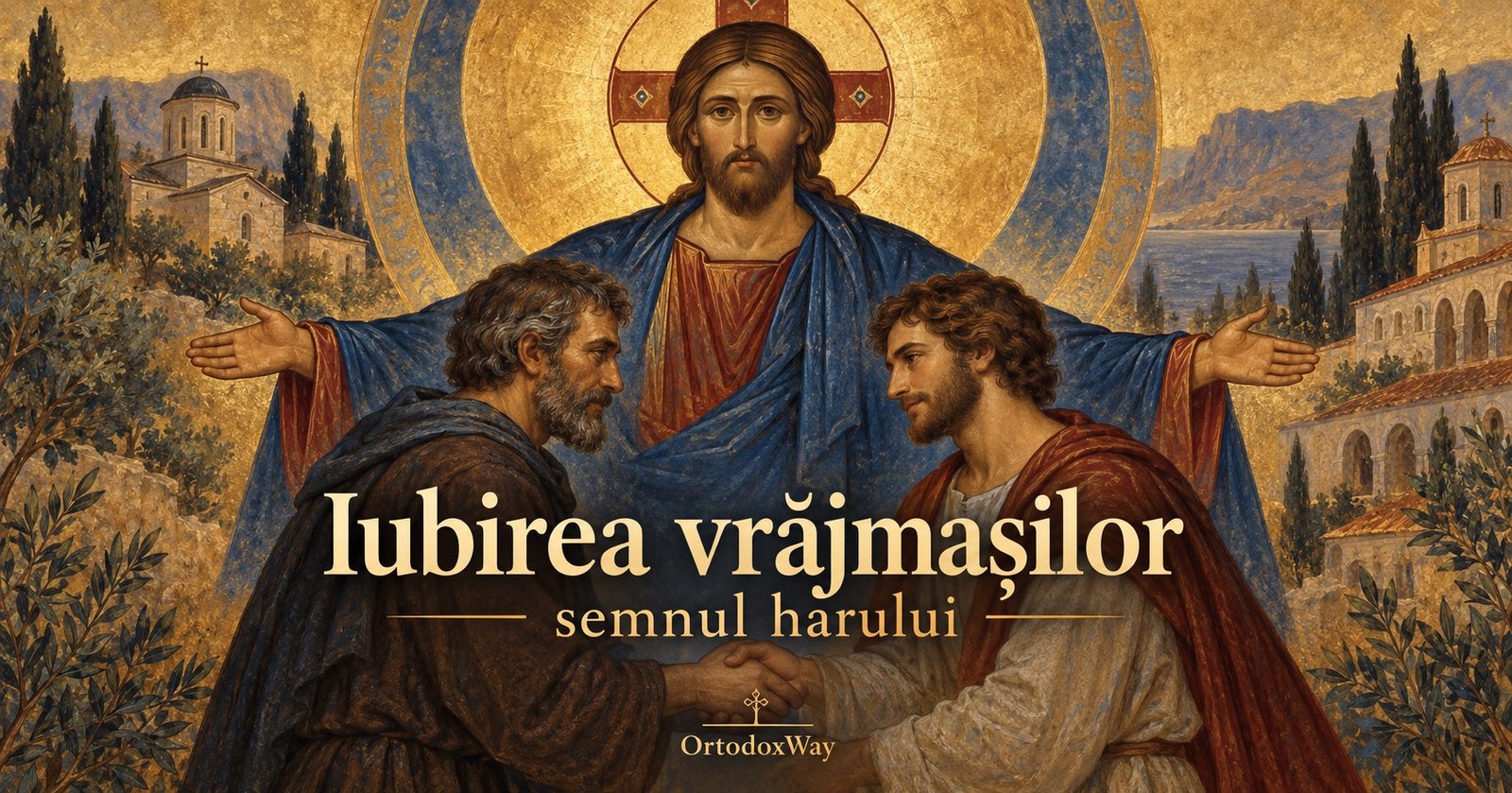
On the Nineteenth Sunday after Pentecost, the Church reads at the Divine Liturgy the commandment in which Christ asks His disciples to love their enemies. This commandment is preserved by the Holy Evangelist Matthew in the Sermon on the Mount, and by the Holy Evangelist Luke in the discourse the Lord gave before His disciples and the multitude, on a level place. Both discourses open with the Beatitudes, the sayings of the Lord that begin with “Blessed”. On the nine Beatitudes of the Gospel according to Matthew I have written in the article How Can We Be Happy?. They tell us who is blessed before God: the poor in spirit, the meek, the merciful, the peacemaker. The Gospel of this Sunday teaches us how such a person behaves toward the one who wrongs him.
The Gospel of the Sunday
“And as ye would that men should do to you, do ye also to them likewise.
For if ye love them which love you, what thank have ye? for sinners also love those that love them.
And if ye do good to them which do good to you, what thank have ye? for sinners also do even the same.
And if ye lend to them of whom ye hope to receive, what thank have ye? for sinners also lend to sinners, to receive as much again.
But love ye your enemies, and do good, and lend, hoping for nothing again; and your reward shall be great, and ye shall be the children of the Highest: for he is kind unto the unthankful and to the evil.
Be ye therefore merciful, as your Father also is merciful.”
(Luke 6:31-36)
The Love That Expects Nothing in Return
The Lord begins with a rule that anyone can understand: that we should do to others what we would have them do to us. He then shows that a love which stops at those who love us remains at the measure of sinners. Sinners too love those who love them, do good to those who do good to them, and lend in order to receive as much again. The Lord does not condemn the love between members of one family or between friends. That love falls short, however, when only those who love us seem worthy of our kindness.
The Gospel was written in Greek. In the Greek text the Lord asks the same question three times, each time using the word charis, which the King James Version renders “thank”. Elsewhere in the New Testament the same word names grace, the unmerited gift by which God enlightens man and gives him strength to live in Christ. Here the Lord calls us to go beyond the exchange between people and to grow like the goodness of the Father.
Then comes the commandment: “But love ye your enemies, and do good, and lend, hoping for nothing again” (Luke 6:35). The Lord asks His disciples for more than putting up with those who hate them. He asks them to love them and to do them good.
In the same verse the Lord adds: “and your reward shall be great”. This promise does not contradict the call to give while hoping for nothing again. Whoever loves in this way stops weighing people by the profit they can bring him and sets his hope on God.
The Lord promises further: “ye shall be the children of the Highest: for he is kind unto the unthankful and to the evil”. A similar promise stands among the Beatitudes: “Blessed are the peacemakers: for they shall be called the children of God” (Matthew 5:9). The words with which the Gospel of this Sunday ends, “Be ye therefore merciful, as your Father also is merciful” (Luke 6:36), are bound to another Beatitude: “Blessed are the merciful: for they shall obtain mercy” (Matthew 5:7).
In the Gospel according to Matthew, the Lord also speaks of the sun which the Father makes to rise “on the evil and on the good” (Matthew 5:45). Where St Luke writes “merciful”, St Matthew writes: “Be ye therefore perfect, even as your Father which is in heaven is perfect” (Matthew 5:48). The perfection of the Father is seen in His kindness toward the unthankful and the evil.
The Steps of St John Chrysostom
St John Chrysostom interprets this teaching in his homilies on the Gospel according to Matthew. He shows that the love of enemies is the summit of a ladder which Christ climbs step by step in the Sermon on the Mount:
“Do you see how many steps He has ascended, and how He has set us on the very summit of virtue? Nay, mark it, numbering from the beginning. A first step is, not to begin with injustice: a second, after he has begun, to vindicate one’s self by equal retaliation; a third, not to do unto him that is vexing us the same that one has suffered, but to be quiet; a fourth, even to give one’s self up to suffer wrongfully; a fifth, to give up yet more than the other, who did the wrong, wishes; a sixth, not to hate him who has done so; a seventh, even to love him; an eighth, to do him good also; a ninth, to entreat God Himself on his behalf.” (Homilies on Matthew 18.4)
The measure of the second step is that of the Old Law: “An eye for an eye, and a tooth for a tooth” (Matthew 5:38). St John explains in the same homily that the Law commanded equal retaliation in order to restrain the hand of the one who wants revenge. Christ raises His disciples to the last step, where a person prays for the one who has wronged him.
St John also stresses the height of the reward promised for this commandment. To the meek the Lord promised the earth, to those who mourn comfort, and to the merciful mercy. To those who love their enemies He promises what is more wonderful than all: to become like God, as far as this is possible for man (Homilies on Matthew 18.4). The comparison shows how high this commandment calls us. It does not set a lesser salvation against a greater one, for among the Beatitudes too the peacemakers are promised that they shall be called children of God.
Whoever hears this commandment asks how it can be fulfilled. St John points him to the Cross: “Having seen God become man, and descend so far, and suffer so much for your sake, do you still inquire and doubt, how it is possible to forgive your fellow-servants their injuriousness?” (Homilies on Matthew 18.5). The Lord Himself prayed for those who crucified Him: “Father, forgive them; for they know not what they do” (Luke 23:34).
In the same homily St John likens the one who wrongs us to a sick man: “For so too the physicians, when they are kicked, and shamefully handled by the insane, then most of all pity them, and take measures for their perfect cure, knowing that the insult comes of the extremity of their disease” (Homilies on Matthew 18.6). The physician does not call the disease health. He sees the person beyond the disease and cares for him.
St Silouan the Athonite
The love of enemies stands at the centre of the teaching of St Silouan the Athonite. The Saint was born in 1866 in a village in the Tambov region of Russia, and received the name Simeon at Baptism. In the autumn of 1892 he came to the Holy Mountain of Athos, to the Russian Monastery of St Panteleimon. There he lived as a monk until 24 September 1938, when he departed to the Lord. His life and writings were made known by his disciple, St Sophrony (Sakharov).
In his youth Simeon was a very strong young man. At a village feast, a drunken youth tried to snatch his accordion in order to show off before the others. Simeon was ashamed at the thought that the girls would laugh at him, and struck him hard in the chest. The man fell with blood and froth at his mouth, and only after more than half an hour could he get up. St Sophrony preserved this incident as the Saint himself told it to him.
The man who in his youth had struck so hard came to weep for the whole world. While he was still a novice, the Lord appeared to him in the small church of the Holy Prophet Elijah, beside the monastery mill. St Silouan bore witness that the Lord Himself had taught him to love his enemies.
The Saint said that without the grace of God we cannot love our enemies. Only the Holy Spirit teaches this love. The soul that has not known the Holy Spirit does not even understand how anyone can love his enemies, and does not accept this teaching. His words show how a person can fulfil the commandment heard in the Gospel.
Yet the Saint also asked for man’s own labour. He counselled whoever wishes to love his enemies to compel his heart from the beginning. The Lord, he said, seeing the person’s good will, will help him in all things, and experience itself will show him the way.
When someone insults you, takes what is yours, or persecutes the Church, St Silouan urged you to pray to the Lord, telling Him that we are all His creatures and asking Him to have mercy on His servants and to turn their hearts to repentance. Whoever prays in this way, he said, will feel grace in his soul.
If you pray for your enemies, the Saint taught, peace will come to you. And if you come to love them, know that a great measure of the grace of God dwells in you. The one who thinks of his enemies with malice does not have the love of God in him and does not know God.
St Sophrony notes that St Silouan weighed even the highest experiences of prayer by the same measure. If afterwards the soul had no love for enemies and for all creation, St Silouan saw in this a sign that the experience had not been a true communion with God.
St Sophrony also preserved a conversation at which he was present. A hermit was saying, with evident satisfaction, that God would punish all atheists and that they would burn in everlasting fire. St Silouan, troubled, asked him whether he would be happy to reach paradise and to see from there someone burning in the fire of hell. The hermit answered that it could not be helped, since it would be their own fault. Then the Saint said to him, with a sorrowful face: “Love could not bear that. We must pray for all!”
The hermit imagined a happiness that could look calmly on the torment of others. St Silouan knew the happiness of the man who carries all people in his prayer. His word calls us to ask unceasingly for the salvation of all and to leave their judgement to God.
The same love was described in the seventh century by St Isaac the Syrian. The merciful heart, he says, is a burning of the heart for the whole of creation. The person who has such a heart prays unceasingly with tears even for the enemies of the truth and for those who harm him, that they may be protected and receive mercy (Ascetical Homilies, 81). This is the mercy to which the Gospel of this Sunday calls us.
Why the Lord Gave This Commandment
St Maximus the Confessor asks why the Lord commanded the love of enemies. The Lord gave it, he answers, to free man from hatred, irritation, anger and the remembrance of wrongs, that is, keeping evil in mind with enmity and with the desire for revenge, and to make him worthy of perfect love. Man attains this love when, following the example of God, he loves all people equally. God loves all equally and wills that all be saved (Four Hundred Texts on Love I.61).
Perfect love, he also writes, looks at human nature, which is one in all people, and embraces all alike, whatever the character of each. It loves the good as friends and the wicked as enemies, does them good, bears with them, and even suffers for them, so as to make them friends if possible. When it does not succeed, it does not change, and goes on giving the fruits of love to all. Thus Christ suffered for all people and gave to all the same hope of resurrection, although each one makes himself worthy of glory or of punishment (Four Hundred Texts on Love I.71).
The First Steps
St John Chrysostom places prayer for one’s enemy on the highest step, while St Silouan also shows it as a beginning. A person begins to pray with effort, out of obedience to the commandment, and in time his prayer can come to spring from love. The grace of God accompanies him both in the first steps and in his growth. That is why the first thing is to remember in prayer the one who has wronged us, even while the heart still resists.
The wound may go on hurting for a long time after a person has begun to pray for the one who wounded him. This pain is not the same thing as a hatred one chooses. The Apostle assures us that “the Spirit also helpeth our infirmities” (Romans 8:26).
St Silouan binds the love of enemies to humility. Where there is pride, he said, there can be no grace. The soul must humble itself and love its enemies, for there is no other way to please God. Yet the person who is still struggling with pride is not left alone. God calls him and helps him to humble himself, and grace works also in the one who repents and asks for help, not only in the one who has reached perfection.
St John Chrysostom ends his homily with very simple advice: not to wait for the other person to speak to us first. Many wait to be greeted first, and this habit, he says, has overthrown countless friendships and brought about many enmities (Homilies on Matthew 18.10).
The love of enemies does not require us to call evil good. When one of the officers who stood by struck Him, the Lord answered: “If I have spoken evil, bear witness of the evil: but if well, why smitest thou me?” (John 18:23). The same Lord then prayed on the Cross for those who crucified Him. We may therefore stop evil, defend the weak and ask for help without wishing the perdition of the one who commits it. Whoever forgives is not bound to say that the deed never happened, nor to pretend to trust where trust has been destroyed.
Children of the Highest
The Beatitudes end with those who are reviled and persecuted for Christ, to whom the Lord says: “Rejoice, and be exceeding glad: for great is your reward in heaven” (Matthew 5:12). The disciples of Christ behave toward those who persecute them as the Gospel of this Sunday asks: they love them, do them good and pray for them. Thus they live as children of the Highest, Who is kind unto the unthankful and to the evil. This adoption, our being received as children of God, is His gift in Christ. By loving our enemies we learn to live according to this gift and grow ever more like the Father, Who loved us first.
St Silouan asked the Lord, day and night, to give him love for his enemies, and the Lord gave him tears for the whole world. This path is open to everyone. It begins with a humble prayer for the one who has wounded us, and with the request the Saint raised unceasingly: that the Lord would teach us, by His Holy Spirit, to love our enemies and to pray for them with tears.
“Be ye therefore merciful, as your Father also is merciful” (Luke 6:36).
Note. Scripture is quoted from the King James Version. The quotations from St John Chrysostom follow the Nicene and Post-Nicene Fathers translation, First Series, vol. 10 (1888), as revised on New Advent. St Silouan’s teachings are given after St Sophrony (Sakharov), Saint Silouan the Athonite, translated by Rosemary Edmonds; the words from the conversation with the hermit are on p. 48 of the 1991 edition (Monastery of St John the Baptist, Tolleshunt Knights, Essex). The homily of St Isaac the Syrian is numbered according to the Greek edition; in the English translation of Holy Transfiguration Monastery it is Homily 71.