
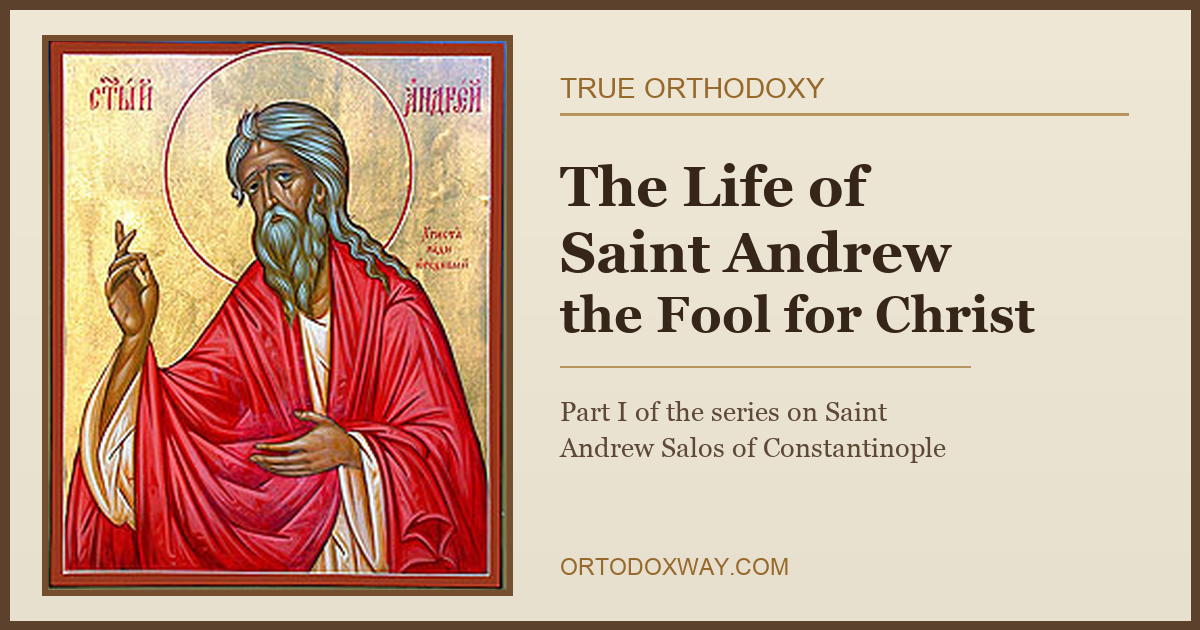
Part I of a three-part series on Saint Andrew the Fool of Constantinople
Why this article
Saint Andrew the Fool for Christ is one of the best-known saints of the East — and, at the same time, one of the least understood. His feast, kept on October 2nd, is known to most Orthodox Christians chiefly through its link to the vision at Blachernae, the foundation of the feast of the Protection of the Mother of God. Beyond that central liturgical moment, however, his Life is seldom read in full, and his place within the Tradition of folly for Christ — the place, that is, in which one comes to understand what a salos is — remains unclear to most readers.
This article begins a series of three parts. The first part lays the foundation: what folly for Christ is, where it has its scriptural and patristic ground, why it holds so high a place in Orthodox Tradition, and how the Church distinguishes it from mere madness; then who Saint Andrew is according to the Life written by the priest Nicephorus, and how this Life was transmitted, from Constantinople down to us, through liturgical commemoration and through its Athonite translation into Romanian. The parts that follow will treat: the vision at Blachernae and the Protection of the Mother of God (Part II), and the apocalyptic section of the Life, with the discernment due to patristic prophecies (Part III).
“We are fools for Christ’s sake… Even unto this present hour we both hunger, and thirst, and are naked, and are buffeted, and have no certain dwellingplace… Being reviled, we bless; being persecuted, we suffer it: being defamed, we intreat: we are made as the filth of the world, and are the offscouring of all things unto this day.”
— Saint Paul the Apostle (1 Corinthians 4:10-13)
Hunger, thirst, nakedness, wandering, reviling, mockery, received with blessing: this is, word for word, the portrait of Saint Andrew on the streets of Constantinople — written by the Apostle Paul eight centuries before he was born. It is from this apostolic word that we set out, for in it is already contained, in seed, all that we shall say of folly for Christ.
The scriptural ground: the folly of the Cross
Folly for Christ is not an invention of later monasticism; it grows from a deep scriptural root: the word of the holy Apostle Paul concerning the folly of the Cross. The whole paradox of the salos phenomenon is already contained, in seed, in the opening chapters of the First Epistle to the Corinthians.
Paul sets down from the very beginning a reversal that will stand at the foundation of the entire ascetic struggle: “For the preaching of the cross is to them that perish foolishness; but unto us which are saved it is the power of God” (1 Corinthians 1:18). What the world reckons folly — a crucified God, victory through defeat, glory through dishonour — is, for the faithful, the very saving power. And Paul carries the reversal to its limit: “Hath not God made foolish the wisdom of this world?” (1:20), only to conclude: “the foolishness of God is wiser than men” (1:25).
Here lies the key. There are two wisdoms and two follies, set crosswise: the wisdom of the world, which before God is folly, and the “folly” of God, which is the true wisdom. The salos takes upon himself precisely this position: putting on visible folly before the world, he confesses that he has chosen the other wisdom. His folly played out in the marketplace is a living icon of the folly of the Cross — a scandal to them that perish, salvation to those who understand it.
And the verse from which we set out carries this reversal into the very flesh: “We are fools for Christ’s sake… we both hunger, and thirst, and are naked, and are buffeted, and have no certain dwellingplace… Being reviled, we bless… we are made as the filth of the world, and are the offscouring of all things” (1 Corinthians 4:10-13). Paul here describes the apostolic life itself, but in terms that will become, letter for letter, the programme of the salos. He does nothing other than carry to an extreme, literal expression what the Apostle called the very condition of a servant of Christ.
For this reason the salos phenomenon, however unusual, is no exotic appendix to the Orthodox tradition, but a living-out to the very end of a central apostolic word. The fools for Christ took with full seriousness, down to the last consequence, what many Christians read without flinching. The first to embody this apostolic word in a complete Life, preserved whole, was Saint Simeon of Emesa, in the sixth century; Saint Andrew, across the centuries, treads the same path.
Why folly for Christ is one of the highest and harshest forms of Orthodox ascetic struggle
The encounter with the tradition of the fools for Christ — saloi in Greek, iurodivye in Russian — produces in most readers a first reaction of bewilderment. How is it that these men and women, who hid their holiness beneath an appearance of madness, sleeping in refuse and at the edges of roads, letting themselves be beaten, spat upon, and dragged through the streets, come to be honoured by the Church alongside the great teachers of the world, alongside martyrs and venerable ascetics? It seems a paradox.
And yet, if we look closely at the teaching of the Fathers on humility, the paradox dissolves. Humility is, by consensual patristic witness, the foundation of all the virtues. Saint Anthony the Great, founder of Eastern monasticism, left the word that remains to this day the touchstone of the spiritual life: “I saw all the snares of the enemy spread out over the earth, and groaning I said: who then can pass through these? And I heard a voice saying to me: humility.”1 The whole work of the enemy can be passed through by a single virtue, and that virtue is humility.
Abba Longinus reinforced the principle: humble-mindedness is greater than all good works, “for it can draw a man up even from the depths of hell, though he be a sinner like a demon.”2 It is the foundation that upholds all the rest.
Moreover, the Fathers showed that humility is not obtained by reflection or by interior striving, but by being actually humbled and receiving that humbling without disturbance. Saint John Climacus, in Step 25 of the Ladder, gives the most precise definition: “It is not he who disparages himself who shows humility; for who will not bear with himself? Rather it is he who, when reviled by another, does not diminish his love toward him.”3 Not self-disparagement, then, but the receiving of reviling from without without the love being shaken. And the same Father testifies to the effect: “I have not fasted, nor kept vigil, nor lain on the bare ground; but I humbled myself, and the Lord speedily saved me.”4
Saint Isaac the Syrian comes still nearer to our subject. Speaking of the refining furnace of ascetic struggle, he names one by one the trials that produce “the exalting humility”: “hunger and thirst, nakedness and bodily illness, the onslaught of the passions, reviling and dishonour, distress and affliction, wounds, prison, the seizure of one’s goods, constraint, restlessness, and every other circumstance found in the diversity of temptations… he will receive these, like gold in the crucible, that he may not lose the exalting humility, which can give to the diligent struggler cleansing from sins and the unfading crown of patience.”5 Here, in Saint Isaac’s list, reviling and dishonour stand alongside hunger and nakedness — not as different trials, but as instruments of the same purifying fire. They are the very same words — hunger, nakedness, reviling — that Paul also spoke; the ascetic struggle does nothing but receive them on purpose.
Abba Macarius the Egyptian, disciple of Saint Anthony and one of the loftiest fathers of the Egyptian desert, gave the plainest counsel to a brother who had asked him how to be saved. He sent him first to the graveyard to revile the dead, then the next day to praise them, and then he interpreted it for him: “You see how much you said to them and they answered you nothing, and how much you praised them and they told you nothing. So too you, if you wish to be saved, make yourself dead; take no account either of the injustice or of the glory of men, as the dead do, and you will be able to be saved.”6 This is, in concentrated form, the definition of the state the salos reaches: dead to reviling and dead to glory alike.
Abba Macarius learned this mystery from the very mouth of the devil. The enemy, unable to overthrow him, confessed that in all things he could imitate him — “you fast, I too fast; you keep vigil, I do not sleep at all” — save in one thing alone: the single thing he cannot imitate, and by which he cannot prevail over him, is humility.7 Fasting, vigil, abstinence — all of these the devil can copy in a lying ascetic show. Humility, never.
Here lies, by the witness of Tradition, the singular ascent of the fools for Christ.
All the other ascetic labours — harsh fasting, all-night vigil, virginity, poverty, withdrawal into the desert — can be practised without receiving direct reviling from men. The harsh hermit is admired. The anchorite is venerated. The stylite is visited by pilgrims. Even poverty, when it is recognized as ascetic labour, draws the honour of those around. The salos, by contrast, sets himself programmatically in the path of reviling: day by day, hour by hour, until death. He does not seek it as an event, does not seek it as a trial, but makes it the very medium of his life. The Life of Saint Andrew puts it in a way that overturns expectation: he was dragged through the marketplaces with a rope round his neck, his face smeared with charcoal, struck with stones by children — not an incident, but his ordinary life. Saint Basil the Blessed of Moscow was insulted in the streets of the capital. Saint Xenia of Petersburg was mocked for forty years.
To this are added four deprivations which the salos receives all at once, as an ascetic labour of several layers:
Contempt coming from Christians themselves. For an ordinary believer, the church is a place of rest, the community a support. For the salos, the church itself is one more place of mockery: the Life of Saint Andrew describes how, on his entering Hagia Sophia, people would say “How did the fool get in here?” — unwanted even in the house of the Father. The contempt came alike from those who went to church and from those who did not, with no place of social rest.
Cold and hunger as a permanent ascetic labour, without rule. The monk’s fast, however harsh, has a rule, a time, a cell to which he returns. The salos does not know whether he will eat tomorrow, whether he will find somewhere to sleep, whether he will survive the winter. The Life of Saint Andrew describes the terrible winter in which he was nearly dead from cold, left outside even by the poor, like a dog — a daily martyrdom, lacking the crown of recognized martyrdom.
Good deeds done in secret. Saint Andrew would give the alms he received to other poor, but would scatter the coins on the ground so that the needy might gather them without knowing whose hand had given. He thus denied himself even the subtle joy that the ordinary religious man seeks: that of being known to do good.
The lack of community and friendship. Hermit life itself can be, against the hermit’s will, encircled by fame: he who flees the world often ends up sought by the world, has a spiritual father, disciples, pilgrims. The salos chooses another path: not only withdrawal from the world’s glory, but the active receiving of its contempt, in an isolation in the very midst of the city, without a word of admiration. Saint Andrew had only two people with whom he spoke without a mask: Nicephorus and Epiphanius. The rest, without exception, treated him as a madman.
And here enters the most precious point of our whole account.
The salos is, in a certain way, a hermit — but a hermit guarded, by his very ascetic labour, from the subtlest snare of the spiritual life: vainglory. Saint John Climacus, in Step 22, openly acknowledges that vainglory is found even in the desert, in the darkest caves; the change of place does not remove it. And Saint Ignatius Brianchaninov, in On Delusion, describes at length how even strugglers who have reached high measures fall into prelest, into the spiritual delusion by which they begin to see themselves as better than they are and to receive false visions, after which they go astray. The only real defence against this fall is, according to the Fathers, deep, sincere humility, exercised daily.
The salos, being humbled daily, being guarded from admiration, being prevented even from self-recognition — because he does not claim to be holy but, on the contrary, presents himself as possessed — is guarded by his very ascetic labour from the subtle snare of glory. He cannot believe of himself that he is someone, because the world tells him daily, through blows and spittle, that he is no one. And his heart, thus guarded, becomes a pure vessel of grace.
For this reason the Church saw in the saloi not a marginal anomaly, but an extreme form of self-denial: a rare path, perilous for those not called, yet radiant where God has shown it to be at work. Saint Basil the Blessed of Moscow would rebuke Tsar Ivan the Terrible without fear, for he had nothing to lose — neither reputation, nor position, nor human comfort. Saint Andrew would see the souls that rise or fall, would see the angels and demons that accompany men, was caught up to the third heaven like the Apostle Paul. Saint Xenia of Petersburg knew beforehand the death of some, the decisions of others. Not because they had the gifts by nature, but because their heart became, through daily humility, a pure vessel of grace.
It must be said, however, before going further, a thing decisive for our whole account. Folly for Christ is not an ascetic labour to be imitated at will, nor a psychological model of eccentric behaviour. It is a rare calling, perilous for the untested, recognized by the Church only by its fruits, by humility, by purity of faith, and by conciliar reception. To the criteria by which this distinction is made we shall return below. The first to embody the apostolic word of folly for Christ in a complete Life, preserved whole, was Saint Simeon of Emesa, in the sixth century; Saint Andrew, across the centuries, treads the same path. And he is not alone: let us first see the line in which he takes his place.
The world of the fools for Christ
The tradition of the saloi extends, in the Orthodox East, from the Egyptian desert of the fourth century down to today. Here are a few representative figures, in chronological order.
Saint Isidora of Tabennisi (4th c., Egypt). The earliest salos of whom we have written witness. She lived in the women’s monastery at Tabennisi, in Upper Egypt. She was reckoned mad by all the other nuns and mocked daily. She would eat the leftovers from the sisters’ table and hid her holiness so well that no one knew her. Saint Pitirim was sent by an angel to seek her out; when he arrived at the monastery and asked to see her, the nuns thought he was joking. Recognizing the honour being shown her, Isidora fled the monastery that very night, and no one ever learned where she died.8
Saint Simeon of Emesa (6th c., Syria). The first salos with a complete written Life — the first, that is, to give the phenomenon a full form, preserved whole. His Life was written by Saint Leontius, bishop of Neapolis in Cyprus, in the seventh century. Simeon first lived twenty-nine years as a hermit in the desert near the Dead Sea, together with his friend Saint John, ascending to a high spiritual measure far from the eyes of the world. Then, judging himself sufficiently strengthened, he asked of God a still harder ascetic labour: to return to the world and serve the salvation of men, hiding his perfection beneath the mask of folly. He bore himself in the city of Emesa in the most scandalous manner of all the saloi — overturning stalls, eating openly during the fast, performing deeds that turned everyone against him — all to draw reviling upon himself. Yet beneath this covering he laboured unceasingly: he turned harlots to repentance, cast out demons, secretly helped those in need, foretold an earthquake that was to strike the city. His work remained unknown until near his death; only after his repose was it discovered who he had been.9 His Life was the literary model upon which, three centuries later, the hagiographer of Saint Andrew drew — and Saint Andrew himself, as we shall see, will ask to be laid to rest beside him.
Saint Andrew of Constantinople (10th c.). The saint whose Life is the subject of this series. A Scythian by birth brought as a slave to Constantinople, taught letters, called in a vision to take upon himself folly for Christ. He lived on the streets of the imperial capital, sleeping with the dogs, eating half a rusk a day or nothing, mocked by all and close to none — except his spiritual father Nicephorus and the young Epiphanius, the future patriarch. To him the Mother of God appeared, covering the faithful with her omophorion in the church of Blachernae, a vision that is the foundation of the feast of the Protection. He is the subject of Parts II and III of this series.
Saint Basil the Blessed of Moscow (1469-1557). A Russian iurodivy in the time of Tsar Ivan IV the Terrible. He went naked through the streets of Moscow winter and summer, overturned the stalls of certain merchants who, it later came to light, were selling deceitful goods — bread mixed with lime and chalk, ill-made kvass — and would bow before the walls of the houses of the licentious. When the Tsar asked him why he did so, he answered that on the merchants’ stalls there were demons, while at the walls of the houses of the licentious the angels were weeping. Tradition says that Ivan the Terrible feared him as he did no other man. At his burial, in 1557, the Tsar himself bore his coffin. The Cathedral of the Protection on Red Square, popularly known as “Saint Basil’s,” came to be linked with his name through the strong veneration of the saint.10
Saint Xenia of Petersburg (c. 1731-after 1803). The widow of an officer of the imperial court, after her husband’s death she distributed her wealth to the poor, took the name of her dead husband (Andrei Feodorovich), and put on his clothes. She walked for forty years through the streets of Petersburg, speaking to others as though she herself were Andrei and Xenia had died. She was mocked by nobles and poor alike. She foretold the death of the Empress Elizabeth, secretly helped in the building of churches, and knew the hearts of those who came to her. She was canonized by the Russian Orthodox Church in 1988 and is today one of the most beloved saints of the Slavic world.11
Saint Gabriel Urgebadze (1929-1995, Georgia). A salos of the twentieth century. He lived under the atheist Soviet regime, built a church from materials salvaged from ruins, and was imprisoned and tortured. After his release, he took upon himself folly for Christ: he assumed the appearance of drunkenness and scandalous conduct, in order to hide his inner labour and to draw the world’s contempt upon himself, entering with difficulty the official churches that collaborated with the Soviet apparatus of religious control. Yet he too healed the sick, comforted the despairing, and knew the hearts of those who came to him. He was canonized by the Georgian Orthodox Church in 2012; his relics are today at the Samtavro monastery in Mtskheta, and are a place of pilgrimage for Orthodox of every jurisdiction.12
The tradition continues, hidden, down to today. Some of the greatest contemporary saints — Saint Tarso of Greece (20th c.), the venerable Pelagia of Diveyevo (19th c.) — belong to the same line. The saloi are not found, by their very nature, in the calendars of wide circulation; they remain hidden until death and discovered only afterward, if the Church discovers them. Many, very many, remain unknown to the end.
How the Church distinguishes folly for Christ from mere madness
Precisely because it is so unusual a path, the salos phenomenon has always been attended by a risk: that a sick man, an eccentric, or even one in delusion might be taken for a saint — or, conversely, that a true saint might be despised as a madman. The Church has never been naive in this regard.
A clear witness stands in a conciliar decision itself. Canon 60 of the Council in Trullo (the year 691) condemns those who “feign themselves possessed by demons and, by depravity of conduct, pretend to be such,” appointing for them the same severity as for those truly possessed.13 In other words, the Church explicitly forbade the feigning of madness and possession. This may seem, at first sight, a condemnation of the saloi themselves. In reality, it shows how seriously the Church regarded the peril of false folly — and why it honoured, in the end, only a small number of saloi, recognized not by their scandalous conduct but by something altogether different.
For it is not bizarre conduct that makes someone a fool for Christ. Thousands of people have behaved scandalously without being saints. Saint Simeon of Emesa, of whom we spoke above, is the plain example: his conduct was the most scandalous of all the saloi — he ate openly during the fast and performed in full view of all deeds that turned everyone against him — and yet the Church honoured him, not for the outward signs, but for the hidden fruits that only a few knew: the repentance of harlots imperceptibly brought to Christ, the alms given in secret, the salvation of souls wrought without witnesses. He shows with the greatest clarity the principle: not the outward sign, but the fruits. What the Church sought, when it honoured a salos, was never the outward sign, but the inner fruits: deep and steadfast humility; the absence of any seeking of self, of glory, or of advantage; the gift of discernment and of clairvoyance placed in the service of others’ salvation, not of one’s own fame; sacrificial love hidden beneath the mockery received; full conformity with right faith; and, above all, conciliar reception — that is, recognition, after death and after long examination, by the conscience of the whole Church.
For this reason folly for Christ cannot be imitated, proposed as a model, or chosen of one’s own will. A Christian cannot “make himself” a salos, just as he cannot make himself a martyr by his own decision. It is a special calling, given by God to very few, proven by fruits and crowned by the recognition of the Church — never a spiritual technique within anyone’s reach. Whoever would take scandalous conduct as a shortcut to holiness would fall into the very snare that the Trullan Canon meant to close.
Now, having thus set the frame, we may pass to our subject — Saint Andrew, his Life, its author, and its transmission down to us.
Saint Andrew: the life according to the written tradition
Saint Andrew, according to the Life written by the priest Nicephorus, was a Scythian by birth — according to this account, brought to Constantinople in the time of the emperor Leo, as the slave of a notable official named Theognostus.14 The traditions of transmission are not uniform as to which emperor Leo is meant: some place him in the time of Leo VI the Wise (886-912), while the internal frame of the text, analysed by Rydén, points toward Leo I (457-474) — a question to which we return below. He was still young when he was bought, fair of face and wise of mind. His master, seeing his quickness, sent him to be instructed in letters, and Andrew quickly learned the Scriptures and the books of the Fathers. He read with love the lives of the martyrs and prayed at night, in secret.
One night, after the devil had tried to frighten him, Andrew had a vision. He found himself in a place of battle, with dark hosts on one side and luminous hosts on the other, and from among the luminous there appeared to him a most beautiful youth, who held three crowns. The youth urged him to fight with a dark giant who was challenging the enlightened. Andrew, strengthened by the youth, threw him down. Then the youth gave him the crowns and said to him: “Go in peace, and from now on be our friend and brother. Run, therefore, toward the good struggle, be naked and a fool for My sake, and you shall be a partaker of many good things in the day of My Kingdom.”15
This is the calling. From that hour, Andrew took upon himself folly for Christ.
The next day, rising, he prayed. Then he took a knife, went to the well of the house, and cut his garment to pieces, feigning madness. His master Theognostus, seeing him so, reckoned him possessed and sent him bound in chains to the church of the Holy Martyr Anastasia, after the manner of the time for those held by unclean spirits. There, Saint Anastasia herself appeared in a vision to a luminous elder — whom the Life shows to be Christ, though without naming Him explicitly — and bore witness concerning Andrew: “He has healed him, who said to him, ‘Be a fool for My sake, and you shall be a partaker of many good things in the day of My Kingdom’; and it is not possible for him to be healed.”16
There too, in the church of Saint Anastasia, Andrew was attacked by the spirits of darkness, who came with axes and spears to kill him. Andrew cried out to Saint John the Apostle, and he came like lightning, accompanied by a luminous host, and commanded that the demons be scourged with Andrew’s own chain. Afterward the Apostle said to him, with a gentleness that will set the tone of his whole Life: “You see that I hastened to your aid, for I care greatly for you, since God has commanded me to watch over you; therefore endure, and soon you shall be free.”17
After four months of torments, seeing that Andrew was not healed, his master set him free. Then began his life in full view of the world: he ran through the streets like a madman, slept in refuse and among the dogs, ate half a rusk a day or nothing, was beaten, spat upon, and shoved; the alms he received he gave to the poor in secret — scattering the coins on the ground so that the needy might gather them without knowing the giving hand. He was seen in the marketplaces, in the taverns, in the most unclean places of the city. By day, he played the part of the madman. By night, in hidden corners or before the doors of the churches, he prayed in secret, at times raised from the ground into the air, according to the witness of those who chanced to see him.
Around him only two close spiritual bonds were kept: that with the priest Nicephorus and that with the young Epiphanius, a nobleman’s son, future patriarch — according to the Saint’s prophecy — and his disciple to the end. To Epiphanius, Andrew showed in visions things that he alone saw: his being caught up to the third heaven in a terrible winter, when he was nearly dead from cold; the visions concerning the souls of the departed (the soul of the licentious rich man carried off to hell by demons, the soul of the woman who had come to defend her body from the grave-robber); the dialogues on the Holy Trinity, on the end of the world, on the Antichrist; the vision at Blachernae, when he saw together with Epiphanius the Mother of God covering the faithful with her omophorion.
Two are those who, according to the Life, know his secret: the priest Nicephorus of Hagia Sophia, presented as his spiritual father and as the one who will write the Life, and Epiphanius, his disciple. With these two Andrew speaks openly, without feigning. With all the rest — he speaks as a madman, or does not speak at all.
He died at the age of sixty-six, on the twenty-eighth of May, after spending a last night in prayer beneath the colonnades of the hippodrome, in the place where the harlots passed the night. His body became invisible. Only a fragrance remained in that place, according to the witness of a poor woman nearby, who came with a light and found nothing but the fragrance. His commemoration, however, is kept on October 2nd, according to the liturgical calendar. Before his end, Andrew had confessed where he hoped his body would find its rest: “The merciful God has forgiven my sins, and will lay my body together with that of the blessed Simeon, who lived a little while before me.”18 Thus Saint Andrew places himself, by his own desire, in the line of the saloi before him — asking to be laid to rest beside Saint Simeon of Emesa, the first fool for Christ with a complete Life. The tradition of folly for Christ is not, therefore, a sum of scattered cases, but a living line, a spiritual filiation that the saints themselves recognize from within.
This is the Life, in very summary form. Beneath this narrative, however, lie questions that Tradition has never concealed, but which modern criticism has deepened in a way that compels us today to look at them squarely.
Who wrote the Life
The author presents himself at the end, in his own words: “I, Nicephorus, by the mercy of God a priest at the Great Church of Hagia Sophia, in the imperial city, have composed this long and wonder-filled writing concerning the manner of life of him among the Saints, Andrew. Besides the things I saw with my own eyes, the rest were made known to me by the ever-memorable Epiphanius, who afterward became Archbishop.”19
Thus the text places itself as the writing of a close spiritual father — the priest Nicephorus of Hagia Sophia — to whom alone, together with the disciple Epiphanius, Andrew is said to have spoken openly, without feigning. This is the traditional reading, transmitted without interruption in the Synaxarion and in the Athonite tradition down to today. In its popular Romanian form, transmitted by the Skete of Lacu on the Holy Mountain through Evanghelismos Press, Saint Andrew lived in the time of the emperor Leo the Wise (Leo VI, 886-912), and Nicephorus wrote of him from direct witness and through Epiphanius.20
Modern philological research, through the standard critical edition of Lennart Rydén, dates the text, in the form in which we have it, later — to the tenth century — and shows that the very chronological frame of the Life is carefully constructed by the author.21 This finding concerns the date and form of the text, not the veneration of Saint Andrew: the Church has never founded the commemoration of its saints on modern historical reconstruction, but on living Tradition, on liturgical commemoration, and on spiritual fruit. The reader interested in the philological arguments will find them treated in the endnotes.22
It is worth saying, however, a thing that belongs to the very nature of Orthodox hagiography. The patristic tradition never knew the simple identity between the Life of a saint and his biography in the modern sense. The hagiographer is not a chronicler; he is a servant of the icon. Just as an icon is not a photograph, yet transmits something truer than a photograph, so too a patristic Life uses the means of narrative — the ordering of events, the construction of dialogues, the selection of episodes — to transmit spiritual truths that mere chronicle could not reach. Lives such as those of Saint Mary of Egypt or Saint Onuphrius the Great were received by the Church, read liturgically, made nourishment for the faithful, precisely because, beyond the narrative layer, they transmit the truth of Tradition. Saint Andrew is real in the liturgical life of the Church, real in the Tradition that received him, real as a spiritual image of folly for Christ — and this is what matters for the one who reads his Life today for his profit.
The transmission of the text
The Life of Saint Andrew is one of the best-transmitted Byzantine hagiographical texts. Rydén’s critical edition catalogues over a hundred Greek manuscripts that contain the text in whole or in part — of which 30 are from the Byzantine period (10th-15th c.) and 82 from the post-Byzantine period (16th-19th c.).23 This abundance testifies to a very wide reception and an uninterrupted circulation in the Greek-speaking Orthodox world.
Transmission into Slavonic began early, already in the eleventh and twelfth centuries, through the translation of the Life into Church Slavonic. In the Russian sphere, the cult of Saint Andrew was closely interwoven with the feast of the Protection (Pokrov), introduced liturgically by Saint Andrew Bogolyubsky in the twelfth century. Pokrov became one of the central feasts of the Russian Church and remains today a cornerstone of Slavic Marian piety.24
In the Greek tradition, the feast of the Protection did not have the same centrality that it acquired in the Slavic world. In 1952, the Church of Greece transferred the commemoration to October 28th, linking it to the memory of the protection of the Mother of God over the Greek people during the Second World War.
In the Romanian tradition, the reception of Saint Andrew and of the feast of the Protection was living but uneven: predominantly through the Slavic channel (before the modern era) and through Romanian Athonite monastic life (especially through the Prodromu Skete and the Lacu Skete, beginning in the eighteenth and nineteenth centuries). In the contemporary Romanian diaspora, especially in communities under jurisdictions of Russian roots, ROCOR or the OCA, the patronal feast of “the Protection of the Mother of God” is today among the most frequently encountered.
The Romanian translation authorized in the liturgical-monastic register — the one that the faithful and pilgrims read today in the Romanian Athonite cells and in the communities at home — is the translation of Hieroschemamonk Stephen Lacoschitiotul (elder of the cell “The Annunciation” at the Lacu Skete, Holy Mountain), published by Evanghelismos Press, Bucharest, 2002.25 It follows the Great Greek Synaxarion of the Paraclitos Monastery and preserves the traditional Romanian liturgical language. For the Romanian Orthodox reader, this version is the living voice of Tradition — distinct, without being in conflict, from the critical edition of Rydén, which serves another purpose (the precise philological reconstruction of the original Greek text).
Conclusion of Part I
Folly for Christ is one of the highest and harshest forms of Orthodox ascetic struggle because it produces humility directly: not through reflection, but through the reviling received daily and through the lack of any human comfort. Guarded by his very ascetic labour from the snare of vainglory, the salos becomes a pure vessel of grace — a path that the Church honoured, by its fruits, as one of the highest and most perilous forms of self-denial. Saint Andrew is its fulfilled image.
As for the text of the Life, philological research, through the work of Lennart Rydén, shows us that it must be read as a great Byzantine hagiographical composition of the tenth century, not as a modern biography. This does not touch the liturgical veneration of Saint Andrew; it asks of us only that we distinguish between the literary layer, the constructed chronological frame, and the spiritual teaching that the Church received.
The articles that follow will deepen the subject in two directions: the vision at Blachernae and the Protection of the Mother of God (Part II), and the discernment due to the prophecies in the apocalyptic section of the Life (Part III).
Notes
Notes
The Egyptian Paterikon (Apophthegmata Patrum, alphabetical collection), Antony 7. Primary source: Migne, P.G. 65, col. 77B. Standard English translation: Benedicta Ward, The Sayings of the Desert Fathers: The Alphabetical Collection, Cistercian Studies Series 59, Kalamazoo, 1975/1984, p. 2 (Antony 7). ↩
The Egyptian Paterikon, Longinus (the answer to the question “which work is greater among all good works?”). Cf. the Romanian edition: Patericul sau Apoftegmele Părinților din pustiu, trans. Cristian Bădiliță, Polirom, 2003, ad loc. ↩
Saint John Climacus, The Ladder, Step 25 (“On the most exalted humble-mindedness, destroyer of the passions, which comes about through unseen inner perception”), scholion 15. In the Romanian edition: Fr. Prof. Dr. Dumitru Stăniloae, Filocalia, vol. IX, IBMBOR Press, jubilee edition 2007, ad loc. The critical Greek text in P.G. 88. ↩
Saint John Climacus, The Ladder, Step 25, in Filocalia IX, ed. Stăniloae. The quotation is taken up by Father Cleopa Ilie in several homilies, as a concentrated formula of Climacus’s teaching on humility. ↩
Saint Isaac the Syrian, Ascetical Homilies, in Filocalia X, trans. Fr. Prof. Dr. Dumitru Stăniloae, IBMBOR Press, Bucharest, 1981. For the recent critical Greek edition of Saint Isaac’s text see Ascetical Words, bilingual edition, vols. I-II, translation and notes by Hieromonk Agapie Corbu, Saint Nectarius Press, Arad, 2022-2024 (Philocalica Syriaca collection, vol. 4). ↩
The Egyptian Paterikon, Macarius the Egyptian 23. The full passage contains Abba Macarius’s counsel to go first to the graveyard to revile the dead, then the next day to praise them, so as to learn that “one must take no account either of the injustice or of the glory of men.” ↩
The Egyptian Paterikon, Macarius the Egyptian 11. The passage describes Abba Macarius’s encounter with the devil, who confesses that the one thing he cannot imitate, and by which he cannot prevail over him, is humility. ↩
The Egyptian Paterikon, Isidora (cf. also the Lausiac History of Palladius, ch. 34). For the critical philological treatment, see Sergey A. Ivanov, Holy Fools in Byzantium and Beyond, Oxford University Press, 2006, pp. 49-66 (“Insane Saints”), which discusses the case of Isidora as the earliest documented salos. ↩
Saint Leontius of Neapolis (Cyprus), The Life of Saint Simeon Salos. Critical Greek edition: A.-J. Festugière and L. Rydén, Léontios de Néapolis, Vie de Syméon le Fou et Vie de Jean de Chypre, Paris, 1974. For the English translation with introductory study: Derek Krueger, Symeon the Holy Fool: Leontius’s Life and the Late Antique City, University of California Press, Berkeley, 1996. ↩
Saint Basil the Blessed (Vasily Blazhenny) is commemorated on August 2nd. Cf. Sergey A. Ivanov, Holy Fools in Byzantium and Beyond, ch. 9 (“Old Russian Iurodstvo”), pp. 244-284. The Cathedral of Saint Basil the Blessed (Pokrovsky Sobor) on Red Square in Moscow was built between 1555-1561. ↩
Saint Xenia of Petersburg (Ksenia Peterburgskaya) is commemorated on January 24th / February 6th. Canonized by the Russian Orthodox Church in June 1988, on the occasion of the millennium of the Christianization of Rus’. Cf. Ivanov, Holy Fools, ch. 11 (“Iurodstvo in an Age of Transition”), pp. 311-344. ↩
Saint Gabriel Urgebadze (1929-1995) was canonized by the Georgian Orthodox Church in December 2012. Commemoration: November 2nd. For his life and accounts of contemporary witnesses see Father Gabriel the Fool for Christ, ed. Iv. Klimentin, Romanian translation, Bunavestire Press, 2015. ↩
Canon 60 of the Council in Trullo (Quinisext, Constantinople, 691). Text in J. B. Mansi (ed.), Sacrorum conciliorum nova et amplissima collectio, vol. XI, Paris, 1901, col. 969; Romanian edition of the canons in Canoanele Bisericii Ortodoxe, notes and commentary by Archdeacon Prof. Dr. Ioan N. Floca, Sibiu, 1993. The canon targets the feigning of possession and of madness, prescribing for those who pretend the same canonical discipline prescribed for those truly held by unclean spirits. For the discussion of the relation between this canon and the salos phenomenon, see Sergey A. Ivanov, Holy Fools in Byzantium and Beyond, Oxford University Press, 2006, pp. 131-132. ↩
The term “Scythian” in late Byzantine and Slavic sources can have an imprecise ethnic value; some traditions call him a Slav, others a Scythian. We do not insist here on a strict ethnic identification, but keep the language of the hagiographical tradition transmitted through the Lacu Skete / Evanghelismos. For a discussion of the ethnic question in the Life of St Andrew, see Lennart Rydén, The Life of St Andrew the Fool, vol. 1, Uppsala, 1995, pp. 41-43; cf. also Lives of Saints, Orthodox Church in America, the entry for St Andrew (October 2nd). ↩
The Life of Saint Andrew the Fool for Christ, translation by Hieroschemamonk Stephen Lacoschitiotul (Lacu Skete, Holy Mountain), Evanghelismos Press, Bucharest, 2002. Text also available at marturieathonita.ro/sfantul-andrei-cel-nebun-pentru-hristos/. Correspondence with the critical edition: Lennart Rydén (ed.), The Life of St Andrew the Fool, vol. 2, Acta Universitatis Upsaliensis, Studia Byzantina Upsaliensia 4:2, Uppsala, 1995, lines 79-88; P.G. 111, col. 633 B-C. ↩
The Life of Saint Andrew the Fool for Christ, Evanghelismos ed. 2002. Correspondence: Rydén, vol. 2, ll. 130-175; P.G. 111, col. 640. ↩
Idem. Correspondence: Rydén, vol. 2, ll. 176-217; P.G. 111, col. 641 C – 644 A. ↩
The Life of Saint Andrew the Fool for Christ, Evanghelismos ed. 2002, the section “On the Repose of the Saint.” The saint whom Andrew names is Saint Simeon of Emesa (6th c.), commemorated on July 21st, the first fool for Christ with a complete written Life. Correspondence with the critical edition: Rydén, vol. 2, ad loc. (the final section of the Life). ↩
The Life of Saint Andrew the Fool for Christ, Evanghelismos ed. 2002, the end of the text. Correspondence: Rydén, vol. 2, ll. 4392-4400; P.G. 111, col. 888 C-D. ↩
This traditional dating, placing Saint Andrew in the time of Leo VI the Wise (886-912), is the form under which the Great Greek Synaxarion of the Paraclitos Monastery and the Athonite tradition through the Lacu Skete transmit the Life. As noted in the text, this traditional chronological placement differs from the modern philological consensus; the two registers — that of liturgical reception and that of critical research — serve distinct purposes and must not be confused. ↩
Lennart Rydén (ed.), The Life of St Andrew the Fool, vol. 1: Introduction, Testimonies and Nachleben. Indices, Uppsala, 1995, pp. 41-71 (“The Date of Composition”). Rydén argues that the Life was composed “in the sixth decade of the tenth century,” with a terminus post quem c. 950 (manuscript A of Munich) and a terminus ante quem November 959 (the death of the emperor Constantine VII Porphyrogenitus). See also Rydén, “The Date of the Life of St Andreas Salos“, Dumbarton Oaks Papers 32 (1978), pp. 127-155. For the wider context of tenth-century Constantinopolitan hagiography as a self-reflexive literary text, see Paul Magdalino, “‘What we Heard in the Lives of the Saints we have Seen with our Own Eyes’: The Holy Man as Literary Text in Tenth-Century Constantinople”, in The Cult of Saints in Christianity and Islam: Essays on the Contribution of Peter Brown, ed. J. Howard-Johnston and P. A. Hayward, Oxford University Press, 1999, pp. 83-112. ↩
Rydén’s arguments for the tenth-century dating are convergent: (1) vocabulary and style — the language differs from seventh-century texts (the Life of St Simeon of Emesa, the Pratum Spirituale, the Miracles of St Artemios) and corresponds to the revised version of the Life of St Philaret, of the tenth century (Rydén, vol. 1, pp. 43-44; cf. “Style and Historical Fiction in the Life of St Andreas Salos“, Jahrbuch der Österreichischen Byzantinistik 32/3, 1982, pp. 175-183); (2) topography — buildings mentioned in the text are not attested before the tenth century, among them the Myrelaion oratory, associated with the monastery raised by Romanos I Lekapenos c. 920 (Rydén, vol. 1, pp. 46-48; cf. Albrecht Berger, Untersuchungen zu den Patria Konstantinupoleos, Bonn, 1988); (3) manuscript A of Munich (codex Monacensis gr. 443), whose fragment in majuscule is dated palaeographically c. 950, possibly from the autograph original itself, written in an archaizing hand so as to appear old (Rydén, vol. 1, pp. 82-105); (4) the apocalyptic material, shared with the Vision of Daniel in Hebrew (945-959), with a “first apocalyptic emperor” who seems to be Constantine VII, giving a terminus ante quem of November 959 (Rydén, vol. 1, pp. 50-53; cf. A. Sharf, Byzantinische-neugriechische Jahrbücher 20, 1970, pp. 302-318); (5) the name Nicephorus, frequent in Constantinople only from the second half of the eighth century (Rydén, vol. 1, p. 46; Oxford Dictionary of Byzantium, art. “Nikephoros”). — From all of these we retain strictly the philological element: the dating of the text and the constructed character of the chronological frame. The wider interpretative conclusion that Rydén adds, concerning the historical existence of the person (vol. 1, p. 143), belongs to the presuppositions of the historical-critical method and exceeds what the philological evidence can establish; we do not adopt it here. — Sergey A. Ivanov suggests that placing the action before the Council in Trullo (691), whose Canon 60 forbade the feigning of possession (see note 13), shields the subject from the canonical prohibition, since a saint presented as being from the fifth century was not obliged to know a decision from the seventh (Holy Fools in Byzantium and Beyond, Oxford, 2006, p. 157). For the wider context of tenth-century Constantinopolitan hagiography as a literary text, see Paul Magdalino, “‘What we Heard in the Lives of the Saints we have Seen with our Own Eyes’: The Holy Man as Literary Text in Tenth-Century Constantinople”, in The Cult of Saints in Christianity and Islam, ed. J. Howard-Johnston and P. A. Hayward, Oxford, 1999, pp. 83-112. ↩
Rydén, vol. 1, pp. 151-181 (“Manuscripts”). The catalogue comprises 112 Greek manuscripts with the Life of Saint Andrew (in whole or in part), of which 30 date from the Byzantine period (10th-15th c.) and 82 from the post-Byzantine period (16th-19th c.). The figures are summarized in Sergey A. Ivanov, Holy Fools in Byzantium and Beyond (Oxford, 2006), p. 156. ↩
Cf. Rydén, vol. 1, pp. 199-203 (“Two Monasteries associated with Andrew in Russian Sources”). On the history of the Pokrov feast in the Slavic sphere see also Vera Shevzov, Russian Orthodoxy on the Eve of Revolution, Oxford University Press, 2004, ch. 5; Ivanov, Holy Fools in Byzantium and Beyond, pp. 262-264 (on the evolution of the iconography of the Pokrov in Russia, in particular the transformation of Saint Andrew from “prophet with melotas” into “half-naked with a rag,” after the model of the Russian iurodivye). ↩
The translation of Hieroschemamonk Stephen Lacoschitiotul (in the world Ștefan Nuțescu), elder of the cell “The Annunciation” at the Lacu Skete, is the source-text for the authorized Romanian reception of the Life. The Great Greek Synaxarion of the Paraclitos Monastery (Oropos, Attica) is the source for the modern Athonite Greek edition, from which the translation was made. ↩