
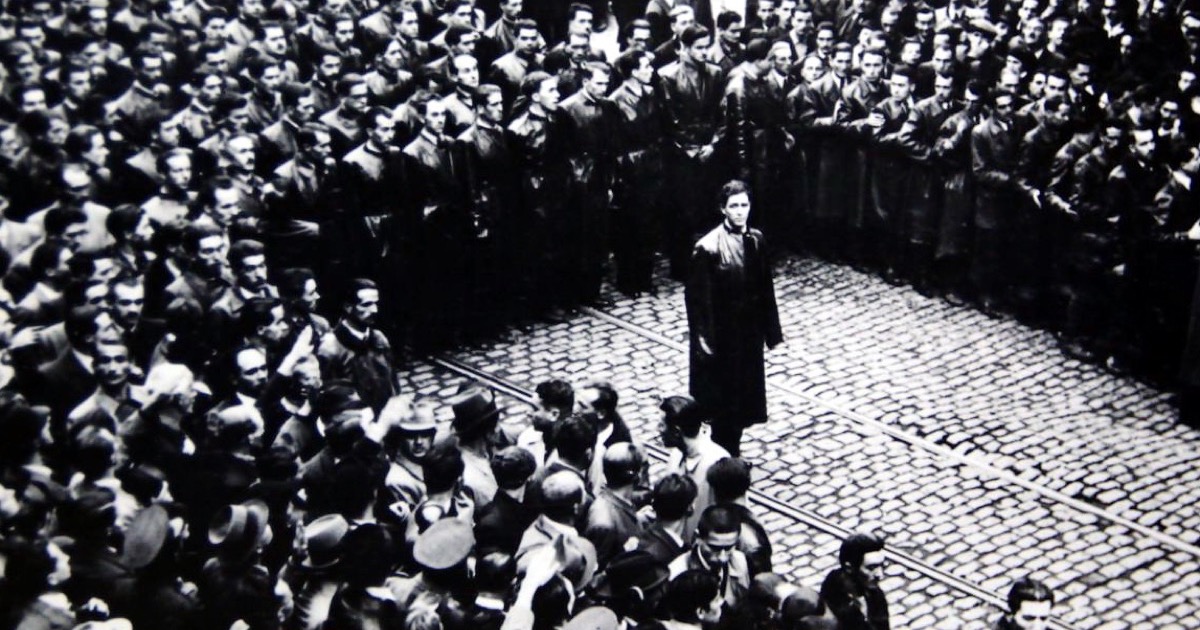
The Legion of the Archangel Michael, known abroad as the Iron Guard, was Romania’s fascist mass movement between the two world wars. Its founder, Corneliu Zelea Codreanu, built it around Orthodox imagery, Orthodox language and the participation of Orthodox priests. Its men murdered two Romanian prime ministers, a former prime minister, a leading historian and more than a hundred Jews. In February 2025 the Romanian Orthodox Church canonised sixteen twentieth-century confessors, and one of the new saints has a documented Legionary past. This article is about the authority the movement borrowed, and about what remains to be clarified.
On Saturday, 25 October 1924, at midday, outside the courthouse in Iași, Corneliu Zelea Codreanu shot the city’s chief of police, Constantin Manciu, in the head. Manciu died on the spot. Codreanu fired twice more, gravely wounding Commissioner Eugen Clos and Deputy Commissioner Gheorghe Hușanu. Under questioning he stated that he had shot all three.
Seven months later he was acquitted. Released from custody, he was met by crowds at the railway stations along the road home to Iași.
Two years after that he founded the Legion of the Archangel Michael, displaying a copy of an icon taken from a prison chapel.
And in February 1937, at the funeral of two of his men, more than two hundred priests and four hierarchs served.
The Legion was not built by the Church and received no commission from it. It did, however, take from the Church the icon, the archangel’s name, the hands of priests and the vocabulary of sacrifice, and put them at the service of a programme the Church had never authorised. That is the borrowing this article is about.
A godfather, a name and a citizenship
Corneliu Zelea Codreanu was born Corneliu Zelinski on 13 September 1899, into a family recently arrived from Bukovina — then a province of Austria-Hungary with a mixed Orthodox, Greek Catholic, Roman Catholic, Protestant and Jewish population.
In the case of his father, Ion Zelinski, three things happen almost together: he attaches himself to an influential protector, he changes his name and acquires citizenship, and he takes on the outward marks of Orthodox respectability. He enrolled at the teachers’ seminary in Iași and began to wear, like students of theology, a high-collared frock coat and a clerical cap. The protector he was still looking for, and the birth of his son gave him the occasion.
He found him in A.C. Cuza, the university professor whose antisemitic lectures he attended along with hundreds of students, and who wrote at home, on Teodor Codrescu Street, about the methods by which Jews ought to be removed from the country. Cuza had just published in verse his own admission that he had regarded religion as a comedy, the funeral service as foolishness, and that his sky had been empty of God. He agreed to stand as the child’s godfather.
That is how the boy came by his baptismal godfather — the boy whose name was taken from the church calendar, after the centurion Cornelius commemorated on the day of his birth. And in 1902 the father applied to have the family name changed in the birth records and in all earlier civil documents, asking for the same on his son’s behalf.
None of this says anything about that family’s blood, and anyone who looked there for proof would be doing the very thing this article opposes. Something else is visible, though: the family made its place in Romanian society by means of documents, a changed name and a godfather chosen for a purpose, and the appearance of being a good Orthodox Christian entered the plan alongside the rest.
How he was acquitted
He was charged with premeditated murder, and the defence answered by pleading self-defence. Such a plea requires the court to establish whether Manciu was threatening Codreanu at the moment of the shooting. The debate moved instead, for the most part, from the act itself to the conduct and character of the victim.
That day, at the courthouse, it was the policemen who stood accused. A student had charged them with beatings and humiliation, and Codreanu was the student’s lawyer. Manciu was shot on his way out of his own trial.
He had been sent to Iași in the winter of 1923 by the Liberal interior minister, with orders to break the student movement in Moldavia, and had set about it with police inside the university and beatings in the street. One student struck at that time fell ill and died days later. At the end of May 1924, two hundred soldiers and forty policemen descended on the student camp at Ungheni, where the students were making bricks for a hostel; those taken down into the police cellars came out with forensic medical certificates. Codreanu himself had been beaten on Lăpușneanu Street and struck in Unirii Square by Commissioner Clos — the same man he would wound in October.
The authorities feared that they would not obtain a conviction in Iași. Jurors were drawn from local residents, and in Iași the local residents were the parents and teachers of those who had come out of the police cellars with medical certificates. The trial was therefore moved to the assize court at Focșani, where the Liberals had influence. Three thousand highlanders were brought there from Transylvania by Amos Frâncu, along with two hundred miners from Reșița, mobilised by Bishop Gheorghe Munteanu, who presented himself in person with their signed petition to act as the defendant’s advocates. The town filled with students who ransacked the Jewish quarters and beat people in the street. When it became clear which way the jury was going, the High Court transferred the trial to Turnu Severin. The highlanders and the miners moved there too.
At Turnu Severin admission was by ticket. Among the defence counsel were A.C. Cuza and Corneliu Șumuleanu, and the town’s mayor made himself the defendant’s advocate as well. Postcards circulated in the hall showing the theatre building with the inscription that Codreanu had been tried and acquitted there — printed before the verdict. The proceedings shifted from the act to the character of the victim, and the reason the defendant gave for the shooting was that Manciu had become an agent of the Jews, which was not true.
The twelve jurors acquitted him on 26 May, at twenty to five in the afternoon, and then had their photograph taken with him. Released at once, he was received as a hero at the stations along the road to Iași.
That acquittal did not establish that the man was innocent. The state had twice looked for a jury that would convict him and had found none. People had come from Transylvania and the Banat, a bishop had mobilised miners for his defence, the mayor of the host town had become his counsel, and postcards announcing the acquittal had been printed before the verdict. It was not twelve jurors who carried him out of that hall. It was a country.
The Romanian journalist Ion Cristoiu connects the founding of the Legion to the day of the acquittal. Codreanu had learnt something he had not known before: that he could shoot a man in the street and that the country would carry him out of the courtroom on its shoulders.
Convicted, he would have been an ordinary murderer, and his name would have died out in a prison. Without that support the Legion would never have risen, because the man who founded it two years later would have been a forgotten convict. Acquitted and paraded through the stations, he came out with authority, and that authority was given him by the people who acclaimed him.
Sixty years earlier a Russian novelist had put the same question. Raskolnikov kills in order to find out whether he is one of those permitted to break other men’s law, and the novel answers him through his own conscience, which will not let him carry the deed through and drives him to confession. Codreanu was answered by his country, and it assured him that he was.
One man, one icon and his own signature
The Legion of the Archangel Michael was founded on 24 June 1927 by the reading of an order of the day. Codreanu had written out a few lines beforehand and had taken care to display the copy made of the icon of the Archangel Michael from the chapel of Văcărești prison. The three stages of the operation he had learnt at the military secondary school at Dealu Monastery: the order, the symbol, the staging.
The text called on those present to join if they believed without limit, and to stay outside if they had doubts. Codreanu did not say that unlimited belief in himself was required. He did, however, place his own leadership and boundless faith in the same sentence, and he ruled doubt out from the very beginning. About fifteen young men gathered, with no political programme and no money.
Here is the matter at issue, and it can be seen without polemic. The vocabulary of faith, of the icon and of doubt was brought into the very act by which a political organisation was founded.
Veneration of the Archangel Michael is Eastern and ancient. In those years, however, his name lay within reach of anyone who wanted to give a militant organisation the appearance of a heavenly host.
The icon has a history of its own. The father, Ion Zelea Codreanu, is said to have pointed out to the prisoners at Văcărești an icon of the archangel in the prison chapel, and they had three copies made of it. The large one stood for a time in the sanctuary of St Spyridon’s church in Iași, from where it was taken three years later and carried to a student hostel. What moved then was not the wood, but the icon’s power to bear witness, transferred to an organisation.
The borrowed services
Ion Moța and Vasile Marin had fallen in Spain on 13 January 1937, fighting on the Nationalist side, whose religious justification was overwhelmingly Catholic, in a war they read as a Christian struggle against communism.
The bodies were brought back by train through France and Belgium. On 6 February, at the Berlin railway station, the coffins were met by SS and SA detachments, by representatives of the Nazi Party, of the Spanish Falange and of Fascist Italy. Religious processions were held at stations across Romania.
On 13 February, at the church of St Elijah Gorgani in Bucharest, more than two hundred priests and four hierarchs served: Metropolitans Gurie Grosu and Nicolae Bălan, Bishop Vartolomeu Stănescu and Auxiliary Bishop Veniamin Pocitan. Historians regard this ceremony as the clearest evidence of collaboration between clergy and Legionaries. From there the two men were taken to the Green House, the movement’s headquarters, and buried in the courtyard beneath a mausoleum built for the purpose.
They were laid in the ground of a political organisation by the hands of two hundred priests. The coffins saluted by the SS in Berlin had been received by those same hands seven days later.
Anyone standing in the crowd had no way of telling where the Church ended and the movement began.
The Church, the hierarchs, the priests
That ceremony does not prove that the Church had accepted the movement, and from here on things that haste confuses must be kept apart. The Holy Synod, as the body that issues decisions binding on the whole Church, is one thing. A single bishop is another. The parish priest is a third. The believer in the pews is a fourth.
The Legion never became the teaching of the Romanian Orthodox Church. The Synod did not receive it and did not bless it as its own work.
In January 1928 the desecration of Jewish graves at Piatra Neamț was condemned. After the murder of Prime Minister I.G. Duca, the church newspaper Telegraful român criticised the assassination, and the Synod issued a pastoral letter calling for calm and expressing alarm at the growing violence among the young. On 4 October 1935 the Synod, under Patriarch Miron Cristea, forbade Legionary work on the repair and building of churches, regarding it also as a means of propaganda; the decision was supported by the minister of cults, Alexandru Lapedatu, and by the secretary of state, Victor Iamandi, and the patriarch subsequently issued measures against the use of clergy in such works. The wider prohibitions — on clergy joining, and on their taking part in the movement’s ceremonies and wearing its insignia — came gradually, up to 1937. In December 1935, Gheorghe Cantacuzino, the head of the Legionary party, blamed the patriarch for these measures.
The restraint stopped halfway, and the reason can be seen in the person of the patriarch himself. Miron Cristea served as prime minister of Romania from February 1938 to March 1939 — this is not a figure of speech; the head of the Romanian Orthodox Church governed the country — which was the period when Codreanu was tried and killed. In a meeting with Wilhelm Fabricius, the German envoy, the patriarch praised the Reich’s antisemitic policy and gave to understand that such a policy ought to be pursued in Romania as well. The British ambassador recorded that the patriarch would not talk about anything except the Jewish question.
Those measures restricted certain forms of collaboration without arriving at a judgement on the substance of Legionarism. A priest was forbidden to bless the flag, but the thesis that nation and faith are the same thing was left untouched. As long as that stood, the ban on blessing flags read as a matter of good order, and priests who went further could suppose that they were doing what the Church itself taught, only with more zeal.
It is worth seeing, too, who gave the movement its signs. They were given by hierarchs and priests, that is, by men with a public ministry, and the movement was followed by young men full of zeal. Of those who would later become well-known spiritual fathers, none was in those years in any position from which to weigh the matter. Zeal is not discernment.
Here lies the hardest thing to say, and it is precisely what explains what happened. There was no synodal reception of the Legion by the Church, but there was a Legionary penetration of the clergy deep enough that an ordinary person could no longer tell the two authorities apart. Two hundred priests at St Elijah Gorgani work on a crowd differently from a synodal decision read out in session.
What the canons say about those clergy
Apostolic Canon 81 forbids a bishop or priest to descend to public office, and Canon 83 lays down the deposition of a cleric who occupies himself with the army and wishes to hold both, the priestly ministry and worldly office, the ground being given in the canon itself: the things of Caesar are Caesar’s, and the things of God are God’s.
The letter should not be stretched beyond its reach. The Legion called itself a legion, but the army in Canon 83 means the military service of the state, not the name an organisation gives itself. To depose a Legionary priest merely because the movement called itself a legion would be wordplay, not canon law.
The real ground is gathered from several places at once. A cleric may not enter the offices of the world. He may not shed blood. He owes obedience to his bishop, and the bishops had plainly forbidden participation in the movement’s ceremonies. And the priesthood is given for all the baptised of a parish, not for one armed part of them set against the other.
The priest who swore loyalty to an organisation that killed people stepped outside all of these at once.
There remains the question that asks itself: if armed defence has a place in Orthodoxy, why not the Legion’s struggle? Because where the Church accepts the armed defence of the community, the power to compel and to strike belongs to the public authority, not to a private political organisation. The princes of old were anointed for this at their enthronement, and the sword came to them from the office they received. Codreanu was anointed by no one and held no commission. The right to shed blood was given him by those who acclaimed him at Turnu Severin, and it is given him by the same sort of people today.
And to the man sent by the public authority the Church gives no crown. Canon 13 of St Basil the Great says that the Fathers did not reckon killings in war among murders, and that pardon is granted to those who fight for godliness — but it advises that such men abstain from Communion for three years, as having unclean hands. The canon therefore does not turn death in war into martyrdom. When the Emperor Nikephoros Phokas asked that soldiers fallen in battle be honoured as martyrs, the bishops set this canon before him and thwarted the plan.
The Legion did both of these in reverse. It took up the sword without a commission, and it called those who fell with it in hand martyrs.
Faith as a covering
The movement considered itself Orthodox, yet it did not require Orthodoxy of those who joined it. Transylvanian Greek Catholics, in communion with Rome, were admitted without being asked to convert to Orthodoxy.
The same was seen in Spain. Two Romanian Orthodox men went to die for a side whose religious justification was Catholic, alongside Falangists and fascists of other nations, within a Christianity understood as a political bloc against communism. The difference between Orthodox and Catholic counted for nothing in that decision.
The same is seen in the founder’s own prayer life. In February 1938, in a text addressed to the Legionaries, alongside his call for a week of fasting with the Paraklesis to the Mother of God, Codreanu wrote that he had carried with him at all times a little book of prayers to St Anthony of Padua, bought from the St Joseph bookshop on Berthelot Street — that is, beside the Roman Catholic cathedral in Bucharest. In May, at Jilava prison, he wrote that he prayed daily to the Mother of God and to St Anthony of Padua, and that through them he had escaped in 1934.
The devotion came from home. The parish priest of St Anthony’s church in Huși was a Bavarian Franciscan, Bernardin Just, who mentions Ion Zelea Codreanu in his journal among the town’s leading men. It was also at Huși that the first issue of the Romanian Franciscan tertiaries’ gazette appeared, in 1918.
None of this makes him a secret Catholic. It does show the man who led the movement of the Orthodox nation praying from a book bought at the Catholic cathedral. A man who cares about the faith asks where his prayer comes from. There the question was never put.
It does not follow that the Legionaries were Orthodox in name only. Most of them genuinely prayed, fasted and received Communion, and their imagination was formed out of Orthodox things. Something less comforting follows instead: a man can be fully Orthodox and still set the nation above the Church, and the movement worked precisely on that confusion.
“We fought against communism”
This is the defence heard most often today, and it has a true core. The Legion was indeed and vigorously anti-communist from the nineteen-twenties onward. Moța and Marin went to Spain with exactly that in mind, and their memory was built around it.
That truth does not take the place of the others.
In 1924 Codreanu shot Constantin Manciu, the chief of police of Iași, and was acquitted. In December 1933 a Legionary squad murdered the Liberal prime minister I.G. Duca on the platform of Sinaia railway station. In July 1936 ten Legionaries entered the ward of the Brâncovenesc Hospital where Mihai Stelescu — a former comrade turned critic of the Captain — lay ill, shot him, and then hacked his body with axes. In September 1939 Prime Minister Armand Călinescu was killed. On the night of 26–27 November 1940, at Jilava prison, the Legionary police shot sixty-four detainees in their cells, and the next day Nicolae Iorga — the historian of European reputation and a former prime minister — and the economist Virgil Madgearu were taken from their homes and murdered. On 21–23 January 1941, during the Legionary rebellion, the Legionaries carried out the Bucharest pogrom, in which between a hundred and twenty and a hundred and twenty-five Jews were killed, some taken to the abattoir and hung on the meat hooks.
Duca, Stelescu, Călinescu, Iorga, Madgearu and those killed in the pogrom did not die in any confrontation with communism. Those who died were ministers of the country, old men taken from their homes, a comrade fallen from favour, and people with no defence at all. Anti-communism explains part of the movement’s creed; it does not explain and still less justify its violence.
The movement was crushed by Marshal Ion Antonescu in January 1941, and Horia Sima fled to Germany. Of Visarion Puiu, former Metropolitan of Bukovina, it was said at the end of 1944 that he had accepted charge of church affairs in the government Sima formed in Vienna, while he himself left testimony that he had refused. The matter remains in dispute and should be stated as such.
What Dostoevsky had seen
More than fifty years earlier a Russian novelist had described this so exactly that it seems written for another country.
Demons appeared in 1872 and takes its starting point from a real event, the murder of the student Ivanov by Nechayev’s circle in 1869. In the novel, Verkhovensky has the circle kill Shatov together, precisely because he wanted to leave. The killing done in common binds them all, and from then on none of them can get out.
The murder of Stelescu has this shape. For a man immobilised in a hospital bed, ten executioners were not needed. Ten came all the same, shot him, and then struck with axes. That number moves the scene beyond the arithmetic of killing and gives it the look of a shared participation.
Deeper than the crime, however, stands Shatov himself. He believes in the Russian people as the bearer of God, he believes in Orthodoxy, he believes the truth is with his own nation. And when Stavrogin presses him with the question whether he believes in God, he cannot answer. He says that he will believe.
Here is the diagnosis, set down fifty years before the Legion, and it shows an inversion of the right order. In faith, God reveals Himself, the Church confesses Him, and the people enter into her. With Shatov the road runs backwards: he begins from the people, arrives through them at Orthodoxy, and only hopes to arrive at God. The nation can thus take first place without a single word of the faith being altered.
The man who arrives there is not a hypocrite. Shatov is one of the most sincere and most tragic characters in the book, a man genuinely seeking faith and trying to get out of an ideological world, and that is exactly why his case is hard to read.
No kinship is being suggested here between the two movements, nor any likeness between their creeds, because there is none. What is alike is the mechanism: the group held to be absolute turns the one who leaves into a traitor, and his blood serves as mortar for those who remain. Dostoevsky saw a structure, not an ideology. Red in Petersburg, green in Iași.
What martyrdom means
The Church’s criteria for numbering someone among the saints require, among other things, a martyr’s death for the true faith, or the confession of the true faith in the face of every danger, even unto death, or a life devoted to the most perfect way of living, or the gift of miracles, or the defence of the faith and of the Church. Beyond all these, there must be the spreading abroad of the fragrance of holiness and the spontaneous veneration of the faithful people.
The decisive words are “for the true faith”. Martyrdom is measured by the cause for which a man suffered, not by how much he suffered.
This judgement, however, is made man by man, and never in bulk. Someone could have been a Legionary in 1938, could have repented in prison, and could have died in 1952 confessing Christ. Someone else could have been imprisoned for political acts and could have died without the cause having changed. No one on the outside can decide for both at once.
One thing remains clear, and it belongs to the Church’s own order rather than to our reckoning: honouring a man does not include honouring the opinions he once held. The Church enters people in the calendar, not political programmes.
The two men most often pointed to
Defenders of the movement usually point to two men: Father Arsenie Papacioc and Valeriu Gafencu. If men like these came out of it, they ask, how can it have been wrong?
Both joined very young. Papacioc enrolled in 1933 and went to the Green House, as he himself later told it, as a boy of eighteen. Gafencu, a student at Iași, was linked to the rebellion of January 1941 and to the attempt to gather schoolboys in support of it. What was worked in them afterwards was worked in prison and in monastic life.
Papacioc, asked at the end of his life whether he had been in the movement, answered that he had, and that he did not regret it. He said there had been Legionaries of great worth there, and he described Codreanu as a presence that had won him over on the spot when he came before him at eighteen. At the same time he acknowledged that killing had been encouraged in the movement and counted this among its errors, adding, however, that he did not know what lay behind the murders.
Two things he said plainly. That the movement must not be laid over Christian teaching, and that to do so would be a fatal error. And that monastic life stands above everything that had gone before.
In a Securitate report of 1957 — the Securitate was the communist secret police — the hieromonk Paulin Lecca, who held him in high regard, said of him that he had entirely renounced Legionarism and all political concerns; the information was drawn from the security files by the historian Adrian Nicolae Petcu. That renunciation concerned political activity. The late interview shows that the man had not come to say of the movement that it had been a delusion.
Papacioc, therefore, does not stand alongside Gafencu, and whoever places him there alters his words.
What clarifies matters is not what he said in old age about the movement, but the order in which things happened in his life.
He enrolled in 1933. He came not from a monastery nor from any spiritual apprenticeship, but from the School of Arts and Crafts and then from the Malaxa armaments factory near Brașov, where he had become a man with a good salary, a car and a driver. There followed the internment camp at Miercurea Ciuc, the mayoralty of Zărnești under the National Legionary State, arrest in 1941 and six years in prison. At Aiud, by his own account, his renunciation of secular life became clear, and with Virgil Maxim he made a vow that if they came out alive they would become monks. He was released in 1946, entered the monastery of Cozia in January 1947, and was tonsured only on 26 September 1949, at Antim, past the age of thirty-five.
In the meantime he had stopped at Sihăstria, where the abbot was Cleopa Ilie, and there, according to those who have gathered his life, he found what he had long been looking for: the simplicity of the man who prays without ceasing. Cleopa had entered the monastery at seventeen. At the age at which one of them was joining the Legion, the other already had years of ascetic labour behind him.
The thought of monastic life, though, he had carried since the years of prosperity. His biographer preserves the saying by which he explained his departure: one should go to the monastery as a victor, not as a defeated man. No one can say, therefore, that he became a monk because the world had cast him off.
And of the stage he had left behind he said, once he had decided, that he had been a Legionary but was now a monk, beyond everything else. He added that those who had passed through those struggles ought not to stop there, but to go further, where self-giving becomes life in God.
This is not a renunciation, and it must not be made to look like one. It is an ordering by degrees, and the highest degree is not the Legion.
From this follows what can be said with certainty. The spiritual father whom the Church came to know was not formed in a Legionary cell. He was formed in what came afterwards: the prison, the surrender of the salary and the car, the monastery, obedience, Cleopa and Paisie, the sacramental life. Whoever presents him as a fruit of the Legion skips precisely the years in which the man became what he became.
From here a question arises that goes beyond his case. Can a spiritual father with great gifts be mistaken in a historical or political judgement? The Church’s answer is that he can. The gift given for the confessional concerns the knowledge of the human soul and its guidance towards repentance; it was not given for weighing political parties. A father may see clearly into the heart of the man kneeling before him and may remain, at the same time, with the opinions of his youth about the world. Whoever does not keep this distinction ends by attributing to the Church what one man happened to say.
As for Gafencu, those who have gathered his life write that he cast off his political creed in favour of the faith, and his saying that a man who calls himself a Christian cannot accept murder as a weapon of struggle circulates to this day even among those who claim him. Prison memoirs attribute to him the surrender of his streptomycin to Pastor Richard Wurmbrand, a Jew who had become a Christian — medicine that might have kept Gafencu himself alive. If things happened in this way, the act is the exact opposite of the creed of a movement that held the Jews to be the cause of the country’s ills. And Wurmbrand himself later described him in terms irreconcilable with militant antisemitism, dwelling on his devotion to the sick. (Wurmbrand, who spent fourteen years in Romanian prisons and later wrote Tortured for Christ, is better known in the English-speaking world than any other name in this article.)
The other half of the reckoning is sometimes brought forward, namely that fathers such as Paisie Olaru or Cleopa never once thought of joining. This is true, but it proves less than it appears to, since they had entered the monastery as young men and were never placed in the same temptation.
Where the Legionary creed survived
The men of the movement who lived on into the post-war years dealt with their past in different ways.
Mircea Eliade kept silent. Florin Țurcanu, in his monograph, brings evidence of Eliade’s adherence to the Legion and then shows the effort to erase the traces; scholars who have read him observe that Eliade never acknowledged his part. Mihail Sebastian had noted as early as the nineteen-thirties, in his journal, that his friend took pains to conceal the matter even from him. That silence is not renunciation.
Horia Sima held on. He led the movement from exile until his death in 1993, without ever recanting. That exile, however, remained a closed circle, with publications produced for a few hundred people, and nothing came back from it into Romania with any authority.
In the March 2001 issue of the journal Permanențe, the archimandrite Iustin Pârvu called Legionarism the highest form of the Romanian genius, and added that the depth of the movement exceeded the mind’s power to penetrate it. At his monastery, Petru Vodă, the nuns sang him an Iron Guard song written by Radu Gyr on two occasions, at his birthday celebrations in 2009 and 2011. A protest was addressed to the Patriarchate, and the Church did not reply.
The difference does not lie between Orthodox and non-Orthodox. Eliade was Orthodox by baptism, so was Sima, and Cioran was born in a priest’s house. It lies in the way the creed was preserved in each setting.
Among laymen it remained a political opinion, and a political opinion is called to account. That is why some kept silent, while others shut themselves into circles that died out with them.
In some monastic communities it was preserved differently: not as an opinion open to examination, but as the spiritual memory of men who had suffered. Veneration is not called to account. An abbot who says of the movement that it cannot be penetrated by the mind closes a discussion, and his disciples receive the words as they would receive spiritual counsel.
The distinction made above, between the spiritual gift and judgement about the world, stands here too. What changes is the consequence. Spoken from the chair of a spiritual father heeded by thousands, a word about the movement no longer prompts examination but obedience, and anyone who would weigh it fears that he is putting a father on trial.
What has been decided and what remains to be clarified
In July 2024 the Holy Synod approved the canonisation of sixteen twentieth-century monastic and priestly confessors. The public proclamation took place on 4 February 2025 at the Patriarchal Cathedral in Bucharest, by synodal tomos, and the names entered the calendar. Among them is St Ilie Lăcătușu, Priest and Confessor, commemorated on 22 July.
The Elie Wiesel National Institute for the Study of the Holocaust in Romania had raised objections in 2024 concerning three of the names, pointing to links with the Legionary movement. The Patriarchate replied that the Church has the right to pronounce according to its own criteria and that it takes into account the change in a sinner’s life, while disputing the way certain documents had been read.
With the canonisation accomplished, the question is no longer whether it ought to have been done. The Synod has decided, and its decision is not judged from our desks.
Something remains to be clarified, however, and the Church owes that clarification to herself. When grave public acts from a man’s youth are attributed to a saint entered in the calendar, their history needs research and a clear pastoral word, so that the honouring of the person is not read as approval of the creed to which he was once attached. Repentance does not always leave papers in an archive, and no one has the right to demand proof of a confession. But deeds done in public are clarified in public.
Without that clarification, anyone looking today for a justification of the Legion will find it in the calendar, and the Church will be made to answer for something she never decided.
What is to be done with the inheritance
A man who suffered in prison is honoured for what he endured. A man who came out of the errors of his youth through repentance is judged by the life that followed, because this is the order of repentance, and without it no one would be saved.
What cannot be accepted is the movement’s claim to have drawn its justification from Orthodoxy. The icon is Orthodox. The service is Orthodox. The priest is Orthodox. The Archangel Michael is Orthodox. None of these, however, turns a party’s programme into the work of the Church, and whoever gathers them together and demands obedience in their name has borrowed an authority that was never given him.
The pattern goes on working. Every time a political movement puts the icon on its banner and calls for obedience in the name of the faith, it repeats this borrowing. It has been seen in Greece, in Serbia and in Russia, under other names and with other saints carried at the front.
The Church has what is her own: Scripture, the canons, the Holy Mysteries, synodal judgement. These are not lent out, and whoever takes them without leave gains by it neither holiness nor justice.
Note. The archangel’s name circulated in that period through other militant settings as well. Leo XIII founded a confraternity of the Archangel Michael in 1878, and in 1886 added the prayer to St Michael to those said after Low Mass in the Roman rite. In the Russian Empire, the antisemitic deputy Vladimir Purishkevich founded a Union of the Archangel Michael. No connection has been demonstrated between the Russian movement and the Romanian one.
A note on names. The movement founded in 1927 was the Legion of the Archangel Michael; its paramilitary wing, formed in 1930, was called the Iron Guard, and that name came to stand for the whole movement in foreign usage. Members called themselves Legionaries and called Codreanu the Captain. The National Legionary State was the regime of September 1940 to January 1941, in which the movement shared power with Marshal Antonescu until it attempted a coup and was crushed. Jilava, Aiud, Pitești and Târgu Ocna were prisons of the communist period, where large numbers of political detainees, Legionaries among them, died.
Sources: Tatiana Niculescu, Mistica rugăciunii și a revolverului. Viața lui Corneliu Zelea Codreanu (Humanitas, 2017) — note that the author herself indicates where she was obliged to infer and to conjecture, and her degree of certainty has been preserved here; Oliver Jens Schmitt, Corneliu Zelea Codreanu. Ascensiunea și căderea „Căpitanului” (Humanitas, 2017; German edition 2016); Roland Clark, Holy Legionary Youth (Cornell University Press, 2015); F.M. Dostoevsky, Crime and Punishment and Demons; for the devotion to St Anthony of Padua: Corneliu Zelea Codreanu, Circulari și manifeste, 18 February 1938, and Însemnări de la Jilava, 15 May 1938; for the Franciscan milieu at Huși, Niculescu, op. cit., who also refers to Francisco Veiga, La mística del ultranacionalismo: historia de la Guardia de Hierro; Florin Țurcanu, Mircea Eliade. Le prisonnier de l’histoire; Mihail Sebastian, Journal 1935–1944; Iustin Pârvu, in Permanențe, March 2001; interview with Father Arsenie Papacioc, Techirghiol, 2010; Sorin Alpetri, Între timp și veșnicie. Viața Părintelui Arsenie Papacioc — a work resting largely on the father’s own recollections, the source of the details about the Malaxa factory, the salary and the car, which have not been verified against archives; Adrian Nicolae Petcu, on the basis of the CNSAS security files, for the 1957 report of the hieromonk Paulin Lecca; Apostolic Canons 81 and 83; Canon 13 of St Basil the Great; John Skylitzes, Synopsis Historiarum, for the bishops’ resistance to Nikephoros Phokas; Fr Prof. Liviu Stan on the canonisation of saints, in the review Ortodoxia; the synodal tomos proclaiming the canonisation of the sixteen Romanian saints, 4 February 2025; the statement of the Elie Wiesel National Institute and the reply of the Romanian Patriarchate, July 2024; press and archival documentation concerning the Synod’s decisions of 1928–1935, the funeral at St Elijah Gorgani, the Legionary rebellion and the January 1941 pogrom. Codreanu’s place of birth is given variously in the literature, as Huși or as Iași; Niculescu has been followed here, placing the family in Iași that year. For the killing of Manciu the date of 25 October 1924 has been kept, that of the contemporary press, of the trial records and of Niculescu; Oliver Jens Schmitt gives 24 October.
Corneliu Zelea Codreanu and the Iron Guard, Bucharest, 1937. Unknown author; public domain in the European Union. Source: Wikimedia Commons.