
Adam lived nine hundred and thirty years1. Scripture does not say how long he remained in Paradise. After the expulsion, he spent his life on the earth that he tilled with his own hands. The Book of Genesis tells at length of his creation and of his fall from Paradise, but about his life after the expulsion it says only a few things: the birth of his sons, the murder of Abel, the birth of Seth and the death of Adam.
About the fall, and about what Adam came to know through it, I have written in the article "What Did Adam Come to Know? The Fall of Man According to the Holy Fathers". Here we follow what came after Adam went out through the gate of Paradise.
The Church, however, has kept more than these few verses. The Holy Fathers interpreted them word by word. The service of the Sunday of Adam's Expulsion from Paradise, sung on the eve of Great Lent, shows Adam weeping at the gate of Paradise. And the Chronograph of Saint Demetrius of Rostov, a history of the world from the Creation onward, translated into Romanian by Metropolitan Veniamin Costache in 1837, gathers what was told in ancient times about Adam's years on earth2.
The Chronograph must be read with care. Saint Demetrius gathered into it much of what the chroniclers before him had written, and for the times before the Flood the chroniclers also collected many stories. Some of them entered the prayer and the icons of the Church. Others remained simple stories, and the Chronograph itself sometimes calls them uncertain. For this reason, wherever it says more than Scripture and the Holy Fathers, we show where what it says comes from.
What Adam Received as He Left Paradise
Before sending him out of Paradise, God told Adam what his life would be from then on: "In the sweat of thy face shalt thou eat thy bread until thou return to the earth out of which thou wast taken, for earth thou art and to earth thou shalt return"3. The earth, which until then had given him everything without toil, would from now on bring forth thorns and thistles. Food would come only through labour, and labour would end in death.
At that same moment, Scripture tells of something that shows God had not turned His face away from man: "And the Lord God made for Adam and his wife garments of skin, and clothed them"4. Adam and Eve had made coverings of fig leaves for themselves, to hide their nakedness. Now God Himself clothes them, as a father clothes his children before a long journey. Punishment and care came in the same hour. In these garments of skin the Holy Fathers also saw the mortal state into which man had come after the fall.
Then came the parting: "So the Lord God sent him forth out of the garden of Delight to cultivate the ground out of which he was taken"5. In Paradise, Adam had been placed to tend and keep the garden. Outside, his work becomes the earth itself, the dust from which he had been formed and to which he would return.
Over Against Paradise
Scripture also shows the place where Adam lived after the expulsion: "And he cast out Adam and caused him to dwell over against the garden of Delight, and stationed the cherubs and the fiery sword that turns about to keep the way of the tree of life"6. God did not send Adam to the edge of the world. He settled him close by, where he could see Paradise.
Saint John Chrysostom dwelt on this detail and saw in it, once again, the love of God: "Not only the casting out from Paradise is a sign of love for man and of goodness, but also the settling over against Paradise, so that Adam's heart might ache unceasingly as he thought from where he had fallen and into what state he had come. Yet even if the sight of Paradise caused him unspeakable pain, this was no small benefit, for the unceasing sight of Paradise was, for the one in sorrow, a strengthening for the future, so that he might not fall again into the same sin"7.
So Adam began his life on earth with his eyes turned toward the place he had lost. Every day of labour, every thorn, every drop of sweat reminded him of what he had once had. And the sight of Paradise, which pained him, also guarded him.
The Church has kept this image of Adam in her hymns. On the evening before the Sunday of Adam's Expulsion from Paradise, at Vespers, she sings: "Adam sat over against Paradise and, lamenting his own nakedness, he wept: Woe is me, who was persuaded by wicked deceit, and robbed, and removed far from glory! Woe is me, who was once naked in simplicity and now am in want! But, O Paradise, no more shall I enjoy thy delight"8 Further on, in the same hymn, Adam says that he will no longer see the Lord, his God and Maker, for he will go into the earth from which he was taken, and he cries out: "O Merciful and Compassionate One, I cry to Thee: have mercy on me who have fallen"9.
Another hymn of the same day gives the reason for the weeping in a few words: "Adam was cast out of Paradise through eating; therefore, sitting over against it, he lamented, wailing with a pitiful voice, and said: Woe is me, what have I suffered, wretch that I am!"10
The Synaxarion of this Sunday explains why the Holy Fathers placed the commemoration of the expulsion on the very threshold of Great Lent. Adam lost Paradise because he did not fast from the one forbidden tree. On the day before the fast, the Church sets his fall before the faithful, so that they may remember it and receive the fast with joy11. Adam weeping at the gate of Paradise thus becomes the first image of the man who enters upon the fast.
Adam's Weeping
The Venerable Abba Dorotheus shows what had been lacking in Paradise and what Adam was to learn outside it. After the fall, God gave Adam the opportunity to repent. "After the fall, God gave him the possibility to repent and to receive mercy, but his neck remained unbent. For God came, saying to him: Adam, where art thou? That is, 'from what glory to what shame hast thou come?'"12 Through His questions, says Saint Dorotheus, God "was preparing him to say: 'Forgive me!' but the man did not have humility!"13 Adam cast the blame on the woman whom God had given him, and the woman on the serpent.
The word that Adam did not speak in Paradise he spoke outside it, with tears. The Chronograph says that Adam and Eve wept for their sin and for the loss of Paradise, and that Adam ate his bread with tears14. It also mentions a story according to which they wept for a hundred years, keeping apart from one another during that time, but it adds at once that the story is not certain15. The number of years cannot be known. What has remained certain in the Tradition of the Church is the weeping itself: the fallen Adam became the repenting Adam.
Scripture itself bears witness that Adam did not remain in his sin. The Book of the Wisdom of Solomon says of the Wisdom of God: "She preserved the first formed father of the world, that was created alone, and brought him out of his fall, and gave him power to rule all things"16. Adam's life after the expulsion is, therefore, also the story of his deliverance from sin.
In our own time, Saint Silouan the Athonite wrote about Adam's weeping as one who had lived it. Saint Silouan had known the grace of God and then lost it for a time, and in his grief he understood what Adam felt after the expulsion. He shows Adam longing for God more than for the beauty of Paradise: "My soul yearns for the Lord, and I seek Him with tears. How can I not seek Him? When I was with Him, my soul was glad and at peace, and the enemy had no entry to me; but now the evil spirit has gained power over me, and he troubles and torments my soul, and so my soul yearns for the Lord even unto death"17. Adam's weeping was not for a lost garden, but for God, Whom he no longer saw. About the life of Saint Silouan and about his whole lament I have written in the article "Saint Silouan the Athonite and Adam's Lament".
From Adam onward, this is the path of every fallen man: to recognise from where he has fallen, to stop casting the blame on another, and to ask for the mercy of God. Saint Dorotheus teaches his disciples to say "Forgive me" at every word. Adam said it after he had lost Paradise. Those who come after him can say it sooner.
Why Adam Did Not Return to Paradise
Adam wept for his sin, and Scripture says that God "brought him out of his fall". Why, then, did God not receive him back into Paradise? Why did Adam remain outside all his life, even though he had repented?
Saint Athanasius the Great helps us to understand this question through what he wrote in his treatise On the Incarnation of the Word. He asks what God was to do after the fall of man: "Or what was God to do? To demand repentance of men for their transgression?" And he answers: "If, then, there had been only the sin, and not also the corruption that followed it, repentance would have been enough"18. God forgives the sin of the one who repents. Through disobedience, however, something else had entered man: corruption, that is, sickness, ageing and death, which had seized the very nature of man. Of this Saint Athanasius says: "On the other hand, repentance could not raise men up from what belongs to nature"19.
Adam's tears were true and were received by God. His repentance, however, could not by itself abolish corruption and death. A simple return to the place from which he had been sent out did not mean the healing of his nature. For that, the work of the One Who had formed him was needed. This is why, says Saint Athanasius, it was necessary that the Word of God Himself become man.
Scripture also shows another reason for the expulsion. After the fall, God said: "Behold, Adam is become as one of us, to know good and evil, and now lest at any time he stretch forth his hand, and take of the tree of life and eat, and so he shall live for ever—"20. Saint Irenaeus of Lyons shows that God kept Adam away from the tree of life out of mercy, so that sin might not remain immortal in him and evil might not be without end21. About this mercy hidden in the punishment, as Saint Gregory the Theologian and Saint Nicholas Cabasilas interpret it, I have written in the article on the fall.
The expulsion was therefore not a rejection of Adam. Saint Irenaeus shows, in the same book, that it was fitting for Adam himself, the first man, to be delivered by Christ: the One Who set the descendants free would not leave their forefather in bondage22. Paradise remained closed until the One came Who could heal nature. The first man to whom Scripture announces entry into Paradise is the thief on the cross. He said: "Lord, remember me when thou comest into thy kingdom", and Jesus answered him: "Verily I say unto thee, To day shalt thou be with me in paradise"23. And Adam was brought out of Hades by Christ Himself, with His own hand.
The Holy Fathers also considered Adam's conduct before the expulsion, and each of them looked at a different aspect of it. Saint Dorotheus stresses that Adam did not acknowledge his guilt when God questioned him. Saint Irenaeus sees in the girdle of fig leaves a sign of Adam's repentance, worn out of fear of God24. Saint Ephrem the Syrian says that if Adam and Eve had repented after transgressing the commandment, they would not have regained all that they had before, but they would have escaped the curses pronounced upon them and upon the earth25. The Fathers show, then, that Adam could have asked for and received the mercy of God even then. Their interpretations do not allow us, however, to reconstruct in detail what would have happened had he confessed his sin before the expulsion. After the expulsion, the hymns of the Church show him weeping and asking for the mercy of God, while full deliverance from the dominion of death was to be accomplished by Christ.
The First Sons
Saint John Chrysostom draws attention to something that Scripture says only after the expulsion: "And Adam knew Eve his wife"26. In Paradise, says Saint John, the first people lived in virginity. Only after the fall, when death had entered the world, did the birth of children come, through which the human race was to continue27.
Eve first bore Cain, and then "she again bore his brother Abel. And Abel was a keeper of sheep, but Cain was a tiller of the ground"28. Adam saw in his sons the beginning of the race that God had blessed already in Paradise. He taught them to work the ground and to tend the flocks, as he himself had learned, in the sweat of his face.
The Chronograph adds that Adam taught his sons to bring sacrifices to God. The sacrificed lamb prefigured Christ, the Lamb of God, and the offering of grain prefigured the Bread of the Holy Eucharist. It was also from Adam, says the Chronograph, that men learned to bow down toward the east, toward the place where Paradise had been planted29. Scripture does not say who taught Cain and Abel to bring sacrifices. The Chronograph links this beginning with the teaching received from Adam.
The First Human Death
Cain brought a sacrifice from the fruits of the earth, and Abel from the firstborn of his flock. "And God looked upon Abel and his gifts"30, but upon Cain and his gifts He did not look. Cain was greatly grieved, and his countenance fell. God rebuked him gently and warned him: "Hast thou not sinned if thou hast brought it rightly, but not rightly divided it? be still, to thee shall be his submission, and thou shalt rule over him"31.
Cain did not heed the warning. He called his brother into the field and killed him there. Then God asked him: "Where is Abel thy brother?", and he answered: "I know not, am I my brother's keeper?"32 God then said to him: "What hast thou done? the voice of thy brother's blood cries to me out of the ground"33.
The question put to Cain resembles the one put to Adam in Paradise. To Adam God said: "Where art thou?" To Cain: "Where is thy brother?" And Cain's answer goes further than his father's: Adam had hidden himself and laid the blame on another, while Cain lies outright.
The murder of Abel was the first human death. God had told Adam that he would die, but until then death had been only a warning. Now it had struck his own son. Saint Silouan writes that Adam knew great sorrow when he was cast out of Paradise, but that his grief was heavier still when he saw Abel slain by Cain, his brother34. The sin that Adam had committed in Paradise was now bearing fruit in his son and had gone as far as the shedding of blood.
Abel has remained in the memory of the Church as the first righteous man to die on earth. The Holy Apostle Paul places him at the head of those who pleased God by faith and says that his sacrifice was better than Cain's35.
Cain was cursed and went away: "So Cain went forth from the presence of God and dwelt in the land of Nod over against Edem"36. Saint John Chrysostom shows that Cain, too, did not dwell far from Paradise, so that the place where he lived might unceasingly remind him also of what had happened to his father37. Thus the first people all lived in the neighbourhood of lost Paradise, and Adam was left with two sons lost at once: one taken by death, the other by sin.
Seth and Those Who Called on the Name of the Lord
After the death of Abel, God gave Adam consolation: "And Adam knew Eve his wife, and she conceived and bore a son, and called his name Seth, saying, For God has raised up to me another seed instead of Abel, whom Cain slew"38.
Scripture says of Seth something it does not say of Cain: "And Adam lived two hundred and thirty years, and begot a son after his own form, and after his own image, and he called his name Seth"39. Adam had been made in the image of God. Now a son is born to him after his own image, that is, a man who carries forward the first image, darkened by sin but not lost.
The number of years differs from one text to another. The Septuagint, the Greek translation of the Old Testament used by the Church from the beginning, says that Adam was two hundred and thirty years old when Seth was born. The Hebrew text gives one hundred and thirty years. The Chronograph mentions both numbers and shows that they do not agree40. The total of the years of Adam's life, however, remains the same in all of them: nine hundred and thirty.
From Seth descends the line of the righteous, from which Christ was to be born according to the flesh. Of Enos, the son of Seth, Scripture says: "he hoped to call on the name of the Lord God"41.
The Chronograph says that Seth was, after Adam, the teacher of men, and that he handed on to them what he had learned about God from his father4243. Scripture says that Seth lived nine hundred and twelve years44.
The Two Lines
From this point, Scripture follows two lines descending from Adam: the line of Cain and the line of Seth. Adam lived long enough to see both of them growing on the earth, side by side.
Of the line of Cain, Scripture first says that he built a city: "And Cain knew his wife, and having conceived she bore Enoch; and he built a city; and he named the city after the name of his son, Enoch"45. The one who had been condemned to be a wanderer on the earth made a place of his own, with walls, and gave it the name of his son.
The line of Cain went on as far as Lamech, the fifth descendant of Cain and the first man of whom Scripture says that he had two wives46. From his sons came life in tents among the flocks, the playing of instruments, and the working of bronze and iron47. In the list of Cain's descendants, Scripture mentions no prayer offered to God.
Lamech then spoke strange words to his wives: "Ada and Sella, Hear my voice, ye wives of Lamech, consider my words, because I have slain a man to my sorrow and a youth to my grief. Because vengeance has been exacted seven times on Cain's behalf, on Lamech's it shall be seventy times seven"48.
Saint John Chrysostom read these words as a confession. Lamech, he says, drew profit from Cain's punishment. Cain, when questioned by God, did not confess his deed but lied. Lamech, with no one questioning him, tells his sin of his own accord before his wives and fears a heavier punishment than Cain's. Saint John praises him for this: the one who accuses himself, he says, has made the beginning of correction49.
The line of Seth goes another way. The fifth chapter of the Book of Genesis lists his descendants, from Seth to Noah. Of each, Scripture says how many years he lived and when his son was born, and at the end, almost every time, the same words: "and he died"50. The death foretold to Adam in Paradise thus passes like a refrain through his whole line.
There is, however, an exception. In the line of Seth there is also an Enoch, with the same name as Cain's son. Of him Scripture says: "And Enoch was well-pleasing to God after his begetting Mathusala, two hundred years, and he begot sons and daughters". And it also says: "And Enoch was well-pleasing to God, and was not found, because God translated him"51. Cain's son gave his name to a city on earth. Enoch of the line of Seth was well-pleasing to God, and God took him to Himself.
Saint Ephrem the Syrian shows that the places where the two lines lived were also different. The descendants of Cain, who bore the curse of their father, dwelt in the land of the curse, and their fruits were poor. The descendants of Seth, those of the blessed line, dwelt near the boundary of Paradise, and their fruits were abundant and full of strength52. The line of Seth thus remained over against Paradise, like Adam.
This separation did not last to the end. Scripture says that, when men had multiplied, "the sons of God having seen the daughters of men that they were beautiful, took to themselves wives of all whom they chose"53. Saint John Chrysostom shows that "the sons of God" are the descendants of Seth, and "the daughters of men" are of the line of Cain. Through these marriages the descendants of Seth also turned away from the way of life of their fathers and let themselves be mastered by the passions. Wickedness thus took hold of both lines54. The account then moves on to the generations before the Flood, when the wickedness of men had multiplied upon the earth.
So Adam left behind him two inheritances. From him descend both the line that forgot God and the line that called on the name of the Lord. Both received from Adam the same body and the same death. What set them apart was the path they chose.
The Nine Hundred and Thirty Years
Scripture closes the life of Adam with a single verse: "And all the days of Adam which he lived were nine hundred and thirty years, and he died"55. The word that God had spoken in Paradise, that he would surely die, was fulfilled.
The Chronograph tells of Adam's end at greater length. It says that, "when the years of his life, 930, were fulfilled, he knew by divine revelation that his end was drawing near"56. Adam then gathered Eve, his sons and daughters, his grandchildren and great-grandchildren. He taught them to live in good works and to keep away from evil, spoke to them of the things that were to come, and gave them all "peace and blessing". Then, says the Chronograph, "he died the death to which he had been condemned by God for transgressing the Commandment"57.
The Chronograph also says, following Saint Irenaeus, that Adam died on a Friday. In Saint Irenaeus, the day of Adam's death is linked with the day of the Lord's Passion58. The Synaxarion of the Sunday of Adam's Expulsion from Paradise also links the day of the fall with the day of the Cross. Adam stretched out his hand toward the tree at the sixth hour, and Christ, the New Adam, stretched out His hands on the Cross on the sixth day and at the sixth hour, to heal what Adam's hand had corrupted59.
According to the Chronograph, Eve lived ten years more after Adam's death. The Chronograph says that she "lived after Adam ten years" and that, at her end, her sons "buried her beside her husband"60.
The Chronograph shows Adam dying in the midst of his descendants. According to the years of the Septuagint, Adam lived until after the birth of Maleleel, the great-grandson of Seth. He died without seeing Paradise opened, but he died in hope, for he had received already in Paradise the promise that the seed of the woman would crush the head of the serpent61. The Holy Fathers understood from the beginning that this "seed" is Christ.
Golgotha, the Place of the Skull
About the place where Adam was buried, the Chronograph gives several opinions of ancient writers. Some said that he was buried at Hebron, in the cave that Abraham would later buy. Others said that he was buried where Golgotha would later be, near Jerusalem62.
The Chronograph also keeps the story of the journey of Adam's body after his death. Noah is said to have taken Adam's relics into the ark, hoping to be saved through them from the Flood. After the Flood, they are said to have been divided among the three sons of Noah. To Shem fell the head of Adam. Shem is said to have buried it on a high place, near where Jerusalem would later stand, and to have named it "the Place of the Skull"63.
The Gospel says that the Lord was crucified in a place called "of a skull", which in Hebrew is called Golgotha64. Saint John Chrysostom, interpreting this passage of the Gospel, does not make the tradition about Adam into a teaching, but he mentions it: some say, he writes, that Adam died there and lies there, and that Jesus, in the place where death had reigned, there also set up the trophy of victory65.
The Church has kept this tradition in the icon of the Crucifixion. Beneath the Lord's Cross a small cave in the rock is painted, and in it a skull: the head of Adam. Through this icon, the Church confesses the victory of Christ over the death that entered the world through Adam. The head of the first man, painted beneath the Cross, shows that the saving work of the Lord embraces also the forefather of the human race.
Adam Brought Out of Hades
The Holy Apostle Paul writes that "as by one man sin entered into the world, and death by sin; and so death passed upon all men"66. Death reigned, he says, from Adam to Moses, even over those who had not sinned after the similitude of Adam's transgression, "who is the figure of him that was to come"67. Adam is called "the figure of him that was to come" through this correspondence: as the disobedience of the first man brought death, so the obedience of Christ brings life68. Through the first man came death, and through the Man Christ came the resurrection: "For as in Adam all die, even so in Christ shall all be made alive"69.
Saint Paul calls both of them by the same name: "The first man Adam was made a living soul; the last Adam was made a quickening spirit"70. And he also says: "The first man is of the earth, earthy: the second man is the Lord from heaven"71. Christ is the new Adam. He fulfilled the obedience that Adam had not fulfilled. Through His obedience unto death, He opened again for man the way to life.
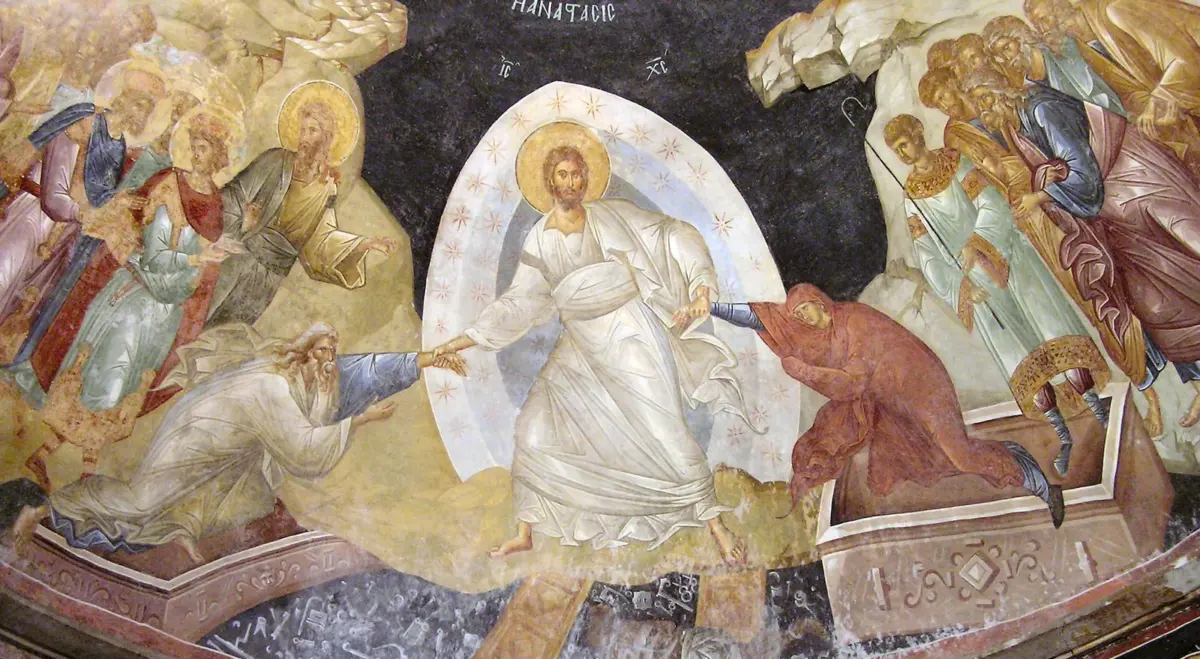
The soul of Adam waited in Hades, together with all the righteous of the Old Testament, for thousands of years. The Church confesses that Christ, after His death on the Cross, descended into Hades with His human soul, united to the Godhead, and crushed the power of death. In the icon of the Resurrection, Christ stands upon the shattered gates of Hades and grasps Adam by the wrist, as one who no longer had the strength to rise by himself.
An ancient homily for Holy Saturday, attributed to Saint Epiphanius of Cyprus, shows the Lord going down into Hades to seek Adam, the first father, as the lost sheep. When Adam sees Him, he beats his breast and cries out to all who were with him. And the Lord takes him by the hand, raises him and says to him: Awake, thou that sleepest, and arise from the dead, and Christ shall give thee light. I am thy God, Who for thy sake became thy son72.
Adam's weeping at the gate of Paradise finds its answer here. Adam had cried out, "Have mercy on me who have fallen", and God not only had mercy on him, but became man from his race, accepted death on the Cross, and went down after him into the depths of Hades.
What We Have Inherited from Adam
Many people ask: why should we bear the consequences of Adam's sin, when at birth we have done nothing? An infant has not eaten from the tree and has broken no commandment. Scripture itself says: "But the soul that sins shall die: and the son shall not bear the iniquity of the father, nor shall the father bear the iniquity of the son"73.
The Holy Fathers do not say that we bear the personal guilt of Adam. Saint Maximus the Confessor distinguishes two things that Scripture calls "sin". The first is the fall of Adam's will from good toward evil, which was a blameworthy sin. The second came from the first, and is the change of human nature from incorruption to corruption. Nature lost its immortality without willing it, as a consequence of Adam's choice, and this change is not a fault74. The guilt was Adam's. To us has remained the nature he left behind: mortal, subject to sickness and to the passions.
Saint John Chrysostom interprets the words of the Holy Apostle Paul in the same way. When the Apostle says that death passed upon all men, this means, according to Saint John, that after the fall of Adam all became mortal, even those who had not eaten from the tree. And when he says that "many were made sinners", Saint John understands that they were made liable to punishment and condemned to death. He also acknowledges the difficulty of the question: that one should be punished for another does not seem to accord with reason, but that one should be saved through another is more fitting and more reasonable75.
Human nature is one and comes from a single root. A child can inherit an illness without being guilty of it. In the same way, every person receives a wounded nature. Personal sins, however, we commit by our own will, and for the healing of nature and the forgiveness of sins we need Christ.
The Holy Apostle Paul, however, sets beside the inheritance from Adam the gift of Christ: if the disobedience of one brought death to the many, much more does the obedience of Christ bring life. His grace surpasses the evil brought by the fall76.
Through Baptism, a person puts on Christ and receives the forgiveness of sins, as we confess in the Creed: "I acknowledge one baptism for the remission of sins". Yet after Baptism bodily death remains. Sickness, weariness and the inclination toward evil also remain, and the mind goes on scattering itself among the things of the world.
Saint Diadochos of Photiki shows what changes through Baptism and what does not change at once. Before Baptism, grace acts upon the soul from outside, while Satan hides within it. After Baptism, grace dwells within, while the devil acts from outside, through the desires of the body. Baptism cleanses the soul of the stain of sin, but it does not at once heal the division of our will between good and evil. The struggle remains, and through it the soul learns to discern good from evil and is humbled77.
Nor is death the same after Christ. Saint Athanasius the Great writes: "Surely, now that the Saviour of all has died for us, we who believe in Christ no longer die as before because of the law that threatened us with death. For this condemnation has ceased". And he adds that from now on the mortal body "is dissolved only for a time, when God appoints for each one, so that we may obtain 'a better resurrection'"78. Death remains, but it has become a passage toward the resurrection.
One of the deep consequences of the fall is seen in the scattering of the mind. Adam's mind, which in Paradise was turned toward God, was scattered after the fall among created things. How this scattering came about, according to Saint Maximus the Confessor and Saint Diadochos, I have shown in the article on the fall. The baptised person also bears this scattering: he prays, and his mind runs off to the cares of the day. Saint Gregory Palamas writes of a father of prayer, Nicephorus, who saw many beginners "unable to master even in part the instability of the mind", and therefore composed for them "a method by which they might restrain a little the scattering and the movement of its imagination"79.
The mind is gathered, then, with toil: through unceasing prayer, through fasting, through stillness, and through life in the Church, at the services and in the Holy Mysteries. Through Baptism we received grace and the beginning of new life; advancing on this path asks for our free and steadfast response to the work of God. Few people today still find the leisure and the stillness for such a labour. Yet the path has remained the same one that Adam walked after the expulsion: labour, tears, and the cry to God.
Adam in the Memory of the Church
The Church does not remember Adam only as the one who fell. On the Sunday before the Nativity of the Lord, the Church commemorates the holy fathers and the righteous of the Old Testament, among whom are also the forefathers of the Saviour according to the flesh. Adam and Eve, Abel the Righteous, Seth and the other righteous are commemorated, up to Joseph, the Betrothed of the Mother of God80. Adam stands at their head. He is also the first in the Lord's line according to the flesh, which the Gospel according to Luke traces back to him81.
Adam's life after the expulsion was a life of labour, of weeping and of waiting, and its end is the deliverance brought by Christ. Every year the Church sets before us the image of Adam at the gate of Paradise, on the threshold of Great Lent. From there begins also the path of the one who fasts: with tears, with toil, and with the cry that Adam learned after he had lost everything: Have mercy on me who have fallen. And the answer is seen in the icon of the Resurrection: Christ grasps Adam by the hand and raises him, showing that man is delivered from the dominion of death by His power.
- Genesis 5:5. ↩︎
- Hronograf, adică Istoria lumii (Chronograph, or the History of the World), compiled by Saint Demetrius of Rostov, translated into Romanian by Metropolitan Veniamin Costache (1837), Pelerinul Român Publishing House, Oradea, 1992; 2nd edition, 2005. Quotations from it are translated from the Romanian. ↩︎
- Genesis 3:19. Scripture is quoted from Brenton's translation of the Septuagint for the Old Testament and from the King James Version for the New Testament. The thorns and thistles: Genesis 3:17–18. ↩︎
- Genesis 3:21. The coverings of fig leaves: Genesis 3:7. ↩︎
- Genesis 3:23. Adam placed in Paradise to tend and keep it: Genesis 2:15. ↩︎
- Genesis 3:24. ↩︎
- Saint John Chrysostom, Homilies on Genesis, Homily 18. ↩︎
- Triodion, Sunday of Adam's Expulsion from Paradise (Cheesefare Sunday), Vespers, Doxastikon, Tone 6 (plagal of the second). ↩︎
- Ibid., the same hymn. ↩︎
- Triodion, Sunday of Adam's Expulsion from Paradise, Vespers, Doxastikon of the Aposticha. ↩︎
- Synaxarion of the Sunday of Adam's Expulsion from Paradise, in the Triodion. ↩︎
- Venerable Abba Dorotheus, Soul-Profiting Teachings, Teaching 1. ↩︎
- Ibid. The answer of Adam and Eve: Genesis 3:12–13. ↩︎
- Chronograph, on the years after the expulsion (2005 ed., approx. pp. 58–60). ↩︎
- Ibid., approx. p. 63. ↩︎
- Wisdom of Solomon 10:1–2. ↩︎
- Saint Silouan the Athonite, "Adam's Lament". ↩︎
- Saint Athanasius the Great, On the Incarnation of the Word, ch. 7. ↩︎
- Ibid. ↩︎
- Genesis 3:22. ↩︎
- Saint Irenaeus of Lyons, Against Heresies, III, 23, 6 (paraphrased). ↩︎
- Ibid., III, 23, 1–2 (paraphrased). ↩︎
- Luke 23:42–43. ↩︎
- Saint Irenaeus of Lyons, Against Heresies, III, 23, 5 (paraphrased). The fig leaves: Genesis 3:7. ↩︎
- Saint Ephrem the Syrian, Commentary on Genesis, on Genesis 3 (paraphrased). ↩︎
- Genesis 4:1. ↩︎
- Saint John Chrysostom, Homilies on Genesis, Homily 18. ↩︎
- Genesis 4:2. ↩︎
- Chronograph (2005 ed., approx. pp. 60–61). ↩︎
- Genesis 4:4. ↩︎
- Genesis 4:7. Cain's grief: Genesis 4:5–6. ↩︎
- Genesis 4:9. ↩︎
- Genesis 4:10. ↩︎
- Saint Silouan the Athonite, "Adam's Lament". ↩︎
- Hebrews 11:4. ↩︎
- Genesis 4:16. Cain's curse: Genesis 4:11–12. ↩︎
- Saint John Chrysostom, Homilies on Genesis, Homily 20. ↩︎
- Genesis 4:25. ↩︎
- Genesis 5:3. Man made in the image of God: Genesis 1:27; 5:1. ↩︎
- Chronograph (2005 ed., approx. pp. 28–34). ↩︎
- Genesis 4:26. ↩︎
- Chronograph (2005 ed., approx. pp. 71–73, 89). ↩︎
- The ancient chronicles gathered in the Chronograph also preserve other details: that Seth was taken up by an angel for forty days and taught the mysteries of heaven, and that in the six-hundredth year of his life Adam received from an angel revelations about the Incarnation of the Lord, the Flood and the Last Judgment (2005 ed., approx. pp. 71–74, after George Cedrenus). We mention them as narrative traditions, without presenting them as teaching of the Church's faith. ↩︎
- Genesis 5:8. ↩︎
- Genesis 4:17. Cain condemned to be a wanderer: Genesis 4:12. ↩︎
- Genesis 4:19. Cain's descendants down to Lamech: Genesis 4:18. ↩︎
- Genesis 4:20–22. ↩︎
- Genesis 4:23–24. ↩︎
- Saint John Chrysostom, Homilies on Genesis, Homily 20 (paraphrased). ↩︎
- Genesis 5:3–32. ↩︎
- Genesis 5:22 and 5:24. See also Hebrews 11:5. ↩︎
- Saint Ephrem the Syrian, Commentary on Genesis, on Genesis 6 (paraphrased). ↩︎
- Genesis 6:2. See also Genesis 6:1. ↩︎
- Saint John Chrysostom, Homilies on Genesis, Homilies 22 and 23 (paraphrased). The wickedness of men before the Flood: Genesis 6:5–7. ↩︎
- Genesis 5:5. The commandment and the warning of death: Genesis 2:17. ↩︎
- Chronograph (2005 ed., approx. p. 94). ↩︎
- Ibid. ↩︎
- Chronograph (2005 ed., approx. p. 94). See Saint Irenaeus, Against Heresies, V, 23, 2, where the argument is typological: the day of Adam's death and the day of the Lord's Passion. ↩︎
- Synaxarion of the Sunday of Adam's Expulsion from Paradise, in the Triodion. ↩︎
- Chronograph (2005 ed., approx. p. 94). ↩︎
- Genesis 3:15. ↩︎
- Chronograph (2005 ed., approx. pp. 59–60, 94–95). The cave bought by Abraham: Genesis 23. ↩︎
- Ibid., approx. pp. 94–95. ↩︎
- John 19:17. See also Matthew 27:33; Mark 15:22. ↩︎
- Saint John Chrysostom, Homilies on the Gospel of John, Homily 85 (paraphrased). ↩︎
- Romans 5:12. ↩︎
- Romans 5:14. ↩︎
- Romans 5:18–19. ↩︎
- 1 Corinthians 15:22. See also 1 Corinthians 15:21. ↩︎
- 1 Corinthians 15:45. ↩︎
- 1 Corinthians 15:47. ↩︎
- Homily on the Burial of the Divine Body of the Lord, attributed to Saint Epiphanius of Cyprus (paraphrased). The words "Awake, thou that sleepest" are from Ephesians 5:14. ↩︎
- Ezekiel 18:20. ↩︎
- Saint Maximus the Confessor, Questions to Thalassius, 42 (paraphrased). ↩︎
- Saint John Chrysostom, Homilies on the Epistle to the Romans, Homily 10, on Romans 5:12–19 (paraphrased). ↩︎
- Romans 5:15–19. ↩︎
- Saint Diadochos of Photiki, On Spiritual Knowledge (One Hundred Chapters), chs. 76–78 (paraphrased). ↩︎
- Saint Athanasius the Great, On the Incarnation of the Word, ch. 21. "A better resurrection": Hebrews 11:35. ↩︎
- Saint Gregory Palamas, Triads, II, 2, "In Defence of Those Who Devoutly Practise Stillness", as quoted in the Romanian Philokalia, vol. VII. ↩︎
- Synaxarion of the Sunday before the Nativity of the Lord. ↩︎
- Luke 3:23–38. ↩︎
