
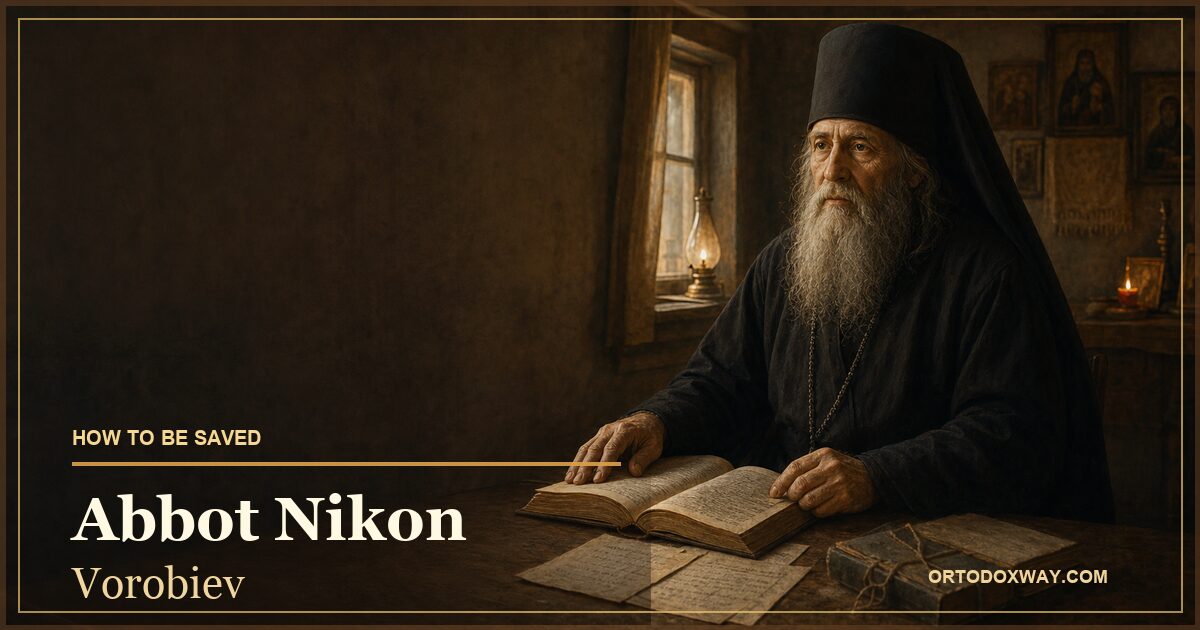
«Repentance Is Left to Us»: a teacher of humility in the age of atheism
Shortly before his death, in September 1963, an abbot unknown to the world — the parish priest of a provincial church in a small Soviet town — left those gathered at his bedside a spoken testament of a single sentence: to repent, to count themselves sinners like the publican, to beg for the mercy of God, and to be merciful to one another.1 Nothing about himself. No prophecy, no vision, no “lofty” word. Only the prayer of the publican, stretched across an entire lifetime and left as an inheritance.
The man who spoke these words was called in the world Nikolai Nikolaevich Vorobiev, and in monasticism Nikon. He lived from 1894 to 1963 — that is, exactly across the abyss into which Orthodox Russia collapsed, and out of which, through the blood of the new martyrs, the persecuted Church of the twentieth century emerged. He founded no monasteries, gathered few disciples, and left behind no theological system. He left letters. Collected after his death under the title «Repentance Is Left to Us», they became a book of the heart for many Russian Christians in the Soviet years and after — and for several decades now they have spoken, through translations, to Orthodox Christians everywhere.2 The title of the book is, in fact, his whole teaching.
This is why Father Nikon is so close to the person of today. He meets us with the realism of a man who knew unbelief, despair, intellectual searching, persecution, illness, and loneliness. This is precisely why his word does not sound bookish. He does not speak of repentance as the theme of a sermon, but as the only plank left to a man when all the others have broken.
The Search: Science, Philosophy, and the Dead End
Nikolai Vorobiev was born on 22 May 1894 — the day of the translation of the relics of Saint Nicholas the Wonderworker, whose name he received at baptism — in the village of Mikshino in the Tver province, into a peasant family with many children, all of them boys.3 From his childhood a single sign was preserved: a fool for Christ who passed through the village, little Vanka, once approached him in the midst of his brothers and repeated, pointing at him: this one is a monk. No one took heed at the time. Of all the brothers, only Nikolai would put on the monastic habit.4
The family was Orthodox, but its faith — like that of most — was the faith of custom and outward observance, without inner foundation. Such a faith, received as a mere inheritance and untested by living experience, is easily lost. So it was with the adolescent Nikolai: having entered the secondary school in Vyshny Volochok, he threw himself with all the ardor of his nature into the study of the sciences, convinced that there the truth lay hidden. Blind faith in science pushed aside, without a struggle, faith in God — which was at that time equally blind.5
But it was the very seriousness of his search that drew him out of this bondage. He soon realized that the empirical sciences do not even raise the question that burned in him: what is the meaning of a man’s life, if death swallows everything? He turned then to the history of philosophy, which he studied through whole nights, with a thirst that often left him without bread money — he gave his last kopecks for books. At the end of this road, his later verdict would be devastating: every philosopher believed he had found the truth, but the philosophers were many, and the truth is one. Philosophy, he said, proved to be a substitute — as if, instead of bread, you gave a man rubber to chew.6
He made one more attempt: in 1914, after a brilliant completion of secondary school, he entered the Psychoneurological Institute in Petrograd, hoping that at least the science of the soul would tell him what man is. What he found there was the study of the speed of nerve processes, of perception, of memory — the “skin” of man, as he would later put it, not man himself.7 After a year he left. All the doors of human knowledge had closed before him one by one, and beyond them he had found no answer. He was twenty-one years old, and he was contemplating suicide.
The Cry and the Answer
In the summer of 1915, in Vyshny Volochok, at the moment when he felt himself in an utter dead end, the faith of his childhood flashed through his mind: but what if God truly exists? Then He must reveal Himself. And the unbeliever cried out from the whole depth of his being — asking not for health, not for deliverance from troubles, not for any earthly benefit, but for one thing only: to know whether God is.8
And the Lord revealed Himself to him. Father Nikon testified to the end of his life that this working of grace cannot be put into words: it assures a man of God’s existence with a power and an evidence that leave no room for the least doubt — as when, after a dark cloud, the sun suddenly breaks forth, and no one asks any longer whether it is the sun or a lantern.9 He fell to the ground and gave himself wholly to God, asking to serve Him all his life and to pass through any suffering, only that he might not fall away from Him. When he rose, in the dead of night, he heard the sound of bells, strong and rhythmic, though no church was serving at that hour.10
It is of the greatest importance how he himself understood this miracle: not as a reward, but as the natural outcome of an honest search carried to the edge of the abyss. God did not answer a passing curiosity, but a man who could no longer live without an answer. And his first experience after his return was a liturgical one: entering a church — the same church in which he had stood for years “like a post” — he remembered the envoys of Prince Vladimir, who in the Greek church no longer knew whether they were in heaven or on earth. The Church, he would say, is not earth: it is a little piece of heaven.11
The School of Humility: The Cell, the World, the Camp
There followed two years of solitude in Sosnovitsy: half a rented house, little bread, a bowl of plain cabbage soup, prayer all day long. Beyond the fence — the revels of the young, to which he too was invited; but the taste for the world had died in him. There he opened, for the first time in earnest, the Gospel and the writings of the Holy Fathers, and made a discovery that would determine his whole path: when a man begins to struggle with himself and to walk the evangelical way, the Fathers cease to be literature — they become close kin, a true mother who consoles, teaches, and feeds.12 Philosophy — as he himself would confess — caused him sorrow and nausea; the Fathers fed him.
In 1917 he entered the Moscow Theological Academy. After a year, the revolution closed it. There followed the hidden road of so many believers of that age: a teacher of mathematics in a Tver village, then a chanter at a church in Moscow. On 23 March 1931 he was tonsured a monk in Minsk, with the name Nikon; on the Annunciation of that same year he was ordained hierodeacon, and at the end of 1932, hieromonk.13
On 23 March 1933 — the day on which two years from his tonsure were completed — he was arrested and sentenced to five years in a labor camp in Siberia.14
Of the camp years Father Nikon spoke little. And the little he said overturns every expectation. Ten days before his death, gathering his last strength, he recounted to those close to him his inner journey — as a “psychological illustration” of the spiritual life, as he put it, from the mouth of a dying man. And he confessed then something staggering in its simplicity: in the years of solitude at Sosnovitsy, beneath the harsh asceticism and the unceasing prayer, in the deepest depth of his soul there grew, unseen, self-regard — the thought that he was living a life of ascetic struggle, that he had understood the prayer of the heart. For this reason, he said, the Lord did not grant him the stillness of the desert he had dreamed of, but cast him into the midst of the world and its vanity, that he might know that he is nothing. And he added, without sparing himself: afterward he received the monastic form, passed through the camp, returned — and still he brought self-regard with him.15
Let us weigh well what we hear here. A confessor of the faith, who paid for his fidelity to Christ with the Siberian camp, does not present his suffering as a crown, but as a medicine that did not even fully cure him of pride. This is the authentic patristic measure: it is not suffering in itself that sanctifies, but the humility that suffering, received without murmuring, works in a man. The ancient Fathers called this sight of one’s own helplessness higher than the sight of angels. In Father Nikon it is not a rhetorical figure, but the diagnosis he pronounces upon himself, on his deathbed, with the lucidity of a man who has nothing left to lose and nothing to gain.
Released in 1937, he worked for years as a medical assistant in Vyshny Volochok, unable to serve. When the war brought the reopening of the churches, he was appointed, in 1944, parish priest in Kozelsk — the little town near Optina, where there still lived the hieromonk Meletius, the last elder of Shamordino and the last monk tonsured by Saint Ambrose of Optina. Father Nikon, himself a sought-after spiritual father, went to the silent old man as a disciple.16 From 1948 he was moved from parish to parish — Belyov, Yefremov, Smolensk — until Gjatsk, a small town in the Smolensk region, where he served fifteen years, until his death, in a parish he received in decay. There, in the poor parish house, were written most of the letters that would carry his name through the world.
The Teaching: Repentance, the One Door
Whoever opens Father Nikon’s letters looks perhaps for “spiritual” counsels in the ordinary sense: rules of prayer, resolutions of perplexities, consolations. He finds them — but all are traversed by a single thread, taken up with an almost monotonous insistence, from the first letter to the last: repentance. Not as an occasional act, but as the foundational state of the Christian; not as a beginner’s stage, but as the one door through which all spiritual good enters.
In a letter to a spiritual daughter, the chain is unfolded whole: from the steadfast state of repentance are born the fear of God and humility, and from the fear of God and humility is born the love of God — and this last cannot exist without those that come before; without repentance and humility, all is vanity and delusion.17 Here, in four sentences, is the measure and criterion of the whole spiritual life. Whoever promises love, vision, “lofty states” without the foundation of repentance — promises delusion. Father Nikon never tired of repeating that the only true sign of spiritual progress is the ever clearer sight of one’s own sins, according to the words of the prayer of Saint Ephraim the Syrian: “grant me to see mine own faults.”
The second great theme of the letters is the patient, uncomplaining endurance of afflictions and illnesses. Father Nikon sets it upon the foundation of the apostolic word — “we must through much tribulation enter into the kingdom of God” (Acts 14:22) — and upon the prophecy of the ancient Fathers that, in the last times, monks will no longer have the ascetic labors of those of old, but will be saved through the endurance of afflictions, and those who endure will be found higher than the first.18 Why are ascetic labors no longer possible? His answer is of an exemplary sobriety: because humility is no longer in men, and without humility ascetic labors give birth to self-regard and delusion; and because there are no longer experienced guides to direct them. The guide of our times, he wrote to a brother, is the Lord Himself — and, in part, books.19
This word about books is not a resignation, but a program. And here we come to the link that binds Father Nikon to a whole chain of tradition.
“Strive to Acquire a Taste for Ignatius Brianchaninov”
Among the counsels Father Nikon repeated most insistently, one returns like a refrain: the reading of Saint Ignatius Brianchaninov. Here it is in full, in a letter to Nadia, a spiritual daughter:
“Strive to acquire a taste for Saint Ignatius Brianchaninov. All his writings are drawn from the Fathers and adapted for us. He writes about the most necessary thing: about repentance, which is the only door to all good. You must strive to have always a disposition of repentance, from which are born the fear of God and humility, and from the fear of God and humility comes the love of God. This last cannot exist without those before it. Without repentance and humility, all is vanity and delusion.
Once more I counsel you: read more good books. Few are the people from whom you can receive anything spiritually, and these are often busy or ill, whereas a book you can always read.
Pray more often, even if only a little, and say the Jesus Prayer and the prayer to the Mother of God.
I wish you all the mercies of God and salvation!
I remember you. Please do not forget me either.
Do not give yourself over to thoughts about loneliness and to other vain thoughts. These are snares of the enemy. God is with us, we are not alone. If there be need, the Lord will send us friends such as we do not even expect.
Struggle according to your strength.”20
Why Ignatius in particular? Because Saint Ignatius accomplished, in the nineteenth century, a work upon which the twentieth century would depend. He did not simply translate the Fathers — that work had been done by the Paisian line of the Philokalia. He took up, sifted, and re-expressed, from within his own ascetic struggle, the great ascetic tradition of the East — systematically, in the living language of his time, with one question ever awake: what of the teaching of the Fathers is still applicable, how, and by whom, in a generation grown spiritually weak and left without Spirit-bearing guides? The Philokalia sets the sources before the reader; Ignatius gives him the map and the warnings — above all, the systematic teaching on delusion, which the ancient Fathers had scattered through thousands of sayings and applied through a living elder. It was Ignatius too who clearly formulated the order for the time of spiritual poverty: where there are no longer Spirit-bearing elders, the unconditional obedience of old is replaced by life according to counsel and by guidance from Scripture and the writings of the Fathers.
Father Nikon’s counsel in the letter above — the book of the Fathers in place of the guide who is lacking — is the precise application of this Ignatian order, carried into the conditions in which its premise had become total: in the Soviet wilderness, where the monasteries had been closed and the spiritual fathers destroyed, the book of the Fathers, read with repentance, remained almost the only guide. Father Nikon innovated nothing; he fulfilled, letter by letter, the program of Saint Ignatius — and by this he became himself a link in the same chain, extending the tradition to those who would come after him.
The End and the Veneration
Father Nikon reposed on 7 September 1963, in Gjatsk, after a long and grievous illness, borne — according to the testimony of those present — as he had taught his spiritual children to bear. On 13 August he had written his testament as well: the request to all his own to hold the Orthodox faith and to work out their salvation through the commandments of the Gospel, through confession and communion; the testimony that, in the hardest trials of his life, consolation had come to him only from faith in Christ and from prayer; and the final exhortation — to be merciful to one another and to love one another, for where there is peace and love, there is God.22 The words about mercy and love were carved on his gravestone in Gjatsk — the town that today is called Gagarin.
That grave was never forgotten. The letters, passed from hand to hand and then printed in ever-renewed editions, made the unknown abbot one of the most widely read spiritual teachers of contemporary Orthodoxy. And at the end of 2023, the Metropolis of Smolensk resolved to begin the gathering of testimonies about his life, with a view to a canonization that the very resolution calls “awaited by all.”23 The Church does its work of inquiry in good order and without haste; the veneration of the faithful has gone ahead, as so often in history — born not of a manufactured fame, but of the fruits verified by thousands of souls who, reading his letters, found in them what he himself said is left to us: repentance.
For this, in the end, is his inheritance — and his measure. A man to whom God revealed Himself in a wondrous way at twenty-one, and who then needed half a century of afflictions, of the camp, and of obscurity to learn — and to teach us — the prayer of the publican. Our times are no richer spiritually than his. But neither has the door changed: “God be merciful to me a sinner” (Luke 18:13).
Where to Find the Book
Father Nikon’s letters are available in Romanian from Sophia Press as Cum să trăim în ziua de astăzi. Scrisori despre viața duhovnicească. The book can be found here.
Notes
1. The oral testament, transmitted by those close to him; see the Russian edition «Нам оставлено покаяние», comp. A. I. Osipov, Sretensky Monastery Press, Moscow, 2005, biographical sketch.
2. «Нам оставлено покаяние», ed. cit., 544 pp. In Romanian: «Cum să trăim în ziua de astăzi. Scrisori despre viața duhovnicească», Sophia Press, Bucharest. No English-language edition of the letters was used here; quotations are translated from the Russian and from the existing Romanian rendering.
3. Biographical sketch (A. I. Osipov). Date: 22 May (New Style) = 9 May (Old Style), the feast of the translation of the relics of Saint Nicholas to Bari (1087). Sources giving other days reflect different calendar conversions.
4. Ibid.
5. Ibid.
6. Ibid.; autobiographical testimony from the end of his life.
7. Ibid.
8. Ibid.
9. Ibid.
10. Ibid.
11. Ibid.
12. Ibid.
13. Dates according to Father Nikon’s autobiography, cited in the biographical sketch (tonsure: 23 March 1931 Old Style = 5 April New Style).
14. Ibid. Arrest: 23 March 1933 Old Style = 5 April New Style; sources giving 5 April do not contradict the date of 23 March but render it in New Style.
15. The confession of 28 August 1963.
16. On the hieromonk Meletius Barmin (†1959).
17. Letter to a spiritual daughter.
18. Letter to Fr. Meletius and the nun Anna, 1 February 1958; cf. the Paterikon, Abba Ischyrion.
19. Ibid.
20. From the group of letters addressed to Nadia and her mother, Nadezhda Evdokimova (in the Russian edition: «Письма к Наде и ее матери Надежде Евдокимовым»); the present letter is addressed directly to the daughter, Nadia. Text translated from the Russian and from the Romanian rendering published on cuvantul-ortodox.ro.
22. The testament of 13 August 1963.
23. Resolution of the diocesan council of the Metropolis of Smolensk of 31 December 2023; the Metropolis’s official communiqué (smoleparh.ru, January 2024).