
Those who received something from Christ, in the years when He walked among men, nearly all came to Him in the same way: they came themselves, they told Him plainly what they needed, and they believed that He could give it to them. A woman who had been ill for twelve years, a Roman officer, a blind man begging by the roadside, a thief crucified beside Him – people who did not know one another and had nothing in common – did the same thing, and each of them received.
This seems simple. And yet many Christians pray for years and feel that their prayer stops somewhere along the way and never arrives. The question these pages try to answer is why not everyone is able to turn to God directly, when in the Gospel this was enough, and what it is that a man places, without realising it, between himself and God.
In this article
The woman who touched His garment
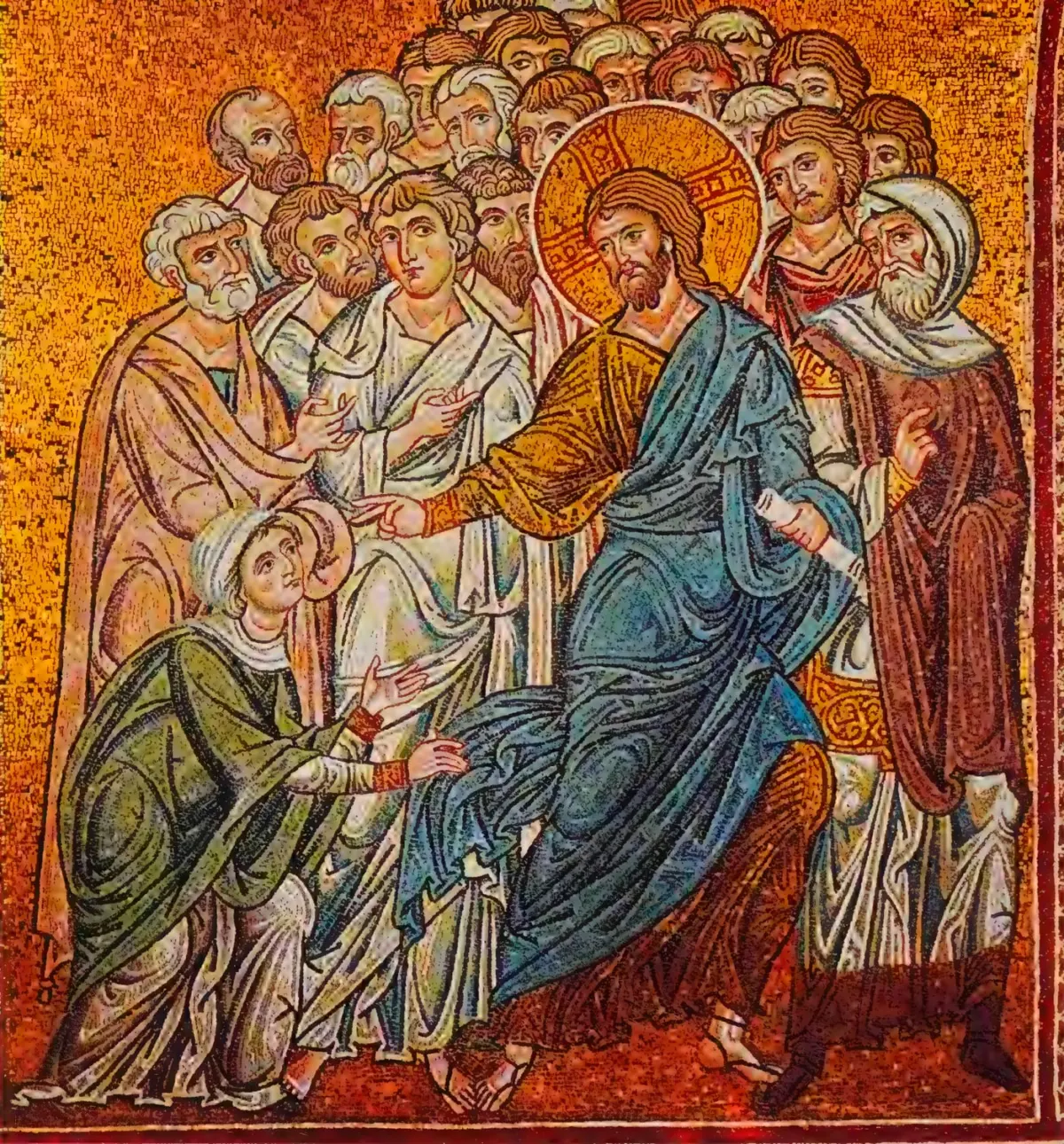
This woman had suffered from a flow of blood that had not stopped for twelve years. She had spent all she had on physicians, and far from being healed, she had grown worse.1 Under the Law of that time her illness made her unclean: she was not allowed to touch anyone, and whoever touched her became unclean as well. This is why she did not come before Him as the other sick did, but slipped through the crowd and came up "behind Him".
She said nothing aloud. Yet her request was so clear within her that the Evangelist records it as spoken words: "For she said within herself, If I may but touch his garment, I shall be whole."2 She touched it, and in that same moment the illness stopped.
The crowd was pressing on Christ from every side, and many touched Him that day. When He asked who had touched Him, the Apostle Peter was surprised at the question, since people were thronging Him on all sides. The Lord answered that He had felt power go out of Him.3 Of all those touches, hers alone was felt, because she alone had come with a request and with faith. Christ turned, looked at her and said: "Daughter, be of good comfort; thy faith hath made thee whole."4
The centurion and the thief
A centurion – a Roman officer with a hundred soldiers under him – came to Christ in Capernaum on behalf of his servant, who lay paralysed at home and was suffering terribly. When the Lord said He would come and heal him, the centurion stopped Him: "Lord, I am not worthy that thou shouldest come under my roof: but speak the word only, and my servant shall be healed." This man, who knew what it meant to give an order and see it carried out, believed that for Christ a word was enough, however far away the sick man might be. The Lord marvelled and said to those who followed Him: "I have not found so great faith, no, not in Israel." Then He said to the centurion: "Go thy way; and as thou hast believed, so be it done unto thee." And the servant was healed in that same hour.5
The centurion was not asking for himself but for someone else, and his prayer was still a direct prayer. The one who prays for another does not stand between that person and God; he comes before God carrying the other with him.
The third man was on a cross. One of the two thieves crucified beside Christ had nothing to bring: no good deeds, and no time left to do any. He spoke a single sentence: "Lord, remember me when thou comest into thy kingdom." And at once he heard the answer: "Verily I say unto thee, To day shalt thou be with me in paradise."6
What they had in common
These people came themselves, asked for a particular thing, and trusted the One they were asking. None of them made a speech. The woman did not open her mouth, the centurion asked for a single word, and the thief spoke one sentence. Saint John of the Ladder counselled monks in exactly this way: do not try to use many words when speaking with God, lest your mind be scattered in searching for words. In the same place he recalls that one word of the publican softened God, and one saying full of faith saved the thief.7
A prayer that runs over all the cares of life without asking for anything in particular is like a letter without an address. Christ Himself sometimes asked the sick what they wanted, though He saw perfectly well what they lacked. He stopped for the blind man of Jericho, who was crying out by the roadside, and asked him what he wanted Him to do; only after the blind man had said, "Lord, that I may receive my sight," did He give him his sight.8 The Lord wanted to hear the request spoken by the man himself.
The trust of these people was not a certainty that things would turn out as they wished. It was trust that the One they were asking is good and mighty, and this trust made them come without detours.
What comes to stand between man and God
If some went straight to Christ, then others stopped on the way because of something they carried within them. The Gospel shows us these too, often among those who stood closest to Him.
The wave you look at
One night the disciples were rowing on the lake against the wind, and Christ came towards them walking on the water. Peter asked Him to bid him come to Him, and the Lord said: "Come." Peter stepped down from the boat and walked on the water for as long as he looked at Christ. "But when he saw the wind boisterous, he was afraid; and beginning to sink, he cried, saying, Lord, save me."9
The wind had not changed. What had changed was Peter's gaze, which had passed from Christ to the waves. So it is with many of us: we pray, but the eyes of our mind stay on the illness, on the debt, on the doctor's test results, on the person who wronged us. The trouble comes to stand between us and the One we pray to, and seems greater to us than He is.
Yet even in the moment he was sinking, Peter's cry was a direct prayer of three words, and Christ answered at once: "And immediately Jesus stretched forth his hand, and caught him, and said unto him, O thou of little faith, wherefore didst thou doubt?"10 Fear too can be brought to Him, if a man cries out to God instead of keeping his eyes on the waves.
"If thou canst"
A father brought his son, tormented by an unclean spirit, to the disciples, and the disciples could not heal him. When he came before Christ, the father said to Him: "If thou canst do any thing, have compassion on us, and help us." The Lord turned his words back to him: "If thou canst believe, all things are possible to him that believeth." Then the father cried out with tears: "Lord, I believe; help thou mine unbelief."11
Between this man and Christ there stood an "if". The man did not hide it; he confessed it and asked the Lord to take it from him, and his son was healed. Doubt becomes a wall when a man keeps it inside and prays over the top of it, as though it were not there. The holy Apostle James says that a man must "ask in faith, nothing wavering", and adds of the one who doubts: "For let not that man think that he shall receive any thing of the Lord."12
What we think we know about Him
When Christ came to Nazareth, the town where He had grown up, the people marvelled at His teaching, but at once began telling one another what they knew about Him: that He was the carpenter's son, that they knew His mother, His brothers and His sisters. Because they had known Him since childhood, they could not accept that He was more than they believed, and they were offended in Him. The Evangelist ends by saying that the Lord did not do many mighty works there, because of their unbelief.13
The same can happen to a man who has grown up in the Church. He knows the prayers by heart, he has heard about God all his life, and long ago he formed an image of Him. Sometimes it is the image of a God who worked miracles once but does so no longer. At other times it is the image of a stern Judge whom the saints must persuade on our behalf. Such a man then prays to the image he has made, and the image comes to stand between him and the living God.
One's own righteousness
Christ told the parable of two men who went up to the temple to pray. The Pharisee, a devout man according to the Law, "stood and prayed thus with himself": he thanked God that he was not as other men, and listed how he fasted twice a week and gave tithes of all he possessed. The publican, a man who collected taxes for the Romans and whom everyone counted a sinner, stood far off and did not dare to lift up his eyes to heaven, "but smote upon his breast, saying, God be merciful to me a sinner." The Lord says that the publican went down to his house justified, and the Pharisee did not.14
The Pharisee prayed "with himself". His good deeds were real, but he had set them between himself and God like a file brought for approval, and his prayer turned back upon himself. The publican came with his sins and put nothing in front of them.
This wall has another face, harder to see: the man who thinks himself too great a sinner to ask for anything. The centurion said "I am not worthy" and asked all the same. The woman came from behind, ashamed, but she came. Their unworthiness made these people ask with humility, but it did not keep them away.
The voice of others
The blind man of Jericho sat by the roadside begging. When he heard that Christ was passing by, he began to cry out after Him. "And they which went before rebuked him, that he should hold his peace: but he cried so much the more, Thou Son of David, have mercy on me."15
Those around us can also come between man and God: what others will say, what is proper and what is not. Often this voice speaks within us and tells us that our trouble is too small for God, that He has greater things to do, that it is not right to trouble Him yet again with the same thing. The blind man did not let himself be stopped, and Christ stopped for him.
Remembering wrongs
Saint John of the Ladder writes: when you go to stand before the Lord, let the whole garment of your soul be woven from the thread – or rather, from the token – of forgetting wrongs; otherwise you will gain nothing from your prayer.16 To "forget wrongs" means no longer to keep in mind the evil another has done to you. Christ Himself said that when we stand praying, we must first forgive, if we have anything against anyone, so that our Father may also forgive us.17
Resentment against our brother is one of the most lasting walls, because a man carries it with him into prayer without even noticing it any more. He speaks the words of prayer, while in his heart there stands, unmoved, the face of the one who wronged him.
Prayer turned into an account
The holy Apostle James says: "Ye ask, and receive not, because ye ask amiss, that ye may consume it upon your lusts."18 One can also ask amiss in another way: when prayer becomes a matter of accounting. A man reads a certain number of akathists, lights a certain number of candles, keeps a certain number of days of fasting, and expects at the end to receive what he asked for, like goods already paid for.
The Church has her rules of prayer, and to read an akathist or light a candle is a good thing. The wall appears when a man puts his hope in the number and not in God. Then the number comes to stand between him and the One he is asking.
The Psalter and the prayers of the saints: wall or door?
Here a natural question arises. If the power of prayer lies in turning to God directly, why does the Church give us the Psalter and prayers written by the saints to read? The psalms are so powerful precisely because David found a way of speaking to God directly. We, however, read them, and the words are not our own. It is the same with the prayers of the saints, which we say every morning and evening. It looks like an indirect way of speaking with God, and yet this is the practice of the Church.
The answer is given by the Fathers who lived with the Psalter day and night. Saint John Cassian spent years among the monks of the Egyptian desert and wrote about the way they prayed. Those monks did not try to get through the psalms in one breath. They divided them into portions, with prayers in between, because what mattered to them was not how many verses they had read, but whether their mind had understood.19
In the conversation on prayer that Saint John Cassian had with Abba Isaac, the elder tells him that the monk who has taken the thoughts of the psalms into himself speaks them as though they were his own words and not the psalmist's. He sees that what was fulfilled in the life of the prophet is fulfilled every day in his own life too: he remembers his struggles, his falls and the help he has received from God, and finds them again in the psalm.20 In the same conversation Abba Isaac gives the monks a single verse from the Psalter, to be said in every state – at work, at table, in bed and on waking: "O God, make speed to save me: O Lord, make haste to help me."21 This verse of David became the cry of thousands of monks, and each of them said it as his own.
Another's words become ours in the way a child makes his own the words his mother teaches him. The child does not yet have words for what he feels; his mother gives them to him, and he says them clumsily at first, then with all his heart, until he no longer knows that he received them from someone else. The Psalter and the prayers of the saints are the words the Church puts into the mouths of those who do not know how to speak to God. They give us a voice; they were not given to take our place.
A psalm comes to stand between man and God only when he reads it as a text that has to be finished, and keeps checking how many pages are left. When he reaches a verse that tells his own trouble exactly, stops, and says it to God as his own, the psalm becomes a door. Saint John of the Ladder gives the same counsel: if in some word of your prayer you feel particular sweetness or compunction, stay with it.22 By "compunction" the Fathers mean that pain of the heart which repents and grows soft. The rule of prayer should not be replaced with words of one's own. But a man can stop in the middle of it at the word that has touched him, and at the end tell God, in a few words of his own, what it is he is asking.
The same can be said of prayer to the saints. In Capernaum, four men brought their paralysed friend to Christ. Because they could not get in for the crowd, they opened up the roof of the house and let him down on his bed in front of the Lord. Christ, seeing their faith, forgave him and healed him.23 Those friends did not stand between the paralytic and Christ. They brought him before Him. This is how the Mother of God and the saints work when we ask them: they take us and bring us before Christ. The wall is not the saint. The wall appears when a man leaves everything to others – hands in a list of names to be commemorated at the altar, lights a candle, asks someone else to pray for him – and never comes himself to say a word to God.
Time, services and cares
Many believe that to be truly in communion with God a man must give Him a special time, away from everything, and that this is why hermits went into the desert. Yet the man of today has so much to do that he cannot find that time. And when he does begin to pray, he does it mechanically, because he was taught that this is how it must be done, while his thoughts stay on what he did during the day and what he still has to do.
Christ had two friends in Bethany, the sisters Martha and Mary. When He entered their house, Martha set about preparing the meal and was troubled with much serving, while Mary sat at His feet and listened to Him. Martha complained that her sister had left her to serve alone. The Lord answered her gently that she was careful and troubled about many things, when only one thing is needful, and that Mary had chosen the good part, which would not be taken from her.24 Martha was doing nothing wrong; indeed, she was serving Christ Himself. Yet her cares, good as they were, had come to stand between her and the One she was serving, and she no longer had time to listen to Him.
The man of today does not drift away from God because he has a great deal to do; people have always had a great deal to do. He drifts away because his cares come into prayer with him. In explaining the parable of the sower, Christ says that the seed which fell among thorns is the man who hears the word, but the care of this world and the deceitfulness of riches choke it, and it becomes unfruitful.25
The Lord also gave us counsel for this: "But thou, when thou prayest, enter into thy closet, and when thou hast shut thy door, pray to thy Father which is in secret."26 The door that must be shut is first of all the door of the mind, through which the cares of the day come in. Hermits went into the desert to keep this door shut all their lives. But they found that their thoughts followed them even there, and this is precisely why the desert Fathers wrote so much about guarding the mind.
The people in the Gospel had no special time set aside for meeting Christ. The woman found Him in the street, in the crush of the crowd. The blind man cried out from the roadside where he begged every day. The thief had only a few hours of life left. Their meeting had power because, in that moment, nothing stood any longer between them and Christ. A few minutes in which a man truly stands before God weigh more than an hour in which he has merely read. The verse Abba Isaac gave the monks was meant precisely for work, for the table and for the road. The Jesus Prayer – "Lord Jesus Christ, Son of God, have mercy on me, a sinner" – is close to the cry of the blind man of Jericho and the sigh of the publican, and a man can carry it with him wherever he is.
The same danger of habit can enter the services of the Church, even for those who spend a great deal of time in them, as monks do in monasteries. The service is not an intermediary; at the Divine Liturgy Christ is present more than anywhere. But a man can stand in church like the people of Nazareth: he knows it all by heart, follows the order of the service, knows which litany comes next – that is, the series of petitions said by the deacon or priest, to which the faithful answer "Lord, have mercy" – and knows what is sung after it, and yet he no longer sees the One who is present. The ritual is not the wall. The wall rises when a man ends up serving the order of the service instead of standing, through it, before God. The monks of Egypt guarded against exactly this when they divided the psalms into portions so as not to rush through them to the end.
The way out of this circle is to turn the mind towards the One to whom we are speaking. Before praying, a man can stop for a moment to remember before Whom he stands, as Saint John of the Ladder says: when you go to stand before the Lord. He can say fewer words, but with attention. In church he can make the "Lord, have mercy" of the litany his own cry, and when the priest commemorates the sick, the travellers or the departed, he can bring before God the names and the troubles he carries in his heart. And when his mind wanders off again to its cares, he can bring it back without losing heart, like Peter, who cried "Lord, save me" at the very moment he was sinking.
Vigil, prostrations and the prayer of the heart
Over the centuries the Church has kept three labours that help a man come before God with nothing between them: vigil, prostrations and the prayer of the heart. They do not take the place of the direct turning to God spoken of so far. They break down the walls that hinder it.
Vigil means taking time from the night's sleep for prayer. Christ Himself "went out into a mountain to pray, and continued all night in prayer to God."27 In the garden of Gethsemane, on the night before His Passion, He asked His disciples to watch and pray, that they might not enter into temptation.28 And David says in a psalm that he rose at midnight to give thanks to God.29 The night answers precisely the man of today who says he has no time. Then the phone is silent, no one asks anything of him, and the business of the day has stopped. The cares grow quiet, and the mind can more easily stand before God. A whole night is not needed. A quarter of an hour taken from sleep, at an hour when the whole house is asleep, may be for many the first prayer in which nothing stands in between any more.
Prostrations are the bows a Christian makes with his body: in the small prostration he bends down until his hand touches the ground, and in the great prostration he kneels and puts his forehead to the ground. Christ Himself, in Gethsemane, fell on His face when He prayed to the Father.30 Through a prostration the body says what the publican said, who did not dare to lift up his eyes to heaven. The man who puts his forehead to the ground will hardly go on listing his good deeds before God, as the Pharisee did. Prostrations also keep the mind bound to prayer, because a body at work does not let it wander off so easily to its cares. Yet here too the accounting lies in wait: prostrations made in order to reach a number become a wall once more. A single prostration made with a broken heart weighs more than a hundred counted ones.
The prayer of the heart is the Jesus Prayer mentioned above – "Lord Jesus Christ, Son of God, have mercy on me, a sinner" – said not only with the lips but with the mind gathered into the heart. It is the purest form of direct address: a Name, a clear request, and trust that He hears. The request is the same as the blind man's of Jericho and the publican's, and the mind has nowhere to scatter, because it is no longer searching for words. The hesychast Fathers laboured in it all their lives and left the counsel that whoever wishes to go deeper into it should do so under the guidance of his spiritual father, so that this labour too does not become a technique placed between man and God. To begin with, it is enough to say it slowly, attentive to every word, and to bring the mind back to it whenever one notices it has wandered.
I have written about the connection between these labours and fasting in the article "What the Saints Sought in Fasting".
When the answer is not the one we asked for
Not every unanswered request means that a man has put something between himself and God. The holy Apostle Paul suffered from an illness or a trial which he calls "a thorn in the flesh". Of it he writes: "For this thing I besought the Lord thrice, that it might depart from me." The answer was not the one he had asked for: "My grace is sufficient for thee: for my strength is made perfect in weakness."31
Paul had no wall between himself and God. He asked directly, three times, and received an answer. Direct prayer always receives an answer, even if it is not always the one we would have chosen. Sometimes God gives the thing asked for; at other times He gives the strength to bear its absence. For the one who feels that his prayer does not arrive, the first thing to do is still to look within himself for the walls described above, before concluding that God has said "no".
Coming yourself
The holy Apostle James sums it all up in a single sentence: "Draw nigh to God, and he will draw nigh to you."32 The woman with the flow of blood did not wait for a way to open through the crowd. She passed among the people with her shame, with her twelve years of illness and with her money spent in vain, and reached out her hand to the hem of His garment. She had no fine words and no worthiness, but she knew what she wanted and she knew to Whom she had come.
Christ turned to her in the middle of the crowd that was pressing on Him, sought her out with His eyes and called her "daughter". He turns in the same way to anyone who comes to Him like this, and the question He put to the blind man of Jericho He puts to each one of us: what wilt thou that I shall do unto thee?
Scripture quotations are from the King James Version.
- Mark 5:25–26. ↩︎
- Matthew 9:20–21. ↩︎
- Luke 8:43–46. ↩︎
- Matthew 9:22. ↩︎
- Matthew 8:5–13. ↩︎
- Luke 23:39–43. ↩︎
- Saint John of the Ladder, The Ladder of Divine Ascent, Step 28, "On Prayer". ↩︎
- Luke 18:35–43; Mark 10:46–52. ↩︎
- Matthew 14:24–30. ↩︎
- Matthew 14:31. ↩︎
- Mark 9:17–27. ↩︎
- James 1:6–7. ↩︎
- Matthew 13:54–58. ↩︎
- Luke 18:9–14. ↩︎
- Luke 18:35–39. ↩︎
- Saint John of the Ladder, The Ladder of Divine Ascent, Step 28. ↩︎
- Mark 11:25. ↩︎
- James 4:3. ↩︎
- Saint John Cassian, The Institutes, Book II, chapter 11. ↩︎
- Saint John Cassian, Conferences, Conference X (the second Conference of Abba Isaac, "On Prayer"), chapter 11. ↩︎
- Psalm 69:1 (70:1 in the Hebrew numbering). Saint John Cassian, Conferences, Conference X, chapter 10. ↩︎
- Saint John of the Ladder, The Ladder of Divine Ascent, Step 28. ↩︎
- Mark 2:1–12. ↩︎
- Luke 10:38–42. ↩︎
- Matthew 13:22. ↩︎
- Matthew 6:6. ↩︎
- Luke 6:12. ↩︎
- Matthew 26:41. ↩︎
- Psalm 118:62 (119:62 in the Hebrew numbering). ↩︎
- Matthew 26:39. ↩︎
- 2 Corinthians 12:7–9. ↩︎
- James 4:8. ↩︎
