
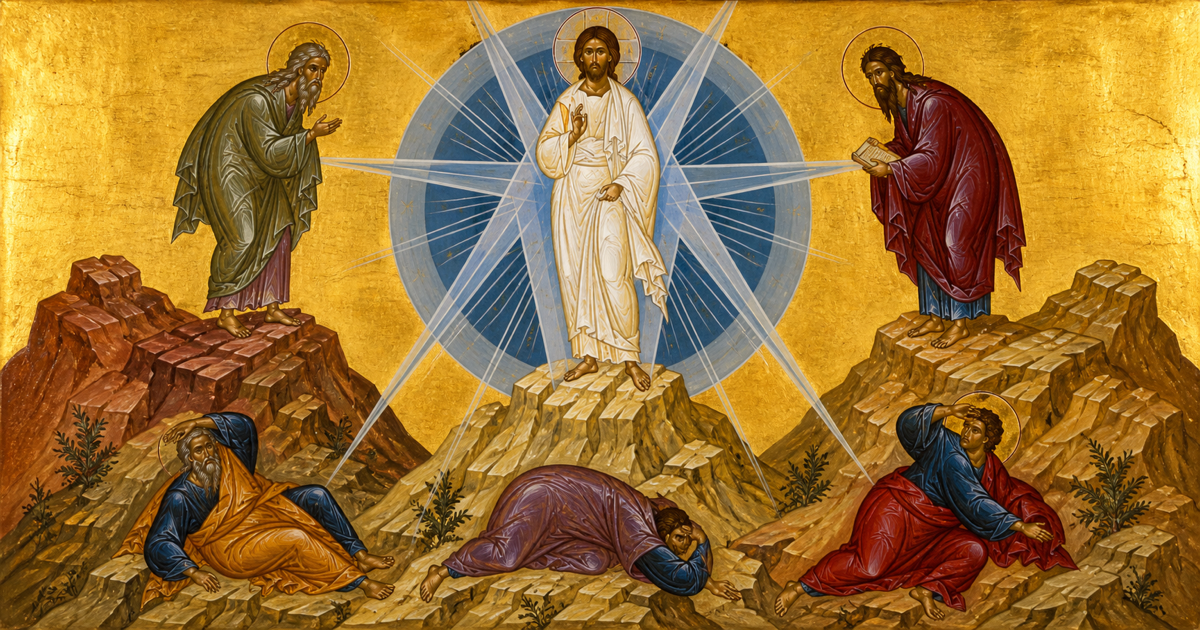
When we speak of a fast lasting forty days, the first names we encounter in Scripture and the interpretations of the Fathers are Moses, Elijah and Christ. In each case, we find the same span of forty days and forty nights, yet the circumstances and purpose of the fast differ.
Moses and Elijah endured this ascetic struggle through the strength God gave them. Moses received the Law and prayed for the forgiveness of the people, while Elijah reached Horeb, where God spoke to him and showed him what he was to do next. Christ, the incarnate Son of God, fasted without needing to be cleansed of sin and overcame the devil’s temptations for our salvation.
Moses fasted twice for forty days
“When I went up the mountain to receive the tablets of stone, the tablets of the covenant, I remained on the mountain forty days and forty nights; I neither ate bread nor drank water” (Deuteronomy 9:9). Moses is recalling his first forty-day stay on the mountain, which is also described in Exodus (24:18).
When he came down with the tablets of the covenant, he found the people worshipping the golden calf. He broke the tablets and then prayed for those who had sinned: “I fell down before the Lord a second time, as at the first, for forty days and forty nights, neither eating bread nor drinking water, because of all the sins you had committed” (Deuteronomy 9:18).
The two fasts arose from different circumstances. During the first, Moses received the tablets of the Law. During the second, he interceded for the people who had broken the covenant, asking God to forgive them. God heard his prayer, spared the people and entrusted him once more with the tablets of the covenant. Exodus 34:28 also speaks of this renewal.
In his homily on fasting, Saint Gregory Palamas recalls how closely Moses drew near to God: he spoke with Him face to face, as a man speaks with his friend. Fasting thus appears alongside prayer, the reception of God’s word and concern for the salvation of others.
Elijah travelled for forty days to Horeb
The Prophet Elijah was fleeing from Jezebel, who had resolved to kill him. Having reached the wilderness, he sat beneath a broom tree and, overwhelmed by suffering, wished to die. An angel woke him and gave him bread baked on hot stones and water. After Elijah fell asleep again, the angel woke him a second time and urged him to eat, for the journey ahead was long.
“Elijah arose, ate and drank, and went in the strength of that food forty days and forty nights to Horeb, the mountain of God” (3 Kingdoms 19:8; 1 Kings 19:8 in most English Bibles).
Scripture says that Elijah travelled for forty days, sustained by the food he had received through the angel. The word “fast” does not appear in this verse, but the Fathers understand the prophet’s struggle during this journey as a fast.
Saint Gregory Palamas explains that, after this fasting, Elijah encountered God on the mountain in the still small voice. In his interpretation, he connects this encounter with the strength the prophet received to continue his ministry, the calling of a successor and his being taken up from the earth. These belong, however, to different moments in Elijah’s life. At Horeb, God strengthens him and sends him back to the work he is to fulfil. Saint Gregory Palamas, Homily VI, on fasting.
Why the Saviour fasted for forty days
After His Baptism in the Jordan, when the Father’s voice bore witness to Him as the beloved Son and the Holy Spirit descended upon Him, the Saviour went into the wilderness. There He spent forty days, being tempted by the devil.
“After fasting forty days and forty nights, He was hungry” (Matthew 4:2). Saint Luke specifies that He ate nothing during those days, while Saint Mark records that He was with the wild beasts and that the angels ministered to Him.
Christ fasts according to the human nature He truly assumed. He had no sins to be cleansed of and no sinful passions to overcome within Himself. Yet He willingly accepted hunger and trial, working for our salvation.
Saint John Chrysostom sees a lesson for the baptised in the fact that the temptation follows Baptism: receiving grace does not mean that trials have ceased. We are called to guard the gift we have received and to remain steadfast in faith.
The same Father also explains why the Saviour kept to the forty days known from the lives of Moses and Elijah. Had He fasted longer, this might have given rise to doubt that He had truly assumed human nature. Through the hunger He accepted at the end of His fast, He shows that His body is real and that He shares the natural needs of human beings. Saint John Chrysostom, Homily XIII on Matthew.
The forty days recall Israel’s trial in the wilderness
The Saviour’s answers to the devil are taken from Deuteronomy, the book in which Moses reminds the people of the trials they had endured in the wilderness and calls them to obey God.
In Deuteronomy 8, the forty years are presented as a time in which what lay in the people’s hearts was revealed, along with whether they would keep the commandments. Hunger and the gift of manna were meant to teach them that human life depends on God, who gives both bread and the strength to live.
It is from this very passage that Christ answers the suggestion that He turn stones into bread: “Man shall not live by bread alone.”
Read together, these passages help us see a connection between the Saviour’s forty days and Israel’s forty years in the wilderness. In His trial, Christ remains wholly obedient to the Father and fulfils what the people had been called to learn during their journey.
Christ conquers where Adam had fallen
Saint Irenaeus of Lyons connects the Saviour’s temptation with Adam’s fall. In Paradise, man had food in abundance, yet accepted the serpent’s suggestion and broke God’s commandment. In the wilderness, Christ is hungry, yet refuses the devil’s suggestion and remains obedient.
Through this comparison, Saint Irenaeus shows that the Son of God came to raise up fallen humanity. Having assumed our nature, He confronts the one who had deceived Adam and defeats him. Saint Irenaeus, Against Heresies, V.21.
Saint Cyril of Alexandria says that human nature receives the victory in Christ. The benefit of the Saviour’s fast for us therefore goes beyond an example of self-restraint: He acts as our Saviour, and through union with Him we receive strength to resist sin. Saint Cyril of Alexandria, Sermon XII on Luke.
What the devil sought through the three temptations
In the first temptation, the devil asks the Saviour to turn stones into bread, making this act a proof that He is the Son of God. Hunger is a natural bodily need. The temptation lies in the invitation to obey the devil and perform a miracle at his bidding. Christ rejects this suggestion and answers with the word of God.
In the second temptation, following the order of Saint Matthew’s account, the devil asks Him to throw Himself down from the pinnacle of the temple, invoking the promise of angelic protection. In this way, he tries to turn trust in God into a demand that this protection be demonstrated through a miracle. The Saviour replies that we must not put God to the test.
In the third temptation, the devil promises Him the kingdoms of the world and their glory, asking for worship in return. Christ dismisses him, declaring that worship and service belong to God alone.
In all three, the Saviour remains obedient to the Father. His victory in the wilderness is part of the whole work of salvation, fulfilled through the Cross and Resurrection.
Why precisely forty days?
Saint Gregory the Dialogist asks this question in a homily on the Saviour’s fasting and temptation. His answer begins with a simple connection: ten commandments and four Gospels — ten multiplied by four makes forty.
The Ten Commandments, received by Moses on the mountain, find their fulfilment in the Saviour’s teaching, preserved in the four Gospels. In this interpretation, the number forty connects fasting with the fulfilment of God’s commandments.
This meaning concerns the entire life of the person who fasts. Restraint in eating must be accompanied by a change in conduct: speaking the truth, avoiding injustice, restraining anger, forgiving and loving one’s neighbour. The forty days thus become a time in which we strive to live more fully according to God’s commandments, in the light of the Gospel.
This is the spiritual interpretation offered by Saint Gregory the Dialogist in Homily XVI on the Gospels, §5.
Moses and Elijah appear beside Christ at the Transfiguration
Moses and Elijah also appear beside the Saviour on the mountain of the Transfiguration. Saint Luke says that they spoke with Him about the departure He was to accomplish at Jerusalem, thus directing the disciples’ attention towards His Passion (Luke 9:28–35).
Moses, through whom the Law was given, and Elijah, one of Israel’s great prophets, stand beside Christ as His servants. The Law and the prophets find their fulfilment in the Son of God, and the Father’s voice commands the disciples to listen to Him.
The two men whose forty-day fasts are recalled by the Fathers now bear witness to the Saviour. Their meeting on the mountain helps us to see ascetic struggle in relation to the whole of God’s work for human salvation.
Joachim’s fast, preserved in a writing outside Scripture
Another account of a forty-day fast is found in the Protoevangelium of James. This ancient writing does not form part of Holy Scripture. Some of the traditions it contains are reflected in the liturgical life of the Church, but this does not mean that the entire work is accepted as having scriptural authority.
According to the account, Joachim, the father of the Mother of God, was prevented from presenting his offerings because he had no children. Deeply grieved, he did not return home but went into the wilderness, where he pitched his tent and fasted forty days and forty nights. He had resolved to persevere in prayer until God visited him.
An angel told him that his prayer had been heard and that Anna would bear him a child. Anna had been told that she would conceive and that the fruit of her womb would be spoken of throughout the world.
The account thus connects Joachim’s fast with his persevering prayer and the announcement of the birth of the Mother of God. Protoevangelium of James, chapters 1–4.
How Saint Symeon the Stylite fasted
For Saint Symeon the Stylite, we have the testimony of Theodoret, Bishop of Cyrrhus, a contemporary who knew him and described his ascetic struggles while the saint was still alive.
Symeon wished to spend forty days without food and asked Bassus to seal the door of his cell with clay. Bassus objected, explaining that deliberately endangering one’s life should not be regarded as a virtue. Ten loaves and a jar of water were left in the cell so that Symeon could eat and drink if he needed to.
At the end of the forty days, Bassus entered and found the loaves untouched and the jar full. Symeon, however, was barely breathing and could neither speak nor move. Bassus moistened his mouth with a sponge and brought him the Holy Mysteries. After recovering some strength, the saint took a little food. Theodoret of Cyrrhus, A History of the Monks of Syria, chapter XXVI.
The account preserves both the saint’s ascetic struggle and the care of the man watching over him. The bread and water left in the cell show that life was to be protected even amid such zeal.
How the monks spent Great Lent in the wilderness
The Life of Saint Mary of Egypt, attributed to Saint Sophronius of Jerusalem, describes the practice of a monastery near the Jordan.
At the beginning of Great Lent, the monks attended the Liturgy, received Holy Communion, ate a little of the monastery’s food and asked one another’s forgiveness. After receiving the abbot’s blessing, they set out into the wilderness. One or two brothers remained in the monastery so that the services could continue.
Each took food according to his own capacity: bread, figs, dates or lentils soaked in water. Some took no provisions and lived on the plants they found in the wilderness.
After crossing the Jordan, they went apart from one another so that each could pray in stillness. If they caught sight of another brother, they changed course, respecting his solitude. They returned on Palm Sunday without asking one another how much each had fasted or what ascetic labours he had undertaken. Life of Saint Mary of Egypt.
A similar practice is also recalled in the lives of the fathers of the Judaean wilderness, written by Cyril of Scythopolis. Saint Euthymius the Great withdrew into the wilderness each year, accompanied by Dometian and later also by Saint Sabbas. They left on 14 January and returned on Palm Sunday.
This retreat lasted longer than forty days. It was a custom of certain communities and fathers, not a rule followed by all monks. At its heart were stillness, prayer and repentance, while the amount and kind of food varied from person to person.
Not every period of forty days mentioned in Scripture is a fast
The number forty appears in several places in Scripture, but the circumstances must be distinguished.
At Nineveh, the forty days are the time announced by Jonah before the city’s destruction, according to the text used in the Romanian Synodal Bible. The book does not say that the Ninevites went without food throughout this entire period (Jonah 3:4–10).
Ezekiel lay on his right side for forty days as a sign concerning the house of Judah (Ezekiel 4:6). The spies explored the promised land for forty days, Goliath challenged the army of Israel for forty days, and the rain of the Flood fell for forty days and forty nights. After His Resurrection, the Saviour appeared to His disciples over a period of forty days.
Daniel’s fast should not be counted among forty-day fasts either. He speaks of three weeks during which he abstained from rich food, meat and wine (Daniel 10:2–3).
Each of these passages has its own meaning, which we discover by reading the whole account.
Can everyone undertake such ascetic struggles?
The fasts without food described in the lives of certain saints are exceptional ascetic labours. They do not establish a rule that every Christian should fulfil.
The life of Saint Sabbas shows how necessary care was even for experienced monks. Sabbas had entered the monastery as a child and had many years of ascetic struggle behind him when he accompanied Saint Euthymius into the wilderness. Even so, in a place without water, he collapsed from thirst.
Euthymius went a stone’s throw away, prayed and dug into the ground three times with a piece of wood. Water sprang forth, and Sabbas drank and recovered his strength. The father who had taken him along made sure that his disciple received what he needed to live. Life of Saint Sabbas the Sanctified.
Likewise, the monks near the Jordan set out into the wilderness with different provisions. They shared the same call to repentance, but not the same bodily strength.
Our personal rule of fasting is established with discernment and the guidance of our spiritual father, taking account of our health and responsibilities. Reading the lives of the saints can strengthen our zeal, while obedience helps us direct it towards what is beneficial.
Fasting is fulfilled through repentance and care for our neighbour
Through the Prophet Isaiah, God shows what kind of fast is pleasing to Him: ending injustice, freeing the oppressed, sharing bread with the hungry, welcoming the homeless poor and clothing the naked (Isaiah 58:6–7).
Restraint in eating must bear fruit in the way we treat others. The person who fasts is called to examine his anger, judgement of others, miserliness and the injustices he commits. What is saved through a simpler meal can become help for someone who has nothing to eat.
A season of fasting can pass while the heart remains hardened. Alongside examining how we have observed the rule concerning food, we should therefore ask whom we have forgiven, whose forgiveness we have sought and whose burden we have eased.
Here we also see the meaning of Saint Gregory the Dialogist’s interpretation: fasting finds its purpose in a life lived according to God’s commandments, in the light of the Gospel.
How we observe the forty days in the life of the Church
In Orthodox practice, the forty days of Great Lent are followed by Lazarus Saturday, Palm Sunday and Holy Week. The Nativity Fast also lasts forty days, from 15 November until the eve of the feast.
These periods do not involve going without food continuously. Christians eat according to the fasting rule and their own capacity, accompanying restraint with prayer, repentance and almsgiving.
Saint Gregory the Theologian clearly distinguishes the Saviour’s fast from the way we fast. Christ fasted completely for forty days, while we measure our ascetic effort according to our strength. He also explains that the fast before Pascha prepares us for the feast and expresses our participation in Christ’s death. We are called to renounce sin and live the new life He gives us. Saint Gregory the Theologian, Oration XL, §30.
We thus follow the Saviour’s fast through faith, obedience and self-restraint, asking for His help in the struggle against sin. The forty days give us time to persevere in this work and prepare to meet Him in the joy of the feast.
From the monks who returned from the wilderness without comparing their ascetic labours, we can also keep this lesson: fasting is to be measured before God, not against one another.
Sources
- Holy Scripture: Exodus 24 and 34; Deuteronomy 6, 8 and 9; 3 Kingdoms 19 (1 Kings 19); Matthew 4; Mark 1; Luke 4 and 9; Isaiah 58; Daniel 10; Jonah 3; Ezekiel 4; Genesis 7; Numbers 13–14; 1 Kingdoms 17 (1 Samuel 17); Acts 1.
- Saint John Chrysostom, Homily XIII on the Gospel of Matthew.
- Saint Irenaeus of Lyons, Against Heresies, Book V, chapter 21.
- Saint Cyril of Alexandria, Sermon XII on the Gospel of Luke.
- Saint Gregory the Dialogist, Homily XVI on the Gospels, §5.
- Saint Gregory the Theologian, Oration XL, On Holy Baptism, §30.
- Saint Gregory Palamas, Homily VI, on fasting, in The Homilies, translated by Christopher Veniamin, Mount Thabor Publishing, 2009.
- Protoevangelium of James, chapters 1–4, a non-canonical writing.
- Theodoret of Cyrrhus, A History of the Monks of Syria, chapter XXVI, on Saint Symeon the Stylite.
- Life of Saint Mary of Egypt, attributed to Saint Sophronius of Jerusalem.
- Cyril of Scythopolis, the lives of Saints Euthymius the Great and Sabbas the Sanctified. The Romanian account published by Doxologia was used for the episode of Sabbas’s thirst.