
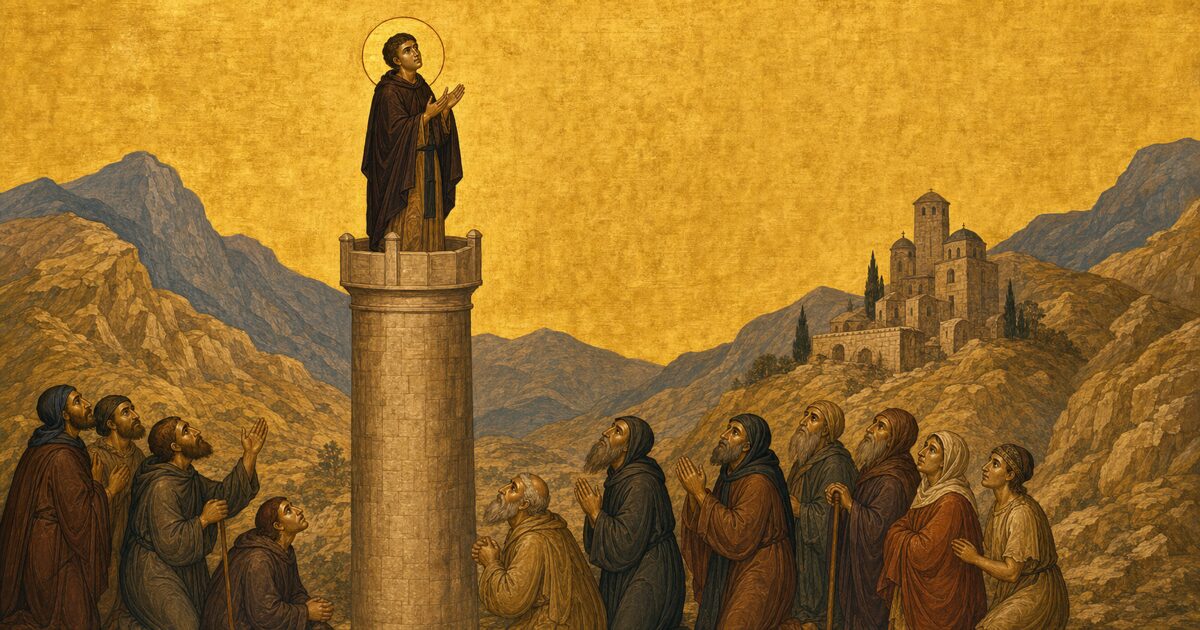
His feast day: May 24
1. A saint who lived on a pillar for sixty-eight years
There exists in the Tradition of the Church an ascetic phenomenon that surpasses the understanding of the modern person: stylitism. Men who, for decades on end, climbed to the top of a stone pillar and never came down again. No shelter. No warm house. No ground beneath their feet. Under the burning Syrian sun and through the freezing nights of winter, standing upright, praying without ceasing.
Saint Simeon of the Wonderful Mountain is one of the greatest stylites of the Church. He climbed the pillar at the age of seven and did not come down until his death at the age of seventy-five. Sixty-eight years on a pillar. We are not dealing with a mere late legend, but with an ancient hagiographic tradition, transmitted through The Life of the Saint, preserved in Greek manuscripts and critically edited in the twentieth century by the Belgian scholar Paul van den Ven, and confirmed by his uninterrupted veneration over fourteen centuries.
His title “of the Wonderful Mountain” distinguishes him from Saint Simeon the Stylite the Elder, who had lived more than a century earlier near Antioch. The Younger — or “the New” as the Greeks call him (ho neóteros) — established his ascetic struggle on a mountain in the vicinity of Antioch, in what is now the Hatay region of Turkey, not far from the town of Samandağ. The locals called this mountain Thaumastón Oros, the Wonderful Mountain, because of the miracles the Saint worked there.
2. Antioch, the earthquake, and the child who spoke with angels
Saint Simeon was born in the year 521 in Antioch of Syria, a city which at that time was the third metropolis of the Roman Empire, after Constantinople and Alexandria. After the great earthquake of 528, Antioch would come to be called Theopolis — “the City of God” — a name found in Byzantine texts and on the seals of the Antiochian patriarchs. The Saint’s father, John, was originally from Edessa of Mesopotamia and had come to Antioch together with his parents, who practiced the craft of aromatics — that is, they were merchants of spices and perfumes. His mother, Martha — also commemorated as a saint, on July 4 — was a native of Antioch.
Martha had not wished to marry. From her youth she had longed for the monastic life, “having heard the exhortation of the Holy Scriptures, that the bodies of virgins should be presented pure to the Lord.” But her parents insisted that she marry John. Considering that she ought not to oppose those who had given her life, in accordance with the commandment “Honor your father and your mother” (Exodus 20:12), Martha ran to the church of Saint John the Forerunner, before the gates of Antioch, and there, shedding many tears, she prayed for divine guidance. Saint John the Forerunner appeared to her and promised that she would bear a son who would serve God.
The child born to her was named Simeon. He was baptized at the age of two, a fact which shows that in sixth-century Syria the practice of infant baptism could take forms and timings different from the rite that became more widely standardized later.
When Simeon was six years old, in the year 526, a catastrophic earthquake struck Antioch. The earth opened, churches collapsed, thousands of people perished beneath the ruins. Among them was the Saint’s father. Byzantine chroniclers speak of a vast number of dead, sometimes reaching figures of over two hundred and fifty thousand — a number which above all expresses the magnitude of the catastrophe, one of the greatest of late antiquity.
Simeon was in church at the moment of the earthquake. He survived, but on leaving the church he became lost. For seven days he was sheltered by a pious woman. The Old Life tells us that Saint John the Baptist himself appeared to Martha and revealed to her where her child was.
After the earthquake, Martha moved with her son to the outskirts of Antioch. And there, the hagiographer tells us, the Lord Jesus Christ appeared to the child Simeon on several occasions, revealing to him the ascetic labors that lay ahead and their reward.
Martha herself had received, even earlier, the assurance of her son’s calling. The Life of Blessed Martha witnesses that, falling asleep, she saw herself “as if winged and lifted to a great height, holding the child and offering him as a gift to the Lord,” saying to the infant: “Your ascent I have waited to behold, my son, that the Lord might release me His handmaid in peace, for I have found grace with God to offer the pains of my childbearing to the Lord.” The word ascent — in ancient Greek a single term meaning both “elevation” and “climbing up” — is a hidden prophecy of her son’s future stylitism.
3. Climbing the pillar at seven years old
At six years of age, Simeon went out into the wilderness. This was his first ascetic struggle, in complete solitude. The Old Life witnesses that a radiant angel watched over him and fed him during that time. Then he came to a monastery led by Abba John the Stylite, who himself lived on a pillar and who received the child with love.
After a while, Simeon asked Abba John for his blessing to also struggle on a pillar. The brothers of the monastery erected a new pillar, next to that of the elder. Abba John himself raised the seven-year-old child onto the pillar, after first tonsuring him as a monk.
Here we must pause. A child of seven years. Raised onto a pillar. Not for a day. Not for a year. For his entire life.
Today, we rush either to find words of explanation, or, on the contrary, of rejection. How could the Church have permitted such a thing? What normal parent would accept this? First of all, we must understand two things.
First, Saint Simeon was not forced. The Lord had spoken to him from infancy. Abba John did not compel him; on the contrary, he received him because he discerned grace resting upon him.
Second, Tradition states clearly: the child, strengthened by the Lord, was growing in spiritual stature so rapidly that he surpassed even his own experienced teacher. This is not the natural child, but the new man, in whom the gift of God overcomes the limits of nature. For this childhood struggle, Saint Simeon received from God the gift of healing.
At the age of eleven, Simeon resolved to ascend an even higher pillar, whose top was about twelve meters above the ground. The bishops of Antioch and Seleucia came to the place of the child’s ascetic struggle and ordained him a deacon. Then they allowed him to climb the new pillar, on which he struggled for eight years.
4. The Wonderful Mountain: the pillar as unceasing crucifixion
At the age of twenty — around the year 541 — Saint Simeon moved to the mountain later called Thaumastón Oros, the Wonderful Mountain. This move was necessary because his fame attracted immense crowds of pilgrims, and quiet contemplation had become impossible.
On the Wonderful Mountain he built a third pillar, higher than the previous ones. Around it a monastic community gathered, and those whom he healed built a church in gratitude for the mercy of God. Thus came into being the great monastic complex of the Wonderful Mountain, whose ruins can still be seen today in the Hatay province of Turkey, near the town of Antakya.
Stylitism must not be regarded as an ascetic eccentricity. It is, in the understanding of the Fathers, a supreme form of inner crucifixion. The stylite stands day and night. He sleeps very little, leaning upright. He does not sit down. He does not move. His body becomes, little by little, the perfect servant of the spirit. And his mind, freed from the ceaseless movements of the body, ascends in pure prayer.
The pillar is the altar on which the stylite continuously offers his body to God as sacrifice. It is a continuation of the Cross in the life of the monk. It is a public witness, seen by all, of what it means “to hate one’s soul in this world” (John 12:25).
For this reason, the Church has always honored the stylites with a special veneration. The Saint’s service calls him “pillar of patience” — not only because he stood upon a pillar, but because he embodied Christian patience itself. The pillar is an icon of patience.
5. Those who came before him: a synthesis of the Church’s stylites
To understand fully the ascetic struggle of Saint Simeon, we must place him within the chain of Tradition to which he himself belonged. The Saint did not invent stylitism. He inherited it, embraced it as a child, and brought it to fulfillment. Who were those who came before him?
Saint Simeon the Stylite the Elder — the founder
At the heart of any discussion of stylitism stands the towering figure of Saint Simeon the Stylite the Elder (c. 390–459, commemorated on September 1). He was the first. Before him, no one had ever climbed onto a pillar to spend his life there. The desert had its hermits. The monasteries had their cenobites. The mountains and caves had their hesychasts. But the pillar was something entirely new.
Of him we have the direct patristic witness of Saint Theodoret of Cyrus (c. 393–c. 458), bishop and hagiographer, who knew Saint Simeon personally, visited him on his pillar several times, and wrote his life while the Saint was still living, around the year 444 A.D. — sixteen years before his repose. This biography is chapter 26 of The Religious History (Φιλόθεος Ἱστορία), Saint Theodoret’s hagiographical work on the fathers of the Syrian desert. Saint Theodoret presents himself as an eyewitness and testifies that he recounts from the lips of Saint Simeon himself: “I heard his sacred tongue recount this.”
How the ascetic struggle began: the interior chain of the calling
Saint Theodoret tells us that Saint Simeon was born in a village called Sisa (today Sis in Cilicia, on the border between the region of Cyrrhus and Cilicia), the son of a shepherd. His parents taught him “first to shepherd animals, so that in this respect too he might be comparable to those great men: the patriarch Jacob, the chaste Joseph, the lawgiver Moses, the king and prophet David, the prophet Micah, and the inspired men of their kind.” Saint Theodoret thus places Simeon within the biblical chain of shepherds chosen by God. Obedience before asceticism.
The calling came through the Beatitudes. On a winter day, when snow prevented the sheep from being led out to pasture, the child Simeon went with his parents to church. There, Saint Theodoret tells us from the Saint’s own mouth, “he heard the Gospel utterance which declares blessed those who weep and mourn, calls wretched those who laugh, terms enviable those who possess a pure soul, and all the other blessings conjoined with them.” He then asked one of those present what one should do to obtain each of these, and that person pointed out to him the solitary life, “that consummate philosophy.”
Then came the prophetic dream. The Saint ran to a shrine of the holy martyrs, bent his knees and forehead to the ground, and after long prayer received a dream which Saint Theodoret records verbatim:
“‘I seemed,’ he said, ‘to be digging foundations, and then hear someone standing by say that I had to make the trench deeper. After adding to its depth as he told me, I again tried to take a rest; but once more he ordered me to dig and not relax my efforts. After charging me a third and a fourth time to do this, he finally said the depth was sufficient, and told me to build effortlessly from now on, since the effort had abated and the building would be effortless.’” (Religious History, 26.3)
Saint Theodoret comments: “This prediction is confirmed by the event, for the facts surpass nature.” The hidden meaning of the dream is revealed later: the deep foundation of inner humility makes possible the lofty ascent of the pillar.
The years at Tell ʿAda. He first spent two years with some ascetics in the neighborhood. Then he came to the monastery of Teleda (Tell ʿAda), where he contended for ten years. He had eighty fellow contestants, and outshone them all: “while the others took food every other day, he would last the whole week without nourishment.” Saint Theodoret recounts from the direct testimony of the next superior of the monastery how the young Simeon girded his loins with a rough palm-rope which lacerated his flesh to the point of blood, for ten days, without telling anyone. For this extreme asceticism, the brothers asked him to leave, “lest he should be a cause of harm to those with a weaker bodily constitution who might try to emulate what was beyond their powers.”
The forty-day fast at Telanissos. The Saint then moved to Telanissos (today Deir Sem’an, in northern Syria), where he lived three years as a recluse in a small cottage. There, for the first time, he undertook the fast of forty days without food, after the manner of Moses and Elijah. He asked Father Bassus to seal him in his cell with mud, leaving him only ten rolls and a jar of water “if I see my body needs nourishment.” After forty days, Bassus opened: the rolls intact, the water untouched, Saint Simeon stretched out without breath, unable to speak or move. Only after he had received the Holy Mysteries did he rise. This forty-day fast became, from that time on, his annual practice. “From that time till today — twenty-eight years have passed — he spends the forty days without food,” writes Saint Theodoret around 444.
The iron chain. He then ascended “that celebrated hill-top” — the same on which his pillar would later stand. He ordered a circular enclosure to be made, procured an iron chain of twenty cubits, nailed one end to a great rock, and fastened the other to his right foot. But the blessed Meletius, then overseer of the territory of Antioch, told him that the iron was superfluous, since the will was sufficient to impose on the body the bonds of reasoning. Saint Simeon obediently submitted, and the chain was severed. Beneath the piece of leather that had been tied to his leg to prevent the iron from injuring his flesh, “people saw, they said, more than twenty large bugs lurking in it” — which the Saint had endured without complaint, though he could easily have crushed them with his hand.
The ascent to the pillar: the direct cause
Here Saint Theodoret describes the exact moment of the birth of stylitism. The cause was not a personal inclination toward originality, but the need to preserve his stillness amid the crowd. Pilgrims came from all sides; all tried to touch him and to obtain some blessing from his garments of skins. Here is Saint Theodoret’s witness:
“Since the visitors were beyond counting and they all tried to touch him and reap some blessing from his garments of skins, […] he devised the standing on a pillar, ordering the cutting of a pillar first of six cubits, then of twelve, afterwards of twenty-two and now of thirty-six — for he yearns to fly up to heaven and to be separated from this life on earth.” (Religious History, 26.12)
This sentence, written while Saint Simeon was still living on his pillar, gives us the exact heights of the four successive pillars: approximately 3 meters, then 6 meters, then 11 meters, and finally about 18 meters.
The theological apology for stylitism — Saint Theodoret’s answer to critics
Here is found, in patristic witness, the full answer to the question “how is such a thing permitted?” — a question which to this day the natural mind poses to any extreme ascetic struggle. Saint Theodoret knows these critiques. And he answers them with a theological apology of astonishing depth.
The first argument: stylitism is divine economy.
“I myself do not think that this standing has occurred without the dispensation of God, and because of this I ask fault-finders to curb their tongue and not to let it be carried away at random.” (Religious History, 26.12)
The second argument: the biblical parallel of the prophets. Saint Theodoret enumerates with striking boldness the unusual works that God Himself commanded the prophets of the Old Covenant:
“Consider how often the Master has contrived such things for the benefit of the more easygoing. He ordered Isaiah to walk naked and barefoot, Jeremiah to put a loincloth on his waist and by this means address prophecy to the unbelieving, and on another occasion to put a wooden collar on his neck and later an iron one, Hosea to take a harlot to wife and again to love a woman immoral and adulterous, Ezekiel to lie on his right side for forty days and on his left for one hundred and fifty, and again to dig through a wall and slip out in flight, making himself a representation of captivity.” (Religious History, 26.12)
The third argument: why God ordained these works. Saint Theodoret answers with a single sentence which, in Tradition, will become the foundation of monastic hagiography:
“The Ruler of the universe ordered each of these things to be done in order to attract, by the singularity of the spectacle, those who would not heed words and could not bear hearing prophecy, and make them listen to the oracles. […] So too he has ordained this new and singular sight in order by its strangeness to draw all men to look, and to make the proffered exhortation persuasive to those who come — for the novelty of the sight is a trustworthy pledge of the teaching, and the man who comes to look departs instructed in divine things.” (Religious History, 26.12)
The fourth argument: the pillar as “a new coin of the heavenly King.” With this image, Saint Theodoret concludes his apology:
“Just as those who have obtained kingship over men alter periodically the images on their coins, at one time striking representations of lions, at another of stars and angels, […] so the universal Sovereign of all things, by attaching to piety like coin-types these new and various modes of life, stirs to eulogy the tongues not only of those nurtured in the faith but also of those afflicted by lack of faith.” (Religious History, 26.12)
The pillar, therefore, is a new coin of the heavenly King. The same true faith, but struck in a new form, so that it may be seen by those who no longer hear the simple words.
The fruits of stylitism: conversion, preaching, endurance
Saint Theodoret describes the fruits of this ascetic struggle with vigorous words. The conversion of the Ishmaelites: “This dazzling lamp, as if placed on a lampstand, has sent out rays in all directions, like the sun. […] The Ishmaelites, arriving in companies, two or three hundred at the same time, sometimes even a thousand, disown with shouts their ancestral imposture” (26.13). Saint Theodoret himself was an eyewitness when the crowd of Ishmaelites, rushing forward to receive blessing, pulled at his beard and clothing — and the Saint dispersed them with a single shout.
Daily preaching: “He has received from the munificent Master the gift also of teaching. Making exhortation two times each day, he floods the ears of his hearers, as he speaks most gracefully and offers the lessons of the divine Spirit, bidding them look up to heaven and take flight, depart from the earth, imagine the expected kingdom, fear the threat of hell” (26.25).
Perfect endurance: Saint Theodoret admires him above all for his endurance. “More than all this I myself admire his endurance. Night and day he is standing within view of all; […] now standing for a long time, and now bending down repeatedly and offering worship to God. Many of those standing by count the number of these acts of worship. Once one of those with me counted one thousand two hundred and forty-four of them, before slackening and giving up count” (26.22).
The wound on his foot. Saint Theodoret records that, as a result of his prolonged standing, a malignant ulcer developed on the Saint’s left foot, with pus continually oozing from it. “Nevertheless, none of these afflictions has overcome his philosophy, but he bears them all nobly, both the voluntary and the involuntary” (26.23).
Defense of the Church: The Saint on his pillar was not distant from the sufferings of the Church. “He does not neglect care of the holy churches — now fighting pagan impiety, now defeating the insolence of the Jews, at other times scattering the bands of the heretics, sometimes sending instructions on these matters to the emperor, at other times rousing the governors to divine zeal” (26.27).
Universal fame
Saint Theodoret seals the entire biography with the witness of universal fame which he places at the very opening of chapter 26:
“The famous Symeon, the great wonder of the world (τὸ μέγα θαῦμα τῆς οἰκουμένης), is known of by all the subjects of the Roman empire and has also been heard of by the Persians, the Medes, the Ethiopians; and the rapid spread of his fame as far as the nomadic Scythians has taught his love of labor and his philosophy. I myself, though having all men, so to speak, as witnesses of his contests that beggar description, am afraid that the narrative may seem to posterity to be a myth totally devoid of truth. For the facts surpass human nature.” (Religious History, 26.1)
This acknowledgement by Saint Theodoret is of a rare honesty: even a contemporary bishop, an eyewitness of the ascetic struggle, understands that the Saint’s deeds surpass natural understanding. This is, indeed, the witness of every historian of authentic sanctity: humility before the wonder.
Repose and inheritance
To Saint Simeon the Elder came emperors (Theodosius II, Leo I, Marcian), patriarchs, bishops, ascetics from Egypt and Palestine. Pilgrims came from Gaul, Britain, Persia, Ethiopia. He firmly supported the Fourth Ecumenical Council of Chalcedon (451) against the Monophysites, writing epistles to the emperors from the top of his pillar.
He fell asleep standing, in prayer, on September 2, 459, at about sixty-nine years of age, after thirty-seven years on the pillar. A disciple climbed the pillar and found him bowed down, as if in worship. Patriarch Martyrius of Antioch presided over the funeral, in the presence of thousands of the faithful. Around his pillar arose the great basilical complex of Qal’at Sim’an — in the fifth and sixth centuries the most impressive Christian structure in the East, before Hagia Sophia. Its majestic ruins survive to this day in northern Syria.
In the year 467, at the request of Saint Daniel the Stylite, the Emperor Leo I transferred a portion of the holy relics of Saint Simeon the Elder to Constantinople. The other portion remained in Antioch, until the Arab conquest.
The chain of stylites — from Saint Simeon the Elder to Saint Simeon the Younger
After the repose of the Elder, the model spread with astonishing rapidity. Here are the most important successors, down to the time of Saint Simeon the Younger:
Saint Daniel the Stylite (409–493, commemorated on December 11) is the second great stylite of the Church. Born in Mesopotamia, he visited Saint Simeon the Elder in his youth and received his blessing. After the Elder’s death, the monastic mantle (cuculla) of the Saint was given to Daniel — a sign of direct continuity. He then climbed a pillar near Constantinople, where he struggled for thirty-three years. The Emperors Leo I and Zeno sought his counsel. He defended Orthodoxy against the Monophysite heresy of the usurper Basiliscus. He fell asleep on December 11, 493.
Abba John the Stylite is the direct link between the Syrian stylite Tradition and Saint Simeon the Younger. He is not well known in the liturgical calendar — the sources about him are brief — but The Old Life of Saint Simeon the Younger itself names him clearly as a stylite. He was the abbot of the monastery where the six-year-old child Simeon was received. Abba John himself lived on a pillar; next to his pillar was raised the small pillar of the child Simeon. The importance of John for the history of stylitism is this: he proves that, sixty to seventy years after Saint Simeon the Elder, in the mountains of Syria there were already entire monastic settlements founded upon this way of life. The Tradition was being transmitted through chains of disciples, not merely by imitation.
Saint Simeon the Stylite III is another Syrian stylite from the end of the fifth century, venerated by both the Orthodox and the Coptic Churches. Little information about him has been preserved. He struggled on a pillar near Hegea, in Cilicia, and was struck by lightning on his pillar — an event interpreted by Tradition as a sign of his calling toward heaven.
There were many others, whose names have not been fully preserved, but who are attested by Saint Theodoret and the Syrian hagiographers: stylites at Hierapolis, at Edessa, in the desert of Antioch, in Palestine. By the sixth century, when Saint Simeon the Younger was born, stylitism was a recognized and venerated form of monasticism, with nearly a century of tradition behind it.
The direct model: the chain that reaches him
Therefore, Saint Simeon the Younger did not climb the pillar as an isolated pioneer. He was born into a world in which the figure of the stylite was deeply impressed upon the consciousness of the Church. His mother, Martha, had given him the name Simeon precisely out of zeal for the Elder. Abba John, his first abbot, was himself a stylite, a direct heir of the Elder’s Tradition.
Moreover, the place of struggle of the two Simeons is in the same region. The pillar of Saint Simeon the Elder stood near Telanissos, in northern Syria. The pillar of Saint Simeon the Younger stood on the Wonderful Mountain, in the vicinity of Antioch. The same geography of Antiochian Syria. The same Syriac language. The same villages. The same bishops. The same patriarchal see of Antioch. Saint Simeon the Younger was, geographically and spiritually, the son of Simeon the Elder.
What he inherited and what he added
From Saint Simeon the Elder, the Younger inherited:
- the form of life — the pillar as altar of daily crucifixion;
- openness toward pilgrims — the sanctification of the world from the height of the pillar;
- the bond with the hierarchy — ordination received upon the pillar, episcopal service at its base;
- the gift of healing — sign of grace resting upon the stylite;
- authority in the life of the Church — a word heeded by emperors and patriarchs.
To all of these, Saint Simeon the Younger added two things of his own:
- Duration — sixty-eight years on the pillar, nearly double the Elder’s struggle. He climbed at seven and never came down. No one, before him or after him, has equaled this duration.
- The written word — Saint Simeon the Elder left no homilies of his own. His words have been preserved only through Theodoret, Antonius, and the Syriac Life. But Saint Simeon the Younger left Ascetical Discourses, a homiletic corpus of his own, becoming thus the only stylite who theologized, through writing, about stylitism itself.
For this reason, the Tradition of the Church honors them both as two pillars of Christian stylitism: the Elder — as founder; the Younger — as the one who perfected the gift through the word. Stylitism is born through the first, but through the second receives its full theological witness.
This connection is not a pious supposition. The great critical editor of The Old Life, the Belgian scholar Paul van den Ven, devotes an entire subchapter of his introductory study precisely to the question: “Did Simeon the Younger imitate Simeon the Elder?” (chapter 4, section E). The answer, traced through the analysis of textual, geographical, and ascetic parallels, is: yes — but not through external imitation, rather through a continuity of spirit, recognized and consciously assumed by the Saint’s hagiographer. The model of Simeon the Elder is internal to the text of The Old Life, not imposed from outside.
6. The descent of the Holy Spirit and the gift of the word
Saint Simeon prayed fervently for the descent of the Holy Spirit upon him. And The Old Life tells us: the Saint’s prayer was heard. The Holy Spirit descended upon him in the form of a radiant light, filling him with divine wisdom.
From this moment, Saint Simeon began to speak. His word flowed like a river, fed from the wellspring of the Spirit. The Ascetical Discourses that have been preserved — thirty in number — are the witness of this gift.
The volume has been translated into Romanian by Laura Enache and published in 2013 by the Doxologia Press, in the collection Life in Christ. Pages of Philokalia, edited by Fr. Dragoș Bahrim. It is among the first integral modern translations of these homilies, and in any case the first integral Romanian translation. These Ascetical Discourses treat of repentance, of monasticism, of the Incarnation of Christ, and of the coming Judgment. They are akin, in their depth, to the homilies of Saint Macarius of Egypt and those of Saint Mark the Ascetic, but they have their own distinctive feature: they are spoken from the pillar, to disciples and pilgrims, with an authority that comes directly from spiritual vision.
7. The toll-houses of the air: a homily delivered at the age of seventeen
One of the most astonishing homilies of Saint Simeon is Discourse XXII, delivered from the pillar at the age of seventeen. Its subject is the soul’s departure from the body and the toll-houses of the air — a teaching which the Saint does not expound speculatively, but bears witness to from his own experience of spiritual visions.
Here is a verbatim patristic fragment, preserved in the Ascetical Discourses:
“The soul is seized and drawn out of the body, as one would draw embers out of a hearth. Then the soul is filled with fear, going forth together with the angels that are with it in the air, with the devil and the demons that are with it, like a fierce toll-collector who hinders the souls of sinners from being borne unharmed by the angels of light toward the majesty of the heavens.” (Discourse XXII, 1)
And further on, concerning the rarity of souls that are saved in the last times:
“In the present times, out of ten thousand souls, scarcely one is found who reaches the hands of the angels.” (Discourse XXII, 2)
This statement — made in the sixth century — is of a gravity that shakes the conscience. In the ascetic language of the Fathers, such words are not statistics of salvation, but cries of wakefulness. They must not be read as a verdict of despair, but as a call to attentiveness. Saint Simeon does not speak in order to discourage us, but in order to awaken us. And the homily ends with an exhortation to ascetic struggle and prayer, with the hope of the resurrection, and with the vision of the Kingdom: “The Kingdom of heaven is within you” (Luke 17:21), the Saint quotes in conclusion.
8. Stylitism as a form of the angelic life
The troparion of Saint Simeon, chanted in his service, begins with the words: “Dweller of the desert and angel in the body and wonder-worker you were shown to be, our God-bearing Father Simeon.”
“Angel in the body” — ángelos en sómati. This is the Byzantine formula for perfected stylitism. The stylite becomes, through long ascetic struggle, a man whose body no longer drags him downward, but rises together with the spirit. He imitates the way of life of the bodiless angels, while still being in the body.
In the kontakion of the service it is sung thus:
“Yearning for the things on high, leaving the things below, you made the pillar a heaven for yourself, through which you received the radiance of miracles, O Venerable Simeon. And now, praying together with the angels of Christ, intercede unceasingly for us all.” (Kontakion, Tone 2)
This image — the pillar as a heaven made for oneself — expresses the profound theology of stylitism. The stylite does not simply flee the world into a geographical desert. He remains seen by the world, but he no longer lives according to its logic. Not on the horizontal, but on the vertical. The pillar becomes a ladder of prayer: the earth remains below, heaven opens above, and the man stands between them as a living sacrifice.
Saint Simeon received the gift of foresight. According to The Old Life, God worked through him healings, exorcisms, mysterious visions of the hearts of men, and even raisings from the dead. His best-known miracle, witnessed by the hagiographer, is the raising of his beloved disciple Conon (chapter 129). With boldness toward Christ, the Saint asks the Lord to restore Conon’s life, as He had raised Lazarus.
These miracles did not remain on the Wonderful Mountain. Pilgrims from all over the East came to receive blessings. Medallions bearing the Saint’s image — discovered archaeologically in many places in Syria, Egypt, and Asia Minor — were offered to pilgrims as blessings, and through them too miracles were wrought.
In the year 540, when Khosrow I of the Persians besieged and conquered Antioch, Saint Simeon, who was then nineteen years old, was forewarned of the disaster in a vision. Two of his disciples, fearing the coming of the barbarians, abandoned him. One was beheaded by the Persians. The other was taken prisoner. And the invaders who approached the Saint’s monastery were driven away only through his prayer.
In the year 560, at the age of thirty-nine, Saint Simeon was ordained a priest by Bishop Dionysius of Seleucia, who climbed up to him on the pillar for the ordination. From that time on, the Saint celebrated the Divine Liturgy on the pillar.
9. His repose and inheritance: the Saint’s head at the Monastery of Neamț
At the age of seventy-five, Saint Simeon was forewarned by the Lord of the nearness of his end. He summoned the brothers of the monastery, spoke to them his final word, and fell asleep in peace in the Lord toward the end of the sixth century — tradition giving the years 592 or 596, according to the chronologies used by different sources. He had labored on the pillar for sixty-eight years.
After his repose, The Old Life witnesses that the miracles continued. His holy relics worked the same healings that the Saint had worked in his lifetime: healings of the blind, the lame, the leprous, exorcisms of demons, and even raisings from the dead.
In Romania a spiritual treasure is preserved: the honored head of Saint Simeon of the Wonderful Mountain. It has rested for more than five hundred years at the Monastery of Neamț, in the narthex of the great church.
How it came there is not known with full certainty. The historian Petre Năsturel, who studied the documents, supposes that it may have been a family heirloom of the ruler Stephen the Great, received from his father Bogdan II. What is certain is that in the year 1463, Saint Voivode Stephen the Great commanded that a golden crown be made for the Saint’s head. On the crown is inscribed in Old Church Slavonic: “Relics of Saint Simeon of the Wonderful Mountain. Adorned by John Stephen Voivode in the year 6971.” This inscription is regarded by historians as the oldest surviving inscription from Stephen the Great.
Tradition links the gift of the honored head to the Monastery of Neamț with the Saint Voivode and with his monastic foundation there. The old crown, given by Stephen, is preserved today separately, as a precious heirloom, after the replacement of the old reliquary.
This is the working of Providence: a Syrian saint of the sixth century, who never came down from his pillar on the Wonderful Mountain, came through the care of an Orthodox ruler to rest in Moldavian soil, comforting for centuries on end the people who venerate him.
10. How was it possible? And how do we climb the pillar today
We return to the question of the beginning: how was it possible to stand day and night on a pillar, for sixty-eight years?
The answer of Tradition is not a psychological one. It does not have to do with iron will, nor with extraordinary bodily endurance. Saint Simeon was not an athlete of asceticism. He was a man full of grace.
The short answer is: through the Holy Spirit. The body, left to itself, cannot. The body, indwelt by the Spirit, can do all things. “I can do all things through Christ who strengthens me” (Philippians 4:13), says the Apostle Paul. And Saint Simeon did not climb alone. He climbed with Christ.
The longer answer — which all the Fathers bear witness to — has three parts. First, the calling. The Saint did not choose his ascetic struggle; he received it, from infancy, through divine revelation. The Lord Himself appeared to him. Saint John the Baptist had foretold it to Martha. It is not a human project, but a divine calling. Second, obedience. The Saint did not ascend on his own. He received the blessing of Abba John, of the bishops, of the Church. He ascended under obedience. Third, grace. The descent of the Holy Spirit upon him, as radiant light, was what made him capable of the ascetic struggle. He did not climb the pillar. Christ raised him onto it.
Here is the door for us.
Our age is the age of ceaseless motion. The age of sleepless nights before screens. The age of the scattered mind. The age in which to stand still — even for half an hour — seems impossible.
Saint Simeon stands on the pillar for sixty-eight years. He does not move. He does not speak unless the Spirit bids him speak. He eats very little. And yet — or rather, for this very reason — he is one of the most powerful saints of the Church, gifted with visions and healings, bearing witness to the very mystery of the angelic life in the body.
Here is the teaching: man becomes strong through stillness, not through agitation. He becomes enlightened through silence, not through a multitude of words. He becomes a spiritual seer through inner immobility, not through the search for new sensations.
Our pillar is not made of stone. It is made of time. It is made of silence. It is made of obedience. Our pillar is the place we determine for our meeting with Christ — and which we do not abandon. A corner of the house where we stand in prayer. An hour of the day when our hands no longer hold the phone. An inner silence in which we hear, if only for a moment, the voice of the Lord.
Saint Simeon cries out to us, across fourteen centuries: climb. Not onto a pillar of stone. Onto your pillar. Onto your place of struggle. And do not come down. Stand. Stand in prayer. Stand in fasting. Stand in stillness. Stand with Christ.
For if you remain there, the Spirit comes. And what was impossible to nature becomes possible through grace. This is the full answer to the question “how was it possible?”: through grace. And grace did not cease with the Saint’s end. It flows on still, in every heart that climbs its pillar and does not come down.
The ten thousand souls of whom the Saint speaks, of whom scarcely one reaches the hands of the angels, are not a comforting prophecy. But neither are they one that should throw us into despair. They are a call to wakefulness. They are the Saint’s summons to us, that we not waste the time of our lives in vanity.
And the hope of the resurrection remains unshaken. As the Saint writes in the conclusion of his homily on the soul’s departure:
“Let no one consider his dwelling to be far away, as one who departs to a nearby place.” (Discourse XXII, 9)
Our eternal dwelling is not far away. And Saint Simeon of the Wonderful Mountain — the angel in the body, the pillar of patience, the soldier sixty-eight years unmoved for Christ — intercedes for us, with boldness toward the Lord, that we too may reach it. Let us therefore climb our pillar. Together with him.
Through the prayers of Saint Simeon, Lord Jesus Christ, have mercy on us and save us. Amen.
Principal Sources
- Viața Sfântului Simeon Stâlpnicul din Muntele Minunat. Viața fericitei Marta (The Life of Saint Simeon the Stylite of the Wonderful Mountain. The Life of Blessed Martha), Romanian translation by Laura Enache, introductory study by Paul van den Ven, edited by Fr. Dragoș Bahrim, Life in Christ Collection, Hagiographica Series, no. 1, Doxologia Press, Iași, 2013.
- Sf. Simeon din Muntele Minunat, Cuvinte ascetice (Saint Simeon of the Wonderful Mountain, Ascetical Discourses), Romanian translation by Laura Enache, edited and with bibliography by Fr. Dragoș Bahrim, Life in Christ. Pages of Philokalia Collection, no. 4, Doxologia Press, Iași, 2013.
- Paul van den Ven, La vie ancienne de s. Syméon Stylite le Jeune (521-592), vols. I-II, Subsidia Hagiographica 32, Société des Bollandistes, Brussels, 1962-1970.
- Theodoret of Cyrus, Religious History (Φιλόθεος Ἱστορία / Historia Religiosa), chapter 26: On Saint Simeon the Stylite — for the life of Saint Simeon the Elder. Critical edition: Pierre Canivet and Alice Leroy-Molinghen, Théodoret de Cyr. Histoire des moines de Syrie, Sources Chrétiennes nos. 234 and 257, Paris, 1977-1979. English translation: R.M. Price, A History of the Monks of Syria by Theodoret of Cyrrhus, Cistercian Studies Series 88, Kalamazoo, Michigan, 1985. Romanian translation: Teodoret al Cirului, Viețile sfinților monahi din Siria, translated by Maria Băjenaru, Doxologia Press, Iași, 2014.
- The Life of Saint Daniel the Stylite, in Acta Sanctorum, December, vol. II, or in the critical edition by H. Delehaye, Les saints stylites, Subsidia Hagiographica 14, Brussels, 1923.
- Petre Năsturel, “The Oldest Surviving Inscription of Stephen the Great (1463)”, in Omagiu lui George Oprescu, Bucharest, 1961, pp. 349-355.
- Vita S. Symeonis Junioris Stylitae, in Patrologia Graeca (PG) 86 bis, col. 2987-3216.