
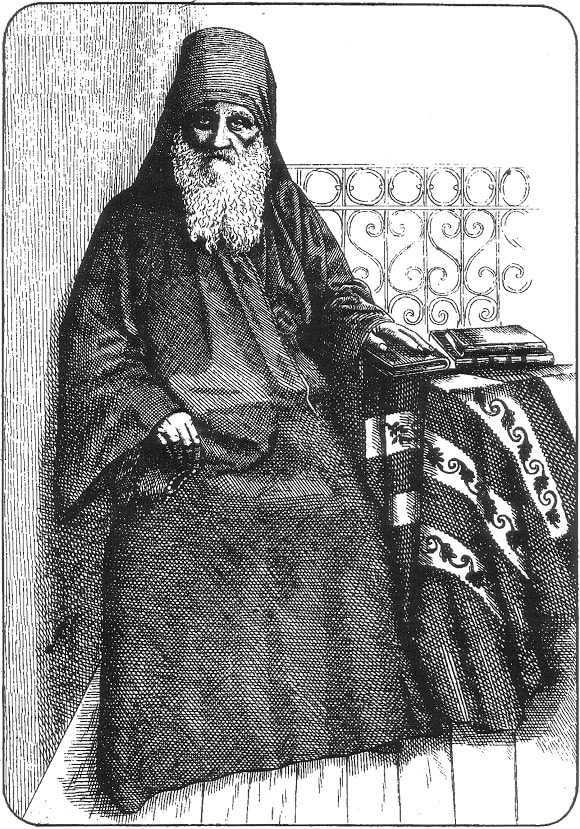
On 18 November the Church commemorates Venerable Nectarius the Protopsaltis, a monk born in 1804 in Huși, in north-eastern Romania, who spent most of his life on the Holy Mountain of Athos, the peninsula in northern Greece that has been given over to monastic life for a thousand years. The protopsaltis is the first chanter of the choir, the one who leads the singing in church. His voice was so pure, and his chanting so full of prayer, that the fathers of the Holy Mountain called him "the nightingale of Athos" and "the new Koukouzelis," after the great chanter of Byzantium, Saint John Koukouzelis. The Greeks also called him Nectarius the Vlach, that is, Nectarius the Romanian, while those of his own land called him "the nightingale of Moldavia."
His life shows how a gift received from God returns, through humility, to the One who gave it. Nectarius chanted for nearly all his life, yet all his life he fled from the praise that his chanting brought him.
The elder brother and the school of chant
At Baptism he received the name Nicholas. His parents, Vasile and Joița Crețu, had eight children: two sons, who both entered the brotherhood of Neamț Monastery, and six daughters, three of whom became nuns at Văratec Monastery. After his parents died, Nicholas was left in the care of his elder brother, the schemamonk Athanasius, who for eight years had been a disciple of Saint George of Cernica, near Bucharest.
Athanasius saw his brother's gift and urged him to learn the Church's chant in the Byzantine tradition, which the Church calls psaltic chant. Nicholas went to the school kept at Golia Monastery in Iași by the Greek hierarch Gregory of Ephesus, and became one of the best chanters of that school. Greek sources also preserve the memory that for a long time he chanted in the choir of a church in Galați.
Then he followed his brother to Neamț Monastery, which at that time had several hundred monks. He entered as a novice, and after the period of trial he was tonsured a monk and received the name Nectarius. The abbot appointed him canonarch, that is, the monk who reads aloud the verses of a hymn before the choir sings them, and chanter in the choir. Clergy and laypeople of every rank came to hear him, and it was at Neamț that he was first called a nightingale.
Fleeing from honour
The abbot of Neamț, seeing his life, wished to ordain him deacon. Nectarius considered himself unworthy of this rank and left with his brother for Ciolanu Monastery, in the region of Buzău. Two years later he was asked there too to accept the diaconate. The two brothers left once more, this time for Căldărușani Monastery, near Bucharest, where they received the great schema, the highest degree of monastic life, in which the monk promises more frequent prayer and a fuller renunciation of the world.
From Căldărușani they withdrew to a more hidden life at Cocioc Skete. There lived at that time Saint Macarius the Protopsaltis, the great teacher of church chant in the Romanian language, whom the Church commemorates on 31 August. The brothers drew much spiritual profit from him, and Nectarius remained known as his disciple.
Athos and the Holy Land
In 1835 the two brothers set out for the Holy Mountain and settled at the Skete of the Annunciation, which belongs to Xenophontos Monastery. A year later they went on pilgrimage to Jerusalem and remained six years in the Holy Land. There Nectarius compiled a collection of church hymns in Greek, and among the names the Athonites gave him is that of "the Hagiopolite," that is, the one from the Holy City, probably a memory of the years he spent in Jerusalem.
In 1842 the brothers returned to Athos and settled at the Skete of Saint Anne, which belongs to the Great Lavra and at that time had twenty Romanian cells. Nectarius learned to carve small wooden crosses, and with the work of his hands he paid for his food and his dues to the monastery.
The voice and the envy
The fame of his voice spread quickly. Greek sources say that his voice had an unusual power and spanned three octaves. The monasteries of the Holy Mountain invited him to chant at their vigils, the all-night services held on the monasteries' feast days. Those who heard him marvelled and compared him to Saint John Koukouzelis, the singer of the Byzantine emperor's court who fled from the glory of the court and became a monk at the Great Lavra. The Athonite fathers remembered that he went to these vigils without a trace of pride, to glorify God, and that when he was not chanting he stood with lowered eyes and prayed.
At the feast of one Athonite monastery there was also a Greek chanter who had come from afar and who sang a particularly beautiful hymn. Nectarius wrote it down in notation exactly as he had heard it and then sang it himself. The visiting chanter was filled with envy and anger and gave him a cup of wine into which he had put poison. Athanasius took oil from the lamp that burned before the wonder-working icon of the Mother of God called the Portaitissa, the Gate-keeper. Nectarius drank it, crying out to the Most Holy Virgin to deliver him, and was healed at once.
After this he no longer went to the feasts to which he was invited. The Lord told in the Gospel the parable of the servant who buried his talent and was condemned for his sloth.1 Nectarius did not bury his gift, for he chanted into his old age. But he understood that people's praise can kindle envy in others and pride in oneself, so he set the praise aside and kept the chanting for God. A monk of the Holy Mountain today, Nectarius Munteanu, says of him that "he did not let the treasury of his heart be plundered by the enemy of all good."
At Prodromou, in the wilderness of Vigla
Around 1854 Nectarius joined the hieroschemamonk Niphon Ionescu, who was then building the Romanian Skete of Prodromou, dedicated to Saint John the Baptist, on the land of the Great Lavra. The skete rises at Vigla, the wild and rocky country at the southern tip of the Holy Mountain, above the sea.
From then on his life was divided between his cell in the wilderness and the choir of the skete. Elder Moses the Athonite, who wrote in Greek the lives of many Athonite fathers, relates that Nectarius and his brother lived for many years in a cell at Vigla. All week long he did not leave his cell at all. Only on Sundays and feasts did he go with his brother to the skete, and there, writes Elder Moses, he chanted like an angel in the flesh. During Great Lent he stayed shut in his cell for the whole fast and ate nothing but broad beans soaked in water.
From 1862, according to the same Elder Moses, he entered the brotherhood of Prodromou, where he lived in obedience to the end of his life. He was the first to enter the church and the first at the work of obedience. He carried stones for the walls of the skete, and when he grew tired he rested apart. He knew how to carve wood, to weave fishing nets and to knit socks for the brethren.
Praise did not change him. He stood in the choir with lowered eyes and often with tears, absorbed in the prayer of the mind, that is, in the Jesus Prayer said unceasingly with the mind brought down into the heart. He was a settled and devout man, and Elder Moses writes that he never laughed or joked. He spoke little and was never troubled. When the brethren began idle talk, he would get up as if he had remembered some forgotten task and withdraw to his cell, so as to sadden no one. When he was asked to speak a word of profit in church or at the refectory, he spoke with great wisdom, and the brethren loved him.
Teacher of chant to the whole Holy Mountain
His gift did not remain shut up in his cell. For nearly fifty years he taught Byzantine chant to the monks of the Athonite monasteries. Almost all the fathers of the Great Lavra, from the proigoumenos Kosmas down to the youngest brethren, learned church chant from him, and disciples of his came also from Simonopetra, from Iviron, from Saint Paul's and from his own skete. A copyist of Prodromou, the monk James, wrote on a manuscript that the chant it contained had been rendered by "Nectarius the Vlach, protopsaltis and teacher of the whole Holy Mountain."
The Greek writer Alexandros Moraitidis, who travelled through Athos a short time after his death, left a testimony about him in his travel notes. Pilgrims went to the skete, he writes, to hear "the nightingale-voiced melody of the famous Vlach, Nectarius, the first music teacher of the Holy Mountain."
Nectarius rendered many hymns from Greek into Romanian and composed new chants himself. His manuscripts are kept today in the libraries of several Athonite houses, among them Xenophontos, Saint Panteleimon, Gregoriou, Saint Paul's and Prodromou. According to Elder Moses, the most beautiful of his compositions were his settings of "It is truly meet," and one of them, in the first tone, is still sung today. In 2026 a Cherubic Hymn of his in the fourth tone was published for the first time, from the manuscript written in his own hand.
He regarded the Mother of God as his helper, both in learning chant and in the prayer of the mind. Elder Moses writes that she delivered him from countless temptations that came from envious people.
The protection of the Mother of God
Prodromou Skete keeps an icon of the Mother of God called the Prodromitissa, painted in Iași in 1863 for this skete. Its painter, Iordache Nicolau, testified in writing that after he had finished the garments, the faces of the Mother of God and of the Child were painted without his hand. The lives of Nectarius written in Greek say that the Prodromitissa was his great love and his defender.
After the consecration of the main church of Prodromou, Nectarius withdrew with his brother to the Cell of Saint Menas, also in the wilderness of Vigla, to live in stillness. After Athanasius departed to the Lord, he settled alone in a secluded place by the sea, on the skete's land.
In 1896, while washing a towel by the sea, he stumbled and fell among the rocks. He lay wounded through a whole night, in rain and wind. The next day the fathers found him, put him on a mule and took him to the skete's infirmary, where they cared for him for more than three months until he recovered. His synaxarion says that the devil then wished to destroy him because of his spiritual life, but God did not allow it.
The Athonite fathers have also kept another account of a similar trial. While he was composing a hymn in honour of the Mother of God in his cell, the devil came upon him in the form of a man, dragged him over the stones down to the sea and tried to drown him. Nectarius called upon the Mother of God, and she appeared to him in the likeness of the Prodromitissa icon, and the enemy vanished. His disciple found him an hour later, half dead, took him to his cell, and the old man recovered.
The end
In old age he lost his sight. Moraitidis writes that, old and blind, Nectarius had stopped chanting years before. The voice that had filled the churches of Athos fell silent, and in its place remained the prayer that has no voice.
Venerable Nectarius departed to the Lord in the night of 17 to 18 November 1899, at more than ninety years of age.2 According to the custom of the Holy Mountain, his bones were taken from the grave after a few years and rest in the ossuary of Prodromou Skete, awaiting the resurrection of the dead. His synaxarion calls him a chosen vessel of the gifts of the Holy Spirit, adorned with the grace of speaking of God by word and by chant, with the gift of tears and with unceasing prayer.
Numbered among the saints
The Holy Mountain of Athos is under the canonical jurisdiction of the Ecumenical Patriarchate, so the canonization of Venerable Nectarius was decided in Constantinople, at the request of the Romanian Patriarchate, which proposed it in 2024. The Holy and Sacred Synod of the Ecumenical Patriarchate decided on his canonization on 18 October 2025, and the Church of Greece announced the decision to all its dioceses. The act of canonization was signed on 29 August 2026 in the Patriarchal Church in Constantinople, together with the acts of other Athonite fathers born in the Romanian lands, among them Saint Niphon, the founder of Prodromou.
Venerable Nectarius received from God a rare voice and glorified Him with it for a whole lifetime. He fled from the diaconate, from the feasts and from praise, and God gave him in return tears, unceasing prayer and the stillness of the wilderness. He taught many monks to chant, and when old age and blindness stopped him from chanting, he remained with the prayer he had learned in his youth. Whoever chants in the choir of a church, whoever has a gift from God and fears to lose it through pride, has in him a protector and an example.
Through his prayers, Lord Jesus Christ our God, have mercy on us. Amen.
Notes
- Matthew 25:14-30. A man who was going to a far country called his servants and entrusted his goods to them: to one five talents, to another two, and to another one. The first two traded with the money and increased it. The third dug a hole and hid the talent in the ground. On his return, the master praised those who had increased what they had received, but he rebuked the one who had buried his talent for his wickedness and sloth, and condemned him. ↩︎
- The Greek biographies follow a different chronology. The life written by Elder Moses the Athonite gives 1808 for his birth and the summer of 1903 for his repose. According to the same work, Nectarius was tonsured at Neamț only after the pilgrimage to Athos and Jerusalem, settled at Vigla in 1845 and entered the brotherhood of Prodromou in 1862. This article follows the synaxarion approved by the Romanian Patriarchate. The years 1804 and 1899 are also given by the canonization decision of the Ecumenical Patriarchate. ↩︎
