
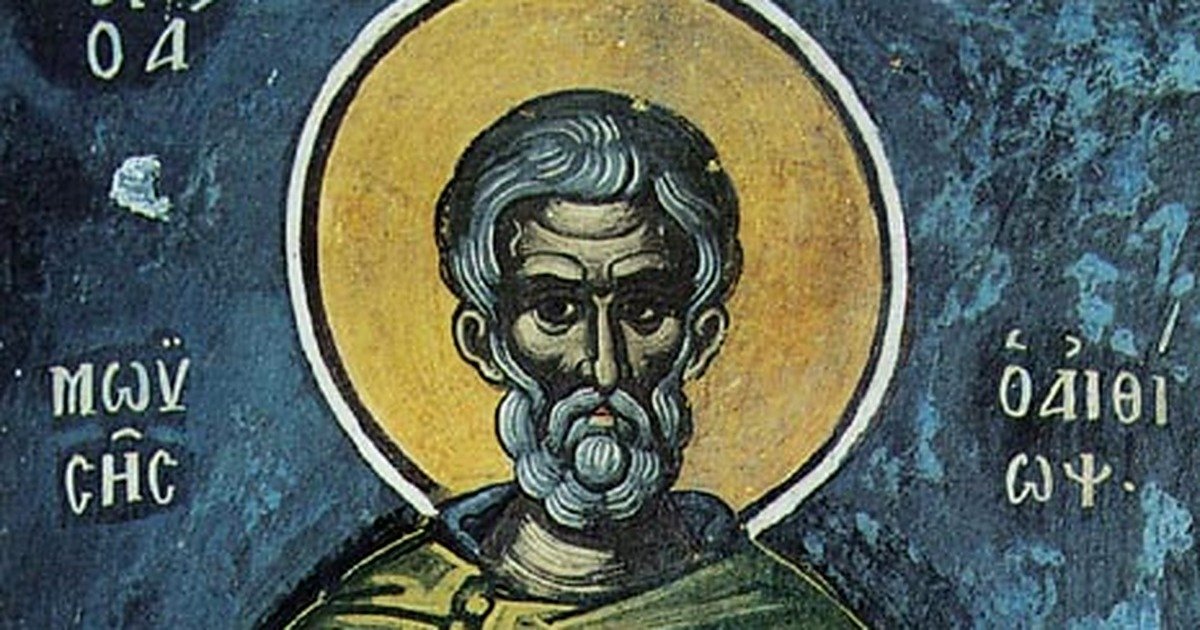
On 28 August the Church commemorates Saint Moses the Ethiopian, called in many places Moses the Black, and in Romanian service books Moses the Arab — an old word for a man with black skin, and the form that stands in the Synaxarion for the day. He was a household slave to an Egyptian official, driven out by his master for his crimes, and then the leader of a band of robbers. In old age he was a priest and the father of a community in the desert of Scetis, in Egypt. He died at the hands of raiders, together with six brothers who stayed with him.
His life is easily read as a conversion that happened all at once, from one extreme to the other. The old sources show something different. They show a struggle that lasted for decades and ended only with his death.
The sources
Four early witnesses tell us about Moses, and they complete one another.
The Lausiac History of Palladius, bishop of Helenopolis, written in the years 419–420. Palladius travelled through the monastic settlements of Egypt himself and knew many of those fathers, so he writes some fifteen to twenty years after Moses died. The chapter on Moses is numbered 19 or 22, depending on the manuscript.
The Sayings of the Desert Fathers, the apophthegmata — the short words that disciples remembered and passed on. The collection took the form we have today around the sixth century. Abba Moses has his own chapter there.
The Ecclesiastical History of Sozomen, written around the years 443–448.
The Synaxarion and the service in the Menaion for August, on the twenty-eighth day.
To these may be added the Conferences of Saint John Cassian, whose first two conferences are held with an Abba Moses of Scetis, on the aim of the monastic life and on discernment. Saints Nikodemos of the Holy Mountain and Makarios of Corinth took these texts into the Philokalia. Tradition has held this abba to be the same as Moses the Ethiopian. The identification is not certain. Modern editors of Cassian have themselves noticed that more than one monk named Moses seems to appear in the Conferences, and the one in the first two may not be the former robber known to Palladius. The question remains open, and nothing in the saint’s veneration depends on it.
From the official’s household to the band of robbers
Palladius hides nothing. Moses was an Ethiopian and black of face, a slave in the household of an official, and his master drove him out for theft and for a life of robbery. It was said of him, Palladius writes, that he had gone as far as murder. The bishop almost apologises to his reader for setting down these deeds, and says why he does it: so that the greatness of the repentance that followed may be seen.
The Synaxarion for the day preserves an incident that shows what kind of man he was. Bearing a grudge against a shepherd who had prevented him from a wicked deed, he decided to kill him. He learned that the shepherd was on the far side of the Nile, and the river was in flood. He put his sword in his teeth and his tunic on his head and swam across. The shepherd had got word and fled. Moses then slaughtered four choice rams, tied them together with a rope, and swam back across the Nile with them on his back.
This is the man the Church today calls righteous.
His conversion and his apprenticeship to Abba Isidore
What turned him the sources do not clearly say. Palladius passes straight to what followed. Moses came to the desert of Scetis and found Abba Isidore, a priest and the father of one of the communities there. Isidore received him, guided him, and kept him under obedience to the end.
The struggle was hard and long. The war of fornication — that is, the thoughts and desires of the flesh — pressed him with a force he himself later confessed to the brothers: he came near to falling away from his monastic promise. The Lives of the Saints speak of six years of such a struggle.
What can be seen here is the most useful thing for us. Moses did not fight alone. He disclosed his struggle to the elders, and above all to Abba Isidore, who appears in the sources as his chief guide. And Isidore gave him neither rebuke nor great counsels, but kept him within his measure. Once, when Moses could bear his cell no longer, the elder took him up to the roof, had him look west, and showed him the multitude of demons ready for battle. Then he had him turn east, and he saw countless holy angels, shining. The help was greater than the enemy, and he had not seen it.
Palladius says further that Moses would go by night to the cells of the elders and fill their water jars in secret, so that no one would know. One night the enemy struck him so hard that he lay ill for nearly a year and recovered his strength with difficulty. Isidore told him then to stop fighting the demons and to stop provoking them. Moses would not accept it. He answered that he would not stop until they stopped appearing to him.
The basket of sand and the testing in the sanctuary
When the war quieted, the fruit appeared. A brother in Scetis had sinned, and the fathers gathered to judge the deed. They sent for Abba Moses as well, but he would not come. The priest sent for him again, telling him that everyone was waiting. Then he rose and came, carrying on his back a basket full of holes, filled with sand. In other versions of the story it is a leaking vessel filled with water. The brothers came out to meet him and asked what this meant. He answered that his sins ran out behind him and he did not see them, and today he had come to judge another man’s sins. The assembly said nothing more to the brother and forgave him.
The same collection says he was ordained priest in old age. Tradition says that Theophilus, archbishop of Alexandria, ordained him. When they clothed him in the white vestment, the bishop said to him that see, Abba Moses had become entirely white. Moses answered that he was white on the outside, but the One who sees within knows how it is there.
Wishing to test him, the bishop instructed the priests that when Moses entered the sanctuary they should drive him out with insults and follow him to hear what he would say. So they did, driving him out as a black man with no place among them. Going out, Moses said to himself that they had done rightly by him, since he was black as ashes and was not a man, to stand among men.
He answered nothing to those who had mocked him. He agreed with them.
“Sit in your cell, and your cell will teach you everything”
A brother came to Abba Moses in Scetis and asked him for a word. The elder told him to go, to sit in his cell, and the cell would teach him everything.
This is his best-known word and the one most easily misunderstood. It does not speak of solitude as a rest. It speaks of the place where a man is left alone with what he actually is, with nothing to hide him from himself. Moses knew what rises up there, because he had passed through it for years.
His other words come from the same spirit: that the monk must die to his neighbour and never judge him in any way at all; that the man who flees the world is like a ripe grape, while the one who remains among men is like an unripe one. The collection also preserves seven counsels he sent to Abba Poemen, saying that whoever keeps them will escape all condemnation and live in peace, whether in the desert or among the brothers.
The sword he waited for
It is said that when he went once with some elders to Saint Macarius the Great, Macarius said that he saw among them one who would receive the crown of martyrdom. Moses answered that it might be himself, since it is written that all who take the sword shall perish by the sword (Matthew 26:52).
When the barbarians came upon Scetis, Moses told the brothers to flee and save their lives. They asked him why he would not flee as well. He answered that he had been waiting for this day for many years, so that the word of the Lord might be fulfilled. The brothers told him they would not flee either, but would die with him. He told them that this was each man’s own choice, not his. Seven stayed beside him.
When the raiders broke in, one of the seven hid nearby. Moses and the other six they killed. And the one hidden saw seven shining crowns descending upon the seven martyrs.
He was seventy-five years old. The Synaxarion says he left seventy disciples; other versions of the Lausiac History and the Greek lives say seventy-five. The year of his death is not known with precision: the early sources do not give it, and present-day chronologies place it around the year 400, some linking it to the first devastation of Scetis, in the years 407–408.
Here lies the thing hardest to overlook in his life. Moses did not forget his past. He carried it to the end as a remembrance that kept him in humility. And when the raiders came, he himself bound the death awaiting him to the word of the Lord: all who take the sword shall perish by the sword. The Synaxarion says of him that through true repentance he pleased God perfectly, and that not only Paradise but heaven itself was opened to him, as to a martyr.
His commemoration in the calendar
In the Byzantine calendar, Saint Moses the Ethiopian is commemorated on 28 August, together with the Righteous Hezekiah the king, and Saint Anna the Prophetess, daughter of Phanuel. Some calendars place the commemoration of Saint Joseph the Hesychast on the same day.
The Coptic Church honours him on a different day: 24 Paoni, that is 1 July, the day of his martyrdom according to their tradition. The saint is widely honoured beyond the bounds of Chalcedonian Orthodoxy as well, and this says something about how early and how far his memory spread.
What Saint Moses leaves us
The first thing is that repentance is not a feeling of regret. It is a work that lasts for years. Moses fought the passions for years after he had entered the desert and after he had taken up the monastic life. His conversion did not make the old habits vanish in a day, and he did not take the struggle as a sign that the conversion had not been real.
The second is that he did not fight alone. He disclosed his struggle to his spiritual father, without hiding and without embellishing. This is the way all the fathers of the desert kept, and after them all who have walked in their footsteps.
The third is that his past was not lost. It remained in him as a wound that would not let him set himself above anyone. Out of it came the basket of sand. The man who had been a robber and a murderer was the only one in that assembly who could not judge.
And last, Moses the Ethiopian stands in the calendar of the Church as an answer for anyone who reckons himself lost because of what he has done. He was not asked to forget what he had been. He was asked to come and to stay. He came, he stayed, and God did the rest.
Troparion, tone 1:
A dweller of the desert and an angel in the body you were shown to be, a wonderworker, our God-bearing father Moses; by fasting, by vigil and by prayer you received heavenly gifts, and you heal the sick and the souls of those who run to you with faith. Glory to Him who gave you strength; glory to Him who crowned you; glory to Him who works healings for all through you.
Holy and righteous father Moses, pray to God for us.
Image: Saint Moses the Ethiopian, fresco by Tzortzi (Zorzis) Foukas, 1547, Dionysiou Monastery, Mount Athos; public domain, via Wikimedia Commons.