
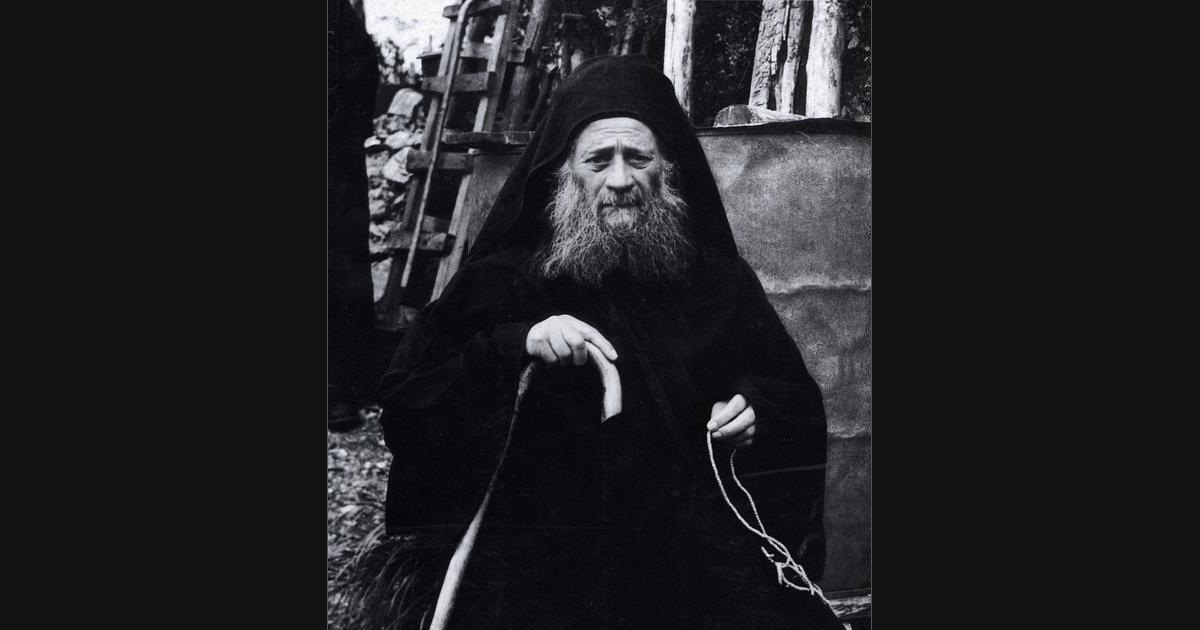
On the feast of the Dormition of the Theotokos in 1959, in a cell of the New Skete on Mount Athos, a Greek monk named Joseph departed this life, whom those around him called the Hesychast. He had spent thirty-eight years in the harshest places on the Holy Mountain, and he left behind a small brotherhood in which not one disciple was then an abbot. In the decades that followed, six of the twenty Athonite monasteries would be renewed by his disciples or by their disciples.
The name under which he became known, Geron Joseph, comes from the Greek γέρων, “old man,” given in the monastic tradition of the East to a tried spiritual father. In the calendar of the Church he was inscribed as Saint Joseph the Hesychast.
The word “school” is used here in its older sense, that of filiation: not a new method, but a way of handing on what had been received, from elder to disciple and further still.
Francis of Lefkes
He was born in the village of Lefkes on the island of Paros, in the Cyclades, on 12 February 1897, to George and Maria Kottis, and received at baptism the name Francis. He was one of seven children of the house. His father died while he was small, and poverty sent him out to work early: he went to Piraeus, where he worked as a merchant to keep his family, and he also served his term in the navy.
Around the age of twenty-three he began to read the lives of the saints, especially of the great ascetics, and this reading changed the order of his days. He broke off the betrothal he had entered into and began to prepare himself for the monastic life, fasting and praying at night in the country around Athens, where he would climb into the hills and remain until dawn.
The Apprenticeship: Katounakia, 1921
He reached the Holy Mountain in 1921, seeking a guide who would teach him the prayer of the heart. For a time he went about among caves and sketes without finding one, and then he stopped in the brotherhood of Saint Daniel of Katounakia, known throughout Athos for his discernment.
The rule of that brotherhood was moderate, and the young Francis wanted a narrower struggle. Elder Daniel saw that he could not remain there, but he also saw the danger: whoever struggles alone, without a guide and without a fellow ascetic, easily falls into delusion. He told him, therefore, to work the prayer for the present in some remote cave and to come to him from time to time for counsel, until a companion should be found for him.
The companion came: the monk Arsenios, eleven years older and tonsured long before, who nevertheless submitted himself to Francis and remained his fellow ascetic to the end. Yet something was still wanting. On Athos, for a man to be an elder himself, it is required that he first have obeyed an elder until that elder’s repose. Following the counsel of Elder Daniel, the two became the disciples of two humble elders in Katounakia, Joseph and Ephraim.
Elder Joseph fell asleep shortly afterwards. Elder Ephraim, left as sole guide, saw what manner of ascetic he had beside him and tonsured him a monk on 31 August 1925, in the cave of Saint Athanasios the Athonite; and he gave him the name Joseph, after the elder who had died.
Here lies the key to the whole life that follows. The obedience that Elder Joseph would later ask of his own disciples he had first received himself, through the counsel of a tried elder and through submission to two fathers unknown to the world.
The Desert of Saint Basil’s Skete
After the repose of Elder Ephraim, the young monk Joseph became an elder in his own right, and he and Arsenios went up into the region of Saint Basil’s Skete, where the rock is bare and water must be carried from far off. There they lived years of fasting, vigil, and unceasing prayer, and word of his struggle began to travel beyond the skete.
In that stretch of years, what he would hand on came clear. Noetic prayer is not gained by diligence alone; it is learned from a guide and held through obedience, and whoever takes it up without measure and without direction falls into imagination. In the same period his brother according to the flesh, Nicholas, came to the Holy Mountain and was tonsured with the name Athanasios.
From those years also comes his bond with the monk Ephraim, known later as Ephraim of Katounakia. This one remained in the brotherhood of his own elder, Nikephoros, but bound himself spiritually to Elder Joseph with that elder’s blessing. The bond was one of spiritual guidance rather than of monastic obedience within the same brotherhood, and the distinction belongs to Athonite order and is worth keeping.
The Brotherhood at Little Saint Anne’s
In 1938 Elder Joseph moved with those who were with him to the Skete of Little Saint Anne, where they settled in caves and built with their own hands their cells and a chapel of the Forerunner. Here the brotherhood took shape.
Its nucleus came to consist of five disciples: Arsenios, his fellow ascetic from the beginning; Athanasios, his brother according to the flesh; Joseph the Cypriot, the future elder of the brotherhood at Vatopedi; Ephraim, the future abbot of the Monastery of Philotheou; and Haralambos, the future abbot of the Monastery of Dionysiou.
The Cypriot came late. He had entered the Skete of Saint Anne at the beginning of 1947 and met Elder Joseph in the summer of that same year. His request to be received was refused at first, and the elder took him into the brotherhood only after he had been given assurance concerning it. He was tonsured into the Great Schema at the hut of the Honourable Forerunner on Lazarus Saturday of 1948 and received the name Joseph; under this name he would be known later as Elder Joseph of Vatopedi.
The order of the brotherhood was at once simple and heavy: at night they kept vigil in their cells with the Jesus Prayer; by day they worked a little with their hands and slept little; food was measured; and thoughts were told to the elder each day. Obedience was not a habit of good form but the foundation on which the prayer stood, and without it Elder Joseph would not permit a prolonged ascetic struggle.
The Letters
The closest testimony to his inner work is given by the letters he sent to disciples and to certain laymen, sixty-five in number, printed later by the Monastery of Philotheou. They do not make up a treatise; they are counsel given according to the measure of the one who asked. From one he requires moderation, from another persistence, from another patience in the time of abandonment.
Through them has been preserved the way he understood the working of grace: grace comes and withdraws according to God’s ordering and not according to the reckoning of the one who struggles; the withdrawal is not punishment but schooling; and the sign of true work is the humility that increases, not the visions that multiply.
The New Skete and His Repose
At the beginning of the 1950s, after more than a decade spent in the caves of Little Saint Anne, the health of the fathers had weakened from the harshness of the place, and Elder Joseph brought the brotherhood lower down, towards the sea, to the New Skete. There he lived until the end.
His disciples testified afterwards that in his last months he had told them the hour of his departure had been made known to him by the Mother of God, and that he would be taken on the day of her feast.
On 14 August 1959 he stood at the vigil of the Dormition of the Theotokos and received Communion. The next day, on 15 August, he fell asleep in the Lord. He was buried that same day in the chapel of the Annunciation at the New Skete, near the tower of the skete, where his grave is to this day.
What Remained After Him
His disciples and their disciples renewed Athonite monasteries that had grown thin: Philotheou, Dionysiou, Vatopedi, Xeropotamou, Konstamonitou, and Karakallou. The work was not done all at once, nor from a single place. Ephraim became abbot at Philotheou, and from the brotherhood there fathers were sent to Karakallou, to Xeropotamou, and to Konstamonitou; Haralambos came with his brotherhood to Dionysiou; the line of Elder Joseph of Vatopedi came to Vatopedi, which returned to cenobitic life in 1990. From the same order convents were founded in Greece, and through Elder Ephraim a wide network of Orthodox monasteries in the United States and Canada.
The bond was not one of organisation but of discipleship: each received the order of prayer from the man who had been his elder, and handed it on in the same way.
On 20 October 2019, while at Karyes, Ecumenical Patriarch Bartholomew announced his approaching entry into the ranks of the saints. On 9 March 2020 the Holy and Sacred Synod of the Ecumenical Patriarchate inscribed his name in the calendar of the Church by a Patriarchal and Synodal Act; in the same session Saints Ephraim of Katounakia and Daniel of Katounakia were also numbered among the saints. His commemoration was appointed for 16 August, so as not to fall on the feast of the Dormition of the Theotokos, on whose day he departed. The Romanian Orthodox Church entered him in its own calendar by a decision of its Holy Synod in July 2023, with the commemoration on 28 August.
His holy relics are kept at the Monastery of Vatopedi, and portions of them are found in other monasteries of his spiritual line.
The Measure of This Life
His entry into the ranks of the saints did not concern a man only. It concerned an order of life: obedience to a guide, the Jesus Prayer held with measure and without ceasing, the confession of thoughts, silence kept, and the conviction that grace is given to the humble. Elder Joseph wrote no new teaching and founded no school in the ordinary sense of the word; he received what had been kept on Athos for centuries, lived it with a rare persistence, and handed it on in the same manner in which he had received it.
Whoever draws near to his life ought also to know where what we know of him comes from. Most of the accounts come from disciples — from Elder Joseph of Vatopedi and from Elder Ephraim of Philotheou — and were written in the manner of a synaxarion, with the reverence of a man commemorating his own father. The testimony that comes directly from him remains above all that of the letters. Whoever wishes to know Saint Joseph as he showed himself should begin there.
Category: Lives of the Saints Commemoration: 16 August (Ecumenical Patriarchate, Mount Athos) / 28 August (Romanian Orthodox Church)
Image: historical photograph of Saint Joseph the Hesychast, published by Agios Arsenios. Adapted to the Facebook editorial format.