
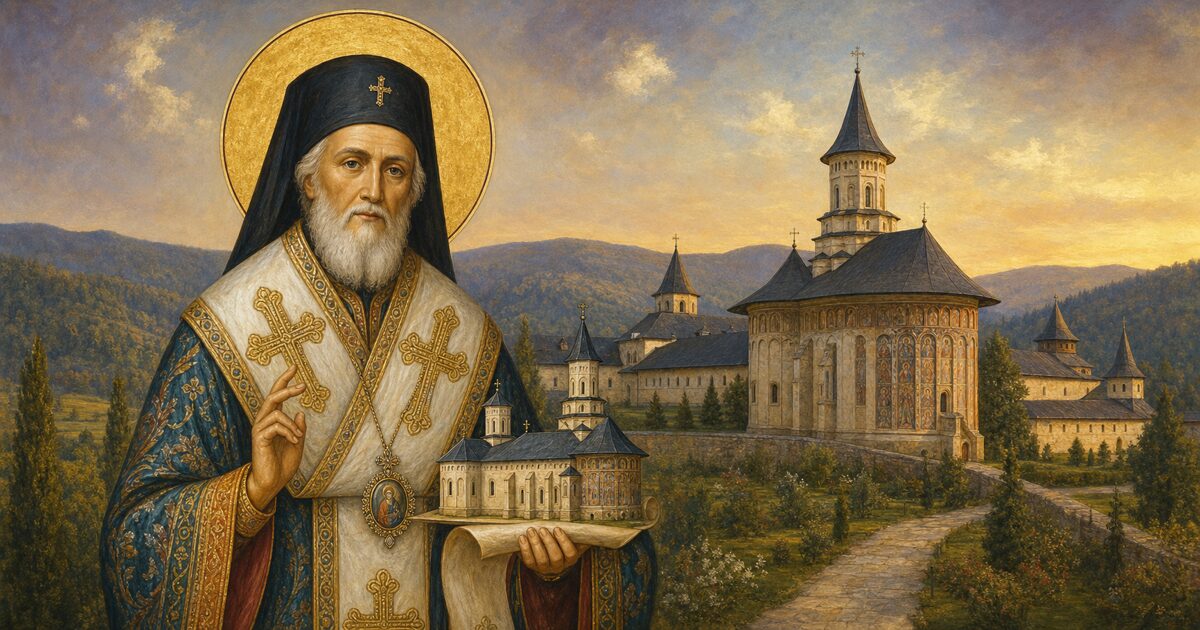
A metropolitan who withdrew from his see in the struggle for his people
A nearly forgotten saint of the Phanariot century
When the Romanian Orthodox Church decided, in the session of the Holy Synod of 6–7 June 2016, to number among the saints Metropolitan Jacob Putneanul of Moldavia, many faithful outside Bukovina were hearing the name of this hierarch for the first time. The solemn proclamation of his canonization took place at Putna Monastery on 14 May 2017, together with his disciples from the Putna Skete, the Venerable Sila, Paisie, and Natan. His day of commemoration was appointed for 15 May, the day of his repose.
That a saint of such spiritual stature should have remained for decades in obscurity tells us something about the way modern Church history has been written: with the emphasis on those hierarchs who left behind written theological works, dogmatic systems, academic schools. Saint Jacob left neither a “Dogmatics,” nor a “Philokalia,” nor systematic treatises. He left behind a people enlightened through books printed in their own tongue, a metropolitan see freely abandoned so that the fire of an oath against an unjust tax should not be trodden underfoot, and a monastery — Putna — made ready to become “one of the pillars of Romanian Orthodoxy in the hard times that were to come with the seizure of Bukovina by the Habsburg Empire in 1775,” as his Life, published on basilica.ro, puts it (Romanian Patriarchate, 8 June 2016).
In what follows, we shall try to look at four faces of his labor: his formation in the hesychast tradition of Putna; his work of enlightening the people through divine service and the book; his confession against Phanariot injustice in 1760; and his end as a humble monk at the Putna Skete, under the name Euthymius.
I. Putna as a school of the spirit — the formation of a hesychast hierarch
Family and entry into the monastery
Saint Jacob was born on 20 January 1719, according to the records preserved at Putna Monastery, into a devout family from the north of Moldavia — most likely from Rădăuți itself. Father Mircea Păcurariu, in his History of the Romanian Orthodox Church, observed that this date raises certain chronological difficulties (it would mean monastic tonsure at twelve and episcopal consecration at twenty-six, while in his will of 1762 the saint writes that he is “at the age of old age”); yet the facts of his formation at Putna are confirmed by several independent sources.
The case of his family is itself a witness: his parents — Adrian and Maria — became monastics in old age and were buried in the porch of Putna Monastery, beside their son. A brother, Ioil, a sister, the nun Pelaghia, and his sister’s husband, the hieromonk Misail of the Doljești Skete, likewise took the monastic path. This is no ordinary family — it is a family that bore a true monastic vocation, a hearth in which the spiritual calling was handed down horizontally, by blood, but also vertically, by grace.
In the year 1731, the young man entered Putna Monastery as a brother. Two years later, in 1733, he received the Little Schema. At seventeen, in 1736, he was ordained deacon, then priest. At twenty-five, in 1744, he was chosen abbot of Putna. At twenty-six — in August 1745 — he became bishop of Rădăuți. At thirty-one, in 1750, he was raised to the metropolitan see of Moldavia.
This swift ascent does not seem to have been the fruit of ambition, but of the unanimous recognition of a chosen life. The Romanian Patericon of Archimandrite Ioanichie Bălan preserves the note that “all profited from his wisdom and gentleness,” seeing in the young Jacob a bearing that held “the wisdom of an elder and a chosen life.”
Putna in the eighteenth century: a node of the Athonite tradition
To understand what kind of formation Saint Jacob received, we must correct an image we have grown used to: that Putna, in the Phanariot century, was no more than a monument of Stephen the Great in decline, until the arrival of the Venerable Paisius of Neamț in the community at Dragomirna. The historical reality is otherwise. Even in the midst of the Phanariot era, Putna remained a significant spiritual and cultural center, with an elementary school, a school for the training of priests, and a “Latin school” for those who desired more advanced theological and humanist studies. To these schools came monks and young men from Moldavia, from Maramureș, from the region of Năsăud, from Galicia — and even from Greece.
Here the young Jacob learned Greek and Slavonic, the interpretation of the Old and New Testaments, the dogmas and canons of the Church, psaltic chant, the typikon, the patristic writings. Yet above the curriculum of study, his Putna was still steeped in the Stephanian spirit of prayer — a spirit that, before the Phanariot enlightenment, had known, through fathers such as Sila, Paisie, and Natan of the Putna Skete, a quiet hesychast continuity, as yet untempted by academic logic.
The direct link: Metropolitan Anthony of Moldavia
The spiritual formation of Saint Jacob is bound directly to a figure of capital importance for the whole Romanian neptic tradition: Metropolitan Anthony of Moldavia (1730–1740). He it was who ordained Jacob deacon and priest in 1736, and who was his spiritual father.
The importance of Anthony does not stop here. He is the same metropolitan who, after the Peace of Belgrade (1739), accompanying the retreating Russian troops, came to Kiev, where he served the Divine Liturgy in the Romanian tongue at the Kievan Caves Lavra. There too, around 1741–1742, a young rasophore named Platon — the future Venerable Paisius of Neamț — heard him serving. The beauty of the Romanian language in the divine service, the testimony of an Orthodox land in which monasticism could flourish unhindered, the longing for a true spiritual father — all of these turned Paisius toward Moldo-Wallachia. So Paisius himself recounts in his Autobiography.
In other words: the same metropolitan who was the spiritual father of Saint Jacob was also the man through whom the future abbot of Neamț was drawn toward the Romanian Lands. The spiritual line is one. Saint Jacob and Saint Paisius are not two parallel traditions — they are two branches of the same neptic trunk, with Anthony of Moldavia at the root.
And this is no mere biographical curiosity. It helps us reconstruct the spiritual geography of Moldavia before the great Paisian renewal at Dragomirna and Neamț. Before Paisius, there already exists at Putna a living monastic tradition, in which holiness is handed down through silent discipleship. Sila, Paisie, and Natan — contemporaries of Saint Jacob and his disciples (Saint Natan was Jacob’s spiritual father in the last days of his life) — were canonized together with him in 2016. The Putna tradition is not annulled by the Paisian renewal; it precedes it, meets it, and, in a certain sense, prepares it.
The fruits of his formation: an abbot who does not leave
Of Jacob as abbot of Putna, the Romanian Patericon preserves this picture: he increased the number of fathers in the community, greatly developed the monastery’s school, bringing “the best of students and teachers,” formed “chosen confessors and parish priests, calligraphers and teachers of Greek and Slavonic,” translated liturgical books “into the language and understanding of the people,” and “renewed the order of the monastery.”
We must note one thing the text says in passing, which is in fact decisive: Jacob did not detach himself from Putna even after he had been made bishop, then metropolitan. Putna remained his permanent point of reference. He used the revenues of the metropolitanate for the restoration of Putna (1756–1760). In his will of 1762 he left a part of his goods to Putna. To Putna he returned after his withdrawal of 1760. At Putna he died and was buried. For him, the metropolitanate was an obedience, but Putna was home. The monastery was the original obedience; the see was a thing of passage.
II. The enlightenment of the people — service and book as pastoral labor
Continuing the work of Saint Dosoftei
Toward the end of the seventeenth century, the holy Metropolitan Dosoftei had begun the translation into Romanian of the books of divine service and their printing — the labor by which, for the first time, the Church’s worship in Moldavia was fully understood by the people. After the death of Saint Dosoftei (1693), this work stagnated for decades. The eighteenth century had begun, for the Moldavian ecclesiastical press, under the sign of an oppressive stagnation.
Between 1700 and 1750, only ten books had been printed in Moldavia, while in Wallachia sixty-six had appeared. In the ten years of his pastorate as metropolitan (1750–1760), Saint Jacob alone printed fifteen books. This figure must be regarded not merely quantitatively, but as the expression of a clear pastoral choice: the liturgical language of the people is the language the people understands. This is not a concession made to “innovations,” but a rigorous application of the Pauline principle: “I had rather speak five words with my understanding, that I might teach others also, than ten thousand words in an unknown tongue” (1 Corinthians 14:19).
The service books
At Rădăuți, as early as 1745, Saint Jacob printed a Slavonic-Romanian Liturgikon — the second Romanian Liturgikon in Moldavia, after the two editions of Saint Dosoftei (1679 and 1683). Then, moving the press to Iași, he printed, in succession: A Gathering of Prayers (1751); Synopsis, or the Gathering of the Seven Mysteries and of the Seven Praises of the Holy Church, and of the Canons from the Holy Rule needful for the mystery of spiritual fatherhood (1751); the Rite of Church Consecration (1752); the Euchologion, that is, the Book of Needs (1754); the Pentecostarion (1754); the Anthologion (1755); the Apostolos (1756); the Psalter (1757); the Liturgikon (1759); the Anthologion (1760).
For one who knows these books, the list speaks for itself. A Euchologion is the book the priest holds in his hands when he celebrates Baptism, Marriage, Holy Unction, the services for those in danger. A Pentecostarion gives the services of the fifty days from Pascha to the Descent of the Holy Spirit — the season of the Church’s joy. An Anthologion contains the troparia, kontakia, and services of the feasts throughout the year. Saint Jacob did not print rare books for scholars, but the very books the village priest uses daily in his ministry.
The books for the spiritual life
Alongside the service books, Saint Jacob printed works of profound spiritual usefulness: A Gathering of Many Teachings for Priests (1753); the Book of Spiritual Guidance (1755); The Soul’s Alphabet, for the common benefit (1755); On the Wood of the Holy Cross (1759).
The Book of Spiritual Guidance is, if we look attentively, one of the most important printings of the Romanian eighteenth century. It offered the parish priest a rule for the mystery of Confession, a manual by which the confessor might guide his spiritual children according to the order of the canons. It is a work by which a metropolitan takes care that the seat of confession in the remotest parish should not be left to improvisation.
The Soul’s Alphabet — a collection of teachings arranged alphabetically — made the teaching of the spiritual fathers accessible to the ordinary layman. In the time when it was printed, it was a true popular Philokalia, set within the reach of all.
Saint Jacob also arranged for the Lives of the Saints of Saint Demetrius of Rostov to be translated — true manuals of the Christian life. During his pastorate, the translation of six of the twelve volumes was accomplished (the months of September, October, November, March, April, May); but after his withdrawal in 1760, the manuscripts remained unprinted. It is one of the great losses of Romanian ecclesiastical culture — a loss bound directly to the events of 1760, of which we shall speak.
The Bucvar of 1755 — the first Moldavian primer
In the year 1755, Saint Jacob printed the Bucvar, or Beginning of Learning — the first primer in the history of Moldavia. In the preface he wrote, as reproduced in Keeping Watch in the House of His Highness (Metropolitan Jacob Putneanul Publishing House, Putna, 2017):
“How then shall you hope for any good where there is no good nourishment for the children? And as for such nourishment in this land, who does not see how great the lack of it is?”
Three observations on this saying. First, the rhetorical question says something grave about the spiritual state of the country — it is not the lack of books that is lamented, but the “nourishment” of children, which is at once knowledge and moral formation. Second, evil at the root bears fruit to the very end — Saint Jacob does not shrink from saying that “from the rearing of children, as from a root good or bad, the whole of life flows.” Third, the responsibility for the nourishment of children is laid upon the whole — prince, hierarch, teacher, parent, monastery — and not upon some “educational institution” alone.
The Bucvar was reprinted in 1759 in an improved edition, and in 1771 it was republished at Vienna for the schools of Bukovina, then occupied by the Habsburg Empire — a sign that its superiority had been acknowledged even by those who had no love for its author.
The first rural school in Moldavia
At the proposal of Saint Jacob, by the princely charter of Theodore Callimachi of 25 June 1759, the first documented rural school in Moldavia was established, for the children of the village of Putna. In its first decades of operation, Saint Jacob entrusted to Archimandrite Bartholomew Măzăreanu and to other Putna monks the obedience of teaching the children and of caring for the upkeep of the school. The school operates without interruption to this day and bears the name “Metropolitan Jacob Putneanul.”
It is difficult to overstate the significance of this act. In a century in which rural education was exclusively informal and village-bound, a metropolitan institutionalizes the rural school, places it under the care of the monastery, and founds it upon a princely charter. And the bond of Putna with the school — the monk as teacher — keeps education within its ecclesial matrix. It does not sever education from the Church in order to remove it into “culture,” as would happen a century later.
Care for the Romanians outside Moldavia
Saint Jacob watched also over the Romanians of Transylvania, Maramureș, and the region of Cluj — faithful then under the pressure of the Greek Catholicism imposed by the Habsburg Empire. He sent them antimensia for the parishes without pastors, ordained priests for them, and sent them his books.
Here is one of the fundamental purposes of his printings: the books from Iași were not for Moldavia alone, but “for all the lands inhabited by Romanians.” Saint Jacob did not shepherd merely a local metropolitanate — he shepherded the pan-Romanian Orthodox communion, in a time when that communion was concretely threatened by the Unia in Transylvania and by Hellenization in Moldavia. And in his prefaces he insisted upon the abolition of the obligation to study the Greek language in schools and churches, an obligation imposed both by the Phanariot princes and by the Greek clerics who accompanied them.
III. The confession of 1760 — the cattle tax and the fire of the oath
This is the part of his biography that has been preserved most vividly in the memory of the people. Nicolae Iorga called him “the shepherd of the poor and the humble, who lived the life of a saint.”
The cattle tax — a levy that starved the peasants
To understand the gravity of the episode, we must say what the cattle tax (văcărit) was. In a medieval peasant economy, the beast — the ox, the cow — was not a “surplus good,” but an instrument of labor (the yoke that draws the plough) and a source of subsistence (the milk, the butter, the cheese for the fast). To impose a levy on every head of cattle was to strike at the very capacity of a man to feed his family and to work his land. In the Phanariot era, the cattle tax — together with the vădrărit (the tax on wine) and the pogonărit (the tax on land) — became one of the principal instruments by which the Phanariot princes, eager to cover the enormous debts they had contracted at Constantinople in order to seize the throne, wrung the country dry.
The Moldavian hierarchs had long understood that, on the political ground, the battle was lost — the authority of the Porte stood behind the prince. The only weapon left was a spiritual one: the binding under a curse (blestem) — a solemn ecclesiastical anathema. For the first time, in the year 1698, Metropolitan Sava of Moldavia (the spiritual forefather of Saint Jacob, as a Putna tradition calls him) succeeded in halting the cattle tax by such a curse. At each new attempt to reintroduce it, the hierarchs renewed the curse.
In 1749, Saint Jacob — still bishop of Rădăuți — had taken part in the binding of the cattle tax under a curse, together with all the Moldavian hierarchs. In 1756, as metropolitan, he obtained the abolition of the vădrărit. On 1 March 1757, together with his suffragan bishops, he once again bound the cattle tax under a curse.
Prince Scarlat Ghica and the attempt to force the curse
Soon after this, Constantin Racoviță was deposed, and Scarlat Ghica came to the throne of Moldavia. He carried enormous debts contracted at Constantinople for the purchase of the reign, and tried to persuade the metropolitan to loose the curse. In the face of a categorical refusal, Scarlat Ghica appealed to the sultan and obtained a firman by which he was permitted to reintroduce the cattle tax, without the hierarchs loosing the curse.
The chronicle of the time records, however, as reproduced by the Life on Doxologia:
“It became known that it was not the will of God that the prayer and the tears of Jacob the Metropolitan and of the other hierarchs should be set aside; for when he had readied the whole order of the ceremony to set the cattle tax in motion, his deposition reached him, and he departed for Wallachia, breaking off all the arrangements of the ceremony he had prepared.”
In 1758, the sultan appointed as prince Ioan Teodor Callimachi. He too persisted for two years, through various officials and through pressure upon other bishops (the case of Bishop Innocent of Huși, who, in order to pay the debts of his own accession, urged the metropolitan to loose the curse) — without result. Saint Jacob could not be moved from the decision he had entrusted, by that curse, to his own conscience.
The renunciation of the metropolitan see — 1760
In the first months of the year 1760, understanding that his resistance would provoke a rupture that would do more harm than good, Saint Jacob took the decision to leave the metropolitan see. The words he spoke then before the prince and the council, preserved by Putna Monastery on the official page dedicated to its faces of holiness, are the creed of his life:
“Behold, I have renounced the metropolitan see, and honor, and all the things of this world, only that I might not take the fire of the oath upon my head and my soul; and consider that we are guests in this world, and that in the world to come we shall live and give account for all our deeds. And may you be well.”
Few are the texts of the Phanariot century in which the voice of a hierarch rings out so clearly in a patristic key. Three things deserve to be underlined here.
First, the structure of the argument: not “I cannot loose the curse because the law would be unjust” — not a moral or political argument — but “lest I take the fire of the oath upon my head and my soul.” The oath, once made before God, has for the saint the reality of a “fire” — a spiritual fire that burns the soul of the one who breaks it. This is no metaphor. It is precisely the patristic teaching on the oath, found in Saint Basil the Great and in Saint John Chrysostom, who speak of the word uttered before God as of something for which one will give account.
Second, the contrast between “honor” and “guest.” The metropolitanate is “honor” — that is, dignity, rank, the place appointed by men. The saint lays it aside because he recognizes that he is, in this world, only a “guest.” And the guest does not sit down upon the throne, but stands, ready to depart. The image is deep, scriptural and monastic. It is, in the end, the expression of earthly life as paroikia — pilgrimage.
Third, accountability: “in the world to come we shall live and give account for all our deeds.” Here the saint speaks at once to himself and to those present — to the prince, to the boyars. He sets the judgment before their eyes, without any wish to reprove them directly. Those present “burst into tears,” according to the word of the chronicle.
On 20 February 1760, Prince Callimachi gave the retired metropolitan a charter granting him certain rights and exemptions — a gesture of pious futility, as history has remarked. The honor, the saint had already laid down. The rest was superfluous.
And — we observe — the effect of his withdrawal was the very one the saint had prepared by that gesture: no prince dared to reintroduce the cattle tax in Moldavia for a long time. The ring with the seal of Jacob Putneanul and his signature on the act of the curse are preserved at Putna.
A key for understanding
For our tradition, the episode of 1760 is not an act of “political opposition,” nor a “resignation in protest,” in the modern sense. It is something else. It is parrhesia — the spiritual boldness of one who holds the word of God above the pressure of the world. It is kenosis — the emptying of self, the laying aside of rank in order to keep the integrity of the soul. It is martyria — the confession of the truth through renunciation, not through discourse.
This distinction is important in our own day, when all too often acts of confession are understood as acts of public positioning, declarations, press releases. Saint Jacob left no press release — he left an empty throne. And he went home, to the monastery of his repentance.
IV. The return to Putna — second founder and the link with Saint Paisius
The eighteen years at Putna
From the spring of 1760 until May 1778, Saint Jacob lived at Putna Monastery as a humble monk. Eighteen years — nearly a quarter of his life, and half of his years of service to the Church. These years are, in the proper sense, his spiritual age.
In these years he was, as his Life on basilica.ro officially acknowledges, “the second great founder of Putna, strengthening it spiritually and materially.” He had already continued the restoration of the monastery from the time when he was metropolitan (1756–1760). After his withdrawal, he gave himself to it with still greater intensity. He strengthened the community, supported the Putna Skete, and kept his bond with his disciples.
The Putna Skete had become, in those years, an ascetic hearth of great depth. There lived those who, in 2016, would be canonized together with him: the Venerable Sila, Paisie, and Natan. Saint Sila had been abbot of the Skete, Saint Paisie succeeded him, and Saint Natan was the spiritual father of Saint Jacob in the last part of his life.
Saint Jacob himself bears witness, in a saying preserved in his Life published by the Patriarchate on basilica.ro, to what this return to prayer meant for him:
“Divine prayer, bringing the light of Christ into our souls and scattering from the soul the darkness that wounds it, makes it thereafter far more radiant than the sun; for it is truly known that the one who converses with God is above death and corruption.”
This text — without being a systematic treatise — is unmistakably hesychast. The light of Christ, the darkness that wounds the soul, the one who converses with God is above death and corruption — the language is that of the prayer of the heart, of theoria, of deification through prayer. This is not a saint who “rests” in the monastery. It is a saint who labors, in the age of old age, at the hardest work of all: pure prayer.
The meeting with Saint Paisius
Here a remarkable historical circle closes. In August 1763, by the charter of Prince Grigorie Callimachi (the brother of Metropolitan Gavriil Callimachi, the successor of Saint Jacob), Saint Paisius Velichkovsky received Dragomirna Monastery — only a few kilometers from Putna — for the community he had brought from Athos. The community numbered sixty-four monks, among whom were Romanian Moldavians who had come to Mount Athos.
Now, as the historical sources of Paisianism attest, the services at Dragomirna were celebrated, alongside Slavonic, in the Romanian tongue — and that from the very books printed at Iași by Saint Jacob Putneanul. The books printed by Saint Jacob became the service books of the community of Saint Paisius. From them chanted the first disciples who, within a few decades, would carry the prayer of the heart and the Philokalia to every part of the Orthodox world — from Optina to Cernica.
This bond is not symbolic but concrete. The work of enlightenment of Saint Jacob (the books) and the work of Athonite renewal of Saint Paisius (the Philokalic community) met physically, in the daily services at Dragomirna, in the very years when Saint Jacob was living, withdrawn, at Putna. They are not two traditions that replaced one another, but two complementary works of the same Spirit.
It is a lesson for those who, today, would separate the pastoral mission from the hesychast life, as though they were two competing vocations. They are not. The books printed by a retired metropolitan supported the service of an Athonite elder. The language of the people served the prayer of the heart. The printing press supported the Philokalia.
The seizure of Bukovina and the preparation for hard times
In 1775, three years before the repose of Saint Jacob, the Habsburg Empire annexed Bukovina. Putna passed under Austrian rule, and the Austrians looked with suspicion upon Eastern Orthodoxy. In that time, the monastery that Saint Jacob had strengthened spiritually and materially over those eighteen years was to become, as the official Life says, “one of the pillars of Romanian Orthodoxy in the hard times.”
Saint Paisius too was compelled, in 1775, to leave Dragomirna for Secu, and then for Neamț. Bukovina would remain, for another century and a half, under foreign rule — Austrian, then Austro-Hungarian. And Putna, strengthened by Saint Jacob, remained throughout this interval the center of prayer and of Romanian Orthodox consciousness in subjugated Bukovina. To the tomb of Stephen the Great there came, under Austrian rule, Mihai Eminescu and his generation.
Saint Jacob did not live to see all these times. But he had prepared the monastery for them.
V. The end — the Great Schema with the name Euthymius
The last week
In the spring of 1778, sensing his end near, after the Pascha of that year, Saint Jacob went to the Putna Skete. There he received the Great Schema by the hand of his spiritual father, the Venerable Natan. At the Great Schema he took the name Euthymius — after Saint Euthymius the Great, on whose day of commemoration (20 January) he himself had been born fifty-nine years before.
The detail is not accidental. Saint Euthymius the Great (377–473) is one of the great fathers of the Palestinian desert, a teacher of prayer and of the veneration of the right faith against monophysitism. To receive at the end of one’s life the name of the saint commemorated on the day of one’s birth — that is, the name under which one has stood in the liturgical calendar all one’s life — is a gesture of deep return to the origin. Fifty-nine years after his birth in the flesh, the saint-to-be was closing the circle: he was beginning again, in another manner, under the same protection.
After four days, on 15 May 1778, “he passed in peace to Christ the Lord.” He was buried, by his own command, “as a monk, without hierarchical vestments and insignia, in the porch of Putna Monastery” — beside his parents, the hieroschemamonk Adrian and the nun Maria.
This is the death of a confessor and a monk. Not of a metropolitan. The saint does not bear before the Lord his rank, but his original obedience: that of a monk of Putna.
By his testament — the will of 1762 — he had ordained that, of his movable and immovable goods, one part should remain to the monastery, and the rest be distributed to the monks, to the poor, or to those who had served him. He kept nothing for himself.
The relics
On 15 June 2016, eight days after the synodal decision of canonization, in the presence of His Eminence Pimen, Archbishop of Suceava and Rădăuți, the fathers of Putna Monastery opened the crypt in the porch of the princely church, where the saint had been buried in 1778. At the finding of the relics it was seen that he had been laid in the grave in the vestments of a schemamonk, with a simple small silver cross upon his breast — the manner of his burial sealing, once more, the manner in which he had lived his life, casting off the glory of the world. The reliquary for the holy relics was consecrated on 24 September 2016 by His Beatitude Patriarch John X of Antioch and All the East — a gesture of a beautiful pan-Orthodox openness, by which a primate of another Orthodox Church took part in the honoring of Saint Jacob, setting it within the light of the communion among the Churches. The placing of the relics in the reliquary took place the following day, on 25 September 2016, as part of the celebration of the 550 years since the laying of the foundation stone of Putna Monastery by Saint Stephen the Great.
Today, the canopy with the reliquary of the relics of Saint Jacob stands in the Chapel of “the Holy Apostles Peter and Paul” of Putna Monastery — a chapel that is itself the foundation of the holy metropolitan. This closes, as it were, the last circle of his life. Jacob did not receive his honor in the Metropolitan Cathedral of Iași, the see from which he withdrew in 1760. He rests his relics in the chapel he himself built at the monastery that had been his spiritual cradle. The place he chose in life was appointed to him also after death.
Several fragments of the saint’s relics have been given, after his canonization, to communities bound to his labor. On 13 October 2022, a fragment from the right hand of Saint Jacob was given to the Monastery of Piatra Sfântă – Tărâța (in the village of Pietrăria, Iași County), one of his own foundations from the time of his pastorate as metropolitan; the delegation from Putna was led by Archimandrite Dosoftei Dijmărescu, cultural exarch of the Archdiocese of Suceava and Rădăuți, and the saint was appointed, on that occasion, the second patron of the monastery. In May 2023, another fragment was given to the Romanian community in the United States, entering the patrimony of the Monastery of “Saint Demetrius the New” in Middletown, New York — a sign that his work of enlightening the Romanian people accompanies them today even in the diaspora.
It is worth remarking, nonetheless, that the fragment sent to the region of Iași was not placed in the Metropolitan Cathedral — the see from which the saint withdrew in 1760 — but in a country monastery, founded through his pastoral care. Even after his honoring by the Church, the resting place of his relics seems to follow the choice the saint made in life: not the throne, but the humble foundations of his ascetic labor.
The relics of the Venerable Sila, Paisie, and Natan, his disciples, rest at the Putna Skete. Each year on 15 May, the reliquary of Saint Jacob is brought for veneration into the porch of the princely church, and at sundown there takes place “the Pilgrimage of the Saints — In the Sound of the Bells”: the two reliquaries — that of Saint Jacob from Putna and that of the Venerable Sila, Paisie, and Natan from the Putna Skete — are carried on foot, in pilgrimage, between the two monasteries. At the pilgrimage of 2017, the year of the proclamation of the canonization, more than two thousand faithful took part.
His commemoration today
The commemoration of Saint Jacob Putneanul was appointed by the Holy Synod of the Romanian Orthodox Church for 15 May. The troparion, in tone 3, to the melody of “Mighty Defender”:
“Casting off all worldly care and living the life of a hermit, as a good shepherd you guarded the rational flock of Moldavia; therefore you rejoice with the angels in heaven, O Holy Hierarch Jacob. O Bishop of Christ, pray for our souls.”
The troparion sums up his life in two gestures: “casting off all worldly care,” “living the life of a hermit.” That is, precisely, the renunciation of 1760 and the years at Putna. There is no mention of printings or of schools; not because these are of no account, but because the root of all these labors lies in the acts of renunciation and of the hermit’s life.
The kontakion, in tone 4, to the melody of “You who were lifted up”:
“Adorned with good works and virtues, O Holy Hierarch Jacob, you showed yourself a skilled teacher of the faithful and were found worthy to be the renewer of the monastery of the Right-believing Voievode Saint Stephen. Therefore Christ has glorified you in the heavens, where you pray unceasingly for our souls.”
Conclusion — what Saint Jacob teaches us today
Returning to the question with which we began — why should a saint of this stature have remained so long in obscurity? — the answer takes clear shape. Saint Jacob does not fit the schemes by which we have grown used to measuring the “greatness” of a hierarch.
He was not a systematic theologian like Saint Basil the Great; he was not a dogmatist like Saint Maximus the Confessor; he was not a canonist-lawgiver like Saint Sava of Serbia. He was something else — namely a bishop-shepherd, in the oldest and most patristic sense of the word. A hierarch who did not confuse service with career. Who did not confuse obedience to the Church with complicity with worldly power. Who understood that the people are nourished first of all through divine service, not through propaganda. Who knew that against Phanariotism one needs not discourse, but a curse held to the very end, and a monastery porch at the last.
Three things he teaches us today.
First: that the authentic hesychast tradition is not opposed to concrete pastoral labor. Saint Jacob printed books, founded a rural school, fought against a tax — and all of these are faces of one and the same prayer. There is no opposition between “Martha” and “Mary” in a hesychast hierarch. There is one single labor, which takes its forms according to the needs of the people.
Second: that obedience to the Church is not the same thing as obedience to secular power, even when that power is Christian in form. The Phanariot prince of Moldavia was “right-believing” and bowed in worship; this did not make the saint loose the curse. Confession is not made through political discourse, but through integral obedience to the word of God, even to the loss of one’s see.
Third: that the end of a life is more eloquent than all the labors that went before. Saint Jacob did not die as a metropolitan, but as a monk. He put into act, in his very last days, what he had said in 1760: “we are guests in this world.” The Great Schema, then the passing to the Lord, on 15 May 1778. In the porch, beside his monastic parents. Without hierarchical vestments. So he willed it.
It is, perhaps, the hardest lesson for us today: that Orthodoxy is not held through discourse, through “presence in the public square,” through buildings, through projects. It is held through men who, having reached the highest step, are ready to descend to the porch, and who, having all things in hand, leave all things, that the fire of the oath may remain whole.
Holy Hierarch Jacob, pray to God for us.
Principal sources
- Fr. Mircea Păcurariu, History of the Romanian Orthodox Church, vol. II, Publishing House of the Biblical and Missionary Institute
- Archim. Ioanichie Bălan, The Romanian Patericon, Sihăstria Monastery Publishing House
- Keeping Watch in the House of His Highness. Pages of a Patericon from Putna Monastery, Metropolitan Jacob Putneanul Publishing House, Putna, 2017 — the source for the preface to the Bucvar
- The Life of Saint Jacob Putneanul, basilica.ro (Romanian Patriarchate, 8 June 2016) — the source for the saying on prayer and for the details of his end and the finding of the relics
- Putna Monastery, St. Hier. Jacob Putneanul — Faces of Holiness, putna.ro — the source for the saying of renunciation of 1760
- The Life of Saint Jacob Putneanul, Metropolitan of Moldavia, Doxologia — the source for the chronicle concerning the deposition of Scarlat Ghica
- Nicolae Iorga, History of the Romanian Church and of the Religious Life of the Romanians — for the characterization “the shepherd of the poor and the humble”
- St. Venerable Paisius of Neamț, Autobiography (Rom. ed., Neamț Monastery) — for the meeting at Kiev with Metropolitan Anthony and the coming to Moldavia
- For the relic fragments: Ziarul Lumina and Basilica.ro, reports of October 2022 (Monastery of Piatra Sfântă – Tărâța) and May 2023 (Monastery of “Saint Demetrius the New,” Middletown, NY)
Editorial note: for an eventual version with critical apparatus, the direct quotations (the saying on prayer, the saying of renunciation, the preface to the Bucvar, the chronicle concerning Scarlat Ghica) should be indicated by footnotes to the exact page of each printed edition, and not in the final bibliography alone.