
On 17 November the Church commemorates Saint Gregory, Bishop of Neocaesarea in Pontus, a city in the north of Asia Minor, on the site of the present-day Turkish town of Niksar. He lived in the third century, almost a hundred years before the Council of Nicaea. The Church calls him Thaumaturgus, a Greek word meaning "the Wonderworker".
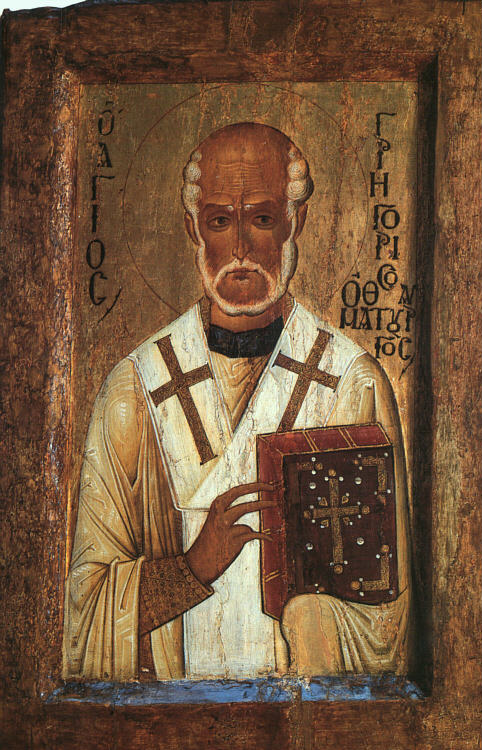
His life was first written down by Saint Gregory of Nyssa, most probably for his feast, in Neocaesarea. Saint Gregory of Nyssa had this story from his own family. His grandmother, Saint Macrina the Elder, had grown up in the Church founded by the Wonderworker, and she had told her grandsons, Basil and Gregory, of his deeds and his words. The Life of the saint in the Lives of the Saints later drew on this same witness.
The name Gregory comes from a Greek verb meaning "to stay awake", "to keep vigil". The troparion of the saint rests on this meaning of his name. Rendered into English from the Greek text of the Menaion, it reads roughly:
Keeping vigil in prayers and persevering in the working of miracles, you made your deeds your name. Entreat Christ God, Father Gregory, to enlighten our souls, lest we fall asleep in sins unto death.
In this way the troparion tells the mystery of his life. The greatest miracles in the life of Saint Gregory came after a night spent in prayer. Before he was a Wonderworker, Gregory was a man who kept vigil.
The Young Theodore
The saint was born around the year 213 in Neocaesarea, into a prominent family that worshipped idols. The name his parents gave him was Theodore. He was orphaned as a child and sent to the pagan schools, where he studied philosophy and medicine. The Lives of the Saints say that, by looking at created things, he began to know their Creator. When he heard the teaching of the Gospel, he followed it at once and received Baptism. From then on he lived in purity and kept his virginity to the end of his life.
His pure life annoyed the young men he studied with. They lived in debauchery, as was the custom of pagan youths, and his purity rebuked them without words. To shame him, they sent a harlot against him. She came while Gregory was talking with famous philosophers and demanded, in front of everyone, payment for a sin he had never committed. Gregory was ashamed and blushed like a maiden. He said nothing harsh to her and called no witnesses to his innocence. He only turned gently to a friend: "Give her quickly the price she asks, so that she may go away from us and trouble us no more."
The moment the woman took the money, she fell to the ground, tormented by an unclean spirit. The devil did not leave her until Gregory had prayed earnestly for her. The Lives of the Saints say that this was how his holiness and his miracles began, already in his youth.
Gregory had a friend from Cappadocia, Firmilian, who carried the same longing in his heart. Together they left pagan philosophy and went to learn the mysteries of Holy Scripture from Origen.
Origen was the most learned Christian of his time, but his life bore an old wound. In his youth he had mutilated himself, taking literally the Lord’s word about those who remain celibate for the sake of the kingdom of heaven1. The canons of the Church bar from the priesthood anyone who has mutilated himself2. Even so, two bishops in Palestine ordained him a priest, and his own bishop, Demetrius of Alexandria, deposed him. When Gregory came to him, Origen had already written the books that contain his errors, but the Church had not yet judged them.
The two remained with him for a long time. Then Gregory returned to his city.
Solitude and an Ordination from Afar
When he returned home, the leading men of the city sought him out. They wanted to have him among them as a magistrate, an official holding power in the city. He fled the glory of the world and withdrew into the wilderness, to live in abstinence and prayer.
Bishop Phaedimus of Amasea heard of him and saw the gift of God in him. He understood that this man would be a pillar of the Church, and he wanted to make him a bishop. Gregory knew beforehand what was being prepared. He thought himself unworthy and wandered from place to place in the wilderness so as not to be found.
Then Phaedimus did something unusual. Though he was three days’ journey away from him, he raised his eyes to God and prayed: "O God, who knowest all things and canst do all things, look upon me and upon Gregory at this hour, and accomplish his ordination by Thy grace." So he ordained Gregory bishop of Neocaesarea, though Gregory was not present. Saint Gregory of Nyssa says that Phaedimus caught Gregory with his word, since he could not catch him with his hand.
Gregory no longer resisted the will of God. Yet before he took the helm of the Church, he prayed and asked for help from on high for so great a work.
The Night the True Faith Was Revealed to Him
At that time the heresy of Paul of Samosata, who denied the divinity of Christ, was beginning to spread. The new bishop wanted to know for certain what he must preach. Gregory did not rely on what he had learned at school. He prayed earnestly to God and to the Mother of God to show him the true faith.
One night, as he was praying more fervently than usual, the Most Pure Virgin Mary appeared to him, shining like the sun. With her was the holy Apostle John the Theologian, clothed in hierarchical vestments. The Mother of God pointed to Gregory with her hand and commanded Saint John to teach him the mystery of the Holy Trinity and how one must rightly believe. Gregory wrote down with his own hand the words he received, and that page was kept for a long time in the church of Neocaesarea.
This confession of faith has come down to us. Here are a few lines from it3:
There is one God, the Father of the living Word, […] perfect Begetter of the Perfect, Father of the Only-begotten Son. There is one Lord, Only from the Only, God from God, the stamp and image of the Godhead […]. And there is one Holy Spirit, who has His being from God and has been made manifest to men through the Son […]. A perfect Trinity, neither divided nor estranged in glory, in eternity and in sovereignty […]. There is nothing created or servile in the Trinity, nothing brought in from outside […]. Never was the Father without the Son, nor the Son without the Spirit; the same Trinity remains ever unchangeable and unalterable.
These lines were written more than half a century before Nicaea. They already confess plainly what the Ecumenical Councils would later defend against the heresies. Saint Basil the Great and Saint Gregory of Nyssa leaned on them in their struggles for the true faith.
This confession also shows what Gregory left aside from his teacher’s school. In some writings Origen had placed the Son below the Father. The Creed says that in the Trinity there is nothing created, and that the Father was never without the Son. The disciple confessed the very faith his teacher had impaired, and he had received it in prayer, not at school.
The First Night in the Pagan Temple
On the road to Neocaesarea, the bishop was overtaken by evening and by heavy rain. Together with the other travellers, he had to enter a pagan temple. There were many idols there, and the demons who dwelt in them appeared to the temple servants and spoke with them. Gregory said there his customary prayers at midnight and at dawn. He signed with the Cross the air defiled by the sacrifices to the idols. The demons were terrified by the Cross and by his prayers, and they fled the temple.
In the morning Gregory went on his way. The servant of the idols came to offer sacrifice, but the gods no longer appeared to him. He begged them at length to return, and they cried out to him from afar: "We cannot enter the place where that stranger was, who was going from the wilderness to Neocaesarea." The servant ran after Gregory, caught up with him and threatened him with the emperor’s judgment.
Gregory calmed his anger with gentle words and told him: "Such is my God, that He commands even the demons, and He has given me power over them." The servant then asked him to command the gods to return. Gregory tore a piece of paper from his little book and wrote on it: "I, Gregory, command you, Satan: enter!" The servant placed the paper on the altar of the idols, and the demons came back and spoke with him as before.
The servant was terrified. He ran after the saint again and asked him where such power came from. Gregory began to speak to him of the one true God, who created all things by His word. On the way, the servant asked him for a miracle. There was a stone there as large as a mountain, which no human strength could move. Gregory commanded it in the name of Christ to move, and the stone went by itself to the place the servant pointed out. The man then confessed that the God preached by Gregory is the one true and almighty God. Saint Gregory of Nyssa adds that he left his house and his possessions and later became the saint’s deacon.
When Gregory entered Neocaesarea, he found only seventeen believers in the city. All the others worshipped idols. The saint prayed in the secret of his heart that God would enlighten so great a multitude of people gone astray. A leading man of the city, Musonius, received him into his house. People came there with their wives and children to listen to him and to see his healings. Not a day passed without someone coming to Christ. In a short time, those who had believed gave from their possessions and built a church.
The Lake, the River and the Mountain
Two brothers inherited a large lake from their father and could not come to an agreement over it. Each wanted the whole of it for himself. They chose Gregory as their judge. The saint came to the lake and tried to reconcile them by his word, but both remained unyielding. Each had many people on his side, and the quarrel had come close to war. The saint could barely stop them from fighting that day.
In the evening each went home, intending to fight the next day. Gregory stayed alone by the lake and spent the whole night in prayer. Then, in the name of the Lord, he commanded the lake to dry up and become good land for ploughing and sowing. The next day the brothers came with armed men and found green land where the water had been. They were reconciled, and all who were present glorified God. Saint Gregory of Nyssa sets this miracle beside the parting of the waters of the Red Sea by Moses and the halting of the Jordan before Joshua4.
Through the region flowed the river Lycus. In spring it burst its banks and flooded the villages, fields and gardens around it. The people heard that Gregory had commanded the lake and it had dried up. They all came, great and small, and fell at his feet. At first the saint told them: "God alone has set a bound to the waters." But they kept entreating him, and Gregory, seeing their distress, went with them to the river. He planted his staff at the edge of the riverbed and said: "Christ commands you, O river, no longer to go beyond your bounds." At once the staff grew into a great oak. From then on, whenever the waters came near the oak, they turned back. Saint Gregory of Nyssa says that the local people called that tree "the Staff".
Another time Gregory wanted to build a church in a beautiful place near a mountain. The site was too narrow for the foundation. The saint stood for a long time in prayer. Then, in the name of Jesus Christ, he commanded the mountain to move back as far as was needed. The mountain shook and moved, leaving room for the church. The Lives of the Saints say that such was the faith of this servant of God that he moved even mountains, according to the word of the Lord5.
Saint Basil the Great also mentions these miracles. He says that Gregory, in the name of Christ, changed the course of rivers and dried up the lake over which two covetous brothers were quarrelling. Basil writes that even his opponents called him "a second Moses".
Alexander the Charcoal-Burner
The city of Comana asked Gregory to appoint a bishop for it. The leading citizens put forward men of standing, wealthy and good speakers. Gregory listened to them and waited. Then one of them shouted in mockery that Alexander the charcoal-burner should be chosen, a poor man, black with soot and dressed in rags.
Gregory did not laugh. He asked for that man to be brought to him and spoke with him in private. He found that Alexander was a learned and pure man who hid his life under a humble trade in order to flee the praise of men. Gregory ordered him to be washed and dressed in his own garments, and then ordained him bishop of Comana. The Lives of the Saints say that Alexander was later found worthy of the crown of martyrdom.
This episode tells us something about the eyes of Saint Gregory. Vigil had cleansed his sight. A man who stands long before God sees in others what the world does not see6.
The Two Trees
Then a persecution came upon the Christians. An imperial decree ordered that all should be forced to worship the idols, and that those who would not bow should be tortured and killed.
Gregory knew that people have different measures. So he counselled those who did not feel able to endure the tortures to hide, according to the word of the Lord7. He told them: "It is better to hide for a little while and wait for the call and the help of the Lord God to the struggle of martyrdom than to deny the faith." He himself withdrew into the wilderness together with a deacon.
The persecutors sought the bishop first, since he was the head of the Christians of the region. Some pagans learned that he was hiding on a mountain and led the soldiers there. When Gregory saw them approaching, he understood that there was nowhere left to flee. He raised his hands to heaven and entrusted himself to God’s protection. He told the deacon to do the same. Both stood with their hands outstretched and prayed. The soldiers passed by them many times but did not see them.
Coming down from the mountain, the soldiers said to those who had brought them: "We found no one on this mountain, only two trees standing not far from one another." One of the pagans understood the miracle. He ran up the mountain alone, found the saint and the deacon standing in prayer, and fell at Gregory’s feet. He asked to become a Christian, and received what he asked.
What He Saw in Prayer
During that same persecution, Gregory was once saying his customary prayers. Suddenly he became greatly troubled and remained a long time motionless and silent, as if he were looking at something that broke his heart. Then his face grew bright. He began to give thanks to God in a loud voice and to sing: "Blessed be the Lord, who hath not given us as a prey to their teeth"8.
The deacon asked him why he had changed so. The saint told him that a Christian boy named Troadius had been brought to trial before the persecutor and, after many tortures, killed for Christ. "At first I was troubled, for I feared that the tortures might overcome him and that he might deny Christ. But now, seeing him complete the struggle of martyrdom and go up to heaven, I rejoice." The deacon marvelled that the saint saw what was happening far away as if it were near.
When the persecution had passed, Gregory returned to his see and gathered his flock again. He established yearly feasts in honour of the martyrs who had suffered in that persecution. Saint Gregory of Nyssa says that he did this wisely, so that the bodily merriment of the old pagan festivals might slowly be changed into spiritual joy.
Shepherd of the City
Saint Gregory was not only a worker of miracles. He was a shepherd who cared for souls with great discernment. After the Goths had passed through Pontus and plundered the region, some Christians fell into sin during the invasion. Gregory then wrote a letter in which he decided, case by case, how they were to be received back in repentance. The Church received this letter among her canons, and it is still read today in the collections of the canons of the Orthodox Church.
Around the year 264, Gregory took part, together with his brother Athenodorus, who had also become a bishop in Pontus, in the synod at Antioch. There the teaching of Paul of Samosata was examined.
Seventeen
Saint Gregory reached a great old age. When his end drew near, he asked those who stood around him: "How many unbelievers are still left in Neocaesarea?" They answered that only seventeen still worshipped idols, and that the whole city believed in Christ. Then the saint said:
Glory to God! For when I came to Neocaesarea as bishop, I found only seventeen Christians, the whole city being given to idols. And now, as I go to God, there remain as many unbelievers as there were believers at first, for now the whole city belongs to Christ.
Having said this, he gave up his soul into the hands of God, around the year 270.
The Legacy of the Wonderworker
The Church that Gregory left behind bore great fruit in the next generation. Macrina the Elder had received the faith from his disciples. She raised her grandsons, Saint Basil the Great and Saint Gregory of Nyssa, in this faith. Saint Basil wrote to the faithful of Neocaesarea that his teaching on the Holy Spirit was the same that they had kept from "the great Gregory". Thus, from the seventeen souls at the beginning, a whole Church arose. From it came the Fathers who defended the true faith in the following century.
What the Troparion Asks of Us
The troparion of Saint Gregory ends with a petition: that we may not fall asleep in sins unto death. The sleep it speaks of is not that of the body. It is the sleep of the soul that grows used to sin and no longer feels it.
The Lord said to His disciples in the Garden of Gethsemane: "Watch and pray, that ye enter not into temptation"9. Saint Gregory lived this word. His miracles were not works set apart from prayer. They were God’s answer to it. The true faith was revealed to him as he prayed at night. The pagan temple was emptied of demons after his midnight prayers. The lake dried up after a night of vigil. He saw the young Troadius overcome his torments while he stood in prayer. In the hour of persecution, the soldiers passed him by while he stood with his hands raised.
Few of us will move mountains or stop rivers. But each of us can stay awake a little before God, in the evening and in the morning, and ask, like the Wonderworker, that God enlighten our mind. From this small vigil begins the struggle against the sleep of sin.
Holy Hierarch Gregory, who kept vigil for a whole city until all of it belonged to Christ, pray for us, that we may not fall asleep in sins unto death.
Further reading (Romanian editions)
- Viețile Sfinților pe Noiembrie – Lives of the Saints commemorated in November.
- Despre viața lui Moise – Saint Gregory of Nyssa. On perfection in virtue and the ascent to God.
- Dreapta credință în scrierile Sfinților Părinți, vol. II – A patristic anthology on the confession of faith, including writings of Saint Gregory of Nyssa.
- Scara Raiului – Saint John Climacus. For a deeper understanding of prayer, vigil and spiritual life.
Commercial links to Booksell. These editions are in Romanian. Check each book’s page for price and availability.
- Matthew 19:12. ↩︎
- Apostolic Canons 22 and 23. ↩︎
- The confession of faith is preserved by Saint Gregory of Nyssa in his homily on the life of Saint Gregory the Wonderworker, and it is also given in the Lives of the Saints for 17 November. The lines above are translated from the Greek text. ↩︎
- Exodus 14:21–22; Joshua 3:14–17. ↩︎
- Matthew 17:20: "If ye have faith as a grain of mustard seed, ye shall say unto this mountain, Remove hence to yonder place; and it shall remove; and nothing shall be impossible unto you." ↩︎
- 1 Samuel (1 Kingdoms) 16:7. When God sent the prophet Samuel to anoint one of the sons of Jesse as king, Samuel thought that the chosen one was the first son brought before him, a tall young man of fine appearance. The Lord then told him that man looks on the outward appearance, but the Lord looks on the heart. The chosen one was David, the youngest of the brothers, who was keeping the sheep. ↩︎
- Matthew 10:23: "But when they persecute you in this city, flee ye into another." ↩︎
- Psalm 123:6 (124:6 in the Hebrew numbering). ↩︎
- Matthew 26:41. ↩︎
