
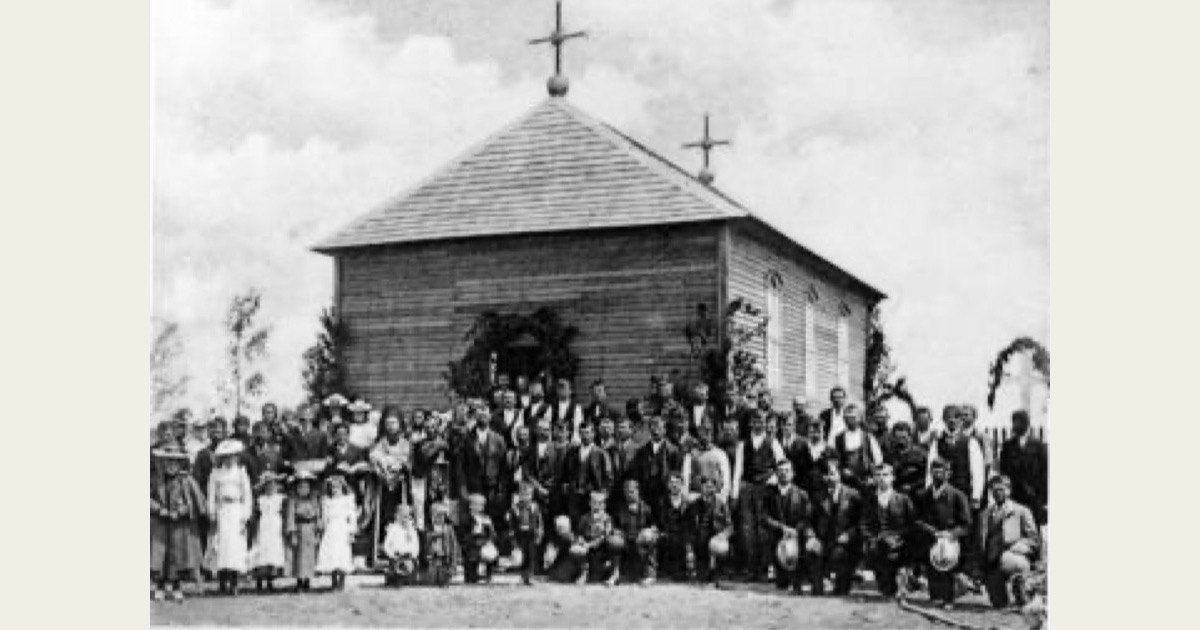
The first Romanian churches on the American continent were built by laymen. The emigrants who came from Transylvania, the Banat and Bukovina at the end of the nineteenth century bought land, gathered into mutual aid societies, raised money for building, and only afterwards sent word to the Old World asking that a priest be given them. That order of things settled the shape Romanian Orthodoxy took in America, and it settles it still.
The beginnings
In 1901, Romanians who had left Boian in Bukovina began the work of raising a church at Boian, in Alberta, some hundred kilometres north-east of Edmonton; the community received forty acres of land, and the church, begun in 1903, was finished and blessed on 2 August 1905. In 1902 the parish of St Nicholas was founded at Regina, Saskatchewan, and on 27 March 1903 Archimandrite Evghenie Ungureanu arrived there, sent with the blessing of the Metropolitan of Moldavia.
In the United States, on 15 August 1904, a hundred and one Romanians gathered in the house of Mihail Borza on Herman Street in Cleveland resolved to found the parish of St Mary, the first Romanian Orthodox parish in the country. In December 1905 Fr Moise Balea arrived there, the first Romanian Orthodox priest sent to America for mission by the Metropolis of Transylvania. In 1906 he began printing the newspaper America. In 1911, again from Sibiu, Fr Ioan Podea was sent with the charge of gathering the parishes into a deanery, and in 1912 the deanery came into being with sixteen parishes.
A division appears in these dates which will matter later: the clergy for the United States came from Sibiu, those for Canada from Iaşi. The communities were not founded by a mission sent out from a centre, but by men who had left to earn money and found themselves far from an altar. Bishop Policarp Morușca would say of that generation that no Romanian had left meaning never to return, but only to gather his thousand and his fare home.
The first diocese
The parishes remained without a bishop for a quarter of a century. Only at the general church congress held in Detroit between 25 and 28 April 1929 was it resolved to found a diocese, and the assembly asked the Holy Synod in Bucharest to send a hierarch. In 1935 Policarp Morușca arrived, the first Romanian Orthodox bishop in America. In 1937 the Grey Tower farm at Grass Lake, Michigan, near Detroit, was bought and named Vatra Românească; the centre was inaugurated on 3–4 July 1938 and has remained since then the heart of Romanian church and cultural life in the United States.
This settlement lasted a short time. In July 1939 Policarp left for Romania to take part in the labours of the Holy Synod and reached the country at the beginning of August. The outbreak of the war prevented his return, and after the communist regime was installed return became impossible; in 1948 he was forcibly retired.
The separation
The communist takeover divided the communities in America along political lines, and the break came in two stages, four years apart.
First, administrative autonomy was restored. The congress of 28 March 1947 abrogated the statute of 1936 and returned in essence to that of 1932, and in 1947 and 1948 the diocese reaffirmed its right to govern itself and to elect its own bishop. The statute of 1948 nevertheless preserved, in its own wording, unity with the Romanian Orthodox Church.
Meanwhile the Patriarchate appointed Bishop Antim Nica for America, whom the diocese in the United States refused to receive. In May 1950 the group holding with Bucharest organised itself in Detroit, and in June 1950 the new legal body was registered in Michigan under the name Romanian Orthodox Missionary Episcopate in America. Fr Andrei Moldovan, an American citizen, dean and parish priest at Akron, Ohio, was consecrated bishop at Sibiu on 12 November 1950, and on his return opened litigation for possession of the diocesan properties. The properties remained with the older diocese.
The full canonical break came at the special congress held in Chicago between 1 and 4 July 1951, which declared complete autonomy in canonical and spiritual matters alike, separating itself from the authority of the Patriarchate. The Federal Court decision of 1953 records this distinction between the two stages clearly.
So the two were settled: the Romanian Orthodox Episcopate of America, with its centre at Vatra Românească, broken from Bucharest, and the Romanian Orthodox Missionary Episcopate in America, remaining faithful to the Patriarchate, which in 1974 would be raised to the rank of archdiocese under the name Romanian Orthodox Missionary Archdiocese in America and Canada, and in 2016 to the rank of metropolia, under the name Romanian Orthodox Metropolia of the Americas, with two dioceses, one for the United States and one for Canada. The names of the two differ by a single word.
Valerian Trifa
On 2 July 1951 the Chicago congress elected as auxiliary bishop Viorel Dionisie Trifa, born at Câmpeni in Transylvania on 28 June 1914 and arrived in the United States in 1950. The election was for the rank of auxiliary because Policarp Morușca was still held to be the bishop of the diocese, detained in his country. The consecration followed on 27 April 1952 in Philadelphia, with the monastic name Valerian, performed by three Ukrainian hierarchs of a jurisdiction the other Orthodox Churches did not hold to be canonical. He became diocesan bishop only after Policarp’s death on 26 October 1958. He had received American citizenship in 1957.
In 1960 he entered, together with his parishes, the North American Metropolia of Russian origin, which in 1970 would become the Orthodox Church in America. The following year the bishops of the Metropolia consecrated him afresh, in order to remove any doubt concerning his earlier ordination and consecration, that of 1952 having been performed in a jurisdiction the other Orthodox Churches did not recognise. His past was not hidden within the Romanian community in America; it had been hidden from the immigration authorities.
It came to light later. In May 1975 the Department of Justice opened proceedings to revoke his citizenship. The legal proceedings concerned the concealment of his membership in the Iron Guard at his entry into the United States and at naturalisation; behind them stood the accusations regarding his part in the legionary rebellion and the Bucharest pogrom of January 1941, during which, according to the United States Holocaust Memorial Museum, more than a hundred Jews were killed. Trifa acknowledged that he had concealed the information but rejected the accusations of war crimes. The Church did not try him canonically for his legionary past; the investigation that would take his citizenship and end his stay in the United States was carried out by the American authorities.
On 25 August 1980 he voluntarily surrendered his citizenship papers, and the federal judge Horace Gilmore pronounced the revocation by a decree entered with the consent of the parties. In October 1982 an immigration judge ordered deportation. He left the United States in 1984, received with temporary residence in Portugal, where he died at Cascais on 28 January 1987. Bishop Nathaniel Popp succeeded him.
From the end of the nineteen-eighties, Ion Mihai Pacepa, a former Securitate general who had taken refuge in the United States, maintained that Trifa had been the target of a frame-up devised by his former colleagues. This has remained Pacepa’s assertion; Trifa’s own admission that he had concealed his membership in the Iron Guard stands in the court record, independently of it.
Valeriu Anania
Valeriu Anania, the future Metropolitan Bartolomeu of Cluj, had served six years of imprisonment between 1958 and 1964. In 1965 he was sent by the Romanian Orthodox Church to the United States, where he worked until 1976 in the Romanian Orthodox Missionary Archdiocese in America and Canada — that is, in the structure under Bucharest, the one in competition with Trifa’s diocese. He was diocesan secretary, cultural counsellor, general secretary of the church congress, director of the diocesan chancery and of the publications department. On 29 October 1967 he was ordained hieromonk by Archbishop Victorin Ursache, and the Synod granted him the rank of archimandrite. He lectured in Detroit, Chicago, Windsor and Honolulu.
Pacepa linked Anania’s being sent there to the campaign against Trifa. The supposition has remained a supposition. What can be said with grounds is that Anania worked eleven years within one of the two rival structures, in a community where men accused one another of collaboration and suspected one another of communist sympathies, and that the two regarded one another as men gone astray.
Gheorghe Calciu
Fr Gheorghe Calciu-Dumitreasa, born at Mahmudia in Dobrogea on 23 November 1925, spent the years 1948 to 1963 in prison, followed by forced residence in the Bărăgan until the amnesty of 1964, and was then imprisoned again between 1979 and 1984. The second sentence had come for the sermons he preached before theological students, in which he opposed the demolition of the churches of Bucharest. He was released on 20 August 1984, after interventions by world leaders. The defrocking pronounced by the Romanian Orthodox Church in 1984 would be lifted by Patriarch Teoctist ten years later.
In 1985 he was compelled to leave the country together with his wife Adriana and his son Andrei, against his own will; he went at the insistence of his family, who could no longer endure the surveillance. In America he worked at first as a bricklayer and carpenter, lodging with those who employed him and seeing his family every two or three weeks, and served as a missionary priest within the Romanian Orthodox Episcopate of America. For four years he lived in the parish house of the Romanian community in Cleveland. In 1988 he moved with his family to the Washington area, where the parish council of Holy Cross church in Alexandria, Virginia, had resolved to call him; he shepherded there until his death on 21 November 2006, listed in the diocesan directory as rector of that church. He was buried, according to his wish, at Petru Vodă monastery in Neamț county.
It is worth observing where he served: under the diocese at Vatra Românească, that is, under the structure broken from Bucharest, not under the one that remained faithful to the Patriarchate. A priest defrocked by the Patriarchate for his confession was received, with the defrocking still in force, by the side that had broken away precisely because of political control over the Patriarchate.
His end weighs more than it appears. The funeral was served first in America, by the auxiliary bishop Irineu Duvlea, and then in his country, at Radu Vodă — the church from which he had been driven in 1979 — by Patriarch Teoctist himself. What jurisdiction had not reconciled, the grave reconciled. It must also be said that the man had been forced out of the country, so that his return undid a compulsion rather than pronouncing judgment upon the Church that had received him.
The three men named here returned in three different ways. Anania returned alive, in 1976, and died Metropolitan of Cluj. Calciu returned in a coffin and was laid at Petru Vodă. Trifa died in Portugal, but his body was brought back across the ocean and buried in the cemetery of Vatra Românească. Of all three, it was the man who had bound the diocese to an American Church who found his grave in America.
The attempt at union
The separation was not accepted as final by either side. Dialogue between the two dioceses was resumed in 1993, and in 2008 it seemed concluded. The joint commission met between 25 and 27 February and signed a common declaration; in July the congresses of the two dioceses were held in parallel and received the proposal as an acceptable basis for continuing work toward a single metropolia, which would have kept a wide autonomy, would have consulted Bucharest in canonical matters, would have received Holy Chrism from there, and whose metropolitan would have taken part in the sessions of the Holy Synod. There were to follow the drafting of a definitive proposal, legal and financial verifications, and if needed an extraordinary congress.
The Patriarchate’s press office nevertheless went further and announced that the union had been decided, giving thanks for the accomplishment of the act. The diocese at Vatra replied that the announcement was premature, that no final decision had been taken, and that nothing had changed in its relationship with the Orthodox Church in America.
What was proposed, however, was not a return to the state of affairs before 1951. The united metropolia was to have its own synod and its own congress, to elect and consecrate its own bishops, and the Patriarchate would have had no right of interference either in its affairs or in judgment; there remained to it the standing of Mother Church, the gift of Holy Chrism, the recognition of the metropolitan, and canonical communion. And the project said of itself that the union of the Romanians was only a necessary and interim step toward the administrative unity of all Orthodoxy in North America. The joint declaration of February showed at the same time that the diocese at Vatra had never rejected the Romanian Patriarchate as its Mother Church, and that since 1991 relations between them had been marked by fraternal dialogue, concelebration and mutual visits.
The work went further. In 2009 the councils of the two dioceses met together; in October of that year the council of the diocese at Vatra examined an improved form of the project, and in June 2010 an annotated version was presented; a communiqué of October 2010 said that the dialogue was continuing, and Solia still spoke in 2011 of the dialogue between the two sister dioceses. After that, no undertaking of the same scope which brought the project nearer to fulfilment is to be found in the public record.
Where matters stand
The two remain separate, and the figures they publish do not permit a direct comparison, because each counts differently.
The Romanian Orthodox Episcopate of America, under the Orthodox Church in America, lists in its directory as updated in 2026 one hundred and six parishes and missions in the United States and Canada, to which three monasteries are added. The diocesan centre remains at Vatra Românească. Its hierarch is elected for life by an electoral congress of the diocese and consecrated by the Holy Synod of Bishops of the Orthodox Church in America.
The Romanian Orthodox Metropolia of the Americas, under the Romanian Patriarchate, counts its units in two different ways, according to the source. The directory on the metropolia’s site lists in the United States two cathedrals, twenty-two parishes and eleven missions, together with two monasteries, and in Canada four cathedrals, nineteen parishes and seven missions, together with one monastery; the communities in Latin America are listed separately. The statistics the Patriarchate gives for the year 2023 reckon otherwise: forty-one parishes in the Archdiocese of the United States, five of them Latin American missions, with sixty clergy and two monasteries, and in Canada thirty-seven parishes, forty-one clergy and two monasteries.
The difference comes from the categories. One source counts cathedrals, parishes and missions as distinct things; the other adds them together. Anyone wanting an honest comparison must first say what he is counting. And the number of churches says nothing about the number of those who come through the door on a Sunday, since neither of the two structures publishes verifiable figures on the faithful.
The number of parishes says little, however, beside what a study made in 2011 shows. Alexei Krindatch then counted almost all the Orthodox parishes in the United States, 98.6 per cent of them responding, and measured among other things how much is served in English and how strongly each parish regarded its own ethnic culture. On a scale from zero to ten, the territorial dioceses of the Orthodox Church in America came out at 1.5, the average of all Orthodox parishes in the country at 4, the Romanian Archdiocese under the Patriarchate at 8.1 — and the diocese at Vatra at 7.5.
Language shows the same thing. In the parishes of the Vatra, English accounted on average for thirty-two per cent of the Liturgy, thirty-two per cent of the sermon and twenty-seven per cent of the choir’s singing. In the territorial dioceses of the same Church, English passed ninety-five per cent.
The explanation lies in the nineteen-nineties. The Orthodox Church in America wrote in 2002 that the Romanian diocese had known in the preceding decade an explosive growth, with thousands of new immigrants arriving from Romania, dozens of parishes and missions founded, and many of the older parishes enlarged. The same wave fed the other structure as well: the parishes of the Archdiocese under the Patriarchate grew from eleven in 1990 to thirty-one in 2010.
Here is seen the most unexpected thing in this whole history. The diocese that had chosen in 1960 to enter a local Church was, thirty years later, made Romanian again by immigration. Its canonical standing is American, and its parishes speak Romanian. In 2026 Archbishop Nathaniel said that the diocese can no longer rely on immigration for growth as it had relied in the decades before.
These figures call for a reservation. The measurement of 2011 shows a state, not a change, since no comparable study exists from before 1989 to set beside it. That the wave of immigrants turned the diocese back toward the language and custom of home remains, therefore, the best explanation of the state measured, not a thing proved by comparison.
Two points of comparison
Something similar happened among the Russians, but with a different ending. The Russian Orthodox Church Outside Russia had broken off administrative ties with the church authority in Moscow in 1927, after the declaration of Metropolitan Sergius by which the Church pledged its loyalty to Soviet rule. It never held itself to be autocephalous, however, but an inseparable part of the Russian Church, governing itself until the circumstances that had caused the separation should cease. Eighty years passed without communion between them. On 17 May 2007, in the Cathedral of Christ the Saviour in Moscow, Patriarch Alexei II and Metropolitan Laurus signed the Act of Canonical Communion, and the Church Outside Russia entered the Moscow Patriarchate as a self-governing part. This happened one year before the Romanian congresses.
The Russians were not the only ones. A separation still closer to the Romanian one occurred among the Serbs in America in 1963, when the Holy Assembly of Bishops in Belgrade divided the single diocese of the United States and Canada into three, and Bishop Dionisije refused to submit and was deposed; the parishes that followed him formed the Free Serbian Orthodox Church. The separation lasted nearly thirty years. The restoration of unity began in 1992, through common communion, with diocesan structures still parallel, and was completed in 2009, when the Holy Assembly resolved to abolish the parallelism and to order the dioceses into a single administration.
The two reconciliations have one thing in common, and that thing is absent among the Romanians. Neither the Church Outside Russia nor the free Serbs had entered under another Church; they had remained apart. Reconciliation therefore required the agreement of two parties, and for both it was the only way out of canonical isolation. The diocese at Vatra, however, had taken in 1960 a step which neither the Russians nor the Serbs had taken: it had entered another ecclesial structure. From then on, return could no longer be a reconciliation between two separated parties, but required also the resettling of its canonical bond with the Orthodox Church in America. It was not the possibility of return that was lost, but its simplicity — and, along with it, its necessity.
The Russians abroad also named openly what they expected from Moscow: the glorification of the New Martyrs and the clarification of the Church’s relation to worldly power. In the year 2000 Moscow did two things they held to be decisive, glorifying the New Martyrs and adopting the Social Concept, which sets the limits of the Church’s obedience to the state. In the negotiations that followed, the commissions of the two sides reached a common formulation on the relation between the Church and political power. Between Bucharest and the Vatra there was no list of expectations, nor any act of comparable weight concerning the Patriarchate’s relation to the communist regime.
Three answers
In the pan-Orthodox work concerning the diaspora it has been acknowledged in writing that the strictly canonical order is the existence of only one bishop in one place. The document of Crete, of 2016, adds openly that the passage to this order is not possible for the present, for historical and pastoral reasons, and that the episcopal assemblies remain a temporary measure.
Until the way is found, the emigration has tried three answers, and all three may be seen in the history above.
The first is continued dependence on the Mother Church. The Metropolia of the Americas follows it, as does the Romanian archdiocese founded in London in 2024. Its drawback is that it never comes to an end: the community remains ordered as an emigration long after it has ceased to be one.
The second is entry into a local Church. The diocese at Vatra has followed it since 1960. It keeps its language, its custom and its own bishop, elected by its own people, but moves the decision into a synod of the place. No one was asked to change language or usage; what changed was only who consecrates the bishop and where the decision is taken. The price is seen in 2008: the bond with the Mother Church can no longer be restored by a simple reconciliation.
The third is remaining independent, reckoned temporary, until circumstances become clear. The Russians outside Russia and the free Serbs in America followed it, and both carried it through to the end. It requires, however, that the separation have a cause capable of ceasing, and that both sides acknowledge that it has ceased.
Romanian Orthodoxy in North America tried the first two at once, in the same place. From this comes the fact that in the same city there may stand today two Romanian parishes, with Romanian priests and Romanian faithful, which do not have the same bishop.
Until 1950 the Romanians there had a single bishop, even if from 1939 Policarp Morușca was in his own country, prevented from returning. Communism explains the separation of 1951. It no longer explains, by itself, the separation of today.
In the meantime the diocese at Vatra has spent sixty-six years within an American synod, has received its bishops from there, and has come to understand itself as a Romanian diocese of a local Church. In the address given to the diocesan congress of 2023, Archbishop Nathaniel said that the Romanian diocese is a diocese of a wider church unity, and that in its case that unity is the Orthodox Church in America. In 2008 it had been ready to restore the canonical bond with the Mother Church, but only within a metropolia almost entirely autonomous, which the union project itself called a temporary step toward the unity of all North American Orthodoxy.
Nor does the difference run between the old Romanians and the new, since the wave after 1989 entered both structures. What began as a political separation can no longer be described today as merely a remnant of communism. In the seventy-five years that have passed, an ecclesiological difference has also come into being: two answers to the question of where the Romanian bishop in America ought finally to stand — in a synod of Romania, or in a synod of the place.
Image: the Romanian community in Regina, Saskatchewan, before the first Romanian church in North America, 1904. Unknown author; Saskatchewan Archives Board, R-B2485. Public domain, via Wikimedia Commons.