
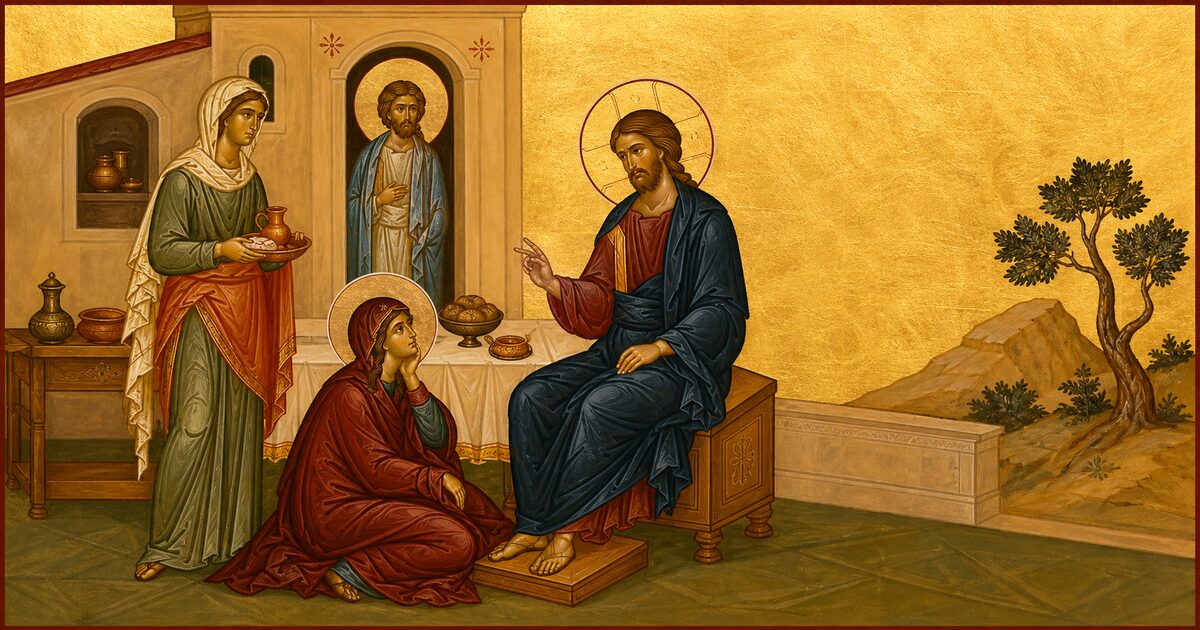
On the fourth of June, the Church honours the holy and righteous Martha and Mary, the sisters of Lazarus of Bethany, whom she also commemorates on the Sunday of the Myrrh-bearing Women. They are, perhaps, among the most familiar women of the Gospel — and yet their lives, and the reading the Fathers gave to the two sisters, remain little known to most. We recognise them at once from a few scenes: one serving in the house, the other sitting at the feet of the Lord, both weeping at the tomb of their brother. Behind these scenes, however, lies a teaching that embraces, in two persons, the whole of the Christian life.
Bethany, the Household Christ Loved
Bethany was a small village a few kilometres from Jerusalem, beyond the Mount of Olives. There stood a house into which Christ entered as into His own. The Evangelist John says it plainly: “Now Jesus loved Martha, and her sister, and Lazarus” (John 11:5). There are few places in Scripture where the Lord’s love for one particular family is spoken of by name like this. In this house of the three siblings — Martha, Mary, and Lazarus — He who had nowhere to lay His head found rest, friendship, a table, and a listening ear. This is why Bethany is not merely a village: it is the icon of the Christian home in which Christ is awaited and received.
The three are never separated, neither in the Gospel nor in the Church’s veneration. And to understand who the two sisters are, we must first say who their brother is.
Where We Find Them in the Gospel
The few Gospel scenes in which we meet the three siblings are these:
- Luke 10:38–42 — Martha serves; Mary listens at the feet of the Lord.
- John 11:1–45 — the death and raising of Lazarus; the confession of Martha.
- John 12:1–8 — the anointing at Bethany, the myrrh of Mary.
- John 12:9–11 — the resolve of the chief priests to put Lazarus also to death.
Lazarus, the Friend of Christ
Saint and Righteous Lazarus is no marginal figure. He stands at the very heart of the Gospel, at the threshold between the work of Christ and His Passion.
When Lazarus fell ill, the sisters sent the Lord a humble word, full of trust: “Lord, behold, he whom thou lovest is sick.” And yet Christ deliberately delayed, allowing His friend to die. Saint John Chrysostom sees here a law of the spiritual life, not an abandonment: “to those especially dear to God it belongs to endure these things; since Lazarus also was one of the friends of Christ, and was sick” (St. John Chrysostom, Homilies on the Gospel of John, 62.1). The sickness and death of the beloved are not a sign that God has forgotten, but often the way by which He prepares a greater glory.
When He came, His friend had lain four days in the tomb — whence the name by which the Church honours him: “Lazarus of the Four Days.” Before the tomb, Christ spoke the words that are the foundation of our hope: “I am the resurrection, and the life: he that believeth in me, though he were dead, yet shall he live” (John 11:25). And before calling him out, He did what is nowhere else said of Him so briefly and so movingly: “Jesus wept” (John 11:35). True God and true Man, He wept at the tomb of a friend, only to cry to him with a loud voice: “Lazarus, come forth” (John 11:43) — and the dead man came out.
The raising of Lazarus is not one miracle among others. It is, by the Church’s witness, the foremost pledge of the general resurrection: by raising Lazarus before His own Passion, Christ confirmed the resurrection of all. This is why, in the order of the Church year, Lazarus Saturday is set immediately before the Entry into Jerusalem, as a door into Holy Week: what was done to Lazarus will be done, at the end, to all.
Yet it must be said that Lazarus did not rise into the state of incorruptible glory in which Christ would rise, He who, being raised from the dead, “dieth no more.” Lazarus was called back into this life, still bearing a mortal body, and would die again. But precisely this return of one four days dead, whose body had begun to see corruption, shows the power of Christ’s voice over death and proclaims the day when all who are in the tombs will hear the voice of the Son of God.
Because the sign was too great to be denied, it also hastened the resolve to put Christ to death — and, with Him, the one He had raised: “But the chief priests consulted that they might put Lazarus also to death; because that by reason of him many of the Jews went away, and believed on Jesus” (John 12:10–11).
According to the tradition of the Church, in the persecution that followed the killing of the Archdeacon Stephen, Lazarus was forced to leave Judea and found refuge in Cyprus. There the holy Apostles Paul and Barnabas appointed him bishop, the first of the city of Kition (present-day Larnaca). He shepherded, according to tradition, for some thirty more years, and there he fell asleep a second time — this time awaiting the final resurrection.
Nor is historical witness lacking. In the year 890, at Larnaca, his second tomb was discovered, bearing a marble slab inscribed: “Lazarus of the Four Days, the friend of Christ.” The Emperor Leo VI built over the tomb the Church of Saint Lazarus — one of the few Byzantine churches preserved in Cyprus to this day — and translated a portion of his relics to Constantinople in the year 898; the commemoration of this translation is kept on the seventeenth of October. Thus the life of Lazarus binds together, in a wondrous way, Palestine, Cyprus, and — later, through the relics carried to the West after the Fourth Crusade — France as well.
A clarification is in order, however, for here East and West followed different threads: the Western tradition made Lazarus a bishop of Marseilles, transferring his see to Provence. The Eastern tradition knows him as bishop of Kition, in Cyprus — and there it keeps his tomb and his commemoration. We shall see shortly that this is not the only time the Western tradition followed another thread concerning this family.
Martha: Work and Confession
We meet Martha most clearly in the house at Bethany, when Christ comes as a guest. She “was cumbered about much serving” — cooking, ordering, labouring that the welcome might be worthy. Mary, meanwhile, sat at the feet of the Lord and listened. Martha, with a grievance every housekeeper understands, asks for help: “Lord, dost thou not care that my sister hath left me to serve alone?” And the Lord answers her with a gentleness that does not scold but sets her in order: “Martha, Martha, thou art careful and troubled about many things: but one thing is needful: and Mary hath chosen that good part, which shall not be taken away from her” (Luke 10:41–42).
This word has often been misread as a condemnation of Martha. It is not. Martha’s serving is a work of love, and without it neither home nor Church nor mercy stands. The Lord does not condemn the serving, but the scattered care — “troubled about many things” — the anxiety that loses sight, amid so many good labours, of the One for whose sake one labours. Martha is the image of the working life, of the welcome given to the stranger — that love of strangers the Fathers call the first step of virtue — of the hands that do not rest.
But Martha is not only the woman of labour. She is also the woman of confession. For at the death of Lazarus, “as soon as she heard that Jesus was coming, [she] went and met him: but Mary sat still in the house” (John 11:20). She runs out first, with sorrow and faith together: “Lord, if thou hadst been here, my brother had not died.” And it is she who utters a confession few take note of: “Yea, Lord: I believe that thou art the Christ, the Son of God, which should come into the world” (John 11:27). This stands, in power and clarity, beside the confession of Peter at Caesarea Philippi — and she speaks it in the face of death, when faith is hardest to hold. Martha “troubled about many things” is, at the same time, Martha whole-hearted in confession.
There is yet another word of Martha’s that shows how inseparable the two sisters are. After meeting Christ and confessing Him as the Son of God, Martha turns and calls her sister, saying to her secretly: “The Master is come, and calleth for thee” (John 11:28). Here Martha is no longer only the one who serves the table, but the one who brings another to Christ. Her labour becomes a calling; her care becomes proclamation. Martha draws Mary out of the house of mourning and leads her to the feet of the Lord, where Mary had always found her place.
Mary: Stillness and Myrrh
Mary is the other face of the same love. We see her first as the one “which also sat at Jesus’ feet, and heard his word” (Luke 10:39). Her place is not in movement but in stillness; not in the many things but in the “one.” Her silence is not idleness, but gathered attentiveness — the whole being’s attention to a single word. This is why her portion is called “good” and “shall not be taken away from her”: the labour passes, the table is cleared, the guest departs, but the word heard in stillness remains in the heart.
At the tomb, too, Mary keeps the same bearing. She does not run, but waits to be called; and when she comes, she falls at the feet of the Lord — where we find her each time — and weeps. The tears of Mary and of those who had come with her trouble the Lord, and the grief of the two sisters gathers before Him like the grief of all mankind in the face of death. Mary’s stillness is not insensibility, but silent love, which weeps and worships.
It is Mary, too, who, six days before the Passover, at Bethany, at the supper where the risen Lazarus reclined once more at table with the Lord — a meal that was itself a feast of the victory of life over death — “took a pound of ointment of spikenard, very costly, and anointed the feet of Jesus, and wiped his feet with her hair: and the house was filled with the odour of the ointment” (John 12:3). Her act is a lavishing of love — a precious myrrh poured out all at once, without reckoning. Judas murmurs that it has been “wasted,” but Christ receives the myrrh as a good work and reveals it as what it truly was: a foretelling of His burial — “Let her alone: against the day of my burying hath she kept this” (John 12:7).
This is why Mary of Bethany is numbered among the Myrrhbearers, the women of the myrrh. When the Church calls her so, she does not do it because the Gospels place her by name among the women who went to the tomb on the morning of the Resurrection — for there they are not named — but because she sees in the anointing at Bethany the same love of the myrrh: the love that honours the Body of the Lord before His burial and that, in a liturgical manner, is joined to the love of the Myrrh-bearing Women. The fragrance that filled the house is the very fragrance of her life: hidden, poured out, whole.
The Two Lives
The Fathers have always seen in the two sisters the two lives of the soul turned toward God: work and vision, action and contemplation — what tradition calls praxis and theoria. Martha is the work: the hands that serve, almsgiving, ascetic labour, obedience in outward things. Mary is stillness: the mind gathered at the feet of the Lord, the hearing of the word, the prayer that is silent and beholds.
Saint John Cassian, gathering the teaching of the desert fathers, gives this reading its clear form. Interpreting the Lord’s word to Martha, he writes that the Lord “makes the chief good consist not in practical work however praiseworthy and rich in fruits it may be, but in contemplation of Him, which indeed is simple and but one” (St. John Cassian, Conferences, I.8). And he adds a discernment worth remembering: though the Lord “says nothing of Martha, and certainly does not appear to blame her, yet in praising the one, He implies that the other is inferior” (ibid.).
What matters is that the two do not war against each other. It is not a question of one good life and one bad, but of an order: the work prepares, purifies, and opens the way; the stillness receives. “One thing is needful” does not abolish Martha’s serving, but sets it under a single head — Christ. He who serves without hearing the word falls into the anxiety of the “many things”; he who would hear without having passed through the labour of serving rarely has the heart purified enough to hear. This is why the Church keeps the two sisters together, in the same house and on the same day of commemoration: they are one human being before God, with the hands of Martha and the heart of Mary.
In the hesychast tradition, Mary’s sitting at the feet of the Lord is the icon of inner stillness — of the gathered attentiveness of a mind that, leaving the “many things,” rests in a single word. Not an empty stillness, but a full one: the stillness of one who listens. “The good part” is precisely this — the one thing that shall not be taken from us, not even by death.
A Clarification: Mary of Bethany Is Not Mary Magdalene
Here it is fitting to say plainly what, in the West, was confused for centuries. In the Eastern tradition, Mary of Bethany, the sister of Martha and Lazarus, is a person distinct from Mary Magdalene (commemorated on the twenty-second of July) and from the sinful woman in the Pharisee’s house, who also anointed the feet of the Lord (Luke 7). They are three women, not one.
It must be added, too, that the anointing by Mary of Bethany (John 12, at the feet of the Lord, six days before the Passover) is not the same as the anointing the Church sings on Great Wednesday — that of the sinful woman of Luke 7. There are two women and two anointings: one of the deliberate love of the disciple, the other of repentance. And the shared detail — the anointing of the feet and the wiping of them with the hair, which appears both in Luke and in John — is the very thing that, in the West, nourished their conflation.
The medieval Western tradition, especially in the wake of a homily of Pope Gregory the Great in the sixth century, developed an identification that merged these three figures into one — “Mary Magdalene, the sister of Lazarus, and the sinful woman.” The trace of this identification is seen in the Roman calendar itself, where for a long time Martha was commemorated alone, on the twenty-ninth of July, without her sister and without her brother. Indeed, the Latin Church itself acknowledged, in a decree of 2021, the traditional uncertainty about Mary’s identity, and changed the commemoration of the twenty-ninth of July to “Saints Martha, Mary, and Lazarus,” celebrating the three siblings together once more.
The clarification is no quarrel of erudition. It helps us read the Gospel rightly. Mary of Bethany is, indeed, the one who anointed the feet of the Lord with the myrrh of nard (John 12) — and so a Myrrhbearer. But she is not the sinful woman of Luke 7, nor Mary Magdalene, from whom seven demons went out and who stood first at the empty tomb. To keep them distinct means to give each her own honour, and not to mingle, under a single name, three distinct works of grace. It is the same clarity with which the East keeps Lazarus bishop of Kition, and not of Marseilles: tradition does not move persons, nor melt one into another.
After the Gospel
What became of the two sisters after the Lord’s Ascension? The Gospel is silent, but the tradition of the Church preserves a humble witness. In the persecution that followed the killing of the Archdeacon Stephen, when Lazarus was driven out of Judea, the sisters accompanied their brother and helped in the preaching of the Gospel in foreign lands. One tradition places their end in Cyprus too, beside their brother, the bishop of Kition; other synaxaria, however, keep silence about the place of their repose, saying only that they accompanied Lazarus in the preaching of the Gospel.
Of the manner of their end, then, little is known — and this silence is itself a teaching. The two women whom Christ loved by name did not seek a name of their own. Their glory rests not in resounding deeds, but in the One whom they served and to whom they listened. Martha served, Mary kept silence and anointed with myrrh, both confessed and both wept at the tomb — and the Church has numbered them among the saints and among the Myrrhbearers not for what they left behind, but for the One whom they received into their house and into their hearts.
Liturgical Veneration
The Church celebrates the holy Martha and Mary on the fourth of June and, together with the other myrrh-bearing women, on the Sunday of the Myrrh-bearing Women — the third Sunday of the Pentecostarion, that is, the second Sunday after the Sunday of Pascha. Their brother, Saint Lazarus, is honoured on Lazarus Saturday, before Palm Sunday, and on the seventeenth of October, when the bringing of his relics is commemorated.
The bond between the three commemorations is seen most clearly in the troparion of Lazarus Saturday, which is also the troparion of Palm Sunday: “By raising Lazarus from the dead before Thy Passion, Thou didst confirm the universal resurrection, O Christ God. Like the children with the palms of victory, we cry out to Thee, O Vanquisher of death: Hosanna in the highest! Blessed is He that cometh in the name of the Lord.” The raising of one alone at Bethany is, in the Church’s hymn, the surety of the resurrection of all.
The hymns of the day see Martha and Mary not separately, but together with Lazarus: sisters who believed in Christ with strength, who adorned themselves with the virtues, and who were counted worthy to dwell, together with their brother, in the choir of the saints. Thus the Church’s veneration does not narrow them to the scene in Luke — one serving, the other listening — but shows them as two whole women: believing, loving, confessing, and praying.
What the Two Sisters Teach Us
Martha and Mary are, together, the whole of the Christian life. We are not to choose between them, but to bear them both: the hands that serve and the heart that listens; the love of strangers and prayer in stillness; the confession of faith in the face of death and the fragrance of love poured out without reckoning. Work without stillness scatters itself; stillness without work withers. The house at Bethany gives us both, under a single Lord.
And so, celebrating them on the fourth of June and on the Sunday of the Myrrh-bearing Women, we entreat the holy Martha and Mary, together with their brother, Saint Lazarus of the Four Days, the friend of Christ, to intercede for us: that, amid the “many things” with which we trouble ourselves, we may never lose “the good part” — Him who is the resurrection and the life.
Related: Eastern tradition carefully distinguishes Mary of Bethany from Saint Mary Magdalene, the Myrrh-bearer and Equal to the Apostles, the disciple healed by the Lord and sent to proclaim His Resurrection.