
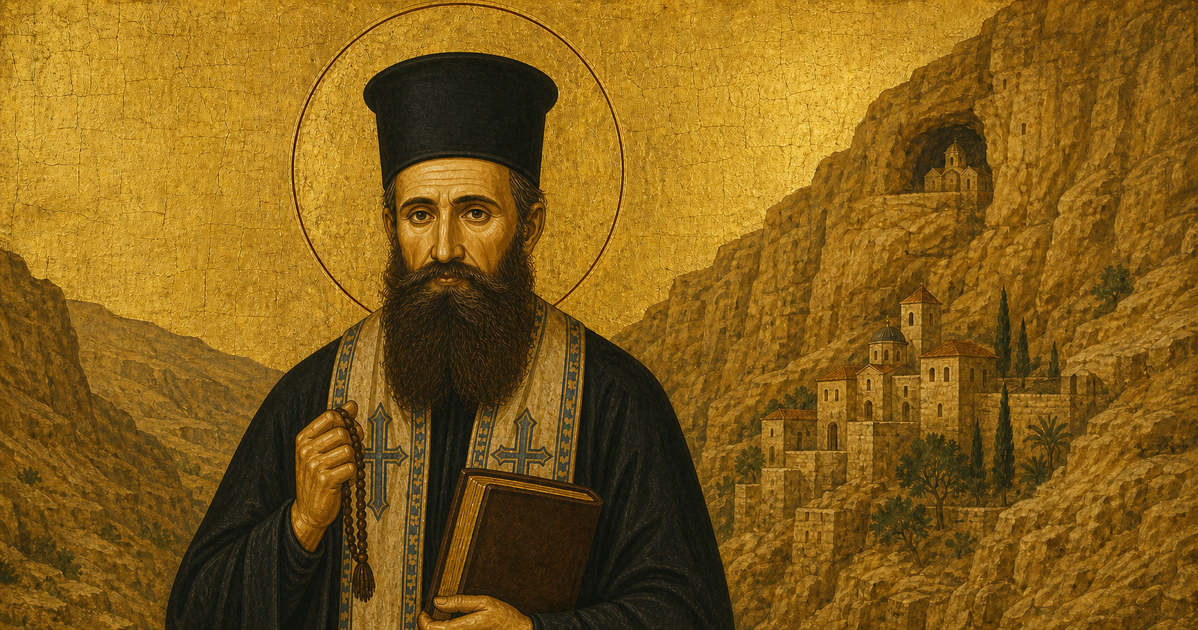
On the fifth of August the Church commemorates Saint John Jacob of Neamț, also called the Chozebite, a Romanian monk who struggled for twenty-four years in the Holy Land and reposed in 1960 in the cave of Saint Anna in the wilderness of Chozeba. Twenty years later, when his grave was opened, his body was found incorrupt. His holy relics rest today in the Monastery of Saint George of Chozeba, near Jericho.
Childhood and coming to Neamț
He was born on the twenty-third of July 1913, in the village of Crăiniceni, in the commune of Horodiștea, then in the county of Dorohoi — a place found today within the county of Botoșani, in the north of Romania — to a pious peasant family, Maxim and Ecaterina Jacob, and received at baptism the name Elias. He lost his mother when he was a few months old and his father during his childhood years, remaining in the care of his grandmother Maria, who taught him prayer from infancy, and afterwards in the care of his uncle Alecu Jacob, who helped him complete his schooling.
In the summer of 1933, at the age of twenty, he entered the brotherhood of Neamț Monastery, received there during the abbacy of Bishop Nicodemus Munteanu, later Metropolitan of Moldavia and Patriarch of Romania. He was placed under the guidance of the monk Job, who cared for the monastery infirmary, and was given obediences in the infirmary and in the library. Between 1934 and 1935 he completed his military service at Dorohoi, again as an infirmarian, after which he returned to the same obediences.
The library of Neamț held translations and Philokalic manuscripts, together with numerous writings of the Fathers, copied in Romanian and in Slavonic through the labours of Saint Paisius of Neamț and his disciples a century and a half earlier. There the young monk read, and from that treasury he shared with others as well. The accounts preserve a habit of his: every day he would carry books to the fathers of the monastery, and whenever he saw a brother downcast or overcome by temptation, he would first ask him whether he had read from the Lives of the Saints, and would place in his hands a book of profit.
Tonsure and departure for the Holy Land
On the eighth of April 1936, on Great Wednesday of Holy Week, he was tonsured a monk by the archimandrite Valerie Moglan, later auxiliary bishop at Iași, in the great church of the monastery founded by Stephen the Great, and received the name John. His sponsor and spiritual father was the hieromonk Joachim Spătarul, abbot of the skete of Pocrov.
According to the life written by his disciple, he had carried the desire to reach Mount Athos, where the old calendar was kept, even before completing his military service, and at that time he had been unable to depart for precisely that reason. After his return from the army and after his tonsure, he set out for Jerusalem, where the Patriarchate kept, as it keeps to this day, the Julian calendar for the feasts of the year.
The longing to dwell in the land where the Lord walked is ancient in the life of monks, and many strugglers had set out before him on the same road. In the autumn of 1936 he began preparing for the journey, using the portion of inheritance left him by his parents, from which he also paid the passage of the two monks of Neamț who accompanied him: the hieromonk Claudiu Derevleanu and the monk Damaschin Trofin. They set out in November 1936, from the port of Constanța toward Haifa, with the blessing of Metropolitan Nicodemus of Moldavia. Beyond this the sources do not speak. We find in the accounts no departure kindled by contention, but a monk who left with a blessing and in peace.
In the wilderness of the Jordan and at the Lavra of Saint Sabbas
Having arrived in the Holy Land, he venerated Golgotha, the Tomb of the Lord and the other places hallowed by the earthly life of the Saviour, at Bethlehem and in Galilee. His companions returned home; he remained.
For two years he struggled in a cave in the wilderness of the Jordan, and then entered the brotherhood of the Lavra of Saint Sabbas the Sanctified, between Bethlehem and the Dead Sea, where he spent eight years. The accounts say that here he received the gift of tears and the prayer of the heart. His spiritual father was the hieroschemamonk Sabbas, a Macedonian by birth, who knew the Romanian tongue. He fulfilled several obediences in the brotherhood: caring for the sick, serving in the church, keeping the library and guiding pilgrims. During the Second World War he was taken, together with other monks, to a camp on the Mount of Olives, and after his release he returned to the same obediences.
The abbacy at the Jordan and the withdrawal to Chozeba
On the fourteenth of September 1947 he was ordained priest in the Church of the Holy Sepulchre and appointed abbot of the Romanian skete by the Jordan, under the care of the Romanian Patriarchate, near the place of the Lord’s Baptism. He shepherded there for five years.
The longing for stillness and for a more austere manner of life led him to lay down the abbacy. In November 1952, with the blessing of Patriarch Timothy of Jerusalem, he entered together with his disciple, the schemamonk Ioanichie Pârâială, the brotherhood of the Monastery of Saint George in the wilderness of Chozeba, in the valley of the brook Cherith, where biblical tradition places the withdrawal of the Holy Prophet Elias in the days of King Ahab.
The cave of Saint Anna
In the summer of the following year he withdrew to the cave known as the Cell of Saint Anna, hewn into the rock high in the cliff, which could be reached only by a ladder — like those caves in walls of stone where other hermits also struggled, among them Saint Ioanichie the New of Muscel, to whose cell one descended by a rope. There he remained until his repose, eating for the most part dried bread, a little fruit and water, brought to him from time to time by a brother.
He fell asleep in the Lord on the fifth of August 1960, in the forty-seventh year of his life. According to the testimony of his disciple, he had foretold the nearness of his end. At the burial, performed by Amphilochius, abbot of Chozeba, the same accounts say that the cave filled with the small birds he had fed daily during his life. He was buried in the place he had prepared for himself, in the rock beside his cell.
His writings
Saint John Jacob wrote throughout his whole monastic life, and his writings were gathered and published under the title From Jericho to Zion. According to the ordering set out in the book, they fall into four parts: verses containing teachings on the passions and the virtues; spiritual writings in prose — letters, gatherings from the Holy Fathers, translations and compositions of his own; liturgical services; and translations from the Fathers.
He learned Greek, and the biographical accounts mention some knowledge of Arabic as well. He translated from the Greek chosen pages from the Holy Fathers; with these texts he first nourished himself, and afterwards he nourished those who came to him.
The Jesus Prayer stands at the heart of his teaching. The verses of the first part, as the book sets forth, were composed for the putting off of the passions and the putting on of the virtues, so as to ease for the reader the way toward this prayer. When he expounds it, he gathers the words of the Apostle Paul, of Saint Macarius, of Saint John of Karpathos and of Saint John Chrysostom, showing that the invocation of the Lord’s Name is set within the reach of all alike — of the young and of the old, of the lettered and of those without learning — each labouring at it according to his own measure and, in its deeper degrees, under spiritual guidance.
A good part of his writings are letters and words of reply to those who remained in the world. His verses often look upon the age in which he lived: the learned who labour to prove that there is no God, the man who raises again the tower of Babel, the fashions and the spirit of the times. In a poem addressed to his disciple Ioanichie he left these lines: should sorrow come upon him near his grave, let him go to their skete, for unseen the saint would go there too.
The finding of the relics
In the summer of 1980, twenty years after his repose, the grave in the cave of Saint Anna was opened, and his body was found whole, untouched by time, giving forth a sweet fragrance. With the blessing of Patriarch Benedict of Jerusalem, the holy relics were brought down from the cave, laid in a reliquary of cypress wood and carried in procession, together with hierarchs of the Patriarchate of Jerusalem and a multitude of pilgrims, to the Monastery of Saint George of Chozeba, where they remain to this day beside the relics of Saint George of Chozeba. Those who come to pray see him, through the glass of the reliquary, as a monk asleep.
The incorruption of a body is not of itself the ground of sanctity, for the Church knows also natural causes of incorruption. In the discernment of the Church such a sign is not separated from the witness of a whole life: it may be received as a seal, and not as a proof standing on its own. So it was received by those who had known Saint John Jacob, who set first the life, and then the sign.
His veneration
Father Petroniu Tănase, a dweller at the Romanian skete of Prodromu on Mount Athos and known to him from the years at Neamț, set down in an article printed in the journal Biserica Ortodoxă Română the signs by which God glorified the hermit of Chozeba: a life of high sanctity, the foretelling of his end, the burial attended by the birds, the finding of the incorrupt body after twenty years, and the sweet fragrance of the relics.
In a homily devoted to his life, Saint Cleopa Ilie of Sihăstria bore witness to the sanctity of the hermit of Chozeba, showing at the same time that God does not make saints of the rich, nor of those praised by men, nor of the learned, but of the humble and the meek, who pray unceasingly and have a pure heart.
The Holy Synod of the Romanian Orthodox Church numbered him among the saints on the twentieth of June 1992, under the name of Saint John of Neamț — the Chozebite, with his commemoration on the fifth of August, the day of his repose. On the thirty-first of January 2016, following the synodal decision taken in the autumn of 2015, the Patriarchate of Jerusalem proclaimed at the Monastery of Saint George of Chozeba his inscription in its own Synaxarion, appointing his commemoration on the twenty-eighth of July according to the Julian calendar, a date which corresponds today to the tenth of August on the civil calendar. He is the first Romanian saint so inscribed in the Synaxarion of the Patriarchate of Jerusalem.
In remembrance of the obedience he fulfilled at Neamț, librarians have taken him as their protector, and he is honoured as spiritual patron of the National Library of Romania.
The life of Saint John Jacob does not require of all that they seek the wilderness; it shows rather what constancy can work within a calling once received. In the infirmary and the library of Neamț, at the Jordan, in the obedience of the abbacy and afterwards in the silence of Chozeba, he kept the same labour: prayer, the service of his neighbour, and the nourishing of the mind from the words of the Fathers. And so the hermit hidden in the rock has remained near to those who live in the world, through his writings and through the prayer with which the Church calls upon him today.
Sources
- Saint John Jacob the Romanian (the Chozebite), From Jericho to Zion, Jerusalem, 1999.
- Petroniu Tănase, “Alte știri despre Cuviosul Ioan cel Nou Hozevitul”, in Biserica Ortodoxă Română, C (1982), no. 3–4, p. 297.
- Cleopa Ilie, Predici la praznice împărătești și la sfinți de peste an, Editura Episcopiei Romanului.
- The Life of Saint John Jacob, composed by his disciple, the schemamonk Ioanichie Pârâială.