
Today we speak of the Church of Greece, the Romanian Church, the Russian Church, or the Serbian Church as autocephalous Churches. Each elects its own primate and governs its own affairs, without being administratively subject to another Church.
But how did each of them attain this status? Who granted its autocephaly?
The answer seems as though it ought to be simple. It is not.
Some Churches had been self-governing since ancient times, and an Ecumenical Council merely defended their rights. Others received autocephaly from another Church. Still others proclaimed it themselves and were recognised decades or even centuries later. Sometimes the emperor intervened; at other times it was the king, the sultan, or the modern state. And in several cases, two Patriarchates maintain different accounts to this day of who had the right to grant autocephaly.
Here lies the key to the whole history: autocephaly did not arise everywhere in the same way.
What autocephaly means
The word comes from Greek and literally means “to be one’s own head.”
An autocephalous Church elects its own primate and does not depend, in its governance, on the primate of another Church. Autocephaly therefore concerns the organisation of the Church, not her faith.
The Church of Cyprus and the Russian Church are independent of one another in governance, but they confess the same faith and belong to the same Orthodox Church.
Three things that are easily confused must be distinguished from the outset:
autocephaly — the right of a Church to govern herself; rank or honour — the place one see occupies among the others; * ecclesiastical communion — the fact that two Churches recognise one another and serve together.
Ecclesiastical communion, or simply communion, means that their bishops and clergy may serve together and that the faithful of one may receive Holy Communion in the other.
One Church may be in communion with another without the latter recognising its autocephaly. This is precisely what happens today in the case of the Orthodox Church in America.
At first, autocephaly was not granted by a tomos
In the modern period, autocephalies are generally set out in a tomos, a solemn ecclesiastical act proclaiming the new status. In the first centuries, however, no such procedure existed.
The oldest Churches did not become autocephalous through a ceremony in which someone handed them a document.
Rome, Alexandria, and Antioch already possessed extensive rights over their territories before the Ecumenical Councils put them into writing.
Alexandria provides a very good example.
At the beginning of the fourth century, Bishop Meletius of Lycopolis came into conflict with Bishop Peter of Alexandria. The dispute had begun over how Christians who had denied the faith during the persecutions should be received back. Meletius did not stop there, however, but began ordaining clergy and appointing bishops in Egypt without Alexandria’s consent.
The matter had therefore become one of jurisdiction: who had the right to govern the bishops of Egypt?
The Council of Nicaea in 325 answered in its sixth canon: the “ancient customs” were to be maintained, according to which the bishop of Alexandria held authority over Egypt, Libya, and the Pentapolis.
Nicaea did not give Alexandria a new autocephaly. It recognised and defended an order that already existed.
This is the first model we meet in history:
a Church is already self-governing by ancient custom, and a council confirms her rights when they are challenged.
Cyprus: autocephaly defended by an Ecumenical Council
Cyprus offers an even clearer case.
In the fifth century, the Patriarchate of Antioch was attempting to extend its authority over the Cypriot bishops. They appealed to the Council of Ephesus in 431 and said, in essence: Antioch is trying to take something that has never belonged to it.
The Council upheld their claim.
The eighth canon ruled that the bishops of Cyprus should elect their own primates according to their ancient custom, and it formulated a broader rule: no bishop was to extend his power over a province that had not been subject to him from ancient times.
Here too the Council did not create an autocephalous Church out of nothing.
Cyprus possessed independence; Ephesus defended it.
But councils could also change the order
The history does not end there.
If we had only Alexandria and Cyprus, we might think that councils merely confirmed what already existed. Constantinople and Jerusalem show that they could also change the order.
Constantinople did not possess the apostolic antiquity and standing of Rome, Alexandria, or Antioch. Its importance grew with the political importance of the city.
In 381, the Second Ecumenical Council gave the bishop of Constantinople precedence of honour after the bishop of Rome, “because it is New Rome.”
At Chalcedon in 451, Canon 28 went further and also gave Constantinople important rights of jurisdiction. The decision was disputed by Pope Leo the Great.
The long dispute between Jerusalem and Antioch was also settled at Chalcedon. Jerusalem had received a special rank of honour at Nicaea, but not the corresponding jurisdiction. In 451, the bishop of Jerusalem received the three Palestines, while Antioch retained Phoenicia and Arabia.
Here we have a second model:
ecclesiastical authority not only confirms an ancient situation but may also alter ranks and ecclesiastical boundaries.
The two models — confirmation of an ancient status and creation of a new order — will appear again and again in history.
Georgia: an autocephaly that took shape gradually
In Georgia’s case, it is difficult to point to a single day and say: “autocephaly was born then.”
The Georgian Church gradually emerged from dependence on Antioch. Some traditions place the beginnings of its autocephaly in the fifth century, but the process continued for a long time, and around the year 1010 the Georgian primate appears with the title Catholicos-Patriarch.
This is why sources and historians give different dates.
Georgia shows us a third model:
autocephaly may be a process, not an event that happened on a single day.
Serbia: who has the right to grant autocephaly?
In 1219, Saint Sava of Serbia travelled to Nicaea. Constantinople was then under Latin occupation, while the Byzantine emperor and the patriarch were living in exile.
Patriarch Manuel I consecrated Sava as Archbishop of the Serbs, and the Serbian Church became self-governing.
There was, however, a problem.
Some of the dioceses included in the new Serbian Church had until then belonged to the Archbishopric of Ohrid, which regarded itself as autocephalous. Archbishop Demetrios Chomatenos of Ohrid protested and maintained that the patriarch at Nicaea had no right to detach territories from his Church.
The dispute matters because it raises the question that has not disappeared even today:
who has the right to grant autocephaly, and what happens if the territory in question already belongs to another Church?
In 1346, Serbia took another step. Stefan Dušan proclaimed himself emperor, and an assembly of hierarchs raised the Serbian Church to the rank of patriarchate. Constantinople did not accept the decision, and a rupture followed that was healed only in 1375.
Thus, even within the history of the same Church, we find two different situations: an autocephaly granted in 1219 and an elevation to patriarchal rank disputed in 1346.
Russia: autocephaly taken during the crisis of Florence
The Russian case is different again.
Metropolitan Isidore of Kiev, sent by Constantinople, had accepted the union with Rome decided at the Council of Ferrara-Florence. In Russia, the union was rejected.
In 1448, the Russian bishops elected Jonah as metropolitan on their own, without Constantinople’s approval.
From that moment Moscow governed itself in practice.
Constantinople did not grant it a tomos of autocephaly at the time. Only in 1589 was the primate of Moscow raised to the rank of patriarch, and the decision was confirmed synodally in the following years, through 1593.
Almost a century and a half passed between de facto independence in 1448 and full recognition.
Russia therefore shows us another situation:
a Church may become independent in practice long before its new status is recognised by the others.
The ecclesiastical ground invoked for this decision was the defence of the faith against the union of Florence. The Russian case therefore differs from the national autocephalies of the nineteenth century, even if it too cannot be separated entirely from the political circumstances of its time.
The nineteenth century changes everything
So far we have spoken chiefly about bishops, councils, and the old empires. In the nineteenth century, however, a new force appears: the nation-state.
Orthodox peoples gradually emerge from Ottoman rule and establish states of their own. Almost at once a question arises: if we have an independent state, why should our Church remain governed from Constantinople?
From here come the modern autocephalies of Greece, Romania, Bulgaria, Serbia, and, later, Albania.
But they too did not follow the same path.
Greece proclaimed its Church autocephalous by an act of the state in 1833. Constantinople recognised it in 1850.
In the Romanian Principalities, Alexandru Ioan Cuza declared by decree in 1864 that the Church was independent in matters of organisation and discipline. Constantinople officially recognised the autocephaly of the Romanian Church in 1885.
Serbia received full autocephaly in 1879, after gaining political independence.
Bulgaria followed the most painful road. The Bulgarian Exarchate was established in 1870 by a firman of the sultan. Constantinople condemned the situation in 1872, and a schism followed that lasted until 1945.
Albania proclaimed its autocephaly in 1922 and was recognised by Constantinople in 1937.
A pattern can be seen here that appears again and again:
the state becomes independent → the local Church asks for or proclaims independence → negotiations and sometimes conflict follow → recognition eventually comes.
But the interval between these steps may be a few years or several generations.
Sometimes autocephaly meant recovering a lost independence
There is another important qualification.
Serbia and Georgia, for example, were not simply asking for something they had never possessed.
The Serbian Patriarchate of Peć was abolished in 1766, and the Archbishopric of Ohrid in 1767. The Georgian Church lost its autocephaly under Russian rule in 1811 and proclaimed its restoration in 1917.
For some peoples, therefore, modern autocephaly was understood not as the acquisition of a new independence, but as the restoration of an old one.
Poland and the Czech lands: two answers to the question “who may grant it?”
In the twentieth century a problem appears that brings us very close to today’s disputes.
The Orthodox Church of Poland received autocephaly from Constantinople in 1924. Moscow did not recognise the act, regarding the territory as belonging to its own jurisdiction.
In 1948, Moscow in turn granted autocephaly to the Church of Poland.
Today no one disputes that the Church of Poland is autocephalous. But Moscow and Constantinople do not tell the same story about where that autocephaly comes from.
Something similar happened with the Orthodox Church of the Czech Lands and Slovakia. Moscow granted it autocephaly in 1951; Constantinople did not recognise that act and issued its own tomos in 1998.
How the act of 1951 should be judged canonically is still debated by historians and canonists.
The dispute here is no longer whether these communities are canonical Orthodox Churches.
The question is another:
who had the right to grant them autocephaly?
This is one of the great unresolved canonical problems of contemporary Orthodoxy.
Unrecognised autocephaly does not necessarily mean schism
An essential distinction must be made here.
The fact that one Church does not recognise another’s autocephaly does not automatically mean that it regards the other as schismatic or without sacraments.
The clearest example is the Orthodox Church in America.
It received autocephaly from Moscow in 1970. Some local Churches recognise it as autocephalous, while others, including Constantinople, do not. Nevertheless, it is recognised as a canonical Orthodox Church, and Eucharistic communion exists.
Three questions must therefore be kept separate:
- Is this community a canonical Orthodox Church?
- Is it autocephalous?
- Who had the right to grant its autocephaly?
The answers are not always the same.
The three cases disputed today
There are at present three important cases in which the question of autocephaly is not received in the same way by all the local Churches.
The Orthodox Church in America received autocephaly from Moscow in 1970. Some Churches recognise it as autocephalous; others regard it as canonical but not autocephalous.
The Orthodox Church of Ukraine received its tomos of autocephaly from Constantinople in 2019. Moscow rejects both the manner in which it was constituted and Constantinople’s right to grant it autocephaly, and the dispute has produced a grave rupture in relations among the local Churches.
The Church in North Macedonia emerged in 2022 from the ecclesiastical isolation in which it had remained for decades. Constantinople restored communion with it under the name Archbishopric of Ohrid, and the Serbian Patriarchate subsequently granted it autocephaly. Several Churches have received this status, but there is not yet a single pan-Orthodox position on all its aspects.
The three cases are different, but all lead to the same old question:
is it enough for the Mother Church to grant autocephaly, or is the consent of the whole Orthodox Church required, and, if so, who expresses that consent?
The Orthodox tried to find a common rule
The problem has not been ignored.
In preparation for the future Great Council of the Orthodox Church, the local Churches spent decades discussing precisely the procedure for granting autocephaly.
At Chambésy in 2009, they came very close to an agreement.
In broad outline, the proposed mechanism was this: the Mother Church receives the request and determines whether the conditions for autocephaly are present; if it agrees, it refers the matter to the Ecumenical Patriarchate; the consensus of all the autocephalous Churches is sought; the autocephaly is then proclaimed by a tomos.
The discussions stalled, however, over the form in which the signatures were to be placed on that tomos and the manner in which the authority of those involved was to be expressed.
For this reason, the subject of autocephaly did not reach the agenda of the Council of Crete in 2016 in an agreed form.
Orthodoxy therefore came very close to a common procedure, but did not succeed in completing it.
How, then, does an autocephalous Church actually come into being?
After almost two thousand years of history, the answer does not fit into a single formula.
There have been at least several paths:
an ancient independence confirmed by an Ecumenical Council — Cyprus; a gradual emergence from the Church on which it depended — Georgia; an autocephaly granted by one ecclesiastical authority but disputed by another — Serbia; an independence taken in practice and recognised much later — Russia; an autocephaly proclaimed together with the independence of the state and recognised later — Greece, Romania, Albania; a proclamation followed by schism and recognition after many decades — Bulgaria; * rival acts of autocephaly issued by two Patriarchates — Poland and the Czech Lands and Slovakia.
History therefore does not leave us a simple rule such as: “autocephaly is always granted by X.”
But neither does history support the opposite conclusion: “anyone may declare themselves autocephalous, and that is enough.”
A Church may come to govern herself before being recognised by all the others. But for her autocephaly to become undisputed throughout Orthodoxy, the other Churches must eventually receive it.
Here lies the difference between de facto independence and autocephaly received by the whole Church.
In brief
If this entire history had to be reduced to a few sentences, they would be these:
Autocephaly means independence in governance, not a different faith.
The autocephalous Churches did not all arise through the same procedure. Some were independent from ancient times, some received autocephaly, and others proclaimed it and waited for recognition.
The state and politics have almost always played a part, from Byzantine emperors and Ottoman sultans to modern nation-states.
The proclamation of autocephaly and its recognition are not the same thing. Sometimes decades or even centuries have passed between them.
Even today there is no pan-Orthodox procedure accepted by all the Churches for granting a new autocephaly. This is precisely why the cases of Ukraine, America, and North Macedonia produce different answers.
The great problem of autocephaly, then, is not only whether a Church can govern herself.
The question that returns from century to century is:
who has the right to say that from now on she may?
To this question Orthodoxy has not yet given an answer received by all.
In the second part, we shall see what this passage from the ancient ecclesiastical centres to the present world of autocephalous Churches has produced, and how it has changed the life of Orthodoxy, for good and for ill.
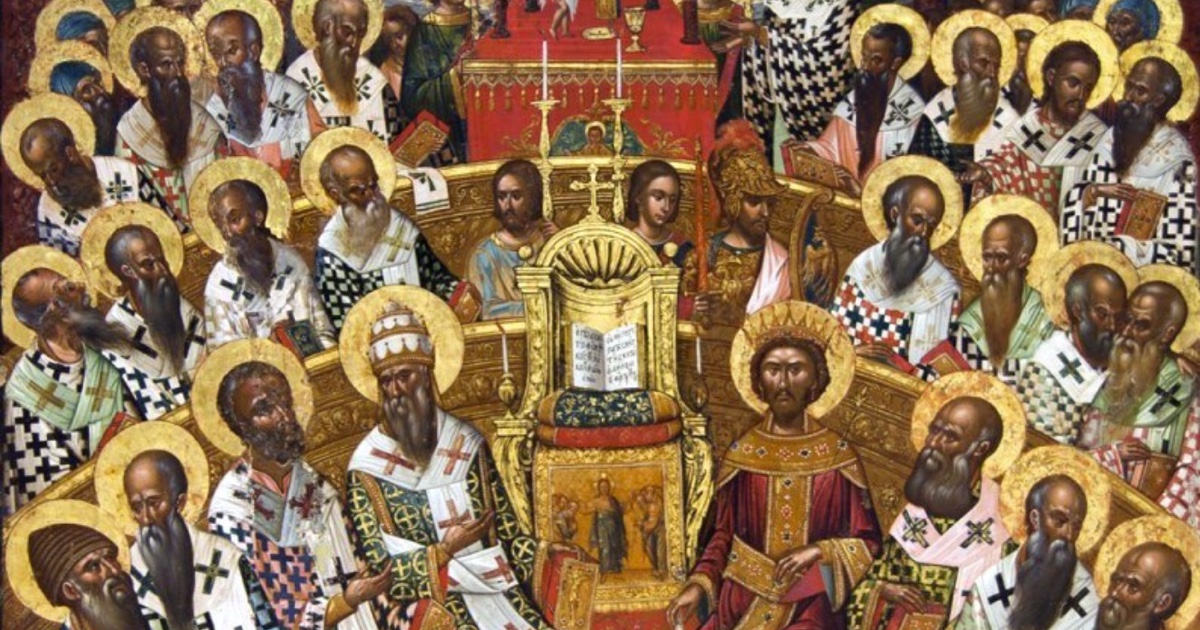
Image: Michael Damaskinos, The First Ecumenical Council (1591), Cretan icon. Public domain, via Wikimedia Commons.