
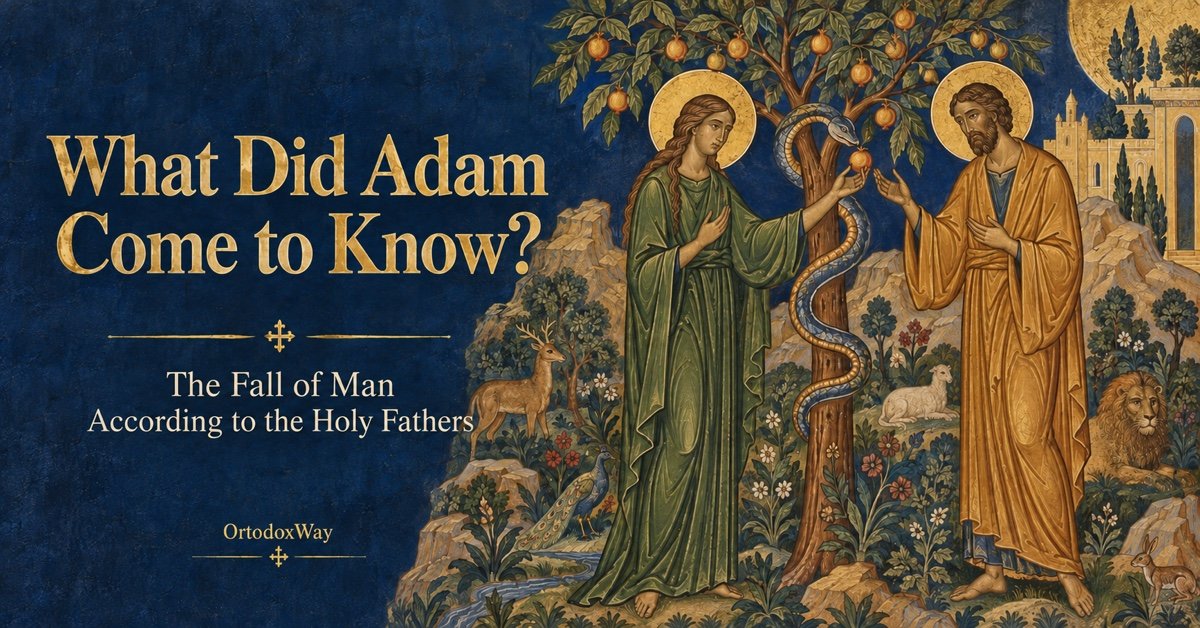
The Book of Genesis tells how the first human beings, Adam and Eve, ate from the tree of which God had commanded them not to eat. The Church calls this disobedience the fall of man, because through it man fell from the life he had shared with God in Paradise.
We usually say that Adam bit into an apple. Scripture, however, does not say what kind of fruit it was; it speaks only of the fruit of the tree of the knowledge of good and evil. The Holy Fathers do not dwell on the fruit. They look at what took place in the heart of man at that moment.
For the Fathers, the fall meant the breaking of the bond of love and obedience by which man lived from God. The serpent had promised that, by eating from the tree, they would be “as gods, knowing good and evil” (Genesis 3:5). Yet the knowledge Adam received was the experience of evil, which he learned by losing the good.
Adam before the Fall
God created man according to His image and likeness (Genesis 1:26). Saint John of Damascus explains that man is according to the image of God through his mind and his free will, and according to the likeness through virtue, as far as this is possible for him. The image he received together with life; toward the likeness he was called to grow, working with the gifts he had received.
Adam, however, was not a man who had reached the end of the road. Theophilus, bishop of Antioch in the second century, writes that God placed man in Paradise “giving him an occasion for progress, so that, growing and becoming perfect, and even being declared a god, he might thus ascend into heaven, possessing immortality.” The same Theophilus says that man was made by nature neither mortal nor immortal: “If God had made him immortal from the beginning, He would have made him a god. And if He had made him mortal, God would seem to be the cause of his death.” Man was made capable of receiving either. By keeping the commandment, he would have received immortality from God as a reward and would have become a god. By breaking it, he would himself become the cause of his own death.
Of the state of the first human beings, Scripture says: “And the two were naked, both Adam and his wife, and were not ashamed” (Genesis 2:25). Saint John Chrysostom interprets these words in his fifteenth Homily on Genesis. He says that as long as sin and disobedience had not yet entered, the two were clothed with “the glory from above,” which did not let them feel shame. Shame and the awareness of nakedness entered only after the commandment was broken. In another homily he says that the glory from above covered them better than any garment.
Saint Diadochos of Photiki is one of the Fathers included in the Philokalia, the collection of writings on prayer and on watchfulness, that is, vigilance over one’s thoughts. He shows that Eve, as long as she kept the commandment in her mind, was covered by the wings of divine love, and for this reason did not know her nakedness.
Saint Gregory the Theologian adds that God honoured man with the gift of free will, “so that the good might be his by choice,” no less than it belonged to Him who had sown in him the seeds of the good.
The Tree of Knowledge and the Commandment
In the midst of Paradise stood the tree of life and the tree of the knowledge of good and evil (Genesis 2:9). God gave Adam a single commandment: “but of the tree of the knowledge of good and evil—of it ye shall not eat, but in whatsoever day ye eat of it, ye shall surely die” (Genesis 2:17).
The Holy Fathers show that this tree was not evil. Theophilus of Antioch writes: “The tree of knowledge was good, and its fruit was good. For it was not the tree, as some think, that had death in it, but the disobedience.” He adds that there was nothing else in the fruit but knowledge, and knowledge is good when one uses it as one ought. Saint Gregory the Theologian says the same thing and rebukes those who think that God begrudged men this tree. Whoever thinks so, he says, imitates the serpent.
Why, then, did God forbid this tree to Adam? Saint Gregory answers that the tree would have been good had man tasted of it at the proper time: “For the tree was, according to my understanding, contemplation, which only those who have reached a perfect habit can enter upon without danger. It is not good for those who are still simpler and greedy, just as solid food is not good for those who are still tender and need milk.” By contemplation the Fathers mean the spiritual beholding of divine things. Theophilus uses the same comparison. He says that Adam was “still an infant in age,” and that, just as a child cannot eat bread as soon as it is born but is first fed with milk, so it would have been with him.
The commandment, then, was a school for man’s freedom. Saint Gregory says that God gave man this law “as material for his free will to work upon,” and calls it a kind of education of our souls, a bridle on delight. This commandment was at the same time a fast. Saint Basil the Great says, in his first homily on fasting, that fasting is as old as mankind, because it was given as a law already in Paradise. Saint Gregory the Theologian writes of us, the descendants of Adam: “We fasted, because we would not fast, overcome by the tree of knowledge.”
What the Fall Consisted Of
The serpent first cast doubt on the word of God. Then he slipped into the woman’s heart the suspicion that God was keeping human beings away from some good: “Ye shall not surely die. For God knew that in whatever day ye should eat of it your eyes would be opened, and ye would be as gods, knowing good and evil” (Genesis 3:4–5).
Saint Maximus the Confessor shows that the devil hid his envy under the appearance of a feigned goodwill. In this way he persuaded man to turn his desire away from God toward a created thing. The first man, says Saint Maximus, fell sick with ignorance of his own Cause, that is, of God, from whom he had received his being. Following the serpent’s counsel, he supposed that the very thing the commandment had forbidden him to eat was God.
The serpent’s promise concealed a deception. God Himself willed that man should become a god by grace. The Fathers call this union of man with God deification. Saint Maximus says that God had forbidden the tree, perhaps, only for a time. Man was first to come to know, by grace, the Cause of his being; then, once deified, he could have beheld creation together with God, without danger. Adam wanted to reach the same goal by another road. In another work, Saint Maximus says that Adam sought to make his own, through the senses, the things of God “without God, before God, and not according to God.”
Saint Athanasius the Great speaks in the same way of all human beings. Casting away the things that are eternal and turning, at the devil’s counsel, to the things that are corruptible, men “became themselves the cause of their own corruption in death.” By corruption the Fathers mean the unravelling of nature, which leads to death. Man was corruptible by nature, because he had been brought into being out of nothing. But the grace of the Word of God, that is, of the Son, in which he partook, would have kept him from corruption had he remained good. Man did not have immortality from himself. He could receive it only from God, by abiding in Him.
The fall, then, began within, before the hand reached out toward the tree. Scripture describes its course: “And the woman saw that the tree was good for food, and that it was pleasant to the eyes to look upon and beautiful to contemplate, and having taken of its fruit she ate, and she gave to her husband also with her, and they ate” (Genesis 3:6). Saint Diadochos of Photiki says that Eve is the first to teach us that sight, taste and the other senses, used without measure, turn the heart away from the remembrance of God. The remembrance of God means unceasing recollection of Him. After Eve had looked at the tree with longing, touched it with desire and tasted its fruit, all her desire turned toward what lay before her senses.
What Adam Came to Know
The serpent had promised opened eyes. Scripture says: “And the eyes of both were opened, and they perceived that they were naked, and they sewed fig leaves together, and made themselves aprons to go round them” (Genesis 3:7). Their eyes were opened, but the first thing they saw was their own nakedness. Saint Gregory the Theologian writes of Adam: “And the first thing he came to know was his own shame, and he hid himself from God.”
Saint John Chrysostom shows that Adam knew how to distinguish good from evil even before the fall. Otherwise God would not have given him a commandment. The tree received its name from what took place beside it. After they had eaten, the two were stripped of the glory from above and came to know sin and shame.
In the language of Scripture, to know often means to live through a thing, not merely to have heard of it. Until then Adam had known the good by living it in God. Now he came to know evil as well, in the same way: by experience.
Saint Maximus says that man, cut off from the knowledge of God, was left to know visible things through the senses alone. Like the irrational animals, he learned by experience that his body lives from visible things: from food, from water and from air. For this reason he made the visible world into a god. Bound to the body, he put all his zeal into tending it and pampering it. So man worshipped creation instead of the Creator. Ever since, he eats unceasingly from the tree of disobedience. Whenever he seeks life in created things, apart from God, he tastes once more of the forbidden fruit. This fruit gives him, through the senses, a knowledge of good and evil mixed into one. He receives the good of creation mixed with evil: pleasure with pain, life with death.
The same Father shows that visible creation may rightly be called the tree of the knowledge of good and evil. Beheld spiritually, it gives the knowledge of good, because it leads man to God. Received carnally, for the pleasure of the senses alone, it gives the knowledge of evil and becomes a teacher of the passions. The passions are the sick impulses of the soul, which enslave man and make him forget divine things.
Fear and Hiding
When they heard the Lord God walking in Paradise in the cool of the evening, Adam and his wife hid among the trees (Genesis 3:8). “And the Lord God called Adam and said to him, Adam, where art thou?” Adam answered: “I heard thy voice as thou walkedst in the garden, and I feared because I was naked and I hid myself” (Genesis 3:9–10).
Theophilus of Antioch says that in Paradise the Word of God used to converse with Adam. Now Adam flees from His voice. Fear has taken the place of trust, and the shame he first came to know makes him hide from the One who created him.
Blame Cast on Another
God did not ask Adam where he was because He did not know. Theophilus of Antioch says that God, being long-suffering, “gave him an occasion for repentance and confession.” Adam’s answer, however, reveals a new wound: “The woman whom thou gavest to be with me—she gave me of the tree and I ate” (Genesis 3:12). Adam casts the blame on the woman, and with the words “whom thou gavest to be with me” he turns it even against God. The woman, in her turn, says that the serpent deceived her (Genesis 3:13). The man who had obeyed God with the simplicity of a child no longer finds in himself the words “I have sinned.”
Pleasure and Pain
Saint Maximus describes what then took place in man as a bond that draws ever tighter. The more man knew visible things through the senses alone, the more he bound himself to ignorance of God. The more he bound himself to this ignorance, the more he clung to the pleasure that things gave him. From this pleasure there was kindled in him the passionate love of self, which the Fathers call philautia.
But man learned by experience that pain follows such pleasure. Ever since, he puts all his strength into seeking pleasure and fleeing pain, thinking he can separate the one from the other, which is impossible. Saint Maximus shows that from this pursuit of pleasure and this flight from pain, both springing from self-love, countless passions are born. From pleasure are born gluttony, pride, vainglory and love of money. From pain are born anger, envy, hatred and despair.
Theophilus of Antioch says the same in few words: from his disobedience man drew, “as from a fountain, toil, pain and grief,” and in the end he fell prey to death.
Saint John of Damascus nevertheless shows that the pleasure of the food that sustains life and of the clothing we need is natural and necessary. The pleasure of lawful marriage is also natural, although a man can live without it. Whoever wishes to live according to God receives these with measure and renounces drunkenness, fornication and gluttonous excess. Evil begins when man seeks pleasure in place of God.
The Scattered Mind
Saint Maximus says that Adam, falling into ignorance of God, mingled the whole power of his mind with the senses. The mind, which the Fathers call in Greek nous, is the inner eye of the soul, through which man can know God. After the fall, this eye became enslaved to the senses. Saint Diadochos of Photiki says that the natural perception of the soul is one, but through Adam’s disobedience it was divided into two modes of operation. Saint Gregory the Theologian shows that the fall into sin comes through the five senses, and that the war is waged around them, because they stand open to temptations.
From this wound begins the work of the hesychasts, the fathers of the prayer of the mind. They seek to gather the mind, scattered outward through the senses, and to bring it back into the heart, to the remembrance of God. We have written about this work in the article “Thinking and the Heart.”
Death and the Garments of Skin
God had said: “in whatsoever day ye eat of it, ye shall surely die.” Yet Adam lived a long time after the fall (Genesis 5:5). Saint Gregory Palamas shows how God’s word was fulfilled on that very day: “As the separation of the soul from the body is the death of the body, so the separation of God from the soul is the death of the soul.” Adam’s soul died then, separated from God by the breaking of the commandment, although his body lived until the age of nine hundred and thirty years. The death of the body came later, as the fruit of this first death.
Saint Maximus the Confessor shows how death entered the life of man. The food of the blessed life was the Bread that came down from heaven, as the Word of God says of Himself in the Gospel. Adam did not wish to be nourished by it, and chose as his food the fruit of the forbidden tree, which was a fruit of death. Ever since, says Saint Maximus, death lives in us and makes us its food, and the end of this life is not death but deliverance from death.
Scripture also says: “And the Lord God made for Adam and his wife garments of skin, and clothed them” (Genesis 3:21). Saint Gregory the Theologian sees in the garments of skin, perhaps, “the coarser flesh, mortal and resistant.”
Saint Gregory of Nyssa also interprets these garments. A garment comes upon a man from outside and serves the body for a time, without growing together with it by nature. In the same way, he says, the mortal condition, taken from the irrational animals, was placed by economy around the nature created for immortality. By economy the Fathers mean the providential care by which God orders the salvation of man. In another work, Saint Gregory lists what man took from the nature of the irrational animals: sexual union, conception, birth, nursing, nourishment, growth, old age, sickness and death. Saint Methodius of Olympus says that the garments of skin are not the body itself. Through them God clothed man in the mortal condition.
Saint John of Damascus says that hunger, thirst, weariness, tears and the fear of death entered human life after the commandment was broken. They are not sins. Christ took them upon Himself in order to sanctify them.
The Image That Remained
Yet the image of God was not effaced from man. Saint Gregory Palamas says that after the transgression we suffered the death of the soul before the death of the body, but, although we cast off the likeness to God, we did not lose the image. Saint Gregory the Theologian interprets in the same spirit the parable of the woman who lost a drachma, a silver coin, and searched the whole house for it. The drachma is the royal image in man, completely covered over by the passions. Christ lit the lamp, that is, His flesh, swept the house, cleansing the sin of the world, and sought the drachma until He found it.
The Mercy Hidden in the Punishment
At first sight the expulsion from Paradise seems to be only a punishment. The Holy Fathers see in it also the mercy of God. Scripture says that God sent man out of Paradise lest he stretch out his hand and take of the tree of life, and eat, and live for ever (Genesis 3:22–23). Saint Gregory the Theologian shows what gain is hidden here: man receives death and the cutting off of sin, “so that evil might not be immortal.” And he adds: “Thus his punishment is turned into mercy, for God punishes, I am persuaded, out of mercy.”
Saint Nicholas Cabasilas says that pain and death were devised from the beginning against sin. For this reason, immediately after the fall, God permitted death and pain, not to condemn the one who had sinned, but to give a remedy to the one who had fallen sick.
Theophilus of Antioch says that God showed man great kindness by not letting him remain in sin for ever. He adds a comparison: just as a vessel that has come out of the making with a flaw is kneaded and worked again so that it may become new and whole, so it happens with man through death. He is broken up so that he may rise whole, that is, spotless, righteous and immortal.
The Way Back
Saint Gregory the Theologian gathers the whole mystery of salvation into a few words: “I had a share in the image and did not keep it; He takes a share in my flesh, that He may save the image and make the flesh immortal.” What Adam lost through disobedience, Christ restored through obedience. The holy Apostle Paul writes: “For as by one man’s disobedience many were made sinners, so by the obedience of one shall many be made righteous” (Romans 5:19). Theophilus of Antioch says likewise: just as man, by disobeying, drew death upon himself, so, by obeying the will of God, whoever wishes can obtain eternal life.
Man is united with Christ through Baptism and Holy Communion. Saint Nicholas Cabasilas says that the one being baptized goes down into the water like matter without form and comes out of it bearing the image of Christ. The Bread by which Adam did not wish to be nourished is now given to us from the Holy Chalice. Every other food, says Cabasilas, is changed into the one who eats it. The Bread of Life changes into Himself the one who receives Him.
The Church sets this road before the faithful every year. The last Sunday before Great Lent is called the Sunday of the Expulsion of Adam from Paradise, and it is also Forgiveness Sunday. Its hymns show Adam sitting before Paradise and weeping with a sorrowful voice, because he broke a single commandment of the Master and deprived himself of every good thing. The fast that begins on the evening of the same day sets man on the road that Adam abandoned. Through abstinence, man learns again the obedience that Adam renounced, and the forgiveness asked of one’s brothers heals the habit of casting the blame on another. Saint Gregory the Theologian says that the commandment of the beginning was given to us so that, by keeping it, we might gain what we had lost by not keeping it.
Saint Silouan the Athonite left a lament of Adam, preserved by his disciple, Saint Sophrony. In it Adam weeps not so much for the beauty of Paradise as for the loss of the love of God, whose sweetness he had tasted there. Saint Silouan says that every soul that has known God in the Holy Spirit and then lost grace passes through Adam’s torment and seeks the Lord with tears.
The icon of the Resurrection shows the end of this road. Christ descends into Hades, shatters its gates and raises Adam and Eve by the hand from their tombs. The knowledge that Adam wanted to seize by himself and before its time, Christ gives to those who are united with Him. Saint Maximus says that man, once deified, would have beheld creation together with God, knowing it not as man but as God. He also says that such a man remains wholly man by nature, in soul and in body, and becomes wholly god, in soul and in body, by grace.
Adam came to know evil by tasting it, and understood how great the good had been only after he had lost it. Christ did not leave him in this knowledge mixed with shame, with fear and with death. He came after him all the way into Hades, to lead him back to where the good is known by living it, in God.
Sources
- The Holy Scripture: Genesis 1–3 and 5:5, in Brenton’s translation of the Septuagint; Romans 5:19, in the King James Version.
- Theophilus of Antioch, To Autolycus, Book II, 22 and 24–27.
- Saint Methodius of Olympus, Aglaophon, or On the Resurrection, I, 38–39.
- Saint Athanasius the Great, On the Incarnation of the Word, 4–5.
- Saint Basil the Great, First Homily on Fasting.
- Saint Gregory the Theologian, Oration 45 (Second Oration on Pascha), 8, 9, 14, 26 and 28.
- Saint Gregory of Nyssa, Great Catechetical Oration, 8; On the Soul and the Resurrection.
- Saint John Chrysostom, Homilies on Genesis, 15 and 16.
- Saint Diadochos of Photiki, On Spiritual Knowledge: One Hundred Texts, in The Philokalia, vol. 1.
- Saint Maximus the Confessor, Responses to Thalassios, Introduction; Ambigua, 7 and 10.
- Saint John of Damascus, An Exact Exposition of the Orthodox Faith, II, 12–13; III, 20.
- Saint Gregory Palamas, To the Most Reverend Nun Xenia and One Hundred and Fifty Chapters, ch. 39, in The Philokalia, vol. 4.
- Saint Nicholas Cabasilas, The Life in Christ, Books I, II and IV.
- Saint Silouan the Athonite, Adam’s Lament, in Saint Sophrony’s book on Saint Silouan.
- The Lenten Triodion, Sunday of the Expulsion of Adam from Paradise, hymns of Vespers.
The passages from the Holy Fathers are given in our own translation, made from the standard Romanian and English translations and checked, where possible, against the Greek text.