
Contents
Foreword
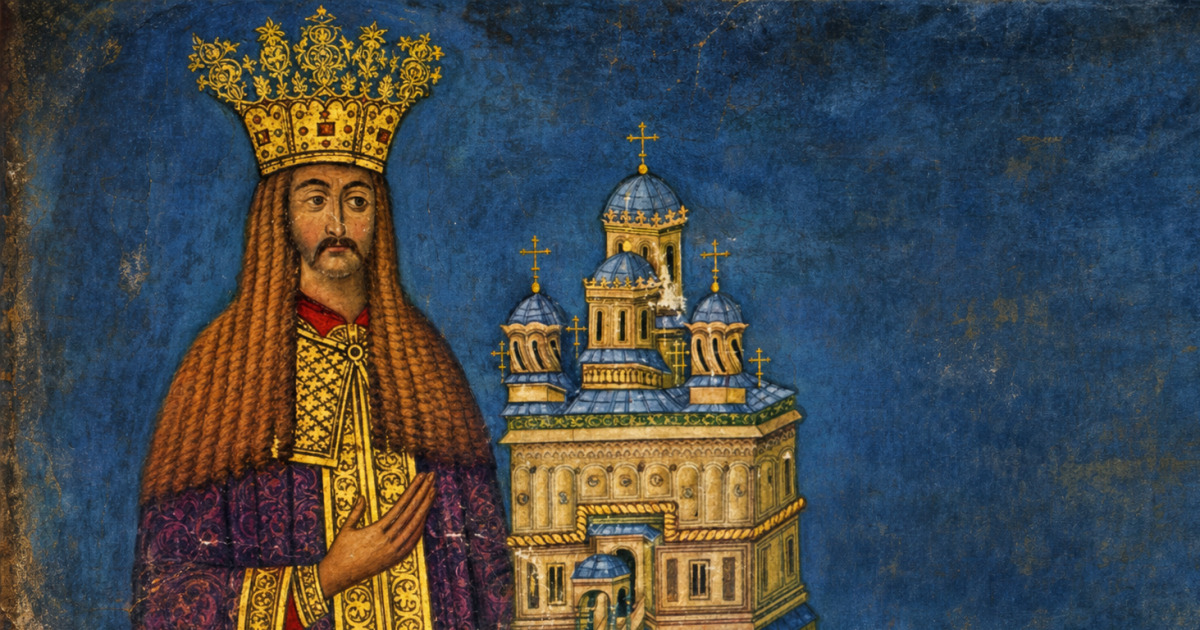
Saint Neagoe Basarab, Voievode of Wallachia, is one of the most luminous and yet least inwardly known figures of Romanian Orthodox history. His name is heard on 26 September, and the monastery of Curtea de Argeș, his miracle in white stone, still preserves his memory before pilgrims. But his spiritual depth is less often told: his discipleship under Saint Niphon of Constantinople, his years of persecution, his refusal of the throne, his care for Mount Athos, and his spiritual testament, The Teachings of Neagoe Basarab to His Son Theodosius.
In the sixteenth century, when Byzantium had fallen more than sixty years earlier and the Orthodox East was learning to live under Ottoman pressure, a lay prince of Wallachia appeared as a man of state and a man of prayer. He was married, the father of six children, a soldier, diplomat, church-builder and writer; yet at the center of his life stood the prayer of the heart and the memory of his spiritual father.
This article follows Saint Neagoe through a key suggested by his own book: the image of David, the psalmist-king. Neagoe was persecuted like David, called by the people to rule like David, received power with tears, and left to his son Theodosius counsel that recalls David’s final words to Solomon.
In brief: Saint Neagoe Basarab ruled Wallachia from 1512 to 1521. He founded the Monastery of Curtea de Argeș, helped many monasteries of Mount Athos, brought the relics of Saint Niphon to Wallachia, and wrote the Teachings, one of the great works of old Romanian Christian literature. The Romanian Orthodox Church commemorates him on 26 September.
This English article continues the wider thread opened in Two Hearths, One Prayer: Sihăstria Putnei and Neamț Monastery in the Hesychast Century of Moldavia. The hesychast renewal of the eighteenth century did not come from nowhere. Before Saint Paisius of Neamț and before the Romanian Philokalic manuscripts, a lay prince of Wallachia was already nourishing Athos, writing a spiritual book for his son, and living the prayer of the heart in the midst of public rule.
I. The Hidden Birth
Neagoe was born around 1481 or 1482. His mother was Neaga, from Hotărani in Oltenia. His father’s identity remains a matter of historical discussion. According to the princely tradition preserved in his own chancery, Neagoe belonged to the Basarab line, through Basarab the Younger, called Țepeluș. Other historians have regarded him as the son of the great vornic Pârvu Craiovescu. The point must be stated carefully: the sources are not read unanimously, but the tradition of his time recognized in Neagoe a “prince’s son”, and after his enthronement he took the dynastic name Basarab.
He grew up in the household of the Craiovescu boyars, one of the most powerful and pious families of Oltenia. His first teacher in the faith was his mother, Neaga. Before the chancery, before diplomacy, before the long burdens of rule, there was the prayer learned at home.
The spiritual hearth of his youth was the Oltenian Monastery of Bistrița, the foundation of the Craiovescu family. There he learned Church Slavonic, the language of the Orthodox culture of his age; there he encountered the Psalms, the lives of the saints, the long services and the living bond with Athos. In Wallachia, Bistrița was a center of books, prayer and ecclesial memory.
This hidden origin should not be read as a stain, but as a sign of the hidden work of God. Scripture itself teaches that God works through wounded human histories. The genealogy of Christ names Tamar, Rahab, Ruth and Bathsheba; the Lord is not ashamed of the broken lines through which He enters history. God does not choose according to worldly honor, but according to the heart.
The Light of Stephen the Great
Neagoe’s youth unfolded under the powerful memory of Saint Stephen the Great of Moldavia. The news of Stephen’s battles, victories and defense of the Orthodox faith reached Oltenia and marked the imagination of the whole Romanian world. Though Neagoe does not directly name Stephen in the Teachings, the ideal ruler he sets before Theodosius resembles the holy voievode of Moldavia: just, pious, humble before God and firm before enemies.
II. The Hidden Discipleship: Saint Niphon
In 1502, Saint Niphon II, former Patriarch of Constantinople, came to Wallachia. A man formed by Athos and by the sufferings of the Church under Ottoman rule, he had occupied the patriarchal throne more than once and had repeatedly been forced into exile. Prince Radu the Great called him to set order in the Church of Wallachia, and Niphon founded the bishoprics of Râmnic and Buzău.
The meeting between Saint Niphon and the young Neagoe is one of the keys of Neagoe’s life. Gabriel the Protos of Athos, the biographer of Saint Niphon, records that the hierarch strengthened Neagoe with his teaching so that he might grow in good works and be pleasing before God and men. This was not merely courtly contact. It was spiritual filiation: a Patriarch of Constantinople formed, in secret, the future prince of Wallachia.
When Saint Niphon rebuked a grave canonical disorder at the court of Radu the Great, the prince became angry and expelled him. Tradition says that whoever received the hierarch risked death and confiscation of his goods. In that atmosphere of fear, Neagoe received Niphon and fed him secretly. This act reveals more than many speeches could: for his spiritual father, the young boyar placed his own life in danger.
“Blessed Niphon strengthened him with his teachings, that he might grow and be lifted up in all good deeds and be pleasing before God and men.”
Gabriel the Protos, Life of Saint Niphon
The relationship recalls the bond between Samuel and David. Samuel anoints David in secret and prepares him for a kingdom that does not come immediately. Niphon spiritually forms Neagoe, and the fruit will later appear in his peaceful reign, in his foundations, in the Teachings, and in his veneration of Niphon’s relics.
III. Persecution Under Three Princes
After his discipleship under Saint Niphon, Neagoe did not immediately ascend the throne. Like David, who passed through years of persecution before receiving the kingdom, Neagoe was threatened under three rulers: Radu the Great, Mihnea the Evil and Vlad the Young, also called Vlăduț.
Under Radu the Great
Under Radu, the danger came through Neagoe’s secret care for Saint Niphon. Neagoe served the court faithfully, yet preserved obedience to his spiritual father. This paradox is profoundly Davidic: he does not rebel, but he also does not betray the holy man placed before him by God.
Under Mihnea the Evil
After Radu’s death, Mihnea the Evil persecuted the Craiovescu boyars. The sources speak of his fierce hatred toward Neagoe, who was seen as a threat. The Craiovescus fled across the Danube, and the Oltenian Monastery of Bistrița, the spiritual home of Neagoe’s youth, was struck harshly. In Neagoe’s spiritual biography, this is the wilderness: the place where it becomes clear whether a man seeks power or waits upon God.
Under Vlăduț
Under Vlad the Young, suspicion grew. Historical tradition preserves the plan to mutilate Neagoe, especially by cutting off his nose, in order to exclude him from any claim to the throne. In the political logic of the age, bodily mutilation could be used to disqualify a ruler. In the logic of the Gospel, the episode reveals something else: Neagoe does not seize justice by revenge, but waits for the hour appointed by God.
This is the first Davidic image: the persecuted man who does not stretch out his hand against the one who hunts him. The details of the chronicles must be read with caution, yet the larger line is clear: Neagoe was tested by fear, exile, threats and political instability, and through this testing his humility was ripened.
IV. Chosen as Prince Through the Will of the People
On 23 January 1512, after the fall of Vlăduț, the boyars and the people turned to Neagoe to make him prince of Wallachia. The scene preserved by tradition is among the most moving in Romanian history: Neagoe refuses the throne, not out of calculation, but because he knows the weight of it.
“Set another whom you will, together with our counsel; but forgive me, for I will not be.”
The people answer:
“Behold, God wills not that it be another, neither do we, but only you shall be prince to us.”
The scene brings Neagoe close to David at Hebron. David does not rush to seize the kingdom after Saul’s death; the people come to him and ask him to shepherd Israel. Neagoe does not leap onto the throne after Vlăduț’s fall; he is called by the people, and he receives rule as obedience, not as possession.
After his enthronement in February 1512, Neagoe took the dynastic name Basarab. Yet the most important fact of his reign is not the title, but the peace: once he received power, he did not take revenge. The chronicles and historians remember him as a ruler of good order, reconciliation and peace. Where vengeance might have been expected, forgiveness appeared.
V. The Relics of Saint Niphon and the Healing of a Wound
After his accession, Neagoe did not forget his spiritual father. In 1515 he sent a delegation to the Monastery of Dionysiou on Athos to bring the relics of Saint Niphon to Wallachia. This was not merely an act of devotion. It was also a work of reconciliation: tradition says that Niphon’s relics were laid upon the tomb of Radu the Great, the prince who had expelled him, as a sign of forgiveness and release.
The act shows one of the deepest traits of Neagoe’s soul. For him, power was not the place of revenge, but of healing. The ruler who had once endangered Niphon is not cursed in memory; he is brought before the saint for reconciliation.
The bringing of Saint Niphon’s relics is also connected with one of the earliest canonizations on Romanian soil. The reliquary later given to Dionysiou preserves the memory of the disciple: Neagoe is represented kneeling before his spiritual father.
VI. Founder of Curtea de Argeș and Benefactor of Athos
The best-known foundation of Saint Neagoe Basarab is the Monastery of Curtea de Argeș. Built between 1512 and 1517 and consecrated on 15 August 1517, it remains one of the most recognizable churches in Romania. It is not only an architectural monument; it is a confession in stone.
Gabriel the Protos praised its beauty in words that have remained famous, setting it among the great churches of the Orthodox world. Neagoe did not merely build a church. He built a place of prayer, memory and spiritual legitimacy for Wallachia.
His work, however, did not stop at the borders of his country. Mount Athos received from him annual gifts and building works. Historical sources mention help given to Koutloumousiou, Hilandar, Rossikon, Zographou, Xenophontos, Vatopedi, Iviron, Saint Paul, Xeropotamou, Philotheou, Pantokrator, Great Lavra and Dionysiou. The title “great founder of all the Holy Mountain” is therefore not sentimental exaggeration, but the summary of a concrete work.
| Monastery | Gift or work remembered by tradition |
|---|---|
| Koutloumousiou | Major annual gift and building works |
| Hilandar | Support for the Serbian monastery, close to Despina’s people |
| Zographou, Rossikon, Xenophontos | Annual gifts to Slavic and Greek communities |
| Iviron, Vatopedi, Saint Paul | Help for buildings, roofs, churches and monastic life |
| Dionysiou | Direct link through Saint Niphon and the reliquary given to the monastery |
In the sixteenth century Athos lived under Ottoman pressure. The gifts of the Romanian princes helped preserve not only walls, but libraries, liturgical life and whole communities. From this perspective, Neagoe Basarab is a major link in the spiritual exchange between the Romanian Lands and the Holy Mountain.
VII. The Teachings to His Son Theodosius
The Teachings of Neagoe Basarab to His Son Theodosius are the spiritual testament of the prince. Mircea Păcurariu calls the book one of the most important original works of old Romanian literature, and modern research, especially through Dan Zamfirescu, has strengthened its attribution to Neagoe Basarab.
This is not a mere political manual. It is a work of Christian pedagogy, a weaving of prayer, princely counsel, biblical memory and patristic culture. In it, Neagoe teaches Theodosius how to honor God, guard the Orthodox faith, judge rightly, be merciful, receive envoys and carry the burden of power without losing his soul.
“Before all things it befits you to honor and praise unceasingly the great and good and merciful God.”
At the heart of the Teachings stands the call to prayer. Neagoe does not ask his son only for political skill, but for a watchful heart. Here the hesychast formation of his youth becomes visible: prayer is not only for the monastic cell, but also for the throne, the family, the table and the public court of judgment.
David to Solomon, Neagoe to Theodosius
The parallel with David becomes especially strong in the final chapter, the prayer at the departure of the soul. There Neagoe’s voice approaches the prayer of Solomon: he asks for a wise heart, for the power of righteous judgment, and for discernment between good and evil. As David leaves Solomon counsel for temple and kingdom, Neagoe leaves Theodosius counsel for rule and for the soul.
This makes the Teachings a rare book: a father’s testament, but also a text of Orthodox civilization. It shows what a Christian ruler was meant to be: a man who may bear the sword, but first knows how to bend the knee.
VIII. Despina-Platonida: The Holy Couple
Beside Neagoe stood Lady Despina Milica, of the Serbian Branković line. After her husband’s death, she entered monastic life under the name Platonida. Her life is not an appendix to the voievode’s life, but part of the same work: marriage, foundation, grief, widowhood, exile and prayer.
Despina bore Neagoe six children: Theodosius, John, Peter, Stana, Ruxandra and Angelina. The death of several of the children deeply marked the princely household. In the major foundations of Neagoe, Despina appears as co-founder: at Curtea de Argeș, at Ostrov, and in the bonds with Athos.
After Neagoe’s death, the sufferings deepened. Theodosius died young, and political turmoil pushed Despina toward exile. She received the monastic habit as Platonida and reposed in 1554. Her body was laid at Curtea de Argeș, near her husband.
On 1 July 2025, the Holy Synod of the Romanian Orthodox Church resolved to canonize sixteen women of holy life, among them the Nun Platonida, wife of Saint Neagoe Basarab, under the title Saint Platonida the Venerable of Argeș, with commemoration on 26 September. Thus the Church officially recognized what the faithful had long felt: Neagoe and Platonida form a holy couple, in whom marriage, foundation and suffering became a road to salvation.
IX. Repose and Canonization
In the last years of his life, illness weighed heavily upon Neagoe. It was precisely then, near death, that the work of the Teachings deepened. Death did not find him unprepared, but writing, praying and preparing his son for a burden far too heavy for his years.
Saint Neagoe Basarab reposed on 15 September 1521, at about forty years of age. He was buried at the Monastery of Curtea de Argeș, his own foundation. His reign lasted less than ten years, yet in the history of the Romanian Church it remains a reign of peace, culture, prayer and founding.
In the session of the Holy Synod of the Romanian Orthodox Church of 8-9 July 2008, the canonization of Saint Neagoe Basarab the Voievode was approved. His commemoration was appointed for 26 September. In the calendar of the Church, he does not stand merely as a ruler, but as a saint: a man who placed earthly power under obedience to Christ.
X. The Hesychast Legacy: From Neagoe to the Philokalia
The life of Saint Neagoe Basarab helps us see the continuity of the hesychast tradition in the Romanian Lands. In the fourteenth century, Saint Nicodemus of Tismana brought the spirit of Athos into the Romanian space. In the sixteenth century, Neagoe materially nourished Athos and preserved the prayer of the heart in princely life. In the eighteenth century, through Saint Paisius of Neamț and his disciples, the Philokalic manuscripts returned from Athos into Moldavia.
| Century | Hearth | Key saints | Work |
|---|---|---|---|
| 14th-15th | Tismana, Vodița, Putna | St. Nicodemus, St. Daniel the Hesychast | The bringing of the Athonite spirit into the Romanian Lands |
| 16th | Oltenian Bistrița, Curtea de Argeș, Athos | St. Neagoe Basarab, St. Niphon | The nourishing of Athos and the writing of the Teachings |
| 18th | Sihăstria of Putna, Neamț | St. Jacob of Putna, St. Paisius of Neamț | The return of the Philokalia in Romanian |
Seen in this way, Neagoe is not an isolated figure, but the central link of a spiritual arc. Athos nourished the Romanian Lands with prayer; the Romanian Lands nourished Athos with gifts; then Athos returned the gift through the Philokalic manuscripts and the work of Saint Paisius. This is the hidden economy of the Church: gifts return, but in God’s own time.
What Saint Neagoe Says to the Orthodox Reader Today
Saint Neagoe Basarab tells us that holiness is not only for monks. He was a layman, husband, father, ruler, diplomat and founder, yet he lived with his heart turned toward God. He tells us that persecution can prepare a man for a greater work. He tells us that true power is not shown in revenge, but in forgiveness. And he tells us that the highest inheritance a father can leave his child is not wealth, but right teaching.
Holy Voievode Neagoe Basarab and Venerable Platonida, pray to God for us!
Chronological Table
| Year | Event |
|---|---|
| c. 1481/1482 | Birth of Neagoe; his origin remains discussed between the Basarab tradition and the Craiovescu household. |
| 1502 | Saint Niphon II comes to Wallachia. |
| 1503 | Synod of Târgoviște; the bishoprics of Râmnic and Buzău are organized. |
| 1504 | Neagoe marries Despina Milica; Saint Stephen the Great reposes. |
| 1505 | Saint Niphon is expelled; according to tradition, Neagoe secretly shelters him. |
| 11 August 1508 | Saint Niphon reposes at Dionysiou Monastery on Athos. |
| 1512 | Neagoe Basarab is chosen prince of Wallachia. |
| 1515-1517 | Building and consecration of the Monastery of Curtea de Argeș. |
| 1515-1517 | The relics of Saint Niphon are brought to Wallachia. |
| 1517-1521 | Writing of the Teachings and continuation of gifts to Athos. |
| 15 September 1521 | Repose of Saint Neagoe Basarab. |
| 25 January 1522 | Death of young Theodosius in Constantinople. |
| 30 January 1554 | Repose of Saint Platonida the Venerable. |
| 8-9 July 2008 | The Holy Synod approves the canonization of Saint Neagoe Basarab. |
| 1 July 2025 | The Holy Synod approves the canonization of Saint Platonida of Argeș. |
| 26 September | Commemoration of Saint Neagoe Basarab and Saint Platonida. |
Saints Mentioned in This Article
- Saint Neagoe Basarab the Voievode († 1521) — commemorated on 26 September.
- Saint Platonida the Venerable of Argeș († 1554) — commemorated on 26 September.
- Saint Niphon II, Patriarch of Constantinople († 1508) — commemorated on 11 August.
- Saint Nicodemus of Tismana († 1406) — commemorated on 26 December.
- Saint Stephen the Great († 1504) — commemorated on 2 July.
Select Bibliography
Primary and Historical Sources
- Gabriel the Protos, The Life of Saint Niphon, Patriarch of Constantinople.
- The Teachings of Neagoe Basarab to His Son Theodosius, critical edition by Manole Neagoe.
- The Cantacuzino Chronicle, for the scene of Neagoe’s choosing as prince.
- Mircea Păcurariu, History of the Romanian Orthodox Church, vol. I.
- Nicolae Iorga, Neagoe Basarab.
- Dan Zamfirescu, Neagoe Basarab and the Teachings to His Son Theodosius.
- Teodor Bodogae, The Romanian Aids to the Monasteries of the Holy Mountain Athos.
Online Sources
- Basilica.ro — Orthodox Calendar, 26 September: Holy Ruler Prince Neagoe Basarab.
- Romanian Patriarchate — Canonization of sixteen women of holy life.
- Basilica.ro — Saint Neagoe Basarab honored in the Romanian Orthodox Church.
Article prepared for OrtodoxWay.com, June 2026. Common commemoration: Saints Neagoe Basarab the Voievode and Platonida the Venerable — 26 September.
For the connection between princely anointing, Orthodox patronage, and Romania’s service to the Christian East, see also The Gate, the Founding, and the Hearth.