
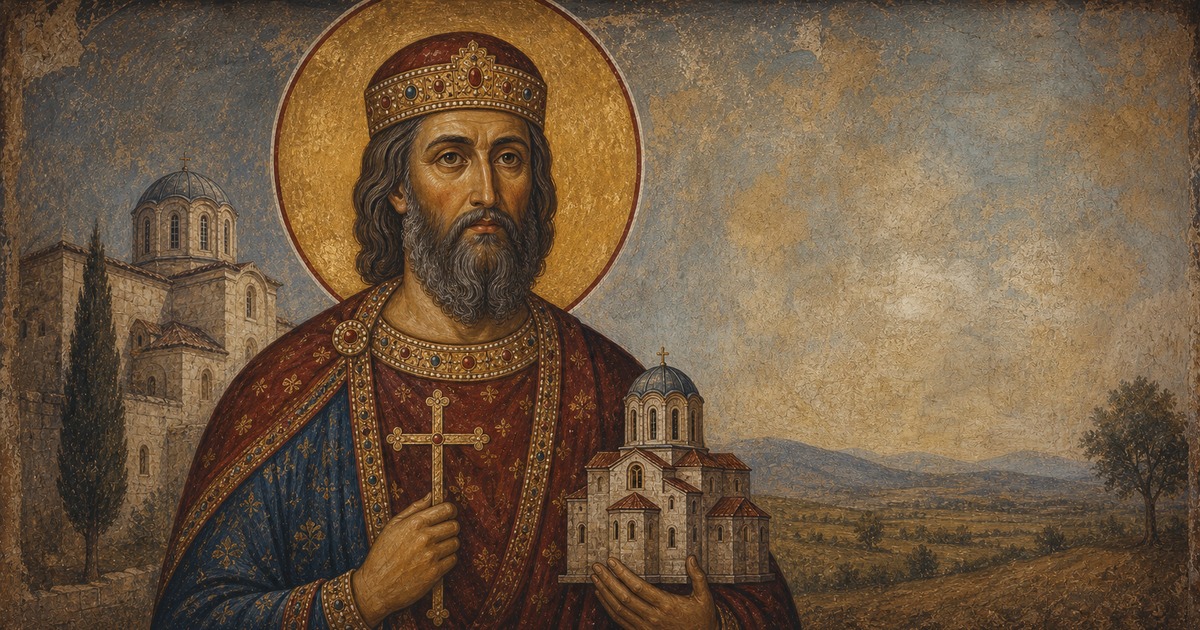
There are deaths on the battlefield that happen in the heat of clashing arms, when a man has no time left to choose, and there are deaths prepared months in advance, offered as a sacrifice in full awareness. The death of Saint Prince Lazar of Serbia, on the 15th of June 1389, on the field of Kosovo, is of the second kind. The prince did not fall struck by chance in the tumult of battle; he was taken alive and beheaded after the fighting, in the manner of a martyr, having first set in order all that pertained to eternity: he had built the monastery in which he wished to be buried, had arranged for his army to receive Communion, and had entered a battle in which he could place no final hope in the strength of arms. This is the thread we follow here: not the national hero of the Serbs, but the martyr who chose the way of the Cross knowing its price beforehand.
The distinction is no small theological nuance. The Church does not honour valour in itself, nor death in battle for the land of one’s country — otherwise it would have numbered among the saints every army that perished defending its borders. More than this: if the martyrdom at Kosovo were the only evidence of the prince’s holiness, then we would remain, however careful we might be, with a holiness of the battlefield still — only through defeat instead of victory. The truth is otherwise, and deeper. Lazar’s holiness is not understood from the moment of his death alone; it is seen in the life that came before — in his piety, in the churches he built, and above all in the deed by which he healed a rupture of communion within the Church. Kosovo is not an isolated foundation of his holiness, but the seal and the crown of a life already turned toward God. A martyr is not improvised in the final hour; he only seals, with his blood, what was there before.
Here, from the outset, a clarification is also in order, so that this article may remain within its bounds: around the prince’s death there was woven, in the centuries that followed, an entire epic and national mythology — the songs about the choice of the “heavenly kingdom” over the earthly one, the legend of the falcon come from Jerusalem, the idea of a “heavenly people” of the Serbs. That folkloric layer, however beautiful in literary terms, is not the source from which we begin, and we do not treat it here. We hold to what can be verified: the historical facts and the ancient ecclesiastical testimony, written in the decades after the battle.
The Prince: His Origin and Reign
Lazar Hrebeljanović was born around the year 1329, in the fortress of Prilepac in Serbia. From his youth he was brought to the court of Emperor Stefan Dušan, the most powerful ruler the medieval Serbian state ever had, and there he grew up in princely service, winning the esteem of those around him through temperance and piety. After the disintegration of the Serbian Empire that followed Dušan’s death, Lazar became, around 1371, the foremost of the remaining Serbian rulers, governing Moravian Serbia — the largest and most powerful part of the shattered former empire.
He was, therefore, a prince — knez, in the Serbian word — and not an emperor. The popular title of “Tsar Lazar,” found in the later tradition, belongs to the language of veneration, not to his actual political office. Lazar did not bear Dušan’s imperial crown; he was the ruler who sought to gather together the divided Serbian princes in the face of the Ottoman threat that advanced ceaselessly from the east.
This work of gathering was, before the battle, the work of his political life. The sources preserve the memory of the prince’s efforts to bring together the nobles and commanders of armies, until then drowned in internal quarrels, and to turn them toward the defence of their common faith. The Serbia he had inherited was a land worn down by struggles among its rulers, and Lazar sought, in the few years he had, to set it once more upon a foundation of unity. The fact that it was precisely at Kosovo, in the gravest hour, that he managed to gather an army from several Serbian domains shows that he had not laboured in vain.
The Founder: A Man Who Built for Eternity
The prince was not only a ruler; he was also a founder of churches, and here the inner man begins to show. His domain was one of the richest centres of church-building in the fourteenth-century Serbian world. His foremost foundation was the Monastery of Ravanica, raised in the mountains of central Serbia and completed around 1381, as the place in which he himself desired to be buried. He also built, at Kruševac, the church dedicated to Saint Stephen the Protomartyr — known to this day as the Lazarica — between the years 1375 and 1378. He renewed old monasteries of great importance: Hilandar, the foremost Serbian foundation on the Holy Mountain, and the monastery of Gornjak. He was a benefactor of the Russian monastery of Saint Panteleimon on Athos and of many other churches and monasteries. And his piety is read also in the documents of his chancery: in a charter of 1380, “the right-believing Prince Lazar” granted to the hospital of Hilandar a village and added a porch to the main church.
These deeds say something about the inner disposition of the man. A ruler who, more than ten years before his death, prepares his place of eternal rest in a monastery built by himself; who renews the monastic centres of his people; who extends a helping hand as far as Athos, the heart of Orthodox monasticism — such a man was not thinking only of the things of this age. Ravanica was, at the same time, the beginning of an artistic current of its own, the Morava School, and the sign of a reign that made the building of churches a steadfast labour, not a chance donation.
Furthermore, the prince’s domain was a place of refuge for the Orthodox monks who fled from lands threatened or already seized by Ottoman rule. This fact brought Lazar a good name as far as the Holy Mountain and made Moravian Serbia a shelter of the faith in a time of collapse. His reign was not only an attempt to gather together the divided princes, but also a work of protecting the life of the Church in the midst of danger.
The Summit: The Healing of the Rupture with Constantinople
If the prince’s Christian life has a summit, it lies not at Kosovo, but fourteen years earlier, in a deed that has nothing of the splendour of arms and everything of the depth of the Church. In the year 1375, Lazar was the chief worker in the healing of the schism between the Serbian Church and the Patriarchate of Constantinople.
The rupture came from far back. Emperor Stefan Dušan, in the pride of his power, had on his own authority raised the Serbian archbishopric to the rank of a patriarchate, without the recognition of Constantinople. The Ecumenical Patriarchate saw in this a violation of canonical order and placed the Serbian Church under anathema. Thus, for nearly a quarter of a century — from the 1350s — the Serbian Church remained cut off from full communion with the Great Church of the East. It must be said plainly: the Serbian Church had been autocephalous since the time of Saint Sava, from 1219; it was not autocephaly that was the cause of the dispute, but its unilateral elevation to the rank of a patriarchate, carried out without the blessing of Constantinople. Many saw in the disintegration and anarchy that had overtaken the empire after Dušan’s death the very bitter fruit of that rupture.
Lazar understood that the true foundation of a Christian rule cannot be set in place so long as the Church of his people remains severed from the body of Orthodoxy. Together with the Athonite monk Isaiah — a notable scholar and translator — the prince sent an embassy to Constantinople, to ask the patriarch for the lifting of the anathema and the return to communion. The embassy succeeded. In the year 1375, full communion between Peć and Constantinople was restored, and the place in which the reconciliation was sealed bears a deep significance: the Monastery of the Holy Archangels, at the very tomb of Emperor Dušan, the one who had caused the rupture. Only in the wake of this reconciliation was Patriarch Ephraim elected, within a framework recognized by both Peć and Constantinople.
Here, truly, is the summit of the prince’s Christian life. Dušan had wanted a Church of his own, raised by his own power, even at the cost of breaking communion. Lazar did the very opposite: he set the unity of the Church and obedience to canonical order above the pride of an autocephaly seized by force. A ruler who heals a schism, who brings the Church of his people back into communion, who places communion above the pride of rule — here is a deed higher than any victory of arms, and more telling of holiness than any feat of valour. The one who accomplished it had, naturally, the full support of the Serbian Church in all his later work, for the Church was indebted to him precisely for this return to unity.
And peace in the Church brought peace in the land as well. The sources preserve the memory of years of quiet that followed the reconciliation: the prince called people back to the towns laid waste by the troubled times, the rich silver mines revived trade and craft, and Moravian Serbia knew a season of flourishing. This is the foundation upon which, at Kosovo, the final sacrifice would be laid: not the despair of a condemned man, but the self-offering of one who had built, reconciled, and protected, and who now was to seal it all with his blood.
The Field of Kosovo: The Seal of the Sacrifice
In the spring of the year 1389, Sultan Murad I gathered his armies and set out westward, toward the Serbian lands. The route he chose brought him to Kosovo — the Field of Blackbirds, as the name is rendered — one of the most important crossroads in the Balkans. There Lazar met him, with an army gathered from several Serbian domains, but one that remained, according to the testimony of the sources, much smaller than the sultan’s.
Here is the heart of the matter. The prince did not enter Kosovo out of a confident military reckoning, as one who hopes for victory. The sources, from the earliest, preserve the awareness that Lazar went to battle knowing how unequal the forces were. The Serbian army was overwhelmingly outnumbered; the fortunes of arms were, by human judgement, against it. And yet the prince did not draw back, did not seek a peace bought through submission, did not choose servitude. He accepted the battle.
It is precisely here that the difference is born between an ordinary heroic death and a martyr’s sacrifice — and precisely here that the importance of the life that came before is seen. A ruler who defends his country and dies in battle is worthy of all human honour, but it is not for that alone that he is numbered among the saints. What raises Lazar’s act above mere valour is that it was a choice made with a clear mind, by a man whose whole life was already turned toward God. The one who accepted the battle at Kosovo was the same who had healed the schism, had built Ravanica, had sheltered the wandering monks. The final sacrifice was not an isolated gesture, but the natural fruit of a life. The prince weighed the two paths — the submission that would have spared lives, and the battle that would have lost them — and chose the second, not out of recklessness, but out of a deeper conviction: that there are things more precious than this life, and that servitude under the rule of those of another faith would have been a greater loss than death in confession.
The preparation that preceded the battle bears the mark of this awareness. Serbian tradition preserves the memory that, before the battle, the army approached the Holy Chalice. The gesture is not that of men going to an ordinary battle; it is that of men who set their souls in order for the passage into eternity. To receive Communion before battle does not mean to lose hope of victory, but to place it beyond the bounds of this present age. The army that drew near the Holy Chalice in the dawn of that day was no longer a mere army, but a gathering of men prepared to die at peace with God.
The battle was fierce. The sources, though few, speak of a clash of rare ferocity, with heavy losses on both sides. Sultan Murad himself fell; the flower of the Serbian nobility fell; and in the end, the prince fell too. But the manner of Lazar’s death bears, in itself, the mark of the martyr.
The Beheading: A Martyr’s Death, Not a Soldier’s
Prince Lazar did not die struck down in the heat of clashing arms. He was taken alive by the Turks during the battle and beheaded after the fighting. This circumstance, according to the ancient ecclesiastical testimony, is no detail without significance. It is the key to the whole of his veneration.
The martyr, in the most proper sense the Church has given the word, is the one who, taken by those of another faith, receives death as a witness of his faith. The martyrs of the time of the Roman persecutions did not die in battle, weapon in hand, but bound, seized, brought before the judges and put to death because they would not deny Christ. It is for this very reason that Lazar’s death was received by the Church as a martyr’s death: not because he fell valiantly, but because he was taken and beheaded by those of another law, having first confessed his faith through his whole life — through the churches he built, through the schism he healed, through the protection of the Church. The beheading after the battle did nothing but seal, with blood, a confession that had lasted a lifetime.
Here it is plainly seen why we speak not of a hero, but of a saint. The hero dies conquering or seeking to conquer; his praise is in the deed, in valour, in the triumph of arms. The martyr dies bearing witness; his praise is in the steadfastness of faith to the very end, even — and most of all — in defeat. Lazar was not honoured because he won at Kosovo; he lost at Kosovo, and the military power of Serbia was broken, the land being pushed soon toward vassalage — full conquest would come later, in the following century. He was honoured because, in that very defeat, he remained until death the man who had chosen the Cross.
This is why the typology of conscious sacrifice is the one befitting this saint, and not that of triumph. His whole preparation — the monastery raised years in advance, the army communed on the eve, the battle accepted with its outcome known — converges upon a single spiritual reality: a man who gave his life in full awareness, as a sacrifice, for what he held to be above life. Not an accident of war, but a choice of freedom turned toward God.
The Word That Was Preserved
Shortly after the battle — around the year 1392 — a writing about the fallen prince was composed, known as The Narration about Prince Lazar and commonly associated with the name of Patriarch Danilo III of Peć. The patriarch was a contemporary of the events and close to the princely house; he himself took part, in 1390 or 1391, in the translation of the prince’s relics from Priština to Ravanica. This writing is the most important ancient ecclesiastical testimony about Lazar, and it blends, according to the manner of the time, the life of a saint, the encomium, and the sermon.
The heart of this writing is the oration the patriarch places in the prince’s mouth, spoken to his soldiers before the battle. It is, in all likelihood, a rhetorical composition of the hierarch — the way in which he wished to give voice to the spiritual significance of Lazar’s sacrifice — and not a transcript of words actually spoken on that morning. But precisely as an ancient ecclesiastical composition, written by a contemporary close to the princely house, it shows us how the prince’s death was understood within the very Church of the time: not as a military disaster, but as a sacrifice offered to God. There the prince calls together his comrades and brothers, the nobles and soldiers, great and small, and exhorts them to receive the battle as a passage toward the true life.
It is fitting to distinguish clearly this ancient writing from the later folkloric layer. This oration belongs to the ecclesiastical literature of the decades immediately following the battle and stands among several ancient texts — including the Encomium to Prince Lazar, embroidered by the nun Jefimija (also called Euphemia) upon the silken shroud of the relics — that made up the service and veneration of the saint. All these texts interpret the death at Kosovo as a martyr’s victory. Something else entirely are the epic folk songs, formed in the following centuries, with the legend of the falcon from Jerusalem and the “choice of the heavenly kingdom” cast in the form of a dramatic dialogue. Those are a late folkloric creation, the foundation of an entire national mythology that does not concern us here. The testimony from which we begin is the ancient ecclesiastical one, and it shows us a martyr, not a hero of ballad.
The Relics and the Veneration
After the beheading, the prince’s body was first buried at Priština, in the Church of the Ascension. A year or two later, in 1390 or 1391, the relics were translated to the Monastery of Ravanica — his foundation, the place he himself had appointed for his final rest. The hierarchs of the Serbian Church took part in the translation, among them Patriarch Danilo. At that time, in all likelihood, the prince was numbered among the holy martyrs, though no written act of this has been preserved — which was, in any case, natural in an age when the proclamation of sanctity did not follow the later procedures.
The relics of Saint Prince Lazar are found to this day at Ravanica, whole, brought out for veneration. Over the centuries they knew a long course of translations: after the Great Migration of the Serbs at the end of the seventeenth century, the wandering monks carried them far from their foundation, coming at last to the monastery of Vrdnik in Fruška Gora — called for that reason the “Ravanica of Srem” — and during the Second World War they were sheltered at the Cathedral of Belgrade. Only in 1989, six centuries after the battle of Kosovo, did the relics return definitively to Ravanica, where they remain to this day. The fact that the prince’s body remained incorrupt, and that it brought forth, over the centuries, testimonies of veneration and of wonder, strengthened in the consciousness of the Church the certainty of his holiness. The pilgrims who come to Ravanica today venerate the whole relics of the one whom the Church names Saint Lazar the Great Martyr, Prince of Serbia.
His commemoration is kept on the 15th of June according to the Julian calendar; in the present civil calendar, this falls on the 28th of June, a day known to the Serbs as Vidovdan. The name preserves the old connection with Saint Vitus, but in Serbian ecclesiastical consciousness and calendar the day is today associated above all with the commemoration of Saint Prince Lazar and the martyrs of Kosovo. The prince’s wife, Princess Milica, would later end her days as a nun — first with the name Eugenia, and then, in the great schema, Euphrosyne — founding the monastery of Ljubostinja, where she is also buried; and their son, Stefan Lazarević, despot of Serbia, is likewise honoured among the saints — so that from the family of the prince martyred at Kosovo the Church received several saints.
What the Prince’s Sacrifice Teaches Us
Saint Prince Lazar sets before us, more clearly perhaps than many other saints, the difference between worldly valour and Christian holiness. The world honours victory; the Church honours faithfulness to the end. The world makes heroes of those who conquer; the Church makes saints of those who turn their life toward God and seal it, at the last, through confession. And Lazar’s holiness does not rest upon the triumph at Kosovo — for at Kosovo he was defeated, the power of Serbia was broken, and the land would be pushed toward vassalage and, in the following century, toward foreign rule. It rests upon a whole life: upon the churches he built, upon the protection of monks, and above all upon the schism he healed, bringing the Church of his people back into the communion of Orthodoxy. Kosovo was the seal of that life, not its foundation.
This is the measure by which his life ought to be read, guarding ourselves against two errors alike. The first is to make of him a national hero, a symbol of a people and of an earthly struggle — an error into which, unfortunately, an entire later folkloric and political tradition fell, clothing the prince’s sacrifice in garments that are not the Church’s. The second is to overlook what he truly was: not an unwise strategist who led his army to ruin, but a martyr who gave his life in full awareness, for a faith more precious than life.
Between these two errors stands the simple truth of his holiness. A prince who healed a rupture of communion and brought the Church of his people back to the unity of Orthodoxy; who built monasteries and sheltered wandering monks; who, years in advance, had prepared his place of eternal rest; who, on the eve of his end, arranged for his army to receive Communion; and who, having to choose between servitude and death, chose death in confession, being in the end taken and beheaded by those of another law, like the martyrs of the first centuries. It was not the victory of arms that made him a saint, but the sacrifice received in awareness, in freedom, as a confession of the kingdom that does not pass away — a seal set upon a life that had itself been a ceaseless turning toward God. This remains, across the centuries, the witness of Saint Lazar the Great Martyr, Prince of Serbia.
Holy Great Martyr Lazar, pray to God for us.
Read Also
- Saint Justin Popović: Confession Within the Church — for the same Serbian line of Orthodox confession in the twentieth century.
- Saint Nikolai Velimirović in America — on one of the great Serbian saints of modern times.
- The Bogomoljci Movement — the great lay awakening of Serbian Orthodoxy.
- Saint Neagoe Basarab — The New David of the Romanian Land — another Orthodox ruler, founder, and man of prayer.
In the Orthodox Slavic world, another prince remembered for his place in the history of the Church is Saint Vladimir, Enlightener of Rus.