
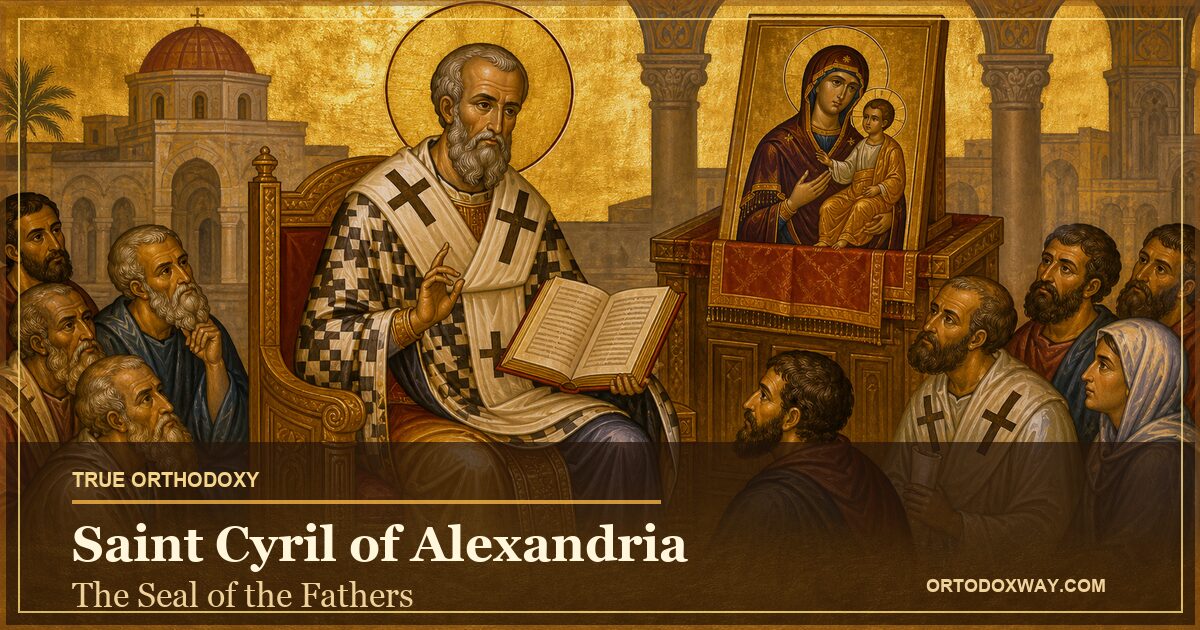
How the faith is defended when error puts on the garment of piety — and why a single word, “Mother of God,” divided Orthodoxy from heresy
A saint we celebrate twice
Saint Cyril of Alexandria is one of the few Fathers whom the Church honours twice in the course of the year: once on the day of his repose, 9 June, and again on 18 January, together with his great predecessor on the throne of Alexandria, Saint Athanasius the Great. This twofold commemoration is no accident of the calendar. It places Cyril in the same light as Athanasius — the two pillars of Alexandria, the two who each defended, in his own time, the very heart of the faith: Athanasius, the divinity of the Son against Arius; Cyril, the unity of the Person of Christ against Nestorius.
Tradition gave him a name that says everything about his place in the Church: “the Seal of the Fathers.” That is, the one in whom the confession of those before him is gathered and brought to completion, as in a seal. Not a beginner of a path, but one who brings it to its close; not a new voice, but the voice that gathers and seals the witness of the whole Tradition up to that point.
The present article is not a simple life of a saint. It is a look at the way in which Saint Cyril defended the right faith — for his struggle teaches us something that remains valid in every age: heresy rarely comes saying, “I am heresy.” Most often it comes with a seemingly pious argument, and even — as with Nestorius — under the pretext of defending the honour of God. And it is precisely for this reason that it must be discerned.
Who was Saint Cyril
He was born in Egypt around the year 378, into a Christian family of standing. His mother’s brother was Theophilus, the Patriarch of Alexandria — the city which, in that century, stood at the height of its importance in the Roman Empire, both in power and in theological splendour. Under his uncle’s protection, the young Cyril received a fine spiritual upbringing and learning, mastering the Scriptures and the Fathers.
In the year 412, upon the death of Theophilus, Cyril was chosen archbishop of Alexandria. He would shepherd this Church for thirty-two years, until his repose, writing throughout that time a great number of works: extensive commentaries on the books of Scripture, both of the Old and of the New Testament, treatises on the Holy Trinity, writings against the errors, and, above all, the christological works through which his name would remain forever in the consciousness of the Church.
He reposed in the Lord on 9 June 444, leaving behind a theological inheritance which the later Councils would receive as a foundation of the right faith.
But to understand why he was called “a defender of the right faith,” we must look to the great trial of his life.
The error of Nestorius: when a single word changes everything
In the year 428, a certain Nestorius was raised to the patriarchate of Constantinople. He was a man with a reputation as an orator, harsh and full of himself. Soon after his enthronement, he began to preach a new teaching which seemed — at first sight — only a nuance of language, but which struck at the very heart of the faith.
The Church called the Most Holy Virgin Mary “Mother of God” — in Greek, Theotokos (Θεοτόκος). Nestorius rose up against this word. He said that the Virgin should not be called “Mother of God,” but at most “Mother of Christ” — Christotokos — for, according to him, Mary did not give birth to God, but to the man Jesus, in whom God the Word only afterwards came to dwell.
At first sight, this seems a quarrel over words. In reality, behind the word lay an entire error about Who Christ is.
For Nestorius, in refusing the word Theotokos, in fact divided Christ in two: on the one hand God the Word, on the other the man Jesus — as though they were two persons placed side by side, two subjects united only by a bond of honour, of good will, of cooperation. According to this teaching, the One crucified was not God, but only the man; and she who gave birth was not the Mother of God, but the mother of a man in whom God dwelt.
This is why it was not a quarrel over words. If Mary is not the Mother of God, then the One born of her is not God — and the whole of salvation collapses. For if it was only a man who died on the Cross, then that death has not saved us; and if the One who became incarnate is not truly God, then it was not God who became man, but only one who dwelt in a man — and humanity was not truly united with God.
Saint Cyril’s answer: one Person, God and Man
When he learned of Nestorius’s preaching, Saint Cyril did not keep silent. First, according to the fatherly order, he tried the gentle way: he wrote Nestorius letters of admonition, calling him to turn back from error and showing him, with clarity, the right teaching of the Church. He wrote also to the Emperor Theodosius the Younger, and to Pope Celestine of Rome, setting forth the danger.
The teaching that Saint Cyril sets before Nestorius is this: Christ is one single Person — one and the same — true God and true Man. The Son of God, born of the Father before all ages, was born in time, as man, of the Most Holy Virgin. There are not two sons — one of God and another of Mary — but one and the same Son: the Word of God, who, while remaining what He was, took upon Himself what He was not, becoming man for us.
From this follows, of necessity, the word Theotokos. If the One born of the Virgin is truly God the Word, incarnate — and not a self-standing man in whom God only afterwards came — then the Virgin is truly the Mother of God. Not because she gave birth to the divinity that is without beginning (a thing impossible and blasphemous), but because the One whom she bore according to the flesh is One of the Persons of the Holy Trinity, God the Word Himself, made man.
Thus Theotokos is not a title given needlessly to the Mother of the Lord. It is the boundary-stone of the whole of christology: the word which confesses that the One incarnate is God, and that the union between divinity and humanity in Christ is so deep and so true that we may say, without fear, that God was born, God suffered, God was crucified — according to the flesh, and not according to the divine nature, but truly He Himself, and not another in His place.
To cut the error at the root, Saint Cyril composed the Twelve Anathemas (also called the Twelve Chapters) against the teaching of Nestorius — twelve condemnations, short and sharp, each striking at one head of the error, each setting in its place the right confession. Nestorius answered with twelve counter-anathemas of his own, hardening himself in error. The way of reconciliation through letters had closed.
The Third Ecumenical Council of Ephesus (431)
Seeing that the error was growing day by day, and that more and more bishops were being harmed by it, the right-believing Emperor Theodosius the Younger commanded the gathering of a council of the whole world. The place chosen was Ephesus — a city bound to the Holy Apostle and Evangelist John and to the veneration of the Most Holy Mother of God. It was there, in a city where the name of the Mother of the Lord had a powerful resonance in the piety of the faithful, that the confession would be sealed that the Virgin Mary is truly Theotokos, the Mother of God. The year was 431.
There gathered at Ephesus more than two hundred bishops from the whole Christian world; and those who could not come sent delegates. Saint Cyril presided over the proceedings of the Council. Under his leadership, after the teaching of Nestorius had been examined and weighed against Scripture and the confession of the Fathers, the Council decreed:
- that the Most Holy Virgin Mary is, truly and rightly, the Mother of God (Theotokos);
- that Christ is one single Person, true God and true Man, and not two sons, nor two persons placed side by side;
- that the teaching of Nestorius is error, and that he himself, persisting in it, ought to be removed from the patriarchal throne and separated from the Church.
Thus Nestorius was deposed and sent into exile. Tradition tells us that, at the news of the right decision, the multitude of the faithful in Ephesus broke out in joy and, with lit torches, accompanied the Fathers of the Council — for the right-believing people had sensed that, through the word Theotokos, their very salvation had been defended.
Saint Cyril’s path was not easy even after this. There followed hard days, imprisonments, slanders, and the intrigues of those who would not receive the decision. But the truth prevailed: the investigation made by the Emperor’s command brought the injustice of the slanders to light, and Saint Cyril, proved innocent, returned to his throne in the autumn of that same year, 431.
The troubles did not subside all at once, however. Only in the year 433, through the reconciliation with John of Antioch and through the so-called Formula of Reunion, was it shown more clearly that the right confession neither divides Christ in two, nor mingles His divinity and His humanity: one is Christ, one the Son, one the Lord — perfect God and perfect man. And the Virgin Mary is called in this confession the Mother of God precisely because God the Word united Himself with the body taken from her.
What Saint Cyril’s struggle teaches us
Here it is fitting that we pause and look more deeply, for it is precisely in this struggle that we see why Saint Cyril is, for us, a teacher of the defence of the right faith — and not merely a name from the ancient history of the Church.
First: his struggle shows us that in the Church a single word can weigh as much as the whole faith. Nestorius seemed to be quarrelling over a nuance. In reality, in that word — Theotokos or Christotokos — it was being decided whether the One crucified for us is God or only man, and therefore whether or not we are saved. Saint Cyril was no quarreller over words. He was a man who saw that, beneath the word, there lay hidden either the life or the death of the soul. For this reason he did not yield.
Second: his struggle shows us that error often puts on the garment of piety. Nestorius did not say, “Let us bring God down.” On the contrary — he believed he was defending the honour of God, guarding Him from being “subjected” to birth and suffering. He seemed more devout, more attentive to the divine majesty. And it was precisely this that made him dangerous: an error which boasts that it guards the honour of God is harder to discern than one that is open. Orthodox discernment is not content with the appearance of devotion; it examines what is truly being confessed about Christ.
Third: his struggle shows us the right order of the defence of the faith. Saint Cyril did not leap at once to condemnation. He first tried the gentle way — the letters of admonition, the call to return. Only after it had become clear that the error was settled and was harming the flock did he pass to firm confession and, finally, to the condemnation of the council. This is the way of the Church: not haste, not condemnation at the first word, but neither cowardly silence in the face of proven error. First long-suffering and the call; and when these are despised, the clear confession and the defence of the flock.
Fourth: and perhaps most important for our own time — the defence of the faith is not enmity toward man, but love for the truth and for those who may be harmed by error. Saint Cyril did not hate Nestorius. He called him, he wrote to him, he persisted. But he did not allow the true peace to be lost for the sake of peace with a man — that peace which is the union in truth with God and among ourselves. There is a false peace, which keeps silent so as not to give offence; and there is the true peace, which must sometimes utter a hard word, that the flock may not go astray.
A clarification for the reader who has heard of “one nature”
For the more inquiring reader a short clarification is fitting, lest he be left with a perplexity.
Saint Cyril, in defending the unity of the Person of Christ against the Nestorian division, sometimes used a formulation which, taken out of its proper sense, can sound perplexing: that in Christ incarnate there is “one nature of God the Word, incarnate.” By this, Saint Cyril did not deny the full human nature of the Lord. The word “nature” he used here in a concrete sense — that of a single subject, one and the same Christ who acts and suffers, and not two sons placed side by side. So too did the later Fathers read it: in the Cyrilline formula, the one “nature” was understood as indicating a single Hypostasis, a single Person of the incarnate Word — the same truth that the Evangelist John utters: “And the Word was made flesh” (John 1:14). And Saint Cyril himself confessed clearly, in other places, that Christ is perfect in divinity and perfect in humanity, without mingling and without change.
This reading is not a later correction imposed upon his words, but their very right sense, recognised conciliarly: at the Fifth Ecumenical Council (553), the Church received Saint Cyril’s formula precisely in this sense — the one “nature” meaning the Person, the Hypostasis of the incarnate Word.
Before this, at the Fourth Ecumenical Council of Chalcedon (451), the Church had clarified and confirmed the same confession, establishing the words which to this day are the foundation of the right faith: one Christ, made known in two natures — divine and human — without confusion and without change, without division and without separation, united in one Person and one Hypostasis. This too is the true teaching of Saint Cyril, read in the full light of the Councils: one Person, in two natures.
Thus the word “nature” in Saint Cyril does not strike against Chalcedon, but, rightly understood, prepares it. He who would read Cyril must read him in the light of the whole confession of the Church — and not stop at a single formulation, torn from the whole.
The Seal of the Fathers
Saint Cyril was called “the Seal of the Fathers” because in him was gathered and brought to completion the christological confession of the Church of the ages before him. The later Councils did nothing but read and confirm what he had confessed. At the Fourth Council of Chalcedon, when the Fathers sought a foundation for the right faith, the letters of Saint Cyril to Nestorius were received as a measure of Orthodoxy — a sign that, more than twenty years after his repose, his voice had remained the voice of the Church.
Therefore, when today we say in the Creed “Who was begotten of the Father before all ages” and, further on, “Who… was incarnate of the Holy Spirit and the Virgin Mary, and was made man,” we confess, without noticing it, the very victory of Saint Cyril: that one and the same Son is both He who was begotten of the Father from eternity and He who was incarnate in time of the Virgin. And when we call the Most Holy Virgin Mother of God — in every service, in every prayer — we seal, without knowing it, the decision of Ephesus.
Conclusion
Saint Cyril of Alexandria shows us that the right faith is not kept of itself. It is defended — sometimes at a heavy price, with condemnation and exile, with slanders and intrigues. But it is defended because in it is our life.
Today, when so many voices urge us toward a “peace” that demands silence in the face of error, and when the discernment of truth from falsehood seems ever harder, the example of Saint Cyril remains clear: first long-suffering and the call to return; and there where error persists and harms the flock, the firm confession of the truth — not out of enmity toward man, but out of love for the truth and for the souls that may be lost.
For this reason the Church honours him twice in the year, and each time utters his name beside Athanasius the Great — the two pillars of Alexandria, the two who guarded, each in his turn, the very heart of our confession.
Through the prayers of our Holy Hierarch Cyril, Archbishop of Alexandria, O Lord Jesus Christ our God, have mercy on us and save us. Amen.
Saint Cyril’s Christological legacy is carried forward in the confession of the Fathers of Chalcedon and the readings appointed for their Sunday.