
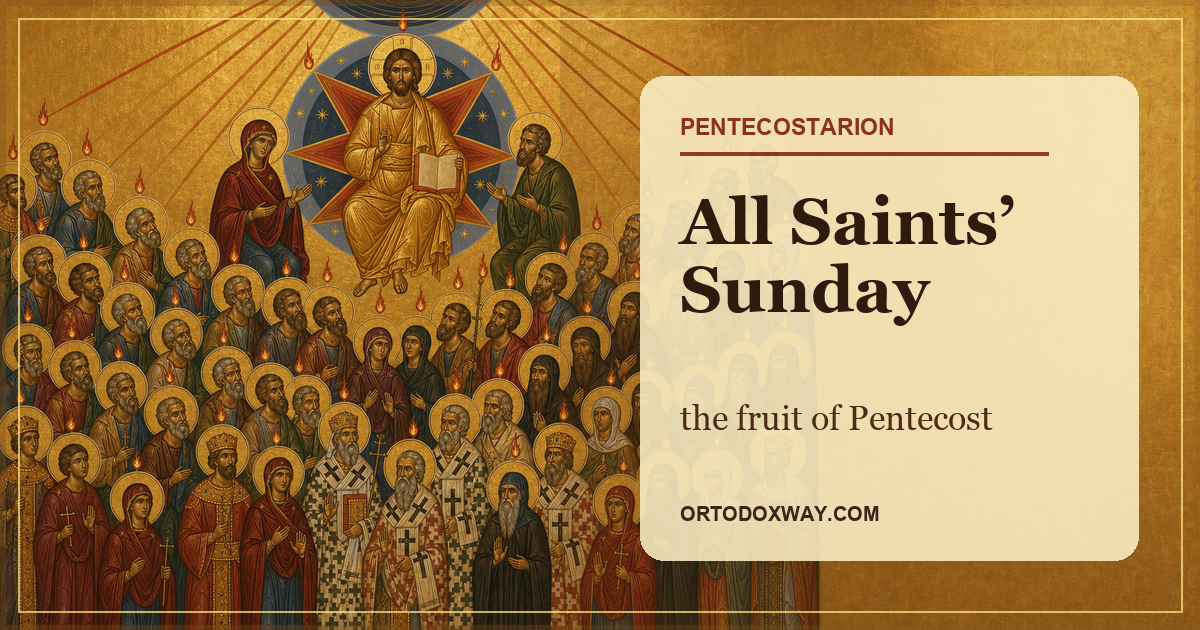
The placing of this feast in the calendar is no accident — and in that very placing lies its key. A week earlier, at Pentecost, the Church celebrated the Descent of the Holy Spirit. And now, on the very next Sunday, she shows what the Spirit does when He descends into human beings: He makes them holy. The saints are, quite literally, the fruit of Pentecost. Today’s feast does not follow Pentecost by chance, but by a bond of root and fruit: the Descent of the Spirit is the root, the saints are the harvest.
This is why the Sunday of All Saints is not, as one might suppose, a feast “of completion” — a day on which we would gather up the saints who were not each commemorated on their own day in the calendar. It is, on the contrary, the feast that reveals the very purpose of Pentecost. The Pentecostarion sets the source and the fruit one after the other: first the Spirit, then the saints whom the Spirit has made. The Synaxarion of the day says it plainly — the coming of the Most Holy Spirit worked through the Apostles such great things that it sanctified men and raised them to the rank of the angels: some through martyrdom and blood, others through a life of virtue. Holiness, in other words, is not a man’s own achievement, but the fruit of the Spirit in a man who has opened himself to His working.
The Fruit of the Spirit
The word “fruit” here is not a felicitous metaphor but the very language of the Apostle Paul. “The fruit of the Spirit is love, joy, peace, longsuffering, gentleness, goodness, faith, meekness, temperance” (Galatians 5:22–23). This is what grows in a man in whom the Spirit is at work. The saints are the place where this fruit has come to full ripeness. What in most of us remains in bud or barely ripened, in them has ripened whole: the same love, the same peace, the same gentleness, but brought to the measure at which they pervade the whole man and transform him.
Paul sets this fruit over against “the works of the flesh” (Galatians 5:19–21) — enmity, wrath, fornication, envy — as two utterly different growths from one and the same human nature. In the saints the first has prevailed: the place still held in most of us by passion and dissipation has been taken, in them, by the fruit of the Spirit.
And here precisely we see why the feast of the saints follows Pentecost, and does not precede it. No one becomes holy by his own power. As the branch does not bear fruit of itself, but only so long as it abides in the vine, so a man bears the fruit of holiness only by abiding in Christ, through the Spirit. The saint is not a hero of his own will, but a man who has let himself be wrought upon by the Spirit to the very end. This is why, in these saints, the Church does not celebrate their own merit, but the Spirit who bore fruit in them.
Known Only to God
Here, too, it becomes clear why there is a single feast, common to all. On every day of the year the calendar commemorates one saint or another, by name and on his own day. But those so commemorated are only a small part. Most of the saints have neither icon, nor day, nor name spoken by us: they lived and were sanctified in silence, and remained unknown to the world — known only to God. The calendar cannot contain them; this day embraces them all.
This is the most humble note of the feast, and perhaps the most consoling. For it says that the greater part of the saved are not great names, but lowly and unknown people: a mother who raised her children in the fear of God, a sick man who bore his suffering without complaint, a poor man who gave alms out of his little, an ordinary Christian whose holiness no one saw. They are a multitude beyond number, in the midst of whom we stand without seeing them. Holiness, then, is not the privilege of a renowned few, but the calling of every baptized person.
“Of Whom the World Was Not Worthy”
Who, then, are these saints beyond number? The epistle read at the feast — taken from the very chapter in which the Apostle Paul makes remembrance of the righteous — gives us a likeness of them. Some shone in power and victory: “through faith subdued kingdoms, wrought righteousness… stopped the mouths of lions, quenched the violence of fire” (Hebrews 11:33–34). Holiness can wear, then, even the garment of visible triumph.
But the same page turns at once toward the lowly and the broken: others were tortured, mocked, imprisoned, stoned, wandering “in sheepskins and goatskins,” destitute and persecuted — “of whom the world was not worthy” (Hebrews 11:38). Here is the reversal the feast brings: those whom the world cast out are the very ones of whom the world was not worthy. The measure of holiness is not the measure of the world.
And over all of them — the glorious and the unknown alike — the Apostle sets a startling word: “these all, having obtained a good report through faith, received not the promise: God having provided some better thing for us, that they without us should not be made perfect” (Hebrews 11:39–40). The saints are not a closed world, set apart from ours: their perfection awaits us. The fullness of their company is not complete without those who come after them. This is why we keep their feast not as that of strangers from another age, but as that of those to whom we are bound, and who are bound to us.
A Holiness That Can Be Reached
And here we come to what concerns each one of us. Today’s feast is the Church pointing her finger at those who have arrived. The saints are the living proof that the goal of the Christian life is not a fine phrase but a state that can truly be reached — since so many have reached it already, from every age, from every nation, from every condition. What is asked of us was possible for others too, men of the same nature, subject to the same temptations.
This is why the Apostle, after recounting the multitude of those who overcame by faith, does not leave us merely to admire them, but calls us into the same race: “we also are compassed about with so great a cloud of witnesses, let us lay aside every weight… and let us run with patience the race that is set before us” (Hebrews 12:1). The saints are not a gallery of faces admired from afar, but witnesses who surround us, who are still running, being at once our example and our pledge that the road has an end. This is why Father Cleopa Ilie said without mincing words: “We cannot be saved unless, according to our strength, we imitate the life of the saints.” The saints are not content to amaze us; they call us to follow them. The hymns of the feast see in them the very filling-up of the angelic choir, diminished by the fall of the proud angels: the place left empty by the fallen angels is filled now by men made holy.
From the Martyrs to All the Saints
At the beginning, this feast had a martyric character: it was the commemoration of all those who confessed Christ unto blood. Its tradition is attested very early in the East, from the fourth century, and the name of Saint John Chrysostom remains bound to this veneration through his homily on the holy martyrs, preserved in Patrologia Graeca 50, 705–712. Later, the commemoration widened from the martyrs to all the ranks of the saints, and settled firmly on the first Sunday after the Descent of the Spirit.
This martyric origin is still visible today in the Gospel of the day, in which the Lord says: “Whosoever therefore shall confess me before men, him will I confess also before my Father which is in heaven” (Matthew 10:32). The first saints were those who confessed Christ unto blood. But confession is not made only in prison and at death: the Synaxarion itself distinguishes the two ways by which the Spirit sanctified men — some through martyrdom and blood, others through a life of virtue. The martyr confesses by dying; the venerable saint confesses by living. Both are the same fruit of the same Spirit.
Where We Are Going
This, then, is what we celebrate today: not a list of names, but the ripened fruit of Pentecost — a humanity made holy by the Spirit, in which the goal of the Christian life is shown to be attained. And because this goal is real and possible, the Church does not leave us merely to gaze upon it from afar. The next day, Monday, the Apostles’ Fast begins: the road on which we too set out, that we may become fruit in our turn. Today we see the end; tomorrow we set out on the way.
For the saints are not given to us to be admired from a distance, as men of another clay, but that we may know ourselves to be in the same race with them — younger brothers of the same family, surrounded by the same cloud of witnesses, called to the same fruit of the Spirit. What ripened in them can ripen in us also, if, like them, we give ourselves to the very end to the working of the Spirit, who descended once and for all at Pentecost and does not cease to work, in every liturgical year and in every heart that opens to Him.