
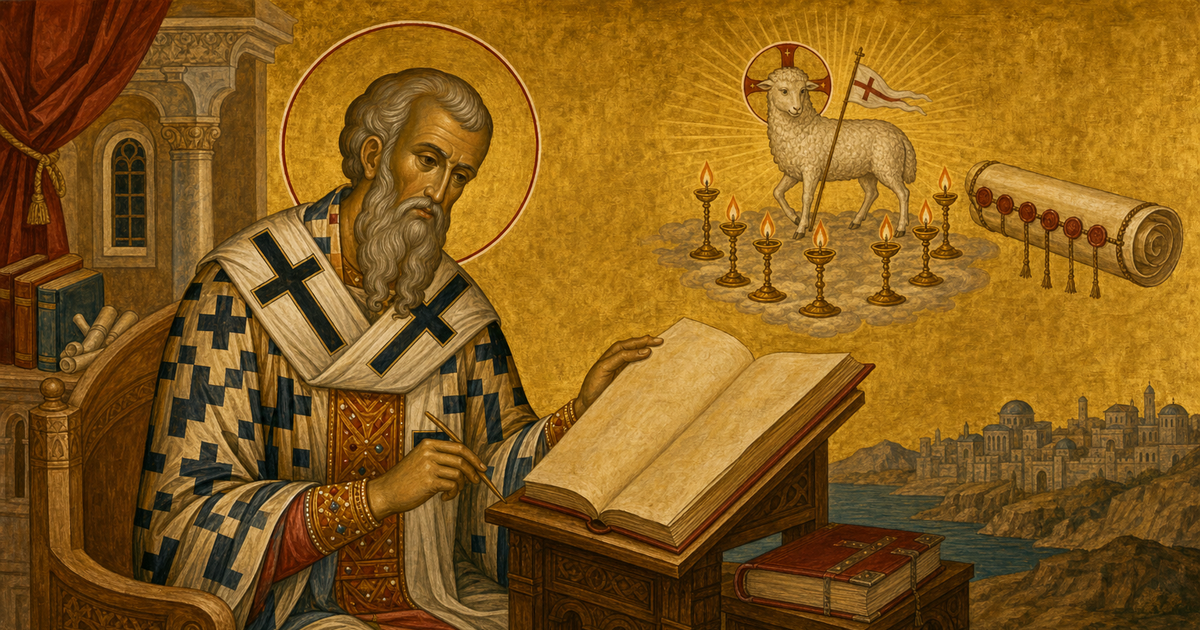
The method of St Andrew of Caesarea and the golden rule of all interpretation
From the series “The Book of Revelation” — an Orthodox reading in five parts.
In the first part we saw a silence: that of the great Greek interpreters, who for centuries kept Revelation away from the ordinary public reading and from systematic commentary. We saw, too, that this silence resembles discernment more than incapacity — a guarding of a book the Church knew to be holy, yet easily misread. And this silence was, in the end, to be broken. At the beginning of the seventh century, around the year 611, the voice arose that opened the book in an ecclesial way.
That voice is St Andrew of Caesarea in Cappadocia. To him we owe the interpretation that became, in the East, the normative one. It was not the first Greek attempt to interpret Revelation — before him, Oecumenius had written the oldest known Greek commentary on the book — but it was Andrew’s that the Church received: it gathered the testimonies of the Fathers before him, kept the balance between history and mystery, and guarded the book from the fever of calculations and the temptation of chiliasm. Since then, it has stood at the foundation of every Orthodox reading of Revelation. And the most precious gift Andrew left us lies not so much in his solutions to this or that vision as in the method itself — the key by which a symbol opens without the mind losing itself in it.
An interpreter who drew near with reverence
The way St Andrew begins his work says much. He confesses that he had been asked many times to interpret this book, but that “I declined” — that is, he held back, delaying — knowing how hard it is to penetrate. What is written there, he says, concerns things to come and was given to the saints in a hidden manner; to understand it, one needs a mind “enlightened by the divine Spirit” (Commentary on the Apocalypse; Romanian ed., Băbuț, Oradea, 1991, p. 10).
Here is a first lesson. The worthiest interpreter of Revelation approaches it with fear, knowing that it is not man’s mind that unlocks the mysteries, but the Spirit who inspired them. This is the first condition of any right reading: not the haste to master the text, but reverence before it. Whoever approaches Revelation convinced that he holds the key to every riddle has already lost, by that very conviction, the ability to read it.
The book’s own name shows the direction. Apokalypsis, in Greek, means revelation, unveiling, the lifting of the veil. The book is not a lock to be picked, but a revelation that God makes — a light given, not a cipher to be deciphered. Andrew calls it, in the very first line of his commentary, “the revealing of the hidden mysteries,” which takes place “when the understanding is enlightened” (St Andrew of Caesarea, Commentary on the Apocalypse; Romanian ed., Băbuț, Oradea, 1991, p. 11). Whoever understands this has already understood that Revelation is not read with the detective’s tool.
The setting in which he wrote says something more. St Andrew did not work in a peaceful age: the East was passing then through plague, famine, war, and devastating invasions, and to many those times seemed the signs of the end. And precisely here the power of the ecclesial reading shows itself. Andrew did not take the fear of his age as the key to the book. He did not force the text to confirm people’s anxiety, but let Scripture judge that anxiety. This is why his interpretation does not kindle the fever of the end but calms it; it does not turn Revelation into a mirror of panic, but into a call to repentance and hope. The one who read the book amid the fears of his own age teaches us, before all else, not to read it through our fears.
Andrew’s aim is not to feed the desire to know when the world will end, but to heal the way man looks at the world. He writes not for curiosity but for vigilance; not for calculation but for repentance; not to breed fear, but to set fear in the light of hope. His interpretation is pastoral before it is learned.
The three levels of reading
Here is the heart of Andrew’s legacy. He does not read the book on a single plane, but on three at once, according to the manner of interpretation inherited from the Fathers since the days of the Alexandrian school.
The first is the historical, or literal, meaning: what truly happened or will happen, the concrete ground of the vision.
The second is the tropological, that is, the moral meaning: what the vision says about the believer’s inner struggle, about passions and virtues, about the soul’s way toward God.
The third is the anagogical — from the Greek word for “ascent” — that is, the spiritual meaning: what the vision reveals about things eternal, about the Kingdom, about the end toward which history moves.
The three levels do not exclude one another, but support one another. A single vision may have, at the same time, a historical ground, a moral teaching, and a revelation about eternity.
Here a clarification is needed, lest we fall into the opposite error. To read spiritually does not mean to abolish history. For the Fathers, the symbol is not opposed to reality; it is the way reality shows itself more deeply. A vision may speak of real events without being exhausted by them; it may look toward the future without fitting into a human calculation; it may show historical powers, but because behind them is waged the deeper struggle, between the Kingdom of God and the kingdoms of the world. Andrew does not choose between history and mystery, but holds them together: he does not discard the letter, but sets it in its spiritual order. The anagogical reading is not a flight from the world into allegory, but a more piercing gaze upon the world.
The power of this method shows itself best where the chiliasts had stumbled. When he comes to the thousand years of the twentieth chapter, St Andrew does not read literalistically. He plainly rejects the notion of a visible reign on earth and understands the number spiritually. The thousand years are for him, in his own words, “the time from the Incarnation of Christ until the coming of the Antichrist” (Commentary on the Apocalypse; Romanian ed., Băbuț, p. 133). The thousand does not measure a span of years — he says emphatically that it cannot mean “ten hundreds, but a great multitude” — but signifies the fullness of the time in which the Gospel is sown in the world. As for the chiliast reading, which awaited an earthly kingdom of pleasures, Andrew rejects it sharply: “This too the Church has not received.” Thus hope is no longer lowered to the dream of a fleshly kingdom, but remains turned toward the unshaken Kingdom. It was not the book that was at fault, but the eye that read it only according to the letter.
The golden rule: Scripture is interpreted through Scripture, in the Church
The whole wisdom of this method gathers into a single rule: the symbols of Revelation are not unfolded through the events of the day, but through Scripture — and not through Scripture torn from the Church, but through Scripture read within Tradition. This is what separates the Orthodox reading from fantasy. The letter of Scripture is not clarified by the mere juxtaposition of texts, but within the life of the Church, which has received and preserves the true meaning.
The first to teach us this rule is the text of the book itself. In the first vision, St John sees One like the Son of Man in the midst of seven golden lampstands, holding in His right hand seven stars. And the Lord does not leave the symbol in darkness, but interprets it Himself: the seven stars are the angels of the seven Churches, and the seven lampstands are the seven Churches (Revelation 1:20). The book thus carries its own key; where clarification can be given from within it, it is given.
This is not the first time Scripture does so. To the prophet Daniel, who had also received visions full of beasts and mysteries, the angel interpreted the meaning (Daniel 7:16; 8:16). Revelation stands in the same order: it speaks the language of the prophets and asks to be read with the whole of Scripture beside it. Whoever knows the prophets of the Old Testament already has the dictionary of John’s visions, for most of the great images of Revelation have their root in the Law and the Prophets.
For Revelation does not use the Old Testament as a list of quotations, but as its own language. John does not append footnotes to the prophets; he thinks, sees, and writes in their light. This is why one who reads Revelation without Genesis, Exodus, Daniel, Ezekiel, Isaiah, and Zechariah is like a man who beholds an icon without knowing the pattern after which it was painted.
The map of the visions: where the great symbols come from
There is, however, a step beyond the rule itself. Scripture is interpreted not only through Scripture, as through a system of references, but through Christ, who is its fulfillment. The key to Revelation is not the beast, nor the number, nor Babylon, but the Lamb. All the symbols become clear only when set around Him: the One slain and living, the One who opens the book, the One who judges and saves. Whoever loses sight of the Lamb is reading a different book.
With this key in hand, let us trace several of the book’s great symbols back to their source. Each time we find the same thing: the root is not in some event of our own times, but in the Old Testament.
The Beast. The beast that rises from the sea, with ten horns (Revelation 13), is no new invention. It gathers, in reverse order, the features of the four beasts Daniel had seen rising from the sea — the lion, the bear, the leopard, and the fourth beast with ten horns (Daniel 7). In John, the beast has the body of a leopard, the feet of a bear, the mouth of a lion, and the horns of the fourth beast. John does not invent: he takes up and recapitulates Daniel’s vision, showing that the same power opposed to God works on in history.
The Throne and the Living Creatures. The vision of the heavenly throne, with the four living creatures around it — with the face of a lion, of an ox, of a man, and of an eagle (Revelation 4) — comes from the vision of the cherubim that Ezekiel had seen by the river Chebar. There, each creature bears all four faces at once; in John, the same four faces are divided among the four living creatures (Ezekiel 1). And their song, the threefold “Holy, Holy, Holy,” is the song of the seraphim heard by Isaiah before the throne of glory (Isaiah 6:3).
The Woman and the Dragon. The woman clothed with the sun, confronted by the dragon (Revelation 12), recalls the very first promise of Scripture: the enmity set by God between the serpent and the woman, between his seed and hers (Genesis 3:15). For St Andrew, this woman is first of all the image of the Church: she gives birth in pain, flees into the wilderness, is persecuted by the dragon, and yet remains under God’s protection, while the crown of twelve stars signifies the apostolic teaching. A single figure thus binds the beginning and the end: Eve and the promise in Paradise, the people of God awaiting the Messiah, the Church that bears children through pain and persecution — and, in the wider light of Tradition, also the mystery of the Mother of God, through whom Christ comes. So the symbol works: not closed in a single solution, but left to breathe on several levels — yet never at will, but within the bounds set by Scripture and the Church.
Babylon. Great Babylon, the city of harlotry that falls (Revelation 17–18), bears the name and likeness of the city the prophets had condemned centuries before. John’s laments over Babylon borrow the words of the laments over the historical Babylon, uttered by Isaiah and Jeremiah (Isaiah 13–14; Jeremiah 50–51). Babylon is, in Scripture, one of the enduring names of the city opposed to God. And the fact that St Andrew himself weighs several possible references — Persia, old Rome or the new, or the wider image of any persecuting power — shows that the ecclesial reading does not fear history: it can see in Babylon a particular power, but only because beyond every passing city stands the same image of pride and of persecution against the saints of God.
The Exodus. The plagues of Revelation cannot be understood apart from the plagues of Egypt. The waters turned to blood, the darkness, the sores sent upon the hardened — all point back to the great deliverance of Israel (Exodus 7–12). And the victors beside the sea of glass sing “the song of Moses and of the Lamb” (Revelation 15:3), joining in a single voice the old deliverance and the new. Revelation is, in this sense, a new Exodus: not out of Egypt, but out of the bondage of this world; not through the Red Sea, but through the victory of the Lamb.
The Temple. The altar, the incense, the golden censers, the ark, the priesthood, and the heavenly song are not poetic ornaments, but the language of worship, drawn from the order of the temple. Through them, Revelation beholds history from within the divine service. Here we only mark the source: of this liturgical face of the book — perhaps the least known and the most consoling — we shall speak in the next part.
The New Jerusalem. The city that descends from heaven at the end of the book (Revelation 21–22) does not arise from nothing: it gathers the prophets’ promises about Zion, the unfading light of the new Jerusalem from Isaiah (Isaiah 60), the temple seen by Ezekiel, and the river of life that flows from the holy place (Ezekiel 47). Here too we only point to the source; the meaning of the city — Scripture’s return to its own beginning, where the lost garden becomes a city — belongs to the end of the road.
The Numbers. The numbers that fill the book are not figures to be counted, but words to be read. Seven is the sign of fullness and perfection. Twelve is the number of the people of God — the twelve tribes, the twelve Apostles. Four is the number of the world, of the four corners of the earth. And the thousand signifies a great multitude and fullness, not a span of years. To read them as reckonings of a calendar is not to have learned the language in which Scripture speaks.
From this follows the touchstone of all interpretation: if someone makes an event of the day the foremost key to Revelation, passing by Scripture, by the prophets, and by the mind of the Church, then he does not interpret, but invents. History may be illumined by Revelation, but the panic of history does not illumine Revelation. St Andrew does not shrink from weighing, with measure, a historical reference; but he never lets the rumor of the day take the seat of Scripture. The key lies within Scripture and in the mind of the Church, not in the fear of the times.
In brief: Revelation is read with reverence, not with haste; through Scripture, not through the news of the day; in the Church, not according to each man’s mind; on several levels, not only literalistically; and with not the beast at its center, but the victorious Lamb.
Toward the heart of the book
We have, then, the key. We now know how Tradition reads this book: with reverence, not with boldness; on three levels, not on one; and, above all, with Scripture open beside it, for John’s visions speak the language of the prophets.
But a key is made to open a door. And beyond the door is no tangle of terrors, as the untrained reader fears, but a sight of unexpected beauty. Read with the right key, Revelation shows itself to be not the book of fear, but the book of the victorious Lamb and of the heavenly Liturgy. Of what this book truly is we shall speak in the next part.
In Part Three: the slain Lamb and the heavenly Liturgy — the true face of the book.
About this series
“The Book of Revelation” is a series in five parts, seeking to recover the Orthodox, patristic reading of the most misunderstood book of Scripture — beyond fears and beyond calculations about the end of the world.
- Why the Fathers Were Silent — The distinct status of Revelation in the Byzantine tradition: a book received with reserve, not read at the services, and long left without commentary. What this silence means.
- The Key to Reading It (the present article) — The method of St Andrew of Caesarea and the golden rule of all interpretation: the symbols are unfolded through Scripture and in the Church, not through the events of the day.
- The Lamb and the Heavenly Liturgy — The true face of the book: not a map of catastrophes, but the vision of the Lamb’s victory and of the heavenly worship.
- The Words That Remained — The famous verses of Revelation, from “the Alpha and the Omega” to the New Jerusalem, and the right way to read them — including the most misread of them all.
- Revelation Today — Why, now that anyone can read it, we need not decipherment but guidance.