
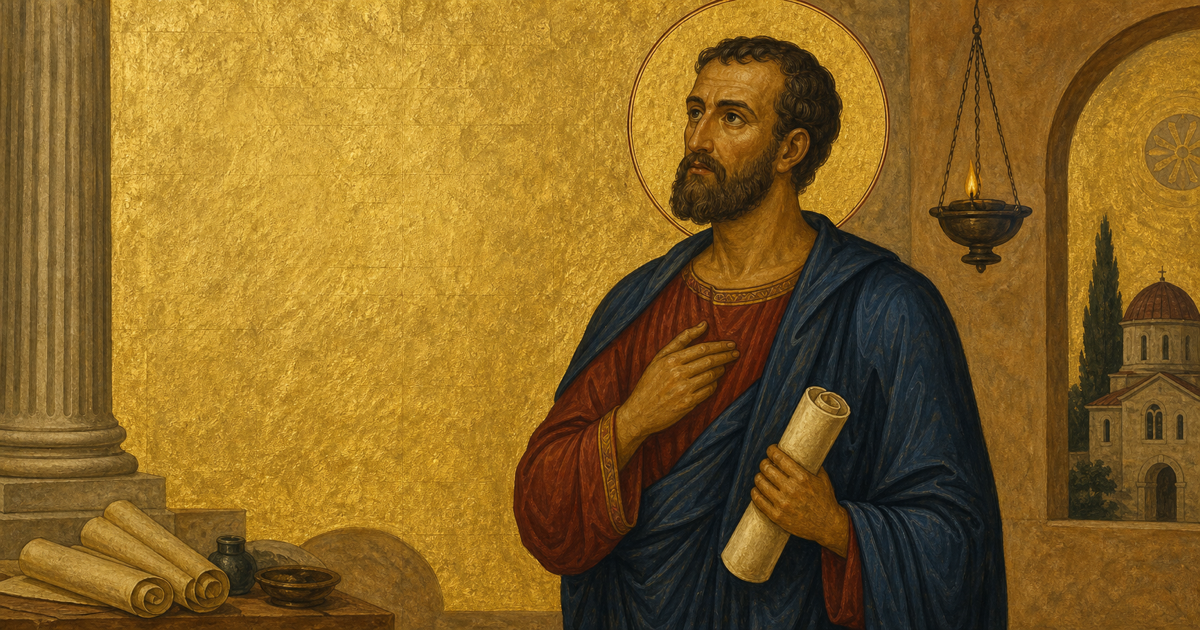
On How Philosophy Can Be Martyrdom
Commemorated on June 1
He was one of the first men of the Greek city who, without casting off his philosophical learning, knelt before Christ and died for Him. Justin did not come to faith by fleeing from thought, but by carrying thought to its very end, where he discovered that the Truth sought by the philosophers is a Person. This is why the Church honours him as both philosopher and martyr, and the two names do not contradict each other in him but contain one another: he was a philosopher precisely because he was ready to die for the Truth, and a martyr precisely because the Truth he loved was alive.
The Search for Truth
Justin was born at the beginning of the second century (around the year 100) on the borders of Samaria, in the ancient city of Shechem, later called Flavia Neapolis — today’s Nablus. His father, Priscus, and his grandfather, Bacchius, were of Greek or Roman stock and worshippers of idols; he himself grew up in that same error, until faith enlightened him. He had a sharp mind and a desire that gave him no rest: to find out what God truly is.
He knocked, one after another, on the doors of the philosophers of his day. The Stoic he first came to knew nothing of God and did not even consider such knowledge necessary; Justin left him. The Peripatetic who followed proved greedy, quickly demanding a fee — a sign, the young man judged, that he was unworthy of the name of philosopher, since he did not know how to rise above worldly gain. The Pythagorean required him to learn first astronomy, music, geometry and arithmetic — many years in which his heart, kindled ever more strongly by longing for God, would have found no comfort. At last he attached himself to a Platonist teacher, whose teaching was at that time held in great esteem, and learned it quickly, becoming a philosopher prized among the Greeks. The contemplation of incorporeal ideas — he used to say — had given his mind wings, as it were. And yet something was missing: the Greek philosophers did not glorify God as God, but exchanged His glory for the likeness of created things. Justin found comfort only in part.
The old man on the seashore
Walking alone one day outside the city, near the sea, absorbed in his thoughts, he met an unknown old man, venerable and adorned with grey hair. The old man asked him what he was seeking in that deserted place, then what philosophy is and what good it brings. Justin answered as a convinced Platonist: philosophy is the knowledge of truth, and God is the One who never changes, the cause of the coming-to-be of all things, and one can reach Him only with “the eye of the mind,” not with the eyes of the body.
The old man listened to him with love, but was not satisfied with that knowledge. And he asked him pointedly: if Plato teaches thus, why did he himself worship the creature — the heavens, the stars, wood and carved stone? The Greek philosophers became empty in their reasonings, and their heart was darkened; professing themselves wise, they became fools. For — the old man told him — the human mind, if it is not guided by the Holy Spirit and enlightened by faith, can in no way come to know the true God.
To Justin’s natural question — then where, and from what teacher, can the truth be found? — the old man spoke to him of the prophets: holy men, older than all the philosophers, filled with the Holy Spirit, who spoke the truth without fear and without sophistic artifice, confirmed it by miracles, and foretold the coming of Christ, the Son of God. And at the end he counselled him with words that are the very key of the whole Christian life: before all things, to pray to the true God to open for him the door of light, for no one knows the things of God except the one to whom God Himself is pleased to reveal them. Then the old man vanished, and Justin never met him again.
“A fire was kindled in my soul”
What followed in his soul, Justin would later tell in his conversation with Trypho the Jew: “A fire was kindled in my soul” — the longing for God and love for the prophets and for those who had been the friends of Christ. He began to seek out the Christian books and to read the Scriptures diligently, setting the ancient prophecies beside the coming, the suffering and the resurrection of Christ; and, taught little by little by the Holy Spirit, he came to true knowledge.
One thing alone still held him back: the persecutions and the slanders hurled against the Christians — that in their nighttime gatherings they would put out the lamps for the sake of impurity and would eat human flesh. Justin did not believe them entirely, knowing how often the judgement of the crowd condemns the innocent. And he made a clear argument, befitting a philosopher: the man who loves pleasure fears death and flees from torments; the Christians, however, go willingly to death as to a banquet, honouring death more than life — therefore it is impossible for them to be slaves of lust and of sin. He himself examined their life and found purity, fasting, unceasing prayer. He loved them, received Holy Baptism — around the years 130–137 — and became, as tradition says, an unconquered soldier of Christ. A thing worth noting: he did not cast off his philosopher’s cloak. He remained a philosopher, but now a Christian philosopher, for to him Christ does not abolish the search for truth but enlightens it and brings it to fulfilment.
The Philosopher in the City
Justin travelled and preached, then came to Rome, where he founded one of the earliest Christian schools of apologetic and philosophical learning — a place in which, under the guise of outward philosophy, he taught the true Christian philosophy. Among his disciples are numbered Tatian the Syrian and Miltiades. There he confronted and put to shame the heresiarch Marcion, who divided the God of the Old Testament from the Father of Christ, writing against him and against other heresies.
In those days there took place in Rome an event that grieved him deeply. A woman converted to Christ, unable to bring her dissolute husband to a pure life, had sought a separation; the husband, learning who had taught her the faith, denounced to the prefect the Christian Ptolemaeus. He was held in prison and then condemned to death simply because he confessed himself a Christian. A man who was present, Lucius, asked the prefect aloud why he condemned a man who was neither dissolute, nor a thief, nor guilty of anything else, but only a Christian — and he too was condemned; and beside them a third was added. Three souls laid down for Christ.
Grieved by such an injustice, Justin wrote the Apology — the book in which he set forth the innocence of the Christians and proved the falsehood of the slanders, asking that men not be condemned for the mere name of “Christian,” but only if evil deeds were proven against them. He delivered it, around the middle of the century (about the years 150–155), to the Emperor Antoninus Pius, to his sons, and to the senate, without fear of death. Later he also wrote a Second Apology, addressed to the senate. Tradition says the emperor marvelled at the wisdom of the Christian philosopher and allowed the persecution to abate for a time. In these same years, at Ephesus, Justin held his long conversation with the learned rabbi Trypho, whom he met from the Scriptures of the Old Law — a conversation preserved in the Dialogue with Trypho, the longest of his writings.
The Word Sown Throughout the World
Here the thought of Saint Justin reaches a depth that nourished the Fathers who came after him. For Justin, Christ is the Logos, the Word of God — the same Word of whom the beginning of the Gospel according to John speaks. And this Word, he says, was at work in the human race before He became incarnate, sowing in the minds of men “seeds of truth” (in Greek spermata aletheias; hence the expression by which his teaching is known, Logos spermatikos, “the Word sown abroad”).
This is why the best of the philosophers were able to utter true things: not from themselves, but insofar as they partook, without fully knowing it, of the Word of God. Justin goes so far as to say that those who lived “with the Word” before Christ — Socrates or Heraclitus among the Greeks, Abraham and others among those before the Law — were, in a sense, Christians before Christ. In short: the philosophers do not possess the whole Truth, but touch the Word only in fragments; the fullness of the Word is Christ.
This teaching must be understood with right discernment, for it can be twisted in two ways, both of them mistaken.
The first is syncretism: to make of the “seeds of truth” a theory of the equality of religions, in which all would have “sparks” equally saving. Justin would be the first to oppose this. He distinguishes clearly between having a seed of the Word and knowing the Word Himself in His fullness. The philosophers had fragments, partial glimpses, often mixed with error; only in Christ did the Word appear whole. The difference between seed and Source remains, for him, the difference between a drop and the sea.
The second, on the contrary, is the charge that Justin “Hellenized” Christianity, dissolving it into philosophy — a charge raised above all by the liberal Protestant criticism of a century ago. And this too misses the truth. Justin does not place Christ beneath philosophy; he places philosophy beneath Christ. His thought is not “Christianity is a form of Platonism,” but “everything true in the philosophers was already, without their knowing it, the working of the Word who is Christ.”
The ultimate ground of this vision is not philosophical but rests on the teaching about man: man is made in the image of God, and the Image after which he was made is the Word Himself. The “seed” of reason in man is a consequence of this making-in-the-image. This is why Justin does not make human reason something divine by nature — he sees it as a created, gifted participation in the working of the Word.
A Philosophy Fulfilled in Martyrdom
In his writings there seem to be two accounts of his conversion: one, from the Dialogue, in which Justin comes to Christ by climbing the steps of philosophy up to Platonism; the other, from the Second Apology, in which he is drawn by the courage of the martyrs in the face of death. How are the two reconciled?
The answer clarified by scholarship — above all by the theologian Oskar Skarsaune — overturns a widespread assumption. Although his philosophical road leads him up to Platonism, his conversion does not come about by continuity but by rupture. The old man on the seashore does not add Christianity on top of Platonism, but dismantles his Platonism, showing him that its theories about God and about the soul lead to a dead end. Justin does not remain a Platonist who has been baptized; he sees his philosophy torn down and leaves it behind.
The consequence is significant: Justin is not a Christian Platonist and does not have a philosophical conception of Christianity; he has, on the contrary, a prophetic understanding of philosophy. The framework of his thought is not Greek metaphysics, but a prophetic and martyric vista: the struggle between God and the fallen powers that hold the human race in ignorance and passion. The One who overcomes them is the Word, Christ — upon the Cross and through His Church. And the crucified Word was foretold both by the prophets of Israel and by the true philosophers, such as Socrates. This is precisely why these were, in Justin’s logic, witnesses before their time: Socrates was killed because he unmasked idolatry, just as the Christian martyrs are killed for the same witness.
Thus true philosophy — wholly distinct from the pseudo-philosophies that ape it — has a prophetic service: to expose idolatry and to bear witness to the Truth, at the cost of being persecuted and killed. The death of the philosopher becomes itself a witness to the crucified Word. This is, at its depth, the message of Saint Justin: true philosophy is martyric, or it is nothing. In him, life and death say the same thing.
“Another God — in Number, Not in Will”
Before Nicaea
Saint Justin writes nearly two centuries before the Council of Nicaea (325) and before the clarification of the words by which the Church would confess the Trinity (essence, hypostasis, consubstantiality). He did not have these tools, nor could he have had them. His teaching about the Word is, therefore, a theology before Nicaea, spoken in words that only later would be polished.
On the one hand, Justin clearly confesses the divinity of the Son: he calls Him “Lord and God, the Son of God” and says He is worthy of worship as God. On the other hand, speaking with a Jewish interlocutor to whom he had to defend the oneness of God, he uses formulations that seem to set the Son “lower.”
A distinction of Person, not of will
The most discussed passage is from the Dialogue with Trypho, where he calls the Word “another God” than the Father — yet clarifying at once in what sense: “another in number, but not in will” (Dial. 56). This qualification is often passed over, though it changes everything: Justin does not speak of two gods with differing wills, but of a distinction of Person, not of will and not of mind.
To call Justin, without any qualification, a “subordinationist” is to judge him by a question that had not yet been posed. He could be neither “Nicene” nor “anti-Nicene.” And yet, by the very image he uses, he says something that would later become an argument of the right faith: just as a fire kindled from another fire does not diminish the first, so the Father, in begetting the Son, loses nothing. The fire from fire preserves the fullness — that is, precisely what the Church would defend at Nicaea.
In Saint Justin, then, we find the roots of the theology of the Trinity, not an error. His language is still unfinished, at times clumsy by the measure of later times, but the heart of his confession is sound: he wills both the divinity of the Son and the oneness of God. From this there follows a lesson of right discernment that concerns us all: the antiquity of a Father is not to be weighed by the ruler of a dogma formulated later, but is to be read in the light of the flawless growth of Tradition, which brings to light in time what was hidden from the beginning, as in a seed.
The Oldest Icon of the Liturgy
Perhaps the most precious gift Saint Justin left us is a page from the First Apology (chapters 65–67): the oldest detailed description of the Divine Liturgy preserved outside the New Testament. Writing for a pagan emperor, to show that the gatherings of the Christians are nothing shameful, Justin set down, without intending to, the image of the Liturgy before the ages.
And this image is astonishingly close to that of today: the Christians gather “on the day called of the sun” (Sunday), all in one place, from the cities and the countryside; there is read from “the memoirs of the Apostles” — that is, the Gospels — and from the writings of the prophets, as long as time allows; the one presiding gives a word of instruction, exhorting to the imitation of what has been read; all rise and pray standing; bread, wine and water are brought; the one presiding offers up the prayer of thanksgiving (in Greek eucharistia), and the people respond “Amen”; all those present partake, and the deacons carry the Holy Gifts to those who are absent; at the end, the well-off help those in need.
Four things shine in this page. First, the clear confession of the Real Presence: Justin says that the bread and wine are not received “as common bread and common drink,” but as the Body and Blood of the incarnate Christ. His language is not yet technical, in the sense of the later dogmatic clarifications — he writes a century and a half before any dispute about the Eucharist — but the faith in the Real Presence is expressed with a clarity that leaves no room for doubt.
Second, the proof of the unbroken continuity of the Liturgy, which is not a later invention but the same from the beginning. Third, the bond between the Eucharist and care for the poor: the Liturgy is not a piety of one alone, but the building up of a single body. Fourth, the order of communion: no one approaches the Holy Gifts without the right faith, without Baptism, and without a life befitting Christ.
The Cup and the Sword
The end of Saint Justin has come down to us in two forms, and their meeting itself says something about the way the Church preserves the memory of her saints.
The account in the Lives of the Saints tells that the Cynic philosopher Crescens — a man of defiled life, who hated the purity of the Christians and envied the honour Justin enjoyed — was always bested by him in disputes and, unable to withstand him, slandered him before the court. Justin was seized and examined, but no fault was found in him; then, fearing he might be set free, the envious man secretly prepared poison and killed by deceit the unconquered soldier of Christ. This is the icon of the “philosopher” poisoned, a kind of Christian Socrates, slain through the envy of a fellow.
The surest testimony for his end, however, is found in the Acts of the Martyrdom — a true court record, one of the most trustworthy martyric testimonies of all Christian antiquity. There Justin and six companions are brought before the prefect of Rome, Rusticus, are urged to sacrifice to the gods, and refuse. At the end, the prefect asks him whether he imagines that, being beheaded, he will ascend to heaven and receive some reward; Justin answers that he does not merely imagine it, but is fully assured of it. There follows the sentence of scourging and beheading, and death. A detail full of meaning: the judge, Rusticus, was himself a renowned Stoic philosopher — indeed the teacher of Stoicism to the philosopher-emperor Marcus Aurelius. Thus the Christian philosopher was condemned by the Stoic philosopher, in the name of an imperial philosophy.
How are the two endings reconciled — the cup of poison and the executioner’s sword? The answer is not a contradiction, but a history of transmission. Eusebius of Caesarea, who was the first to write at length about Justin, links his death to the conflict with Crescens, on the basis of the allusions in the apologist’s writings; he does not appear to have known the Acts yet, which became known in the East only later. From then on the two accounts ran side by side, and the liturgical memory, unable to reconcile them, came to commemorate the saint as though in two forms — “Justin the Philosopher” and “Justin the Martyr” — on the same day. The old iconography preserved both as well: in one church in Tarnovo, Justin receives the cup of poison; in another, in Macedonia, he is depicted beneath the sword. Two deaths, one single person. Hagiographic scholarship today recovers his unity: not two saints, but one alone — Justin the Philosopher-Martyr, in whom thought and sacrifice are one.
A Thin Thread Through the Ages
It is worth knowing, if only briefly, how slender was the thread by which his writings have reached us. Saint Justin was a fruitful author, but today only three works are recognized as indubitably his: the two Apologies and the Dialogue with Trypho. The rest were lost, or mingled with the writings of others placed, in time, under his saint’s name. And the Greek text of the three authentic works came to us from a single manuscript — copied late, in the year 1364, and that one with gaps. Over this narrow bridge the voice of the first Christian philosopher passed through the ages. That it was not lost belongs to the providence of God — and it teaches us to treasure the labour of those who kept pure the ancient testimonies of the faith.
The Commemoration on June 1
In the calendar of the Church, Saint Justin the Martyr and Philosopher is commemorated on June 1, together with those who suffered with him: Chariton, the virgin Charito, Euelpistus, Hierax, Paeon and Liberian (called Valerian in some synaxaria); some calendars add as well a martyr Justus. The Painter’s Manual of Dionysius of Fourna directs that Saint Justin be depicted as an old man with a long beard.
His veneration knows in our own days a renewal as well. At Stavropoleos Monastery in Bucharest — the only church in Bucharest that has Saint Justin as its patron, a dedication granted by Patriarch Daniel on the occasion of the re-consecration of the church, in the year 2012 — there is kept, in a reliquary, a fragment of his holy relics, brought from an Orthodox monastery in Brookline, Massachusetts. There too his service and, more recently, the Paraklesis have been translated and set to music — an occasion for those who bear his name or have devotion to him to entreat him more readily.
Troparion (Tone 4): Your Martyrs, O Lord, in their courageous contest won the crowns of incorruption from You, our God; for having Your strength, they cast down the tyrants and shattered the powerless boldness of demons. By their intercessions, O Christ God, save our souls.
Kontakion (Tone 2): With the wisdom of your divine words, O Justin, the whole Church of God, adorned through the radiance of your life, enlightens the world; and having received a crown for the shedding of your blood, standing now before Christ together with the angels, pray unceasingly for us all.
Saint Justin remains a living teacher for every Christian who feels that mind and faith are enemies. He sought the Truth with all the power of thought, but did not stop at theory; and when he found the living Truth in Christ, he laid at His feet his learning, his mind, and, in the end, his blood. The philosopher who sought the Truth, found it in Christ, and confessed it unto death.
Sources and further reading: the authentic writings of Saint Justin — the First Apology, the Second Apology, and the Dialogue with Trypho; the Acts of the Martyrdom of Saint Justin and his Companions (ed. H. Musurillo; Romanian transl. Pr. Ioan Rămureanu, PSB 11); Eusebius of Caesarea, Ecclesiastical History, Book IV; and, for deeper study, O. Skarsaune, The Proof from Prophecy (Brill, 1987), together with the studies of Archdeacon Ioan I. Ică jr and of Bogdan Tătaru-Cazaban on the life, work and veneration of the saint.