
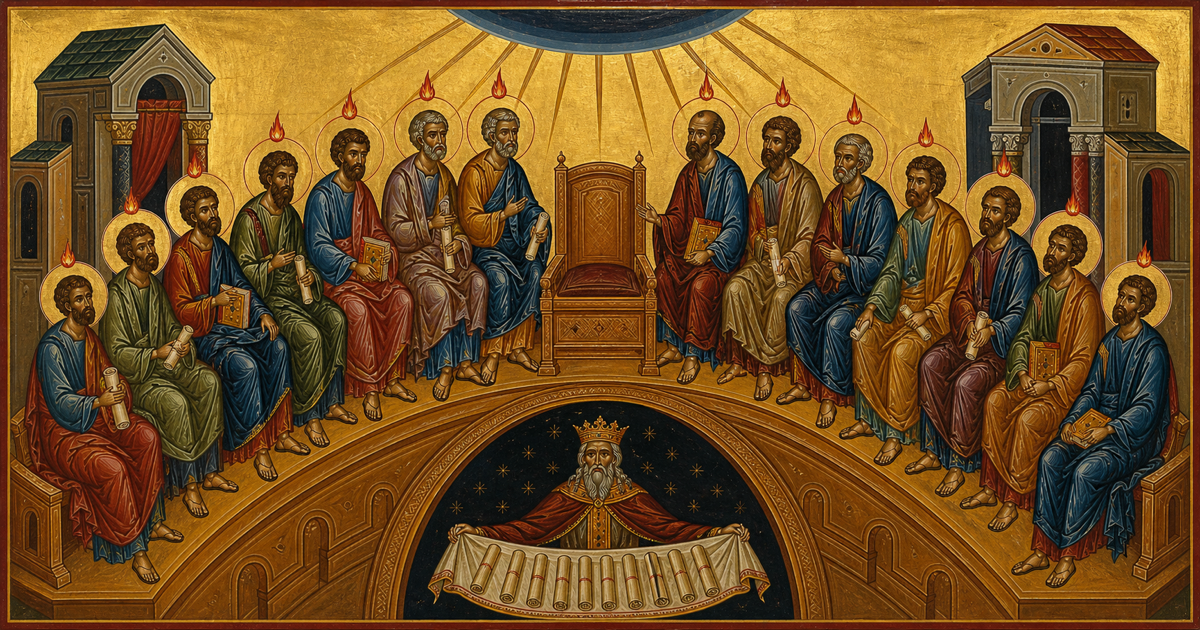
How Pentecost made the Apostles into other men than they had been fifty days earlier
I. The Paradox of the Apostles
Those who came down from the Mount of the Ascension were the same eleven men who, fifty days earlier, had fled from the Mount of Olives on the night Christ was arrested. The same hearts that had trembled before a courtyard servant girl. The same mouths that had argued, on the night of the foot-washing, petty questions about who would be greatest. The same souls who, after the Resurrection, still sat behind locked doors for fear of the Jews.
And ten days later, after Pentecost, those same men stood in the midst of Jerusalem — the city whose streets still bore the smell of Christ’s blood — and proclaimed the Crucified One with a boldness that no longer knew either fear or faintheartedness. Peter, who had not dared to confess Christ before a servant girl, now cried out before thousands of Jews. Thomas, who would not believe until he had touched the wounds, was setting out for India. Andrew departed for Scythia. John turned his eyes toward Patmos.
What happened in those ten days between the Ascension and Pentecost? Nothing. They sat in the house, in prayer and in conversation with the Mother of God and the hundred and twenty. They had read no new treatises. They had received no catechumenate. They had passed through no process of formation. And yet, when they came down into Jerusalem after the descent of the tongues of fire, they were other men.
This is the paradox of Pentecost: the same men, but other men. The same minds, but new light. The same hearts, but new fire. And this not through growth, through learning, through a journey, but instantaneously — through the descent of Someone.
Saint John Chrysostom, in his Fourth Homily on the Acts of the Apostles, describes the transformation in a single phrase that no dogmatician has ever surpassed in precision: “Wherever the Holy Spirit is present, He makes men of gold out of men of clay.” This is Pentecost. Not a new teaching. Not a program of life. But a descent that transforms the very matter of man.
This article is not an exposition of what Pentecost means. It is an invitation to look at the Apostles before and after, to discover Who it is that makes a fearful Peter into a bold Peter, an unbelieving Thomas into a witness as far as India, a silent John on Patmos into a beholder of the Apocalypse. And to ask: can that Spirit do the same thing today? With us?
The answer of the Fathers is one: yes. Pentecost is not an anniversary. It is a reality that continues.
II. The Ancient Witness: the Pre-Nicene Fathers
Before opening the Book of Acts and reading how the evangelist describes Pentecost, let us listen to how the earliest Fathers spoke — those who had known the Apostles through their direct disciples. Their witness is close to the source; it had not yet been formulated in the dogmatic categories of the fourth and fifth centuries, yet it has a density of its own precisely through that nearness.
Saint Justin Martyr, writing before the middle of the second century, testifies in the Dialogue with Trypho (ch. 82) that the prophetic gifts which were once among the Jews have passed to the Church of the nations. Each believer receives, through the name of Christ, gifts of the Spirit — the spirit of wisdom, of counsel, of strength, of healing, of foreknowledge, of teaching, of the fear of God — each according to the measure of his worthiness.
This testimony of Saint Justin must be made clear. The Holy Fathers honor, in the liturgical calendar, on the Sunday before the Nativity of the Lord, the “Holy Forefathers according to the flesh of the Lord” — and their roll begins with Adam and Eve, with Seth, with Enoch, with Noah, with Abraham, with the patriarchs. All these are righteous ones of the Old Covenant, yet they are honored in the Church as our own, as belonging to the Church. Saint Paul calls them, in the Epistle to the Hebrews, a “cloud of witnesses” surrounding us (Heb. 12:1). And Saint Peter, speaking of the ancient Israel, calls it “a chosen race, a royal priesthood, a people acquired by God” (with reference to Exodus 19:5-6) — formulas which he then applies to the Christians of the nations (1 Peter 2:9), a sign that it is one and the same mystery.
The teaching of the Holy Fathers about the Church unfolds, therefore, in several stages. The righteous of the Old Covenant were part of the Church as promise; they awaited Christ. At the Cross and Resurrection, the Church was built as fulfillment — from the side of Christ, through water and blood, as we shall see at length in the following section. At the Lord’s descent into hades, Christ brought out the righteous who waited in the bosom of Abraham and led them into the visible Church. At Pentecost, the Church built upon the Cross received the Holy Spirit who enlivens her, and showed herself to the world as a full body, preaching universally.
For Saint Justin, therefore, the Church is the fulfillment of God’s chosen people — the true Israel, “the Israel of God” of whom Saint Paul speaks (Gal. 6:16). Pentecost is the moment when the gifts of the Spirit cease to be the portion of a single people according to the flesh and become the portion of every man who believes, from every nation. The Church preserves her continuity with Abraham — not through blood, but through faith (Rom. 4:11-12) — yet now receives her fullness, because the Messiah has come, has died, has risen, and has sent the Spirit.
Saint Irenaeus of Lyons (†202), disciple of Saint Polycarp, who in turn had been a disciple of Saint John the Evangelist, develops the witness concerning Pentecost in Adversus Haereses III, 17, 1-3. Two images are central to him: Pentecost as Babel reversed, and the Spirit as dew upon dry ground.
Concerning Babel reversed, Saint Irenaeus writes:
“Luke says that the Spirit descended upon the disciples at Pentecost, after the Lord’s ascension, with power to open to all nations the gate of life and to make known to them the New Covenant. So it came about that men of every tongue united in a single hymn of praise to God, and the scattered tribes, restored to unity by the Spirit, were offered to the Father as the first-fruits of all the nations.“
And concerning the Spirit as dew, in an image that would later be taken up by the Pentecostarion and by Byzantine hymnography:
“As dry flour cannot be made into one lump, one loaf, without water, so neither could we, being many, have become one in Christ Jesus without the water that comes from heaven. And as dry earth bears nothing unless it receives moisture, so we too, who were once like a tree without water, could never have lived and borne fruit without this abundant rain from above.“
This image is very important for the modern reader, because it overturns a mistaken notion about the Holy Spirit: that He is an abstract “energy” or “power,” a diffuse spiritual influence. For Saint Irenaeus, the Spirit is the water that makes flour into bread — that is, the One who gives man unity, form, life. Without Him, man remains dry flour: separated from others, without taste, without use.
Saint Irenaeus further develops a striking exegesis of the parable of the Good Samaritan. Christ is the Samaritan; the man fallen among thieves is humanity; oil and wine are the Mysteries; and the inn is the Church. Who is the innkeeper to whom the wounded man is entrusted?
“The Lord, in His mercy for the man who had fallen among thieves, having Himself bound up his wounds and left in his care two royal denarii, entrusted him to the Holy Spirit. Now, through the Spirit, the image and inscription of the Father and of the Son have been given to us, and it is our duty to make use of this denarius entrusted to us and to make it yield abundant fruit for the Lord.“
Pentecost, therefore, is the moment when Christ, ascending to the Father, entrusts redeemed humanity to the Holy Spirit — the true Innkeeper of the Church. This image will be taken up later, but nothing surpasses it in clarity.
Saint Hippolytus of Rome (†235), in the Apostolic Tradition, preserves one of the most ancient prayers of invocation of the Spirit in the life of the Church. At the ordination of a bishop, the Church of the second and third centuries prayed: “Send forth the Spirit who is from You, by whom You sent Him to our Lord Jesus Christ upon the Apostles; and by whom He founded the Church in every place…” Pentecost is therefore, already in the second century, regarded as the founding event of every ministry in the Church. Every ordination is a new, local Pentecost.
This line of the pre-Nicene Fathers is of great importance, because it answers a modern objection: that the theology of the Holy Spirit was formed late, at the councils. No. It was already present in the Church, in her living language, from the first century after the Apostles. The councils did not invent it; they defended it.
III. The Exegesis of Acts 2:1-13
The text of Pentecost — Acts of the Apostles 2:1-13 — is so well known that it risks no longer being heard. The Fathers, however, read it with an attention that no modern commentator surpasses. Saint John Chrysostom devotes an entire homily to it in his commentary on the Acts of the Apostles — Homily 4 — and Saint Cyril of Jerusalem makes Pentecost the summit of the eighteen baptismal Catecheses delivered, according to tradition, in the very Church of the Holy Sepulchre, very near the place of the Upper Room.
Listen first to the witness of Saint Cyril, who spoke at the very place where the event had occurred:
“Jesus, then, ascended into heaven and fulfilled the promise. For He had said to them: ‘I will pray the Father, and He shall give you another Comforter’ (John 14:16). They were sitting, then, awaiting the coming of the Holy Spirit; and when the day of Pentecost was fully come, here, in this city of Jerusalem — for this honor too is ours; and we speak not of the good things that befell others, but of those given to us — on the day of Pentecost, I say, they were sitting, and the Comforter descended from heaven, the Guardian and Sanctifier of the Church, the Helmsman of souls, the Pilot of the storm-tossed, who leads the wandering to light, who presides over the strugglers and crowns the victors.” (Catechesis 17, 13)
This enumeration — Guardian, Sanctifier, Helmsman, Pilot, Guide, Master of struggles, Crowner of victors — is not rhetoric. It is a concrete description of what the Spirit does in every soul after Pentecost. Each title is a distinct work, but all of the same Spirit.
Saint John Chrysostom develops the typology of Pentecost as harvest. Acts 2:1 says: “And when the day of Pentecost was fully come.” For the Jewish reader, Pentecost was the feast of the first-fruits — Shavuot, the day of fifty days after Passover, when the first-fruits of the fields were offered. And Chrysostom comments:
“Do you see the type? What is this Pentecost? The time when the sickle was to be put to the harvest, and the gathering-in was made. See now the reality: when the time had come to put in the sickle of the Word — for here, like a keen-edged sickle, the Spirit descended. For hear the words of Christ: ‘Lift up your eyes and behold the fields, for they are already white for harvest’ (John 4:35).“
Pentecost, therefore, is not an event without root in the Old Covenant. It is the fulfillment of the Jewish feast — just as the Pascha of the Resurrection is the fulfillment of the Passover of the lamb. God did not cast away the Old Covenant; He fulfilled it, unveiling its hidden meaning. The feast of the harvest becomes the feast of the harvest of souls.
Concerning the sound “as of a rushing mighty wind” (Acts 2:2), Saint John Chrysostom observes:
“That sound was as of a fountain of water. This showed the abundance, as the fire showed the vehemence. This never happened in the case of the prophets; for upon souls not yet inebriated with the Spirit, such descents are not accompanied by great commotion. But ‘when they shall be drunken with new wine,’ then, yes, it is as here. With the prophets it was otherwise.“
This distinction is theological, not merely rhetorical. With the prophets, the Spirit came as a touch — He touched the lips of Isaiah (Is. 6), He touched the mouth of Jeremiah (Jer. 1:9), He seized Elisha through the mantle of Elijah (4 Kings 2). It was an external touch. At Pentecost, the Spirit comes as fire that enters within and as water that fills. It is no longer a touch — it is indwelling. It is no longer a gift — it is a Person. And to this we shall return in Section VI.
Concerning the tongues “as of fire” (Acts 2:3), Saint Cyril of Jerusalem offers a liturgical-typological exegesis:
“They partook of fire, not burning fire, but the fire of salvation; the fire that burns up the thorns of sins, but gives radiance to the soul. (…) And it sat upon them in the form of tongues of fire, that they might be crowned with new and spiritual crowns through the tongues of fire upon their heads. A fiery sword once barred the gate of Paradise; a fiery tongue, which brought salvation, restored the gift.” (Catechesis 17, 15)
The fiery sword at the gate of Paradise (Gen. 3:24) — kept man out. The fiery tongue at Pentecost — brought him back in. The cherub who guarded with a flaming sword now guards with a flaming tongue. And what was a barrier becomes an opening. This is the genius of patristic exegesis — it sees Scripture as a single thread running from Genesis to Revelation.
And concerning the speaking in tongues that follows — the linguistic phenomenon that astonished the crowd — Saint Cyril develops the image that Saint Irenaeus had only sketched: Pentecost as Babel reversed.
“The multitude of the hearers was confounded — it was a second confusion, in place of that first, evil one at Babylon. For at that confusion of tongues there was a division of mind, because their thought was against God; but here minds were restored and united, because the object was divine. The means of the fall became the means of restoration.” (Catechesis 17, 17)
Babel reversed
At Babylon, men spoke a single tongue but were divided in heart; they were divided into tongues as a punishment for their unity in rebellion. At Pentecost, men spoke many tongues, yet the Apostles were heard by each in his own language — a sign that the evil of Babel had been healed. The division of tongues remains (the Apostles did not speak a single restored language — they spoke the languages of their hearers), but the division of hearts ceases. The unity of the Church does not abolish the diversity of peoples: it sanctifies it.
This is one of the most important teachings of Pentecost for the age in which we live. The Church does not uniformize. She does not impose a single language, a single culture, a single style. The Church speaks, through the Spirit, the tongue of each. She sanctifies the Romanian as Romanian, the Greek as Greek, the Arab as Arab. On condition that the heart be turned to God.
And the crowd that said “they are full of new wine” (Acts 2:13) receives, through Saint Cyril, an astonishing reply:
“‘They are full of new wine,’ they said, and they spoke truly, though in mockery. For indeed it was new wine — the grace of the New Covenant. But this new wine was from a spiritual Vine, which had often borne fruit in the Prophets and had budded forth in the New Covenant. (…) They are drunk with a sober drunkenness, deadly to sin and life-giving to the heart, a drunkenness opposite to that of the body; for the latter causes forgetfulness even of what is known, while the former bestows knowledge even of what is unknown.” (Catechesis 17, 18-19)
“Sober drunkenness” — νηφάλιος μέθη, a phrase the hesychasts would take up to describe the state of one who has received grace. It is a paradoxical state: man no longer governs himself by the reckonings of the world, yet is more awake than anyone. He has lost the knowledge of passing things and received the knowledge of things eternal.
Here it is fitting to answer a question that the exegesis of Acts naturally raises: was Pentecost the day of the founding of the Church? The question is not academic. In the contemporary Orthodox world one often hears the simplified formula “Pentecost is the birthday of the Church,” repeated in sermons, portal articles, catechetical manuals, and even in hierarchical addresses. The formula contains a kernel of truth, but cast in this form it conceals the Cross, and this loss is theologically grave. The Fathers speak otherwise.
Saint John Chrysostom, in his Third Catechesis to those preparing for Baptism, speaks of the birth of the Church not from Pentecost, but from the Cross — from the side of Christ, when water and blood flowed forth:
“This is why the symbols of Baptism and the Eucharist flowed from His side; from His side Christ built the Church, as He built Eve from the side of Adam. Moses gives a sign of this mystery when he tells of the first man and makes him cry out: ‘Bone of my bones and flesh of my flesh!’ As God took a rib from the side of Adam to build the woman, so Christ gave us blood and water from His side to build the Church. God took the rib while Adam was in a deep sleep, and so Christ gave us the blood and the water after He Himself had died.” (St. John Chrysostom, Third Catechesis, 13-19, SC 50)
The same teaching Saint Chrysostom takes up again in his Homily 20 on the Epistle to the Ephesians, when commenting on the Apostle Paul’s word about Christ and the Church: “How may we show that the Church arose from the side of Christ? Scripture tells us plainly. When Christ was lifted up on the Cross, after He had been nailed to it and had died, one of the soldiers pierced His side, and there came out blood and water. From that blood and water the whole Church arose.” Two independent places, the same theology — the sign of a teaching that for Saint Chrysostom was beyond dispute.
And he is not the only one. Saint Methodius of Olympus (†311), bishop and martyr before the First Ecumenical Council — therefore a pre-Nicene witness — teaches the same in his Banquet of the Ten Virgins: Christ fell asleep in the ecstasy of His Passion, and the Church, His bride, came forth from the wound of His side, as Eve had come forth from the side of Adam. The witness of Saint Methodius carries special weight because it comes from the third century, before dogmatics were systematized — that is, from the age in which the Church still preserved alive the word handed down from the Apostles.
Saint Cyril of Jerusalem, in his Catechesis 13 on the Cross, develops the theme with a liturgical exegesis: the water and blood from the Lord’s side are the foundations of two works of the Church — water for those illumined through Baptism, blood for the martyrs in times of persecution. The fact that Saint Cyril speaks these things in the baptismal catecheses delivered in the very Church of the Holy Sepulchre, a few steps from the place of the Crucifixion, gives his words added force: he was pointing to the place itself.
Saint Ambrose of Milan, in his Commentary on Luke (II, 86) — a Western Father honored in the Orthodox Church on December 7 — teaches that the Church was formed from the side of Christ on the Cross, after the figure of Eve from the side of Adam. He takes up the same typology of the New Adam in On the Mysteries, his treatise on Baptism and the Eucharist.
We thus have a strong and convergent patristic consensus: Saint Methodius in the third century (a pre-Nicene witness), Saint Cyril of Jerusalem in the fourth, Saint Ambrose, Saint John Chrysostom (in two independent places) — all say one thing: the Church was built upon the Cross, from the side of Christ. And this teaching is no late theological speculation, but was spoken without interruption from the apostolic Fathers through the fourth and fifth centuries and preserved further in Byzantine hymnography — for on Great Friday, when the Church sings “Today He who hung the earth upon the waters is hung upon the Tree,” the iconography of the Crucifixion shows angels gathering into chalices the blood and water poured from the Lord’s side — a direct representation of the Church being born in that very moment.
This, then, is how matters stand, according to the unanimous witness of the Fathers: the Church is built upon the Cross, as Eve was built from the side of Adam. Pentecost, therefore, is not the building of the Church. Pentecost is the descent of the Spirit upon the Church already built through death and resurrection; it is her full enlivening; it is her visible manifestation to the world as a divine-human institution, preaching and baptizing three thousand souls in a single day.
Three moments, therefore, hold together the whole mystery of the Church: on the Cross she was built from the side of Christ; at the Resurrection she received the Spirit through the Lord’s breathing upon the Apostles; and at Pentecost she showed herself to the world as a living body, full of the Spirit, preaching universally. No moment can be severed from the others without the mystery suffering loss. To say that the Church was born at Pentecost, without mentioning the Cross, is to cut away the side from which she flowed. And the Holy Fathers do not permit this cutting.
IV. Why now: the ten days between the Ascension and Pentecost
The Apostles had already received the Holy Spirit at the Resurrection — when the Lord breathed upon them and said: “Receive the Holy Spirit; whose sins you forgive, they are forgiven; whose sins you retain, they are retained” (John 20:22-23). Why, then, was Pentecost still necessary? Why ten days of waiting after the Ascension? Why yet another descent of the Spirit?
The answer of the Fathers is one, but expressed in many ways.
Saint Cyril of Jerusalem says that at the Resurrection the Lord gave the Apostles “as much grace as their vessel could hold,” and at Pentecost He clothed them with the fullness:
“But though He gave the grace then, He was about to pour it forth more abundantly; and He said to them: ‘I am ready to give it to you even now, but the vessel cannot yet contain it; for a time, therefore, receive as much of the grace as you can bear, and look forward to more; but tarry in the city of Jerusalem until you are clothed with power from on high’ (Luke 24:49). Receive in part now; afterward you shall be clothed with the fullness. For he who receives has the gift in part; but he who is clothed is wholly enwrapped in his garment.” (Catechesis 17, 12)
This image — the vessel that cannot yet contain, the grace “in part” at the Resurrection and the fullness at Pentecost — answers a real question. The Apostles had believed in the Resurrection. They had eaten with the risen Christ. They had touched His wounds. And yet, on the eve of Pentecost, they were still sitting in the house, not going out to preach. Something essential was still lacking.
Saint Gregory the Theologian, in his Oration 41 on Pentecost, gives the most precise answer. His distinction is one of the heights of patristic theology, and we cite it at length because everything that follows rests upon it:
“The Spirit worked first in the angels (…). Then in the Patriarchs and Prophets: to whom He gave the knowledge of God. To some of them He gave also the foreknowledge of the future, making them behold things to come as if present. (…) And He worked in the disciples of Christ — in three stages, according to the measure of their capacity: before the glorification of Christ through the Passion; then after the Resurrection, when Christ breathed upon them; and finally at Pentecost.
The first manifestation was indistinct; the second, clearer; the present one, perfect, for the Spirit is no longer present merely by His working, as at the beginning, but in essence — οὐσιωδῶς — if one may so speak, dwelling and abiding with them. For it was fitting — once the Son had been made known to us bodily — that the Spirit too should be made manifest bodily; and after Christ had returned to His own place, that the Spirit should descend upon us, coming as Lord.” (Oration 41, 11)
This is one of the most important texts of patristic theology on the Holy Spirit. The distinction Saint Gregory makes — between the working of the Spirit (ἐνέργεια) in the prophets, and the presence of the Spirit in essence (οὐσιωδῶς) at Pentecost — is the key that opens the whole mystery.
Before Pentecost, the Spirit worked from without, through touches, through revelations. He came upon the prophets, worked through them, then withdrew. The prophets were “borne along by the Holy Spirit” (2 Peter 1:21), but they did not have Him dwelling within them. It was a visitation, not an indwelling.
At Pentecost, the Spirit comes to remain. He no longer visits — He dwells. He no longer works as a power come from without — He is present in the very being of the Church. This is why the Apostles before and after are the same men, but other men. Before, they had the Spirit beside them. Now they had Him within.
These same ten days between the Ascension and Pentecost have also another meaning, worth mentioning briefly: they were days of preparation through prayer. Acts 1:14 says: “These all continued with one accord in prayer and supplication, with the women, and Mary the mother of Jesus, and with His brethren.” The Apostles did not receive the Spirit in their beds. They received Him in prayer. And this detail has value for every Christian until the end of the ages: the Spirit comes upon those who await Him in unceasing prayer. The witness of Acts 1:14 is an instruction for life, not a historical detail.
V. Instantaneous Transformation
Now we come to the question that gave rise to this article. How was it possible for the Apostles to become, in a single moment, other men? Knowledge, courage, longing to bear witness, understanding of the Scriptures — all received at once, through grace, without apprenticeship, without a long process?
There is a precedent in the Old Testament which shows that God can give man all at once what would naturally require years of learning. The Book of Exodus says of Bezalel — the craftsman who made the Tabernacle of witness: “Behold, I have called by name Bezalel, the son of Uri, the son of Hur, of the tribe of Judah. And I have filled him with the Spirit of God, with wisdom, with understanding, with knowledge, and in all manner of workmanship, to devise designs, to work in gold, silver, and bronze, to cut stones for setting and to carve wood, to make all manner of works” (Ex. 31:2-5).
All these — craft, designs, work in gold and stones, carving in wood — given all at once, through the “filling with the Spirit of God.” Not through apprenticeship. Not through years of schooling. Through descent.
Saint Basil the Great, in On the Holy Spirit (ch. 16), shows that the Spirit is co-worker with the Father and the Son in the very building of the world. Applying Psalm 32:6 — “By the word of the Lord the heavens were established, and by the breath of His mouth all their host” — Saint Basil teaches that the Word is no mere passing sound, nor is “the breath of His mouth” a material breath, but a divine Person co-working with the Word in the making of all things visible and invisible, according to the good pleasure of the Father.
So the Spirit is the One who gives power — both to the physical heaven and to man. And as He could give the heaven all its power in the instant of creation, so too He can give man, in an instant, all the gifts.
Saint John Chrysostom develops the same logic, but from another direction. He compares the way the Apostles received the Spirit with the way the prophets of the Old Testament received Him:
“Moses was the greatest of the prophets, yet, when others were to receive the Spirit, he suffered diminution. But here it is not so; rather, as fire kindles as many flames as it will, so here too the greatness of the Spirit was shown in this, that each received a fountain of the Spirit — as He Himself had said before, that those who believe in Him would have ‘a well of water springing up unto life everlasting’ (John 4:14).” (Homily 4 on Acts)
This distinction — between Moses and the Apostles — is very important. When Moses received the seventy elders to help him in judgment (Num. 11:16-30), the Spirit was taken from him and distributed among them. It was a single “portion” of Spirit, divided. At Pentecost, each Apostle received not a fragment, but a whole fountain of the Spirit. And every baptized believer receives the same fountain — not a fragment of the Apostles’ fountain.
Thus the paradox of the Apostles is theologically resolved. They did not grow gradually in knowledge. They received no information. They received the One who is the Fountain of knowledge. They had Christ before them and heard the parables; after Pentecost, they had the Spirit who interpreted all things to them. As the Lord had said: “But when He, the Spirit of truth, has come, He will guide you into all truth; for He will not speak on His own authority, but whatever He hears He will speak, and He will declare to you the things to come” (John 16:13).
The Apostles no longer needed to learn the Scriptures as Paul had learned them at the feet of Gamaliel. They understood them at a glance, because the One who had inspired the Scriptures spoke within them. Saint Peter, who had not read Greek philosophy, spoke in the Areopagus against the Greek poets, because the Spirit gave him direct knowledge, not mediated through books. Saint Paul, returning from Damascus, took no courses in Christian theology: he received the Gospel directly from the risen Christ (Gal. 1:11-12), through the Spirit.
Saint John Chrysostom sums up this transformation in the most famous page of Homily 4:
“Behold what it is to be a spiritual man! Only let us too bring ourselves into a state worthy of the grace from above, and all becomes easy. For as a man of fire falling into the midst of stubble would take no harm himself, but would set fire to others — so also the Apostles contended against these adversaries with great boldness. (…) For wherever the Holy Spirit is present, He makes men of gold out of men of clay. Look, I pray you, at Peter now: examine well that timid and uncomprehending man — as Christ said, ‘Are you also still without understanding?’ — the man who, after that wonderful confession, was called ‘Satan.’ And consider that this man, after he had feared even the question of a poor servant girl, now, in the midst of the people — a whole people that wanted nothing but death — speaks with such boldness that this very boldness becomes an undeniable proof of the Resurrection.“
This is Pentecost: not a new teaching, not a spiritual technique, not an ascetic program, but the descent of Someone who transforms the very matter of man. Clay becomes gold. The fearful Peter becomes the bold Peter. And not through gradual growth, but instantaneously.
And this is the hope of every Christian. One does not need years of spiritual apprenticeship for the Holy Spirit to transform him. He can do this in an instant, if you are pure and open. Pentecost is not a human achievement. It is a gift.
VI. The Struggle for the Divinity of the Spirit
In the previous article on the Mystery of the Holy Trinity, we have already traced the history of the struggle for the divinity of the Holy Spirit in the fourth century. Here we do not repeat that exposition, but we recall what is indispensable for understanding Pentecost.
In the years immediately after the First Ecumenical Council of Nicaea (325), when the divinity of the Son had been defended through the term homoousios, there arose some who, accepting the divinity of the Son, refused the divinity of the Spirit. These, called pneumatomachoi (from the Greek πνευματομάχοι — “fighters against the Spirit”), said that the Spirit was a creature — a ministering being, higher than the angels, but not God.
Saint Athanasius the Great, in his Letters to Serapion (c. 359-360), was the first to refute this error with consistent patristic arguments. Saint Basil the Great, in On the Holy Spirit (c. 375), offered the most developed treatise. Saint Gregory of Nyssa, in To Ablabius, explained why three Persons do not make three gods. Saint Ambrose of Milan, in the West, wrote De Spiritu Sancto (c. 381) — the first Latin work on the Holy Spirit, owing much to translation from Basil and the Cappadocians.
And Saint Gregory the Theologian, in his Oration 41 on Pentecost, uttered that description of the Holy Spirit which became the very dogmatic formula for the centuries to follow:
“The Holy Spirit always was, and is, and will be — without beginning, without end, but eternally ranked and numbered together with the Father and the Son. For it was never fitting that the Son should be lacking to the Father, or the Spirit to the Son. It would have been the greatest dishonor to the Godhead to have arrived at the fullness of perfection through some afterthought (as though it had changed its counsel). Therefore the Spirit is ever participated, but does not participate; perfects, but is not perfected; fills, but is not filled; sanctifies, but is not sanctified; deifies, but is not deified.” (Or. 41, 9)
This formula — the Spirit deifies, but is not deified — is the most concentrated expression of the Spirit’s divinity. If the Spirit were created, then man, receiving the Spirit, would receive a creature; and no creature can make another creature become God. Only God can deify. Therefore, if man becomes “partaker of the divine nature” (2 Peter 1:4) through the Spirit, then the Spirit Himself is God.
Saint Basil the Great goes further and describes the Holy Spirit with a phrase that no other Father has surpassed in philosophical precision:
“And as for the title of the Spirit — who, hearing it, is not lifted up in soul, who does not raise his thought to the supreme nature? He is called ‘Spirit of God,’ ‘Spirit of truth which proceeds from the Father,’ ‘right Spirit,’ ‘guiding Spirit.’ His proper and distinctive name is ‘Holy Spirit,’ a name fitting above all for everything bodiless, purely immaterial, and indivisible. (…) We are compelled to advance in thought toward the highest and to conceive an intelligent essence, infinite in power, unlimited in greatness, unmeasured by times or ages, the abundant Bestower of His own goods.” (On the Holy Spirit, ch. 9)
And the conclusion of the same chapter, which binds the whole dogmatic teaching about the Spirit to the reality of deification:
“Hence comes the foreknowledge of the future, the understanding of mysteries, the comprehension of hidden things, the distribution of gifts, the heavenly citizenship, a place in the choir of angels, joy without end, abiding in God, likeness to God, and, highest of all, becoming God.“
“Becoming God” — θεὸν γενέσθαι. This is the theology of deification spoken without circumlocution. And the Holy Spirit is the One who accomplishes it. Not a work of the Spirit. The Spirit Himself.
The Second Ecumenical Council of Constantinople (381) defined dogmatically what the Fathers had defended in their writings. In the Symbol of Faith, the article on the Holy Spirit — which we recite at every Divine Liturgy — reads: “And in the Holy Spirit, the Lord, the Giver of life, who proceeds from the Father, who together with the Father and the Son is worshipped and glorified, who spoke through the prophets.” Every word of this article is an answer to the pneumatomachoi: Lord (not servant), Giver of life (not created), proceeds from the Father (not created by the Father), co-worshipped and co-glorified (therefore of equal honor with the Father and the Son), spoke through the prophets (it is the same Spirit in the Old and New Testaments).
Pentecost, therefore, is the descent of God Himself, in the Person of the Holy Spirit — not of an energy of His, not of an influence, not of some gift, but of a divine Person. This is the ontological foundation of the transformation of the Apostles: it was not an energy that visited them, but a Person who came within them.
VII. The Syriac Confession: Saint Ephrem the Syrian
The Syriac tradition of the Church — the one that took shape in Edessa and Nisibis, in the Syriac tongue, a near sister of the Aramaic that Christ spoke — has a witness concerning Pentecost which it expresses differently from the Greek tradition. It sings, it does not argue. And yet it says the same thing.
Saint Ephrem the Syrian (†373), poet and theologian, deacon of the Church of Edessa, author of many hundreds of hymns, is the voice of this tradition. His hymns — madrashe, in Syriac — have been sung in the services of the Syriac Church without interruption from the fourth century until today. And their power lies in the beloved paradox: impossible images, absurd to reason, but which for the heart of faith open a door to the mystery.
In his Eighth Hymn on the Baptism of the Lord, Saint Ephrem binds into a single image the furnace of Nebuchadnezzar, the Baptism of the Lord, and the descent of the Holy Spirit:
“The famed three youths in Babylon were baptized in the fiery furnace and came forth. They entered and bathed in the flood of flame; they were struck by the burning waves. And there descended upon them the dew that fell from heaven; it loosed from them the bonds of the earthly king. Behold, the famed three entered and found a fourth in the furnace. Blessed are you, whose bodies were made to shine! That visible fire which conquered from without showed forth the fire of the Holy Spirit which is mingled — behold! — in the water of Baptism.“
The image is astounding: the furnace of Nebuchadnezzar is the prefiguration of Pentecost and of Baptism at once. The three youths (Ananias, Azarias, Misael) enter the fire — and are not consumed, because the heavenly dew enwraps them. And that outer fire, which does not burn them, is a prefiguration of the fire of the Holy Spirit which is mingled, at Pentecost, in the body of the Apostles and does not burn them, but makes them shine.
Saint Ephrem grasps, through this paradox, what the Greek tradition would express through Palamas’s theology of the uncreated energies: the fire of the Spirit is not material fire that burns, but uncreated fire that shines. Water that burns and fire that refreshes — the paradoxical formula that the Syriac tongue cultivates by preference.
This Syriac confession of Pentecost deserves remembering because it teaches us that the theology of the Holy Spirit is not reduced to the precise dogmatic formula of the Cappadocians. It is confessed also through song, through paradoxical image, through honest paradox. And the Orthodox Church, which received Syriac hymnography into her Pentecostarion (many stichera and troparia are of Syriac origin, reworked through Saint John of Damascus and Saint Cosmas of Maiuma), preserves this twofold speech — both of the dogmatic argument and of the paradoxical song. Pentecost is lived alike with the mind that understands and with the heart that sings.
VIII. The Work of the Spirit in the Apostles — seven marks
What did the Holy Spirit do concretely in the Apostles at Pentecost? Acts chapter 2 shows us a Peter who speaks, but does not tell us what changed within the Apostles. The Fathers, reading the text and the later life of the Apostles attentively, identified seven marks of the Spirit’s work in them. These seven marks, recapitulated here following Saint John Chrysostom above all, are also the measure of what the Spirit can do in us.
1. Boldness (παρρησία) — the ceasing of fear.
This is the most visible transformation. The Apostles who had fled on the night of the arrest, who sat behind locked doors for fear of the Jews, suddenly come out into the square of Jerusalem. Saint Peter, who had not dared before a servant girl, preaches before thousands and accuses the inhabitants of Jerusalem directly: “Jesus of Nazareth (…) Him you have slain” (Acts 2:22-23). This boldness — parresia in Greek — is no human courage. It is the gift of the Spirit. Saint John Chrysostom says that this boldness of the Apostles “becomes itself an undeniable proof of the Resurrection.” Whoever sees a Peter on fire can no longer deny that Christ has risen. The boldness of the Apostles is the most powerful apology of the faith.
2. The understanding of the Scriptures.
Peter, who on the night of the Resurrection did not understand even the prophecy of Jonah which the Lord Himself had told him (Matt. 12:39-40), now, at Pentecost, cites from Joel (Acts 2:16-21), from Psalm 15 (Acts 2:25-28), from Psalm 109 (Acts 2:34-35). And he does not merely cite them, but applies them prophetically. He saw at once what he had not seen before: that the whole Old Testament spoke of Christ. The same Scripture he had heard from childhood became, through the Spirit, opened to him. This is what the Lord had promised: “But the Comforter, the Holy Spirit, whom the Father will send in My name, He shall teach you all things” (John 14:26).
3. The speaking in other tongues.
Saint Cyril of Jerusalem explains: “The Galilean Peter or Andrew spoke Persian or Median. John and the other Apostles spoke every tongue to those of the nations. (…) What teacher could ever be found so great as to teach men all at once things they had never learned? So many years they learn through grammar and other arts merely to speak Greek well; and not all speak it equally well; the rhetorician perhaps succeeds in speaking well, while the grammarian sometimes does not. But the Holy Spirit taught them many tongues at once — tongues which in their whole lives they had never known. This is indeed boundless wisdom, this is divine power.” (Catechesis 17, 16)
4. Love for one another.
After Pentecost, the Apostles who had been in rivalry — who would be greatest? — become “one heart and one soul” (Acts 4:32). Selfishness dies at Pentecost. The communion of goods appears — not as a socio-economic system, but as a fruit of love: “No one said that anything of his possessions was his own, but they had all things in common” (Acts 4:32). This is the clearest sign that the Holy Spirit is present: not the speaking in tongues (which was given for a single generation), not the miracles (which do not endure), but love among brethren.
5. The power to work miracles.
Peter and John heal the lame man at the Beautiful Gate of the temple (Acts 3:1-10). Peter, merely passing through the city, heals the sick with his shadow (Acts 5:15). Paul, at Ephesus, heals the sick through handkerchiefs and aprons brought from his body (Acts 19:12). These are not personal feats. They are manifestations of the Spirit through the bodies of the Apostles. Saint Cyril says that “the Spirit baptizes also the inner soul” — and therefore the bodies of the Apostles, sanctified through the Spirit, become channels of His power.
6. The foreknowledge of things to come.
Saint Peter, at Joppa, has the vision of the vessel descending from heaven with the unclean creatures (Acts 10:9-16), through which he learns that the nations may enter the Church. Saint Paul, at Miletus, foretells that chains await him in Jerusalem (Acts 20:23). And these are not human conjectures about the future — they are revelations of the Spirit. Saint Gregory the Theologian says that this foreknowledge of the future was present also in the prophets, but in the Apostles it is clearer, surer, more concrete, because the Spirit is no longer a temporary guest, but an uninterrupted dweller.
7. Joy in suffering.
This is, perhaps, the most astonishing mark. The Apostles beaten in the council of the Jews depart “rejoicing that they were counted worthy to suffer dishonor for the name of Christ” (Acts 5:41). Paul and Silas, in prison, sing hymns (Acts 16:25). This joy is no positive human attitude. It is the fruit of the Spirit, the first of those named by Saint Paul: “But the fruit of the Spirit is love, joy, peace, longsuffering, kindness, goodness, faithfulness, gentleness, self-control” (Gal. 5:22-23).
Hear now once more the word of Saint Chrysostom which gathers all these seven marks into a single image, one of the most powerful in patristic literature:
“Behold what it is to be a spiritual man! Only let us too bring ourselves into a state worthy of the grace from above, and all becomes easy. For as a man of fire falling into the midst of stubble would take no harm himself, but would set fire to others — so also the Apostles contended against these adversaries with great boldness. (…) For wherever the Holy Spirit is present, He makes men of gold out of men of clay.“
Gold cannot be harmed by fire. Gold does not rust. Gold melts only at temperatures which God Himself alone can give. The Apostles had become gold, and therefore nothing could destroy them — not prisons, not scourgings, not crucifixions, not the sword. Only at the end, when bodily death took them, they lost nothing, because gold remains gold even in the grave.
This is the hope of every Christian: that he may, through the Spirit, become gold. Not through his own striving. Through the descent of the Spirit.
IX. Fruits, Gifts, Charisms
Holy Scripture clearly distinguishes between the fruits of the Spirit, the gifts of the Spirit, and the charisms of the Spirit. These three realities have often been confused in the speech of modern Christians, but the Fathers kept the distinction strictly.
The fruits of the Spirit are those named by Saint Paul in Galatians 5:22-23: “But the fruit of the Spirit is love, joy, peace, longsuffering, kindness, goodness, faithfulness, gentleness, self-control.” These are the virtues that grow in the soul of the one who has the Spirit, like the fruit that grows on a healthy tree. The fruits are obligatory for every Christian. There is no Christian without them. And their absence is the sign of the absence of the Spirit. Saint Paul does not say “the fruits of one who has received the great gifts,” but simply “the fruit of the Spirit.” Whoever does not have these nine does not have the Spirit.
The gifts of the Spirit are the seven from Isaiah 11:2-3, often cited by the Fathers: “And the Spirit of God shall rest upon Him — the Spirit of wisdom and understanding, the Spirit of counsel and might, the Spirit of knowledge and godliness; and the Spirit of the fear of God shall fill Him.” These are given to every baptized person — they are the dowry with which one enters the Church. Saint Basil the Great says: “He is the Spirit of wisdom and understanding, of counsel and might, of knowledge and piety, of fear.” All these seven are one — the Holy Spirit Himself, who becomes in us according to the need of each: wisdom when we need wisdom, strength when we need strength, the fear of God when we are in danger of falling into pride.
The charisms of the Spirit are those named by Saint Paul in 1 Corinthians 12:8-10: “To one is given, through the Spirit, the word of wisdom; to another, according to the same Spirit, the word of knowledge. And to one is given, in the same Spirit, faith; to another, the gifts of healings, in the same Spirit. To another, the working of miracles; to another, prophecy; to another, the discerning of spirits; to another, kinds of tongues; to another, the interpretation of tongues.” These are distinct gifts, distributed according to the will of the Spirit. They are not given to all, but to some — for the benefit of the Church. Paul himself says immediately: “Are all apostles? Are all prophets? Are all teachers? Do all work miracles?” (1 Cor. 12:29).
This distinction has a very important practical consequence: no one ought to seek the charisms. No one ought to feel less a Christian if he does not have the gift of working miracles or of speaking in tongues. These charisms are given according to the will of the Spirit, not according to man’s zeal. Whoever covets them, loses them. Whoever humbles himself and seeks only the fruits and the fundamental gifts receives, if the Spirit wills, the charisms too — but not for himself, rather for the benefit of his neighbor.
And if we wish to see a living icon of all these three realities met in a single man of the twentieth century, turning our gaze to Saint Porphyrios Kavsokalyvitis (†1991) shows us something very clear. Born in Euboea, taken as a child to the Holy Mountain, withdrawn into a poverty that no one had sought, Porphyrios lived hidden for half a century. And from his hiddenness, toward the end of his life, he burst into the world of contemporary Orthodoxy as a man who bore in himself all the gifts of the Apostles.
The witness of Metropolitan Hierotheos Vlachos of Nafpaktos, who knew him personally, places him soberly among the charismatic and empirical theologians of the twentieth century: a man who had not read dogmatic treatises, but who spoke of God as one speaks who has seen Him. He seemed to live on earth, but with his mind in heaven; he had the grace of foresight, of clairvoyance, of healing — and yet he bore them all with so deep a humility that those around him found it hard to believe that the work came from him.
The charisms of Saint Porphyrios, canonically attested through his canonization in 2013 by the Ecumenical Patriarchate, are those of the Apostles: foresight (from the age of 14 he saw what the monks were doing in their cells, far away), clairvoyance (he knew the thoughts of those who came to him before they opened their mouths), the healing of illnesses (he had healed through prayer countless sick, including grave diseases medically attested), the gift of spiritual speech, the casting out of unclean spirits, sight at a distance, the discerning of thoughts, spiritual smell — that is, sensing directly the purity or the sin in those who came to him.
And yet, Saint Porphyrios never made the charisms a subject of pride. The teaching he left to those who came to him to gain such gifts was simple: humbling oneself before God is the foundation of every true charism. And if the Holy Spirit does not bestow the charisms, the humble man has anyway the best portion — God Himself, who is not taken from the one who seeks Him in truth.
This is the Orthodox teaching about charisms: do not seek the gifts, seek the Giver. And if the Giver gives them to you, receive them humbly, not for yourself, but to serve others. And if He does not give them to you — you have anyway all that you need, if you have received Him.
Saint Porphyrios often turned those who came to him toward the heart of the matter: the Holy Spirit is love. Whoever has love has the Holy Spirit. And true love is not born of one’s own will, but is kindled in the heart through the working of the Holy Spirit — when the heart is cleansed of the passions.
Here is the return to 1 Corinthians 13. Saint Paul, after enumerating the charisms, ends with a severe word: “Though I speak with the tongues of men and of angels, but have not love, I have become sounding brass or a clanging cymbal.” The charisms without love are noise. Love without charisms remains love. This is the hierarchy that Saint Porphyrios lived and taught.
In the twentieth and twenty-first centuries, when the Protestant charismatic movements have spread a feverish search for the gifts — speaking in tongues, healings, prophecies — the Orthodox Church has kept this measure. Not because she refuses the gifts (she has had them and has them, as is seen in Saint Porphyrios or Saint Paisios the Athonite), but because she knows that the road to them passes through love and humility, not through direct zeal. Whoever seeks the charisms directly, loses them. Whoever seeks Christ and the Holy Spirit receives them, if the Spirit wills.
X. The Feeling of the Spirit in Man
There is in the life of every Christian an unspoken but painful question: can I feel the Holy Spirit in me, or was Pentecost only for the Apostles?
The answer of the Fathers is one: yes, every Christian can feel the Spirit. Not only the Apostles. Not only the great Saints. Everyone. And if we do not feel Him, it is not because He is not in us, but because something hinders us from feeling Him.
This teaching developed in the tradition of the Philokalic Fathers, beginning with Saint Macarius of Egypt in the fourth century and culminating with Saint Symeon the New Theologian in the eleventh and Saint Gregory Palamas in the fourteenth.
Saint Macarius of Egypt (4th c.), in the corpus of the Fifty Spiritual Homilies, develops the image of the soul given drink from the Spirit as the members of one who drinks wine are turned into wine: he who tastes the Spirit of God is no longer the same, but is transformed into Him, and the mind penetrated by the divine light becomes itself light. And concerning Pentecost, Saint Macarius draws attention to a detail that must not be lost: the glory which the Apostles had hidden in their souls from the Lord’s breathing on the evening of the Resurrection had not yet shone forth outwardly; only at Pentecost did it burst forth also upon their bodies, in the form of tongues of fire. This is an essential teaching: the grace of Baptism is within, hidden, awaiting the moment when it will burst forth also outwardly.
Saint Diadochos of Photiki (†c. 486), one of the most precise Fathers of the hesychast tradition, explains technically what happens in the soul of the baptized:
“Some have imagined that grace and sin are hidden together in the mind of the baptized — that is, the Spirit of truth and the spirit of error. (…) But I, from Holy Scripture and from the very understanding of the mind, have come to know things otherwise. Before Holy Baptism, grace urges the soul toward good from without, while Satan lurks in its depths, trying to block all the paths of the mind toward the things of God. But from the moment we are reborn through baptism, the demon is outside, and grace is within.” (One Hundred Chapters, 76)
This distinction is capital. Before Baptism, grace was from without (calling, urging, drawing), and evil was within (rising from the depths of the fallen nature). After Baptism, the situation is reversed: grace is within, and evil is from without (it attacks, tempts, tries to enter — but no longer rules within the soul unless the door is opened to it through sin).
Saint Diadochos continues, explaining why many of the baptized do not feel grace although they have it:
“First, as I have said above, grace hides its presence in the baptized, awaiting the soul’s will; but when a man turns his will wholly toward the Lord, then grace reveals its presence in the heart through an ineffable feeling.” (One Hundred Chapters, 85)
Here is the solution of the mystery. The grace of Baptism is in us, but it hides itself. Not because it is powerless, but because it awaits the free will of man. If man turns his heart toward God, grace comes out of hiding and makes itself felt. If man remains turned toward the world, grace remains hidden — present, but silent.
This is the personal Pentecost of every Christian. Baptism gives us the Spirit. The turning of the heart makes us feel the Spirit. And this feeling is no sentimental sensation — it is, according to Diadochos, an “ineffable feeling,” a kind of direct knowledge, without words, by which the soul knows that God is near to it.
Saint Mark the Ascetic, a contemporary of Diadochos, confirms the same teaching: Christ, dwelling in us as a spiritual mystery through Baptism, makes His presence felt in the measure of the keeping of the commandments. It is not because we have not partaken of grace that we do not feel the presence of grace; rather, because, not keeping the commandments, we deprive ourselves of the feeling of the grace that lies within us.
In other words: it is not the gift we lack. It is the feeling of the gift. And the feeling comes through the life according to the commandments. Fasting, prayer, almsgiving, forgiveness, the guarding of the heart — all these do not buy grace (it cannot be bought), but open the grace hidden in us.
Saint Symeon the New Theologian (†1022) — one of the three saints whom the Church has called “the Theologian” with a proper title, alongside Saint John the Evangelist and Saint Gregory of Nazianzus, because he spoke of divine things from direct vision, not from book-learning — wrote with a severe force against those who held that the feeling of the Spirit was no longer accessible to Christians after the Apostles. Precisely because he had himself seen the uncreated light and had described it with an unmatched clarity, Saint Symeon could speak of the feeling of the Spirit as a witness, not as a theoretician. For him, the one who says that the coming of the Spirit is not felt within him confesses by that very thing that he has not received it; for the Holy Spirit, when He comes, does not come with noise, but neither does He pass unnoticed. And Pentecost, in Saint Symeon’s vision, is not a mere annual commemoration — it is the reality of the Church that never ceases: the Spirit who descended then upon the Apostles never withdrew, but dwells in the Church, gives Himself through the Mysteries, fills those who call upon Him with faith.
In his Tenth Ethical Discourse, Saint Symeon develops this teaching at length, rebuking those who hold that the age of grace has passed and that there is room only for a cold faith. And in his Hymns of Divine Love, he weeps with tears over how many Christians, having received the Spirit at Baptism, remain strangers to Him for the rest of their lives — confessing Him with their lips, without knowing Him with their hearts.
Saint Gregory Palamas (†1359), the defender of hesychasm, closes the theological circle. For him — and here is seen the summit of the patristic teaching about Pentecost — the light that descended upon the Apostles in the form of tongues of fire is nothing other than the very light which the three Apostles had seen on Tabor at the Lord’s Transfiguration. There, on the mount of the Transfiguration, the light appeared to them as an external vision. At Pentecost, the same light settles within them.
This is the key: Pentecost is the interiorization of Tabor. What the Apostles had seen as an external vision on the mount becomes, at Pentecost, an interior reality. And the same light which the hesychast Saints — Saint Symeon the New Theologian, Saint Gregory of Sinai, Saint Gregory Palamas — saw in prayer is the light of Tabor interiorized through Pentecost.
And at the end of the line of these witnesses, listen to Saint Silouan the Athonite (†1938), one of the greatest Saints of the twentieth century, a simple man, unlettered, but who received the Spirit as the ancient Fathers received Him. Here is how he speaks of the feeling of the Spirit:
“Whoever wishes to know the Lord must love his enemies. Whoever thinks evil of his enemies does not know God. Whoever does not love his enemies cannot know the Lord, nor the sweetness of the Holy Spirit.“
And the word that binds pneumatology (the teaching about the Spirit) to ethics (the teaching about deeds), the criterion by which Saint Silouan distinguished the one who has the Spirit from the one who does not:
“If anyone prays much and fasts, but has no love for his enemies, he cannot have peace of soul.“
And another word, about how the presence of grace makes itself felt through the state of the heart toward neighbor and toward enemies:
“The Lord wills that we love our neighbor; and if you think of him that the Lord loves him, this means that the love of the Lord is with you; and if you believe that the Lord loves His creation greatly, and you have pity on the whole creation, and you love your enemies, while you count yourself worse than all, this means that a great grace of the Holy Spirit is with you.“
This is the test which no Christian can flee. Do we speak in tongues? Good. Do we work miracles? Very good. Do we have foreknowledge of the future? Better still. But do we love those who hate us? Do we forgive those who have wronged us? Do we pray for those who have persecuted us? If not, Saint Silouan tells us plainly: whatever we may have, we do not have the Spirit. And if we have only this, but we love our enemies — we have the Spirit, whatever other gifts we lack.
And for those who feel nothing anymore, who have grown cold, who weep and receive no answer, Saint Silouan has the word the Lord spoke to him after long years of seeking the lost grace: “Keep your mind in hell, and do not despair.” It is not a teaching of despair — it is a teaching of deep humility. Keep yourself low, but do not fall into despair. And through this humility, the Spirit will return.
Pentecost is not a memory. It is a preparation for the call that every Christian makes to the Spirit at every moment. Come and abide in us.
XI. Liturgical Pentecost: the prayers of Saint Basil the Great
The Orthodox Church does not merely remember Pentecost once a year — she relives it. And the highest moment of this reliving is the Great Vespers of Pentecost with the kneeling, a service unique in the whole liturgical year.
Throughout the fifty days between Pascha and Pentecost, the Orthodox Christian does not kneel. This not-kneeling is the sign of victory: we have been raised together with Christ, therefore we stand upright. And at the Vespers of the feast, for the first time after Pascha, we bend our knees. And we do so reciting the three prayers attributed to Saint Basil the Great — texts of a beauty and a theological density unmatched elsewhere in the liturgical year.
The first prayer is an address to the Father. It reads:
“All-pure, undefiled, unoriginate, invisible, incomprehensible, unsearchable, unchangeable, unsurpassed, immeasurable, unresentful Lord, You who alone have immortality and dwell in unapproachable light; You who made heaven and earth and the sea and all things created in them…“
A long series of epithets that say nothing concrete about God — and yet say everything. All the attributes of the Godhead through negation: not impure, not defiled… And at the end: “dwell in unapproachable light.” The same light which the Apostles saw on Tabor and received at Pentecost — light beyond which natural man cannot pass, but which through the Spirit becomes accessible.
The second prayer is an address to the Son, but renews the invocation of the Spirit:
“Send down upon us Your All-Holy Comforter, who proceeds from You, as a gift; for the prayers of Your most pure Mother and of all Your saints.“
This invocation is, in its depth, the epiclesis — the calling-down of the Spirit — which the Church offers for every Christian. At every Liturgy, the priest calls down the Spirit upon the gifts. At every ordination, upon the one being ordained. At the Vespers of Pentecost, upon the whole gathered community, upon every kneeling soul.
The third prayer is to the Holy Spirit, and contains a work unique in the Eastern Tradition: it asks remembrance for the departed, including for those fallen into hades:
“You who also on this most perfect and saving feast have been well-pleased to accept prayers of propitiation for those held in hades, granting to us great hopes that rest and relief will be sent down to them from You…“
This is unique in the whole liturgical year. Only at Pentecost does the Church extend her prayer to those in the darkness of the abode of death, interceding that the Holy Spirit might descend also upon them. It is a theological boldness which only the Eastern Tradition preserves. It has its foundation in 1 Peter 3:19 — Christ preached to the spirits in prison — and in the deep conviction of the Fathers that the Holy Spirit can work even where the human mind ceases to see Him.
And the troparion of the feast, which every Orthodox church in the world sings at Pentecost, concentrates in a few words what we have described in ten sections:
“Blessed are You, O Christ our God, who made the fishermen all-wise, sending down upon them the Holy Spirit; and through them You drew the world into Your net. O Lover of mankind, glory to You!“
“The fishermen all-wise.” Here is Pentecost: men of clay become men of gold. Fishermen of Galilee become theologians who turned the world. And the means: “sending down upon them the Holy Spirit.” That is all. Not schooling, not books, not apprenticeship — the descent of the Spirit.
The kontakion, which follows the troparion, links Pentecost directly with Babel:
“When the Most High came down and confounded the tongues, He divided the nations; but when He distributed the tongues of fire, He called all to unity. And with one voice we glorify the All-Holy Spirit.“
The same theology we read in Saint Cyril of Jerusalem, but concentrated in four lines of song. And Byzantine hymnography — above all the iambic canon of Saint John of Damascus and the canon of Saint Cosmas of Maiuma — develops all these themes in stichera, troparia, sessional hymns, and irmoi. At every service of Pentecost, the Church recites them.
Father Cleopa Ilie, in his long labor as a spiritual father at Sihăstria, gave Pentecost a particular attention among the feasts of the year — regarding it as the day on which the Church sees more clearly than ever the mystery of her own being.
XII. The Iconography of Pentecost
The Orthodox iconography of Pentecost teaches us theology. The painting here is not mere ornament — it is an exposition of the teaching in colors and forms.
In the classical Byzantine icon of Pentecost, we see twelve Apostles seated in the form of a horseshoe (or semicircle). And above the head of each, a tongue of fire. The composition is formed with care. One element is missing which, we would expect, ought to be there: Christ does not appear. At almost all the great feasts, Christ is at the center — at the Baptism, the Transfiguration, the Resurrection. At Pentecost, however, He does not appear visibly. Where we would expect to see Him, we see a light — the Holy Spirit, the energy of the Trinity — or, in many icons, a symbolic representation (a sun with rays or a dove).
What does this absence teach us? That Christ has returned to the Father. That now it is “another” who works in the Church — the Holy Spirit. Not another God, but another Person of the same God. This is the message: Christ is absent from the icon because now He works through the Spirit, no longer bodily.
In the central place of the icon, where Christ might be expected, there often appears a figure whom modern icons teach us to call Cosmos — an old man with a crown, representing the world, the nations, whom the Apostles are sent to bring to Christ. The old man holds in his hands twelve scrolls — the teaching of the Apostles — and lifts his eyes toward the tongues of fire.
The iconography of Pentecost has a history worth recalling, for it is itself a confession of faith in development. The oldest representations of the feast appear around the sixth century. One of the best known is the miniature from the Rabbula Gospels (Mesopotamia/Syria, the year 586), where Pentecost is depicted alongside the Ascension. In these old icons, in the upper part, there descends from heaven the hand of God — dextera Dei, “the right hand of the Lord” — a sign of the Father who cannot be depicted as a human figure, but who works and sends. Beneath the hand of the Father is depicted the Dove, the image of the Holy Spirit, and from It the rays descend upon the Apostles. The teaching of this old form is clear: the Father is the One who sends the Spirit upon the Apostles, through the ascended Son. Pentecost is not a work of the Spirit separate from the Father and the Son, but the work of the whole Trinity.
In some icons, in the upper place, instead of the hand of the Father or the figure of Christ, there is depicted the symbol of the whole Trinity: an empty Throne (sign of the Father), on which lies the Gospel (sign of the Son-Word), and above it the Dove (sign of the Spirit). This is the Hetoimasia — “the prepared throne” — which shows that Pentecost is the full revelation of the Holy Trinity in the world.
One detail calls for clarification: in the classical icon of Pentecost the Mother of God is not depicted. This seems surprising, for from the Acts of the Apostles (1:14) we know that the Mother of God was in the Upper Room together with the Apostles, persevering in prayer. In the oldest icons (until the seventh century) she sometimes appeared in the center. But the later iconographic tradition removed her from the center — not out of dishonor, but for a precise theological reason, which we clarify at once.
And one more essential detail must be observed: in the classical icon of Pentecost, the central place at the top, between Peter and Paul, is left empty. The two are at the apex of the semicircle, but between them remains an unoccupied place. The iconographic tradition calls this place the Teacher’s Seat — cathedra — the place of honor around which the disciples gather. And this place is empty because it is the place of Christ, the invisible head of the Church, who ascended bodily into the heavens, but continues to preside through the Spirit. Father Nicolas Ozolin, the iconographer, says of this empty place that it is not merely a necessary element of the Orthodox icon of Pentecost, but seems to be the indispensable key to the correct understanding of the whole icon. And Paul Evdokimov, in The Art of the Icon, explains at length this silence of the center: it does not say that Christ is absent, but that He is present otherwise — not visible as on Tabor, but through the working of the Spirit in the midst of the Apostles. Here too is clarified why the Mother of God was removed from the center of the icon: that place could be no one’s, not even hers, for it is Christ’s, the invisible head of the Church. Whoever would occupy that place would take the place of the Master. The icon shows the Church as she is ontologically: led by Christ, enlivened by the Spirit, served through the Apostles.
The tongues of fire in the icon are not identical. There are twelve flames, but each has its own hue. This teaches us, visibly, what Saint Paul says: the same Spirit, but diverse gifts. The Apostles do not receive a single uniform energy — each receives grace according to his own measure, according to his own calling. Peter and Paul, John and James, Matthew and Andrew — all receive the same Spirit, but each receives Him in his own way.
And one more thing must be observed: at the Baptism of the Lord, the Holy Spirit descended in the form of a dove (Matt. 3:16); at Pentecost, in the form of tongues of fire. The difference is not accidental. The dove is the gentleness that shows the divinity of Christ the perfect one. The fire is the working that transforms the Apostles, not yet clothed with power. For the perfect One, the sign is gentleness; for those who are being made perfect, the sign is fire. Eastern iconography preserves this distinction strictly, never confusing the two forms.
XIII. The Monday of the Holy Spirit, the Holy Trinity, the Fast of the Holy Apostles
The feast of Pentecost does not end on Sunday evening. It extends, in the calendar of the Church, through three liturgical realities worth recalling.
The Monday after Pentecost is called, in the Pentecostarion and in the Eastern liturgical tradition, the Monday of the Holy Spirit. The Synaxarion of the Matins of this day says it plainly: “On this day we celebrate the All-Holy and life-creating and almighty Spirit Himself, who is one of the Trinity, God.” Therefore, after on Sunday we celebrated the descent of the Spirit upon the Apostles, on Monday the Church honors the Holy Spirit in particular, as a divine Person — for on Sunday the feast was of the whole economy, while Monday is dedicated specifically to the One who descended.
In the Romanian calendars, however, this day is listed as the feast of the Holy Trinity. This name, of more recent date, comes most probably under Western influence — among the Catholics, the Trinity is celebrated on the first Sunday after Pentecost (a feast which not even in the West was generalized in the twelfth century, being established definitively only in 1334). The other Orthodox Churches preserve the name from the Pentecostarion: the Monday of the Holy Spirit. The difference is not a contradiction — both the Trinity and the Spirit are honored — but it is good to know that the proper, ancient liturgical name is that of the Holy Spirit.
And the very day of Pentecost — Sunday — is, in its depth, a feast of the whole Trinity. For at Pentecost we did not receive the Spirit “in isolation” from the Father and the Son, but the Spirit as a Person of the Holy Trinity, sent by the Father through the Son. Therefore the service of the Sunday of Pentecost confesses the three Persons alike. The Doxastikon of Great Vespers says it plainly:
“Come, O peoples, let us worship the Godhead in Three Hypostases: the Son in the Father, together with the Holy Spirit. For the Father timelessly begot the Son, co-eternal and co-enthroned; and the Holy Spirit was in the Father, glorified together with the Son. One Power, one Essence, one Godhead — whom worshipping, we all say: Holy God, who made all things through the Son, with the co-working of the Holy Spirit; Holy Mighty, through whom we have known the Father and through whom the Holy Spirit came into the world; Holy Immortal, the Comforter Spirit, who proceeds from the Father and rests in the Son — Holy Trinity, glory to You!“
This is, perhaps, the most concentrated confession of the Holy Trinity in all of Byzantine hymnography. And it is part of the service of Pentecost.
The Fast of the Holy Apostles begins on the Monday after the Sunday of All Saints, that is, eight days after Pentecost. This fast — the second longest in the Orthodox year — is given by the Church to continue in a practical way what Pentecost has given us spiritually. If at Pentecost we received the Spirit, the Fast of the Holy Apostles is the time in which we learn to live according to the Spirit, not according to the flesh. Its end — the feast of the Holy Apostles Peter and Paul (June 29) — seals the year in which we received the Spirit: we recognize Him through those who received Him first.
XIV. Conclusion: the same Pentecost, other men
We began this article with a question: what happened to the Apostles in those ten days between the Ascension and Pentecost? And the answer of the Fathers, which we have heard from the second century to the twentieth, is one: the Holy Spirit descended upon them, no longer as a working from without, but as a presence in essence. The same men, but other men. The same hearts, but now indwelt by the One who can make them gold.
And the question that naturally follows is: can that Spirit do the same thing with us?
The answer of every Father we have heard is: yes. Baptism gave us the Spirit. Chrismation sealed us with the Spirit. The Liturgy feeds us with the Spirit. Confession cleanses us so that the Spirit may dwell in us. And our life — fasting, prayer, almsgiving, forgiveness — is the way in which the Spirit, hidden in our depths from Baptism, makes Himself felt.
Saint Diadochos taught that the grace of Baptism, though present in all the baptized, hides its presence until the will of the soul turns wholly toward the Lord. This is the reality in which we live. We have the Spirit, but we do not always feel Him. And not because He is absent, but because we are turned toward other things. And the turning of the heart — metanoia — is the personal Pentecost of every Christian.
Saint Symeon the New Theologian spoke with grief of those who live a whole life as Christians in name only, without knowing with the heart the One whom they received at Baptism. The question is for us. We can live a whole life as Christians in name only, having the Spirit hidden in us and giving no sign that we feel Him. Or we can, through the turning of the heart, through the life according to the commandments, through the unceasing calling of the name of the Lord, open the door and let the Spirit come forth into the light. This is a choice that stands before us.
And at the end of all the witnesses, listen once more to Saint Silouan the Athonite — a Russian from the region of Tambov, an Athonite by choice, simple as an Apostle from Galilee. His words about the Spirit are not technical theology — they are the witness of a man who felt:
“Behold, our joy: God is with us and in us. Do all know this? Alas, not all, but only those who have humbled themselves before God and have cut off their own wills, for God resists the proud and dwells only in a humble heart.“
Here is the longing that must rule every Christian at Pentecost. Not an intellectual curiosity about how it was with the Apostles. Not a passing emotion. But a deep awareness of the fact that God is with us and in us — but that this awareness makes itself felt only through humility.
The Apostles sat ten days in unceasing prayer, together with the Mother of God and the hundred and twenty. They waited. And the Spirit came.
And today, after two thousand years, the Spirit is no farther from us than He was from them. He asks no more than He asked then: waiting, prayer, the turning of the heart. And the rest we cannot do ourselves.
And here it is fitting to ask, without evasion, what the whole article has prepared: can the Holy Spirit do today, with us, what He did then with the Apostles? Can He make us, the slothful, diligent and industrious? The miserly, merciful? Can He kindle our cold hearts with love? Can He loose our mouths, silent in the confession of Christ? Can He make us, fainthearted before an evil word, bold like Peter in Jerusalem?
The answer of the Fathers, from Irenaeus to Silouan, is the same: yes. There is no passion so deep that the Spirit cannot pull it up by the root. There is no heart so frozen that His fire cannot melt it. There is no mouth so bound by fear that the Comforter cannot loose it. Our clay can become gold — and this gold will not be lost even in the grave.
The one condition is set by the Lord Himself, through the mouth of John the Baptist: Repent, for the Kingdom of heaven is at hand (Matt. 3:2). And repentance is no passing emotion at confession — it is metanoia, the entire turning of the mind and the heart toward God. Saint Diadochos showed that the grace of Baptism awaits this turning in order to make itself felt. Saint Mark the Ascetic showed that the keeping of the commandments is the way by which we open it. Saint Silouan showed that the love of enemies is the sign by which we know it. All these are one and the same work: man turns his heart, and the Spirit, who was already within from Baptism, comes forth into the light and begins to transform the matter.
And the transformation is no theory. It is very concrete. The one who was ruled by anger begins, through the working of the Spirit, to bear without flaring up. The one who could no longer love begins to feel love even for those who hate him. The one who lived in the greed of money begins to give, without regret. The one who did not dare to confess the name of Christ before those around him begins to speak it naturally, without effort. The one cold at the service begins to feel tears. The one scattered in prayer begins to gather the mind. And none of all this comes from us. It comes through the Spirit, when the heart turns.
Pentecost is, therefore, the promise that we are changeable. We are not condemned to remain what we have been. The same men — but other men. This is the hope of the Church. This is the hope of each one of us.
On this day, on which the Church calls us to bend our knees, we can say together with all the Christian ages:
O Heavenly King, the Comforter, the Spirit of truth, who are everywhere present and fill all things, the Treasury of good things and Giver of life, come and abide in us and cleanse us from every stain, and save our souls, O Good One.