
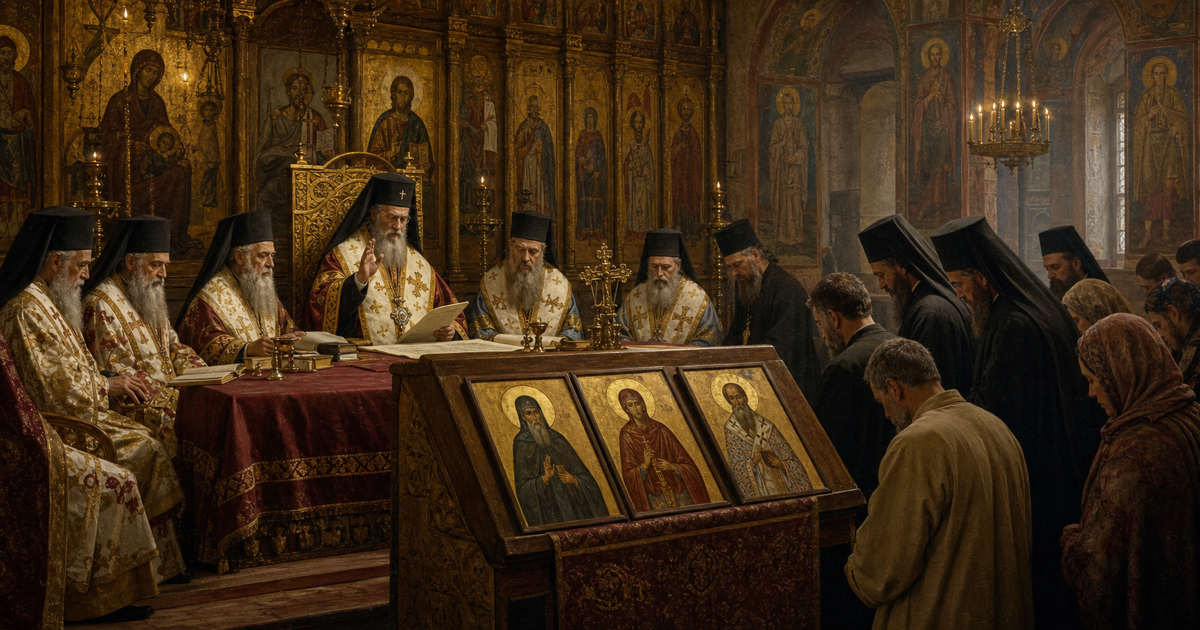
What distinguishes a person who is saved from a saint who is proclaimed? An Orthodox clarification on canonization, hidden holiness, the veneration of the faithful, and the discernment of the Church.
There is, in the life of the Church, a question that piety, left to itself, tends to avoid out of delicacy, but which discernment cannot avoid without harm: what distinguishes a person who is saved from a saint who is proclaimed? At first glance the question seems improper. Who are we to weigh another’s holiness? And yet the Church herself weighs it every time she inscribes a name in the Synaxarion — for to proclaim a saint is not the same thing as to hope that a person has been saved. These are two works of a different nature, and confusing them, however well-meant, weakens the very thing it seeks to honor.
This article looks toward no particular case. It is neither accusation nor defense. It is an attempt to set down the criterion — to place once again upon the table the measuring-rod that the Fathers and the canonical order of the Church have always used, before it is applied to anything. For first we must know what we are measuring, and only then measure.
What a Saint Actually Is
Before speaking of proclamation, we must say what it is that is proclaimed. For in everyday speech “saint” has come to mean, in a weakened sense, “a very good person” or “a devout person.” Tradition understands something altogether different. A saint is not, in the first place, one who does good deeds, but one in whom grace has come to dwell to the point of transfiguring his very being — one who has arrived, through purification from the passions and union with Christ, at deification (theosis). Holiness, the Fathers say, is participation in the holiness of God Himself, the fruitful presence of the Spirit in man, likeness to God through grace.
Saint John of Damascus, the last of the great Fathers, places this at the very heart of the Church’s dogmatic teaching. The saints, he writes, are to be honored “because they are friends of Christ, sons and heirs of God”; and since God is called “the God of gods,” the saints too may rightly be called, by grace, “gods” — not by nature, but by participation in the divine life. This is the true measure of a saint: not noble conduct, but a nature penetrated and transfigured by grace, become, as tradition says, both bearer and shower of God.
From this flows also the ground of their veneration, established dogmatically by the Seventh Ecumenical Council (Nicaea, 787), which ordained that the apostles, prophets, martyrs, and all “God-bearing saints” be honored and called upon for intercession. We venerate them, the same Damascene explains, not as though they were gods by nature, but as those whom God has glorified and made partakers of His glory — and the honor given to them ascends to God, the source of all holiness.
It must be said emphatically, lest a misunderstanding arise: the call to holiness belongs to all, without exception. “Be holy, for I am holy,” the Lord commands all alike (Lev. 11:44; 1 Pet. 1:16); holiness is not reserved for clergy, monastics, or the “more pious,” but is, as has been beautifully said, “the full realization of the human.” For this very reason the distinction that follows does not concern who can become holy — for all can, and all are called — but who is shown forth and proclaimed as a saint before the whole Church. One thing is the calling, open to all; another is the proclamation, which attests that in a particular person the calling has been visibly fulfilled.
Two Works That Are Not to Be Confused
Salvation is the work of God in man, received through repentance, ascetic struggle, and grace. It concerns the eternity of the soul and remains, for the most part, hidden — fully known to God alone. We hope for those who have fallen asleep, we pray for them, we commemorate them; but we do not pronounce sentence upon their state, for judgment belongs to the Master, not to us.
The proclamation of a saint is something else. It is not a “producing” of holiness by the Church, but the solemn recognition that God has already manifested the holiness of that person within the life of the Church. The Church does not bestow holiness; she ascertains and publicly confesses it: holiness comes from God, through the struggles of the chosen one, and the Church only attests it. And what she attests is not merely that someone has been saved, but that in that person the work of grace has been manifested to a degree that makes him a model and an intercessor for the whole community. The very Greek word from which “canonization” derives — kanon — means measure, rule: to number someone among the saints is to recognize him as a measure and model of Christian living, one who may be followed by others. The proclaimed saint is, therefore, not merely one who is saved; he is a living icon, a proof shown to all that the Gospel can be lived to the end. This is why proclamation concerns not only the one proclaimed, but us, who look toward him.
Saint Paul the Apostle captures this twofold reality when he writes to the Corinthians concerning the departed: each will receive his reward according to his labor, yet “star differs from star in glory” (1 Cor. 15:41). All who are saved are in glory; not all shine alike, and not all are shown to the Church as lamps set upon a lampstand. Some remain, in the Lord’s word, a light that “gives light to all in the house” (Mt. 5:15); others, no less saved, remain hidden, according to their own will and the ordering of God.
The Host of Unknown Saints
The Church has never forgotten that the great multitude of the sanctified remains without a name in the calendar. For this reason she ordained the commemoration of All Saints — and, in our Church, the Sunday of the Romanian Saints — precisely to honor both the known and the unknown alike: those entered in the calendar and the Synaxarion, but also those unknown to men and known to God alone, whom He reveals when He wills and as He wills. This unknown host is not a lesser category. On the contrary: it surely contains souls that surpass in purity many of those commemorated by name. Their hiddenness is not a lack, but often the very form of their perfection — for he who fled the glory of men in life does not seek it after death either.
Here it is fitting to listen to a word of Father Cleopa Ilie, the spiritual guide of tens of thousands of faithful, who himself confessed, with that humility which was his seal, that his brethren in the monastery struggled more austerely than he did. This confession is not mere modesty; it touches a truth of monastic life: severe asceticism — fasting, vigil, little sleep, unceasing toil — is, in monasteries of authentic life, the ordinary rule, not the exception. Hundreds of monks have lived and died in this austerity, without their names ever being inscribed in the Synaxarion.
And yet — here is the question that clarifies everything — we have not canonized them all. No one proposes that all who have struggled worthily in our monasteries be individually proclaimed, though many of them surely stand before the Throne. Why? Because asceticism, however severe, saves the one who bears it, but does not in itself make him an icon for others. Asceticism is the way to God; it is not, by its mere measure, a ground for public proclamation.
What Raises a Soul Out of the Unknown Host
If common asceticism is not the ground, what is? Tradition answers through an example of singular clarity: Saint Silouan the Athonite.
Saint Silouan was a simple monk at the Monastery of Saint Panteleimon on Athos, among hundreds of monks who fasted, kept vigil, and prayed as he did. Many around him led an asceticism at least as severe. By what, then, was he distinguished, that he should be glorified in 1987 while the others remained in the unknown host? Not by the length of his vigils, nor by the severity of his fasting — those belonged to all. He was distinguished by a particular summit: the word he received from Christ in the hour of despair — “Keep your mind in hell, and despair not” — and the height of prayer and humility to which he attained through it. Moreover, this experience did not remain his alone, but was transmitted and nourished the whole Church through his disciple, Archimandrite Sophrony, who wrote his life and preserved his teaching.
Here is the whole distinction, contained in a single man. Silouan and his brethren struggled alike; but to Silouan was added an identifiable spiritual gift, a manifest and transmissible work of grace, which made him a model for all. The others were saved, most probably, in the same asceticism; but they did not leave behind that manifest summit which raises a life out of the silence of monastic struggle into the light of proclamation.
In the same way, the most unexpected path of holiness is also clarified — folly for Christ. Saint Xenia of Petersburg was a widow, a laywoman, without office in the Church, without the martyrdom of blood, without dogmatic dispute. And yet she was glorified — because her asceticism reached a rare summit: forty-five years of voluntary folly for Christ, the total renunciation of property, home, and good name, the embrace of mockery and utter poverty, crowned with the gift of clairvoyance and with countless miracles. Xenia was not proclaimed because she suffered — many suffered more, against their will — but because she chose and carried to the end an asceticism that made her life an icon.
The Signs of Glorification, According to the Order of the Church
This distinction is not a private opinion, but is found in the very canonical criteria of glorification, as formulated by the treatises of Orthodox canon law. For a person to be numbered among the saints, three conditions are required, as a rule: unshaken right faith; glorification by God through at least one of the signs; and the spontaneous veneration of the faithful people.
The second point — glorification by God — is precisely what we have called the summit. It is shown through a manifest work of grace, recognized by the conscience of the Church, along at least one of the paths: martyrdom for the right faith; confession of it under dangers and torments, unto death; outstanding ascetic struggle, carried to the highest measure; heroic defense of the faith and the Church; the working of miracles, in life or after death; or other spiritual fruits recognized by the community of the faithful. The list is not a rigid grid, but a description of the ways in which manifest holiness has shown itself across the centuries.
Two things must be observed with attention in this order. First, that at least one of the signs is required — thus not all cumulatively; a single summit, but a real one, is sufficient. The martyr need not also have worked miracles; the ascetic need not have suffered martyrdom. Second, and more important: each sign is required in heroic form — “the most perfect living,” confession “unto death,” “heroic” devotion. What is required is not merely the presence of struggle, but its culminating intensity. Tradition does not proclaim the one who was good, but the one who was perfect along at least one path.
From this it is also seen why the working of miracles, though a precious sign, was not held by the Fathers to be an absolutely necessary condition, nor the incorruption of the body. There are saints, such as Saint Nicodemus of the Holy Mountain or Saint Innocent of Moscow, of whom no miracles are known, and who were nonetheless glorified — because they had another manifest work of grace. Miracles may be lacking, if another summit exists. But a manifest and heroic work of grace must exist — along at least one of the paths. Otherwise we do not have a saint to proclaim, but a soul to commemorate, with love and hope, in the unknown host.
Why It Matters: The Saints as Living Models
One might ask: if the one-saved-without-a-summit is in glory anyway, what harm comes from proclaiming him nonetheless? Is this not an added honor, a work of piety? The answer is no — and here we touch the heart of the whole matter.
The saints are not an ornament of the Church; they are her measure. They are the living proof that the deification of man is not a theory, but a reality lived to the end. When the Church points to a saint and says “behold, it is possible,” the power of that gesture rests entirely on the certainty that there is truly fullness there, not merely a decent life. The saint is, at the same time, also an intercessor: we call upon him in prayer precisely because, being a “friend of Christ” in the Damascene’s word, his prayer has boldness before God. And Saint John Chrysostom teaches us that recourse to the intercession of the saints does not exempt us from labor, but calls us to work ourselves “after the example they have given us” — for the saint is at once one who prays for us and a model to be followed. This is why his clarity is a common good, upon which depends the way we all live: if we no longer know clearly who is a model, we no longer know clearly toward what we are ascending.
Here a law operates that everyone knows from daily life: the law of inflation. When the currency is multiplied beyond measure, it is not only the new banknote that is debased — everything already in circulation loses value. In the same way, every proclamation made without a summit wounds not only that case; it weakens the very word “saint,” makes it cheaper, and through this lowers the awe with which we look even upon the saints beyond doubt. A model at half-measure does not add a model; it weakens the power of all models, for it teaches the eye to be content with less.
The Fathers who were truly Spirit-bearers always had this reverent caution. They did not scatter the name of saint, precisely because they knew how much it weighs. Their reverence before holiness — the hesitation to name it where they were not assured of its fullness — was not coldness, but guardianship. The guardianship of a good they had received and were bound to hand on undiminished.
The Salvation We Hope For, the Model We Show
Let us, then, set things in their place, without denying anything worthy of honor.
The one who struggled worthily, bore tribulations with faith, loved his neighbor, and died in repentance — that one is, by the mercy of God, in the host of the saved, and it is fitting that we commemorate him with love and hope. We do not deny his hidden holiness; on the contrary, we confess it, honoring him among “the known and the unknown.”
But to raise him out of this host into the rank of those individually proclaimed, as an icon for the whole Church, is a work that requires more: a manifest, verified, heroic summit, along at least one of the paths of holiness. Lacking that summit, proclamation does not honor the departed more — who rests in glory anyway — but weakens the meaning of proclamation for all the rest.
To preserve this distinction is neither severity nor lack of piety. It is the very pastoral care that models remain models, and that the word “saint” keep the weight that makes it useful to our salvation. For upon the clarity of the saints depends the clarity of our own path toward them.
“You are the light of the world. A city set on a hill cannot be hidden. Nor do they light a lamp and put it under a basket, but on a lampstand, and it gives light to all in the house.” (Matthew 5:14–15)
The city on the hill is seen from afar precisely because it is on the hill. This is, in a mysterious way, also the meaning of proclaimed holiness: not every light is set on a lampstand before all, but that one which, by the height it has reached, gives light to the whole house. The other lights — no less true — give light in secret, before God, who sees in secret and rewards in secret.
Sources: Saint John of Damascus, An Exact Exposition of the Orthodox Faith (on the veneration of the saints as “friends of Christ” and “gods by grace”); the Seventh Ecumenical Council, Nicaea 787 (the dogmatic ground for the veneration of the saints and their intercession); Saint John Chrysostom (the intercession of the saints together with our own labor); the patristic teaching on holiness as deification and participation in the grace of God; the criteria of canonization according to the rules of Orthodox canon law (right faith, glorification by God through the signs of holiness, the veneration of the people); the life of Saint Silouan the Athonite written by Archimandrite Sophrony (Sakharov); Saint Xenia of Petersburg, glorified in 1988; saints glorified without known miracles (Saint Nicodemus of the Holy Mountain, Saint Innocent of Moscow). Scriptural citations: Leviticus 11:44; 1 Peter 1:16; 1 Corinthians 15:41; Matthew 5:14–15.