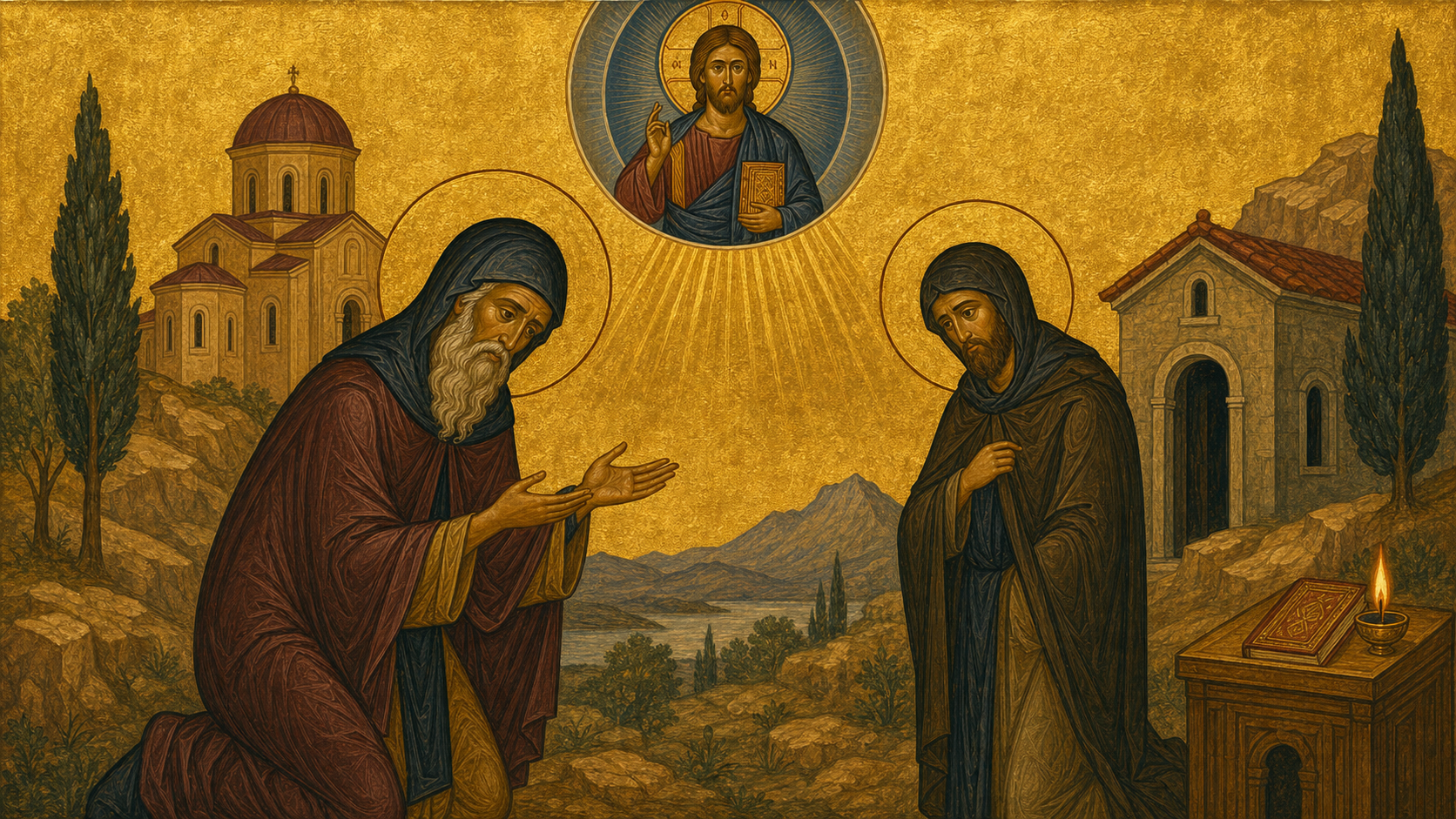
Why did the saints, however greatly they were wronged, condemn no one – neither by appearance, nor by conduct, even when evil was done to them – while we judge almost anyone, sometimes rightly, more often wrongly? This question touches something deeper than a difference of gentle temperament. The saints were not indifferent people, nor were they lacking in the power to discern good from evil. On the contrary, they saw sin more clearly than we do. And yet they did not make themselves judges of men. The answer to this question reveals a whole inner order, which the Fathers called non-judgment of one’s neighbor, and which we have almost entirely lost.
Where we stand, at the opposite pole
The Christian of today judges easily and judges much. He judges the one who cut ahead of him in traffic, the one who spoke harshly, the one whose conduct he does not understand. Sometimes he judges with some ground – the other really did wrong. But most of the time he judges without ground, from a word half-heard, from an action seen only from the outside, from his own imagining of what must have taken place in the other’s soul. And, what is more serious, he grounds his condemnation precisely on the neighbor’s weaknesses: “that is how he is,” “he attacked me,” “he wasted my time,” “he deserves it.” That is, he turns the other person’s weakness into his own right to condemn him.
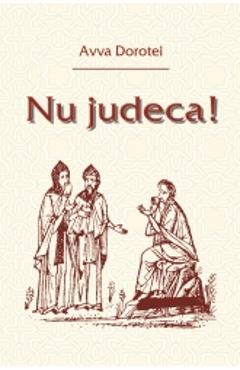
Here lies a distinction that Abba Dorotheos makes with complete clarity: one thing is to speak ill of an action, and another thing entirely is to condemn the person who committed it. “Slander refers to one action or another of someone; judgment refers to that very person himself, in his entirety,” he writes. To judge means, therefore, “to draw the conclusion, from someone’s evil deed, that he himself is of that sort, that he can act only as he acted” (Philokalia, vol. 9, p. 618). We see a single fall and decide from it that the whole man is like that and will remain like that.
It is precisely of this that the Savior spoke, and Abba Dorotheos places His word at the foundation: “Thou hypocrite, cast out first the beam out of thine own eye, and then shalt thou see clearly to pull out the mote that is in thy brother’s eye” (Luke 6:42). And the interpretation he gives to this word shakes our habit of judging: “He compared the neighbor’s sin to the mote, and judging him to the beam” (Philokalia, vol. 9, p. 618). In other words, the judging of our neighbor may be, in us, a fall more dangerous than the fault we see in him, because it places us in the position of God. The mote belongs to the brother; the beam belongs to us, and we carry it precisely when we believe ourselves justified in examining him.
Why the saints did not judge
The foundation Abba Dorotheos sets down for non-judgment is not a simple call to gentleness, but a fact: we do not know the inner state of the other person, and therefore we cannot judge him rightly. To God alone belongs the right to justify and condemn, he writes, “for He alone knows the inner state of each one, his conduct, gifts, nature, and capacity, so as to judge each one according to what only He knows” (Philokalia, vol. 9, p. 620). And he adds a distinction that we can never make: God judges differently the things of the guide and the disciple, differently the elder and the younger, differently the sick and the healthy. For He who made human nature knows how much struggle each one gave for the little he accomplished. We see only the outward deed. We do not see the struggle behind it, nor the wound from which it came, nor how much it cost the other person. We judge, therefore, an appearance.
More than this, by judging we place ourselves in the position of God, seizing something that is not ours. “Why do we take judgment away from God?” asks Abba Dorotheos. “What do we want from God’s creature?” (Philokalia, vol. 9, p. 619). And in a note at this point, the Father explains why we do not have this right: the creature does not owe something to us, but to God, because He brought it into existence and He sustains it. The one who did not make human nature cannot judge human nature.
To show how fearful condemnation is, Abba Dorotheos brings an example from the Paterikon. A great elder, hearing about a brother who had fallen into sin, said: “He did badly.” Shortly afterward, the angel brought before him the soul of the departed brother and said to him: “Behold the one whom you judged! He has fallen asleep. Where do you command that I take him: to the Kingdom, or to hell?” The elder was shaken, because he understood what burden he had taken upon himself by condemning. He fell at the angel’s feet and received forgiveness, but, writes Abba Dorotheos, “the elder’s soul could no longer be comforted from his weeping until death” (Philokalia, vol. 9, p. 620). One single word of condemnation – and what a burden it brought upon him.
Here is the heart of the matter. The saints did not judge, not because they did not see evil, but because they saw something above it: they saw that judgment belongs to God, and that the man who condemns seizes something that is not his. They saw, at the same time, their own state – and whoever truly sees his own sins no longer has time to examine those of others.
The thought of condemnation first corrupts us
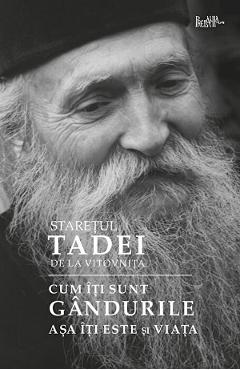
Abba Dorotheos shows us why we must not judge. A father closer to our own days adds something about the way condemnation works within us: the thought itself, even unspoken, is a reality that works. Elder Thaddeus of Vitovnica, a Serbian elder of Romanian origin, left an entire teaching on the power of thoughts. His mention here is not foreign to the source of these lines: in 1995, when he came on pilgrimage to Romania, Elder Thaddeus met Father Cleopa at Sihastria Monastery – the two fathers, the Serb and the Romanian, standing face to face at the springs of the same hesychastic life.
His teaching begins from a simple and weighty observation: “From our thoughts there springs good or evil, peace or discord” (Our Thoughts Determine Our Lives, p. 83). The thought of condemnation that we nurture about someone does not remain closed and inactive within us. “All good and all evil spring from thoughts, for we are a thinking apparatus,” says the Elder (p. 97). And further on he shows that “our thoughts influence not only us, but also everything around us” (p. 97). This is not about some magical power of thought, as though thought itself fashioned outward reality, but about the inner work of the heart: the evil thought darkens the soul, breaks peace, and overflows, even unspoken, into the way we look, speak, and behave toward our neighbor. Thus the one who judges in secret, without speaking a word, first troubles himself: he loses his peace, darkens his gaze, and inwardly separates himself from the one whom he has condemned in thought.
From this we see why non-judgment is not only a duty toward the neighbor, but also the guarding of one’s own heart. The saints, keeping themselves from evil thoughts about anyone, preserved inner peace – and this peace was itself the fruit of non-judgment. From here Elder Thaddeus also builds the bridge toward the highest step: “The Lord commands us to love our enemies, not for their sake, but for our own. We must forgive everything from the heart” (p. 97). Forgiving the one who does us wrong is therefore not only a gift we give him; it is our own liberation from the bondage of the condemning thought.
Not condemnation, but forgiveness of those who wrong us
The saints did not stop at not judging. They went further, to the highest step: they forgave and blessed those who openly did them harm, even those who condemned them to death. This step does not arise from human power, but descends from one single Source.
The Source is Christ on the Cross. At the very moment when He was being nailed by those who had condemned Him unjustly, He did not ask for vengeance, but said: “Father, forgive them; for they know not what they do” (Luke 23:34). This is the measure. Not a forgiveness asked after the pain has passed, but one spoken in the very midst of the injustice, for the very ones who were committing it.
This forgiveness is not a step reserved for a few chosen ones. Christ placed it in the very prayer He gave to all: “and forgive us our debts, as we forgive our debtors” (Matthew 6:12). And immediately after the prayer He bound our forgiveness to the forgiveness we receive from God: “For if ye forgive men their trespasses, your heavenly Father will also forgive you: but if ye forgive not men their trespasses, neither will your Father forgive your trespasses” (Matthew 6:14-15). Whenever we say the Lord’s Prayer, we ourselves pronounce the measure by which we ask to be judged. Whoever remembers evil and condemns asks, without realizing it, that God should judge him in the same way.
From this measure sprang the first fruit of the Cross in the Church. The Archdeacon Stephen, the first martyr, while being killed with stones, knelt down and cried with a loud voice: “Lord, lay not this sin to their charge” (Acts 7:60). These are almost the very words of the Savior – a sign that the true disciple does not merely believe in the Cross, but makes it his own, forgiving exactly as Christ forgave, in the very hour of his death and for his very killers.
The same word was heard in our own century. Mircea Vulcanescu, who died in detention at Aiud in 1952, remained in Romanian Christian memory through the word attributed to him and transmitted by a surviving witness: “Do not avenge us.” He was not a man proclaimed saint by the Church, and that is not why we mention him here. We mention him because, in prison and in the face of unjust death, he spoke a Christian word – a word that echoes the prayer of the Archdeacon Stephen: “Lord, lay not this sin to their charge.” This shows that this step did not remain in ancient centuries. It is possible even today, in the most difficult circumstances, when the heart has truly received the Cross.
Saint Silouan: non-judgment and prayer for enemies are one
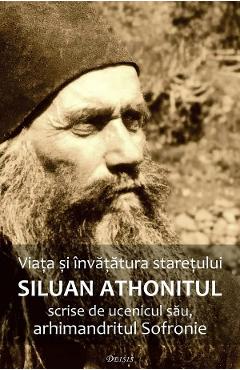
A saint of the last century showed, through his whole life, that non-judgment, inner peace, and love for enemies are not three different things, but one single work of grace. Saint Silouan the Athonite (1866-1938), a Russian peasant who became a monk on Mount Athos, first learned this in his father’s house. He spoke of his father as his first teacher of meekness and confessed, humbly: “I have not reached the measure of my father.” His father was a man who, when someone in his household did wrong, did not condemn on the spot, but waited and spoke later with gentleness – and that gentleness was imprinted on his son for his whole life.
Silouan preserved the same state in the monastery. The one who knew him and wrote his life testifies that Silouan “never judged anyone,” and that, when someone was condemned in his presence, he defended the one condemned. He did not join the accusation, even when those around him urged him to do so; and if he himself was contradicted or wronged, he kept silent, not trying to justify himself. This was not indifference, but the fruit of the same vision Abba Dorotheos had: that judgment of the neighbor darkens the soul of the one who utters it.
The heart of this state, however, is prayer for enemies, which Saint Silouan set down as the touchstone of true faith: “Whoever does not love his enemies does not have within him the grace of God.” This word is not a juridical sentence, as though the one who is still struggling with this love were wholly deprived of every work of grace; Saint Silouan speaks ascetically, showing that the man who does not come to love his enemies has not yet fully known the sweetness and work of the Holy Spirit. And positively: “The Holy Spirit teaches the soul to love its enemies, so that the soul prays for them with tears.” This love does not come from human power, says the Saint, but is the sure sign of the dwelling of the Holy Spirit in the heart. And he himself had lived it from his youth: “In the years when I was a young man I prayed for those who reviled me; I said: ‘Lord, do not count against them their sins against me.'” These are, once again, the words of the Archdeacon Stephen – a sign that Saint Silouan stands in the same line, from the Cross down to today.
In him we also see clearly the connection with the inner peace of which Elder Thaddeus spoke. “Peace is lost,” says Saint Silouan, “if you raise yourself above your brother, if you judge someone.” And further: “If someone prays much and fasts, but does not have love for enemies, he cannot have peace in his soul.” Thus, in Saint Silouan the three threads of this life are gathered into one: you judge no one, you pray for those who wrong you, and from this peace is born – or, if you judge, you lose them all at once.
How we can leave behind the habit of judging
This teaching does not remain without use if we put it into practice. The Fathers did not leave us only rebuke, but also the path. Here are a few things to do, taken from Abba Dorotheos and from the Paterikon, not from worldly wisdom.
First and most important: instead of examining the neighbor’s sin, “let each one take heed to himself and to his own sins” (Philokalia, vol. 9, p. 620). Abba Dorotheos places this as the foundation of the whole healing. Whoever knows in detail his own falls, for which he will have to give an account to God, no longer has either the time or the boldness to weigh those of another. Judgment of the neighbor grows precisely from lack of self-knowledge.
Second: let us distinguish the deed from the person. To say that a thing is evil is not the same as condemning the one who did it. We can know that an action is sin without deciding where the soul of the one who committed it is going. The elder in the example did not err because he called sin sin, but because he passed from the deed to condemnation of the person – that is, he drew from the visible deed the conclusion that the whole man was like that.
Third: when the thought of condemnation comes, let us remember that we do not know the other’s struggle. We do not know from what the deed came, what burden he carries, how much he has already overcome in secret. This one thought – “I do not know what is in his soul, nor how much this cost him” – cuts condemnation at the root.
Fourth: let us pray for the one we are tempted to judge. Prayer for someone and condemnation of him cannot stand together in the same heart. When the thought of judgment persists, turning it into prayer for that person disperses it.
Fifth, and hardest: when evil is done to us, let us not seek our own justice, but remember Him who, being wronged, did not condemn, but forgave. We cannot climb at once to Stephen’s step. But we can begin from below: not to repay evil with evil, to keep silent where we would want to take revenge, and to ask from God the power to forgive, which we do not have from ourselves.
Sixth, as the crown of all: let us make it a habit to pray for those who have wronged us, not against them. Saint Silouan says that if we become accustomed to praying from the heart for enemies, peace will always dwell in our soul. We do not first need to feel love in order to pray; on the contrary, prayer for the one who has wronged us slowly gives birth, itself, to the love we did not have at first. This is the strongest remedy against condemnation: you cannot keep the evil of someone in memory if you pray for him with tears.
Abba Pior, a father from the Egyptian desert, gathered all of this into one example. Once, while standing among the Fathers and being asked about something, he remained silent; then he took a sack, filled it with sand, and carried it on his shoulder, while in a small pouch he placed a little sand and carried it in front of himself. Asked what this meant, he answered: “This sack, which has much sand, is my sins, for they are many, and I have left them behind me so that I may not feel pain for them and weep. And behold, these small ones of my brother are before me, and in these I occupy myself, judging him. But this is not what I ought to do; rather, I should carry my own before me.” And the Fathers, hearing this, said: “Truly, this is the way of salvation.” Here we see why the Fathers considered non-judgment a sure way of salvation: it does not require ascetic labors beyond human strength, but only a turning of the gaze – from the sins of the brother, which we carry before us in order to examine them, to our own, which we have thrown behind our back so as not to see them anymore. It seems easy, but it is not light, because it strikes directly at the root of pride.
Non-judgment of one’s neighbor is therefore not the weakness of someone who does not dare to speak the truth. It is the fruit of two sights that the saints had and that we have lost: the sight of one’s own state, and the sight that judgment belongs to God. Whoever acquires these ceases to condemn – not by force, but because his heart has changed. And from the ceasing of condemnation there opens the path to the highest step, where the one who has been wronged no longer asks for revenge, but says, exactly like the crucified Christ: “Father, forgive them.”