
On the so-called “water-only fast,” “fasting and repentance” retreats, and the Church’s forgotten complete fast
A new practice is spreading today among Orthodox Christians: the so-called “water fast” – whole days, sometimes weeks, in which a person eats nothing, but drinks water without measure. Around it there have appeared testimonies, conferences, books, groups, organized retreats with programs and prices, promises of healing, and a language half therapeutic and half ecclesiastical, in which the practice is presented as a lofty work for body and soul – even being called, against the very meaning of the words, a “black fast with water.” I have called it in the title a “river-fast” because two things flow through it without measure: water, drunk without limit, and days, counted aloud – three, seven, ten, twenty-one, forty.
Whoever dares to ask whether this is still the fast of the Church usually receives two ready-made answers: “the saints fasted only from food, not from water,” and “Christ Himself fasted forty days only from food.” The present article examines, one by one, the whole chain: what complete fasting is in the order of the Church and why water belongs to it; what Scripture truly says about the fasting of the saints and of the Lord; why abstinence cannot work with the unlimited; where this practice comes from and what has attached itself to it – enemas, drainage, “detox,” fees; and what the Christian must do who wants to fast according to God, not according to fashion.
Not every abstinence from food is fasting
Before anything else, a boundary must be drawn. A person may refrain from eating for many reasons: medical, aesthetic, athletic, psychological, therapeutic. He may refrain from eating in order to lose weight, for personal discipline, for “detoxification,” to regulate metabolism, or to test his will. All these can be discussed in their own place, with the physicians and specialists proper to them. But none of them is, in itself, fasting. The fast of the Church is not defined by an empty stomach, but by abstinence, repentance, prayer, and the turning of the whole man toward God. The empty stomach is the body of the fast; repentance is its soul. Where the soul is missing, the body remains a simple dietary abstinence – however religious the vocabulary around it may be.
For this reason, the expression “water fast” must be examined carefully. Not because water is bad, not because the body should be despised, and not because a sick or weakened person cannot receive economia. Rather, because in the Tradition of the Church, fasting is not a technique of dietary abstinence with hydration, but an ascetic order of measure.
What complete fasting is in the order of the Church
The Church does not have one single form of fasting, but a whole ladder of degrees, fitted to each person’s strength and to the importance of the days. On the lower steps stand the ordinary abstinences: leaving aside meat, dairy, and eggs. Higher up is cooked food without oil. Higher still is xerophagy – dry food: bread, water, dried fruit – once in the day, after the ninth hour, that is, after about three in the afternoon, the hour at which the Lord gave up His spirit on the Cross. And at the top of the ladder stands the complete fast: nothing – neither food nor water. This is the step that the people have always called the “black fast”: a day on which nothing is tasted and nothing is drunk, usually until sunset, and among the more zealous for the whole day.
That the complete fast includes water is not an opinion, but the written order of the Church. The Typikon requires – for those who are able – complete fasting on the first two days of Great Lent and on Holy and Great Friday, while to the weak and elderly it allows, toward evening, bread and water. This allowance says everything: if bread and water are the concession given to the infirm, then water is part of what is laid aside in the complete fast, not something to be drunk freely.
But the proof closest at hand is carried by every believer in his own ecclesial life: the fast before Holy Communion. From the previous evening – nothing: neither food nor water. This is what the instructions of the service books require, and this is what the Church has ordained from ancient times: “The holy things of the altar are not to be celebrated except by persons who have fasted,” decrees the Council of Carthage (canon 41), an order later strengthened for the whole Church by the Council in Trullo (canon 29). To fast, in the language of the canons, means not to have tasted anything – neither food nor drink. If fasting, in its full sense, did not include water, the Church would never have forbidden the glass of water on the morning of Communion. She forbids it – and every Christian knows it.
Here the first reversal of the “water fast” becomes visible: it presents itself as the summit of ascetic struggle, yet it stands lower than the step which the Church requires, at least from time to time, of almost every believer. Whoever drinks water without measure is not keeping a complete fast; he is simply enduring a long hunger. And “black fast with water” is a combination of words that cancels itself out, as if one were to say cold fire: the black fast is, by its very name, the fast into which nothing enters – not even water.
Let this be clear from the beginning: no one is saying that drinking water during a fast is a sin. In the long fasts of the Church – Great Lent, the Nativity Fast – water is naturally drunk, just as fasting food is eaten. We are speaking here of something else: the claim that many days of hunger with unlimited water would be the highest step, the “black fast,” the perfect ascetic labor. That claim is what does not stand.
“The saints fasted only from food, not from water”
So goes the first answer. It is enough to open Scripture to see that it is simply untrue.
Moses, ascending Sinai to receive the Law: “Moses was there with the Lord forty days and forty nights; he neither ate bread nor drank water” (Exodus 34:28). Not once, but twice, he himself bears witness to this forty-day fast, without bread and without water (Deuteronomy 9:9 and 9:18). The longest and highest fast of the Old Testament – the only forty-day fast before that of the Lord – is, according to the clear letter of Scripture, a fast both from food and from water.
Esther, before going in to the king with death before her, asks the whole people: “fast ye for me, and neither eat nor drink three days, night or day” (Esther 4:16). Nineveh, the city that repented at the preaching of Jonah, receives a royal command that includes even the animals: “Let neither man nor beast, herd nor flock, taste any thing: let them not feed, nor drink water” (Jonah 3:7). And in the New Law, Saul of Tarsus, struck down on the road to Damascus: “And he was three days without sight, and neither did eat nor drink” (Acts 9:9). The first three days of repentance of the one who was to become the Apostle Paul were a complete fast – without food and without water. The same Paul would later list the labors of his apostleship, placing hunger and thirst together with frequent fastings (2 Corinthians 11:27) – a sign that thirst belonged to his ascetic struggle, not that it was avoided with a full cup.
Deeper still than these examples is the very shape of biblical fasting. In ancient Israel, a day of fasting meant: nothing until evening. Thus the children of Israel fasted at Bethel until evening (Judges 20:26); thus David and his men fasted until evening at the death of Saul (2 Samuel 1:12). From this shape – nothing until sunset – Christian complete fasting until the ninth hour or until evening was born. The fast day of Scripture was not a liquid diet, but a day of hunger and thirst before God.
An objection may be raised here: but water does not nourish. It has no calories; it is not food in the same sense as bread, oil, or meat. Why should there be a problem if a person drinks it? It is true: water does not nourish the body. But it strengthens it, supports it, eases it, and helps it pass more easily through the lack of food. Precisely for this reason, in strict fasting, abstaining from water was not a detail, but part of the very logic of abstinence. The one who fasted without food and without water was not seeking the destruction of the body, but the weakening of the body’s claim to immediate consolation. Thirst was not an end in itself, but a place of patience: through thirst, the body was brought to silence; through prayer, the soul was strengthened.
Therefore, “the saints fasted only from food” – no. When the saints kept a complete fast, they fasted completely. What is true – and no one denies it – is that in the long fasts, over weeks, water is drunk: human nature cannot otherwise endure. But here precisely lies the wisdom of the Church’s order: the Church never requires, at the same time, both length and completeness. The long fast is complete as abstinence from certain foods, but it allows water; the complete fast – the black fast – is short: one day, two. A twenty-one-day “water fast” breaks this wisdom in the most subtle way: it takes the length from one order and claims the crown of the other.
“But Christ fasted forty days only from food”
The second answer seems weightier, because it invokes the example of the Lord Himself. Let us see, then, what the Gospel says – and what it does not say.
Saint Luke writes of the forty days in the wilderness: “And in those days he did eat nothing: and when they were ended, he afterward hungered” (Luke 4:2). Saint Matthew bears the same witness: after forty days and forty nights of fasting, He hungered (Matthew 4:2). That is all. The Gospel says that the Lord ate nothing and that He hungered. It nowhere says that He drank water. The silence of Scripture is silent in both directions: from it one cannot draw either that the Lord drank, or any new order of fasting for the Church. To build a practice on what Scripture does not say, against what the Church has done for two thousand years, is not the Orthodox way of reading the Word; it is the method of one who seeks in the text his own justification, not the truth.
But let us, for a moment, take the answer seriously as it is given. Let us suppose that the Lord did drink water in the wilderness – Scripture, once again, does not say this. What would follow from this for the one who invokes the example? It would follow that he should also follow it: forty days without any food, in the wilderness, in perfect solitude, in battle with the devil. None of those who raise this argument does or proposes such a thing – and rightly so, for it would be his ruin. The example of the Lord is invoked for one single detail – the supposed water – and abandoned in all the rest. This is not following Christ; it is covering oneself with the name of Christ.
The Church followed the forty days of the Lord differently – in the only way possible for human beings: she ordained Great Lent. Forty days of abstinence, with its degrees, allowances, and concessions, with its days of complete fasting at the beginning and in Holy Week. This is the reading that the Church has given to the fast in the wilderness. Whoever wishes to follow the Lord’s fast has the path already trodden by the saints: it is called the Holy and Great Fast – not a marathon of hunger with water without measure.
Abstinence does not work with the unlimited
Beyond the witness of Scripture and the canons, the “water fast” collides with the very nature of asceticism.
Orthodox fasting does not mean only “I do not eat.” It means: I do not give the body everything it asks, when it asks, and as much as it asks. It means measure, the cutting off of self-will, the diminishing of the rule of the passions. But where food is removed entirely, while water is drunk freely, whenever and however much one wishes, the principle of limitlessness remains untouched. The body is not given bread, but it is given water without boundary; one demand is not fulfilled, but another is left free. Fasting, in the Church’s understanding, is not the changing of the object by which the body is comforted, but the diminishing of its rule over the soul. It is not a technique for bypassing hunger, but a school of patience. The moment you say “unlimited,” you have left the spirit of measure – and asceticism does not work with the unlimited, but with measure.
This practice is often wrapped in talk about “mind, body, and soul” – one retreat poster promises, word for word, fasting “on all three components of the human being: mind, body, and soul” – as though man were made of three compartments to be repaired by three techniques: water for the body, “clarity” for the mind, “energy” for the soul. This is not the language of the Church. However the Fathers speak about the composition of man, they always see him as a whole – one man, with his soul and his body, who turns wholly to God or is lost wholly. The body is not evil: the body worships, the body fasts, the body receives the Holy Mysteries, the body will rise. But after the Fall, the body often seeks the first place: it asks for food, water, sleep, comfort, quick relief, and the soul, instead of governing it, is dragged after its demands. Here fasting enters. Fasting does not hate the body, but humbles it; it does not destroy it, but sets it back in order; it does not punish it, but teaches it obedience. Through fasting, man says to the body: you do not command. Through prayer, man says to the soul: neither do you command by yourself, but God.
And once more, lest this be read wrongly: the problem is not that a person drinks water. There are weakened, sick, beginning people who cannot fast strictly – and for them the Church is not cruel: the spiritual father allows, the physician prescribes, and the person does what he can. Better a small fast with humility than a great ascetic labor with pride or bodily harm. The problem is something else: when water drunk freely, without measure, is placed under the name of fasting and presented as a lofty spiritual practice.
Where “water-only fasting” comes from – and what has attached itself to it
If it does not come from Scripture and does not come from the order of the Church, where does it come from? The answer is visible, with its English name: water fasting.
“Water-only fasting” has for years been one of the great fashions of the secular health culture. Detox clinics, weight-loss books, videos about “day fourteen of my water fast,” apps that count the hours of not eating, endless discussions about “autophagy” – the cellular mechanism whose research received the Nobel Prize in Medicine in 2016 and which was immediately taken up as a banner by the whole industry of self-starvation. The goals of this fashion are all bodily: weight loss, the “cleansing” of the body, the prolonging of life. And its first counsel, repeated everywhere, is: drink as much water as possible. Naturally so – because without water, weeks of hunger would be impossible, and where the goal is the body, water is the tool that keeps the marathon alive.
In the Romanian space, this fashion has also taken an organized form, which can be examined publicly from the organizers’ own announcements: associations of “therapeutic fasting,” “fasting and repentance” retreats hosted in monastery precincts, with series scheduled precisely during the fasts ordained by the Church, with fees of many hundreds or even over a thousand lei for ten days, with deposits, couple discounts, and limited places. The daily program of such retreats – openly stated on their pages – follows the model of a secular therapeutic starvation clinic in Russia: an enema every morning, purgative solutions at the entrance into the fast, massage and lymphatic drainage sessions every two or three days, measurements and medical files, evening seminars “about fasting and prayer,” priests made available for confession, and in some places even commercial recommendations for supplements and water-filter devices.
Here we are no longer in the ascetic language of the Church, but in a mixture of wellness, detox, bodily therapy, and religiosity. And the mixture must be named plainly, because it leads souls astray more deeply than a simple dietary fashion. The fast of the Church is not a technique for evacuating the body. It is not intestinal cleansing, it is not drainage, it is not “metabolic resetting,” it is not bodily hygiene spiritualized. An enema may have its medical place, where a doctor prescribes it. But placed in a retreat called “fasting and repentance,” next to confession and services, it builds a grave confusion: a person may come to believe that spiritual work is accomplished through bodily procedures. But temptation is not eliminated by enema. Passion is not removed by drainage. Pride is not evacuated by detox. These are healed through repentance, confession, prayer, humility, forgiveness, and obedience.
“Detox from temptations” – this stands, word for word, among the spiritual goals on the poster of such a retreat, alongside “clarity of mind” and “peace of soul.” When therapeutic language begins to speak about cleansing from temptations as though it were detoxification, the confusion is complete. Temptations are not toxins. Passions are not residues. Sin is not a metabolic impurity. Orthodoxy knows the purification of the heart, but this purification is not detoxification: it is done by the grace of God and by man’s cooperation – repentance, prayer, fasting, almsgiving, tears, the cutting off of self-will. When we use medical words for spiritual realities, we risk changing the very understanding of salvation: man no longer seeks the forgiveness of sins, but the feeling of cleansing; he no longer seeks contrition of heart, but “clarity of mind”; he no longer seeks humility, but well-being. This is not the language of the Fathers. It is the language of today’s world, brought into the courtyard of the Church and hastily baptized with Christian terms.
Finally, diagnostic honesty is needed. Not everything foreign comes from the same direction, and not every error is an “Western ecclesiastical influence.” “Water fasting” was not brought by Catholics or Protestants; it comes from the godless world of the “healthy lifestyle” – and, through the retreat model, from a secular sanatorium pattern, not from the order of any Church. The ground on which it has taken hold among some Orthodox is not geography, but a passion as old as the world: vainglory – the desire to do more than everyone, to have a number to show, an ascetic feat to recount. The river of water flows from wellness; the river of days flows from pride.
Not everything done near a monastery is tradition
The confusion thickens when such practices are hosted in ecclesiastical settings. For many believers, the simple fact that something takes place at a monastery, with priests present, is enough for that thing to appear to belong to the Church. But not everything done near a monastery becomes the tradition of the Church. Not every initiative with services and religious language becomes patristic order. Not every retreat placed in a monastic setting thereby receives the authority of Tradition.
As long as such retreats are announced publicly – with posters, programs, prices, locations, procedures, and registrations – they can be examined publicly. This is not a matter of entering anyone’s private life, nor of judging the intentions of organizers or residents, but of defending a holy word: fasting. “Therapeutic fasting” retreats with enemas and drainage have taken place publicly, year after year, in the precincts of well-known monasteries – among them Saint John Cassian Monastery in Dobrogea and Dorna Arini Monastery. And for the summer of 2026 there is publicly advertised, through posters spread on social media, a retreat called “Fasters in Christ” at Oasa Monastery: seven days of “water fasting” – with “therapeutic waters” included – three days of refeeding, five lymphatic drainage sessions, some of them called “glymphatic,” which would “cleanse the brain during sleep,” one osteopathy session, medical, nutritional, and psychological consultation, individual objects for enema, conferences with specialists in nutrition, therapy, and related fields, a confession program with a spiritual father from the monastery, and daily access to religious services, “with the possibility of receiving Communion” – all for 2,100 lei, rising to 2,500 after a certain date, with full payment at registration. In the face of such a poster, believers have the right and the duty to ask: is this Orthodox order, or a modern therapeutic method placed in an ecclesiastical setting? And one more question, raised by the poster itself: how does “the possibility of receiving Communion” fit with the order we saw above – that before Holy Communion nothing is tasted, not even water? At precisely its highest point, the “water fast” collides with the fast of the Church. The name of the place does not change the nature of the practice. On the contrary: precisely the name of the place makes the confusion stronger for simple believers. A monastery is not a wellness hall, but the place where the meaning of fasting should be guarded more strictly than anywhere. And this criticism is not a lack of reverence toward a monastery; the lack of reverence toward fasting would be silence, when an ecclesiastical word is placed on a package of dietary abstinence with unlimited hydration, enema, and drainage.
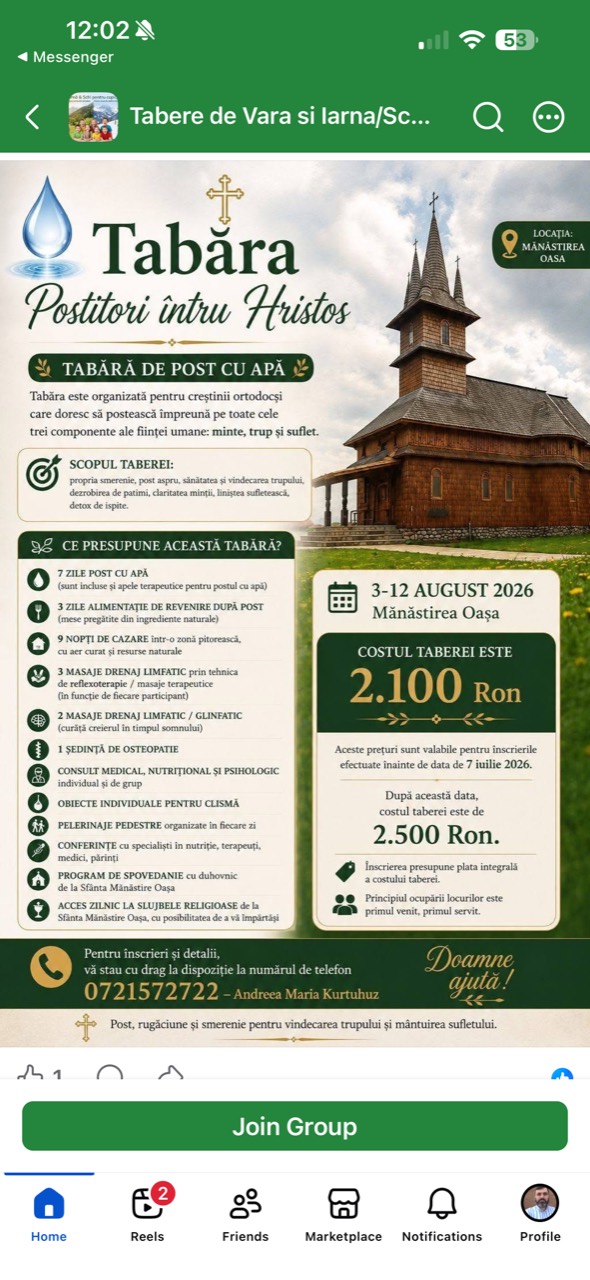
And one more sign of the times cannot be avoided: fasting has come to be sold. Modern man buys peace, buys detox, buys retreats, buys spirituality – and carries with him, into all of them, the same logic of the world: methods, guarantees, benefits, packages, registrations, limited places. Accommodation can, of course, be paid for; expenses can be covered. But fasting itself is not a product. It cannot be packaged as a method, sold as a superior experience, or guaranteed as healing. The image of a person paying large sums in order not to eat, while this deprivation is presented to him in the language of fasting and repentance, raises a question no one can avoid: where does spiritual retreat end and where does trade in asceticism begin? The fast of the Church is voluntary poverty. When it becomes a package, program, or brand, ascetic struggle has been moved from the altar of humility into the display window of the market.
The fast counted in public
Above all this stands the clear commandment of the Lord: “Moreover when ye fast, be not, as the hypocrites, of a sad countenance: for they disfigure their faces, that they may appear unto men to fast. Verily I say unto you, They have their reward. But thou, when thou fastest, anoint thine head, and wash thy face; that thou appear not unto men to fast, but unto thy Father which is in secret: and thy Father, which seeth in secret, shall reward thee openly” (Matthew 6:16-18). This commandment does not abolish the common fast of the Church, appointed for all at the same time; it shows its spirit: discretion, humility, sobriety. True fasting does not ask for admiration, does not boast of its duration, is not measured in filmed testimonies, and does not make a name for itself out of performance.
“Water fasting,” by contrast, lives precisely from the number and the testimony. The number impresses, the testimony moves, the bodily result seems to convince. A person sees changes in the body and believes they mean, of themselves, changes in the soul. But spiritual things do not work that way: the body may grow thin, while pride may grow; hunger may pass, while judgment of the neighbor remains. A person may drink only water and still feed himself on vainglory. Orthodox fasting does not first ask, “How long did you endure?” but “Were you humbled?”; not “How many days did you drink only water?” but “What passion did you cut off, and how much love did you gain?”
God has seen before fasts chosen by men in place of those required by Him, and He answered through the prophet: “Is not this the fast that I have chosen? to loose the bands of wickedness… to deal thy bread to the hungry” (Isaiah 58:6-7). The fast pleasing to God is known by its fruits – humility, almsgiving, repentance – not by numbers.
Finally, the dangers must also be named. The spiritual danger: the Fathers of the desert always looked with fear upon ascetic labors beyond measure chosen by a person for himself, without blessing – not because they are too hard, but because delusion enters through their gate. Self-will can hide even in severity: a person can be disobedient not only when he does not fast, but also when he fasts according to his own head. Whoever feels called to more than the order of the Church must ask himself, with fear, who is calling him. And the bodily danger, which we cannot pass over in silence: hunger for weeks on end is not a game, and the Church has never appointed it as a common norm, nor as a public program for believers. Whoever feels drawn toward such labors needs a spiritual father – and, if necessary, a doctor – before any “day one.”
What we have to do
First: let us keep the fast of the Church as it is, with its degrees and its allowances. It is not “the weak fast”; it is the fast that has made saints for two thousand years.
Then, whoever truly wants greater severity has the way of the Church, not of the internet and not of retreats with fees: to ask the blessing of his spiritual father for one day of true complete fasting – without food and without water, until sunset, according to strength – on the days when the Church herself appoints it: Holy and Great Friday, the Eve of Theophany, the first days of Great Lent, or, with counsel, Wednesdays and Fridays. One such day, kept in obedience and in secret, is closer to the fast of the saints than forty days of water with the count kept before the eyes of the world.
And, so that the words remain clean, let us name them once again: fasting is fasting, not dieting. Complete fasting is complete fasting, not an “eating pause.” The black fast is without food and without water. Strict fasting is with little, not with the unlimited. Not every abstinence is fasting, and not every “detox” is repentance.
And on the day of complete fasting received with a blessing, a person can understand with his body what the psalm says with words: in the wilderness of Judea, David did not quench his thirst, but made it prayer: his soul thirsted for God, his body longed for Him, as a dry and waterless land (Psalm 62:1-2). The thirst of a single day tells the body what the mind forgets: that we do not hold ourselves in life. Here is the deepest difference: the fast of the world drinks water so that the body may endure; the complete fast of the Church endures even thirst, so that the body too may cry out for God.
The blessedness promised by the Lord is not for those who endure many days, but for those who hunger and thirst after righteousness (Matthew 5:6). Christian fasting is not a river; it is a wilderness – the dry and silent place where man hungers and thirsts not in order to cleanse his body, but in order to make room for God. Whoever has understood this no longer has any use for counting the days: one day of true thirst may be enough for him to see his soul – and a whole life of the Church’s fast to let it be healed by God.
Recommended Books
Useful readings on fasting, repentance, confession, discernment, and ascetic struggle within the order of the Church.