
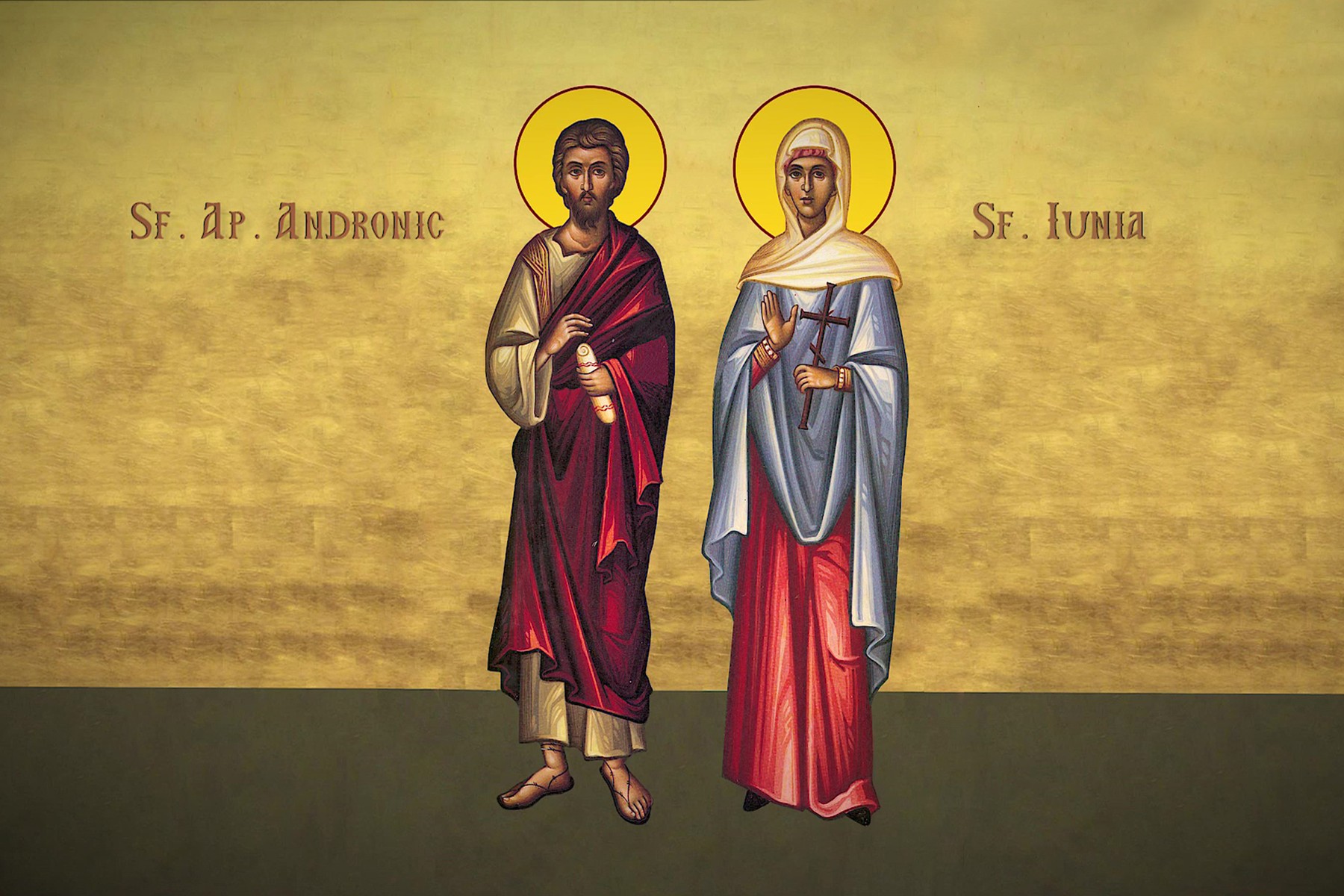
An article on three apostolic couples in the Early Church and on how the Christian household becomes a little church: prayer, hospitality, obedience, sacrifice, and shared witness.
Three couples in the Pauline greetings
At the end of the Epistle to the Romans, Saint Paul does something that the hasty reader is tempted to overlook: he lists, in an entire chapter of greetings, twenty-six personal names. This is not a protocol list. It is a living map of the Church in its first generation, in which Paul, writing from a Greek city to a community he had neither founded nor yet visited, names by name those whom he knew to be bearing the witness of Christ in Rome. And in this list we find a recurring fact: the names often appear in pairs, husband and wife, labouring together for the Gospel.
Three of these pairs are explicitly identified as married couples: Andronicus and Junia (Romans 16:7), Aquila and Priscilla (Romans 16:3-4), and Philemon and Apphia (named together in the epistle addressed to them — Philemon 1:1-2). The patristic Tradition has seen in these three families not a sociological coincidence but a paradigm of the apostolic Church: marriage understood not merely as the personal mystery of two persons, but as a common labour borne in the service of the Gospel.
The present article seeks to place this patristic paradigm before the Orthodox reader of today, drawing not on modern sociological reconstruction but on the reading the Holy Fathers — especially Saint John Chrysostom — have given to the Pauline passages. This is not an article on the “role of women in the Church” as that subject is debated in the Western world, nor a plea for any confessional agenda. It is an attempt to recover an image that the Fathers held clearly before their eyes: the couple as common ascetic labour, the house as little church, conjugal obedience as a form of apostolic obedience.
The Seventy. A less-remembered company
Before entering into the details of each pair, we must pause over a reality that modern piety tends to forget: that in the apostolic Church there were two companies of sent disciples, not one. Alongside the Twelve, of whom the Gospels constantly speak, the Lord chose a larger company of whom only Saint Luke speaks, in the tenth chapter of his Gospel: “After these things the Lord appointed seventy others also, and sent them two by two before His face into every city and place where He Himself was about to go” (Luke 10:1).
This sending — the only scriptural mention of the Seventy as a distinct group — contains several essential elements for understanding the present article. First, they are sent two by two. This is not an accidental detail. The Lord Himself, by His choice, institutes the principle of missionary synergy: no one is sent alone. The pattern of labour in pairs recurs throughout the apostolic Church: Peter with John, Paul with Barnabas, later Paul with Silas, and within the company of the Seventy, Andronicus with Junia. Secondly, the Seventy are sent before His face, that is, in preparation — not to bear a complete teaching (Pentecost had not yet come), but to open the way. And third, the very discourse the Lord addresses to the Seventy is essentially the same as that addressed to the Twelve (cf. Matthew 10), with the well-known saying: “Behold, I send you out as lambs in the midst of wolves” (Luke 10:3).
A detail noted by certain manuscripts of Saint Luke is that their number was in fact seventy-two. Saint Epiphanius of Salamis, in the fourth century, also attests this variant, and the textual question is real and acknowledged in modern manuscript criticism. The Eastern Tradition has nonetheless preserved the round number of seventy — which, in the symbolic reading of the Fathers, points to a precise biblical fullness: seventy were the elders of Israel whom Moses gathered to help him bear the burden of the people (Numbers 11:16); seventy are the descendants of Jacob who went down into Egypt (Genesis 46:27); seventy are the nations of the earth in the table of peoples in Genesis 10. In this patristic reading, the number seventy thus signifies the fullness of the nations. The Twelve are sent to the twelve tribes of Israel; the Seventy are sent to all the nations of the earth. The mission of the Church is, by this very twofold sending, universal from its very foundation.
Concerning the concrete identity of the Seventy, the Tradition preserves an honesty that deserves notice. Eusebius of Caesarea, in his Ecclesiastical History (Book I, chapter 12), written around the year 320, prudently affirms that “the names of the twelve apostles of Christ are known well enough from the testimony of the Gospels, but no list of the seventy is found anywhere with certainty.” In other words, the Father of Church history openly recognises that the list of the Seventy is reconstructed from oral tradition, from the scattered mentions in the Pauline epistles, and from identifications made later by the Fathers. This is not a weakness of Tradition but its sincerity. The lists of the Seventy that have come down to us — that attributed to Saint Hippolytus of Rome, and that reconstituted by collating the synaxaria — are composite testimonies, in which names of certain scriptural attestation (Aquila, Andronicus, Junia, Philemon, Mark, Luke, Timothy, Titus, Silas, Silvanus, and others) stand alongside names preserved only through liturgical commemoration. The list does not claim to be infallible; it claims only to witness the fact, attested in Scripture, that around the Twelve there existed a wider company of sent disciples, through whom the Gospel spread to the ends of the known world.
The Synaxis of the Seventy is commemorated together on January 4th. Each of them, however, also has a proper commemoration on the day of their repose. Thus, within this company of the Seventy are numbered Andronicus, Junia, Aquila, and Philemon — and alongside them, dozens of other confessors who shared with the Twelve the task of preaching.
Andronicus and Junia. “Of note among the apostles”
The scriptural passage
The only scriptural mention of these two saints is found in Romans 16:7: “Greet Andronicus and Junia, my kinsfolk and my fellow prisoners, who are of note among the apostles, who also were in Christ before me.”
The text is brief but dense. It contains five affirmations, each of which would alone be sufficient to draw a portrait of honour: they are kin to Paul; they have suffered imprisonment with him; they are “of note among the apostles”; they were in Christ before Paul; they are greeted together, as a single missionary entity.
Two of the Greek words used by Paul in this passage deserve a closer look, for behind them lie nuances that the English translation smooths over. For “kin”, Paul uses the term syngeneis (συγγενεῖς) — a word of broad spectrum, which may mean either simple Jewish compatriots or blood relatives. The fact that Paul uses it selectively in this chapter (for only a few among the twenty-six on his list) suggests, however, a closer bond than mere belonging to the same people — most likely a biological kinship or a close clan affiliation. Even more telling is the second term: synaichmalōtoi (συναιχμάλωτοι), translated as “fellow prisoners”. The word does not denote an ordinary administrative detainee; its root is aichmē, meaning “spear-point”, and its literal sense is “captives by the spear” — that is, prisoners of war. Paul uses it only three times in his entire corpus (here, in Colossians 4:10 for Aristarchus, and in Philemon 1:23 for Epaphras), each time for those with whom he shared the suffering of prison. The term thus evokes the image of a spiritual front: Christians are not common-law detainees, but combatants captured in the front line of a spiritual war, treated by the authorities as enemies of the Empire.
Who they were
Andronicus was a Jew — Paul calls him “my kinsman”, an expression the apostle uses for those related to him after the Jewish flesh. This means Andronicus came, like Paul, from a Jewish diaspora family — likely from among those Jews who, after the edict of Claudius in the year 49 A.D., lived for a time outside Rome and then returned. Junia, his wife, is also Jewish — Paul uses the same formula “kinsman of mine” for both.
The fact that they came to believe in Christ before Paul is of particular importance. Paul’s conversion occurred on the road to Damascus, after the death of Saint Stephen, that is, no later than the year 35-36 A.D. This means that Andronicus and Junia had received the faith in Jesus Christ very close to Pentecost, most likely in Jerusalem itself, in the very first years of the Church. They were, therefore, direct witnesses of the earliest apostolic times — they may have seen the Twelve preaching in the squares of Jerusalem; they may have heard the words of Saint Peter at Pentecost.
Moreover, their antiquity in the faith opens a possibility worth mentioning. In 1 Corinthians 15:5-7, Paul lists the four categories of witnesses of the Resurrection: the Twelve, “over five hundred brethren at once”, Saint James, “and all the apostles”. If Andronicus and Junia were in Jerusalem in the first years after the Resurrection, it is quite possible that they were numbered among those “over five hundred” who saw the Risen Christ. For those worthy of the title “apostle” in the broader sense, Paul uses the criterion of having directly seen the Risen Lord and of having been sent by Him (cf. 1 Corinthians 9:1). The naming of Andronicus and Junia as “of note among the apostles” may thus rest not only on their later missionary work, but also on this direct encounter with the Risen Lord.
This hypothesis is, in fact, no modern invention. Origen, the great Alexandrian exegete of the third century, in his commentary on the Epistle to the Romans (the earliest preserved patristic interpretation of this passage), explicitly suggests that Andronicus and Junia were numbered among “the seventy” sent by the Lord in Luke 10. We thus have a patristic witness of the first rank linking, as early as the third century, the identity of these two saints with the company of the Seventy. Once again: this remains a plausible hypothesis, not a certainty. But it is a hypothesis supported by a Father of Origen’s weight.
The fact that they were “fellow prisoners” of Paul shows that they shared with him the sufferings of imprisonment. Saint John Chrysostom, commenting on this passage in the thirty-first Homily on Romans, dwells especially upon this point: if we consider the zeal with which Paul was continually surrounded by adversaries, seeing spears on every side and sharpened swords and armies and wars, then to be called “fellow prisoner” with him means to have shared in the same dangers. This shared suffering is, for Chrysostom, the highest crown of all.
“Of note among the apostles”
The most weighty word in this passage is “of note among the apostles”. Saint John Chrysostom observes, without hesitation and without polemic, that Junia is a woman — the wife of Andronicus. And his commentary goes further into a phrase that, in the Greek original, begins with an exclamation of wonder: “Βαβαί! πόση τῆς γυναικὸς ταύτης ἡ φιλοσοφία, ὡς καὶ τῆς τῶν ἀποστόλων ἀξιωθῆναι προσηγορίας.” — “Oh, how great is the wisdom of this woman, that she has been counted worthy of the appellation of apostle!” That Βαβαί — a rare exclamation of wonder in the Chrysostomic corpus — shows that the Father does not merely comment coolly, but marvels at the apostolic greatness of a woman. For Chrysostom, the fact requires no defence; it requires astonishment.
The same reading is found before Chrysostom in Origen, and after Chrysostom in Theodoret of Cyr, in Saint John of Damascus (who, in the eighth century, takes up Chrysostom’s words almost literally: “To be called an apostle is a great thing… but to be of note among the apostles — consider what a great praise this is!”), and in Saint Theophylact of Bulgaria. This last, a Byzantine commentator of great authority from the eleventh century, writes clearly of Junia: “kai tauta gynaika ousan ten Iounian” — “and this, though being a woman, namely Junia” (PG 124, 552). Theophylact’s witness is all the more precious because it is contemporary with the first Western innovations attempting to masculinise the name: in the Byzantine sphere, until the eleventh century and even beyond, there was no doubt — Junia was a woman.
We thus have an unbroken patristic filiation from the third to the eleventh century: Origen → Chrysostom → Theodoret → Damascene → Theophylact. All of them, without exception, recognise in Junia a woman and a confessor of the name of Christ. It must nonetheless be said, since in the Western world this question became a matter of controversy, that in the late Middle Ages certain Latin copyists began to read the name as Junias (masculine), to suit a sensibility that could not accept the idea of a woman “apostle”. This innovation has no basis in the older Greek manuscripts and no basis in the Eastern patristic Tradition. The Orthodox Synaxarion has, from the beginning, preserved both her name and her feminine identity.
Here, however, we must make a distinction that the Fathers take for granted but that, for the modern reader weighed down with Western debates, is essential. The term apostle (from the Greek ἀπόστολος, “one sent”) has in the New Testament at least two senses. In the strict sense, it designates the Twelve, the direct successors of the Lord, to whom the sacramental ministry of the Church was entrusted. In the broader sense, it designates the wider circle of the Seventy — missionary disciples sent by the Lord to preach, but without that ministry implying the sacramental priesthood in its full sense. Junia is an apostle in the broader sense — a missionary, a confessor, a bearer of the Gospel alongside her husband. She is neither priest nor bishop. Saint Andronicus, on the other hand, was ordained bishop. Their common labour does not abolish this distinction; it presupposes it. He has the hierarchical ministry; she accompanies him, helps him, witnesses alongside him, suffers imprisonment alongside him, and dies for Christ alongside him. They are “one flesh” not only in the natural sense of marriage, but also in the sense of ministry.
Pannonia. Their missionary territory
The Synaxarion tells us that Saint Andronicus was consecrated Bishop of Pannonia. This detail, most often left in passing in the lives of the saints, deserves to be unfolded, for only by understanding first-century Pannonia can we understand what the preaching of these two saints meant.
Pannonia was a Roman province situated in what is today western Hungary, eastern Austria, Slovenia, northern Croatia, and Serbia. It had only recently been conquered by Rome — in the year 9 A.D. it had been finally pacified, after a revolt of the local tribes that had lasted nearly three years. The population was of Illyrian origin, related to the Dalmatian tribes and those further south. They were warlike, pagan peoples, worshipping their own gods — Silvanus, god of the forest, Sedates, divinities tied to springs and mountains. The Romans had built powerful military fortresses there — Sirmium, Carnuntum, Aquincum, Vindobona (today’s Vienna) — to hold the Danubian frontier against the barbarians of the north. It was a zone of garrisons, of legions, of military roads. A harsh region.
Here Andronicus was sent. The Synaxarion gives a precious detail: he held no fixed episcopal throne. “He was preacher and teacher not of one city or country only, but of all the world, for, running everywhere tirelessly, he tore up by the roots the demonic deception, preaching Christ.” Andronicus was, therefore, a missionary bishop — a bishop without fixed residence, who traversed the province from end to end, preaching, baptising, ordaining other ministers, organising communities in garrison towns and in Illyrian villages. And Junia, the Synaxarion tells us, was “his helper” — Chrysostom uses, for Priscilla, the same Greek word, συνεργός, “fellow worker”. She walked with him. She shared the roads, the cold, the weariness, the dangers.
Here a candid parenthesis must be opened. More recent sources, especially those of official Romanian provenance, present Andronicus and Junia as apostles who supposedly preached “to our Thracian forefathers”. This identification must be treated with historical caution. First-century Pannonia cannot be simply equated with Thracian or Daco-Roman space; its population was chiefly Pannonian-Illyrian, with Celtic elements in the west. The Thracians occupied more eastern zones — Moesia, southern Dacia, Thrace proper. The confusion, if such it is, probably arises from a careless reading of the fact that Pannonia bordered Thracian zones on its east, and that later, through the extensions of Constantine the Great in 324, the frontiers of Pannonia took in territories inhabited by Daco-Romans. But in the time of Saint Andronicus, in the first century, his hand extended over Illyrians, not over Thracians. There is no shame in this; it is simply the historical truth. To preach truly of the holy apostles means, first of all, to preach them as they were, not as we might wish them to have been.
Their works
The Synaxarion, preserved in the version known through Saint Demetrius of Rostov and the Romanian Lives of the Saints, gives us four concrete works of these two saints: “they cast down the temples of idols, they built churches of God, they drove out unclean spirits from men, and they healed the infirmities of those in need.”
Each of these four works deserves to be dwelt upon.
Casting down the temples of idols — that is, the destruction of pagan temples — was, in the first century, a perilous act. The temples belonged to the city, were defended by civil authority, and their profanation was punishable by death. The fact that Andronicus and Junia did so and survived long enough to continue their mission shows two things: that they worked with prudence (most likely in rural zones, where Roman control was weaker), and that the local people, after conversion, accepted or even helped them in this work. The conversion of an entire community precedes the destruction of its temples; one cannot tear down a temple that the community still venerates.
Building churches of God — that is, the raising of Christian places of worship on the site of former temples. This is the work that naturally follows the first. The cross set up in the place of the idol. The blessing of the water of the spring where sacrifice had been offered to a goddess. The place becomes another, for the place itself stands in need of purification.
Driving out unclean spirits — that is, exorcisms. The pagan world was deeply demonised; many of those whom Andronicus converted had previously been possessed by evil spirits through the very practice of idolatry. For this, the power of the name of Christ was needed. We see the same work in the apostles in the Book of Acts — Paul casts out a spirit of divination from a slave girl at Philippi (Acts 16:18); the apostles heal the demon-possessed.
Healing the infirmities of those in need — bodily healings. The holy apostles, by invoking the name of Christ, healed the sick. This was then, as now, the most immediate proof of the power of the Gospel. The sickness overcome is preaching without words.
All these four works, the Synaxarion tells us, they did together. The verbs of the Synaxarion stand in the plural — “they cast down, they built, they drove out, they healed” — and Tradition does not present Junia as a passive presence alongside her husband-bishop, but as a fellow worker in the apostolate. We cannot reconstruct in detail what each of them did. But the work was of the house, not of one spouse alone.
Martyrdom and commemoration
The Synaxarion tells us that Andronicus and Junia “paid the common debt of nature as good debtors, and departing from this place, received from the Lord the crown of apostleship and of martyrdom, as those who had suffered much at the hands of unbelievers.” The day of their repose is May 17. Their special commemoration is, therefore, on this day. Saint Andronicus is also commemorated separately on July 30, as one of the most renowned of the Seventy. And both are commemorated, together with all the others, in the Synaxis of the Seventy Apostles on January 4.
How the Greek East sings them
The Greek Synaxarion, in its most widespread version — set down by Saint Nicodemus of the Holy Mountain in his Synaxaristes of the eighteenth century, but taking up the early Byzantine tradition — preserves the commemoration of these saints on May 17 with three short distichs in Greek, worth citing. The first, for Andronicus: “Ἔθνη διδάξας Ἀνδρόνικος μυρία, πρὸς Χριστὸν ἦλθεν, ὃς καλεῖ πρὸς φῶς ἔθνη.” — “Andronicus, having taught countless nations, came to Christ, Who calls the nations to the light.” The second, for Junia, contains a wordplay full of meaning: “Ἰουνία τέθνηκε μηνὶ Μαΐῳ, ὃς πρῶτός ἐστιν εἰσιὼν Ἰουνίου.” — “Junia departed in the month of May, which is the first to enter toward June.” The name Junia is thus poetically linked to the month of June which follows, and her repose at the end of May receives, through this play, the seal of her name. The third distich weaves their names into a single line: “Ἑβδομάτῃ δεκάτῃ θάν’ Ἰουνίη Ἀνδρόνικός τε.” — “On the seventeenth day died Junia and Andronicus.”
The text of the Greek Synaxarion itself describes their work in a phrase that has crossed the centuries and that, as we shall see, is taken up almost literally in ecclesiastical hymnography. Of Andronicus, the Synaxarion says that he “ran through the whole world as if he had wings, and tore up by the roots the deception of idolatry”. Of Junia, the formula is yet more concentrated: he had Andronicus “having alongside him as companion and on the wondrous Junia, who, dead to the world, lived only for Christ” — νεκρωθεῖσα τῷ κόσμῳ καὶ τῷ Χριστῷ μόνῳ ζῶσα. This last formula is of great theological density. It describes the apostolic life as a death to the world — that is, a renunciation of self, of natural things, of worldly things — and a living for Christ alone. And what is important is that this formula is not a later literary construction; it appears nearly identically in the Menologion of Emperor Basil II Porphyrogenitus, composed in the tenth century under Byzantine imperial authority, for the commemoration of the same May 17. And further, in the ninth century, Saint Joseph the Hymnographer will take it up as the theme of the entire canon of the service that he composed for these saints. We thus have a remarkable textual continuity: the same theological formula, almost unchanged, traverses five centuries of Eastern Tradition — Greek Synaxarion → imperial Menologion → hymnographic canon. Junia is not retrieved; she is continually honoured, in the same words, by the entire Greek Church.
The finding of the relics
There is a chapter of their history that deserves to be dwelt upon, for it is one of the most beautiful moments of Christian Byzantium. At the end of the fourth or the beginning of the fifth century, during the joint reigns of the emperors Arcadius (in the East, 395-408) and Honorius (in the West, 393-423), in the outskirts of Constantinople, near the gate and tower called Eugenius, the faithful discovered the relics of seventeen martyrs buried together. In times of earlier persecution, Christians had often hidden the bodies of confessors in concealed places, to protect them from desecration. Of these seventeen, however, nothing was known. Their names were lost. Only God still knew them.
And God Himself bore witness to them. At the place of the common burial, unexpected healings began to occur — a clear sign that these were no ordinary dead. The relics were translated with honour to a church, and their veneration spread. Some time passed before, by divine revelation, the identity of at least two of the seventeen was made known. Tradition preserves the name of the one who received this revelation: a pious cleric, a copyist of church books, named Nicholas Kalligraphos. To him was revealed in a vision that among the seventeen were the bodies of the Holy Apostle Andronicus, one of the Seventy, and of his helper Junia.
This finding of the relics is commemorated separately in the Orthodox calendar on February 22. And its significance is not only liturgical. Sanctity bears witness to itself through the healings that precede the knowledge of identity; the names are then revealed, through vision, as a seal upon what the people had already received. Tradition does not invent identities on the basis of historical guesswork; it receives them by grace, when God is pleased to disclose them.
Later, on the site of the finding, a modest church was first raised. And in the twelfth century, Emperor Andronicus I Komnenos (1183-1185), who bore the name of the Saint — whose patron was the Apostle Andronicus —, built on the same site a larger domed church dedicated to these martyrs. The church stood there until the fall of the City, and its memory is still preserved in Byzantine texts.
These details, apparently secondary, have for us a particular significance. They show that the commemoration of Saints Andronicus and Junia was never merely a literary tradition, but a living veneration, with places, churches, worshippers, and emperors bearing their names. And that, although little of them we know historically, the Church preserved what is most precious of them: the relics, in which the same grace works that worked through them when they preached on the roads of Pannonia.
Another tradition. The Coptic Synaxarion
Before concluding the hagiological part, it is worth recalling a detail that shows the unity of the Eastern Tradition beyond Byzantium. The Coptic Orthodox Church of Egypt also preserves the commemoration of these saints — on 22 Bashans (Pashons), which in the Gregorian calendar falls between late May and early June. But the Coptic version of their end differs, in a subtle nuance, from the Byzantine.
In the Coptic Synaxarion we read: “They preached the Gospel in many cities, together with Junia, and led many to the Christian faith, and performed many miracles, healed the sick, and turned the temples of the idols into churches. And when they had completed their course, and the Lord willed to take them from this world, Andronicus fell ill for a short time and departed in peace. Junia buried him in a cave, and prayed to the Lord to take her also. And the next day she too departed unto the Lord.”
The comparison of these two versions is illuminating. Byzantium stresses their martyric end through torments; the Egyptian tradition preserves their departure in peace, with the moving detail of the burial in a cave by the wife who, having done her duty, settles down to pray for her own departure. This is no contradiction but a nuance. In the first centuries, the term “martyr” (μάρτυς, “witness”) was also applied to the great confessors who had survived prisons and tortures — confessores in the Latin tradition — but who had given their lives through apostolic exhaustion. The fact that Andronicus and Junia “laid down their lives for the Gospel”, as the iconographic Hermeneia says, is understood by Byzantium as full martyrdom, and by Egypt as a departure in peace after the good fight has been fought. The essence remains the same: a life given to Christ.
The detail of the burial by Junia is, moreover, a beautiful testimony of their conjugal unity even in death. The wife does not flee when Andronicus dies; nor does she give herself up immediately to martyrdom. She buries her husband with honour, she prays, and then she too departs unto the Lord on the very next day. The husband enters the Kingdom; the wife follows him, after fulfilling what is fitting. What better icon of Christian marriage could be imagined?
The hymn of the Church
The veneration of these two saints reached its fullness, in the ninth century, through the words of a great Byzantine hymnographer, Saint Joseph the Hymnographer († 886), who composed the liturgical canon still sung today in their service on May 17. The canon, preserved in the Menaion of May, bears witness in hymnographic form to all that we have tried to set forth here through the harsher words of prose. And precious for us is the fact that it takes up, in the language of song, the very formulation we have already encountered in the Greek Synaxarion: apostolic life as death to the world and life only in Christ.
The canon calls Andronicus “the most luminous star, who with the light of divine wisdom illumined the nations”. And both together — “the bright stars and most holy Apostles”. It honours Junia as “the wise Junia, who laboured ascetically with him in preaching” — a formula which, by the very verb chosen (laboured ascetically), confirms our patristic reading: she was no passive presence, but a fellow ascetic with her husband. And it bears witness to their concrete works in words that take up almost literally the Synaxarion: “Your house pours forth springs of healings… Driving away the assaults of demons, you cleanse the bitter passions of men.”
And, significantly for the theme of our article, the canon includes a troparion in which the apostle Paul himself is called as witness: “The blessed Paul preaches you to the assembly of the Church, as those of note among the Apostles, O blessed ones.” That is, the very phrase from Romans 16:7 which has stood at the foundation of our entire article is taken up, eight centuries later, in the language of ecclesiastical song, as a sign that the Church has never changed the way she beholds these spouses. The words of Paul from around the year 57 A.D. become, through Chrysostom in the fourth century, through the Greek Synaxarion, through the Menologion of Basil Porphyrogenitus in the tenth, through the canon of Joseph the Hymnographer in the ninth, and through the commentary of Theophylact of Bulgaria in the eleventh, the song of a Church that beholds Junia exactly as the apostle did: as one of note among the apostles, alongside her husband Andronicus.
Aquila and Priscilla. The tentmakers who taught Apollos
Of Aquila and Priscilla we have several scriptural mentions — and each adds a new feature to their portrait. They appear for the first time in Acts 18:2, when Paul, having come to Corinth, meets them there: they were Jewish Christians newly arrived from Italy, after the edict of Emperor Claudius which had expelled the Jews from Rome. Paul stays to work with them, for they had the same trade: they were, like himself, tentmakers.
From this meeting is born a bond that will last all the rest of Paul’s apostolic life. Aquila and Priscilla accompany him afterwards to Ephesus (Acts 18:18-19), where they settle for a time. There takes place the episode that will assure them an indelible place in the memory of the Church: they meet the Alexandrian Jew Apollos, a man “learned and mighty in the Scriptures”, who however knew only the baptism of John. And the text of Scripture notes with remarkable precision: “And he began to speak boldly in the synagogue: whom when Aquila and Priscilla had heard, they took him unto them, and expounded unto him the way of God more perfectly” (Acts 18:26).
This passage has often been passed over, but it contains an extraordinarily precious fact: a Christian woman, together with her husband, instructs a man — a teacher of the Scriptures, future great preacher of the Church — in the perfect way of the Gospel. And she does so not in a church, not in a public setting, but in her own house, in secret, without publicity, “taking him unto them”. Saint John Chrysostom, commenting on this moment, observes that Priscilla is often named before her husband, which he explains by her particular zeal in the things of the faith. This is not, however, an inverted subordination, but a recognition of the fact that, in common labour, each may contribute their own gift. Apollos becomes, after this catechesis in the house of tentmakers, one of the most powerful preachers of the apostolic Church — so powerful that Paul wrote to the Corinthians: “I have planted, Apollos watered; but God gave the increase” (1 Corinthians 3:6).
In Romans 16:3-4, Paul greets them with exceptional words: “Greet Priscilla and Aquila my helpers in Christ Jesus: who have for my life laid down their own necks: unto whom not only I give thanks, but also all the churches of the Gentiles.” We do not know exactly when or where they “laid down their necks” for Paul, but we know that they were ready to die for him. And we know, from the same chapter, one more precious detail: in their house gathered the Church of Rome. “Likewise greet the church that is in their house” (Romans 16:5). The same formula we find later, when they have moved to Ephesus (1 Corinthians 16:19) — and there too their house was a church.
For the Fathers, a house does not become a “church” because it shelters services, but because the life of the family itself becomes witness. The house in which the husband and wife pray together, in which strangers are received, in which children are raised in the fear of the Lord, in which no quarrels and no curses are heard but only hymns and reading of the Scriptures — that house is, in the most proper sense, a church.
In the Orthodox calendar, Saint Aquila is commemorated on July 14 as an apostle of the Seventy, and in the Greek calendar Aquila and Priscilla are commemorated together on February 13.
Philemon and Apphia. The master who received his slave as a brother
The third pair, Philemon and Apphia, opens for us another window into the early Church: not that of itinerant missionaries, but of a settled Christian household, rooted in a city, become itself the centre of a small community.
The Epistle to Philemon — the only letter of Paul addressed to a private individual and his wife — is a masterpiece of pastoral delicacy. Paul is in chains (probably in Rome), and there approaches him a runaway slave, Onesimus, who had fled from his master Philemon in Colossae. Paul receives him, catechises him, baptises him, and then sends him back to his master — with a letter in which he asks Philemon not to forgive Onesimus, but to receive him “not now as a servant, but above a servant, a brother beloved” (Philemon 1:16).
The letter begins with a greeting of direct interest to us: “Paul, a prisoner of Jesus Christ, and Timothy our brother, unto Philemon our dearly beloved, and fellow labourer, and to our beloved Apphia, and Archippus our fellow soldier, and to the church in thy house” (Philemon 1:1-2). Paul greets all three: Philemon (the husband, the master of the house), Apphia (the wife), and Archippus (most likely their son — whom Paul calls, in Colossians 4:17, a minister in the Lord). And once again, we find the formula “the church in your house”.
Saint John Chrysostom, in the prologue to his commentary on the Epistle to Philemon, observes that Paul writes not only to Philemon but also to his wife, because the matter concerns them both. The affairs of the house are not of one alone, but of both. The decision to receive Onesimus back not as a slave but as a brother is not one a husband takes alone; it is a decision of the household. Apphia is involved in the management of the house and is therefore part of the deliberation Paul requests.
Tradition preserves a dramatic end to this family. In the time of Emperor Nero, in Colossae in Phrygia, when the pagan multitude had gathered for a great festival of the local goddess, the house of Philemon — in which the Church gathered — was invaded. Philemon, Apphia, and Archippus were seized and suffered martyrdom together. The Orthodox Synaxarion commemorates all three on November 22, and Saint Apphia has a separate commemoration on February 19.
The Hermeneia. “Apostles from the company of the Seventy”
Before passing to the patristic reading of these three couples as a paradigm, it is worth recalling a detail of iconography that the Byzantine Hermeneia preserves with precision. The Hermeneia of Byzantine Painting by Dionysius of Fourna, one of the most important witnesses to the Orthodox iconographic tradition, prescribes a particular way of depicting these three husbands and wives together. The iconographer is instructed to write above them: “Holy Apostles from the company of the Seventy: Aquila with thy wife Priscilla; Andronicus with thy wife Junia; and Philemon with thy wife Apphia, and with your son Archippus, for the love of Christ you have forsaken the things of the world and laid down your necks for the Gospel and for the Truth, gaining the crown of martyrdom.” Saint Junia, according to the same Hermeneia, is to be depicted alongside Saint Andronicus, after the manner of holy female martyrs, holding a cross in her hand.
The iconographic tradition does not, therefore, separate husband from wife. It paints them together. The cross which Junia holds in her hand is the same cross that Andronicus holds. This iconographic unity is the plastic expression of a theological reality: marriage, in the patristic reading, is not a bond which death undoes, but a synergy which finds its fulfilment in common martyrdom.
The Fathers on the couple who labour together
Up to this point we have treated each pair in turn, following what Scripture and the Synaxarion tell us. We must now take a deeper step: to ask what the patristic Tradition sees in the paradigm itself of the apostolic couple, and why this paradigm remains, to this day, a model for every Orthodox family.
Saint John Chrysostom, more than any other Father, meditated upon the reality of Christian marriage. Here are some of his main lines.
First, the house as little church. The formula is not a pious metaphor. For Saint John, it describes an ontological reality: through the Mystery of Crowning, the spouses form together an ecclesial unity. This unity has its own liturgy — common prayer in morning and evening; its own catechumenate — the raising of the children; its own oeconomy — the receiving of strangers, the aid of the poor; its own martyrdom — mutual patience, the struggle with the passions, the keeping of chastity. All of this, without sacramental priesthood in its full sense, but not without priesthood in the broader sense of the “royal priesthood” of which Saint Peter speaks (1 Peter 2:9).
Then, synergy as the law of the Christian household. Saint John insists on this word — συνεργία, “co-working” — and finds it again and again in the Pauline text: “my fellow workers in Christ Jesus” (Romans 16:3); “my fellow prisoners” (Romans 16:7); “our fellow soldier” (Philemon 1:2). For Chrysostom, this co-working is not only the mark of the apostolic families, but a law of Christian marriage in general. Two who walk together on the path to the Kingdom walk more safely than one alone. Two who pray together draw more mercy than one alone. Two who bear one another’s weaknesses grow spiritually faster than either of them alone. This is why the Fathers called marriage a way of salvation — not a compromise for those unable to bear monasticism, but a way of its own, with its specific labours and its specific crowns.
Next, mutual obedience. In the place most often quoted and most often misunderstood in all of Scripture — Ephesians 5:22-33 — Paul speaks of the wife’s submission to her husband. But the verse that immediately precedes this passage, and gives its key, is: “Submitting yourselves one to another in the fear of God” (Ephesians 5:21). Saint John Chrysostom insists in his commentary that the wife’s obedience is not a slave’s submission, but a loving obedience, similar to the obedience of the Church to Christ — an obedience that presupposes on the husband’s part a sacrifice like that of Christ: “as Christ also loved the Church, and gave Himself for it” (Ephesians 5:25). That is: the husband sacrifices, the wife obeys; but her obedience is born from his sacrifice, and his sacrifice is perfected in her obedience.
Fourthly, martyrdom together. The three apostolic couples share a common trait: none of the spouses witnesses alone. Andronicus and Junia are imprisoned with Paul, suffer together, die together. Aquila and Priscilla lay down their necks together for Paul. Philemon and Apphia die together in Colossae, in their house. This common suffering is no historical accident. It is the ultimate expression of conjugal unity. Those who have laboured together here will recognise one another there. Those who have struggled together here will receive together the crown.
Fifthly, the absence of spectacle. A detail must be underlined which, for the modern reader, is almost counter-intuitive: none of these families appears in the foreground. Andronicus is a bishop, but we know not one of the cities in which he preached. Aquila is a teacher, but not a single one of his writings has been preserved. Philemon is the head of a house-church, but we know nothing of his words. Their wives are even more silent. Junia has no word preserved in Scripture. Priscilla does not speak directly in the text of Acts — we only hear that they “took him unto them”, without our hearing what they said to him. Apphia is mentioned only by name.
And yet, these families formed the backbone of the early Church. Their most powerful work was not public preaching, but silent faithfulness. They did what they did every day — they stitched tents, they raised children, they received strangers, they buried the dead, they taught catechumens — but they did it all “in Christ”. And this “in Christ” transformed every small gesture into a witness that has crossed the ages.
The distinction. Apostolate and priesthood
We must return, before closing, to a distinction we have touched upon already in the part on Andronicus and Junia, but which deserves clearer treatment.
The patristic Tradition, while recognising in Junia, Priscilla, and Apphia a real missionary ministry, did not draw the conclusion that women may receive priestly ordination. On this point, the patristic consensus is unambiguous. Saint John Chrysostom, who praises Junia for her wisdom and Priscilla for her zeal, sees no contradiction between this praise and the constant teaching of the Church that ordination is reserved to men. For the Fathers, this absence of contradiction is self-evident, because missionary apostolate and sacramental priesthood are not the same thing.
Missionary apostolate is a work of the whole people of God. All are called to it, without distinction — men and women, slaves and free, learned and unlearned. All are called to bear witness to Christ, each in their state, with their gifts, in their circumstances. The Holy Myrrhbearers are the first to announce the Resurrection — and they are its heralds to the apostles themselves. Saint Mary Magdalene is, in the Eastern tradition, called “Equal-to-the-Apostles”. Saints Thecla, Nina, Olga, Helen, and many others have borne baptism to whole peoples. Junia is no exception; she is one case in a series.
The sacramental priesthood, however, is something else. It is not a higher ministry than the missionary apostolate — such a hierarchy is foreign to patristic thought — but a specific ministry, tied to the celebration of the Mysteries. And this, following the model of the Lord Himself and of the Twelve whom He chose, is reserved to men.
Those who, in more recent times, would use the example of Junia to argue for the ordination of women commit a double falsification. First, they falsify the meaning of the word apostle, superimposing its two senses (the strict and the broad) and pretending that if Junia is an apostle in the broad sense, she is also an apostle in the strict sense. Then, they falsify the patristic tradition, citing selected passages from Chrysostom without taking into account the whole of his teaching on ecclesial order and sacramental ministry. Junia is a holy apostle exactly as the Orthodox Synaxarion names her — that is, a missionary alongside her bishop husband, a witness of the Gospel, a martyr of the Lord. None of these dignities needs ordination to be real. And none of them substitutes for ordination.
The house as little church. A lesson for today
Returning to the three couples, we observe that what unites them beyond the details of each biography is the common structure of their life. All three made of their house a place of gathering of the Church. All three suffered together for Christ. All three passed the faith on — through those whom they catechised (Aquila and Priscilla, Apollos), through those whom they received as brothers (Philemon and Apphia, Onesimus), through those whom they won in preaching (Andronicus and Junia, in Pannonia). None lived for themselves. All became a church for those around them.
From this we may draw a few concrete pieces of guidance for today’s Orthodox family.
First, common prayer. The three couples prayed together. This detail seems insignificant, but it is not. Spouses who do not pray together are not, in the proper sense, “a little church”. The evening prayer rule read by both together, even for a few minutes, is the foundation of all Christian life in two. Without it, the rest is mere sociology.
Then, hospitality. The houses of the three couples were open houses. Not for worldly entertainments, but for brothers, for travellers, for those in need. And where the house is open, Christ also enters: “I was a stranger and ye took Me in” (Matthew 25:35).
Then, the raising of children in the faith. The family of Philemon and Apphia had a son, Archippus, whom Paul calls, in Colossians 4:17, a minister in the Lord, and whom he exhorts: “Take heed to the ministry which thou hast received in the Lord, that thou fulfil it.” Archippus is the direct fruit of the way his parents understood to live their life. Children do not grow in the faith through formal lessons; they grow by seeing. By seeing parents who pray, who forgive one another, who do not shout, who receive strangers, who labour for the Church, who go to the services without complaint.
Then, mutual patience. The passions are in us all, and they will strike against one another in the furnace of marriage. Mutual patience is, in the reading of Saint John Chrysostom, the first form of conjugal martyrdom. Not to answer with an evil word the evil word, not to let the sun set upon thy wrath (Ephesians 4:26), not to keep account of wrongs — these are the small daily labours which, gathered together, make the church of the house.
And finally, martyrdom together, in its broader sense. There will not be, for all of us in our age, prisons and swords. But martyrdom has many faces. The martyrdom of remaining faithful in a world that demands daily that you deny Him. The martyrdom of raising your children Orthodox in an educational system that works against the faith. The martyrdom of keeping the fast, when all around eat. The martyrdom of going to the services on Sunday, when all around go shopping. All these are witnesses — μαρτυρίαι — in the most proper sense. And all are borne more easily by two, when the two are truly one.
Conclusion. Three couples, a single lesson
Saint Apostle Andronicus and his wife Junia. Saint Apostle Aquila and his wife Priscilla. Saint Apostle Philemon and his wife Apphia. Three little-known names, six persons whom secular history has forgotten, but whom the Church has kept in her calendar as pillars of her own foundation.
None of them wrote epistles. None founded a school of theology. None appears in the best-known icons. And yet, they did what was hardest and most important: they took the word of the Gospel and made it household life. They took the apostolic preaching and made it threshold, table, bed, evening prayer, child raised, stranger received, silent martyrdom. They made of their marriage a ministry. And they left a Church behind them.
Saint John Chrysostom, closing his commentary on chapter 16 of the Epistle to the Romans, exclaims with a wonder worth remembering: that Paul, after so much lofty theology, after so many pages on faith, on the Law, on grace, on predestination, closes everything with a list of names. And that this list of names is in no sense a minor appendix. It is, on the contrary, the place where all the theology of the preceding chapters is to be seen. Behold the body of Christ. Behold the Church. Behold where all that has been said leads — into these houses, into these families, into these persons who have no other name than the name of Christ.
This observation should remain with us. Theology is for the purpose of being lived. And it is lived, before all else, in the house of each of us. Aquila and Priscilla were tentmakers. Philemon was the master of a runaway slave. Andronicus preached in an inconsiderable region of the Empire, alongside Junia, labouring on the dusty roads of Illyrian Pannonia. And yet, their houses were for Christ, and for this their names are written in heaven.
Holy Apostles Andronicus and Junia, Aquila and Priscilla, Philemon and Apphia, pray to God for us.
Principal sources:
- The Holy Scriptures: Romans 16; Acts of the Apostles 18; Luke 10:1-24; 1 Corinthians 9:1; 1 Corinthians 15:5-7; 1 Corinthians 16:19; 2 Timothy 4:19; Epistle to Philemon; Colossians 4:17; Ephesians 5:21-33.
- Origen, Commentarius in Epistolam ad Romanos, Book 10 (PG 14, 1280).
- Saint John Chrysostom, Homilies on the Epistle to the Romans, especially Homily XXX and Homily XXXI (PG 60, 669-670).
- Saint John Chrysostom, Commentary on the Epistles to 1-2 Timothy, Titus, and Philemon.
- Saint John of Damascus, commentary on Romans 16:7.
- Saint Theophylact of Bulgaria, Commentarius in Epistolam ad Romanos, chapter 16 (PG 124, 552).
- Eusebius of Caesarea, Ecclesiastical History, Book I, chapter 12.
- Saint Joseph the Hymnographer, Canon to the Holy Apostles Andronicus and his wife Junia, in the Menaion of May, May 17.
- The Menologion of Emperor Basil II Porphyrogenitus (10th century), commemoration of May 17.
- Synaxaristes of Saint Nicodemus of the Holy Mountain, May 17 (Greek text).
- The Synaxarion of the Orthodox Church (Byzantine-Slavonic-Romanian tradition): May 17 (Saints Andronicus and Junia); July 30 (Saint Andronicus and others); July 14 (Saints Aquila and Priscilla); November 22 (Saints Philemon, Apphia, and Archippus); February 19 (Saint Apphia); February 22 (Finding of the relics of the Saints at Eugenius); January 4 (Synaxis of the Seventy Apostles).
- The Coptic Synaxarion, 22 Bashans (Pashons): The Departure of Saint Apostle Andronicus.
- Dionysius of Fourna, Hermeneia of Byzantine Painting.