The Case of Ilie Lăcătușu: Can Political Suffering Become Patristic Confession?

An Orthodox discernment study on the canonization of Ilie Lăcătușu, the patristic criteria, relics, political detention, and the category of Confessor.

The Case of Ilie Lăcătușu: Can Political Suffering Become Patristic Confession?
False Saints of Orthodoxy · Discernment on Recent Canonizations

This article does not judge Father Ilie Lăcătușu’s personal salvation. It asks whether the public title “Saint Priest Confessor” can stand according to the patristic criteria of canonization.

1909birth in Vâlcea and formation for married parish priesthood
1942Romanian mission in Transnistria under the Antonescu regime
1952first political detention, connected to his Legionary past
1998discovery of the incorrupt body and beginning of popular veneration
2024canonization approved by the Holy Synod of the Romanian Orthodox Church
2025local proclamation and controversy over political instrumentalization

Reading Key

This text should be read as an act of ecclesial reception: between respect for a man’s suffering and the public recognition of sanctity there is a patristic distinction the Church cannot afford to lose.

Why We Begin with This Case

On July 12, 2024, the Holy Synod of the Romanian Orthodox Church approved the canonization of sixteen individuals. Among them is Father Ilie Lăcătușu (1909–1983), proclaimed "St. Priest Confessor Ilie Lăcătușu" with a feast day on July 22.

This article poses a question proper to Orthodox discernment: were the patristic criteria for canonization respected?

This is the first article in a series dedicated to examining recent canonizations through the grid of Patristic Tradition. We begin with a case where methodology can be seen clearly.

First, however, we must be clear about one thing: criticism of a synodal act is not, in Orthodox Tradition, automatically an act of schism. In Orthodox Tradition, synodal acts are not simple administrative acts but require living reception in the consciousness of the Church. This principle operated even in grave dogmatic matters — the Council of Florence (1439) was rejected by the Church’s conscience despite being signed by hierarchs, while the usurper council of Ephesus (449) was recognized as such only after it had been surpassed by Chalcedon. All the more so in hagiological matters, where piety, historical memory, and patristic criteria must be clarified over time. Reception means that the Church’s body — cleric, monk, layperson — weighs whether the act corresponds to Tradition. Silence is not reception; it is only delay.

This article participates in the process of reception, not interrupting it.

Political suffering does not automatically become patristic confession.


What Is Canonization in Orthodox Tradition?

Before examining the case, we must be clear about what canonization is — and what it is not — within Orthodox Tradition.

Father Professor Liviu Stan, one of the most serious canonical authorities of the Romanian Orthodox Church in the 20th century, wrote in 1950 in the journal Ortodoxia (the official organ of the Romanian Patriarchate): "Through canonization, the Church does nothing but attest, recognize, and declare, confess the sainthood of one of its children who has been glorified by the Lord with the power of sanctity. Thus, canonization has an evident declarative character, not a constitutive one."

The distinction is crucial. The Church does not make saints. Only the Lord makes saints. The Church only recognizes what God has already worked in a soul and publicly confesses this recognition so that it can honor that person and propose them as a model to others.

Father Liviu Stan continued: "There is no case in the life of the Orthodox Church where any Synod has attempted to create, institute, and impose the cult of an unpreviously consecrated saint."

This is the basic principle of Orthodox canonization, distinct from that of Roman Catholicism: saints are not decreed administratively; they are recognized. Recognition presupposes that there is something to be recognized — a life worked in the Spirit, attested independently of any administrative decision.

In the article cited, Father Liviu Stan formulates three fundamental conditions for any canonization:

First condition: unshakeable Orthodox faith of the person in question, preserved until death.

Second condition: glorification by the Lord, at least through one of the following gifts or powers:

  • The power to suffer martyrdom for right faith
  • The power to face any dangers or torments for confessing right faith, up to death
  • The power to consecrate one’s life to the most perfect moral and religious living
  • The power to perform miracles in life or after death
  • The power to defend and serve with heroic devotion faith and the Church

Third condition: spreading of the fragrance of sanctity after his death and confirmation thereof through spontaneous cult accorded by the faithful people.

These conditions, formulated by a Romanian canonical theologian published by the very Patriarchate of Romania, are not a polemical invention. They represent the consensus of Orthodox Tradition on canonization.

More clarification from patristic sources is needed, for it will be essential in this case: the category of "confessor" has a specific content in Tradition.

St. Maximus the Confessor was not canonized because he was mutilated. He was glorified because he confessed, in writing and before the synods, dyothelitism against monothelitism – his Disputatio cum Pyrrho and letters are the text of confession. Suffering was the consequence of public dogmatic confession, not confession itself. Similarly, St. Theodore Studite was honored for his Antirrhetics against iconoclasm, not for exile.

This is the model: confession of the right faith, articulated publicly, with a concrete and transmissible content, followed by suffering due to confession. Not every Christian detainee was a confessor. Suffering does not sanctify itself – it can only be sanctifying if endured for a concrete confession of faith. In particular, the suffering of a Christian arrested for a political option is not, in itself, Christian confession. A Christian imprisoned for pre-communist political affiliation may be a wronged sufferer, worthy of respect and private prayer, but he is not a martyr in the technical sense of the word. The distinction is fundamental for what follows.


Typology: different criteria for different categories

Before applying the criteria to the concrete case, another clarification is needed. Tradition does not canonize according to the same typology all saints. Different criteria are applied depending on the hagiographic category in which a person is placed:

Venerables (monks-ascetics) are honored for their hesychastic work, ascetic life, guidance of disciples, spiritual writings or oral transmitted wisdom.

Martyrs are honored for death for Christ, before an imposed choice: renounce or die.

Confessors are honored for public confession, articulated and followed by suffering (without death) – with the transmission of confession through writings or disciples.

Hierarchs are honored for exemplary pastoring of their flock, defense of faith, and teaching work.

Righteous Ones (laymen) are honored for exemplary Christian living in their state – St. Philaret the Merciful is a classic example.

Married parish priests form a distinct category. They are not canonized according to the criterion of hesychasm (specific to monks) and neither according to that of hermitage. The criteria applicable to a married parish priest are: exemplary pastoring (attested spiritual disciples, revitalized parishes, sermons or pastoral writings, confession and guidance work), model Christian family life, and – eventually – martyrdom or confession in context of persecution. A clear example in modern Russian Tradition is St. John of Kronstadt – a married parish priest, recognized as a great spiritual guide during his lifetime, with thousands of named disciples, with pastoral writings (My Life in Christ), with evident missionary and social work in the eyes of society.

The fruits of his work were verifiable publicly even during his lifetime.

Father Ilie Lăcătușu was a married parish priest, the father of five children, parish priest for forty-four years. This means that we will evaluate criteria applicable to his category, not a foreign one. We do not ask him to be an Athonite hesychast. We apply criteria for married parish priests: was there exemplary pastoring? were there attested spiritual disciples? did he leave sermons or pastoral writings? was he recognized during his lifetime as a remarkable spiritual guide? did he fulfill the vocation of priestly ministry in a way that surpasses ordinary correct but unremarkable priests? These are the relevant questions. We will return to them.


About the criterion of relics

In the case of Father Ilie Lăcătușu, the discovery of his incorrupt body in 1998 was the triggering element for popular cult. Therefore, we must be clear about what the incorruption of the body means — and does not mean — in Orthodox Tradition.

A significant difference exists between the Slavic and Greek traditions, especially the Athonite tradition, which was emphasized by the disciples of St. Cleopa and St. Arsenie Papacioc.

In the Slavic tradition, incorrupt bodies have become almost an automatic sign of sainthood. In the Greek tradition, things are entirely different.

St. John Chrysostom, speaking about St. Babylas, says: "A long time has passed since the burial of St. Babylas, so that in the grave only bones remained." And about the Maccabees: "Do not speak to me about earth, do not put before me ashes and bones decayed by time, but open the eyes of faith and look at the power of God which is in them."

St. Ambrose of Milan says it is astonishing to see how corruptible bodies of saints perform miracles.

The patristic tradition has never equated relics with incorrupt bodies. "Relics" means holy remains — whether they be clean bones, a body, or even dust. St. Basil the Great, St. Gregory the Theologian, and St. John Chrysostom — all three great hierarchs left behind bones, not entire incorrupt bodies. The head of St. John Chrysostom is preserved at Vatopedi Monastery in Athos, his right hand at Philotheou Monastery, other fragments at Iviron, Dionysiou, and Docheiariou. the Holy Apostle Paul left behind bones. Saints canonized on the Holy Mountain are mostly venerated through bones or fragments of relics — not entire incorrupt bodies.

In Athonite practice, things are even clearer. At the Holy Mountain, after three years from a monk’s burial, the body is exhumed — it’s standard procedure. The normal expectation is that the body will have decomposed. White and clean bones with an golden hue are signs of a pure life. If the body has not decomposed, it is viewed with concern — often as a sign that something is amiss, that the person died under some unresolved ecclesiastical censure or inner burden.

This patristic tradition is also present in the Romanian Orthodox Church through St. Cleopa Ilie, disciple of St. Paisie Olaru, in his Sermon on the Incorrupt Bodies. St. Cleopa lists eight reasons for incorrupt bodies, citing explicitly Pidalionul de la Neamț, ediția 1844, foaia 444 verso, subînsemnarea canonului 14 din Sardica, and only one of them is sainthood:

"I. The first reason is when you find a dead body in the grave and all the flesh has putrefied, but the bones remain stuck together like a bundle. That person is not under a curse. That person is a strong man by nature who does not putrefy for 40-50 years.

II. When you find a dead body in the grave that has not putrefied and it is exactly as you placed it, that person did not putrefy due to the earth. It is earth where the deceased does not putrefy if he is not moved. (…) These are natural putrefactions, but there are also putrefactions beyond nature:

III. When you find a dead body in the tomb that has not putrefied and its flesh is as soft as moss and white, that person is someone who was cursed by divine rules. (…)

IV. When you find a dead body in the grave that has not putrefied and it is black and swollen like a bladder (…), that person is cursed by a priest or bishop.

V. (…) this person committed some great injustice in life (…) and until his family returns what he took, he does not putrefy (…).

VI. (…) this person is under anathema, under the most severe punishment of the Church. This person is like that for two reasons: either he blasphemed God and priests and apostatized from faith, or he lived in great incest of the first degree (…).

VII. (…) this person struck his father or mother and greatly grieved his parents and was cursed by them (…).

VIII. And when you find a body that has not putrefied and it is as light as a feather and smells very sweet and is very joyful in face and performs miracles, those are holy relics (…)."

This teaching comes from The Pidalion of Neamț, the commentary by St. Nicodemus the Athonite, and was transmitted to the Romanian Orthodox Church through one of the greatest spiritual fathers of the 20th century. Of eight reasons for the incorruption of the body, only one — the eighth — is sanctity. And that reason is not defined solely by incorruption, but by four correlated signs: a light body, pleasant fragrance, a joyful face, and miracles. The other seven reasons are either natural (constitution, earth) or the opposite of sanctity (a curse by the divine canons, a priestly curse, unrepaired injustice, anathema for blasphemy or incest, a paternal curse).

This is the patristic grid for discernment. Before naming an incorrupt body "relics," Tradition requires examining the eight reasons through the person’s life and specific signs. Alone, incorruption cannot distinguish between reason I (tough constitution) and reason VIII (sanctity). Only the person’s life and correlated miracles make the distinction.

Within the contemporary Romanian Orthodox Church there is awareness of this distinction. A case from 2014 at a monastery in Neamț County provides an instructive example. An incorrupt body had been exposed and venerated as "relics" for seven years. The Metropolitanate of Moldavia and Bukovina decided to rebury the body. The spokesperson for the metropolitanate, Constantin Sturzu, declared publicly: "There is a possibility that it was a curse, that it was another work than that of sanctifying grace."

This is the official formulation of a metropolis of the Romanian Orthodox Church, expressed in 2014 regarding an incorrupt body. This distinction is old and widely known within the BOR.

Thus, the incorruption of the body can be a sign inviting examination, but it is never a proof of sanctity. Alone, it does not canonize anyone. Tradition requires that incorruption — when it appears — be correlated with the person’s life and other signs, such as miracles at relics, pleasant fragrance, the teaching left to disciples, and the testimony recorded by those who knew them.

With this critical apparatus established, we can now proceed to the concrete case.


The Biographical Data of Father Ilie Lăcătușu

We will first present the facts without polemic, as they emerge from both pro and con sources.

Origin and Formation (1909–1934). Ilie Lăcătușu was born on December 6, 1909, on the feast day of St. Nicholas, in the village of Crăpăturile (now Țepești), Vâlcea County. He was the second of seven children from a peasant family — his father Marin, a church cantor at the village church. Of the seven children, only Ilie followed the path of priesthood. He attended the Theological Seminary "St. Nicholas" in Râmnicu Vâlcea (1923–1930), graduating with a Diploma of Virtue, and then the Faculty of Theology in Bucharest (1930–1934). During this period there is no attestation of an extraordinary ascetic calling, but rather domestic piety formed in the faithful peasant family environment of interwar Vâlcea.

Family (1931 and after). On July 5, 1931, still a theology student, he married Ecaterina Popescu, a teacher. They had five children, four of whom died at tender ages — in August 1955, during his first detention, the fourth child died. Only their daughter Maria Sabina (Spirache) survived. He was ordained priest on August 28, 1934 for the parish of Osica de Jos (Olt), then from November 1934 transferred to the parish of Pluta–Buicești (Mehedinți), with 469 families and 1,805 souls, where he served until 1942. His wife Ecaterina founded a church choir — an ordinary pastoral work attested as positive.

Mission in Transnistria (1942–1943).

Sent by the Metropolis of Oltenia as part of the Romanian Orthodox Mission in Transnistria – a territory occupied by the Antonescu regime. He served first at Odesa, then from November 1, 1942, at the parish of Sersenița (Râbnița district), Holy Archangel Michael Church. The parish had 974 families (approximately 4,000 souls). The church had been transformed by the Bolsheviks into a political club; Father reorganized it, equipped it with what was necessary for worship, and reconsecrated it on November 3, 1942. In the six months he served there, he performed concrete pastoral work: distribution of religious objects, assistance with firewood, a canteen for orphaned schoolchildren, and teaching religion in schools. These are worthy pastoral deeds as the work of a correct priest.

With necessary caution, however: The Romanian Orthodox Mission in Transnistria operated in the same territories where the Antonescu regime deported Romanian and Ukrainian Jews. Râbnița was a central deportation zone. Following the Antonescu operations in Transnistria, over 250,000 Jews died. There is no evidence that Father Ilie Lăcătușu personally participated in atrocities. However, the Mission as an institution functioned within the political-military project of the regime – it could not be separated from it.

The Legionary Period (1937–1941).

Documented facts, through corroboration of sources including apologetic ones: In the 1930s he was a member of a local legionary structure ("Olețul de Jos"). In November 1940, during the National-Legionary State, critical sources claim that he was delegated as chief of the sector to which he belonged. The official defense published by the Romanian Patriarchate (Basilica.ro) maintains that this status is not proven documentarily solid but rather comes from notes of the Securitate and contradictory denunciations. His own testimony in 1941, cited by both pro and contra sources: "I joined the Legionary Movement with the purest intentions, for the sake of sacrifice, for the good of the Nation and Fatherland, working with wisdom and tact in my role as educator in this civic-national-patriotic guidance."

In a later statement from 1954, given while under arrest, Father Lăcătușu describes the context of his adherence, in his own words (quoted by the apologetic website Mărturisitorii.ro from CNSAS files): He was told, he says, "in a convincing tone" that they had to give support "to that party which nurtures good for the Church and country and fights for the justice of the many". This formulation is instructive: Father describes being convinced to adhere through ecclesiastico-national arguments ("nurtures good for the Church and country") – i.e., the Movement was presented as an ally of the Church, not a neutral political project. Adherence, according to his own word, was by conviction on a church goal, not under coercion.

In the same 1954 statement, Father describes the activity of the cell as strictly household: several gatherings, decisions for completing the bridges, clearing the road of snow, collecting old iron and pig hair, with division into sectors of activity. This description is used apologetically as proof that he did not commit grave acts. However, it should be noted that this is a statement given under arrest, under interrogation, in which any detainee would minimize their political activity for which they are being investigated – minimizing in prison is the natural reflex, not objective testimony. The statement tells us how he described his activity in 1954, not what his actual activity was.

Adherence, according to his own testimony from 1941, was by conviction, not under coercion. Documented concrete activity attests to being modest: distributing election posters, organizing local gatherings, household initiatives. There is no evidence of direct participation in violent actions. There are public accusations that he participated as a leader of an insurgent group in the Legionary rebellion of January 1941 – accusations contested by the official defense of the Patriarchate.

Periods of Detention (1952–1954 and 1959–1964).

Arrested in July 1952 as part of the anti-legionary repression wave. Sent to Canal (Galeșu colonies, Peninsula), then to Târgu Ocna. At Peninsula, he was part of the "priest brigade." Released in April 1954. Rearrested in July 1959 and sent to Periprava (Danube Delta) as part of the group of Oltenian priests, together with Father Iustin Pârvu. Released in May 1964 with severely impaired health.

During detention, according to the testimonies of his colleagues – especially those of Father Iustin Pârvu – he displayed an exceptional behavior: he took on the workload of the weakest, distributed packages among the sickest, and spiritually encouraged those who were defeated. Iustin Pârvu noted "strong interiorization and silence" – he rarely spoke but urged others to pray.

Excerpts from CNSAS Files (publicly cited).

Articles by Adrian Nicolae Petcu published in Ziarul Lumina and the official statement of the Patriarchate on Basilica.ro quote excerpts from the CNSAS file, fond Informativ, nr. 195829. An informative note dated April 20, 1967, source "Angelescu" (f. 11), states that Father Lăcătușu, when asked what he was guilty of having suffered for, replied: "for legionary politics." The same note portrays him as making "mea culpa" for his past and stating that he had not been formally enrolled but participated in several Legionary meetings. A note by Captain of Security Răduț Constantin from the same file states that Father Lăcătușu "regretted his past actions" and had a "good position," which is why it was proposed to transfer him to the "passive compartment." These excerpts, attested by sources originating from official defense, are important factual elements: they show in the very words of Father Lăcătușu (transmitted through the informant) that he himself described his detention as a consequence of "legionary politics," not of faith.

Post-Detention Period (1964–1978).

Forced residence at Bolintin, work as a stonemason. Through the care of Patriarch Iustinian Marina – which indicates official rehabilitation through BOR channels – he received in December 1964 the parish of Gârdești (Teleorman), where he renovated the church painted by Nicolae Grigorescu. From August 1970, the parish of Cucuruzu (Giurgiu), from which he retired at his own request in January 1978, almost 70 years old. Throughout this time, he was under surveillance by the Securitate, attested by the CNSAS file. The fourteen years of post-detention service are the most important for establishing whether he was a remarkable spiritual guide or a rural parish priest.

The Last Years (1978–1983).

Pensioner in Bucharest, without documented public activity. He died on July 22, 1983 at Panduri Hospital.

Discovery of the Body in 1998.

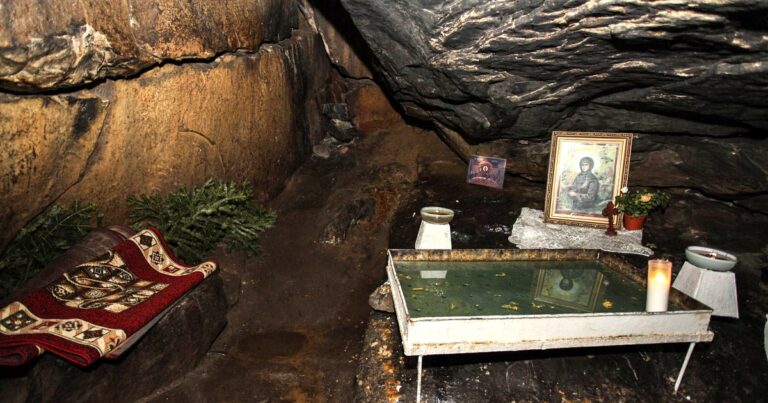
On September 29, 1998, during the burial of presbytera Ecaterina, Father Lăcătușu’s body was found incorrupt. Exhumation was legal for reburial in the family vault. There is no publicly available medical-legal, sanitary, or criminalistic report documenting the state of the body – descriptions (low weight, odor, flexibility, preservation of features) come exclusively from ecclesiastical and journalistic reports, not an independent protocol.

Note: I have preserved the original Markdown structure exactly as it was in the Romanian text.

Canonization memorandum and the Patriarchate’s response (1999).

On October 5, 1998, Father Ilie Lăcătușu’s daughter, Maria Sabina Spirache, submitted a petition to the Archbishopric of Bucharest regarding the discovery of his incorrupt body. On June 21, 1999, eight associations (The Romanian Orthodox Brotherhood, The Student League, The Association of Former Political Detainees and Anti-Communist Fighters, The Scara Group, The Christiana Association, The Anastasia Foundation, The Romanian Orthodox Youth League, and The Romanian Orthodox Students’ Association) signed a petition for the opening of the canonization file. On July 16, 1999, the Press Office of the Romanian Patriarchate responded officially with clear reservations: "The Church has not established precise or approximate terms for verifying sanctity. (…) It is indeed true that the Church has never placed particular haste in canonization proceedings except when the avalanche of popular piety forced it to do so. In the case of Father Ilie Lăcătușu, the Archbishopric became aware of the discovery of his incorrupt body. However, the path to canonization requires many stages and extraordinary efforts, as has been done in the past." This official response from 1999 articulates exactly the patristic position that this article supports: the discovery of an incorrupt body, in itself, does not automatically produce canonization; there is a need for stages and verifications; and the formula about "the avalanche of popular piety" reiterates even the formulation of Father Liviu Stan from 1950.

Three successive hierarchical prayers of absolution (1999–2000).

In response to the discovery of his body, the descendants and clergy involved sought patristic prayers of absolution. Beginning on May 1, 1999, at Frăsinei Monastery, 40 days of liturgical services after the Divine Liturgy were performed. On September 29, 1999, during the one-year anniversary of the discovery, Bishop Teodosie Snagoveanul, vicar of the Archbishopric of Bucharest, read "a hierarchical prayer for absolution for any grave sins or anathemas that might prevent Father Ilie Lăcătușu’s body from decomposing". On February 6, 2000, Metropolitan Serafim Joantă of Germany, Central Europe, and the North officiated a special service accompanied by prayers of absolution. Three successive hierarchical interventions over nearly two years, each aimed at absolution from sin or anathema — which confirms patristically what we have shown in the section on relics: hierarchs who examined the case did not start from the assumption of sanctity but rather from the natural patristic doubt, going through the eight causes of incorruption listed by St. Cleopa. The persistence of incorruption after these absolutions was later interpreted apologetically as proof of sanctity, but — as we have shown — this interpretation does not resolve the distinction between natural causes (firm constitution, soil with chemicals) and the cause of sanctity proper (the eighth), which requires correlation with a person’s life, pleasant fragrance, joyful countenance, and miracles.

The cult grew gradually. In July 2008, the press reported over 800 pilgrims at commemorative events organized by relatives and "Prezent!" association — a name that reiterates the traditional greeting of the Legionary Movement ("Comrades, present!"). This terminological association around the tomb of a priest later canonized as "Confessor" shows from the start the type of social environment that coagulated the cult.

Canonization chronology.

On July 11–12, 2024, the Holy Synod of the Romanian Orthodox Church approved canonization under the title "St. Confessor Priest Ilie Lăcătușu," with a feast day on July 22. The general proclamation of the sixteen saints took place at the Patriarchal Cathedral on February 4, 2025; the local proclamation of Father Ilie Lăcătușu occurred on July 13, 2025.

Problems with the mode of veneration (2016 and 2025).

In 2016, the Archdiocese of Bucharest published on Basilica.ro a "Clarification" in which it found that the family had proceeded without authorization to elevate the tomb and expose the body. In the document, the Patriarchate asked publicly: "Is it legitimate to ask whether perhaps the family of Father Ilie Lăcătușu is exploiting the veneration of the faithful for financial gain?" — and proposed formally moving the relics "to a chapel next to the parish church until a canonical decision". This official proposal from an episcopal authority shows that, eight years before canonization, the Archdiocese itself considered the administration of worship insufficiently canonical to be accepted in its form at the tomb. The Patriarchate invited the family several times to find "a legal and canonical solution".

On July 22, 2025, on the first celebration after local proclamation, legionary flags were hung at the tomb during the service. The Patriarchate was forced to issue a public statement distancing itself "firmly from any extremist ideology, totalitarianism". The police removed the flags.

In the same statement in July 2025, the Patriarchate explained the official grounds for canonization: Father Ilie Lăcătușu was canonized "for confessing Christian faith and suffering in communist prisons", and "the main evidence of his sanctity are his whole relics and reported miracles". This official formulation is important because it clearly lists the three grounds for canonization: suffering, relics, and post-mortem miracles. This article will show in the following sections that, through the grid of patristic criteria formulated by Father Liviu Stan, none of these three grounds is sufficient on its own, and together they do not meet the requirements for the canonization of a Confessor.

These are the facts. We now move to examination.


ConfessionWas there a public, articulated position of faith for which the person suffered?
LifeIs there a recognized life, disciples, transmitted teaching, and exceptional pastoral fruit?
RelicsIs incorruption corroborated with patristic signs, rather than treated as automatic proof?
ReceptionIs the popular cult healthy, conciliar, and free from political instrumentalization?

Applying Patristic Criteria

We will take each of the three conditions formulated by Father Liviu Stan one by one and see how they apply in this case.

First condition: Unquestionable orthodoxy of faith

Here, there is no indication that Father Ilie Lăcătușu had dogmatic deviations. He lived and died as an Orthodox priest in communion with the Romanian Orthodox Church. He did not fall into any Christological, Trinitarian, or Mariological heresy.

However, it should be noted that patristic tradition does not separate Orthodox faith from life in Christ: "faith without works is dead" (James 2:26). The Legionary Movement is treated by major international historiography (Stanley G. Payne, Armin Heinen, Roland Clark, Oliver Jens Schmitt, Constantin Iordachi) as a Romanian fascist movement, with central anti-Semitism and a sacralization of the nation — expressed in cultural-religious language, but functioning as a fascist ideological structure. Conscious adherence to such a movement touches an area that is not strictly dogmatic, but neither completely separate from the problem of Orthodox confession.

The Legionary Movement was not just a political option among others. It was a movement that incorporated Orthodoxy into its national-ethnic project, which had "St. Archangel Michael" instrumentalized as patron of the Nation, which preached a cult of "martyrs for the Nation" with heterodox aspects. Stanley G. Payne, classic historian of fascism, notes that the Legionary Movement was called "a kind of Christian heretical sect" within fascist Europe itself, due to its theological heterodoxy (cult of death, "the new man", self-assumed martyrdom as sacrifice for the Nation, even at the cost of damnation). Subordination of faith to the national-ethnic project — phyletism — had been formally condemned as an ecclesiastical heresy by the Council of Constantinople in 1872.

Adherence with conviction to such a project — not formal obedience under pressure — raises questions. We do not say that Father Ilie Lăcătușu was heretical in the dogmatic sense. We say that his adherence — for which there are recorded indications of personal regret in the 1967 informative notes, but no public, articulated, theological, and ecclesial retraction — touches a domain on which the criterion of unshakeable orthodoxy leaves it open, not automatically closing it in favor of canonization.

Verdict on criterion I: No clear dogmatic deviations exist. However, there is an association with a movement whose ideological structure incorporated heterodox elements. The informative notes in the CNSAS file record personal regret expressed in 1967, but no public retraction, articulated, theological, and conciliar, ecclesial retraction of this association exists. The criterion cannot be fulfilled without a public examination, which did not take place.

Second condition: glorification by the Lord

Here we enter the heart of the matter. Father Liviu Stan lists five possibilities. Let us consider them one by one.

(a) Martyrdom for Right Faith. Father Ilie Lăcătușu did not die a martyr’s death. He died at 73 years old, in a hospital bed, after a natural illness, in 1983 — nineteen years after his last release from prison. What he endured in detention was real and hard, but it was not martyrdom. The criterion does not apply.

(b) Confession of Right Faith in the Face of Perils. We must be very careful here, as this is the category in which he was canonized: "confessor". We have seen that in Tradition, confession presupposes a concrete and articulated public content: a thesis, a dogmatic or ecclesiastical position, articulated before the authorities who would force him to abandon it. St. Maxim confessed dyothelitism. St. Mark of Ephesus confessed against Florence. St. Theodore Studite confessed the veneration of icons.

What did Father Ilie Lăcătușu confess? In the Securitate interrogations, he minimized his Legionary involvement. His 1941 testimony says that he served the Movement "with the purest intentions". His 1954 testimony in detention attests: "I held a few gatherings, I took decisions to complete and repair the small bridges begun and deteriorated in the commune." This is a strategic reduction, understood in a context of repression, but it is not public confession of a dogmatic or ecclesiastical position.

He did not publish any confession of faith before the Securitate. He did not articulate an anti-communist position from theological motives recorded. There is no text of his that says "Behold what I confess about Christ in the face of those who would reduce me to silence." There is no anti-communist Antirrhetic by Father Ilie Lăcătușu. There is no Letter to Friends like St. Theodore Studite’s.

He suffered, yes. But he suffered as a good and pure man among other good and pure men, without formulating and transmitting a public confession, with content, about faith.

This is a Christian suffering borne, perhaps even exemplary humanly and pastorally, but it does not yet appear in the available public documents that articulated ecclesial confession which technically justifies the title of "Confessor".

We must make a distinction here, on which understanding the entire category of "saints of the prisons" depends. Father Ilie Lăcătușu was not arrested for faith. He was arrested as a former member of the Legionary Movement.

This is attested without ambiguity by his Securitate file. The arrest in July 1952 came in the context of a wave of reprisals against former local leaders of the Legion. The arrest in July 1959 came in the second wave of purges, after the Hungarian Revolution, when the regime feared an internal opposition resurgence. In both files, the official reason for detention is Legionary activity, not Orthodox faith. He was not asked to deny Christ. He was not asked to renounce the Church. He was not asked to subscribe to heresy. He was asked to give statements about his Legionary activity, which he did, minimizing it.

In addition, Father Ilie Lăcătușu himself described the reason for his suffering in a note from April 20, 1967, in the CNSAS Informativ file 195829: when asked what he was guilty of to have suffered, he would have replied "for legionary politics." This is not an external classification imposed by enemies, but, according to the document cited by the official defense, Father Ilie’s own classification regarding his detention.

This distinction is not marginal. It is of capital importance for the entire Orthodox hagiology. St. Maxim the Confessor suffered for dyothelitism — a dogmatic thesis that he articulated publicly, in writing, before the emperor and the synod. St. Theodore Studite suffered for public defense of icons, through treatises and articulate letters. The new Russian Martyrs and Confessors suffered for identifiable public acts: refusal to hand over sacred vessels (Metropolitan Veniamin of Petrograd), public anathematization of the persecuting regime (Patriarch Tikhon), refusal of Sergius’s Declaration (Metropolitan Joseph of Petrograd, the entire "Josephite" movement). In each case, suffering was a direct consequence of a publicly articulated confession of faith.

The suffering of a Christian arrested for a pre-communist political option — whether legionary, peasant, liberal, monarchist, or of another nature — is not, in itself, martyrdom or Christian confession. It may be unjust suffering, worthy of human respect and private commemoration in prayers. However, the Patristic Tradition has never confused "victim of political injustice" with "confessor of faith." If we reduce confession to "keeping one’s faith in suffering," the category becomes so broad that it loses all content: all true Christians keep their faith in suffering.

In the case of Father Ilie Lăcătușu, public documents show detention for his Legionary past, not for a dogmatic or ecclesiastical confession articulated publicly.

(c) Moral and Religious Perfection. Here we must apply the relevant criteria to his state — married parish priest, rural parish priest. As shown in the section on hagiographic typology, married parish priests are not evaluated according to monastic hesychasm, but according to pastoral criteria: confirmed spiritual disciples, pastoral sermons or writings, recognition as a living spiritual guide, exceptional pastoral work, identifiable spiritual filiation.

On each of these markers, from consulted public sources, we find the following:

Confirmed Spiritual Disciples: I have not identified in public sources any named spiritual disciples with consistent testimony about the guidance they received from him. The Akathist, written after 1998, speaks of "his blessed disciples," but does not name anyone concretely and does not quote any recorded testimony.

Pastoral Sermons or Writings: There are no published sermons, ascetic writings, or spiritual correspondence. His own testimony from 1941 — the only text systematically quoted — refers to general pastoral conduct, but concrete sermons do not survive. There is a reference to "a few letters" from parishioners in Râmnicu Vâlcea who regretted him in 1943, but their content is unknown.

Recognition as an Exceptional Spiritual Guide: From the research of accessible public sources, Father Ilie Lăcătușu does not appear as a major spiritual reference point in the testimonies of contemporary great spiritual guides (Cleopa, Paisie Olaru, Sofian Boghiu, Arsenie Papacioc). The only "spiritual" recognition in life comes from Father Iustin Pârvu — his fellow prisoner at Periprava, himself with unretracted legionary antecedents. In the same period (1964–1983), St. Cleopa at Sihăstria received tens of thousands of pilgrims and was known from the Patriarchate to the smallest village. Father Ilie Lăcătușu, in the same period, was a parish priest at Gârdești and then Cucuruzu — villages in the Burnas Plain, far from any spiritual center. I have not identified in public sources contemporary testimonies (1964–1983) that he received pilgrims for confession or counsel.

Exceptional Pastoral Work: We identify a few concrete positive facts: at Pluta–Buicești, correct pastoral work (with his wife’s choir); in Transnistria, in six months he performed evident missionary actions (reconsecration, orphanage canteen, wood assistance); at Gârdești, he renovated a valuable church painted by Nicolae Grigorescu. These are facts of a diligent parish priest, not an exceptional one. Most good priests from that era have done similar things.

Personal Spiritual Guide: Tradition requires that a future saint had himself a spiritual guide, a mentor, a filiation. Sanctity is transmitted in a chain. St. Paisie Olaru was the spiritual guide of St. Cleopa. St. Cleopa guided Father Ioanichie Bălan. The filiation is evident. Who was the spiritual guide of Father Ilie Lăcătușu? In public sources, the name does not appear. There are no testimonies referring to his spiritual mentor or a concrete ascetic filiation.

Verdict on criterion c): His priesthood was correct, devout, dignified. His pastoral work included good concrete deeds. His conduct in prison was beautiful. However, from available public sources, there is no independent attestation of perfectly lived religious experiences — that is, surpassing the state of a correct parish priest towards that measure which, in Tradition, means glorification by the Lord. Apologetic sources present him retrospectively as an hesychast spiritual guide, but no source from his lifetime confirms this characterization.

(d) Performing miracles during life or after death. The testimonies about miracles associated with Father Ilie Lăcătușu are almost entirely post-mortem, starting with the discovery of the body in 1998. There is a testimony by Father Iustin Pârvu about a "miracle" at Periprava (the weather improved due to Father’s prayer), but it is a singular, post-factum, oral transmission. There are no contemporaneous written records of healings, seeing souls, or foreknowledge attested by a contemporary in writing during his lifetime.

Post-mortem miracles at relics are a widespread phenomenon of Orthodox popular piety. They appear even with non-canonical figures. Alone, they are not sufficient — Tradition requires that the miracles be corroborated with a life worked in the Spirit, independently attested.

(e) Heroic devotion to defending faith and Church. The criterion would apply to figures like St. Antim Ivireanul (martyr for the Romanian Church), St. Constantin Brâncoveanu (martyr for his faith before the Turks), St. Iorest or St. Ilie Iorest (defenders of Orthodoxy in Catholicized Transylvania). It is about people who performed public, articulated, attested acts of defending the Church as an institution and faith as a dogma.

Father Ilie Lăcătușu did not perform such acts. He renovated a church at Gârdești. That’s ordinary pastoral administrative work, not heroic defense of faith.

Verdict on criterion II: None of the five forms required by Tradition are fulfilled. Suffering in detention, however real, does not rise to the level of patristic confession — because it lacks public articulation of a concrete Christian position. There is no transmitted teaching, named disciples, writings, or contemporary attestations of an ascetic life. The miracles are almost exclusively post-mortem.

Third condition: spontaneous cult of the people

Here, the criterion is partially fulfilled, but must be viewed with discernment.

It is true that after the body’s discovery in 1998, a popular cult coalesced around the crypt at Giulești Cemetery. There have been reports of miracles. Acathists have been composed. Pilgrims continue to come.

It must be noted that the cult of Father Ilie Lăcătușu did not emerge spontaneously throughout the Romanian Orthodox Church. He was systematically cultivated within a specific network: Petru-Vodă Monastery (Father Iustin Pârvu), publications Atitudini, Mărturisitorii, SACCSIV blog, and the "traditional orthodoxy" Romanian media working on the theme of "Christian anti-communist resistance". This is a network that has fueled the cult by painting Father Ilie’s image on monastery walls, producing books, organizing conferences, and exerting media pressure.

This is not exactly what Father Liviu Stan means by "spontaneous veneration of the people." Spontaneous veneration appears from below, from a diffuse ecclesiastical consciousness. Ideologically directed cults appear from above, from networks with clear agendas.

Moreover, the criterion of popular cult cannot be isolated. Tradition demands that popular veneration should confirm a sanctity already glorified by God through life and miracles – not to supplement the lack of attestation.

But there is something else, and it’s very grave. Patristic tradition does not honor every popular cult – it examines them. There are markers for a healthy popular cult and markers for a problematic one. In this case, we find two severe problems within the cult:

Problem I: Financial Exploitation of Relics by Family

In 2016, the Bucharest Archdiocese officially published on Basilica.ro an "Explanation" in which it found that Father Ilie’s family – especially his nephew, Mr. Mihai Spirache – had proceeded without authorization to raise the tomb and expose the body, violating official permission for exhumation-reburial. The Patriarchate publicly asked: "Is it legitimate to wonder if perhaps Father Ilie Lăcătușu’s family is exploiting the veneration of believers in order to obtain financial benefits?" Mr. Spirache, although not a priest and not employed by the Patriarchate, collects prayer cards and money from pilgrims. The Patriarchate has repeatedly invited the family to find "legal and canonical solutions".

At least at the level of official communication from the Bucharest Archdiocese, the case was considered problematic enough to raise publicly the question of financial exploitation.

Problem II: Post-Canonization Political Instrumentalization

On July 22, 2025, during the first commemoration after the general proclamation of saints (February 4, 2025) and local proclamation (July 13, 2025), legionary flags were erected at the tomb during the commemorative service. The Romanian Orthodox Patriarchate was forced to issue a public statement distancing itself from "any extremist ideology, totalitarianism". Police removed the flags. This is not a minor detail. It confirms publicly, visually, officially that honoring Father Ilie Lăcătușu is used – even at his tomb, on his commemoration day – for retroactive validation of the Legionary Movement.

Verdict on criterion III: There exists a cult, but it is ideologically directed, accompanied by explicit financial exploitation ascertained by the Patriarchate, and subject to public legionary instrumentalization. In its concrete form, this cult cannot be viewed as "spontaneous veneration of the faithful" in Father Liviu Stan’s sense. Moreover, the criterion of cult cannot replace the lack of criteria I and II.


Questions for Ecclesiastical Reflection

Instead of a firm conclusion, we will formulate questions that, according to our judgment, ecclesiastical consciousness is called upon to pose before this canonization.

Firstly: On which category of Tradition was Father Ilie Lăcătușu canonized? The title is "St. Confessor Priest". However, confession requires articulated public content, transmitted to disciples, attested in writing. Father Ilie Lăcătușu did not leave such a confession. He endured imprisonment – a real and grave fact, but not sufficient by itself. Moreover, he was arrested as a former member of the Legionary Movement, not for his Orthodox faith. Can we extend the patristic category of "confessor" to include any Christian political detainee, or do we lose the content of the category in this way?

Secondly: Was his incorrupt body sufficient for canonization? If so, how do we relate to Athonite cases where an incorrupt body was interpreted as a sign of demonic influence? How do we relate to the decision of the Metropolis of Moldavia and Bukovina in 2014, which reburied an incorrupt body from a monastery in Neamț, invoking even the possibility of a curse? Is there a coherent standard of the Romanian Orthodox Church regarding relics or does it vary from case to case?

Thirdly: How does this canonization relate to Father Ilie Lăcătușu’s conscious and declared membership in a nationalist-fascist movement, programmatically anti-Semitic? Father Ilie Lăcătușu adhered to a movement that incorporated Orthodoxy into its national-ethnic project. His adherence was not publicly retracted. Can we proclaim such an individual "St. Confessor" without thereby giving the Legionary Movement retroactive validation it does not deserve theologically?

Fourthly: Did the Holy Synod of the Romanian Orthodox Church conduct a public examination of the period of the Legion and the mission in Transnistria before canonization? The Patriarchate’s defense published on Basilica.ro appeared after canonization, as a response to external criticism. This suggests that critical reflection did not precede the decision but followed it. Is this procedure correct for a canonization?

Fifthly, and most painfully: was Father Ilie Lăcătușu canonized as a person or as a symbol? The case is not simple, because the man suffered in reality, remained a priest of the Church, and left behind popular veneration. But precisely for this reason, the question must be asked with greater rigor: is this veneration sufficient for the title of "St. Confessor Priest", when lacking articulated public confession, pastoral work transmitted, confirmed spiritual disciples, and transparent examination of his Legionary past? If the answer is affirmative, then the Romanian Orthodox Church has extended the category of "confessor" in a new sense. If the answer is negative, the canonization remains problematic on its own aghiological grounds.

The Sixth: In the official communiqué of July 2025, the Romanian Orthodox Church explained that Father Ilie Lăcătușu was canonized "for confessing the Christian faith and suffering in communist prisons", and that "the main evidence of his sanctity are his whole relics and reported miracles". This official formulation lists three grounds: (1) suffering in communist prisons, (2) whole relics, (3) reported post-mortem miracles. Compared to Father Liviu Stan’s grid, this enumeration is instructive: suffering alone is not sufficient – Tradition requires that the suffering be a consequence of a publicly articulated confession of faith, which does not appear in his file; whole relics are not in themselves a criterion – Tradition requires that incorruptibility be correlated with the man’s life attested independently; post-mortem miracles are the third criterion of Father Liviu Stan, but he requires them to confirm a sanctity already proclaimed through life, not to replace it. None of the three official grounds listed by the Patriarchate mention: a publicly articulated dogmatic or ecclesiastical confession; spiritual disciples with recorded testimonies; pastoral writings transmitted; recognition as a remarkable spiritual father during his lifetime by his contemporaries; attested miracles in life.


Conclusion

Summarizing coldly, after reviewing all public sources – official church, apologetic, critical, and archival ones cited publicly – we must say clearly what we found and what we did not find. This article will not leave the reader with a hazy impression of a "complex" person who cannot be judged. Just as patristic tradition requires clarity in canonization, there will be clarity here too.

Father Ilie Lăcătușu was not a confessor in the sense of Tradition. Confessing requires a publicly articulated dogmatic or ecclesiastical confession, attested in writing, transmitted to disciples, for which the man suffers the consequences. None of this appears in Father Lăcătușu’s file. He was arrested and detained as a former member of the Legionary Movement, not for his Orthodox faith. He himself described in 1967, in the words recorded by his Securitate file, that he suffered "for Legionary politics" – his own classification of his own detention. He endured the unjust suffering of prisons with Christian dignity, which is true and deserves human respect; but the suffering of a Christian arrested for pre-communist political affiliation is not, in itself, martyrdom or patristic confession.

Father Ilie Lăcătușu did not have an attested life of sanctity. He was not recognized as a remarkable spiritual father during his lifetime by any of the great spiritual fathers (Cleopa, Paisie Olaru, Sofian Boghiu, Arsenie Papacioc). He did not have named spiritual disciples with recorded testimonies. He did not generate pilgrimages to him in life. As a rural parish priest – Pluta-Buicești, Gârdești, Cucuruzu – he was correct but not exceptional. The fourteen years of pastoral service post-detention (1964–1978) are the years when sanctity would have been expected to be seen in the Church; it was not seen. And his own spiritual father – an element without which, in Tradition, there is no ascetic filiation – does not appear in any source.

Father Ilie Lăcătușu did not leave remarkable writings. There is no volume of sermons, no notebook of spiritual notes, no published correspondence, no Antirrhetic, no Disputatio, no recorded homilies in diocesan journals. The only quoted text systematically is his 1941 declaration about adherence to the Legionary Movement. In forty-nine years of priesthood, he left nothing for the Church as transmitted teaching.

Father Ilie Lăcătușu did not make any public statement, written or verbal, of renouncing the Legionary Movement. There are indications in CNSAS files, cited by the official defense of the Patriarchate, of personal regrets expressed in an informative note from 1967. However, personal regret expressed to a Securitate informant is not a public, articulated, theological, and ecclesial retraction. Throughout the 1970s, when Father Ilie served freely as a parish priest at Cucuruzu and then lived as a pensioner in Bucharest, he did not publish, preach, or articulate in any ecclesiastical forum his renunciation of his youthful adherence to the Legionary Movement — an allegiance which he himself described, in 1954, as a response to the conviction that the movement "seeks the good of Church and country". The pious withdrawal and humility of his last years do not replace for a public statement that Tradition demands from those whose public veneration is proposed.

These are the facts. We have verified each one in pro-canonical sources (Patriarchate, Mărturisitorii.ro, Doxologia, Basilica) and archival sources (CNSAS, through public citations). None of them come from "the enemy’s attack". All come from the official file of the case itself. And the question posed by the article in its title — can political suffering become patristic confession? — now receives its answer: it cannot, without emptying the category of "confessor" of any content.

This is not a judgment on Father Ilie Lăcătușu’s personal salvation. Salvation is God’s business and we pray for each Orthodox cleric who has fallen asleep, regardless of canonization. This is a patristic judgment on public veneration which proposes to an entire people that they venerate, as a model of sanctity, a figure who, through the grid of classical Patristic Tradition, does not meet the criteria of the category under which he was proclaimed. Recognizing sanctity is not an identitarian affirmation; it is ecclesiastical testimony. And ecclesiastical testimony demands truth — truth about life, truth about confession, truth about renouncing political error, truth about the fruits transmitted. In Father Ilie Lăcătușu’s case, these truths are lacking.


What does a saint give us? A question that each reader can ask themselves

After we have gone through the patristic criteria, biography, Security file, prayers of absolution, and official formulation of the Patriarchate, there remains a simpler question which each Orthodox Christian can ask themselves without theologian, canonist, or apologist. What do I expect from a saint? What can I learn from him?

Patristic Tradition teaches us that a saint gives us two things: a life to imitate and an instruction to follow. Saints are models, not just mediators. The Holy Liturgy is made fruitful by the saints mentioned there because they are living testimony that the Gospel can be lived — that man, through grace, can become like Christ. From each saint venerated we have something concrete: a way of speaking, an asceticism, an instruction on prayer, a testimony of faith in the face of enemies, a pastoral service which has raised up the souls entrusted to him.

Ask yourself, reader: when I venerate the relics of St. John of Kronstadt, what do I take home with me? I take My Life in Christ, I take the prayer rule he wrote, I take the example of the priest who gave his last penny to the poor, I take his words about the Holy Eucharist as a medicine for the soul. When I read about St. Paisios the Athonite, what do I take? I take his words, I take examples of love and humility, I take how he prayed for an entire world, I take testimony of his labors in Panaguda Hermitage. When I think of St. Cleopa Ilie, what do I take? I take thousands of pages of sermons, I take the instruction on mental prayer transmitted to his disciples, I take how he read Scripture, I take testimony of decades of service at Sihăstria where tens of thousands of pilgrims returned to Christ through his mouth.

Now ask yourself honestly: what do I take from Father Ilie Lăcătușu? What model of life does he offer for the Romanian Christian today? What teaching about prayer, repentance, heart purity, and love for one’s neighbor? What example of how to navigate this world towards the Kingdom? What is there to imitate? What should I read? What should I listen to?

The answer, if we are honest, is the incorrupt body in the Giulești cemetery crypt. That’s it. There is no transmitted teaching, no disciples from whom to hear his voice, no writings in which to enter, no Pateric that preserves his words as the Romanian Pateric of Father Ioanichie Bălan preserves the voices of Cleopa and Paisius. There is an incorrupt body, fragrance, miracles attributed to the tomb — all post-mortem events, all signs without a word. The veneration of Ilie Lăcătușu is almost exclusively the veneration of a body, not of a life and not of a teaching.

This may be the most serious signal for the entire contemporary Romanian ecclesiastical consciousness. Orthodox piety today seems more associated with miracles and healings than with imitating the example and teaching. The modern Romanian Orthodox pilgrim travels to relics to receive bodily healing, deliverance from troubles, release from burdens — and this is not bad in itself, because relics truly work by grace. But if the only veneration a saint receives is for what he does through his body after death and not for what he taught in life, then we have reduced sainthood to a kind of spiritual medicine — a point of contact with grace that heals but no longer teaches, no longer forms, no longer changes life. The saint becomes a wonderworker, not a teacher. And Orthodoxy, without teachers, without models to imitate, becomes ritual and hope in miracles — it is no longer the continuous discipleship of man in Christ through likeness to those who became like Him.


Series · Discernment on Recent Canonizations
The Case of Ilie Lăcătușu (you are reading it now) · political suffering, relics, confession, and ecclesial reception
Future cases · examinations according to the same patristic grid, published as the documentation is ready

The purpose of the series is Orthodox discernment: not attacking the Church, but testing the criteria by which public sanctity is recognized.

Series Announcement

We began with the most methodologically clear case, not because it’s the most widespread cult. The cult of Father Ilie Lăcătușu remains relatively marginal within the Romanian Orthodox Church. The truly difficult cases are only now coming.

In the articles that follow in this category, we will examine other recent canonizations with the same patristic grid. We work on each case with documentary rigor and spiritual consultation, and the examination will appear as it is ready. We do not publish political verdicts about living or deceased persons — we ask patristic questions about ecclesiastical decisions that concern us all as children of the Church.

The purpose of the series is not to attack the Romanian Orthodox Church. The goal is to ask for authentic spiritual discernment, without which the Church becomes an instrument of national affirmation rather than the Body of Christ. This is a temptation known by every Orthodox national church — in Moscow, in Bucharest, and everywhere else — and it cannot be clarified without serious reflection on the relationship between Orthodoxy and ethno-nationalism.

Recognizing sainthood is too important to be treated as an identity statement. And criticizing a synodal act, when done within communion with the Church, according to the criteria of Tradition and with concern for its health, is not schism. It’s reception.

Main Sources

Main sources: Fr. Prof. Liviu Stan, "About the canonization of saints in the Orthodox Church", Ortodoxia magazine, year II, no. 2, Bucharest, 1950. St. Nicodemus the Athonite, Pidalion of Neamț, edition 1844, page 444 verso (annotation to canon 14 of the local synod at Sardica). St. Cleopa Ilie, Sermon about the incorrupt bodies (on Saturday of the Dead), in Sermons for Sundays throughout the year, Scara Publishing House, 2002. St. John Chrysostom, Homily on Maccabees, Homily on St. Babylas. The Athonite tradition about exhuming corpses (Great Lavra, Vatoped). The Metropolitanate of Moldavia and Bukovina, official statement in 2014 regarding an incorrupt body reburied. The official website of the Romanian Orthodox Church (Basilica.ro): "Clarification regarding the tomb of Father Ilie Lăcătușu", 2016; information about the proclamation of canonization (2024–2025); post-canonization defense; July 2025 statement regarding the grounds for canonization. CNSAS, Informativ Fund, files no. 210831 and 195829, Rețea Fund, file no. 254359 (cited by Adrian Nicolae Petcu, Ziarul Lumina, through the Patriarchate’s defense and published extracts on the apologetic website Mărturisitorii.ro, 2014). The State Secretariat for Cults Archive, Direcția Secretariat file 1964; National Archives of Romania, Ministerul Cultelor și Artelor Fund, file 93/1964. For the historical context of the Legionary Movement: Stanley G. Payne, A History of Fascism 1914–1945; Armin Heinen, Legiunea "Arhanghelul Mihail"; Roland Clark, Holy Legionary Youth; Oliver Jens Schmitt, Corneliu Zelea Codreanu. Ascensiunea și căderea "Căpitanului"; Constantin Iordachi, studies on Romanian fascism.

Leave a Reply

Your email address will not be published. Required fields are marked *