In the Holy Orthodox Church, water is not merely a creature of nature, but one of the foremost through which the gift of God works. From the very Creation, the Holy Spirit moved upon the face of the waters (Genesis 1:2), and when our Lord Jesus Christ descended into the Jordan, the nature of the waters was sanctified forever. From this comes the tradition which the people callaghiasma — a word taken from the Greek ἁγίασμα, meaning “sanctification.”
The Orthodox Church knows two kinds of holy water:Great Holy Water, performed once a year at the Feast of the Lord’s Baptism, andSmall Holy Water, performed whenever the need arises. Both share the same heart — the invocation of the Most Holy Spirit upon the water — but they differ in their order and their occasion. In what follows we shall see how this tradition was received and established in the sister Churches of the East, and finally — how the Romanian order differs.
Byzantine Roots
The earliest testimony about the sanctification of waters at Theophany comes from Saint John Chrysostom, who, as early as the fourth century, mentions in his homilies the Christians’ custom of drawing water on the night of Theophany, “for the nature of the waters is sanctified on this day.” At that time the order was still brief.
The complete form of the Great Holy Water, as we know it today, was composed bySaint Sophronius, Patriarch of Jerusalem(7th c.). He established the two great prayers, full of profound meanings, which are read to this day — beginning with “Great art Thou, O Lord, and marvellous are Thy works” — with the remembrance of the Jordan, the Baptism of the Lord, and the crushing of the heads of the dragons in the waters.
Centuries later,Saint Symeon of Thessalonica(15th c.), in his writings on the orders of the Church, explained that holy water is not a human custom but a work of the Holy Church, through which water becomes a bearer of grace — for the cleansing and sanctification of those who partake of it with devotion.
Great Holy Water — the Feast of Theophany
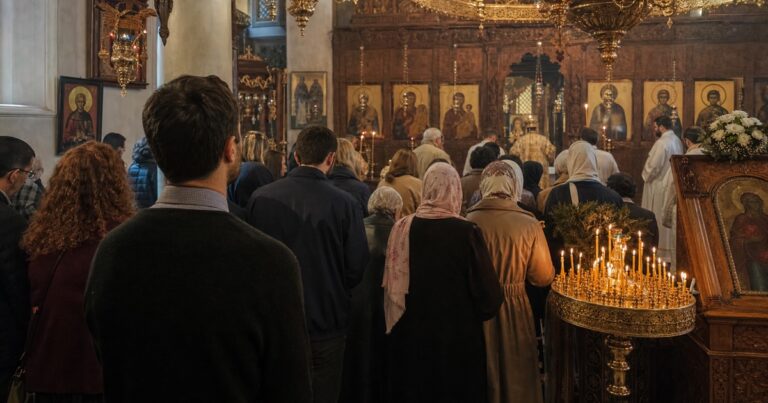
The Great Holy Water is performed twice: on the eve of the Lord’s Baptism (January 5), after the Holy Liturgy, and on the day of the feast (January 6), also after the Liturgy. In many places the service is held outside — at a river, pond, or well — where a procession is made with the Holy Cross. The prophecies from Isaiah are read, along with the Apostle and the Holy Gospel, after which the celebrant lowers the Holy Cross into the water and chants“When Thou, O Lord, wast baptised in the Jordan…”
The Great Holy Water is kept in a place of honour in the home, and the faithful taste it in the morning on an empty stomach, in times of illness, trouble, or on feast days. Holy Tradition witnesses that the Great Holy Water does not spoil for an entire year — a sign of the Holy Spirit’s work upon the nature of the waters.
Small Holy Water — the Daily Blessing
The Small Holy Water — called in the service booksSfeștanieorthe Lesser Sanctification of Water— is performed whenever need arises: at the beginning of the month (the monthly Sfeștanie), upon entering a new house, for the blessing of fields, in times of illness or hardship. Its order is shorter, but it still contains the invocation of the Spirit upon the water, a reading from the Apostle and Gospel, and the prayers through which the priest asks forgiveness of sins and deliverance from illnesses for those standing before him.
With the Small Holy Water, homes, tools, livestock, and fields are sprinkled. It is, in its proper sense, the daily blessing of the life of the Orthodox Christian.
Russia — “Vodokreshchenie” and the Jordan Cut in the Ice
In Holy Russia, Ukraine, and Belarus, the Feast of Baptism is calledVodokreshchenie(Водокрещение) orKreshchenie— “the Sanctification of Waters.” The Byzantine order was received through the Metropolitanate of Kiev, then perfected in the monastic life of the hermits of the Kyiv Caves Lavra and those in the community of Venerable Sergius of Radonezh.
The most notable Russian custom is theprorub— in Slavonic, “the cut” — or, as they call it,the Jordan in the ice. In the midst of winter’s frost, a great cross is cut into the river ice, and after the sanctification of the waters, the faithful immerse themselves three times in the frozen water, for the cleansing of body and soul. This ascetic practice of immersion has been preserved from the hermits of the Russian wilderness and is considered a bodily confession of faith in the working of grace.
In Moscow, Saint Petersburg, and at the Holy Trinity Lavra — the service of the Great Holy Water is performed with a long procession, with the troparia chanted in the eight tones, and with the icon of the Lord’s Baptism carried ahead. In Russian villages, the priest brings the Great Holy Water to the homes of the faithful only after the host has kept the eve’s fast.
Serbia and the Legacy of Saint Sava
In the Serbian Church, the feast bears the nameBogojavljenje(Богојављење) — “the Manifestation of God” — and is closely tied to the legacy ofSaint Sava, the first archbishop of the Serbs, who established the Serbian liturgical order after the Typikon of the Holy Mountain. The service of the Great Holy Water is held at the river — on the Morava, on the Drina, on the Danube — and the celebrant throws the Holy Cross into the water, after which young men dive to retrieve it. It is held that the one who brings the Cross back to shore will have a blessed year.
The Serbs call this customplivanje za Krst— “swimming for the Cross.” Holy Water is kept at the great Serbian monastic foundations — Hilandar, Studenica, Peć, Gračanica — as a witness of the unceasing bond with Mount Athos.
Bulgaria — Yordanovden
Among the Bulgarians, the feast is calledYordanovden(Йордановден) — “the Day of the Jordan” — and is kept on January 6 with a zeal like that of the Greeks. In Plovdiv, Sofia, and especially on the Danube, the hierarch throws the Cross into the water, and young men dive after it into the frozen river. The one who retrieves it is considered a bearer of joy for the whole village in the year to come.
The Byzantine order entered the Bulgarians directly, through the labours ofSaints Cyril and Methodius— the two teachers of the Slavs — through whom the Slavonic tongue entered the church services. The Bulgarian service books contain the order of Holy Water in the same form as the Greek, but in the Slavonic language.
Greece and the Holy Mountain — Θεοφάνεια
In Greece, the feast is calledΘεοφάνεια(Theophany) orΦώτα— “the Lights.” In Piraeus, Thessaloniki, and on the Aegean islands, the service of the Great Holy Water is held at sea, and the hierarch throws the Holy Cross into the waves, after which the young men dive to recover it.
This is the mother-tradition, from which the other Orthodox Churches have inherited. The troparion“When Thou, O Lord, wast baptised in the Jordan”is sung in the first Byzantine tone, with the isons arranged according to the tradition of Saint John of Damascus. OnMount Athos, the Great Holy Water is celebrated with full solemnity at the great monasteries — the Great Lavra, Vatopedi, Iviron — and is distributed to all pilgrims who come for the feast.
Georgia, the Ancient Patriarchates, and the Other Churches
In the Church of Georgia, the order received from Antioch is calledNatlisgebaand preserves its own prayers, translated as early as the first centuries of the Christianization of the Kartvelians. In the ancient Patriarchates — Antioch, Alexandria, Jerusalem — the order of Holy Water has remained nearly unchanged since the time of Saint Sophronius. Each local Church has its own particular variation — an added verse, an amplified prayer — but the heart of the order is everywhere the same: the invocation of the Holy Spirit upon the water, through the voice of the celebrant and through the faith of the people.
Romanian Orthodoxy — Between Byzantium and Slavdom
In the Romanian lands, the order of Holy Water has two sources: thedirectly Byzantine— through the Metropolitanate of Wallachia and Moldavia, which kept an unbroken bond with Constantinople and with Mount Athos — and theSlavonic, through the service books copied and printed at Neamț, Râmnic, and Bucharest, in the Church Slavonic language.
VenerablePaisius Velichkovsky, labouring at Dragomirna, Secu, and Neamț in the 18th century, established in the Slavonic tongue of Moldavia the order of Holy Water after the Athonite Typikon, and from there it flowed into the whole of church life. From Neamț came the prayer books that reached as far as Bessarabia, Transylvania, and beyond the Carpathians.
The distinctive customs of Romanian Orthodoxy are:
- “Chiralesa!”— the children’s cry of“Chiralesa! Chiralesa!”(from the Greek Κύριε ἐλέησον — “Lord, have mercy”), raised as the celebrant emerges with the Cross from the holy church. This custom has been preserved especially in Moldavia and isunique among all the Orthodox countries— nowhere else has the Greek invocation remained on the lips of the village children.
- “The Walking with the Cross”or“the walking with Theophany”— the priest, together with the chanter, goes from house to house, with the Holy Cross, with the basil, and with the Great Holy Water, and blesses all the members of the household.
- The Frost of Theophany— considered a sanctified frost, a bodily witness of the heavenly feast.
- The Remembrance of the Departedwith Great Holy Water, at the grave, during the Bright Week of Theophany.
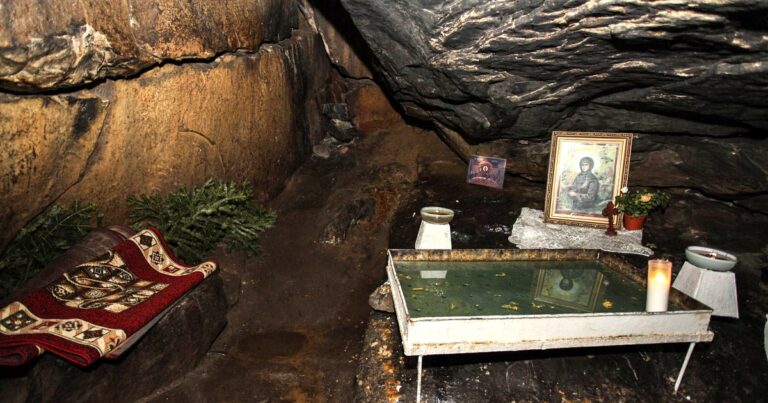
- The Blessing of Monastery Springs — the Life-Giving Spring, the Skete of Scărișoara, the springs of Neamț, Agapia, Văratec — with freshly sanctified Holy Water, year after year.
What Distinguishes the Romanian Tradition
The first distinction of Romanian Orthodoxy isthe weaving together of the two inheritances— Byzantine and Slavonic — into a settled, measured tradition, without the extremes of local customs. If among the Greeks the service is held chiefly by the sea, among the Russians on the ice of frozen rivers, and among the Bulgarians on the Danube — in Romania it is heldwherever there is flowing water: at brooks, at ponds, at wells, at monastery springs.
The second distinction isthe ever-presence of “the walking with the Cross”. In every Romanian village, the priest with the chanter enters every house, with the Holy Cross, the basil, and the Great Holy Water, and blesses all the members of the household, naming one by one the living and the departed. This custom exists elsewhere too, but nowhere is it as widespread as among us.
The third distinction — and the most moving — is“Chiralesa”. A living witness that the Greek prayer has remained on the lips of the Romanian peasant, as a living bridge between the Byzantium of old and the heart of the people today.
Great Holy Water — a landmark of Orthodox identity
Holy water — small or great — is, throughout Orthodoxy, the witness that all creation, through the Lord’s Baptism in the Jordan, has been sanctified and called to renewal. Each sister Church has received the same Byzantine heart and placed it within its own tongue and customs: the Russians with the prorub cut in the ice, the Serbs with the swim for the Cross, the Bulgarians with Yordanovden, the Greeks with Theophany at the sea. The Romanians, through the labours of the venerable fathers of Mount Athos and of Neamț, received the settled order of the feast — with the richness of the two sources, Byzantine and Slavonic, deeply woven into the heart of the people.
The nature of the waters is sanctified. So too is our soul, through the blessing of Holy Water received with devotion.