The Name of God (IV): The Jesus Prayer and Hesychasm

Part IV of the Name of God series: the Jesus Prayer, hesychasm, Saint Gregory Palamas, the Philokalia, and the calling of the Name in the heart.

The Name of God (IV): The Jesus Prayer and Hesychasm
The Name of God · Part IV

Part IV reaches the heart of the series: the Jesus Prayer, hesychasm, Saint Gregory Palamas, and the living transmission of the Name in the heart.

FathersDiadochos, Climacus, Hesychios, and Symeon
1351the Synod defends hesychasm and uncreated grace
PhilokaliaTradition is transmitted through Nikodimos, Basil, and Paisius
TodayJoseph the Hesychast, Sophrony, and the Romanian inheritance
Study in 5 Parts · The Name of God

The “Name of God” Series

Part IV · The Jesus Prayer and Hesychasm (you are reading this now)
Part V · Taking the Name in vain and the imiaslavie controversy (in preparation)

The articles can be read separately, but together they follow the path of the Name from the Old Testament to the prayer of the heart and to reverent use of the Name.

Reading Key

The Jesus Prayer is not a technique, a mantra, or a magical formula. It is the living invocation of the Person of Christ, in repentance, in the Church, and under spiritual guidance.

Preamble: from the Egyptian cell to the hesychast heart

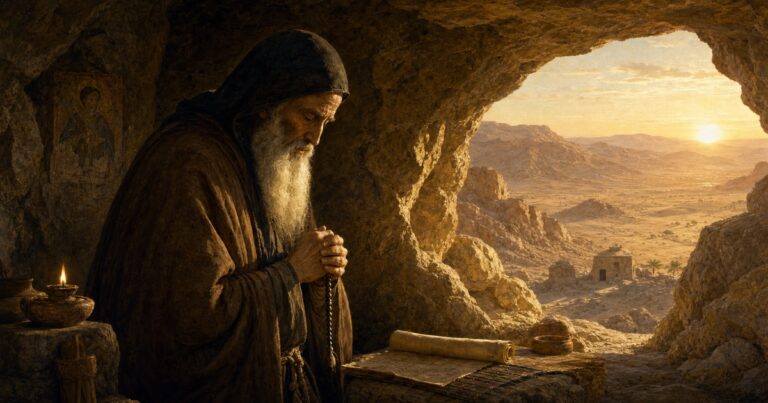
In the previous article of this series we followed how, in the Egyptian desert of the third and fourth centuries, a short, repeated form of prayer was born from the apostolic experience of the Name — monologistos euchē, the “prayer of one word.” Saint Anthony the Great invoked the Name of Christ in his struggles with evil spirits; Abba Isaac, through the voice of Saint John Cassian, repeated in his cell the psalmic verse: “O God, come to my assistance; O Lord, make haste to help me!” (Psalm 69:1). From all these threads, gradually, the form we know today took shape: “Lord Jesus Christ, Son of God, have mercy on me, a sinner.”

The present part reaches the place where all the threads of this series gather into one invocation. This is not a mere formula of devotion, but the heart of the hesychast Tradition — hesychasm, from the Greek hesychia, “stillness, quiet” — the Tradition in which the Name spoken in the heart becomes the natural way in which man meets God through grace. We will follow how this way was clarified by the Holy Fathers, from Diadochos of Photiki to Gregory Palamas, what the Synod of Constantinople in 1351 defended, and how this Tradition came down, through Saint Paisius Velichkovsky and the Philokalia, to Athos and to the Eastern monasteries of our own century.

One clarification is necessary from the beginning, because it will protect everything that follows: when the Fathers speak of the power of the Name — that it “burns,” that it “illumines,” that it “drives out demons,” that it “dwells in the heart” — they do not understand the Name as a magical or autonomous reality, but as the living invocation of the Person of Christ, through which the grace of God works. The Name Jesus does not work instead of Christ or apart from Christ; the Name works because Christ Himself, through the Holy Spirit, is present in the invocation of His Name. This distinction — developed in the previous article — is the key to any Orthodox reading of the theology of the Name. It will also guard us, in the final part of this series, from every deviation toward a theology that would treat the Name as an isolated magical power.

This article is not a practical manual for the Jesus Prayer. Such books exist — first of all the Philokalia, but also The Way of a Pilgrim or the volumes published by Sihastria Monastery from the talks of Father Cleopa Ilie. The present article is a theology of the Name as seen by the hesychast Tradition: what the Jesus Prayer is, how it works through grace, and what it promises to the one who keeps it in the heart. The rest — the practice itself — is learned under the guidance of a spiritual father, not from an article.


I. The five patristic pillars of the Prayer of the Name

1.1. Diadochos of Photiki (fifth century): the mind descends into the heart

Saint Diadochos of Photiki (†486), bishop of a small city in Epirus, is among the first patristic authors to formulate clearly the link between remembrance of God, the invocation of the Name of Jesus, and the work of the mind in the heart. His Chapters on Spiritual Knowledge — an ascetical text of one hundred chapters preserved in the Philokalia — contains one of the clearest teachings of the hesychast tradition.

In Chapter 59, Diadochos writes: “The mind demands from us, when we close all its outlets through remembrance of God, an occupation that will satisfy it. We must give it the one occupation that answers its desire: ‘Lord Jesus.’ ‘No one,’ says the Apostle, ‘can say that Jesus is Lord except in the Holy Spirit’ (1 Corinthians 12:3).”

Three things must be observed. First: Diadochos recognizes that the human mind is in ceaseless motion — thoughts, images, plans, memories. We cannot stop this motion; we can only redirect it. The one occupation that answers the desire of the mind is the Name Jesus — because in the Name Jesus the mind finds not a passing satisfaction, but its true object, the One it was created to know. Second: Diadochos links the invocation of the Name with the Holy Spirit. To say “Jesus is Lord” is not a simple mental act; it is an act in the Spirit. The Name spoken in the heart with faith becomes the place where Christ works through the Holy Spirit. Third — and most important for the hesychast tradition — Diadochos introduces the expression “remembrance of God” (mnēmē Theou), that is, the keeping of the Name unceasingly in the heart. This will become one of the cardinal formulas of hesychast theology.

In Chapter 61, Diadochos continues with an image that will remain for all centuries: the Name Jesus must be kept in the heart “as in an active fire.” The Name burns in the heart; it is not a cold word, but fire. This image — the Name as fire — will become familiar in later neptic literature. But it must be said again: the fire of which the Fathers speak is the work of the uncreated grace of Christ through the invocation of His Name; it is not a property of the word in itself.

1.2. Saint John Climacus (seventh century): the Name united with the breath

The second patristic pillar of the Prayer of the Name is Saint John Climacus (†649), abbot of Saint Catherine’s Monastery on Sinai and author of The Ladder of Divine Ascent — a text of immense influence throughout the Orthodox world, traditionally read in many monasteries during Great Lent. In Step 27 (on holy stillness), Saint John gives one of the best-known sentences of the hesychast Tradition: “Let the remembrance of Jesus be united with your breathing — and then you will know the benefit of stillness.”

The remembrance of Jesus united with breathing — here, in seed form, is one of the practical intuitions of hesychasm: prayer must embrace the whole life of man, down to the rhythm of his breathing. The Name Jesus is spoken in the rhythm of the breath. Inhalation — “Lord Jesus Christ, Son of God”; exhalation — “have mercy on me, a sinner.” Or, in the short form: with the inhalation, Jesus; with the exhalation, have mercy on me. Thus every breath becomes prayer, and life itself becomes life in the Name.

But what does Saint John Climacus mean when he joins the remembrance of Jesus to breathing? Not a technique in the modern, athletic or meditative sense; rather, a spiritual reality: that the Name Jesus is, for the baptized person, more familiar than the air he breathes, more necessary than breathing itself. In the spirit of Father Sophrony Sakharov, disciple of Saint Silouan the Athonite: for the baptized Christian, the Name Jesus becomes life itself — just as man cannot live without breathing, so the Christian cannot live fully in Christ without the invocation of His Name.

1.3. Hesychios the Sinaite (eighth-ninth century): watchfulness (nepsis) as a shield

The third pillar is Saint Hesychios the Sinaite, author of the Discourse on Watchfulness and Virtue — an essential text on watchfulness (nepsis), from which the whole tradition takes its name (neptic). For Hesychios, the Prayer of the Name is inseparable from watchfulness — that is, from the unceasing attention (prosochē) with which the mind guards the heart from passionate thoughts.

“Watchfulness is a spiritual method,” writes Hesychios, “which, if practiced diligently, with God’s help frees a man from passionate thoughts and evil words. (…) Watchfulness is the path to every virtue. (…) And watchfulness is born from the remembrance of Jesus.”

Two things must be remembered. First: the Prayer of the Name is not a relaxation technique. It is a battle — a battle with thoughts, a battle with the passions, a battle with the “old man” within us. The Name of Jesus is a shield against temptations, a sword against evil thoughts, and a light by which the mind begins to see itself. Second: the Name and watchfulness are born from one another. The more one speaks the Name, the more attention gathers in the heart; the more concentrated the mind becomes, the more clearly the Name is spoken. This is the inner spiral of the hesychast life.

1.4. Saint Symeon the New Theologian (tenth-eleventh century): the vision of Light as the fruit of repentance

The fourth patristic pillar, and one of the greatest mystical theologians of the Eastern Church, is Saint Symeon the New Theologian (†1022), abbot of the Monastery of Saint Mamas in Constantinople. Called “the New Theologian” — the third to bear that title, after Saint John the Evangelist and Saint Gregory of Nazianzus — Symeon articulated, with unmatched intensity, the experience of the vision of the uncreated Light in authentic Christian life.

In the Hymns of Divine Love and in the Ethical Discourses, Symeon testifies, with astonishing frankness for a man of the Eastern Tradition, that he saw the divine Light — the same Light that shone on Tabor, the same Light the apostles saw at the Transfiguration, the same Light to which the whole mystical tradition of the East will bear witness. The Light that shines unceasingly in my heart, writes Symeon, is Jesus Christ Himself.

An important clarification is needed here, so that we do not connect Saint Symeon’s testimony too directly with the exact form of the Jesus Prayer known from the Philokalia. In Saint Symeon the New Theologian, the experience of divine Light does not appear as the result of a technique, but as the fruit of deep repentance, purification of the heart, and the work of grace. Symeon does not systematize the formula of the Jesus Prayer in the later Philokalic manner; rather, he is an essential bridge between the inner prayer of the ancient Fathers and the Palamite theology that will come later. What he bears witness to is the foundation: that the vision of the uncreated Light is accessible in this life, through grace, to those who truly repent.

Two things remain essential. First: for Symeon, the experience of grace is not reserved for a few exceptional monks. It is the promise of Baptism — the normal fulfillment of Christian life. The one who has been baptized, who keeps the commandments, who repents with tears, who prays unceasingly, is called to a real encounter with Christ. Second: this encounter is not an imaginative, mental, or psychological vision; it is real knowledge, given by grace, in which the Christian knows Christ directly through the Holy Spirit. It is not rational illumination, but a personal encounter with the One who is Named.

For the later hesychast tradition, Symeon the New Theologian is a boundary stone: through his own witness, he confirms that prayer of the Name is not a pious exercise, but the gate of a real experience of God — an experience that does not abolish the Holy Mysteries, but fulfills them.

1.5. Saint Gregory of Sinai (fourteenth century): the Athonite method

The fifth patristic pillar — the last before the great Palamite controversy — is Saint Gregory of Sinai (†1346), a monk from Asia Minor, formed at Sinai and on Athos, who systematized the practice of the Prayer of the Name in a form transmissible to monastic generations. Gregory of Sinai transformed Athonite prayer — until then an oral tradition kept in cells — into a written teaching accessible to monks.

In the Most Helpful Chapters in Acrostic and in On Prayer and Stillness, Gregory of Sinai describes step by step how the monk learns the Prayer: how he chooses his cell, how he sits, how he joins breathing to prayer, how he guards the mind from thoughts, how he brings the mind into the heart. All the elements that will become classic in the Philokalia — attention to breathing, bowing of the head, repetition of the formula, the struggle with dreams and thoughts — are already present in Gregory of Sinai.

But it must be said soberly, as Gregory of Sinai himself says: these technical forms are helps, not the essence. The essence is the Name Jesus spoken with faith. Technique — breathing, posture, attention — are guides that help the mind settle in the heart. But they can be dangerous if practiced without spiritual guidance. This is why, in the whole authentic hesychast Tradition — from Gregory of Sinai to the Fathers of our own century — the guidance of an experienced spiritual father is required. The Prayer of the Name is not an exercise learned from a book; it is a spiritual path walked with accompaniment.


II. The great controversy: Saint Gregory Palamas and the Synod of 1351

All these lines of Tradition — from Diadochos to Gregory of Sinai — were lived and guarded continuously by the community of the Holy Mountain Athos. But in the first half of the fourteenth century, this Tradition was attacked from outside, on theological grounds. The attack came from an unexpected place: Calabria in southern Italy.

2.1. Barlaam the Calabrian and “Greek philosophy”

Barlaam the Calabrian (†1348) was a southern Italian monk of Greek origin, educated in classical philosophy and formed in the humanist circles of the imperial court at Constantinople. In the late 1330s, after arriving in Thessaloniki, Barlaam first heard of the hesychast practice of the Athonite monks: the unceasing repetition of the Name Jesus, the union of breathing with prayer, the bowing of the head toward the chest, and the vision of the uncreated Light. Barlaam was scandalized. For a philosopher raised in the Platonic tradition, these practices seemed crude, material, even idolatrous. He mocked the Athonite monks as “men who keep their soul in their navel”, translating literally the expression “to bring the mind into the heart” in a way intended to ridicule them. Barlaam published a series of polemical writings against the hesychasts, maintaining two theses: first, that God cannot be seen in any way — every “vision of Light” is an illusion; second, that prayer must remain intellectual, not bound to the body.

2.2. The response of Saint Gregory Palamas

The answer came from a young Athonite monk, formed at the Great Lavra and a disciple of Father Theoleptos of Philadelphia: Saint Gregory Palamas (†1359). In response to Barlaam’s attacks, Palamas wrote the Triads in Defense of the Holy Hesychasts — a monumental text that became a cornerstone of Orthodox mystical theology.

Palamas’ argument, in brief, is this: God, in His essence (ousia), remains unknown and inaccessible; but through His energies (energeiai), He truly makes Himself accessible to man. The Light seen by the hesychasts in the prayer of the Name is not a psychological illusion, nor a created light — it is the uncreated energy of God, the very glory of the Trinity revealed to man just as it was revealed to the apostles on Tabor.

The distinction between ousia and energeia — essence and energies — which Palamas inherits from the Cappadocian Fathers (especially Saint Basil the Great and Saint Gregory of Nyssa) and systematizes, is one of the most important distinctions of Orthodox theology. It shows that prayer of the Name is not a subjective or psychological experience; it is a real encounter with God — an encounter through grace (charis), through His uncreated energy, which makes man a participant, by grace, in the divine life itself. This is, in Saint Peter’s words, “participation in the divine nature” (2 Peter 1:4). In patristic language, this is deification (theōsis).

2.3. The Synod of Constantinople in 1351: the theological defense of hesychasm

Between 1341 and 1351, the Holy and Great local Synod of Constantinople — culminating in 1351 under Patriarch Callistus I and Emperor John VI Kantakouzenos — examined the theology of Saint Gregory Palamas and condemned the teachings of Barlaam and Akindynos (another rationalist theologian who had followed Barlaam). The Synod defended the theological foundation of hesychasm: that man does not meet, in prayer, a mere psychological state, but the uncreated energy of God, through grace. More precisely, the Synod solemnly recognized:

  • The distinction between the essence of God (unknown) and His uncreated energies (through which He makes Himself known);
  • The reality of the uncreated Light as the energeia of God, seen by the hesychast monks during prayer;
  • The real possibility of deification (theōsis) by grace, through man’s participation in the divine energies;
  • The legitimacy of hesychasm — the monastic way of life based on inner prayer and stillness — as an authentic expression of Christian life.

This Synod is regarded by many Orthodox theologians as having an almost ecumenical importance for the Orthodox East, although it is not formally numbered among the seven Ecumenical Councils. Saint Gregory Palamas was canonized in 1368, only nine years after his death, and the Orthodox Church commemorates him on the second Sunday of Great Lent — immediately after the Sunday of Orthodoxy. This liturgical placement is eloquent: through Saint Gregory Palamas, the Orthodox East defended the dogmatic heart of Christian life itself — that man, by grace, can truly know God.

What does this Palamite synthesis mean for our theme? It means that the Name Jesus, spoken in the heart with faith and watchfulness, becomes — through the work of grace — the real place of man’s encounter with Christ. It is not a technique, not an exercise in piety, not a magical formula — it is the living invocation of the Person of Christ, through which the deifying grace of God works by the Holy Spirit.

2.4. What Palamite theology does not say

With the same clarity, we must also say what Palamite theology does not affirm — because, in later centuries, teachings will appear that claim to continue it while actually deforming it.

Palamas does not say that the Name Jesus, in itself, is God in His essence. The divine essence remains uncontained by any name — this is precisely the apophatic premise that Palamas inherits from Saint Gregory of Nyssa, a premise discussed in Part II of this series. The Name Jesus is the living invocation of the Person of Christ through which, by the Holy Spirit, the uncreated grace of God works; but the Name is not, in a metaphysical sense, the very essence of God, nor does it act as an autonomous reality separated from the Person of the One who is Named.

This distinction — which seems subtle, but is crucial — will be taken up again in Part V of this series. For now, it is enough to remember: the hesychast Tradition preserves both the reality of invoking the Name as the place where grace works, and the mystery of the divine essence, which remains beyond every name. Losing either one leads to error — on one side, toward a rationalism that reduces prayer to a psychological state; on the other, toward a magic of the Name that treats it as an autonomous power.


III. The Philokalia and the transmission of Tradition

After the Synod of 1351, the hesychast Tradition was preserved without interruption in the cells of the Holy Mountain Athos and of Sinai, in the monasteries of Byzantium, and then, after 1453, in the communities living under Ottoman rule. But a time came when, under the historical pressure of the fall of the Byzantine Empire, under the pressure of the rationalist “Enlightenment” coming from the West, and under the weakening of Greek learning in the Slavic and Romanian worlds, the transmission grew thin.

3.1. Saint Nikodimos the Hagiorite (eighteenth century): the collection of the Philokalia

In the second half of the eighteenth century, two Athonite monks made a decision that saved the entire hesychast Tradition: to gather, into one collection, the most important texts of the neptic Fathers, beginning with the fourth century (Anthony the Great, Evagrius) and ending with the fourteenth century (Gregory of Sinai, Gregory Palamas, Kallistos and Ignatios Xanthopoulos). These two monks were Saint Nikodimos the Hagiorite (†1809) and Saint Makarios of Corinth (†1805). The collection they prepared is still called the Philokalia — “the love of the beautiful,” more precisely: the love of the beautiful things of God.

The Philokalia, first published in Venice in 1782, is one of the most important books of post-Byzantine Christian literature. In its five volumes (in the original Greek edition) are gathered the essential texts of the hesychast Tradition — texts that, until then, had been scattered across dozens of hard-to-find manuscripts preserved only in a few major Athonite libraries. Through the Philokalia, the entire neptic inheritance suddenly became available to any Orthodox monk — or to any lay Christian who wished to know it.

Saint Nikodimos the Hagiorite was a man of Tradition — not an innovator, but a preserver. For those who truly seek the prayer of the heart, the Philokalia is the patristic key by which the whole of Scripture opens, in its spiritual fullness, to the baptized person. Not because it replaces Scripture, but because it shows how to read Scripture with the heart.

3.2. Saint Basil of Poiana Mărului (eighteenth century): the little-known predecessor

Before speaking of Saint Paisius Velichkovsky, something too often passed over in silence must be said: the Philokalic revival in the Romanian world does not begin with Paisius, but with the holy hieroschemamonk Basil of Poiana Mărului (1692-1767), the spiritual father who received Paisius as a disciple, tonsured him into monasticism, and guided him spiritually at the beginning of his hesychast work. When Paisius, having left Ukraine in search of a living guide to the Jesus Prayer, reached the Buzău Mountains, he found at Poiana Mărului what he had found nowhere else: a living teacher of the neptic Tradition.

Saint Basil, although less known than his disciple, is a figure of immense importance. At Poiana Mărului, under his guidance, there functioned already in the first half of the eighteenth century an active scriptorium — a workshop for copying, translating, and spreading Slavonic Philokalic texts, decades before the Greek Philokalia was printed in Venice in 1782. Romanian philological research of the last decade (Daniar Mutalâp, Adrian Marinescu, Gheorghe Holbea) has identified around fifty-eight manuscripts preserving works or copies of Saint Basil, proving the remarkable spread of his work in Romanian and Slavic monasteries.

Saint Basil’s teaching is concentrated in several Philokalic prefaces — introductions to the books of Saint Gregory of Sinai, Blessed Philotheos the Sinaite, and Saint Nil Sorsky — short texts, but of remarkable clarity and theological authority. His central thesis — the Jesus Prayer is for all Christians, not only for the perfected — overturns, already in the eighteenth century, the widespread opinion that prayer of the heart was reserved only for holy, passionless monks. “Many, reading the book of Saint Gregory of Sinai and not having experience of the work of the mind, err in the right understanding of it, thinking that this work was given only to holy men free from passion” — so Saint Basil begins his preface, announcing a pastoral vision of prayer for the whole Church, laypeople and monks together.

The international reception of his work is astonishing. Saint Ignatius Brianchaninov (†1867), one of the greatest ascetic theologians of imperial Russia, wrote of Saint Basil: “The writings of Elder Basil can and should be regarded as the first book to which anyone who wishes to practice the Jesus Prayer successfully in our time must turn.” Father Dumitru Stăniloae included the “Preface to Saint Gregory of Sinai” in the Romanian Philokalia, volume VIII (1979), thereby placing Saint Basil definitively among the recognized Philokalic authors of the modern Orthodox tradition.

We also owe to Saint Basil a remarkable pastoral intuition for our own century: the concept of the “Royal Way” — the small hesychast skete, guided by a spiritual father — as a middle path between the large cenobitic monastery and total eremitic solitude. This is the model that, a century later, the saints of Optina would take up, and that we find in the Romanian Carpathians at Sihăstria, Sihla, and Frăsinei. For a detailed account of the life and work of Saint Basil, the reader may consult our two-part study dedicated to him in the About Prayer category.

3.3. Saint Paisius Velichkovsky (eighteenth century): Tradition in Slavonic and Romanian

With this foundation laid by Saint Basil, we can understand the true role of Saint Paisius Velichkovsky (†1794). Paisius, a monk born in the Ukrainian lands (at Poltava, in 1722), had searched for a long time in Russia for a living guide to the Jesus Prayer and found none. Hearing of Saint Basil, he came to the Buzău Mountains, to Poiana Mărului, around 1741. There, under Saint Basil’s guidance, Paisius received his first lessons in hesychast life; and even after his departure for Athos in 1746, the discipleship continued: Saint Basil himself traveled to Athos in 1750 to tonsure Paisius into monasticism with the name Paisius. This spiritual filiation — Basil first, Paisius after him — is a historical key often omitted in Romanian presentations.

On Athos, Paisius lived for almost twenty years, discovering Philokalic manuscripts and learning, through his own reading and through encounters with Athonite hermits, the whole inner Tradition of the Prayer of the Name. Eleven years after the Greek Philokalia was published in Venice (1782), the Slavonic translation, the Dobrotolubiye, appeared in 1793, connected with Paisius’ labor.

After 1763, Paisius settled at Dragomirna Monastery in Moldavia, and after 1779 at Neamț Monastery, where he founded a spiritual school without equal in the modern Orthodox East. At Neamț, under his direction, more than a hundred Romanian, Ukrainian, Russian, and Serbian monks learned the Jesus Prayer and copied manuscripts in Slavonic and Romanian. What had begun more modestly at Poiana Mărului under Saint Basil now became, under Paisius, a true international renewal.

The importance of Saint Paisius for the Eastern Orthodox world is difficult to exaggerate. Through his disciples — who spread through the monasteries of Russia, Ukraine, Moldavia, Wallachia, and Athos — the hesychast Tradition was transmitted into the Slavic and Romanian worlds. From him also flowed the celebrated communities of Optina in nineteenth-century Russia, where Elders Leonid, Makarios, and Ambrose carried the Philokalic fruit further. Through the generations of elders and disciples that followed, this inheritance continued to live — often in difficult conditions, under historical pressures — down to our own century.

3.4. The Way of a Pilgrim: the Philokalia reaches ordinary people

One of the most widely read books of modern Orthodoxy is The Way of a Pilgrim — an anonymous text written in Russia in the second half of the nineteenth century, telling the journey of a simple Russian pilgrim who, asking how he can fulfill Saint Paul’s command to “pray without ceasing” (1 Thessalonians 5:17), learns the Jesus Prayer from a spiritual father and practices it gradually until it becomes “joined to his heart” — that is, until it speaks itself unceasingly within him, even in sleep.

The book is connected to the Russian Philokalic revival of the nineteenth century and circulated in a world close to the spirituality of the Optina elders — one of the greatest centers of this revival, where Dostoevsky met Elders Ambrose and Makarios, and where the Philokalia translated by Saint Paisius Velichkovsky was read daily. The book was published anonymously in 1881 at Kazan and became, within a few decades, one of the most widely read Orthodox books — translated into dozens of languages, cited by pilgrims, monks, and writers (including J. D. Salinger in Franny and Zooey, which made the Jesus Prayer known in the English-speaking world of the 1960s).

The importance of The Way of a Pilgrim is this: it shows that the Jesus Prayer is not reserved for monks. The Russian pilgrim is an ordinary man — an unlettered peasant, without a monastery, without a monastic rule. And yet, through the Name spoken unceasingly, he reaches the prayer that prays itself in the heart. This is one of the most important witnesses in the modern history of Orthodoxy: the Name is accessible to anyone. Whoever speaks it with faith, remains in the Church, lives in repentance, and obeys a spiritual father places himself on the path on which God may give, in His time and according to His measure, the grace of the prayer of the heart — whether monk or layperson.

3.5. Saint Theophan the Recluse (nineteenth century): teacher of laypeople

In the same period as The Way of a Pilgrim, nineteenth-century Russia knew one of the most important teachers of the Jesus Prayer: Saint Theophan the Recluse (†1894), a bishop who, after seven years of episcopal service, withdrew into complete seclusion and wrote, from his cell, hundreds of spiritual letters to laypeople. Saint Theophan prepared a new Russian edition of the Philokalia, published between 1877 and 1889 — adapted and partly recomposed for the Russian world, distinct from the Paisian Dobrotolubiye — and in his own writings he set forth one of the clearest teachings on the Jesus Prayer accessible to Christians living in the world.

Saint Theophan formulates a teaching that remains normative: the Jesus Prayer has three stages — prayer of the lips, prayer of the mind, prayer of the heart. At first, the Christian speaks the Name with the lips, aloud or in a whisper, like any other prayer. Then, gradually, the repetition passes into the mind — the Name is spoken inwardly, without sound, with the attention of the mind gathered. Then, by grace, the Name descends into the heart — that is, into the center of the Christian’s being, where, according to Orthodox anthropology, the person, the will, and love have their seat. Then the Name speaks by itself — as the Russian pilgrim recounts — and the Christian becomes only the vessel in which the Name is spoken.

Saint Theophan adds, however, an important warning: all three stages are the gift of God. None is obtained by technique, training, or method. Technique is the smallest part; the rest is grace. This is why he insists severely that the Jesus Prayer is learned only under the guidance of an experienced spiritual father — never from a book, never alone.


IV. The hesychast renewal of the twentieth century: Saint Joseph the Hesychast

In the architecture of the hesychast Tradition, there are two great moments of renewal — moments when, after periods in which transmission had thinned, one father of high life, with devoted disciples, reopened the entire spring. The first was Saint Paisius Velichkovsky in the eighteenth century, of whom we spoke above: through the labor of translation and through the life of the community at Neamț, he recovered the hesychast Tradition for the Slavic and Romanian worlds. The second — and closest to us — was Saint Joseph the Hesychast in the twentieth century.

4.1. Saint Joseph the Hesychast: promoter of the Athonite renewal

Saint Joseph the Hesychast (†1959, canonized by the Ecumenical Patriarchate in 2019) is, according to the broad consensus of contemporary Orthodox scholarship, the key figure in the revival of hesychasm in the twentieth century. At the beginning of the last century, Athos had entered a time of spiritual thinning: the number of monks had fallen sharply, the large monasteries had largely moved into an idiorrhythmic way of life (in which each monk lives separately, without the common rule of a brotherhood), and the living practice of the Jesus Prayer was preserved more in remote hermit cells than in the great communities.

Saint Joseph, born in 1897 on Paros and arriving on Athos in 1921, sought — with living thirst — the living Tradition of the Jesus Prayer. He spent many years in harsh eremitic life, in the caves of the southwestern part of the Holy Mountain (Little Saint Anne, the Skete of Saint Basil, Little Saint Anne again, and finally New Skete). In these places, through ascetic labor, struggles with evil spirits, and prolonged repentance, Saint Joseph received the gift of the prayer of the heart — the Name spoken without effort, uninterruptedly, in the depths of the heart.

Around him there gradually formed a small brotherhood of disciples — among them Joseph of Vatopedi, Ephraim of Katounakia, Ephraim of Philotheou (the future elder of Arizona), and Haralambos of Dionysiou. After Saint Joseph’s death in 1959, these disciples became the engine of the Athonite renewal of the entire twentieth century. In the decades 1970-1990, they repopulated six great monasteries on Athos — including Vatopedi, Philotheou, Karakallou, and Xeropotamou — restoring cenobitic life and the practice of the Jesus Prayer to the large brotherhoods. Through Ephraim of Philotheou, this renewal crossed the ocean: he founded more than twenty Orthodox monasteries in the United States and Canada, especially Saint Anthony’s Monastery in Arizona, making the Jesus Prayer known to generations of American Orthodox Christians and converts.

The sixty-five letters of Saint Joseph the Hesychast, published by Philotheou Monastery, are among the most precious direct witnesses to the work of the Name in the twentieth century. Joseph describes, with astonishing frankness, the inner struggle of the first months of practicing the Prayer, the grace that gradually comes into the heart, victory over evil spirits through the invocation of the Name, and — in those who reach a high measure of prayer — the gift of the Name spoken without effort in the heart, uninterruptedly, even in sleep.

Saint Joseph the Hesychast’s witness confirms three things for Christians today. First: the hesychast Tradition is not dead — in our own century, in the cells of Athos, the same prayer is lived as in the time of Saint Anthony the Great. Second: Tradition can be rekindled — even after periods of thinning, when a single father of authentic life rediscovers it, it bursts forth again and spreads. Third — and most important for us: the same Prayer that burned in the heart of Saint Anthony burned in the heart of Saint Joseph the Hesychast, and burns today in the hearts of those who call upon it with faith.

4.2. Father Sophrony Sakharov: theologian of the Name for the modern world

Alongside the Athonite renewal promoted by Saint Joseph the Hesychast, the twentieth century knew another great witness of the hesychast Tradition — in the Russian diaspora — through Father Sophrony Sakharov (†1993). Disciple of Saint Silouan the Athonite (†1938), Father Sophrony lived on Athos between 1925 and 1947, then founded, in 1959, the Monastery of Saint John the Baptist in Essex, England — an Orthodox monastery in a profoundly secular environment.

What is distinctive about Sophrony is not, as with Joseph the Hesychast, the reopening of a living tradition within a monastic brotherhood; it is the translation of that tradition into language accessible to the modern Western Christian. In his books — On Prayer, The Word of the Cross, We Shall See Him as He Is — Father Sophrony wrote one of the most penetrating theologies of the Name addressed to the Christian who lives in the contemporary world, with all its confusions and challenges.

For Sophrony, the Jesus Prayer is not a technique or a method, but the very life of the Christian in its fullness. Through the invocation of the Name Jesus, the Christian enters into real communion with the Person of Christ, in the Holy Spirit, toward the Father — that is, into the Trinitarian life itself to which he was called by Baptism. In Father Sophrony’s understanding, this is the very heart of Christianity concentrated into one short utterance in the heart.

Sophrony adds, however, an important nuance for the modern Christian. For the Christian today, the Prayer of the Name cannot be separated from repentance. If the ancient Christian spoke the Name from a state already grounded in grace, the modern Christian speaks the Name from within the inner confusion of the contemporary world — from noise, distraction, and the fragmentation of modern life. Therefore, in the spirit of Father Sophrony’s teaching, the invocation of the Name must always be accompanied by the words “have mercy on me, a sinner” — not as a pious formula, but as a cry from the real depth of repentance. The Name Jesus without repentance is, for modern man, more temptation than help.

4.3. The Romanian space: practitioners and beneficiaries of renewals

It must be said, with documentary sobriety, that in the Romanian space of the nineteenth and twentieth centuries there was no hesychast renewal of its own comparable to the Athonite one. There was, however, in the years 1945-1948, an attempt to rekindle the inner life through the movement known as the “Burning Bush of the Mother of God”, founded at Antim Monastery in Bucharest. At the origin of this movement stood the meeting, on Pentecost Sunday 1945, between Father Daniil Sandu Tudor (1896-1962) — former journalist and poet, later a monk at Antim — and the hieromonk Ioan Kulîghin (called “the Stranger”), a hesychast spiritual father formed in the tradition of the elders of Optina, who had taken refuge in Romania in 1943 after the Soviet occupation. Father Ioan came with the Sbornik — the Philokalic collection compiled at Valaam in 1936, in two volumes on the Prayer of the Heart — and with the gift of unceasing prayer, descended from the mind into the heart, so that he prayed while speaking, while serving, and even in sleep. Through him, this living tradition was transmitted, in little more than a year of common labor (summer 1945 – autumn 1946), to a circle of monks and intellectuals in Bucharest — among them Father Benedict Ghiuș, Father Sofian Boghiu, Father Petroniu Tănase, Vasile Voiculescu, Alexandru Mironescu, and others. Father Dumitru Stăniloae, although he attended meetings of the circle, consistently denied formal membership in the movement; his own spiritual filiation at that time passed through Sâmbăta de Sus Monastery, where he had begun translating the Philokalia in the 1930s. Father Ioan Kulîghin was arrested and deported to Odessa in January 1947, where his trace was lost; the movement was banned by the communists in 1948, and its members were scattered. Sandu Tudor died as a martyr at Aiud in November 1962, after the political condemnation of the Burning Bush group; beyond the juridical language of the communist regime, one of the realities being persecuted was precisely this inner life founded on the Prayer of the Heart. The Burning Bush was not allowed by history to settle as a durable spiritual school — but through the Akathist Hymn of the Mother of God, the Burning Bush, written by Sandu Tudor, and through the spiritual labor of those who survived it, the movement kept alive in the Romanian space the consciousness of the Prayer of the Name as the foundation of Christian life. For biographical details about Father Daniil Sandu Tudor and Father Ioan Kulîghin, about the Valaam Sbornik, about the members of the Antim circle, and about the arrests that ended the movement, the reader may consult our dedicated article on the Burning Bush movement.

Thus, in the Romanian space of the last century, the monasteries benefited — directly or indirectly — both from the Philokalic renewal that began from Athos through Saint Paisius Velichkovsky in the eighteenth century, and from the echoes of the attempt at Antim and of the Athonite renewal promoted by Saint Joseph the Hesychast. The Romanian fathers of the last century — among them Father Cleopa Ilie (†1998) of Sihăstria Monastery, whose talks were published by the monastery after 1990 — were, honestly speaking, practitioners and beneficiaries of these inheritances, not promoters of new traditions. This does not mean their labor was smaller — on the contrary, living under the harsh conditions of communism, preserving the living Tradition in a time of persecution, and offering words of consolation to pilgrims over decades of spiritual fatherhood were great labors in themselves. But it is important to place those labors in their true context: faithful heirs of a Tradition they did not create and did not renew.

The Romanian reader interested in the Jesus Prayer may therefore labor along three parallel paths. First: the reading of the Philokalia (in Father Stăniloae’s translation or in other available editions) — the foundation. Second: the writings of Saint Joseph the Hesychast and his disciples — for the witness of contemporary renewal. Third: the volumes of Father Cleopa Ilie published by Sihăstria Monastery, for the Romanian continuity of the Tradition. And over all three: pilgrimage to a monastery and the guidance of a spiritual father. Books are only the beginning; life in Christ is learned in the Church, under living guidance.


V. What, in the end, is the Jesus Prayer?

In this article we have traveled from the hermits of Egypt (Part III) through Diadochos, John Climacus, Hesychios, Symeon the New Theologian, Gregory of Sinai, Gregory Palamas and the Synod of 1351, the Philokalia, Paisius Velichkovsky, Theophan the Recluse, Joseph the Hesychast, and Sophrony Sakharov. The question with which we end is: what, in the end, is the Jesus Prayer?

The answer, in the light of the entire Tradition unfolded above, can be formulated in several theses.

First: the Jesus Prayer is the apostolic synthesis. In the short words “Lord Jesus Christ, Son of God, have mercy on me, a sinner” are contained Peter’s apostolic confession (Matthew 16:16: “You are the Christ, the Son of the living God”), the cry of the two blind men of Jericho (Matthew 20:30: “Jesus, Son of David, have mercy on us!”), the prayer of the publican in the Temple (Luke 18:13: “God, be merciful to me, a sinner!”), and the short form (monologistos) of the Egyptian hermits. It is not a late monastic invention; it is the very heart of the Gospel, condensed into a short sentence.

Second: the Jesus Prayer is, in a spiritual sense, the echo of the Liturgy in the heart. Everything spoken in the Divine Liturgy of the Church — invocations of the Name, the litanies of “Lord, have mercy,” Christological confessions — finds, in the Christian’s cell, a short and concentrated continuation. The Jesus Prayer does not replace the Liturgy and does not reduce it to a private formula; it extends into daily life the invocation of the Name that the Church speaks unceasingly in her worship.

Third: the Jesus Prayer is not a technique. All technical methods — joining the breath, bowing the head, attention to the body — are helps, not the essence. The essence is the Name spoken with faith, repentance, and hope. Whoever speaks the Name with a clean heart opens himself to the work of grace — whether or not he uses technical methods. Whoever practices technique without faith receives only fatigue.

Fourth: the Jesus Prayer places man on the path of deification. This is not rhetorical exaggeration. The Synod of Constantinople in 1351 defended synodally the reality of deification: through invoking the Name in repentance and faith, man may become — by the free work of divine grace — a partaker of the divine nature (2 Peter 1:4), that is, of the uncreated energies of God, in Christ, through the Holy Spirit. Whoever keeps the Name Jesus in the heart places himself on this path; how far and in what way he reaches its fulfillment remains in the will of God, according to the measure of each person’s repentance and humility.

Fifth: the Jesus Prayer is learned under the guidance of a spiritual father. The whole Tradition — from Saint Anthony the Great to our own century — insists severely on this point. The Prayer of the Name is not a solitary practice learned from a book. It is a spiritual path walked with accompaniment. The spiritual father corrects delusions, gives counsel in darkness, guards against deception, and offers consolation in dry times. Without a spiritual father — or at least without a guide who has himself walked this way — the Prayer of the Name may become delusion (plani), not salvation.


VI. What the Jesus Prayer is NOT

To keep everything we have unfolded clear, it is useful also to say what the Jesus Prayer is not — especially for the modern reader, who today encounters many “spiritual” practices that seem similar at first glance. But the resemblance is deceptive; the differences are essential.

1. The Jesus Prayer is not an Eastern mantra. A Hindu or Buddhist mantra is a sacred syllable or phrase repeated in order to bring the mind into a state of absorption or to unite it with an impersonal principle. The Jesus Prayer does not unite the mind with “a principle,” but the Christian with a Person — Christ, the incarnate Son of God. The invocation of the Name Jesus is not repetition for the sake of an inner state; it is conversation — the calling of a living Person who answers, through grace, the one who calls upon Him with faith.

2. The Jesus Prayer is not a breathing technique. The Athonite Fathers did speak of uniting the Name with breathing — but always as a help, never as the essence. The essence is the Person of Christ invoked through His Name, in repentance and faith. Breathing technique, without this foundation, becomes only a physical exercise; and without spiritual guidance, it may even become dangerous. It is not breathing that makes the Prayer, but faith and repentance.

3. The Jesus Prayer is not a method of psychological self-calming. In the contemporary world, many practices of mindfulness and meditation seek to reduce anxiety, calm the mind, or bring emotional balance. These things are good in themselves — but they are not the goal of the Jesus Prayer. The goal of the Jesus Prayer is union with Christ, through grace, in repentance. Peace of soul, when it comes, is a fruit of this union, not its objective. Whoever practices the Jesus Prayer for psychological effects misses its very heart.

4. The Jesus Prayer is not a magical formula. The Name Jesus does not work automatically by mere mechanical repetition. The Palamite Fathers are clear: grace works through the invocation of the Name in living communion with the Person of Christ, in the Holy Spirit, within the bond of the Church. The Name spoken without faith, without repentance, without sacramental life becomes only an empty word, however often it is repeated. This is the classic warning of the entire patristic Tradition against every magic of the Name.

5. The Jesus Prayer is not a substitute for Liturgy, Confession, and Communion. This is the point guarded most carefully by the whole patristic Tradition, from the Egyptian desert to the monasteries of our own century. The Jesus Prayer presupposes the sacramental life of the Church; it does not replace it. Whoever cuts the Jesus Prayer off from the Liturgy, Holy Communion, Confession, and the guidance of a spiritual father leaves the spirit of authentic hesychast Tradition. The Name Jesus is spoken in the heart precisely in order to carry forward, into daily life, what we receive in the Liturgy. And purification of the heart — the foundation of the Prayer — takes place through Confession, not through inner techniques.

These five clarifications matter because, in the modern world, the Jesus Prayer is sometimes presented — even by well-intentioned people — in a way that brings it close to Eastern practices or to the generic “spiritualities” of the contemporary world. Authentic hesychast Tradition is something else: Orthodox Christian life brought to fullness, in the Church, under the guidance of a spiritual father, through the living invocation of the Name of Jesus.


VII. Conclusion: the Name that lives in us

We have reached the end of this article with a question not for the author, but for the reader. The whole hesychast Tradition unfolded here — from Diadochos to Sophrony, from Athos to Sihăstria — is not a chapter of history. It is an invitation. Tradition is not transmitted by reading; it is transmitted by living. And the reading of this article helps nothing if, at the end of it, the reader does not open his mouth — or at least his heart — and say, even once, slowly and with faith: “Lord Jesus Christ, Son of God, have mercy on me, a sinner.”

The Name is here. Through Baptism, the Name of Christ was spoken over you as the seal of your calling; your parents brought you to the font, and the Church marked you as belonging to Christ. Since then, the Name accompanies you whenever you make the sign of the Cross. The Name is in the Liturgy you attend (or ought to attend). The Name is in every “Lord, have mercy” that you say without attention. The Name was given to you through Baptism, through the apostolic inheritance left to you by the Church. But what you received as a gift must be worked — through faith, repentance, and life in the Church — so that this gift may bear fruit in the depth of your heart.

The question is not “how can I receive the Name?” — the Name has been given to you. The question is “how can I open my heart to the Name I already bear?” And the answer of Tradition, repeated by all the Fathers, is the same: through unceasing invocation. Not intellectual, but of the heart. Not mechanical, but with repentance. Not solitary, but under the guidance of a spiritual father. Not at the expense of the Liturgy, but as its continuation.

The Athonite tradition formulates this practice in seven simple rules that lay Christians can also remember:

  • Say the Name whenever you remember Him. On waking, at meals, at work, before sleep. Not long prayer, but short and frequent invocation.
  • Do not seek experiences. The vision of Light, tears, warmth of the heart — these are gifts of God, not objectives to be reached. Ask only for mercy.
  • Say the Name with repentance. Not as a pious formula, but as the cry of the sinner asking for God’s mercy.
  • Do not bind the prayer to breathing without spiritual guidance. The technique is useful, but it can be dangerous without an experienced guide.
  • Go to the Divine Liturgy. The prayer of the heart does not replace the Liturgy — it presupposes it. Whoever separates the Jesus Prayer from the Liturgy and from the life of the Church leaves the spirit of the Tradition.
  • Confess often. The Name Jesus must not be used as a shortcut that bypasses repentance and confession. Prayer of the heart rests on purification of the heart through Confession, not on hiding sin.
  • Patience. Tradition says that for the Name truly to enter the heart, years — sometimes decades — are needed. Do not be saddened if you do not see fruit. The fruit grows in secret. The Name works even when we do not feel it.

Having said this, I end with a spiritual observation found throughout the patristic Tradition, from ancient times until today. The whole Christian life is preparation for the hour of death. And death is, in turn, the final examination of the Name. The Church has always desired that man cross the threshold of death with the Name of Christ on his lips and in his heart — not as a magical formula, but as the final confession of faith, repentance, and hope. This is why, in Eastern Orthodoxy, the Name Jesus is spoken at the bedside of the dying until the last hour. Tradition shows us that the great people of prayer desired to die calling with faith upon the Name of Christ. This is, in fact, the aim of prayer: not spectacular experience, but the attachment of the heart to Christ until the hour of death.

This is the ultimate stake of the Jesus Prayer: not mystical experiences, not exalted states, not spiritual curiosities, but the attachment of the heart to Christ. The Christian does not seek Light as a phenomenon, stillness as a performance, or prayer of the heart as a personal achievement. He asks for mercy. And if God wills, in His own time, this humble invocation deepens into the heart and becomes the hidden breath of life in Christ. Let us not die with our mind scattered among fears, images, and worries, but with the heart bound to Christ.

In Part V — which will close this series — we will see the reverse side of the matter: what it means to take the Name in vain, to violate the third commandment today. We will see there how the Name Jesus, spoken with true faith, sanctifies; while the Name trivialized in everyday speech, spoken without due reverence, becomes — even for those who speak it — a stumbling stone.

Until then, the beginning remains both simple and hard:

“Lord Jesus Christ, Son of God, have mercy on me, a sinner.”

Study in 5 Parts · The Name of God

Continue the Series

Part IV · The Jesus Prayer and Hesychasm (you are reading this now)
Part V · Taking the Name in vain and the imiaslavie controversy (in preparation)

Part V will close the series by examining the taking of the Name in vain and the distortions of the theology of the Name.

Leave a Reply

Your email address will not be published. Required fields are marked *