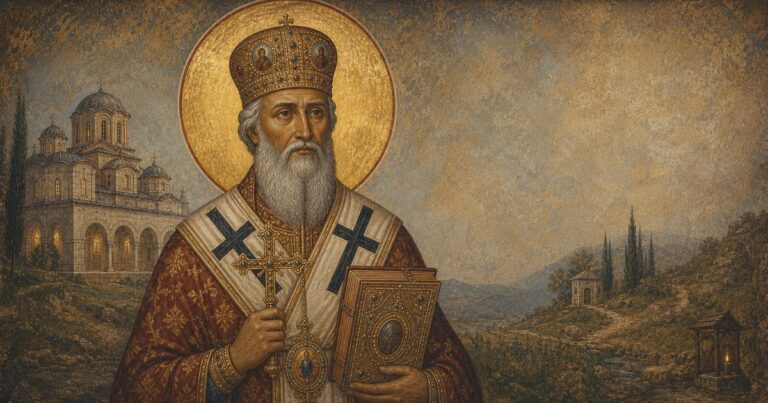
On the afternoon of 5 May 2026, at the conclusion of its proceedings, the ROCOR Council of Bishops officially published the Epistle of the Council of Bishops, dated 22 April / 5 May 2026, signed by Metropolitan Nicholas (Olhovsky) and by all the bishop-members of the Council. The official text is available on synod.com and uses a formulation different from “canonization”:
“the Council of Bishops, having recognised the righteous course of life of the ever-memorable Hieromonk Seraphim (Rose), has blessed the process of preparing his ecclesiastical glorification among the ranks of our venerable Fathers.”
What this means concretely
In Orthodox glorification there are, as a rule, several stages: the establishment of a commission of inquiry, the blessing of preparations (the composition of the service, troparion and kontakion, the painting of the official icon, the fixing of the day of commemoration), and then the glorification itself, carried out through a solemn service, with the name entered into the Synaxarion. The Munich decision is the second stage, not the third.
Practical consequences at this moment:
- Father Seraphim is not yet commemorated liturgically and officially in ROCOR parishes and monasteries.
- There is not yet an official service, troparion, kontakion, icon, or day of commemoration established — these are to be prepared by the commission headed by Bishop James (Corazza) of Sonora.
- The actual glorification will come through a later solemn service, possibly months or years from now. By comparison, preparations for Br. José Muñoz-Cortés began in 2017 and are still not completed after nine years.
- According to the same Epistle, the Synod is also examining preparations for the glorification of other twentieth-century ROCOR confessors: Metropolitan Philaret (Voznesensky) of Eastern America, Archbishop Tikhon of San Francisco, Br. José Muñoz-Cortés (guardian of the Montreal Iveron Icon of the Mother of God), and Bishop Constantine of Richmond. The Munich decision therefore concerns a wider process of discernment regarding ROCOR’s twentieth-century inheritance, not only the isolated case of Father Seraphim.
How the article below should be read after this update
The article was written on the night of 4 May 2026, on the basis of the unofficial reports then circulating, which spoke of a “canonization.” Its questions of discernment and canonical distinctions (jurisdictional vs universal, the relation to Akhalkalaki and ROCOR-A, the comparison with Br. José, the Podmoshensky question, the teaching on the aerial toll-houses, and the form of reception into the Church in 1962) remain fully valid — they concern precisely what will be decided in the preparations that now follow, not merely at the moment of the completed glorification.
At the same time, certain passages were written in the register of “completed canonization” and must now be read in the register of “glorification in preparation”:
- The section title “The third canonization chronologically, not the first” remains historically meaningful (Akhalkalaki 2023, ROCOR-A 2024, mainstream ROCOR 2026), but the ROCOR action in Munich is not yet a completed canonization; it is the blessing of preparations for it.
- The section “How other Churches will probably react” is premature for the present moment; reactions, if they come, will come at the actual glorification.
- The answer to “So is Father Seraphim a saint or not?” must be read in this key: for ROCOR, as of 5 May 2026, his glorification is officially in preparation, not yet accomplished.
For the Romanian Orthodox reader, the practical conclusion does not substantially change: personal discernment remains necessary, in communion with one’s own spiritual father and local Church. In the calendar of the Romanian Orthodox Church, Father Seraphim does not appear, and there is no indication that this will change soon.
We will return in a separate article with a deeper analysis of the canonical distinction between the blessing of preparations and the completed act of glorification.
A necessary update to our previous article, in light of the synodal decision of 4 May 2026
Context
On 4 May 2026, on the final day of the Council of Bishops of the Russian Orthodox Church Outside Russia (ROCOR), gathered in Munich for the centenary of the German Diocese, initial unofficial reports indicated that the hierarchs present had voted for the canonization of Hieromonk Seraphim Rose of Platina (1934–1982). According to the Telegram channel cited in these reports, the vote is said to have been ten in favour and two abstentions out of twelve bishops present. At the time of writing, the official communiqué from synod.com had not yet been published, so the liturgical and canonical details of the act remain to be confirmed.
Approximately two weeks before this decision, OrtodoxWay published the article "Father Seraphim Rose Between Repentance, Hagiography and Discernment" (previous article), which proposed a critical but not iconoclastic reading of his life and reception, drawing attention to certain complicated biographical areas insufficiently discussed in the Romanian Orthodox space. The present article is a necessary continuation of that intervention, in light of what appears to be an accomplished fact.
What we said in the previous article — briefly
The April article began from an observation: Father Seraphim Rose is probably the most widely read contemporary American Orthodox author in Romania, with tens of thousands of copies in circulation, akathists composed in his honour, and an almost unanimous reverent reception. And yet his biography — as it appears in less hagiographic sources (Cathy Scott, Joseph Sciambra, testimonies on Pokrov Truth, the archive of Father Daniel Everiss) — contains dark areas of which the Romanian reader almost never hears.
It was not an article of demythologization. It was an article of pre-decisional discernment, written at a moment when canonization was still a possibility, not an accomplished fact. The central argument was not "Father Seraphim cannot be canonized," but rather "before any canonization, certain questions need a public synodal answer."
The principal questions remained:
What did Father Seraphim know about the conduct of Father Gleb Podmoshensky (co-founder of the St. Herman Brotherhood, expelled from ROCOR in 1988 for abuse of minors and young men), and what did he do or fail to do between 1970 and his death in 1982? Written complaints exist in the archives of the ROCOR Western American Diocese and of the Synod in New York, but they remain sealed.
How is his teaching on the aerial toll-houses to be evaluated synodally — a teaching contested even within ROCOR (Archbishop Lazar Puhalo, Father Michael Pomazansky, and others)?
And, more broadly: how do we receive an Orthodox author whose written work is powerful, but whose earthly biography contains unresolved areas?
At the time of writing, the article treats a publicly reported vote, not a final synod.com communiqué. The wording therefore remains deliberately cautious: “reportedly,” “initial reports,” and “subject to official confirmation.”
What was actually decided: distinctions that matter
In the public discussions that will follow — and there will be many — people will often speak, simplistically, of "the canonization of Father Seraphim Rose." Before anything else, it is important to establish what kind of canonization has been made, because in Orthodoxy there is no single type of canonizing act.
1. A jurisdictional canonization, not a universal one. ROCOR is an autonomous Church within the Moscow Patriarchate, not an autocephalous Church with universal jurisdiction. The Munich decision is liturgically binding only on ROCOR parishes and monasteries. It is neither an act of the Synod of the Moscow Patriarchate, nor an act of a universal Orthodox Synod — such extensions, if they come, will require separate, subsequent acts from each autocephalous Church.
2. The third canonization chronologically, not the first. Father Seraphim was previously canonized locally in the Eparchy of Akhalkalaki, Kumurdo and Kars (Church of Georgia) in February 2023 by Metropolitan Nikoloz, who carried out the act on his own diocesan authority, hoping to inspire other hierarchs. The Synod of the Church of Georgia did not ratify the decision as an act of the whole Church.
There was also a "canonization" in November 2024 under Metropolitan Agafangel (Pashkovsky), but this is not taken into consideration: his structure, "ROCOR-A" based in Odessa, is a branch that refused the 2007 reunification with the Moscow Patriarchate and is regarded as non-canonical by all mainstream Churches.
The ROCOR decision in Munich, under Metropolitan Nicholas (Olhovsky), is therefore the first canonization made at the level of a canonical episcopal synod in full communion with mainstream Orthodoxy, rather than only at a local-diocesan level.
3. Five months from commission to canonization. The ROCOR Synod established the commission to study the life and veneration on 9–11 December 2025, under the chairmanship of Bishop James (Corazza) of Sonora. The decision reportedly came on 4 May 2026. By comparison, the commission for the canonization of Brother José Muñoz-Cortés (the keeper of the Montreal Iveron Icon, killed in 1997) was established in 2017–2018 under Metropolitan Hilarion and, after nine years, has still not concluded its work.
This contrast — five months versus nine years — is a factual reality that we record without, in this article, attributing to it a single meaning. The reader can form his own opinion.
4. The chairman of the commission. Bishop James (Corazza) of Sonora converted to Orthodoxy in 1979 precisely through reading Father Seraphim’s Orthodoxy and the Religion of the Future. He knew him personally at UC Santa Cruz a year before his death. In his published memoirs, he testifies that reading the book was the decisive moment of his conversion. The commission of inquiry was therefore led by a personal convert of the very subject under investigation.
5. Two abstentions. According to the Telegram channel cited in initial reports, of the twelve hierarchs present, two reportedly abstained from the vote. Their identities and motives are not yet public. In the ROCOR Synod, an abstention is a signal — not frontal opposition, but not assent either. Their possible reasons may, in time, become part of the wider discussion, if they are made public.
What was addressed — and what was not
The official communiqué has not yet been published, so we cannot judge definitively. However, from the known preparatory materials — particularly the report of the March 2026 retreat at Holy Virgin Cathedral, San Francisco, led by Bishop James himself together with Archpriest Martin Person, and Hammond’s book Voice in the Wilderness, regarded as semi-official support for the canonization — the emphasis was placed on:
- the ascetic life in the Platina cell,
- the written work (with emphasis on Orthodoxy and the Religion of the Future and The Soul After Death),
- discipleship under Saint John Maximovitch,
- testimonies of his spiritual children (Bishop Gerasim of Fort Worth, Abbot Damascene Christensen, Metropolitan Jonah Paffhausen),
- the veneration spontaneously spread in Russia, Serbia, Greece, Bulgaria, Romania, and on Mount Athos.
What does not appear in publicly available preparatory materials:
- the Podmoshensky question, in either of the two possible forms (knowledge with inaction, or unawareness raising the question of discernment);
- a synodal evaluation of the teaching on the aerial toll-houses, with the arguments of those who raised objections within ROCOR;
- the form of his reception into the Church (he was chrismated in 1962 without baptism, his Protestant single-immersion baptism being accepted as valid — a point later disputed in ROCOR).
It is possible that these matters were addressed in internal synodal acts that will not be made public. But the absence of these themes from the proclamation discourse has a meaning that it is more honest to record than to conceal.
How other Churches will probably react
The following observations are prudent hypotheses, not official information. The reception of a jurisdictional canonization by other Churches typically takes months or years; at the time of writing, the vote was cast only a few hours ago.
The Moscow Patriarchate could integrate such a canonization gradually. ROCOR is its autonomous part since 2007. Metropolitan Tikhon Shevkunov (now of Crimea) and Metropolitan Hierotheos Vlachos of Nafpaktos have publicly defended, in the past, the teaching on the aerial toll-houses — which has created a more open theological climate. Inclusion in the universal Russian calendar, if it comes, will come through a separate synodal decision, possibly several years from now.
The Serbian Church has a direct connection: St. Herman’s Monastery in Platina, where the relics rest, has been under Serbian jurisdiction since the 2000s, after leaving ROCOR. The Serbian Bishop Maxim of Los Angeles had already been approached in 2022 by Metropolitan Nikoloz of Georgia for a joint canonization. Serbian reception could be favourable.
The Bulgarian Church, Cyprus, and the Athonite monasteries — veneration was already present; a formal recognition is plausible, but without urgency.
The Ecumenical Patriarchate (Constantinople) is, predictably, the most reserved chapter. Relations with Moscow have been broken since 2018 over the Ukrainian question; a ROCOR canonization could be viewed with politico-ecclesiological suspicion. In addition, Father Seraphim was a critic of ecumenism — a theme on which Constantinople holds an opposite position. Any eventual recognition would likely come late and without enthusiasm.
The Church of Greece will likely divide along familiar lines: traditionalist metropolitans (such as Vlachos, Morphou) already accept him; those aligned with Constantinople will be reserved.
The Romanian Orthodox Church (BOR) is, for our reader, the most important chapter. And here we must say openly: there is, at this moment, no indication that BOR will take an official position any time soon.
How the question settles for the Romanian Orthodox reader
BOR has, regarding canonizations made by other jurisdictional Churches, a practice of institutional prudence. The Romanian Synod does not reflexively add to its calendar saints canonized by other autocephalous Churches — much less by autonomous ones. The process of inclusion in the Romanian calendar, if it should arise, would go through its own synodal process and its own pace.
In concrete practice, this means that:
In the official BOR calendar, Father Seraphim Rose does not appear at this time, and there is no indication that this will change soon.
In the official services of Romanian parishes in the country, he will not be commemorated as a saint. Priests who would explicitly commemorate him in the services would be acting outside the local canonical framework.
In private devotion, however, some faithful will probably continue to honour him as they were already doing; for the Romanian reader, it is healthier for this practice to be placed under the guidance of one’s own spiritual father, in light of one’s own life of prayer and one’s own communion with the local Church.
In Romanian monasteries where Father Seraphim was already greatly loved (there is a tradition of reading him at Putna, Cernica, in the Prodromou community on Mount Athos), an informal intensification of veneration is likely, without this turning into official liturgical commemoration.
For the Romanian Orthodox reader with formed discernment, the situation is therefore settled: one can quietly receive the good part of this decision (the public recognition of a life that has helped many) without being obliged to accept the interpretive framework of ROCOR, and without feeling pressured to turn private devotion into a public stand.
Answers to three predictable questions
"Does the canonization mean that all the objections have been resolved?"
No. It means that the ROCOR Synod, by qualified majority, has reportedly considered that one may proceed to glorification. Canonization is not an infallible dogmatic act of the same order as the definitions of the Ecumenical Councils. Orthodoxy knows historical cases of canonizations subsequently nuanced, contested internally, or never circulated beyond the local Church that performed the act. The fact that ROCOR has taken this decision does not close the historical discussion about Podmoshensky, about the aerial toll-houses, or about the problematic biographical passages. It only closes the internal liturgical discussion within ROCOR.
"Then is the previous OrtodoxWay article invalidated?"
No. The previous article raised legitimate questions of discernment — questions that still have not received a public synodal answer. On the contrary, the accelerated pace of the decision and the composition of the commission may be read as indications that these questions were passed over institutionally rather than resolved. The Romanian Orthodox reader’s discernment is not nullified by a jurisdictional synodal act of another Church. It remains a personal labour, in communion with one’s own Church and one’s own spiritual father.
"So is Father Seraphim a saint or not?"
For ROCOR, beginning 4 May 2026 (subject to confirmation by official communiqué), yes, in a liturgically official sense. For BOR, at the time of writing, he is not commemorated liturgically — which is not a negative judgment, only the absence of a positive decision. For the personal Orthodox reader, the real question is not the abstract one — "is he or is he not a saint in general?" — but the concrete one: do I commemorate him, in my own prayer, with confidence? This question cannot be answered by this article, by any blog, or by a synod foreign to one’s own Church. It is answered by one’s own spiritual father, in the light of one’s own life of prayer.
A pastoral note
For the Romanian Orthodox reader, this moment may be an occasion of unrest — whether for those who have long venerated him and now feel confirmed (perhaps too enthusiastically), or for those who have discernment concerns and now feel pressured (too defensively).
It is neither the one nor the other. It is simply a jurisdictional act of a sister Church. Orthodoxy has lived for two thousand years with different calendars between sister Churches, with saints commemorated in one jurisdiction and not in another, with venerations that have spread slowly or remained local. This diversity is a richness, not a weakness.
The essential thing for our reader is not to move a question of discernment onto the field of polemic. To say "I am not convinced by this canonization" is not the same as attacking Father Seraphim. To receive his books with profit is not the same as accepting wholesale everything he did or failed to do between 1970 and 1982.
Biographical truth and spiritual benefit are two things which, in Orthodoxy, can stand together without being confused.
What we will follow next
In the weeks and months ahead, OrtodoxWay will be watching closely:
- the publication of the official ROCOR communiqué and the exact content of the act of glorification,
- the day of commemoration that is established,
- the form of the service of glorification and the liturgical texts adopted,
- the reactions of the hierarchy of the Moscow Patriarchate,
- any possible reactions from the Ecumenical Patriarchate,
- the response of the community of victims of Father Gleb Podmoshensky’s abuses (Pokrov Truth has already announced it will publish),
- the position — or, more likely, the silence — of the BOR Synod.
We will return with a synthesis once the dust has settled — probably in three to six months, when the act can be judged as a whole, not merely through telegrams from Munich.
Until then, we recommend to the Romanian Orthodox reader: quiet prayer, discerning reading, trust in one’s own spiritual father. Neither forced enthusiasm nor polemical contestation. Orthodoxy is in no hurry.
Article published on OrtodoxWay.com — True Orthodoxy section. Comments are open to readers who wish to respond with arguments and sources.