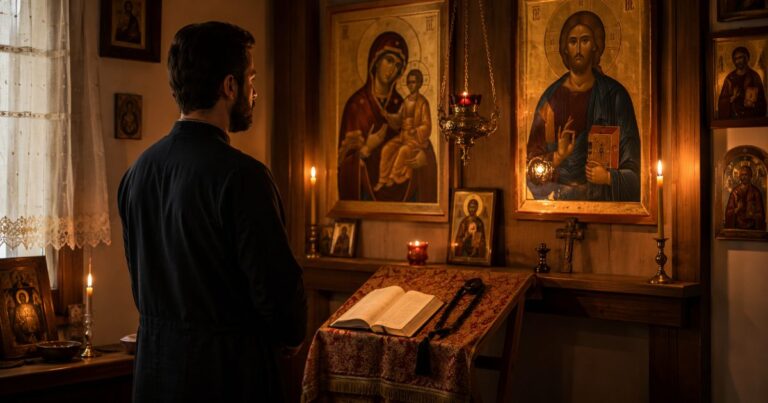
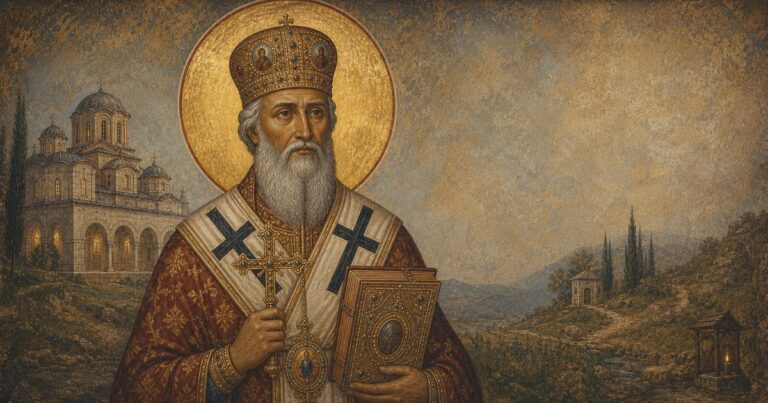
Part II follows how the hidden Name of YHWH becomes, in Christ, a human, speakable, and saving Name: Jesus. The study passes through biblical philology, Kyrios, Incarnation, Cross, Resurrection, liturgy, and the foundation of the Jesus Prayer.
Preamble: From YHWH to Jesus
In the first part of this series we traced the way the Name of God is revealed in the Old Testament — from YHWH revealed to Moses at the burning bush, through the Shem-theology of the prophets, to the messianic expectation of a new Name that would gather into itself the entire fullness of the hidden Name. We saw there that the divine Name is not, in Scripture, a mere convenient label, but the place of presence — the way in which God makes Himself accessible to man without losing His transcendence. YHWH does not pronounce a theory about Himself; He makes Himself known as the One who is — and this "is" becomes present in the Name.
The question with which we ended Part I was this: how can that hidden Name, which the devout Israelite did not dare to pronounce, become a Name that can be spoken — a Name that saves, heals, casts out demons, and opens the heavens? The New Testament’s answer is one, and scandalous in its simplicity: through the Incarnation. The Word of God, He who bears and reveals the Name of the Father, became flesh (John 1:14). What the prophets called Shem, what the people heard at the burning bush, what was kept behind the veil of the Temple — He who was, in the Person of the Son, the eternal Bearer of the Name, now receives, in the fullness of time, a human name: Jesus.
The present article seeks to set this affirmation in its full depth. It is not a devotional reflection but a study — biblical, philological, patristic, and liturgical — of the way in which the Tradition of the Church has understood the Name Jesus: not as a label attached to a historical person, but as the economic name of the incarnate Son — the name received in the flesh, through which the saving work of the one true God becomes accessible, speakable, and invocable. This is, I believe, the presupposition without which the Jesus Prayer cannot be understood; and without which the entire theology of Hesychasm, which we shall meet in Part IV, remains opaque.
The Name Jesus is not a historical label, but the economic Name of the incarnate Son.
The article does not say that the linguistic form “Jesus” mechanically replaces the Tetragrammaton. It says that the Person who bears the name Jesus is the eternal Son, consubstantial with the Father and the Spirit, and that the Name received in the flesh reveals God’s saving work.
I. The Name Jesus in the Light of Biblical Philology
1.1. Yeshua: The Name and Its Meaning
The name which the angel pronounces to Joseph in Matthew 1:21 — "And you shall call His name Jesus, for He will save His people from their sins" — is, in the Aramaic spoken by the Mother of God and the disciples, Yeshua (יֵשׁוּעַ), a late form of the Hebrew Yehoshua (יְהוֹשֻׁעַ). The etymology was transparent for any first-century Israelite: the name is a condensed sentence, composed of the short form of the Tetragrammaton — Yeho — and the verbal root yasha, "to save," "to deliver." Yehoshua means, literally, "YHWH saves" or "YHWH is salvation."
This etymology is not a marginal detail to be passed over. It is the axis on which the entire New Testament theology of the Name rests. When Matthew translates the angel’s explanation — "for He will save" — he allows the full weight of the semantic play to surface for the Jewish reader: the child’s Name says what the child will do, because it says who the child is. Yeshua is not, then, an arbitrary name chosen for an arbitrary child; it is the economic name par excellence — the name received at the Incarnation, bound strictly to the economy of salvation, and which discloses in human register the work that only the God of Israel can accomplish: the deliverance of His people.
We must here state with the utmost precision what we are affirming and what we are not. We are not saying that the Son begins to be God through the name Jesus: the Person of the Son is eternal, His divinity is from everlasting, alongside the Father and the Spirit. Yeshua is not the eternal Name of the Son as a linguistic form — the Son does not speak Aramaic in eternity. We are saying, however, that the God-Son, in receiving a human name in the flesh, receives a name that is not arbitrary: it is the name that speaks the economy. St. John of Damascus formulates this point with the sobriety proper to the Eastern tradition: the name Jesus is interpreted as Saviour, following the explanation given by the angel himself, and this name belongs to the incarnate Son as the human expression of His saving work.
St. Cyril of Alexandria will show consistently that the work disclosed in the Name Jesus is none other than the work of the God of Israel: He who shall save is He whose work is, from of old, salvation. The economic name and the eternal Person are not separated — but neither are they confused into a simple linguistic equation.
1.2. The Unspoken Tetragrammaton and the Ketib/Qere Mechanism
Before tracing how the Septuagint translates the Tetragrammaton, we must understand how it was read in the Judaism of the Second Temple period — for it is precisely this practice of reading that providentially prepares the Christological key of the New Testament.
The Tetragrammaton YHWH is, in the Torah, the proper Name of God revealed to Moses. The practice of not pronouncing the Tetragrammaton is ancient and predates Christianity — its roots probably go back to the post-exilic period (5th–4th centuries BC) and were consolidated in Second Temple Judaism. This was, in the eyes of the rabbis, the expression of absolute reverence before the third commandment: "You shall not take the Name of the Lord your God in vain" (Exodus 20:7). In the Temple cult, the explicit pronouncing of the Name remained tied to the high-priestly service of the Day of Atonement (Yom Kippur) — Talmudic tradition (Yoma 6:2) mentions the High Priest pronouncing the Name at several points in the service — and disappeared with the destruction of the Temple in AD 70.
The scribal system known as ketib/qere (literally: "what is written" / "what is read") — the fixing in writing of this older practice — is, however, a late and medieval development. The qere notes, the vowel pointings, and the masoretic marginalia were elaborated by the masoretic schools (especially that of Tiberias) between the 6th and 10th centuries AD. In the Masoretic text thus constituted, the Tetragrammaton YHWH remains written (ketib), but the reader is directed, through the system of added vowel pointings, to pronounce (qere) Adonai ("my Lord") or, in certain contexts, Elohim ("God"). The vowels of Adonai are, in the medieval Masoretic text, "borrowed" by the consonants YHWH, producing the hybrid form Yəhōwāh, which in the West generated, through misunderstanding of this mechanism, the false pronunciation Jehovah — a form unknown to ancient Jews and to Eastern Christians alike.
It is important, however, to distinguish two strata: the practice of substituting the pronouncing of the Tetragrammaton is pre-Christian and was active in the Judaism of Jesus’ time; the scribal system that fixes this practice in pointed text is the work of the medieval Masoretes. The two should not be confused, but both bear witness to the same theological principle — the Name of God is real, holy, and therefore not to be touched by the unprepared lip.
The rabbinic tradition multiplied circumlocutions to avoid the Name. Ha-Shem ("the Name") became a frequent substitute — and is in fact the term still used today in Orthodox Judaism. Ha-Maqom ("the Place") was another form — God is the Place of the world, but the world is not His place. Ha-Gevurah ("the Power") appears in the Talmud and in the Gospels — Jesus Himself answers the Sanhedrin: "You shall see the Son of Man sitting at the right hand of Power" (Mark 14:62), where "Power" is, in this rabbinic register, Ha-Gevurah, that is, God Himself.
The Aramaic Targums — the paraphrastic translations of Scripture used in Aramaic-speaking synagogues — add a term that will be of capital importance for patristic Christology: Memra, "the Word." Where the Hebrew text says "YHWH spoke", the Targum says "the Memra of the Lord spoke." Memra is, in the Targums, a way of speaking about God’s work and word without exposing God Himself to direct anthropomorphism. The rabbis were rigorous monotheists: Memra was not, for them, a distinct hypostasis alongside YHWH, but a respectful circumlocution for the mode by which the transcendent YHWH enters into contact with the world without His transcendence being compromised.
When St. John the Evangelist opens his Gospel with "In the beginning was the Word (Logos), and the Word was with God, and the Word was God" (John 1:1), his prologue can also be read in light of this Aramaic tradition — for a Jewish reader formed in the synagogue, the echoes are evident. But it is equally important to say that the Johannine prologue is not reducible to the targumic theology of Memra. St. John integrates equally the sapiential tradition of the Old Testament (Wisdom who was with God at the creation of the world — Proverbs 8:22ff.; Wisdom of Solomon 7), the prophetic tradition of the Word (Isaiah 55:11; Jeremiah 1:9), and the proper revelation of the Holy Spirit by whom the Gospel was given to him.
What the targumic Memra suggested — the mode of God’s working in the world — is, in John, radically transcended: what in the Targums remained a respectful circumlocution for a divine activity becomes, in John, an eternal divine Person. The Johannine Logos is not a mode of YHWH, not a personified activity, but the Person of the eternal Son, consubstantial with the Father, through whom all things were made (John 1:3). And this Person became flesh. The distance between the targumic Memra and the Johannine Logos is therefore the distance between a prudent theological circumlocution and the fully trinitarian revelation of the New Covenant.
With this nuance in place, we can say: what Judaism kept reverently at a distance — through ketib/qere, through Ha-Shem, through Memra, through all these respectful substitutes for the inaccessible Name — finds in the Incarnation a single fulfillment: the Person of the Son, consubstantial with the Father, receives a body and a human name, Yeshua, through which the saving work of the Trinity becomes accessible. The distance between ketib and qere is traversed once and for all — not by abolishing the distance between God and man, but by its assumption in the Person of the incarnate Word.
1.3. Kyrios: Translation as Confession
In the form transmitted and used by the early Church, the Septuagint — the Greek translation of the Old Testament — generally renders the Tetragrammaton YHWH by Kyrios, "the Lord." This corresponded to the liturgical practice of diaspora Judaism: no one pronounced the Tetragrammaton, but all said Adonai (in Hebrew) or Kyrios (in Greek), and the Church received the Septuagint precisely in this form, with Kyrios as the standard rendering.
We must, however, introduce a historical nuance that modern manuscript scholarship has made necessary. The early textual situation of the Septuagint is more complex than appears at first sight: certain pre-Christian Jewish Greek manuscripts, preserved fragmentarily (Papyrus Fouad 266 from the 1st century BC, 4QLXXLevb from Qumran, the Oxyrhynchus LXX papyri), still preserve the Tetragrammaton in Hebrew or paleo-Hebrew letters within the Greek text, rather than rendering it as Kyrios. The process by which Kyrios became the standard translation was therefore gradual and complex; but for apostolic and patristic Christianity, the form with Kyrios is the form received, read, and confessed — and this is the form that Paul, Peter, and John use in their citations from the Old Testament.
The consequence is one which the Fathers will exploit with wonder: when Paul writes to the Philippians that "at the Name of Jesus every knee should bow … and every tongue confess that Jesus Christ is Lord (Kyrios)" (Philippians 2:10–11), he is not making a merely devotional statement. He is quoting — and the Jewish or proselyte reader familiar with the Septuagint recognizes it at once — Isaiah 45:23: "to Me every knee shall bow, every tongue shall swear." The original subject of the universal oath is YHWH Himself. Paul identifies Him, without hesitation, with Jesus.
This is not a mere comparison. It is a Christological confession of the highest possible weight: Jesus Christ is Lord (Kyrios) in the strong sense of the divine Name — the incarnate Son is consubstantial with the Father and the Spirit; He is the God of Israel disclosed now in the Person of the Son. The Name above every name, of which Paul speaks two verses earlier (Philippians 2:9), is the divine Name publicly recognized by the Father as belonging to the incarnate Son — the Son who, being in the form of God, humbled Himself to death on the Cross.
We must say this here with the greatest care, lest we fall either into modalist confusion or into Arian diminishment. We do not say that the Father and the Son are one Person (modalism). We do not say that the Son is a secondary god alongside the Father (Arianism). We say what the Council of Nicaea (325) said: the Son is consubstantial (homoousios) with the Father, true God of true God — and is, from eternity, the Person of the Son. And the apostolic confession Iēsous Kyrios means that the incarnate Son is, in His Person, the God of Israel fully disclosed — alongside the Father and the Spirit, in the one divine nature.
1.4. Onoma: The Name as Presence in New Testament Greek
The Greek word onoma (ὄνομα), which translates the Hebrew shem, preserves in the New Testament the full semantic density of its Semitic original. When Jesus says "I have manifested Your Name to the men" (John 17:6), He is not speaking of linguistic information — He is not teaching the disciples how to pronounce "YHWH" correctly — but of an ontological reality: the Name disclosed introduces us into the knowledge of the Father through the Son, in the Spirit. To know the Father’s Name, in the Johannine sense, is to be made a partaker of the trinitarian life through the incarnate Son and the Spirit who is sent.
In the same chapter 17 of John’s Gospel — the High-Priestly Prayer, the theological heart of the New Testament — Jesus says: "Holy Father, keep them in Your Name which You have given Me" (John 17:11). "The Name" here is not a word — it is a place (in which we are kept), a power (which keeps), a presence of the Father confessed through the Son in the Spirit. It is precisely the Old Testament meaning of Shem — dwelling, presence, glory — now disclosed in the economy of the New Covenant as the work of the Son who leads His own, through the Spirit, to the knowledge of the Father.
We can therefore formulate the conclusion of this first point as follows: for the New Testament, the Name "Jesus" is the economic name of the incarnate Son — the name in which the saving work of the one true God becomes accessible and invocable. It is not a matter of confusing the economic name Jesus with the Tetragrammaton YHWH as a linguistic form — these are two names in two different languages, in two registers of the economy. It is rather a matter of recognizing that the Person who bears the name Jesus is the Person of the eternal Son, consubstantial with the Father and the Spirit, through whom the God of Israel is disclosed in fullness. The identity between the work of the Name Jesus and the work of the God of Israel is no pious association — it is the very structure of apostolic theology.
II. The Incarnation as the Event of the Name
2.1. Et Verbum caro factum est: The Word Receives Body and Name
"And the Word became flesh and dwelt among us" (John 1:14). The verb the evangelist uses — eskēnōsen, literally "He pitched His tent" — is, for any reader whose ear has been formed by the Septuagint, a direct allusion to the Shekinah, the presence of the glory of YHWH that dwelt in the Tabernacle of Witness and afterwards in the Temple of Solomon. Shekinah derives from the same Hebrew root as miskan, "the tent"; and this presence was, in the rabbinic theology contemporary with Jesus, the place where the Name of God dwelt — "There I will make My Name dwell," says YHWH of the Temple (cf. Deuteronomy 12:11; 1 Kings 8:29).
John says, then, more than appears at first sight. He says that the Word (the Logos) — He through whom the Father’s Name is disclosed, He who is, from eternity, the Bearer of the Name alongside the Father and the Spirit — has now pitched His Tent in the body of Jesus. Et tabernaculum suum posuit in nobis, the Vulgate translates — And He set His Tabernacle among us. The body of Jesus is the new Temple (John 2:19–21), because in it dwells, by hypostatic union, the Person of the Son — He who, consubstantial with the Father, fully discloses the Name of the Father.
This is the formulation we must retain with the greatest precision. The Word, the Bearer and Revealer of the Name, became flesh — and received, in this assumption of human nature, a human name: Jesus. It is not the case that "the Name" in the abstract became flesh — the Person who is incarnate is the Son-Word, not the Name as such. The Name remains the mode of revelation, of invocation, of presence; and the Person who, being the eternal Bearer of the activity named in the Name, now assumes human nature and makes Himself accessible through the economic name Jesus.
This distinction — which the patristic tradition has guarded with rigour — is vital if we are not to fall into confusion. The Name is not an autonomous hypostasis that becomes incarnate; the Person who is incarnate is the Son, consubstantial with the Father. But it is this Son who, through the Incarnation, makes accessible to man what stood, under the Old Covenant, behind the veil of the unspoken Name.
2.2. The Economy of the Name in the Earthly Ministry of Jesus
If we look at the Gospels with this key, we see that the work of Jesus is, from end to end, an economy of the Name — a gradual disclosure, never abrupt, of the fact that the divine Name is invoked in His Person and that through His Person the work of the Father is made accessible.
In John’s Gospel there are two distinct registers of the formula Egō eimi ("I am") which we must not confuse. The first register is that of the absolute statements — without predicate — which point directly to the divine identity of Christ, in echo of Egō eimi ho ōn in the Septuagint (Exodus 3:14): "Before Abraham was, I am" (John 8:58); "Unless you believe that I am, you will die in your sins" (John 8:24); "I tell you these things now, before they come to pass, that when they do come to pass you may believe that I am" (John 13:19); "Whom do you seek? — Jesus of Nazareth. — I am" (John 18:4–6). The second register is that of the predicated statements — "I am the bread of life" (6:35), "I am the light of the world" (8:12), "I am the door" (10:9), "I am the good shepherd" (10:11), "I am the resurrection and the life" (11:25), "I am the way, the truth, and the life" (14:6), "I am the true vine" (15:1) — which are Christological revelations through images, unfolding in saving language the same divine identity.
The most dramatic illustration of the absolute register is at Gethsemane, on the night of the betrayal. The soldiers come to take Him; Jesus asks them: "Whom do you seek?" — "Jesus of Nazareth," they answer. "I am" (Egō eimi) — and the evangelist notes with an almost liturgical realism: "they drew back and fell to the ground" (John 18:4–6). Why this falling? Because Egō eimi is, in the Greek of the Septuagint, the exact translation of the Name revealed to Moses — "I am Who am" (Exodus 3:14, in LXX Egō eimi ho ōn). The soldiers hear, without understanding, the pronunciation of the divine Name; and their bodies respond, before their minds can register it, by the falling familiar to every ancient theophany. St. John Chrysostom, in his homilies on John, reads this moment as proof that Christ gives Himself up willingly — He could at any moment, by His Name, have overthrown them; the fact that He does not is the expression of the saving will of the Cross.
John 8:58 — "Before Abraham was, I am" — pushes the affirmation to its polemical limit, in the absolute register. The hearers do not mistake the meaning: "they took up stones to throw at Him" (8:59). They have understood that Jesus is saying not merely that He is older than Abraham, but that He is, in His Person, consubstantial with the Father — the One whose work appeared to Abraham at Mamre, to Jacob at the Jabbok, to Moses at the burning bush.
2.3. Baptism, Transfiguration, Resurrection: The Threefold Public Disclosure of the Name
Three moments in the Gospels publicly disclose the incarnate Name, and each shares the same structure — a theophany in which the Father, by a voice, bears witness to the identity of the Son.
At the Baptism: "This is My beloved Son, in whom I am well pleased" (Matthew 3:17). The Father publicly utters the hidden Name of the Son — My Son — and the Spirit descends. The Trinity discloses itself, and the incarnate Name is acknowledged by the Father Himself.
At the Transfiguration on Tabor: the same structure, the same formula, but now Jesus Himself shines with the uncreated Light. The Fathers will see here the disclosure of the glory of the Name — the Name which, in the Old Testament, filled the Temple with a luminous cloud, now shines forth from the body of Jesus, because in Him dwells the whole fullness of divinity bodily (Colossians 2:9).
At the Resurrection: Paul sums up the entire economy in a single sentence — "Therefore God has highly exalted Him and bestowed on Him the Name which is above every name" (Philippians 2:9). The "bestowing of the Name" does not, of course, mean that the Son did not have the Name before; it means that the hidden Name, until now veiled by the humble body, by death itself, is now disclosed in glory, recognized by every creature, accessible to faith and prayer. The risen body now bears the Name in a way that can no longer be veiled.
This, then, is the meaning of the Incarnation as the event of the Name: He who is the Person of the eternal Son, He through whom the hidden YHWH worked under the Old Covenant — kept behind the veil, preserved in the unspoken Tetragrammaton — steps out of hiddenness through the body. The holiness of the Name remains — it is not profaned, not banalized — but the mode of presence changes: what was inaccessible by distance becomes, in the Person of the incarnate Word, accessible through the economic name Jesus. The Name remains holy; but it is now speakable, saving, invocable.
III. The Patristic Witness: The Incarnate Name in the Fathers of the Church
3.1. St. Ignatius of Antioch: The Name and the Christian’s Life
In St. Ignatius the God-bearer (†107), bishop of Antioch, writing only a few decades after the death of the last Apostles, we find the earliest post-apostolic witnesses to the Name of Jesus in the life of the Church. We must formulate with care what we find and what we do not find in him.
In the Epistle to the Ephesians, Ignatius calls Christians theophoroi (God-bearers), christophoroi (Christ-bearers), naophoroi (temple-bearers), and hagiophoroi (bearers of holiness). The theme is one of the Christian’s incorporation into the glory of Christ: the Christian bears in his body the presence of God, just as the Tabernacle bore the glory in the wilderness, and the Temple in Sion. Paul used the same intuition when he said: "do you not know that your body is a temple of the Holy Spirit who is in you?" (1 Corinthians 6:19). In Ignatius this becomes pastoral theology: the bishop, the priests, the deacons, the martyrs — all bear in their body the One whom they confess.
The theme of the Name as such appears in Ignatius chiefly in a polemical-negative register: there are some — he says — who "bear the Name" or who use it with the lips, but live unworthy of God and do not act according to the Name they pronounce. For Ignatius, the martyrdom toward which he is going — at Rome, under the beasts of the Coliseum — is the act by which he himself fulfills the Name he confesses; it is the act by which the Christian not only bears the name of Christian, but is a Christian in the whole of his being.
This Ignatian distinction is precious for the Eastern tradition: the Name does not work as an autonomous formula; it requires a life that matches it. This observation, received from the martyr of Antioch, will be taken up — centuries later — by all the neptic Fathers, when they say that the saying of the Jesus Prayer without repentance, humility, and ascetic struggle is no longer the Jesus Prayer, but mere repetition of words.
3.2. St. Justin Martyr: The Typology of Joshua/Jesus
St. Justin Martyr (†165), in the Dialogue with Trypho the Jew, develops a typological reading of the Name Jesus that will become a commonplace for the patristic tradition. He insists on the equivalence Yehoshua/Jesus and on the fact that Joshua, son of Nun (Navi), who led the people into the Promised Land, bore the same Name as a prefiguration of the Saviour. Justin also recalls that Moses changed the name of Hoshea, making him Yehoshua (Joshua), precisely so that the one who would lead the people into the Promised Land should already bear, prophetically, the Name of Him who was to come.
Further, Justin makes a memorable typological link: in the battle at Rephidim (Exodus 17:8–13), Joshua/Jesus led the fight with the sword, while Moses stood with his hands outstretched — prefiguring the Cross. The Name Jesus is already at work in the Old Covenant, in figural form; and the Incarnation discloses Him who bore this Name in hidden working under the old shadows.
We must, however, state soberly what we are claiming. We are not saying that Justin already formulates a complete philological theology of the Name in the strong sense — he remains in the register of biblical typology proper to early apologetic. We are saying that Justin sees in the name of Joshua/Jesus a prefiguration of Christ and reads the entry into the Promised Land as a type of the salvation brought by the true Jesus. This is the foundation upon which the Alexandrians will build.
3.3. Origen: An Early Witness to the Power of Invoking the Name
Origen (†253), in Contra Celsum, leaves a witness of capital importance for the history of the invocation of the Name in the Church. Replying to the pagan Celsus, who mocked the Christians’ claim that the Name of Jesus drove out demons, Origen affirms that the Name Jesus has a real, observable power: it casts out unclean spirits, heals diseases, sanctifies those who pronounce it in faith. And — he adds — even unlearned men, even simple believers without theological training, can work through this Name, because the power belongs to the One invoked, not to the qualities of the one invoking.
We must read this witness with a double prudence. On the one hand, it is an early and precious testimony that the early Church practised the invocation of the Name Jesus as an efficacious reality, not as a subjective devotion; and Origen defends this practice not mystically but factually, as something Celsus could verify if he wished. On the other hand, Origen has a "philosophy of names" specific to ancient thought — at times close to the period’s mentality about the power of language — and we must not retroject onto him the later theology of the divine energies, which would only be precisely formulated by the Cappadocian Fathers and definitively by St. Gregory Palamas.
What we can take with certainty from Origen is, however, this essential point: in the Tradition of the early Church, the Name of Jesus was not regarded as a mere word associated with the memory of an absent person, but as the real invocation of a Person present through His activity. The Name and the Person of Him who is named are not separated. This intuition — which Origen transmits but does not systematically ground — will be the foundation upon which the Cappadocian Fathers will build with greater precision.
3.4. St. Gregory of Nyssa: The Apophatic Premise
St. Gregory of Nyssa (†394) introduces into the theology of the Name a distinction that the entire Eastern tradition will preserve. In Contra Eunomium — replying to Eunomius, who claimed that we can know the essence of God by names, identifying "unbegotten" with the divine essence itself — Gregory makes a capital distinction: divine names do not describe the essence of God, which remains inaccessible to human knowledge; they describe His activities (energeiai) toward us.
This distinction may appear, at first sight, to relativize the importance of the Name. In reality, it sets it correctly — and provides the Eastern tradition with the apophatic premise without which the later Hesychast theology could not have been formulated without falling into confusions. The Name Jesus is not a label for a divine being which we could, in principle, comprehend; the essence of God remains mystery — apophasis — and cannot be contained in a name. The Name Jesus is, however, the mode by which the saving activity of God becomes accessible to creation. His activity discloses itself in the Name, through the Name, and through the Name becomes accessible to man.
We must say with sobriety: Gregory of Nyssa does not yet formulate Hesychast theology — that will come later, with the late Cappadocians and definitively with Palamas. We say only that St. Gregory provides the apophatic premise: names do not contain the divine essence. This premise is, however, essential. Without it, any theology of the Name risks falling into confusion between the spoken name and the divine essence — a confusion the Eastern tradition has always rejected.
For the later Hesychast tradition, the Cappadocian distinction will be vital. The neptic Fathers will never affirm that the Name is God in His essence; but they will affirm with full consistency that the Name is a real bearer of God’s activity — and that the prayer of the Name is therefore a real encounter with the Person, not a mental representation.
3.5. St. Cyril of Alexandria: The Christological Foundation of the Incarnate Name
St. Cyril of Alexandria (†444), in his polemic with Nestorius and in his anticipation of Chalcedonian Christology, offers the Eastern tradition the Christological foundation of the theology of the incarnate Name. We must formulate with great care what Cyril affirms and what he does not.
In his Commentary on John (especially on John 17, the High-Priestly Prayer), when Jesus says to the Father "I have manifested Your Name to the men" (John 17:6), Cyril interprets: Christ has manifested the Father’s Name because He shows in Himself the glory, the nature, and the working of the Father. Cyril’s emphasis is Christological — the Son fully discloses the Father — not philological. He does not make a direct linguistic equivalence between the Tetragrammaton YHWH and the name Jesus; it would be anachronistic to attribute that to him.
What Cyril does, however, is of capital importance: he provides the Christological foundation without which all of Eastern theology of the Name would remain suspended. For Cyril, the Person of Jesus is the Person of the eternal Son, consubstantial with the Father — there is no human Person "Jesus" alongside the divine Person of the Son (the error he attributes to Nestorianism). There is one Christ, in two natures, and this Christ is He who shows in the flesh the full glory of the Father. The activity disclosed in the name Jesus is, then, the activity itself of the Trinity — because the Person who is incarnate is the Son consubstantial with the Father and the Spirit.
This Cyrilline position is, for the Eastern tradition, an unshakeable axis. It will allow the formulation of the Chalcedonian definition (451) — the union of the two natures in one Person — and it will give theological grounding to the invocation of the Name Jesus as the real invocation of the incarnate divine Person. The attentive reader will note that, in this formulation, it is not the Name that is incarnate — the Person of the Son is incarnate — but the economic name Jesus, received at the Incarnation, becomes the mode by which the activity of the incarnate Person is made accessible to human invocation.
3.6. St. John of Damascus and the Eastern Synthesis
St. John of Damascus (†749), in his Exact Exposition of the Orthodox Faith (Book III), offers the systematic synthesis of the patristic tradition on the Name. He recapitulates: the name Jesus is interpreted as Saviour, following the explanation given by the angel to Joseph (Matthew 1:21); it is the name of the incarnate Person, and therefore common to the two natures, but properly attributed to the Son in the economy of salvation; it is a name which expresses, by its etymology, the proper work for which the Son became incarnate.
The Damascene also affirms that in the Person of Christ the two natures — divine and human — are united hypostatically, without confusion and without separation, according to the Chalcedonian formula. The consequence is that everything attributed to the Person of Christ is attributed equally, by communicatio idiomatum (the communication of properties), to the eternal Son and to the incarnate Son — because the Person is one. This teaching, formulated with the greatest clarity by the Damascene, is the foundation upon which the Eastern tradition will build both the theology of the icon (to which the Damascene contributed decisively in the iconoclastic controversy) and, by consequence, the theology of the prayer of the Name.
We must say with sobriety what is, in the Damascene, direct affirmation and what is our own interpretive synthesis. Found directly in the Damascene: the name Jesus means Saviour; it is the name of the incarnate Person; the two natures are united hypostatically; the properties are communicated by the union in the Person. Our synthetic conclusion — that in the economy of salvation, the Name Jesus thereby becomes the mode by which the incarnate Person is invoked in prayer as the bearer of the entire divine activity — is the conclusion that the Eastern tradition will draw from the Damascene’s premises, especially through the neptic Fathers. The Damascene provides the foundation; Hesychasm will draw the consequences for prayer.
IV. The Name, the Cross, and the Resurrection: Three Events of a Single Disclosure
The Incarnation, we have said, is the event of the Name. But this event does not confine itself to the moment of the Nativity at Bethlehem; it unfolds throughout the whole earthly life of Jesus and reaches its fullness in the Cross, in the descent into Hades, and in the Resurrection. The Name Jesus, received at the Circumcision, is borne through the entire economy of salvation — and only at the Resurrection does it fully unveil its power.
4.1. The Name on the Cross: The Titulus and the Humility of the Name
The inscription that Pilate places on the Cross — Jesus of Nazareth, the King of the Jews — in three languages (Hebrew, Greek, Latin) is, in the symbolic logic of the Gospels, the last public disclosure of the Name in the time of the Crucifixion. Jesus, who at Gethsemane had pronounced Egō eimi and made the soldiers fall, is now crucified with the Name written above His head. The Name is, paradoxically, mocked and confessed at the same time: for the Jews, it is the messianic claim for which they condemn Him; for the pagans, it is the title of a condemned man; for the Father, it is the Name of the beloved Son who goes to His death.
St. John dwells on this detail: "Many of the Jews read this inscription, for the place where Jesus was crucified was near the city. And it was written in Hebrew, in Latin, and in Greek. So the chief priests of the Jews said to Pilate, ‘Do not write, "The King of the Jews," but, "This man said, I am King of the Jews." ‘ Pilate answered, ‘What I have written, I have written’" (John 19:20–22). The Name has been written, and it remains. Pilate — without knowing it — seals in three languages, for the three great traditions of the ancient world, the confession of the incarnate Name. Quod scripsi, scripsi: what is written of the Name remains written, in history and in eternity.
The Fathers will dwell on this detail with love. St. John Chrysostom, in his homilies on John, observes that the Cross itself is, by the blood that flowed on it, "a seal of the Name" — the place where the incarnate Name proves through suffering that it truly is YHWH-saves. The Name Jesus is therefore not just any name for any child of any mother; it is the Name of Him who, in order to fulfill what His Name says, ascends the Cross. Yeshua — "YHWH saves" — is the Name that does what it says. The Cross is the fulfillment of the etymology.
4.2. The Descent into Hades: The Name in the Depths
The patristic and liturgical tradition of Holy Saturday affirms, with a theological realism that astonishes modern readers, that in the time between the Crucifixion and the Resurrection, Jesus descends into Hades — with His body in the tomb, with His soul in the depths of the earth, with His divinity everywhere — and there preaches (cf. 1 Peter 3:19; 4:6). What does He preach? The incarnate Name. The earthly breath of the Name Jesus ceased at the moment of death on the Cross, but the hypostatic utterance of the Name — the eternal coincidence between Person and Name — continues in the depths.
The troparia of Holy Saturday and of the Resurrection make this mystery the very axis of their theology. "In the grave bodily, but in Hades with Your soul as God; in Paradise with the thief, and on the throne with the Father and the Spirit were You, O Christ, filling all things, Yourself uncircumscribed" — this prayer from the Liturgy (during the reading of the kathisma after the Proskomide) is a concentrated confession of the active omnipresence of the incarnate Name. The Name Jesus, received in a body, is everywhere — because the Person who bears it is the Person of the eternal Son.
4.3. The Resurrection: The Public Disclosure of the Name
At the Resurrection, the Name comes forth from the hiddenness of the humble body, of death, of Hades, and discloses its fullness. This is the moment Paul sums up in Philippians 2:9–11 — a passage we have already returned to, but which deserves here a closer reading, for it is the summa of the apostolic theology of the Name:
"Therefore God has highly exalted Him and bestowed on Him the Name which is above every name, that at the Name of Jesus every knee should bow, in heaven and on earth and under the earth, and every tongue confess that Jesus Christ is Lord (Kyrios), to the glory of God the Father." (Philippians 2:9–11)
Three things must be noted here. First: "and bestowed on Him the Name which is above every name" — the Greek verb echarisato means "He bestowed by grace" (from charis). The Name is not an attribute added to the being of Jesus, but is the Name which, being His from eternity, is now publicly recognized by the Father as His, in the risen body. It is a "bestowal" in the order of the economy, not in the order of being.
Second: "every tongue confess that Jesus Christ is Lord (Kyrios)". As we have seen, Kyrios is the Septuagint translation of YHWH. Paul therefore affirms that the central Christian confession — Jesus is Lord, Iēsous Kyrios — is the maximal Christological confession: Jesus Christ is Lord (Kyrios) in the strong sense of the divine Name; the incarnate Son is consubstantial with the Father and the Spirit; the God of Israel is now disclosed in the Person of the Son. This confession, which according to many commentators was the earliest baptismal formula of the Church (cf. Romans 10:9: "because if you confess with your mouth that Jesus is Lord and believe in your heart that God raised Him from the dead, you will be saved"), is from the beginning the full trinitarian confession of the incarnate Person.
Third: "in heaven and on earth and under the earth". The incarnate Name has power over the three levels of the ancient cosmos — heavens, earth, and the underworld. He is the Pantokrator: He who upholds all things, through His Name.
4.4. Acts 4:12: There Is No Other Name Under Heaven
In this framework we understand exactly what St. Peter says before the Sanhedrin: "There is salvation in no one else, for there is no other name under heaven given among men by which we must be saved" (Acts 4:12). The modern reader, formed in religious relativism, is tempted to read this as an exclusivist claim — and to feel uncomfortable. But its logic is otherwise: Peter is not saying that Jesus is a name better than others; he is saying that there is no other Name, in an absolute sense — because the Name Jesus is the incarnate Name of the only true God.
It is not, then, a matter of competition between divine names which we might arbitrate; it is the matter of the very uniqueness of God. Shema Yisrael, YHWH Eloheinu, YHWH echad — "Hear, O Israel, the Lord our God is one" (Deuteronomy 6:4). The confession of God’s uniqueness in the Old Covenant becomes, in the New, the confession of the uniqueness of the Name Jesus — because the Person who bears this name is the Person of the incarnate Son, consubstantial with the Father and the Spirit, through whom the one God of Israel fully discloses Himself. Acts 4:12 is therefore, in its depth, a messianic Shema — not another God alongside YHWH, but YHWH fully disclosed in the Person of the incarnate Son.
V. The Incarnate Name in the Liturgical Texts
The Orthodox liturgical tradition is, perhaps more than any theological treatise, the place where one sees clearly what the Church has believed about the Name Jesus. Lex orandi, lex credendi — the way the Church prays is the way she believes. And in the Liturgy, the incarnate Name is at the centre.
5.1. The Circumcision and the Naming: The Feast of the Name
On 1 January, the Church celebrates the Circumcision according to the flesh of the Lord — a feast which, in the patristic tradition, is understood not only as the fulfillment of the Law, but as the feast of the Naming of Jesus. The service of this feast is a continuous meditation on the Name: troparia, kontakia, stichera take up, in ever-changing registers, the mystery that the eight-day-old Child now publicly receives the Name which has been His from eternity.
In the Menaion, on 1 January, formulations of remarkable theological density are sung — the Child not yet a year old receives the Name which has no beginning; the Boundless One is named with a human Name; He who gives names to all now receives a Name spoken by human voices. These troparia are a liturgical commentary on Philippians 2:9: the Name which is above every name is disclosed in the humility of the Circumcision.
5.2. The Liturgy: Litany, Anaphora, Trisagion
The most ancient liturgical structures of the Church are built around the invocation of the Name. Holy God, Holy Mighty, Holy Immortal, have mercy on us — the Trisagion — is, according to tradition, a hymn received by revelation in the time of the Emperor Theodosius II (5th century), and its content is the triadic invocation of the Name. Lord have mercy — Kyrie eleison — which punctuates all the litanies, is the invocation of the Name Kyrios, which, as we have seen in Section I, is the Greek translation of the Tetragrammaton.
The Anaphora of the Liturgy of St. John Chrysostom begins with the invocation of the Father through the Son in the Spirit, but reaches its culmination in the consecration, where the priest asks for the descent of the Spirit upon the Gifts "to make this bread the precious Body of Your Christ" — and here the Name Christ is invoked as the foundation of the celebration of the mystery. Baptism itself is performed "in the Name of the Father, and of the Son, and of the Holy Spirit" (Matthew 28:19) — and the Fathers (Basil the Great, in On the Holy Spirit) will insist that the trinitarian utterance of the Name is the mystery, the place where the working of grace meets the man who receives.
5.3. The Akathist of the Name of the Lord Jesus
There is, in the Orthodox liturgical tradition, a text which deserves separate mention: the Akathist to the Most Sweet Lord Jesus, attributed in tradition to St. Peter Mohyla, Metropolitan of Kiev (17th century), but reprising structures and formulations far older, present in the Byzantine hymnographic tradition. The Akathist is, in its entirety, an invocation of the incarnate Name, alternating the formula "Jesus, Son of God, have mercy on me" with countless epithets — Jesus most wonderful, Jesus most sweet, Jesus my Creator, Jesus my Redeemer.
For the Hesychast tradition, the Akathist is not a substitute for the Jesus Prayer but a lyrical form of the same theology: the Name Jesus, pronounced in ever-new registers, is the calling of person to Person. Each epithet adds a level of affective knowledge (in the patristic sense of gnosis, not the modern sentimental sense): one knows Jesus through His Name, and one knows His Name through His works.
5.4. The Pomelnic: The Name as Participation in Salvation
The practice of the pomelnic — the commemoration of names at the Proskomide, the cutting of particles for each name pronounced — is once again a concrete liturgical theology of the Name. The name of the living or departed faithful is placed, by the priest’s invocation, in connection with the Name of Jesus present in the Holy Sacrifice. This connection is not symbolic but real: the human name, brought before the Sacrifice of Christ, enters into liturgical communion with the Name of Him who saves, receiving by grace participation in the salvation wrought in Christ.
This practice, seemingly simple, presupposes the theology we have unfolded throughout: that the Name Jesus is the real bearer of saving activity, and that the pronouncing of it in the liturgical act engages the very presence of the Person.
VI. Theological Synthesis: Five Theses on the Incarnate Name
Having reached this point, we may gather the study into a few summary propositions, which will serve as a bridge to Part III (the Name in the early Church) and especially to Part IV (the Jesus Prayer and Hesychasm).
1. The Name Jesus is the economic name of the incarnate Son — neither a merely historical label, nor the eternal Name of the Son as a linguistic form. Let the reader retain, if nothing else from this article, this distinction. The Person of the Son is eternal, His divinity is from everlasting, the Word (Logos) is from eternity alongside the Father and the Spirit. But the Name Jesus — in the Aramaic of the Mother of God, Yeshua — is not the eternal Name of the Son as a sound; it is the name received at the Incarnation, the economic name in which the work for which the Son became man is disclosed: YHWH saves. The economic name and the eternal Person are not separated — the Person is the One who bears the name, the name speaks the work of the Person — but neither are they confused into a simple linguistic equation.
2. The incarnate Name is therefore accessible to man in a truly divine manner, without losing its holiness. What was hidden behind the veil of the Temple, what was unspeakable in late Judaism, becomes in Christ speakable — but not profaned. The holiness of the Name remains; the mode of presence changes. The Name which, in the Old Covenant, sanctified by distance, now sanctifies by nearness.
3. The incarnate Name is a real bearer of the divine activity (energeia). The patristic tradition, following the Cappadocian distinction between essence and activities, affirms that the Name Jesus is not the divine essence (which remains incomprehensible), but bears its activity. This is why the Name works: it heals, it saves, it sanctifies. Not by magic, but by the real coincidence between Name and Person.
4. The incarnate Name is invocable, and this invocation is an ontological encounter, not merely a devotional remembrance. This is the practical implication for today’s Christian. To pronounce the Name Jesus is not to recall an absent person; it is to call upon a present Person. The Person of Jesus, ascended at the right hand of the Father but present in the Church through the Spirit, responds to the invocation of His Name, because He does not remain indifferent to His own Name.
5. The entire theology of the Jesus Prayer, which we shall develop in Part IV, is the practical unfolding of these four theses. The neptic Fathers did not invent a meditation technique; they drew the ultimate consequence of the theology of the Incarnation. If the Person of Jesus, called upon in the economic name Jesus, is the Person of the incarnate Son — consubstantial with the Father and the Spirit — then the continuous pronouncing of this Name is the continuous calling upon the Person of Him who saves. Nepsis, hesychia, monologia (prayer of one word) — all are forms by which man enters, through the Name, into permanent connection with the Person of Him who is named.
The Name is not a technique, formula, or vibration. The Name works because the Person invoked works, and man receives this work through faith, repentance, humility, and life in the Church.
VII. The Name Jesus: Economic Name, Not Magical Formula
Before concluding, we must formulate a distinction that the entire Eastern tradition has guarded with the greatest care, and without which everything said up to this point risks being misunderstood.
The Name Jesus does not work as an autonomous formula, separated from faith, repentance, and the life of the Church. The power of the Name is not the magic of sound, the repetition of a syllable, the vibration of a word with hidden properties. The power of the Name is the presence of the Person invoked — and this presence becomes accessible only in living connection with Christ as preached, confessed, and received in the Church through Baptism and the Eucharist.
This distinction must be stated emphatically, because in the history of spirituality there have been deviations on both sides. On the one hand, there is the temptation of nominalism — to separate the Name from the Person, to regard Jesus as an abstract memory and His Name as a mere commemorative word. This temptation is met by the entire patristic witness we have unfolded: the Name is indissolubly bound to the Person through activity. On the other hand, there is the opposite temptation — magism — to regard the Name as an autonomous force which works of itself, independently of faith and life. This temptation is equally foreign to the neptic Fathers. For them, the Name works because the Person works, and the Person works in the Christian who receives this working through repentance, humility, and the life of the Church.
For this reason, the Fathers never separate the invocation of the Name from right faith, repentance, Baptism, the Eucharist, and the purification of the heart. St. John Climacus says that "with the Name of Jesus, scourge your enemies" — but the same St. John Climacus builds the entire Ladder around the gradual purification of the heart, without which the spoken name remains on the lips and does not descend to the depth. St. Isaac the Syrian asks for tears, humility, flight from vainglory — and only within this ascetic framework does he speak of the pronouncing of the Name. St. Gregory Palamas himself, summing up the Hesychast tradition, will bind the Jesus Prayer indissolubly to life in the Church, to the Holy Mysteries, to obedience to a spiritual father.
To pronounce the Name without repentance is to turn it into a technique or an incantation. To pronounce it with faith, with humility, in the life of repentance, is to enter into a living relationship with the Person of Him who is invoked. The difference between the two is not one of intensity but of nature.
This distinction is vital for everything we shall say in Part IV about Hesychasm. The neptic Fathers do not propose an autonomous spiritual technique; they do not say: "pronounce this word and you will have illumination." They say: "enter, through repentance, humility, obedience to a spiritual father, and the life of the Church, into living connection with the Person of Jesus, and the pronouncing of the Name will keep you in this connection." The Name is a gate, not a force; it is a calling, not a formula. He who responds to the calling is the Person of Jesus Himself, through the Spirit, who leads His own to the Father.
The attentive reader will recognize here the economic structure of the entire Eastern theology: we never confuse the essence of God with His activity, we never confuse the Person with the instrument by which the Person is invoked, we never confuse the call with the response. The Name Jesus is, in the economy of salvation, the mode by which the Person of the incarnate Son becomes invocable; but He who responds is the Person, through His activity, in the freedom of grace. He who calls upon the Name calls upon the Lord; He who saves is the Lord.
Conclusion: Toward the Early Church
We began this article with the question: how can the Name of YHWH, kept behind the veil, become a Name that saves and is spoken? We traced the answer through biblical philology (the economic name Jesus = "YHWH saves"), through the dynamic of the Incarnation (the Word, Bearer and Revealer of the Father’s Name, became flesh and received the name Jesus; He pitched His Tent among us), through the witness of the Fathers (from Ignatius to the Damascene), and through the liturgical texts (from the Circumcision to the pomelnic).
The conclusion is not abstract: it is practical. The Name Jesus, which we pronounce dozens of times a day — in prayer, on hearing bad news, without thinking — is the economic name of the incarnate Son: the name received at the Incarnation through which the Person of the Son, consubstantial with the Father and the Spirit, is invocable; it is the Name witnessed by the Father at the Baptism, the Name that shone on Tabor, the Name that wrought the Resurrection. The trivialization of this Name — its use as exclamation, as figure of speech, as element of "religious atmosphere" — is, in the strict logic of patristic theology, a grave loss. Father Cleopa Ilie, Father Arsenie Papacioc, and all the neptic Fathers of the Philokalia did not cease to preach this: the Name Jesus is to be pronounced with trembling, because through it the Person of Him who saves is invoked.
Part III of this series — to be published in the coming weeks — will trace how this Name was lived in the early Church: in the Acts of the Apostles (where over ten explicit references are made to "the Name" as power), in the sub-apostolic literature (the Didache, the Shepherd of Hermas), and in the first forms of Egyptian monastic prayer, where there will be born, in the cells of Anthony the Great and his disciples, the monologia — prayer of one word — which would later become the Jesus Prayer.
And Part IV — the theological heart of the series — will show that Hesychasm on Athos, synthesized by St. Gregory Palamas in the 14th century, is nothing other than the full living-out of the theses we have formulated here: the incarnate Name, invoked in the silence of the heart, opens to man real participation in the activity (energeia) of God — what we call, in patristic language, deification (theosis).
Until then, a practical proposal: pronounce at least once a day, slowly and attentively, Lord Jesus Christ, Son of God, have mercy on me, a sinner. Not as a method, but as a confession. In that pronouncing is contained the whole theology we have unfolded here. And — what is more — it contains the encounter with Him who is named.
The articles can be read separately, but together they form a single arc: from the Tetragrammaton of the Old Testament to the prayer of the heart.