Cleopa, the Last Saint of Romania

Saint Cleopa Ilie, glorified in 2025, as a patristically verifiable Romanian Orthodox elder: life, teaching, humility, gifts, and fruits.

Kapsala, September 1977

In the shadow of Stavronikita Monastery, on the eastern slope of Mount Athos, two men stood face to face on a small porch barely two square meters wide. One had just arrived from Moldavia — an archimandrite, sixty-five years old, white-bearded, his eyes weary from the journey. The other was the hermit of Kapsala, fifty-four years old, thin, plainly dressed, hidden from the world in a stone cell beside a cold mountain stream. On the table between them: two glasses of water, two figs, a small dish of cherry preserves.

Neither of them spoke the other’s language. Cleopa knew only Romanian. Paisios knew only Greek. And yet, when the Romanian pilgrims came through the gate, the hermit greeted them by calling each one by name, though he had never seen them before: “Father Abbot Victorin of Sihăstria, Father Ioanichie, Father Vartolomeu Florea, Father Archimandrite Cleopa Ilie — welcome!”

Cleopa wanted to remain on the Holy Mountain. He had two relatives there — uncles who had become monks, one of them, Schemamonk Varlaam Vântu, having lived to a hundred years of age. He dreamed of ending his days in the desert of Athos, beside the graves of his spiritual kinsmen. Father Ioanichie Bălan, the disciple accompanying him, asked Saint Paisios on Cleopa’s behalf:

— Father Paisios, we wanted to ask: Father Cleopa wishes to remain in the Holy Mountain. What do you say — should he stay here?

The hermit was silent for a moment. Then he spoke, without being asked anything more — he already knew everything:

“Your monastery is a missionary one, where many souls come. Father Cleopa, if he comes to the Holy Mountain, will be saved as a simple monk. But if he stays where he is and has much patience, he will be saved as an apostle.”

Cleopa returned to Romania. He would live another twenty-one years — all of them at Sihăstria, never leaving again. He died on December 2, 1998, with prayer ropes in his hand. On August 7, 2025, the Holy Synod of the Romanian Orthodox Church proclaimed him officially a saint: Saint Cleopa of Sihăstria, the Venerable.

Saint Paisios’s prophecy was fulfilled to the letter. Cleopa chose patience. And he received the apostolic crown.


The Thesis

If you are looking for trustworthy Orthodox sources in the Romanian spiritual tradition, the last unquestionable point of reference is Father Cleopa Ilie. In his shadow, as immediately preceding markers, stand Father Arsenie Papacioc (†2011) and Father Sofian Boghiu (†2002, glorified in 2025). After these three, the ground is no longer firm.

This is not to say that God has stopped giving saints to the Romanian people. God does not stop. There are surely, even now in 2026, men in our monasteries, in the wilderness, perhaps even unknown laypeople, who are completing their struggle and to whom the Church will one day give due recognition. But what we are saying is something else: that the line of great Romanian elders — publicly recognized, patristically verifiable, and glorified without controversy — closed with the Cleopa-Papacioc-Sofian generation. Those who came after either departed to the Lord without leaving the same power of transmission, or left behind figures surrounded by serious theological disputes, or founded problematic personal cults that the broader Orthodox world has rightly questioned.

Orthodoxy lives through saints. Not through institution alone, not through liturgy alone, not through books alone. It lives through living men who have done what they preached. Without saints, Orthodoxy enters into inevitable decline and dissolution. For the absence of saints means the absence of living Tradition — and the absence of living Tradition means exposure to heresies and deformations within the Church itself. The saints are those who keep Tradition open, working, transmissible. Without them, what remains is letter without spirit, structure without life, and — inevitably — confusion.

We argue this in what follows. Not polemically. Not by tearing others down. But by listing the patristic criteria fulfilled by Cleopa and verifying them with documented sources.


From Sulița to Sihăstria

Constantin Ilie was born on April 10, 1912, in the village of Sulița, Botoșani County, the fifth child of ten. His parents, Alexandru and Ana, were householders of deep faith — among the foremost in the village. They had 150 sheep, more than 20 head of cattle, and 30 hectares of land. The ancestors on his father’s side were shepherds from Săliștea Sibiului in Transylvania, who had moved to Moldavia in the eighteenth century to escape Uniate religious persecution. The family home had an entire room filled with icons — “a kind of chapel,” as Cleopa later said. Five of the ten children took the monastic path — four sons and one daughter. Widowed in 1943, the mother Ana entered monastic life at Agapia Veche in 1947, taking the name Agafia, and reposed in the Lord in 1968 at the age of ninety-two.

Constantin had an extraordinary memory, inherited from his mother. By age eleven, he knew the Akathist of the Annunciation by heart — learned while shucking corn on the field, with the prayer book hidden under the husks. For three years, in his adolescence, he was a spiritual disciple of the hermit Paisie Olaru, who lived at Cozancea Skete.

Before he ever left home for the monastery, Constantin read the Psalter over his dying sister. Profira, his older sister, working in the field, suddenly felt unwell and asked her brother to read from the Psalter to her. As he was reading, Profira gave up her soul into the hands of the Lord. There, in the middle of the field, the adolescent Constantin learned what would become the constant of his later life: that the Psalter accompanies the soul to Christ.

On December 12, 1929, the feast of Saint Spyridon, Constantin arrived together with his brother Vasile at the gate of Sihăstria Skete. The abbot, Father Ioanichie Moroi, gave the steward this command: to set them at the monastery gate for three days and three nights, without food, each beating with a stick on the wooden posts of the gate and saying continually the prayer “Lord Jesus.” On the third evening, the steward came and asked them:

“— Well, brothers, did the tree say anything?
— No.
— Is the tree hungry?
— No.
— Then this is how a monk must endure in the monastery.”

So entered Brother Constantin into Sihăstria.

His first obedience was to tend the sheep. For twelve years he stayed at the sheepfold, together with his uncle, the monk Galaction Ilie, and the monk Antonie Olaru. Cleopa called this period, with authentic humility, “my school of monasticism and theology.”

The rule of Sihăstria under Ioanichie Moroi was Athonite and strict: weekly confession every Friday, Holy Communion every 30-40 days, one meal per day on Mondays, Wednesdays, and Fridays (without oil, at three in the afternoon), 300 prostrations and 600 bows daily in the cell, daily reading of the Psalter. Those who did not attend Matins did not receive food that day. Five brothers and monks of the community knew the entire Psalter by heart and recited it daily. Cleopa was not a singular case — he was in a rigorous school where memorizing Scripture was the standard practice for those who were zealous.

In those twelve years at the sheepfold, Brother Constantin read with thirst whatever he could find: Holy Scripture, which he memorized in large part; the Lives of the Saints; the Sayings of the Desert Fathers; the Horologion and the Psalter. He visited the library of Neamț Monastery — the richest patristic library in Moldavia, reorganized after 1779 by Saint Paisius Velichkovsky himself. The librarian of Neamț Monastery during the years when Brother Constantin was borrowing books was Saint John Iacob of Hozeva. One saint was lending books to another future saint.

There, at Neamț, he encountered the Paisian Philokalia — Romanian-language manuscripts made by the disciples of Saint Paisius Velichkovsky. Saint Paisius had translated from Greek into Slavonic, but also “into Moldavian,” for the Romanian brothers in his community. These manuscripts remained at Neamț: not systematically studied, never printed, but accessible to those who knew how to look.

Cleopa found them. He read them. He committed them to memory.

This is the Paisian filiation in Cleopa, in concrete form: not an editorial label, not a continuity of typikon, but the text itself. Cleopa read the manuscripts written by the disciples of Saint Paisius. He received the Philokalia through the most direct channel possible — the handwritten copy made within the very community of the man who had translated it.

Cleopa himself explained this with a phrase of authentic humility:

“The words of the Holy Fathers were so dear to me that whatever I read was imprinted in my mind, as if you were writing with your finger on wax.”

Brother Constantin was tonsured a monk on August 2, 1937, with the name Cleopa — meaning “the one who walks ahead,” “the guide.” In June 1942 he was appointed deputy abbot, at thirty years of age. In January 1945 he was ordained a hieromonk by Bishop Galaction Cordun. In 1947 Sihăstria was elevated to the rank of monastery, and Cleopa was made archimandrite by Patriarch Nicodim Munteanu.

He was thirty-five years old and already abbot. What was to come would be harder.


The Mountains as Proof of Faith

Three withdrawals into the wilderness. Seven and a half years of life in forests and dugouts. This is what the communist regime made of Archimandrite Cleopa Ilie between 1948 and 1964. And this is what Cleopa made of persecution: a school of unceasing prayer.

The first withdrawal — 1948. On May 21, the feast of the Holy Emperors Constantine and Helen, Cleopa preached at Sihăstria, applying — without naming them explicitly — the comparison between Christian emperors and the atheist rulers of the day. He was arrested at Târgu Neamț, thrown in a cellar, and held for five days without food or water. Upon his release, he disappeared into the forests around the monastery. He remained hidden for almost six months.

The second withdrawal — 1952-1954. Two years in the Stânișoara Mountains, together with Father Arsenie Papacioc. They were interrogated at Fălticeni for “religious propaganda.” Here occurs the episode that became emblematic: in one interrogation, the Securitate officers placed Cleopa in a cellar with “several hundred light bulbs” burning at full power — a form of psychological torture through extreme light, which broke most prisoners. Cleopa’s testimony, preserved in the Sihăstria Paterikon:

“They put me in there, hoping to break my mind. So I brought my mind down into my heart with the Jesus Prayer. After an hour they took me out, and they all marveled that I was still walking and speaking on my own.”

The third withdrawal — spring 1959 to autumn 1964. Five years. In the Neamț Mountains, in the forests of Hangu, then in a dugout shelter near the peak of Mount Petru Vodă. Alone. The reason: Decree 410 of 1959, by which the communist regime expelled from monasteries every monk under 55 without theological studies — over four thousand monks forced to leave the monastic habit. Cleopa refused. He refused also the forced domicile in his native village. He went into the mountains.

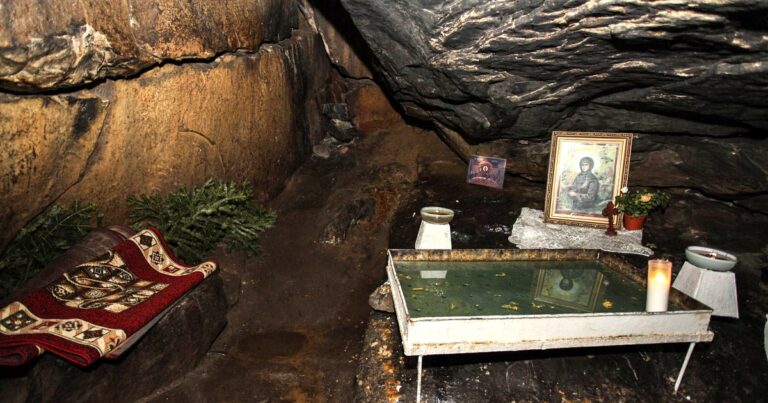
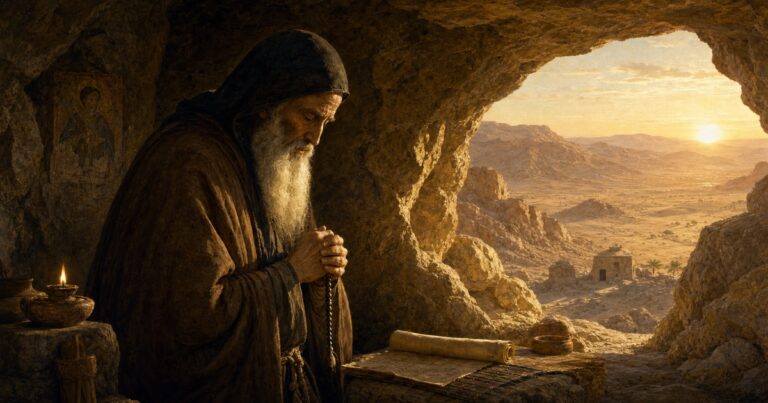
Five years of true desert life. Twelve to fifteen hours of prayer daily. Liturgy celebrated alone, on a tree stump. Sparse food, cold, bears, wolves. According to the disciples’ testimony, at the first Liturgy he served in the wilderness, when the moment came, “having no one to chant the responses, God ordained that a flock of birds should sing for him — birds such as he had never seen in his life.”

Cleopa returned permanently to Sihăstria on September 29, 1964. He was brought back by Father Ioanichie Bălan, who had climbed in secret to the mountain dugout and pleaded with him, in the name of the brotherhood and of the faithful, to come back. He was fifty-two. He would live another thirty-four years — all of them at Sihăstria, as principal confessor.

Here is the unshakable point of his biography: Cleopa made no compromise with the regime. He passed through arrest, through wilderness, through hunger, through the violence of communist decrees — and he came out into the light without having signed anything, without having denounced anyone, without having accepted any politically imposed function. This is no small virtue in the Romanian Church of the twentieth century, where the Securitate files of certain prominent figures raised serious questions after 1989.

Cleopa has no file.


Teaching Without Invention

The entire written work of Father Cleopa is patristically verifiable. This means that, across more than twenty published volumes, every major theological statement can be traced back to its source in the Holy Fathers. Cleopa invented nothing. He created no personal theology. He transmitted what he had received, citing constantly.

His written work includes:

  • On the Orthodox Faith (1981) — apologetic manual published by the Biblical Institute Press
  • A Guide in the Orthodox Faith (Galați, 1991) — the key book, nearly 600 pages, a complete apologetic manual of Orthodoxy for the modern Romanian reader
  • Sermons for Imperial Feasts and Saints of the Year (Roman Diocese Press, 1986)
  • Sermons for the Sundays of the Year (Roman Diocese Press, 1990)
  • Ascent Toward the Resurrection — fifty Philokalic homilies written in the wilderness, printed in 1992, translated into Greek as early as 1988 in Thessaloniki
  • On Dreams and Visions (Anastasia Press, 1993)
  • The Value of the Soul, The Akathist Book (with Father Paisie Olaru), God’s Wonders in Creation
  • The series Father Cleopa Speaks to Us — over twenty volumes edited by Father Ioanichie Bălan
  • The posthumous series May Paradise Devour You! — four volumes of testimonies and teachings

On what subjects did Cleopa teach? Four major axes.

The Prayer of the Heart. Cleopa taught the prayer he called “monologic”“of one word, of one thought.” The mind passes through two checkpoints before descending into the heart: the checkpoint of imagination and the checkpoint of reason. He constantly cited Saint Nilus the Ascetic: “Blessed is the mind that has come to pray to Christ without imagery, without form.” He also taught the distinction made by Saint Vasile of Poiana Mărului between the “three kinds of warmth” that come during the Prayer of the Heart — and warned firmly against spiritual delusion (prelest). He knew the prefaces of Vasile to the Philokalia. Direct reading of the sources, not pious citation from hearsay.

The Holy Mysteries. Cleopa insisted on frequent confession — weekly for monastics, every forty days or once per fast for laypeople. He categorically opposed receiving Holy Communion without confession:

“— Father, in case of necessity, can Holy Communion be given without confession?
— No. Never. Not even at the moment of death, not for any reason. First confession, then Communion.”

Right Faith. Cleopa was no ecumenist and made no concessions to pastoral modernism. On relations with Protestants, in a 1989 dialogue, he said simply: “You, in the first place, do not have the Holy Mysteries.” On dealings with heretics, he cited the Pedalion: “With the heretic, do not speak; do not receive him in your house; do not sit at table with him; do not even greet him. These are the forerunners of Antichrist.” And on the Romanian people:

“Know that the root and the life of our nation, before God, is right faith in Christ — that is, Orthodoxy. Our Romanian land has been Orthodox from the beginning, and must hold the line of Orthodoxy. Orthodox we were born from our origins, from the colonization of Dacia; Orthodox we have lived for two thousand years; and Orthodox we must remain unto death. This is the true faith of Romania — Orthodoxy.”

Salvation as Patience. His most famous formula remains the answer he gave to a Brother John who asked what was needed for salvation:

“For salvation, three things are necessary. First: patience. Second: patience. Third: patience. Brother John, you also need one more thing: almsgiving. You don’t have to give the cow! God didn’t ask you for the cow, never! Heaven forbid! Not even the calf. But the bottle of milk you must give! And one more thing, Brother John: prayer. Step and God! Without patience, without almsgiving, and without prayer, no man can be saved!”

Patience. The keyword of his entire teaching. The same word from Saint Paisios’s prophecy: “if he stays where he is and has much patience, he will be saved as an apostle.” Cleopa received the word and translated it into a life.


Real Gifts, Real Humility

Sanctity is verified patristically by two criteria that go together: visible gifts (memory, tears, foreknowledge, healing) and the humility that covers them. A gift without humility breeds delusion. Humility without gifts remains hidden. With Cleopa, both were attested by dozens of direct disciples.

Memory. The 480 pages of A Guide in the Orthodox Faith were written by a man who had only seven grades of primary school. He knew the Philokalia directly from the Paisian manuscripts, before modern translations existed. He could recite by heart whole paragraphs from Saint Isaac the Syrian, from the Sayings of the Desert Fathers, from the Ladder. The testimony of the disciples of his cell: when asked for an instruction, he would not search in a book — he would answer directly, with reference to chapter and page, like one who had seen the text only days before.

Tears. The disciples’ testimony: “He wept at the Liturgy, especially during the epiclesis. Often he hid himself so those around him would not see.” And the testimony of an ordinary believer, preserved in the Sihăstria Paterikon: “When I come out from confession with Father Cleopa, I go to my cell and say only this: ‘Lord Jesus Christ, through the prayers of Your Most Pure Mother and of Father Cleopa, have mercy on me, the sinner!’ And such compunction comes upon me, and such tears, that I cannot stop weeping.”

Unceasing Prayer. His daily rule, described by his cell attendant: morning prayers, the Akathist of the Saviour with its canon, the Akathist of the Mother of God, the Psalter, three or four canons from the Theotokarion, the Canon of Repentance, the Canon to the Guardian Angel, the Canon to All Saints. And this all before noon. “You could always see him with the prayer rope in his hand, so much so that the nail of the finger by which he counted each bead was worn through.”

Foreknowledge. The testimony of the direct disciple, the monk Iachint: “I believe Father Cleopa was a clairvoyant. For he told me many things while he was alive that I did not believe, but they came to pass exactly as he said. I believe Father Cleopa is a saint!” Concrete episodes: he called out by name, in the middle of a crowd, a pilgrim he had never met before; he prophesied to a Greek hierarch, years in advance, that he would become a bishop — which came to pass; he prophesied the future buildings at Sihăstria by looking down and saying only: “Walls, walls, walls…”; he prophesied, days before his death, that he would have “a great and beautiful cross at his head” — and exactly so, the wooden cross in the middle of the cemetery was completed in the week of his funeral.

And yet, above all these gifts, humility — the supreme patristic criterion.

Cleopa called himself “Old Rotten Wood.” “Cleopa the Non-Monk.” “A clay shard tied with wire.” “A shepherd.” “The fool from the sheep.” He refused titles. He bowed his head when people kissed his hand.

There is one episode that, more than any other testimony, shows who we are dealing with. In the wilderness, Cleopa had begun reading the Akathist of the Protection of the Mother of God. Each time he wanted to read it, he sensed a fragrance of lilies and roses — a visible, sensory mystical gift, attested in the patristic tradition. Most would have received the gift with joy. Cleopa refused the gift. He prayed to the Mother of God to take the fragrance away, lest by receiving it he fall into delusion. After forty days of prayer, the fragrance ceased.

This is the face of the authentic saint: he rejects the visible gift, lest the true inner work be lost. The humility that cuts even the heavenly fragrance, if it might give birth to self-regard.

And at the end of his life, one final sign. Sunday, November 29, 1998, three days before his death, Cleopa sat down in his usual chair for confession. It was four in the afternoon. He remained there motionless, with eyes half-open, no longer responding to the questions of his disciples, for more than eleven hours. When he came back from the rapture, he was serene, like one who had received a hidden revelation. He told no one what he had seen. Two days later he would die.


The Living Filiation

Cleopa stands within a living, conscious, recognized tradition. Three names place him in context.

Father Paisie Olaru (1897-1990) — the schemamonk of Cozancea, the first guide of Brother Constantin, later the confessor of the brotherhoods of Sihăstria and Slatina, later the personal spiritual father of Father Cleopa for over six decades. Cleopa never forgot his spiritual father. He spoke of him with rare tenderness: “Such was Father Paisie Olaru: humble, silent, gentle, wise in word, exceedingly merciful and loving toward his neighbor. He did not like to live among many, and he hid his life and his ascesis.” The two were canonized together on February 4, 2025. They are commemorated together on December 2. A rare and theologically significant case: the disciple and the spiritual father, side by side in the calendar of the Church.

Protosynkellos Ioanichie Moroi (1859-1944) — the abbot who received Brother Constantin at Sihăstria in 1929 and tonsured him a monk in 1937. Moroi had lived for ten years at a Romanian skete on Mount Athos before coming to Sihăstria in 1909. He brought to Moldavia the Athonite Paisian rule. Under his abbacy, Sihăstria was restored to what it had been under Saint Paisius Velichkovsky: a living hesychast hearth. Cleopa inherited this rule directly — not through books, but through daily life: twelve years at the sheepfold under a strict Athonite discipline.

Saint Paisius of Neamț (1722-1794) — Velichkovsky. Cleopa is not his personal disciple — they are separated by nearly 150 years. But he knows him, understands him, invokes him. In his volume Sermons for Imperial Feasts, Cleopa preached a full sermon dedicated to Saint Paisius for the day of November 15. There he calls him “the most accomplished elder of the Romanian monasteries from the eighteenth century to our day” and “the praise of Moldavia and the adornment of Orthodoxy.” Furthermore, Cleopa knows also Paisius’s own teacher, Saint Vasile of Poiana Mărului, of whom he speaks with technical precision — the prefaces to the Philokalia, the distinction of the three kinds of warmth in the Prayer of the Heart. Cleopa recognized him as a saint more than thirty years before his official canonization in 2003. Spiritual discernment ahead of the institutional seal.

In his sermon on Saint Paisius, Cleopa lists seven essential virtues: holiness of life, unceasing prayer, obedience, the holy services, weekly confession, the rule of the cell, spiritual love. Look at that list carefully. These are exactly the seven virtues that Cleopa’s own disciples, after his death, would attest of him. This is no stylistic coincidence. Cleopa, preaching about Paisius, was preaching the model he himself was living. The Paisian filiation in Cleopa is not an editorial formula. It is a coincidence of spiritual profile.


The Fruits of the Apostle

Saint Paisios’s prophecy spoke of patience. The patience of an apostle is seen in fruits. Cleopa did, until his death, what an apostle does: he formed men. Not one, not two — entire generations.

Slatina Monastery, 1949-1956. Patriarch Justinian sent Cleopa, together with thirty monks from Sihăstria, to revive the princely foundation of Alexandru Lăpușneanu. In seven years, Slatina became the most vibrant monastery in Moldavia: nearly one hundred inhabitants, a three-year monastic seminary with forty students, eight monasteries under Cleopa’s spiritual oversight (Slatina, Sihăstria, Rarău, Sihla, Râșca, Moldovița, Cămârzani, Orata). Metropolitan Antonie Plămădeală, who took refuge there in hiding from the Securitate, would later call it “a true spiritual academy, recognized throughout the country.”

Those who passed through Slatina under Cleopa’s abbacy:

  • Father Paisie Olaru, transferred there from Sihăstria
  • Father Petroniu Tănase (1914-2011), the future abbot of the Romanian Skete of Prodromos on Mount Athos, professor of Typikon at the monastic seminary
  • Father Arsenie Papacioc (1914-2011), the future great elder of Techirghiol
  • Father Daniil Sandu Tudor (1896-1962), author of the Akathist of the Burning Bush, the intellectual-monk who would later die in the Aiud prison
  • Antonie Plămădeală (1926-2005), the future Metropolitan of Transylvania
  • Andrei Scrima (1925-2000), the Romanian theologian who would later become an interlocutor of Patriarch Athenagoras and of Pope Paul VI
  • Professor Anton Dumitriu (1905-1992), the philosopher and logician, six months in the brotherhood
  • Father Proclu Nicău (1929-2017), the future hermit of Mărășești

Slatina was not merely a monastery. It was the laboratory in which Cleopa, in the mid-1950s, formed the figures who would hold Romanian Orthodoxy together after the persecution. Patriarch Justinian knew what he was doing when he sent him there.

There is a direct testimony from Metropolitan Antonie Plămădeală about his reception at Slatina in 1950. Plămădeală had fled Prislop Monastery, was condemned in absentia by the communist regime, and was being hunted by the Securitate. He arrived at Slatina with the recommendation of Father Arsenie Papacioc. Cleopa was not there. He waited. When Cleopa came, he took him to a clearing behind the monastery, face to face, and asked for the truth. Plămădeală told him everything — that he was condemned, that he was being hunted. Cleopa’s answer, preserved verbatim:

“I receive you. Beyond that, no one needs to know anything.”

That was all. No report to the authorities, no precautions, no hesitation. Cleopa hid a hunted monk under his own responsibility, in his own brotherhood. An abba who shielded his sons with his own neck.

Sihăstria, 1964-1998. Three decades of uninterrupted service after the return from the wilderness. Here Cleopa received the faithful by the hundreds and the thousands.

Testimony from the present-day fathers of Sihăstria, preserved in recent reports: in front of the porch of Cleopa’s cell were “benches for one hundred people,” but the space was “too small” for those who came. Whole bus-loads of pilgrims from across the country. Cleopa, though sick, would preach up to fourteen hours a day, when the doctor had given him permission to speak only thirty minutes. Foreigners came as well — especially Serbs, “with great reverence as to a saint.” Bishops came from other countries.

Father Ioanichie Bălan (1930-2007) — the biographer, the editor, the literary disciple. Without him, we would have almost nothing of Cleopa’s teaching in written form. Bălan edited all the more than twenty volumes of Father Cleopa Speaks to Us. He wrote The Life of Father Cleopa. He wrote the Romanian Paterikon. He was the one who, in September 1964, climbed in secret to the dugout in the mountains and pleaded with Cleopa to return.

Disciples who reached high hierarchical service. In addition to Metropolitan Antonie Plămădeală, several bishops alive today in the Romanian Orthodox Church were spiritually formed at the cell of Father Cleopa. We do not name them here — each of them carries in his ministry a part of the discipleship received at Sihăstria.

International transmission. Father Cleopa’s books have been translated, to date, into ten languages: English, French, German, Italian, Spanish, Greek, Russian, Serbian, Japanese, Arabic. Ascent Toward the Resurrection was printed in Greek as early as 1988 in Thessaloniki, ten years before Cleopa’s death. The English biography appeared at Lake George, NY, in 2001, with the title Elder Cleopa of Sihăstria: In the Tradition of Saint Paisius Velichkovsky. The Greek monk Damaschin Grigoriatis translated Cleopa’s work into Greek for Mount Athos. The fathers of Grigoriou Monastery on Athos already considered him a saint after the visit Cleopa made there in the 1970s — they would ask Romanian pilgrims “how is it that the elder has not yet been entered officially in the calendar, since he is a saint?”

This is the point that matters most for the attentive reader: Cleopa did not found a closed, isolated, sectarian school. His disciples took different paths and bore fruit in different spaces. Petroniu on Athos. Antonie in Transylvania. Ioanichie in archives and libraries. Arsenie at the Black Sea. Proclu in the wilderness. Plus current bishops of the Romanian Church. Plus tens of thousands of laypeople transformed.

This is the proof of the good tree: the fruits spread out. They did not concentrate into a personality cult, did not produce a closed phenomenon around the figure of Cleopa. He strengthened Orthodoxy in many places through the men he formed. This, in itself, is a proof of apostolic discernment.


The Final Recognition

Tuesday, December 1, 1998, evening. Cleopa, weakened, having returned from the eleven-hour rapture two days earlier, called Father Mihail, a priest close to him. He said:

“Father Mihail, behold my last word: Watch and pray, for you know not the day nor the hour when the Son of Man will come! Pray for me as well! Pray!…”

He continued to receive the faithful past midnight. Wednesday, December 2, 1998, at 2:20 in the morning, he gave up his soul into the hands of the Lord.

That same evening, in Bucharest, an event took place that no one can explain to this day. The testimony of Father Arsenie Muscalu, then Great Ekklesiarch of the Patriarchal Cathedral, published in Lumea Credinței magazine: he was hearing confessions in the Cathedral around seven in the evening when, with no liturgical reason, the great bell of the Patriarchal Cathedral — over eight tons, rung only at the Divine Liturgy — began to toll on its own. It tolled with force for two or three minutes. Father Nicolae Toderiță climbed up to the bell tower, broke the lock on the door: there was no one. He had to remove the electrical fuses to stop it. The next day, the news arrived that Father Cleopa had departed to the Lord. “All the fathers to whom I told this story had the same thought,” Father Arsenie said: “It is a sign that someone great will depart to the Lord.”

The funeral was held on a winter day with unexpected sunshine — though the previous days had been cold and overcast. Eight hierarchs served, and more than ten thousand faithful participated.

On July 11-12, 2024, the Holy Synod of the Romanian Orthodox Church approved the canonization of Father Cleopa Ilie. The decision was made in the context of the 2025 anniversary year — 140 years from the recognition of Romanian autocephaly and 100 years from the elevation of the Romanian Church to the rank of Patriarchate.

On April 28, 2025, at Sihăstria Monastery, the relics of Saint Cleopa and of Saint Paisie Olaru were uncovered. The testimony of those present: a sweet fragrance “of cinnamon” at Saint Cleopa, “of roses” at Saint Paisie. On August 7, 2025, at Sihăstria Monastery, the local proclamation of the canonization was made, served by Metropolitan Teofan of Moldavia and Bukovina. The official canonical name: Saint Cleopa of Sihăstria, the Venerable. Feast day: December 2, together with Saint Paisie of Sihăstria.

The message read at the proclamation bore a title that summarizes everything we have said in this article about the spiritual filiation of these two: “Two pillars of light between mountains and sky.”


Why “the Last”

This article opened with a strong statement. Now, after going through the biography, the teaching, the gifts, the humility, the filiation, and the fruits, we return to it.

Why “the last saint of Romania”?

Not because God has stopped giving saints to the Romanian people. God does not stop. In our monasteries, in the wilderness, perhaps even in unknown laypeople, there are surely now, in 2026, men and women completing their struggle, to whom the Church will one day give due recognition.

But for the reader of today — for the one who is searching for a sure, verifiable point of reference, free of controversy, free of theological disputes, free of canonical problems — Cleopa remains the last fixed point. The last figure who fulfills, simultaneously and beyond doubt, all the patristic criteria of authentic sanctity:

  • Continuity with tradition — direct formation under two authentic spiritual fathers, the Paisian library of Neamț, the Philokalia memorized
  • Patristic verifiability — every major theological statement traced to its source, with exact references to the Philokalic Fathers
  • No compromise — three withdrawals, refusal of Decree 410, no Securitate file
  • Orthodoxy without concessions — no ecumenism, no pastoral modernization, no theological compromise
  • Public confession — long sermons, The Guide as an apologetic manual, unshaken in times of confusion
  • Authentic humility — humble self-designations, the refusal of the fragrance of the mystical gift as a sign of discernment
  • Real, attested gifts — memory, tears, foreknowledge, posthumous healings
  • Fruits spread wide — disciples in every direction of Orthodoxy, no personality cult
  • Official and popular recognition — canonized in 2025, with fragrance at the uncovering of the relics, without synodal disputes

All of these, simultaneously. This is the rare combination. This is Cleopa.

The question we leave with the reader is another: if Orthodoxy is transmitted through living saints, what happens when their line grows thin?

The answer, until the next sure marker that God will give to the Romanian Church, is Cleopa. His books are in the bookstores. His sermons are on the internet. His relics are at Sihăstria. His grave is daily covered with fresh earth brought by the monks, because pilgrims take it with them home — each silence of the man who, in 1977, was greeted by name by another saint in the desert of Athos and was told, without having asked:

“If he stays where he is and has much patience, he will be saved as an apostle.”

He stayed. He had patience. Now he prays for us.

Holy Venerable Father Cleopa, pray to God for us.


Principal Sources

  • Archim. Ioanichie Bălan, The Life of Father Cleopa, Trinitas Press, Iași
  • Archim. Ioanichie Bălan (ed.), Father Cleopa Speaks to Us, vols. 1-20, Sihăstria Monastery Press
  • Archim. Cleopa Ilie, A Guide in the Orthodox Faith, 4th ed., Roman Diocese Press, 2000
  • Archim. Cleopa Ilie, Sermons for Imperial Feasts and Saints of the Year, Roman Diocese Press
  • Archim. Cleopa Ilie, Ascent Toward the Resurrection, Trinitas / Doxologia
  • Archim. Cleopa Ilie, Spiritual Counsels for This Life and the Next, Teognost Press, Cluj-Napoca, 2004
  • May Paradise Devour You!, vols. I-IV, Sihăstria Monastery Press
  • Metropolitan Antonie Plămădeală, Tradition and Freedom in Orthodox Spirituality, Sibiu, 1983
  • Sihăstria Monastery official page: sihastria.mmb.ro
  • Father Cleopa’s complete sermon on Saint Paisius of Neamț: acvila30.ro
  • The meeting with Saint Paisios of Mount Athos (vol. 15 Father Cleopa Speaks to Us): pravila.ro
  • Elder Cleopa of Sihăstria: In the Tradition of Saint Paisius Velichkovsky, St. Herman of Alaska Brotherhood, Lake George, NY, 2001 — the English biography

Leave a Reply

Your email address will not be published. Required fields are marked *